Subscribe for ad free access & additional features for teachers. Authors: 267, Books: 3,607, Poems & Short Stories: 4,435, Forum Members: 71,154, Forum Posts: 1,238,602, Quizzes: 344
Don Quixote
Originally titled-- El ingenioso hidalgo don Quijote de la Mancha.
Part I first published in 1605, Part II in 1615.
Translated to English, in 1885, by John Ormsby (1829-1895)
With Beautiful Illustrations by Gustave Dore.
Introduction:
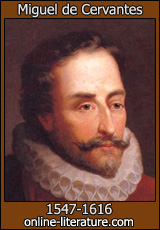
It would be interesting to know how much of the story of Don Quixote was inspired by the author's own life. Authors often do translate their experiences and observations into their writing. When you read a biography about Miguel Cervantes, you can find similarities and understand the philosophies that are often expressed in his most famous work. Don Quixote puts on his armor in hopes of making his name and fortune by becoming a knight. As he often states, he doesn't have letters, so he makes his fame by arms. Miguel Cervantes struggled all of his life for the same achievements. He achieved fame with the publication of Don Quixote in 1605 (the first part)--which was considered the first best seller (translated into 60 different languages) and credited as the first modern novel. Yet, it did not make him rich--as authors did not receive royalties.
The author was a son of a deaf surgeon, born in 1547, and also tried to make his fortune by taking up arms in 1570. He fought as a soldier against the Ottoman empire, and no doubt his experiences were told through the character Ruy Perez. Cervantes was known for his bravery, and he suffered crippling injuries, maiming his left hand along with two chest wounds. In 1575, he and his brother were captured by the Turks on a return voyage to Spain. Cervantes would spend five years as a slave, despite numerous attempts to escape--finally being liberated when his ransom was paid. He tried to make it as a playwright, which was considered more lucrative (and no doubt inspired some dialogue in Don Quixote about the perversity of plays), and failed. He worked as a commissary for the Spanish Armada. He was not apparently very good at convincing rural communities to hand over their grain, and he was imprisoned twice for mismanagement. However, it was in prison that he started writing his greatest work.
Don Quixote has inspired many artists in different fields. It is considered mainly to be a comedy. However, woven into the tale is a lot of Spain's history. Don Quixote's name even penned a type of psychosis. In fact, anyone who has had experience with the mentally ill may find it difficult to regard Don Quixote as a comedy. After all, he was not totally harmless. "A man attacked a driver because he believed he was abducting a woman, who was travelling in another car on the same road. After injuring the driver, the suspect's accomplice then forced the driver to remove his clothes and give them to him"--if this was reported on the news, we would probably be horrified. Here was an innocent person, just going about his business, who had no connection to the other people who were on the same road--and he gets attacked by a madman whose delusions cause him to believe a different reality. Yet, this is exactly what happens in Don Quixote in the first book. Most people probably laugh at the incident because they don't consider the harm a delusional person can do in reality. Don Quixote also is a victim of his delusions. He suffers physical harm, and many people play practical jokes on him for entertainment. Don Quixote's friends and family find very little support from other people when they want him to come home and rest, hoping to cure him of his delusions. As the character Don Moreno states, to cure Don Quixote of his insanity is to deprive the world, for he is more amusing as a madman than a sane one. This paints a picture of some of the old attitudes towards the mentally ill, which often made them ripe for exploitation. However, Don Quixote--though hardly a good book for the impatient due to its length--is a good book to read and a worthy classic. It isn't just a story about a lunatic who thinks a windmill is a giant--social problems, history, mores, and politics are interwoven into the story. It is a perfect time capsule of a period of time in Spain's history.
Don Quixote is the alpha and the omega of the novel form, the first true novel, the best-selling novel and in the eyes of many, the greatest novel of all time. Cervantes uses the theme of the idealistic, insane knight and the devoted, down to earth squire to portray many complex themes through a plethora of unforgettable incidents, tragic and comic, in a blend of great variety and colour. The book is unsurpassed as a masterpiece of droll humour, a scintillating portrait of 16th century Spanish society made all the more beautiful by the fantastic prose style. Cervantes started the novel in order to parody the many romances of chivalry which were circulating in those times and which the Church was unsuccessfully trying to check, but the hero got the better of him. The result is Don Quixote, and as the author says, the Don is "so conspicuous and void of difficulty that children may handle him, youths may read him, men may understand him, and old men may celebrate him"--Submitted by Anonymous
For me it is crystal clear that Cervantes used the person of Don Quixote as a symbol for the Catholic church, to free himself from any fear of the inquisition. It is so clear that Quixote, by presenting himself as a major imposer of good and right and just then his failure for doing that and his great success in harming others is what the Catholic church does by imposing false creeds and worshipping Mary instead of God and declaring herself as the sole way to heaven, preventing ALL from having a free mind set as she is the only allowed mind stand. The reader will find in every chapter something that proves that this concept is very much in agreement with what is written. Don Quixote is a great and true satire for what the Catholic church did and is doing ....well done Cervantes.--Submitted by Mody Nader
Fan of this book? Help us introduce it to others by writing a better introduction for it. It's quick and easy, click here.
Recent Forum Posts on Don Quixote
Some quick thoughts
In case anyone is reading... - Did reading this book ever make you irritated? I say that because I find the story, and characters hard to believe. Don's madness is so obviously not possible in real life; Pancho seems wont to lie. - Does this strike you a little bit like children who are pretending to be superheros? Don just seems childish to me when I really get into it, like an early teenager. - finally, the violence strikes me as a bit like Tom and Jerry, in that characters keep getting pummelled with very little emotional or even rational cost. I figure that part of why I'm hatin is because this book represents a broader genre that doesn't square with the postmodernism I may be accustomed to. But I'm loathe to read more analysis lest I miss the impact of the story. Thanks for reading...
Hola Don!
Commenced Quixote based upon Susan Wise Bauer's recommended list of Western classics in "The Well-Educated Mind." Anybody here enjoy it?
Embarking on Self-Education Journey
I am reading The Well-Educated Mind: A Guide to the Classical Education You Never Had by Susan Wise Bauer. Bauer suggests beginning with novels, as they are the most accessible of the Great Books. Within each genre, she advises readers to work from the past toward the present in chronological order. So, I am beginning with the first novel: Don Quixote. I came to this forum hoping that there might be someone else willing to embark on this journey with me. I'd like someone with whom I could correspond as we support each other in educating ourselves.
A few Thoughts of Mine on Don Quixote
Warning - this thread shall have uncomfortable religious thoughts in it, anyone who is of faith is advised not to read, in order not to be offended. These are simply and purely my thoughts, and they most likely are immature. This spring I was in Rome with my elder cousin, one night in a bar I was complaining to him on how such a civilized and wealthy country like America can have so many idiots who actually believe in creationism. And then he chided me for being so quick to insult other nations without looking at my own first. He said "for a scientific and logical mind, is the concept of Creationism any more absurd than the concept of The Virgin Birth. Is the former truly any more ridiculous than the latter. And yet the majority of Italians believe in the Virgin Birth as much as they believe that there is a moon." Yesterday I finished reading the first part of Don Quixote. And this conversation sprang up in my mind, whilst I was thinking about Don Quixote's madness. I do not know what Cervantes beliefs were, and were he a non-believer, he surely would not have let the slightest doubt arise concerning his thoughts, in a 16th century Spain were men were burnt alive for merely being of the wrong sect of Christianity. So we shall never know. But these my thoughts concern the book without concerning authorial intent. Firstly, how can we truly call Don Quixote mad? If we call him mad everyone around him is equally mad. The men in the book think him mad because he reads book and thinks that everything within them is true. Yet al those who call him mad do the same, they read the scriptures and believe that everything in them is true. Don Quixote beliefs in evil and good enchanters and magicians, and that is mad - when he is struck by misfortune he blames evil enchanters, and when he is fortunate he thanks the wise and good enchanters; and this is mad. Yet everyone around him, when they have good luck thank god and the good angels for it, and when they have bad luck they blame the devil, and that is sane. Don Quixote reads his chivalric books of fictions and seeks to emulate and impossible ideal, and that is madness which everyone laughs at. Yet who laughs when the sam men which laugh at Quixote read fictions of saints and they seek to emulate an impossible ideal. At the beginning of his Journey, if Don Quixote had not read of it he would refuse to do it, he vowed not eat except at banquets because in the tales he read the only times the Knights are described eating, is during banquets. ANd this is pure and hysterical madness. Yet how many men were sent to the stake, how many wars were started merely because in the other book, something was not mentioned and because it was not mentioned people made equally mad vows as the Don. During various passages we see that Don Quixote is a learned and reasonable man, except for his madness when it comes to Knight errantry. And at first I found this hilarious and laughed out loud whilst reading several times. And yet how deeply unsettling that there was nothing mad in this for most men of his time were exactly like him. They were perfectly reasonable and intelligent men, until it came to religion, and there they lacked as much reason and sanity as Don Quixote when it comes to Chivalric tales. The more I thought of it, the more this comedy became darker. I remembered the hilarity that whenever someone would disagree with Don Quixote upon a certain thing concerning Knight Errantry he would enter in a wild rage and attempt to kill the man who questioned his beliefs, and these scenes made me laugh a good deal. But how many sane and intelligent men, as soon as someone did not agree with them on a certain point concerning their Book, grabbed their swords like Don Quixote and were ready to kill the man who questioned them with the same ease that Don Quixote was ready to kill the men who questioned him. Another interesting point continuing this vein of thought is Sancho. At the beginning of the journey, he is cowardly and vulgar but he is sane, sane to the fullest extent (in that no one around him called him mad.) Yet by the end of the first book we seem him just as mad as Don Quixote with his Enchantments and Countships and Insulas. And this sparked up another thought in my feeble mind. Quixote is Sancho's superior, and Sancho follows and listens to Quixote with a perfect believe that Quixote's word is law and that everything he said must be true. And the result of this mostly unquestioning obedience is that Sancho the sane, after 17 days with Quixote becomes Sancho the mad. Needless to say I found this hilarious. yet if anything it is a perfect illustration of how religious madness can become the norm in society as it was in Spain. The last point I wish to make, is the reaction of many characters to Don Quixote's Madness, many wish to burn the books of Chivalry which made him mad, and yet we cannot truly say that the book made him mad, for most other characters read them and did not turn out like Quixote. And in fact, these books of chivalry show an ideal of valor and Courage and Honesty and Justice, that they seem to be only a good influence, yet these books which seem to contain only lessons on how to be an honorable man, lead Don Quixote do do many dishonorable things and leave the people he wishes to help in much worse conditions. And here the similarity of the Holy Books is as amusing as it is tragic, books which in truth contain only good teachings, yet from these books look at the evil men especially in 16th century Spanish society did in the name of these books. What right have we to call Don Quixote mad, in truth he is just as sane as everyone around him, yet he is called mad because his madness is draped in a cloak of silver whilst the madness of all those around him wears a cloak of gold. The book becomes suddenly very tragic when the 16th century spanish reader realizes, that he lives in a world ruled and surrounded and controlled by Don Quixote's. And there is not a single voice of out there who can call Don Quixote what he really is; mad.
Lessons Learned
It took me about 2 months to finish Don Quixote and i would gladly read it over again. I have the Penguin Classics version and its almost 1,100 pages long. This is honestly the greatest book I think anyone could ever read. It has taught me to be more virtuous and to help people no matter how difficult the task is. In a way i guess i would say it made me take on some of Don Quixote's characteristics. It even made me almost join the armed forces so i could "march into hell for a heavenly cause" To me this book is a bible without a all-knowing being in it but rather a man who puts forth all his effort and determination into what he wants to achieve and sometimes fails but mainly comes out as a more brave and intelligent person. It also amazes me how this book has lasted throughout time for 400 years. I know thats nothing compared to the Odyssey but in my opinion the book is much better than homer could ever do. It is certainly a life changer of a read and makes you wish that there were people like don quixote in the world today. to aid anyone who asks for it is such a hard task but it is worth it in the end because just like him, you will be renowned throughout the world in one way or another and people will smile in joy as your name is mentioned
La Mancha, Land of Don Quixote
Hello Friends: I live in La Mancha, in Mota del Cuervo, this village has 7 of the windmills tha Cervantes fought with. It is also just 10 km from El Toboso and here around were when Cervantes located most of the adventures of Don Quixote. La Mancha is a very nice place for visiting and living. Just ask me about you want from La Mancha and I'd like to answer it. See you soon.
Hidden message in Don Quixote
I believe there is a hidden message in Don Quixote. The key for decoding it can be found in the full title of the book - El ingenioso hidalgo don Quijote de la Mancha. La Mancha is a central region in Spain, but it’s almost identical to French “La Manche” – the English Channel. It suggests that we should apply English language for deciphering the meaning of the names used in the book. Right away, we can try that key on the book title to see if it makes sense using it - it’s a kind of key validation. Taking into account the original pronunciation of “Don Quixote” as “Don kiˈʃote” and using anagrammic approach, the title could be read in macaronic language the following way, from right to left, starting right after (better say, right before) “La Mancha”: “Donkey Shot hid algo (something) oio en Ingles (in English)”. What could be “oio”? May be, it’s the hidden message itself, and we have to find out its meaning from the book. At first glance, the only thing we can tell about “oio” is that it has some symmetrical structure and resembles digits “010". The initial guess is that it might be some word that has a double meaning in English translation. What’s “Donkey Shot”? It might look like a weird name, but somehow the notion of “donkey shot” is quite popular in modern culture. The search for “donkey shot” with Google renders about 323 000 results, including a paraphrase of Alexander the Great quotation “Veni, Vidi, Tiré a dos burros”, which subtly means “I came, I saw, I won by shooting two targets at once”; Swedish psychedelic music project dOnKey sHot; and a rather peculiar sex practice: “A Donkey Shot or "Don Quichotte" is when someone's doing a chick from behind and as he's about to bust, punches the chick in the side so she clenches up" (taken from Urbandictionary website). There is also a classic scene in the movie Patton, based on a true life event: during a battle on a bridge, General Patton shot a donkey which blocked the way forward for the Third Army. Thus, in modern culture “to shot a donkey” basically means to decisively remove the nonsensical obstacles in order to fulfill the bigger mission. As to “oio”, in the whole opus magnum, electronically searched both in Spanish and English versions, there is no such combination of the letters as “oio”, and it seems that to decode “oio”, we should understand the extra-linguistic significance of the Cervantes’s book. It’s not only the first creation of modern literature, with the most published copies after the Bible, but it also laid the foundations for modern science, as Cervantes introduced the concept of relativity 17 years before Galileo and more than fifty years before Newton. In chapter XLI blindfolded Don Quixote and Sancho Panza ride a wooden horse Clavileño the Swift, which is moving relatively to the wind created by the duke, the duchess and their majordomo. As Sancho said, “…such a strong wind comes against me on this side, that it seems as if people were blowing on me with a thousand pair of bellows”; which was the case; they were puffing at him with a great pair of bellows”. As to Newton, there is a mystical connotation of his name with the name of Don Quixote’s horse Rocinante. “Ton” is a unit of measure derived from “tun”, the term applied to a barrel of the largest size. So Newton’s name means “new big barrel”. “Rocinante” also has two parts: “rocin” means “nag (low-quality horse) or rough man”, and “ante” means “before” either in space or time. But “rocin” is also similar to “rosin” (colophony or Greek pitch), which is made from resin, used for insulating barrels in form of tar (basically, tar and rosin are differently cooked resin). So, combining Newton with Rocinante we get “a new big barrel with old tar”. By the way, Sir Isaac Newton was knighted by Queen Anne – he was a knight like Don Quixote, but the real one. Then there comes the famous fight with the mills. In Spanish it’s “molinas” which can be playfully interpreted in English as “mol in ass”, and “mol” is widely used as a short name for “molecula”. This way we come to the microcosm, and it makes perfect sense: collapsing the central part of Quixote & Rocinante, we obtain “quant”, as well as “exotic” from the inner leftovers. By the way, in physical reality quants are represented by quarks, whose name comes from another magnum opus widely recognized as the greatest book of the 20th century – Ulysses, which is quite opposite in its genre, but is very similar in its plot as an epical journey (“quark” is derived from the book’s quotation “Three quarks for Muster Mark!”, which goes by without explanation of the meaning of quarks). There could be a hidden allusion to the quarks in the mills. There are six flavors (types) of quarks (up, down, charm, strange, top, bottom), and taken at 45-degree circular increments, 4 blades of a mill may have at maximum as many possible states as the quarks: at any given moment they can be only in 2 positions, visually represented by + and ×. Besides, in each position the blades can be found in 3 motional states: static (S), spinning clockwise (CW) and spinning counter-clockwise (CCW). So, in total there are as many states of the mill blades, as the types of quarks: +S, +CW, +CCW, ×S, ×CW and ×CCW. The whole fight with the mills can be likened to the quantum mechanics in action: when you throw a stone at the spinning blades (and the quanta also have a “spin”, though they are not actually spinning), you can hit a blade with a certain degree of probability, depending on the speed of rotation. Similarly, the whole quantum theory is based on probability, as the location of the particles at any given moment of time can be adequately described only as a matrix of probabilities. To raise the probability of hitting the blade, you should throw at it not a round stone, but some elongated object, as Don Quixote did by throwing a lance at the blades. His horse Rocinante also can be helpful with solving the quantum puzzles, because rosin is used by musicians for conditioning the strings of the bowed instruments to make them speak, and Rocinante can be interpreted as “resonante”, which means “resonating”, and all of that alludes to the string theory, the latest version of which is called “M-theory”, backfiring to the molinas and mills. And the last but not least, as was said before, “ante” means “before” either in space or time, as “before” means either “before” or “before”, but not the both at once. So, the hidden message is that the vibrating elementary particles can exist either in space or in time, but not in space and time simultaneously, and it is in conformity with the uncertainty principle of quantum mechanics. There is also something very similar to quanta in the mills, which is not visible from outside and is not even mentioned in the book – it’s what the mills are made for, i.e. flour. Flour can serve as a perfect model of the matter in general, as it can be in all the main states of the latter: gaseous (dust), liquid (suspension in water), amorphous (dough) and solid (baked or dried dough). And it has flavor, just like quarks! Seriously, it acts as if it has a corpuscular-wave nature, as in case of quanta: it consists of small particles, but when you drop a stone on it, you can see a wave on its surface radiating from the center of the impact. Interestingly enough, in Spanish flour is “flor de harina”, and Don Quixote regarded his beloved Dulcinea as a “flor” (flower): "O lady of my soul, Dulcinea, flower of beauty, come to the aid of this your knight, who, in fulfilling his obligations to your beauty, finds himself in this extreme peril" (chapter VIII). Considering all of the above, oio could be the sublime meaning of “flor” (“flor de harina”) as a quantum realm, which is substantiated by the connotation between identically sounding “flour” and “flower” in English. Anyway, the mission of Don Quixote failed: he did not defeat his enemy, because the latter was not really in the mills, and it means that if you “shoot the donkey”, i.e. eliminate the seemingly nonsensical aspects on your way to the main goal, you are doomed to fail. On the other hand, Don Quixote in his role of a knight is quite nonsensical himself, so even as he fails in space at any specific location, his mission progresses in time through aeons and beyond.
Don Quixote - Good Editions
Any preferred editions of Don Quixote? Good notes, good translation, good introduction etc...? Any have any particularly good or bad experiences? Thanks in advance :)
Just finished Don Quixote and would like to discuss it!
I recently finished Don Quixote (doing my own 'Great Books' study following S. W. Bauer's The Well-Educated Mind). I'm working through my thoughts on the book and would like to discuss it with others who have read Quixote (that's how I discovered this website). What would you consider the book's most important event (a situation that causes the character(s) to change or behave differently?) I'll admit that I'm struggling with the answer to this question. I've got a few thoughts about what it might be - 1. The last chapter - Quixote renounces books of chivalry. Obviously going from madness to sanity would be a changing point. 2. The first chapter - Quixote goes mad. Wouldn't have the book without that event, so I'd say it's fairly important. 3. When Sanson defeats Quixote and sends him home. An important event but I don't see a change in the character because of it. Thoughts?
Is Don Quijote Really Mad?
Yes, Don Quijote attacked windmills and was dillusional. But was he really mad? Don't people today decieve themselves that money will make them happy, or that they can live however they want without consequences? So yes, Don Quijote is a bit extreme. But is he really deceiving himself any more than modern day people, who strive to reach an unobtainable goal or chose to ignore reality? I'm not so sure that Don Quijote crazier than the average person. :idea:
Please submit a quiz here.
Here is where you find links to related content on this site or other sites, possibly including full books or essays about Miguel de Cervantes written by other authors featured on this site.