
Subscribe for ad free access & additional features for teachers. Authors: 267, Books: 3,607, Poems & Short Stories: 4,435, Forum Members: 71,154, Forum Posts: 1,238,602, Quizzes: 344
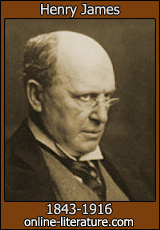
Henry James
Henry James (1843-1916), noted American-born English essayist, critic, and author of the realism movement wrote The Ambassadors (1903), The Turn of the Screw (1898), and The Portrait of a Lady (1881);
"I always understood," he continued, "though it was so strange--so pitiful. You wanted to look at life for yourself--but you were not allowed; you were punished for your wish. You were ground in the very mill of the conventional!"--Ch. 54
James's works, many of which were first serialised in the magazine The Atlantic Monthly include narrative romances with highly developed characters set amongst illuminating social commentary on politics, class, and status, as well as explorations of the themes of personal freedom, feminism, and morality. In his short stories and novels he employs techniques of interior monologue and point of view to expand the readers' enjoyment of character perception and insight. Often comparing the Old World with the New, and influenced by Honore de Balzac, Henrik Ibsen, Charles Dickens, and Nathaniel Hawthorne of whose work he wrote "too original and exquisite to pass away" James would become widely respected in North America and Europe, earning honorary degrees from Harvard and Oxford Universities, in 1911 and 1912 respectively. He was acquainted with many notable literary figures of the day including Robert Browning, Ivan S. Turgenev, Emile Zola, Lord Alfred Tennyson, and Gustave Flaubert. American-born and never married, James would live the majority of his life in Europe, becoming a British citizen in 1915 after the outbreak of World War I. Many of his works have inspired other author's works and adaptations to the stage and screen.
Henry James was born on 15 April 1843 in New York City, New York State, United States, the second of five children born to theologian Henry James Sr. (1811-1882) and Mary Robertson nee Walsh. Henry James Sr. was one of the most wealthy intellectuals of the time, connected with noted philosophers and transcendentalists as Ralph Waldo Emerson and Henry David Thoreau, as well as Nathaniel Hawthorne, Thomas Carlyle, and Henry Wadsworth Longfellow; fellow friends and influential thinkers of the time who would have a profound effect on his son's life. Education was of the utmost importance to Henry Sr. and the family spent many years in Europe and the major cities of England, Italy, Switzerland, France, and Germany, his children being tutored in languages and literature.
After several attempts at attending schools to study science and law, by 1864 James decided he would become a writer. He was always a voracious reader and he now immersed himself in French, Russian, English, and American classic literature. He ventured out on his own travels to Europe, wrote book reviews, and submitted stories to magazines such as the North American Review, Nation, North American Tribune, Macmillan's, and The Atlantic Monthly which also serialised his first novel Watch and Ward (1871). James left America and lived for a time in Paris, France before moving to London, England in 1876. He continued his prodigious output of short stories and novels including Roderick Hudson (1875), The American (1877), The Europeans (1878), Confidence (1879), Washington Square (1880), The Pension Beaurepas (1881), and his extended critical critical essay Hawthorne (1879). He also wrote the novella Daisy Miller (1879) which he later based a play on; one of many that proved unsuccessful. A Little Tour In France (1884) was followed by The Bostonians (1886), The Aspern Papers (1888), The Reverberator (1888), The Tragic Muse (1890), The Pupil (1891), Sir Dominick Ferrand (1892), The Death of the Lion (1894), The Coxon Fund (1894), and The Altar of the Dead (1895).
In 1897 James retired from the hectic city of London to the quieter town of Rye in East Sussex, where James bought "Lamb House" and continued to write What Maisie Knew (1897), In The Cage (1898), The Awkward Age (1899), The Wings of the Dove (1902), The Beast in the Jungle (1903), The Golden Bowl (1904), Italian Hours (1909), and The Outcry (1911). Autobiographies include A Small Boy And Others (1913), Notes Of A Son And Brother (1914), and The Middle Years (1917).
In 1904 James travelled to America where he embarked on a cross-country lecture tour, which inspired his series of essays first published in North American Review, Harper's, The Fortnightly Review then in 1907 as The American Scene. When World War I broke out, being an American ex-patriate, James was not happy with America's reluctance to join the war and became a British Citizen in 1915. In 1916 he was awarded the Order of Merit by King George V.
After several years of decline and a stroke a few months earlier, Henry James died of pneumonia on 28 February 1916. His ashes were interred at the Cambridge Cemetery in Massachusetts, United States, his stone inscribed "Novelist, Citizen of Two Countries, Interpreter of His Generation On Both Sides Of The Sea". A memorial stone was placed for him in the Poets' Corner of Westminster Abbey, London, England in 1976.
"Live all you can; it's a mistake not to. It doesn't so much matter what you do in particular so long as you have your life. If you haven't had that what have you had?--from the Preface of The Ambassadors
Biography written by C. D. Merriman for Jalic Inc. Copyright Jalic Inc. 2008. All Rights Reserved.
The above biography is copyrighted. Do not republish it without permission.
Forum Discussions on Henry JamesRecent Forum Posts on Henry James
Please submit a quiz here.
Here is where you find links to related content on this site or other sites, possibly including full books or essays about Henry James written by other authors featured on this site.

What does this word mean in "What Maisie Knew"?
I've since seen there's a different place for discussion of this novel and I've copied my post there....
Posted By Jackson Richardson in James, Henry || 0 Replies
The Princess Casamassima
The novel tells of a clever young London bookbinder, Hyacinth Robinson, whose young mother had long ago murdered his father, Lord Frederick. Young Hyacinth begins to dabble in revolutionary politics and finally commits himself to an assassination attempt in London. Ultimately he kills himself instead, fearing among other things that his lethal mission will recall the shameful felony and incarceration of his long dead mother. But the novel is titled The Princess Casamassima! The role of the princess in the ending is fascinating. Both her and Hyacinth are manipulated like puppets by the urbane and supremely intelligent Paul Muniment. Hyacinth has been charged to assassinate her e...
Posted By Gladys in James, Henry || 0 Replies
Henry James major phase: what do you think?
So I'm writing on James' relationship to tradition, focusing on The Ambassadors and Wings of the Dove. Basically, I'd be very interested to find out where you think James' late novels are in relation to modernism, impressionism, realism etc. Any feedback on these two novels or Henry James in general would be appreciated! My argument is that the late novels are not increasingly anti-mimetic but rather undermine the dichotomy of impressions/actuality. I'm using Lacan's work on the Real as a framework, so it would be fantastic if you have any thoughts on that too. :) Thanks in advance!!...
Posted By tasnim in James, Henry || 4 Replies
Why I love reading Henry James: an analysis
In these days of fast paced entertainment reading a book can be the equivalent of a walk in a spring forest. The story is handed out at a measured tempo and you can digest it at your leisure. Having read a particularly difficult part you can stare outside for a moment and mull over the words you just read. The story will be waiting there for you to commence reading whenever you are ready. This way of enjoying a book does also allow for appreciating the language used by the author. This is especially important when reading Henry James, I feel. His writing is often intricate and ingenious. It takes time to read a Henry James novel as story, that which makes you turn pages, is of lesser impo...
Posted By tdaonp in James, Henry || 5 Replies
"The Other House" - a thriller
Have others read Henry James' 1896 suspense thriller, "The Other House"? With blatant and imponderable ambiguity on every page, the novel is so different from his understated earlier novel, "Washington Square" (1880). I intend to read "The Awkward Age" (1899) next. While I found "The Other House" enticing reading, I had immense difficulty in seeing malignity in Rose Armiger until she was exposed as the murderer. On re-reading the first chapter, I see her family background was noxious, she hates children, harmless Mrs Beever dislikes her, and Rose speaks with cryptic irony. Still, murdering Effie on the day she returns from a four year absence seems a bit much. Did she kill to win...
Posted By Gladys in James, Henry || 1 Reply
The New York Edition
Hi all, This is a more materialistic (not literary of cerebral) post. Does anyone now a good website to find rare and collectible books besides Amazon? I was at a library sale two days ago and came across the original Charles Scribners Sons New York Edition of Novels & Tales of Henry James for $12. However, the collection is missing volumes IV & XVIII. So, as you can probably imagine, I am on a quest for the two missing volumes. The set that I have is an old college library set and is in rough condition. I am collecting for myself and not as a financial investment; however, I would like to get originals and not reprints. I've checked Amazon and right now they don't have the vo...
Posted By epi_lon in James, Henry || 0 Replies
Help - Henry James christening present
My son, Henry James, is to be christened (baptised) and his great-grandmother wants to get him something to remember her by. I thought she could give a H.J book (namesake) and inscribe a few words to him in the front cover. Which title would you recommend? Many thanks : yawnb::thumbs_up...
Posted By Hazel from UK in James, Henry || 2 Replies
please !!! help me
In this year we study The Portrait Of A Lady for Henry James... I have a question and I want you to answer me please this question is " The international situation plays an important in nearly all James's novels.....Discuss " we're asked to discuss the above sentence.... please give me your opinions about the international situation in The Portrait Of A Lady as fast as you can ... I am very thankful for you ,who answer me...
Posted By Saudi in James, Henry || 0 Replies
James and the voice of American innocence
Bitterfly had earlier asked me some nicely framed questions about James and American innocence, and I think the issue is worth continued discussion under James as a specific author. Here is how we started the discussion, and as an avid Jamesian, there are many aspects to it: Originally Posted by Bitterfly Speaking about James, I was interested in what you said about the American voice being characterised by its innocence, Jozanny. If you read my post, would you care to explain? Do you mean there are many innocent narrators, or that there's a general wistfulness for a lost age of innocence? I would have said that innocence, its loss and its quest were themes rather than ...
Posted By Jozanny in James, Henry || 7 Replies
Edels Complete Tales - why are volumes 9-12 so hard to find?
I have volumes 1-8 of the Edels Complete Tales and despite years of searching, I've found hardly any of available second hand copies of volumes 9-12 whereas volumes 1-8 are plentiful. Just look on abebooks - many of 1-8 but no volumes 9-12. It's been that way for years. I was wondering why this was - any ideas? I know it's possible to buy compete 1-12 sets but I already have 1-8 and I am now intrigued as to why there is such a disparity in availability?...
Posted By philkime in James, Henry || 0 Replies
Was James better understood by his intended audience?
Reading the Ambassadors now, this is just something I began to contemplate over. Do you suppose that James' intended audieence, that is the people who were reading his work at the time he was writing it would have acutally understood his work better than future readers who are reading his work today? Or do you think his work would have been equally difficult and confussing to understand for those reading at the time, as it is for many people reading it now?...
Posted By Dark Muse in James, Henry || 10 Replies
The Jolly Corner
What is this story about? I have recently finnished reading The Jolly Corner, and I found it completely confusing, and only have some very vauge notion as to the meaning and purpose of this story. But I also found it dreadfully difficult to get through the thing. If anyone could offer any insight on the story it would be apperciated....
Posted By Dark Muse in James, Henry || 2 Replies
Post a New Comment/Question on James