
Subscribe for ad free access & additional features for teachers. Authors: 267, Books: 3,607, Poems & Short Stories: 4,435, Forum Members: 71,154, Forum Posts: 1,238,602, Quizzes: 344
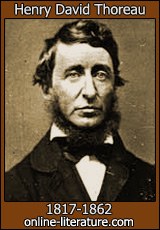
Henry David Thoreau
Henry David Thoreau (1817-1862), American Transcendentalist, philosopher, abolitionist, naturalist, essayist, and poet wrote Walden; or, Life in the Woods (1854);
The mass of men lead lives of quiet desperation. What is called resignation is confirmed desperation. .... A stereotyped but unconscious despair is concealed even under what are called the games and amusements of mankind.--Ch. 1
Writing on such varied topics as Economy, Reading, Winter Animals, and Solitude, Thoreau spent just over two years in a cabin he built on the edge of Walden Pond on the property of Ralph Waldo Emerson. It was a place for him to find solitude while he wrote, but for his ever-questioning mind it was also an experiment in self-reliance and living close to nature. Thoreau did not assert that others should live the same way, for Walden is the definitive text on Thoreau's own philosophy of life, what he believed in and how he lived it. But many have now come to see the importance of what Thoreau did, and see the significance of his message; that man's spiritual quest to find harmony within himself should also reflect directly on his social, political, and cultural surroundings. In his Biographical Sketch to Thoreau's Excursions (1863) Emerson writes;
He was bred to no profession; he never married; he lived alone; he never went to church; he never voted; he refused to pay a tax to the State: he ate no flesh, he drank no wine, he never knew the use of tobacco; and, though a naturalist, he used neither trap nor gun. He chose, wisely, no doubt, for himself, to be the bachelor of thought and Nature. He had no talent for wealth, and knew how to be poor without the least hint of squalor or inelegance. .... Thoreau was sincerity itself ...
In his most famous essay "On the Duty of Civil Disobedience" (1849) Thoreau states "That government is best which governs least"; and I should like to see it acted up to more rapidly and systematically." He spoke publicly on many political issues at the Concord Lyceum, many of his speeches later published including "Paradise (to be) Regained" (1843), "Slavery in Massachusetts" (1854), and his controversial "A Plea For Captain John Brown" (1859). He researched, supported, and wrote about many social and political causes for reform in his lifetime including civil rights and nature conservancy. In 1846 he was jailed for tax evasion, disagreeing with how public money was spent and on what, including war and the spread of slavery, but was soon released when thereafter friends and family paid his taxes for him. Through his actions and writings, Thoreau has inspired countless individuals including Mahatma Gandhi and Martin Luther King, Jr. who have also taken up the causes he so emphatically believed in. There are many groups now founded in honour of Thoreau including The Thoreau Society and The Walden Woods Project at the Thoreau Institute in Lincoln, Massachusetts. Thoreau was friends with many influential thinkers and writers of his time including Bronson Alcott, father of Louisa May Alcott, Ellery Channing, Margaret Fuller, and Nathaniel Hawthorne and his son Julian Hawthorne. Many authors and poets including Leo Tolstoy, Willa Cather, and William Butler Yeats have sung his praises and believed that, like Emerson, "The country knows not yet, or in the least part, how great a son it has lost."
Henry David Thoreau was born at what is now the Thoreau Farm Trust in Concord, Massachusetts on 12 July 1817 to Cynthia (1787-1872) and John Thoreau (1787-1859), pencil maker. He had two sisters and one brother; Helen, Sophia, and John. While he lived the majority of his life in Concord, Henry travelled to a few other States including New York and Maine, which inspired many essays and The Maine Woods (1864). He also went to Canada and wrote An Excursion to Canada in 1853. Thoreau attended Harvard University in Cambridge, Massachusetts where he studied the classics as well as science and math, graduating in 1837. From then on Nature became his hall of study; he returned to his beloved Concord and worked in his father's pencil factory. He also did some tutoring and began to write for periodicals. Some of his earliest writings include "A Natural History of Massachusetts" (1842), "Sir Walter Raleigh" (1843), and "Thomas Carlyle and His Works" (1847).
In the 1850's Thoreau became a land surveyor, an occupation which afforded him much time to go for long walks where he could immerse himself in his natural surroundings and gather information to further write about. He kept lengthy and detailed journal accounts of his travels; A Week on the Concord and Merrimack Rivers (1849) is based on a trip he took with his brother "I had often stood on the banks of the Concord, .... and at last I resolved to launch myself on its bosom and float whither it would bear me." His essay "Walking" (1861) was followed by Cape Cod in 1865, based on a series of excursions he took to the Atlantic sea-side town to study her people and the Cape's and flora and fauna. Thoreau wrote on myriad topics, often including poetry and anecdotes. A supporter of Charles Darwin's Theory of Evolution, some of his writings include detailed observation and analysis of botanical, meteorological, and geographical elements including "The Succession of Forest Trees" (1860), "Autumnal Tints" and "Wild Apples: The History of the Apple Tree" (1862).
Henry David Thoreau died of tuberculosis on 6 May 1862 and now rests in the Thoreau family plot of the Sleepy Hollow Cemetery in Concord, Massachusetts.
Why should we be in such desperate haste to succeed and in such desperate enterprises? If a man does not keep pace with his companions, perhaps it is because he hears a different drummer. Let him step to the music which he hears, however measured or far away. It is not important that he should mature as soon as an apple tree or an oak. Shall he turn his spring into summer?--Ch. 18, Walden
Biography written by C. D. Merriman for Jalic Inc. Copyright Jalic Inc. 2008. All Rights Reserved.
The above biography is copyrighted. Do not republish it without permission.
Forum Discussions on Henry David ThoreauRecent Forum Posts on Henry David Thoreau
Please submit a quiz here.
Here is where you find links to related content on this site or other sites, possibly including full books or essays about Henry David Thoreau written by other authors featured on this site.
Sorry, no links available.

Did Thoreau think there were no English translations of Homer?
Walden; or, Life in the Woods, from the section "Reading:"Those who have not learned to read the ancient classics in the language in which they were written must have a very imperfect knowledge of the history of the human race; for it is remarkable that no transcript of them has ever been made into any modern tongue, unless our civilization itself may be regarded as such a transcript. Homer has never yet been printed in English, nor Æschylus, nor Virgil even—works as refined, as solidly done, and as beautiful almost as the morning itself; for later writers, say what we will of their genius, have rarely, if ever, equalled the elaborate beauty and finish and the lifelong and hero...
Posted By dpbsmith in Thoreau, Henry David || 0 Replies
A Different Drummer
I was told that Henry David Thoreau said, "If a man does not keep pace with his companions, perhaps it is because he hears a different drummer. Let him step to the music that he hears, no matter how far away." I'm not sure if I have the quote exactly right, but I think that's the gist of it. Does anyone know if he really said this, and if so, in which of his works can it be found?...
Posted By Motherof8 in Thoreau, Henry David || 2 Replies
Who is Toscar in a poem of chapter 5: solitude (Walden) ?
Hi, everyone, I am reading the chapter 5: solitude of the book, Walden. There is a poem below written when Thoreau felt how congenial Nature is to him in a rainning day: "Mourning untimely consumes the sad; Few are their days in the land of the living, Beautiful daughter of Toscar." Then the question is: Who is the Toscar, or especially his/her daughter ?:argue: plus: How to understand the poem ? I would like to quote some sentences before the poem in the book to help you understanding the context: " In the midst of a gentle rain while these thoughts prevailed, I was suddenly sensible ...
Posted By thoreaufan in Thoreau, Henry David || 3 Replies
Translated Throeau quote (French)-need original
I'm translating a text from French into English and there are quotes by Thoreau. I've found all the originals except this one. The French is: "la présence d’une alouette, d’un ruisseau ou d’une pierre importe souvent plus que celles des humains bavards et creux" Which would literally translate something like: "the presence of a lark, a brook, or a stone often matters more than that of garrulous and hollow human beings" Please reply if this rings a bell. It might help to know that it seems that regarding this Thoreau quotes Blake: "to see the world in a grain of sand, and a heaven in a wildflower, hold infinity in the palm of your hand, and eternity in an hour"...
Posted By lapislazouli in Thoreau, Henry David || 0 Replies
need to understan Thoreau
I'm working on my literature test. Can anyone help me to understand one of his expression? That is an excerpt from Thoreau work "Life without principle" Most men would feel insulted, if it were proposed to employ them in throwing stones over a wall, and then in throwing them back, merely that they might earn their wages. But many are no more worthily employed now. For instance: just after sunrise, one summer morning, I noticed one of my neighbors walking beside his team, which was slowly drawing a heavy hewn stone swung under the axle, surrounded by an atmosphere of industry,--his day's work begun,--his brow commenced to sweat,--a reproach to all sluggards and idlers,--pausing abreast ...
Posted By proshenekuda in Thoreau, Henry David || 3 Replies
The works of Thoreau through movies
Have you seen the puzzling "Into the wild" ? Give you impressions and please quote Thoreau's quotes that appeared in the movie if you do remember and from what work have they been picked up. Cheers :) ;)...
Posted By Eef's in Thoreau, Henry David || 4 Replies
Introductions have too much detail?
So far all of the introductions I've read aren't simply introductions that introduces you to a book but rather a summary or general overview of the book. Sometimes I just want to skip it all but they give SO much information you can write on and on about it and contemplate over it. Just in case you're wondering, I'm reading Walden right now and it is so interesting despite what my other friends say. I love how he thinks about human life in general and some of his "unconventional" ideas (which I don't find that eccentric). Okay, I've got to stop ruminating about this. I just want to get to the actual writings of Thoreau. Should I always read the introduction though? or... should I ...
Posted By Integral in Thoreau, Henry David || 6 Replies
Parables in Walden
Thoreau ends his book with the story of the bug resurecting for an applewood table some sixty years after the egg was placed in the tree. What's the point of the story? Why is it at the end of the book?...
Posted By Nancy Brown in Thoreau, Henry David || 4 Replies
Post a New Comment/Question on Thoreau