
Subscribe for ad free access & additional features for teachers. Authors: 267, Books: 3,607, Poems & Short Stories: 4,435, Forum Members: 71,154, Forum Posts: 1,238,602, Quizzes: 344
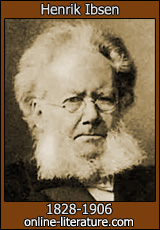
Henrik Ibsen
Henrik Ibsen (1828-1906), Norwegian dramatist wrote the contemporary drama A Doll's House (1879);
"Our home has been nothing but a play-room. I’ve been your doll-wife here, just as at home I was Papa’s doll-child. And the children have been my dolls in their turn. I liked it when you came and played with me, just as they liked it when I came and played with them. That’s what our marriage has been, Torvald."--Nora Helmer, act 3
Internationally acclaimed during his lifetime and one hundred years after his death, Ibsen remains amongst the most popular studied and produced playwrights ever. Some say second only to Shakespeare. Edvard Munch, famous Norwegian painter, is said to have been inspired by his works. Originally written in Norwegian, translators have devoted themselves to the often difficult task of capturing the nuance and subtleties of his themes.
Henrik Johan Ibsen was born 20 March 1828 in the house then-called `Stockmannsgården' in the port town of Skien, Norway, the son of Marichen and Knud Ibsen, a merchant. The bustling port town, his father's merchant company and decline in fortunes would profoundly affect Ibsen's life and work. While apprenticing with a chemist Ibsen found his true calling, penning Catiline (1850), a tragedy in verse. He then attended Christiania (now Oslo) University where he edited the student paper. By his early twenties however he was completely immersed in the writing and direction of a number of successful dramatic productions throughout Norway.
While living in Germany, in 1858 Ibsen married Suzannah Thoreson with whom he would have a son. Among his many works produced during this time were The Pretenders (1863); Love's Comedy (1863); Brand (1866); Peer Gynt (1867); Emperor and Galilean (1873); Pillars of Society (1877), "The spirit of truth and the spirit of freedom—these are the pillars of society."; Ghosts (1881); and An Enemy of the People (1882). Hedda Gabler (1890) was published in Munich, Germany;
"In your power, all the same. Subject to your will and your demands. No longer free! No! That’s a thought I’ll never endure! Never."--Hedda Gabler, act 4.
As in A Doll's House the theme of suicide again recurs in Hedda Gabler. It has been said that Ibsen himself suffered from depression and at times contemplated suicide. Societal breakdown, stereotypes, class struggle and issues of morality dominate his characters. His later works of deep psychological questioning include The Wild Duck (1884); Rosmersholm (1886); The Lady from the Sea (1888); The Master Builder (1892); Little Eyolf (1894); John Gabriel Borkman (1896) and When We Dead Awaken (1899). Ibsen also wrote poetry, his first edition of Poems published in 1871, and he created a large amount of artwork over his lifetime in the form of watercolours, oils, cartoons, and sketches.
Although he travelled extensively and worked on stage productions in a number of other countries including Italy and Germany, Ibsen returned to Oslo to spend his final years. Plagued by ill health including paralysing strokes that caused him to be bedridden, he died peacefully on 23 May 1906. He lies buried in the Cemetery of Our Saviour, Vår Frelsers Gravlund, in Oslo, Norway. Many obituaries were published about him including a glowing tribute by Georg Brandes, Danish critic and scholar.
Biography written by C.D. Merriman for Jalic Inc. Copyright Jalic Inc. 2006. All Rights Reserved.
The above biography is copyrighted. Do not republish it without permission.
Forum Discussions on Henrik IbsenRecent Forum Posts on Henrik Ibsen
Please submit a quiz here.
Here is where you find links to related content on this site or other sites, possibly including full books or essays about Henrik Ibsen written by other authors featured on this site.
Sorry, no links available.

Recommended translations for ibsen
What are the best translations of ibsen's plays?...
Posted By gustave dore in Ibsen, Henrik || 0 Replies
The tragic fall of Solness in ''The Master Builder?''
I would have trouble coming up with a reading that viewed the fall of Solness as a 'happy' one (perhaps reminiscent of the Fortunate Fall...). His fall, literal and figurative, doesn't strike me as being a happy one. But is it a tragic fall? In any event, what courage by Ibsen to portray the dramatic (and perhaps tragic) fall of Solness by means of a physical fall, meaning how on earth is he going to do a satisfactory job on this? (An aside: I don't know Norwegian and I don't know if the 'fall' in any Norwegian expression for 'dramatic fall' is the same 'fall' used for a physical fall.) Is it really being linear-minded and literal-minded just to think that the physical fall of Solness stands...
Posted By KHaight in Ibsen, Henrik || 1 Reply
Ibsen and Comedy?
As a self confessed comedy buff any plays of Henrik that will make me laugh or considered comedic?...
Posted By Theunderground in Ibsen, Henrik || 5 Replies
Play on Ibsens Life
Hi all, Just wondered if there is a play that exists based on Henrik Ibsen's life? If so, can someone point me in the right direction of it please? Looking for different plays to put on with my theatre company Crimson Horse :) :thumbs_up...
Posted By sassysash in Ibsen, Henrik || 0 Replies
Emperor and Galilean - Countercurrents
Ibsen spent eight years writing the double play he regarded as his seminal work, Emperor and Galilean (1873), dramatizing the last decade of the erudite Julian, nephew of the first Christian emperor, Constantine the Great. In 361 AD, the 30-year-old pristine Julian succeeds the murderous Constantius II as Roman emperor. Emperor Julian, labelled the Apostate, dies three years later in a Persia from a spear wound. http://www.sacred-texts.com/cla/toj/img/julian.jpg Shocking is the transition of Julian from lone man of integrity - in a Christian empire crippled by mediocrity and corruption - to deified tyrant. But more shocking is the transition of Christi...
Posted By Gladys in Ibsen, Henrik || 0 Replies
Ibsen on stage and film
Having seen a few of Ibsen plays on film, I have been disappointed by what has been cut for the performance. Removing a dozen or more lines from Ibsen seems to alter the meaning of the whole. Am I alone in this?...
Posted By Gladys in Ibsen, Henrik || 0 Replies
Kierkegaard's Christian – through the eyes of Ibsen
Has anyone read Henrik Ibsen’s play ‘Brand’, written as an epic poem with a radical and compelling Christian theology? The young (Lutheran?) priest Brand and his wife Agnes are outrageous and heroic in their ‘naught or all’ struggle of the will, towards death. It is my surmise that through Brand and Agnes, Ibsen portrays the 'true Christian' of great Danish philosopher, Soren Kierkegaard - an unordained priest who died a decade before the publication of ‘Brand’. Disclaiming knowledge of Kierkegaard, Ibsen once said he 'had read very little and understood even less'. ‘Brand’ combines two Biblical ideas: And he [God...
Posted By Gladys in Ibsen, Henrik || 1 Reply
Peer Gynt - a poem!
After reading most of the later plays, the stream of consciousness that is Peer Gynt is a shock to the system. And the play seems so long. Should I attempt 'Brand'?...
Posted By Gladys in Ibsen, Henrik || 1 Reply
Ibsen - Interlinked and Stunning
Is anyone else enchanted by massive interlinking, combined with the unexpected, in Ibsen plays? I find myself beginning to understand each play weeks after reading it. So much, in so few words....
Posted By Gladys in Ibsen, Henrik || 0 Replies
Shoot "The Wild Duck"!
Alone in the attic, Hedvig finally shoots 'the wild duck', rescued from the sexual adventures of Werle, her father. Therefore, Hjalmar repents of rejecting Hedvig, in a glorious vindication of idealistic Gregers, Hedvig's half-brother. Is there more?...
Posted By Gladys in Ibsen, Henrik || 2 Replies
Assignment on the Wild Duck
Hello all, I'm currently in my last year of IB higher level english and I have been set a task to write a creative piece about some aspect of The Wild Duck. After reading over the play a couple times, I have decided on what I believe could be a potentially strong piece of work. I decided to write a reflection from the point of the doctor Relling (Gregers opposite half) about the sudden death of Hedvig. As the criteria for the assignment requires, I intend to write from Relling's point of view, in his voice and personality, and focus on the themes of the play and their meaning (such as lies, truths, blindness, etc.) by reflecting on how Hedvig happened to kill herself under Relling'...
Posted By MightyMouse in Ibsen, Henrik || 0 Replies
Ibsen and infants
A former drama professor told me that Ibsen wrote a play which dealt with infant injury and its psychological aftermath. I was wondering if anyone might know which play this is? Thank you....
Posted By Jozanny in Ibsen, Henrik || 1 Reply
Post a New Comment/Question on Ibsen