
Subscribe for ad free access & additional features for teachers. Authors: 267, Books: 3,607, Poems & Short Stories: 4,435, Forum Members: 71,154, Forum Posts: 1,238,602, Quizzes: 344
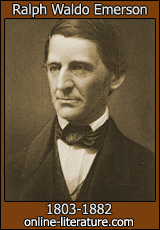
Ralph Waldo Emerson
Ralph Waldo Emerson (1803-1882), American Transcendentalist poet, philosopher, lecturer, and essayist wrote Nature (1836);
To go into solitude, a man needs to retire as much from his chamber as from society. I am not solitary whilst I read and write, though nobody is with me. But if a man would be alone, let him look at the stars. The rays that come from those heavenly worlds, will separate between him and what he touches. One might think the atmosphere was made transparent with this design, to give man, in the heavenly bodies, the perpetual presence of the sublime. Seen in the streets of cities, how great they are! If the stars should appear one night in a thousand years, how would men believe and adore; and preserve for many generations the remembrance of the city of God which had been shown! But every night come out these envoys of beauty, and light the universe with their admonishing smile.--Ch. 1
Initially published anonymously, Emerson's first collection of essays, Nature, is the culmination of much soul-searching and scholarly study by Emerson in the fields of philosophy and religion. Never intending to be regarded as a philosopher, Emerson emerged as one of the original thinkers of his age, oftentimes poetically expressing his ideals;
' .... of Nature itself upon the soul; the sunrise, the haze of autumn, the winter starlight seem interlocutors; the prevailing sense is that of an exposition in poetry; a high discourse, the voice of the speaker seems to breathe as much from the landscape as from his own breast; it is Nature communing with the seer.'
Emerson believed in individualism, non-conformity, and the need for harmony between man and nature. He was a proponent of abolition, and spoke out about the cruel treatment of Native Americans. Influenced by the Eastern philosophy of unity and a divine whole, emphasizing God Immanent, to be found in everyone and everything, Emerson sowed the seeds of the American Transcendentalist movement. He realised the importance of the spiritual inner self over the material external self through studying Kantianism, Confucianism, Neo-Platonism, Romanticism, and dialectical metaphysics and reading the works of Saint Augustine, Sir Francis Bacon, Samuel Taylor Coleridge, and William Shakespeare among many others. During his lifetime and since Emerson has had a profound influence on some of the 19th and 20th century's most prominent figures in the arts, religion, education, and politics.
Ralph Waldo Emerson was born on 25 May 1803 in the Puritan New England town of Boston, Massachusetts to Ruth née Haskins (d.1853) and Unitarian minister William Emerson (d.1811). Young Ralph had a strict but loving upbringing in the household of a minister who died when he was just eight years old. It was the first of many untimely deaths of Emerson's relatives. While his father had died young, he was very close to his mother, siblings, and Aunt Mary Moody who had a great and positive influence on his intellectual growth. Early on young Waldo as he like to be called started keeping journals and later would base many of his essays on his thoughts and observations expressed therein. While his writings were sometimes criticised as being too abstract, he was an eloquent and popular speaker.
After studying the classics at the Boston Latin School, Emerson enrolled in Harvard College, graduating in 1821. He then taught at his brother William's Boston school for young ladies. Emerson's first publication, "Thoughts on the Religion of the Middle Ages" appeared in 1822 in the Christian Disciple. When in 1825, Emerson entered Harvard Divinity School, there was much discussion of and influence from translations of the German critics and Hindu and Buddhist poetry--it was the beginning of his struggle to come to terms with his own Christian beliefs. "Divinity School Address" is one such work.
The same year Emerson was ordained minister in the Second Church in Boston, on 30 September 1829, he married Ellen Louisa Tucker. She died of tuberculosis a few years later and her death caused another wave of religious questioning and doubt for Emerson. He next married Lydia 'Lidian' Jackson (d.1892) on 14 September 1835 with whom he would have four children: Waldo (d. 1842), Ellen (d.1909), Edith, and Edward. They settled in Concord, Massachusetts where they would live for the rest of their lives, their home now the National Historic Landmark Ralph Waldo Emerson House. They entertained many friends and noted artists, free thinkers, poets, authors, and Transcendentalists of the time including Nathaniel Hawthorne and Bronson Alcott and his daughter Louisa May Alcott. Henry David Thoreau built his Walden Pond cabin on Emerson's property; he watched over Emerson's family when he lectured abroad.
In 1832 Emerson resigned his position with the Church and sailed for Europe. His health had been troubling him for some time, and he was advised to take a rest. He visited England, Scotland, France, and Italy, meeting poets Samuel Taylor Coleridge and William Wordsworth, and philosophers John Stuart Mill and Thomas Carlyle, with whom he maintained a lengthy correspondence, published as Correspondence of Thomas Carlyle and R.W. Emerson (1883). English Traits (1856) is based on his travels. Emerson's first book Nature (1836) includes his essays "Nature", "Commodity", "Beauty", "Language", "Discipline", "Idealism", "Spirit", "Prospects", "The American Scholar", "Divinity School Address", "Literary Ethics", "The Method of Nature", "Man the Reformer", "Introductory Lecture on the Times", "The Conservative", "The Transcendentalist", and "The Young American".
Emerson had been lecturing for some time, and in 1838 made his controversial "Divinity School Address at Harvard, whereupon he was labeled an atheist. In 1840 he started The Dial with Margaret Fuller, which served as the official publication of the Transcendentalists until 1844. Emerson was a prolific essayist; many of them first appeared in The Dial, many of them were lectures he had given. Essays: First Series (1841) includes "History", "Self-Reliance", "Compensation", "Spiritual Laws", "Love", "Friendship", "Prudence", "Heroism", "The Over-Soul", "Circles", "Intellect" and "Art". Essays: Second Series (1844) includes "The Poet", "Experience", "Character", "Manners", "Gifts", "Nature", "Politics", "Nominalist and Realist", and "New England Reformers".
The same year Emerson embarked on year-long lecture tour of Europe, his poetry collection Poems (1847) was published. Miscellanies; Embracing Nature, Addresses, and Lectures (1849) was followed by another collection of lectures as essays, Representative Men (1850) that includes essays on Plato and Johann Wolfgang von Goethe--"Uses of Great Men", "Plato; or, the Philosopher", "Plato; New Readings", "Swedenborg; or, the Mystic", "Montaigne; or, the Skeptic", "Shakspeare; or, the Poet", "Napoleon; or, the Man of the World", and "Goethe; or, the Writer". The Conduct of Life (1860) appeared just before Emerson started a North American lecture series. His next collection of poetry May-Day and Other Pieces (1867) was followed by Society and Solitude (1870). Emerson next launched into his "Natural History of Intellect" series of lectures at Harvard University.
In 1872 the Emerson family sailed for Europe and Egypt while their home, badly damaged by fire, underwent repairs. When they returned, Emerson continued to write and address students and admirers alike. At the age of seventy-eight, Emerson caught a cold from being out in the New England rainy damp weather and it turned into pneumonia. On 27 April 1882 Ralph Waldo Emerson died at home in Concord, Massachusetts. Lydia survived him by ten years, and now rests beside him on Author's Ridge in the Sleepy Hollow Cemetery in Concord, Middlesex County, Massachusetts, U.S.A.
Mine are the night and morning,
The pits of air, the gulf of space,
The sportive sun, the gibbous moon,
The innumerable days.I hide in the solar glory,
I am dumb in the pealing song,
I rest on the pitch of the torrent,
In slumber I am strong.....
--from "Song of Nature", May-Day and Other Pieces
Biography written by C. D. Merriman for Jalic Inc. Copyright Jalic Inc. 2007. All Rights Reserved.
The above biography is copyrighted. Do not republish it without permission.
Forum Discussions on Ralph Waldo EmersonRecent Forum Posts on Ralph Waldo Emerson
Please submit a quiz here.
Here is where you find links to related content on this site or other sites, possibly including full books or essays about Ralph Waldo Emerson written by other authors featured on this site.

Reflections...
post what your mind comes up with while reading an emerson essay. read it and then post all your thoughts. post what emerson inspires you to write. post what emerson makes you want to write so bad, that you can't continue reading until it has been written down....
Posted By bojangle in Emerson, Ralph Waldo || 0 Replies
Need help locating a quote...
I found this in an article online, and I want to use it for an essay I'm writing. Could somebody help me find the original location of this quote, so that I can cite it properly? "As soon as there is life, there is danger." - RW Emerson....
Posted By Desolation in Emerson, Ralph Waldo || 0 Replies
emerson analysis
I'm kinda new to the whole transcendentalism thing and was wondering how do you approach these readings? It's not fictional writing so how do you critically analyze his essays, what kinds of things is one supposed to look for when reading them? Thanks....
Posted By aromero007 in Emerson, Ralph Waldo || 0 Replies
Favorite of Emerson's Work?
It seems that Emerson possesses the talent of reaching into the core essence of man or woman and expressing truths about humanity and nature in beautifully simple and poignant manners. I consider him among other things a masterful pedagogue of truths universally unacknowledged. But my question for you is which is your favorite work of his and why? I myself cannot decide but would love to hear from you....
Posted By isidro in Emerson, Ralph Waldo || 8 Replies
Need help lpease help
RALPH WALDO EMERSON WHY WAS HE KICKED OUT OF THE CLERGY ???? AND WHAT WAS THE RELATIONSHIP BETWEEN HIS SECOND WIFE LYDIA AND HIS FAVORITE STUDENT HENRY DAVID THOREAU????:banana::banana::banana:...
Posted By SMOKEYNOK in Emerson, Ralph Waldo || 1 Reply
I found a book... Emerson's Work
Its titled Emerson's Work:: printed in 1906.. Gold leaf pages, leather bound.. its a tiny bit crooked, but it is from 1906, with "Pete from Esther 1908" written with what looks like either a fountain pen or a quill.. I havent read it myself.. Im not a reader. Sorry about that.. I just registered here because I know forums are were you get your best information! I was wondering to whom I could send pictures as proof and possibly sell the book? Would anyone know the value of the book? I've searched online, but no one reeeally gave me any useful information.. Interested in hearing from you! Coin...
Posted By insertcoin in Emerson, Ralph Waldo || 3 Replies
hi im new :) can someone help me quick?
hi hope all is well with every one, i normally..well have never done this, but would someone mind giving me a quick analysis of the poem illusions by Ralph waldo emerson?...
Posted By treeline09 in Emerson, Ralph Waldo || 0 Replies
Emerson Anyone
“Every man is a consumer, and ought to be a producer. He is by constitution expensive, and needs to be rich.” Emerson wrote it, does anyone know where?...
Posted By FalseReality in Emerson, Ralph Waldo || 1 Reply
Emerson
He rocks!!! :yawnb:...
Posted By Zackary Vincent in Emerson, Ralph Waldo || 0 Replies
Ralph Waldo Emerson's Each and All
I am a student from Vietnam. I have an English poetry class this Saturday and I will have a presentation about the poem Each And All by Ralph Waldo Emerson. The presentation is involved with answering the questions given by my teacher. Some of his questions are so difficult that I cannot think of any idea about them. So I really need your help Each And All Little thinks, in the field, yon red-cloaked clown, Of thee from the hill-top looking down; The heifer that lows in the upland farm, Far-heard, lows not thine ear to charm; The sexton, tolling his bell at noon, Deems not that great Napoleon Stops his horse, and lists with delight, Whilst his files sweep round yon Alpine he...
Posted By thinh in Emerson, Ralph Waldo || 2 Replies
Drawing on Emerson--and Byron
UNTREATED My poetry is a blending of autobiographical elements, echoes of the literature of the social sciences and humanities and a steady stream of references to and influences from Baha’i writings, history and teachings. This evening I was reading about the English poet George Byron(1788-1824). I was particularly struck by the fact that all of Byron's poetry is a blending of autobiographical elements and echoes of the literature he had absorbed over the years. And so I felt a certain affinity to Byron for this reason. His poem Don Juan is considered the most autobiographical of Byron’s works. Almost all of Don Juan is real life either Byron’s or the lives of those whom he knew...
Posted By Ron Price in Emerson, Ralph Waldo || 1 Reply
Eastern Religion's Influence on Emerson?
Hi, I am in a class devoted to the influence that Chinese thought has had on the West. We have been given considerable freedom to write on whatever we wish, and I have decided on examining Emerson with regard to the Chinese texts I believe him to have been fond of. I have a few areas in which I need some help though: 1) How can I know what texts Emerson definitively read? Is there an archive anywhere on the net of the books he's read? 2) Are his Journals available anywhere online with some ability to search through them? If not, can anyone direct me in acquiring his journals? Anyone know which ones contain abundant references to Buddhism, Confucianism, etc? Thanks in advance....
Posted By MontaigneLN in Emerson, Ralph Waldo || 1 Reply
Post a New Comment/Question on Emerson