
Subscribe for ad free access & additional features for teachers. Authors: 267, Books: 3,607, Poems & Short Stories: 4,435, Forum Members: 71,154, Forum Posts: 1,238,602, Quizzes: 344
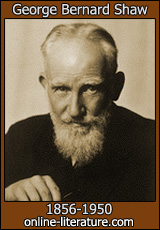
George Bernard Shaw
George Bernard Shaw (1856-1950), Nobel prize-winning Irish playwright wrote dozens of popular plays including Pygmalion (1912);
"The English have no respect for their language, and will not teach their children to speak it. .... It is impossible for an Englishman to open his mouth without making some other Englishman hate or despise him. ....The reformer England needs today is an energetic phonetic enthusiast: that is why I have made such a one the hero of a popular play."--from the Preface
The story of Cockney flower girl Eliza Doolittle, who utters one of Shaw's then-controversial lines ("Walk! Not bloody likely." Act III) remains one of Shaw's most popular plays today. As in the Greek myth where Pygmalion falls in love with a statue that he has carved, so too does phonetics professor Henry Higgins fall in love with his creation, a transformed Lady of Society. "I don't want to talk grammar. I want to talk like a lady." (Act II). Cloaked in witty humour, Shaw examines the superficiality of class behaviour and distinctions. In 1938 he won the Oscar award for Best Screenplay for his film adaptation of Pygmalion starring Leslie Howard and Wendy Hiller. In 1956 it was first adapted as a musical titled "My Fair Lady". Like his rival of the time Oscar Wilde, the oft-quoted Shaw inspired countless authors and poets and became one of the most popular playwrights of his time, infusing irony and wit into his over fifty plays, many of which are still in production today. An avid photographer, social reformer, women's rights advocate, satirist, popular public speaker, vegetarian (after reading Percy Bysshe Shelley), accomplished music and theatre critic, the term Shavian is now used in reference to all things Shaw, also known as G.B.S.
Act I: The Early Years
George Bernhard Shaw was born on 26 July 1856 at what is now 33 Synge Street in Dublin, Ireland. His parents were George Carr Shaw (1815-1885), a retired civil servant, and 'Bessie' Lucinda Elizabeth nee Gurly (1830-1913), amateur mezzo soprano singer. He had two older sisters, Lucinda Frances (1853-1920) and Elinor Agnes (1855-1876). The early years for young 'Sonny' (as he was known as a child) were a struggle in the Shaw residence. His father was an unsuccessful corn merchant and alcoholic who squandered his money on drink. Being of landed gentry was no cure against the genteel poverty that pervaded the Shaw household. It was a humiliation that Shaw often wryly referred to in his writings and Shaw: An Autobiography 1856-1898 (edited by Stanley Weintraub, 1970). His mother taught piano to help support the family and was a member of a musical society. Summers spent in the countryside greatly contributed to the development of Shaw's imaginative inner life. He was very happy at these times despite being raised by somewhat detached parents. His mother was especially busy with her music but her love of art, theatre, literature, and music had a positive affect on her only son. He often visited the National Gallery in Dublin. He was tutored by an uncle for a time and attended various schools in Dublin, although he soon developed a distaste for institutionalised learning, likening them to prisons.
"Liberty is the breath of life to nations; and liberty is the one thing that parents, schoolmasters, and rulers spend their lives in extirpating for the sake of an immediately quiet and finally disastrous life."--"Treatise On Parents And Children" (1910)
Shaw's first employment was as cashier with a land agent where he conducted tasks such as book keeping and rent collection. At the age of sixteen he was receiving a fairly decent wage but he found the work tedious. He also realised the odious disparity among the classes, the daily struggles of the have-nots. He longed for more intellectual pursuits. He did manage to go to the theatre, read literature, and immerse himself in the poetry of Lord George Gordon Byron and William Blake. His sister Agnes died of tuberculosis in 1876, the same year that Bernhard (he dropped the use of his first name George at this time) moved out of his father's home and travelled to London, England, where his mother had moved a few years earlier to teach singing. She was living with voice teacher and conductor G. J. Vandeleur Lee. While living with her Shaw was now able to pursue his interest in the arts by visiting galleries and museums. He furthered his studies at the British Museum attending lectures. This led him to write critiques and essays on various subjects, often with irony and humour. Emerging themes in his works were marriage, education, politics, class struggle, and religion. Some of his articles and book reviews began appearing in the Pall Mall Gazette in 1885. He wrote as music critic under the pseudonym Corno di Bassetto. While his first fictional efforts such as Immaturity (1879) had been rejected by publishers, he finally found his voice when he became theatre critic for Saturday Review in 1895. His other novels are Cashel Byron's Profession (1882), An Unsocial Socialist (1887), The Irrational Knot (1880), and Love Among the Artists (1881).
Act II: Politics
Many critics during his lifetime and after his death would come to criticise Shaw's humanitarian politics and sometimes contradictory but often controversial opinions. "Revolutions have never lightened the burden of tyranny: they have only shifted it to another shoulder." (The Revolutionist's Handbook and Pocket Companion, 1903). Of Charles Dickens's Little Dorrit Shaw said it "remains the most accurate and penetrating study of the genteel littleness of our class governments in the English language," (The Shewing-up of Blanco Posnet, 1909). Shaw was a staunch socialist and member of the Fabian Society which he joined in 1884. His political interests led him, in 1893, to helping form the Independent Labour Party. In 1895 he was one of the founders of the London School of Economics and Political Science. He often lauded the writings of Leo Tolstoy and Maxim Gorky. An advocate of Stalinism, he travelled with his wife Charlotte to the USSR in the 1930's. He wrote many political essays and articles during his lifetime including Fabian Essays in Socialism (1889), The Intelligent Woman's Guide to Socialism and Capitalism (1912), and Everybody's Political What's What (1944). "The golden rule is that there are no golden rules." ("Maxims for Revolutionists", 1903).
"Most people either say that they agree with Bernard Shaw or that they do not understand him. I am the only person who understands him, and I do not agree with him."--Gilbert Keith Chesterton (1909)
Act III: Romance
"....the service was really only an honest attempt to make the best of a commercial contract of property and slavery by subjecting it to some religious restraint and elevating it by some touch of poetry. But the actual result is that when two people are under the influence of the most violent, most insane, most delusive, and most transient of passions, they are required to swear that they will remain in that excited, abnormal, and exhausting condition continuously until death do them part."--Preface to Getting Married (1908)
Shaw's thoughts on the institution of marriage were not necessarily positive, but at the age of forty-one he married heiress, actress, feminist, and fellow Fabian society member Charlotte Payne Townshend (1857-1943) on 2 June 1898. In 1906 they moved to the village of Ayot St. Lawrence in Hertfordshire, England, just an hour away from London. Their home, the Edwardian villa "Shaw's Corner" is now maintained by the National Trust as a museum. At the bottom of the garden there is a small house that can be turned, allowing for the best of light in the windows at any time of the day, and was Shaw's favourite writing place. The Shaws also had a residence in London at 29 Fitzroy Square. It is claimed that their marriage was never consummated. Shaw had a number of close friendships with women, including fellow Fabian society member and author of The Railway Children (1906) Edith Nesbit. In 1912 he fell in love with actress Stella Campbell, or Mrs. Patrick Campbell, who became his muse and inspiration for Eliza Doolittle in Pygmalion. "....there are two tragedies in life. One is not to get your heart's desire. The other is to get it." (Act IV, Man and Superman. In the 1930's the Shaws travelled extensively throughout Europe, Africa, Asia, New Zealand, and North America. It was at this time that Shaw started with his photography in earnest. The London School of Economics and Political Science, University of London, houses the archive of thousands of negatives and photographs from his every day life and travels around the world.
Act IV: The Plays
A long-time admirer of the works of playwright Henrik Ibsen, Shaw wrote the essay "Quintessence of Ibsenism" in 1891;
"Here I must leave the matter, merely reminding those who may think that I have forgotten to reduce Ibsenism to a formula for them, that its quintessence is that there is no formula."
Ibsen's was a new style of realistic drama that very much appealed to Shaw's sensibilities. His first series of Plays Unpleasant (published in 1898) include Widowers' Houses (1892), The Philanderer (1898), and Mrs Warren's Profession (1893). Plays Pleasant (published in 1898) includes Arms and the Man (1894), Candida (1894), The Man of Destiny (1895), and You Never Can Tell (1897). Plays for Puritans (published in 1901) include The Devil's Disciple (1897), Caesar and Cleopatra (1898), and Captain Brassbound's Conversion (1899). Back to Methuselah: A Metabiological Pentateuch was published in 1921. It is a collection of five plays titled "In the Beginning", "The Gospel of the Brothers Barnabas", "The Thing Happens", "Tragedy of an Elderly Gentleman", and "As Far as Thought Can Reach". "In the Beginning" contains one of Shaw's many quoted lines;
THE SERPENT. If I can do that, what can I not do? I tell you I am very subtle. When you and Adam talk, I hear you say 'Why?' Always 'Why?' You see things; and you say 'Why?' But I dream things that never were; and I say 'Why not?' I made the word dead to describe my old skin that I cast when I am renewed. I call that renewal being born.--Act I
Don Juan themed Man and Superman (1903), William Butler Yeat's commissioned John Bull's Other Island (1904), Major Barbara (1905), and Saint Joan (1923) are other popular works. Shaw was no fan of William Shakespeare and in 1949 penned Shakes versus Shav (1949), a Punch and Judy styled puppet play wherein he himself spars with Shakepeare in a fight against "bardolotry", and who is the greater writer. Another of Shaw's many influences was Samuel Butler, author of The Way of All Flesh (1903). He referred to Shaw as "the greatest English writer of the latter half of the nineteenth century". Shaw was also friends with H. G. Wells, James M. Barrie, and The Portrait of a Lady author Henry James. In 1950 Shaw started his last play Why She Would Not.
Act V: The Final Curtain
An avid gardener especially in his final years, Bernard Shaw died on 2 November 1950 at the age of 94 after complications from injuries after falling in his garden at Ayot. He had kept Charlotte's ashes and on 23 November their ashes were together scattered in their garden. He left a legacy of thousands of letters, published as Bernard Shaw: Collected Letters, 1874-1897 (1965) and Collected Letters, 1898-1910 (1972) edited by Dan H. Laurence. When Shaw was contacted by officials from the Royal Swedish Academy Nobel Prize committee in 1925 he humbly tried to refuse the monetary prize, saying he earned enough from his writings. However, in the end it was used in his name to further cultural relations between Sweden and Great Britain. The World-Renowned Shaw Festival Theatre in Niagara-on-the-Lake, Ontario, Canada was founded by Brian Doherty in 1962, in honour of the playwright and to promote his works. In 1972 the theatre was officially opened by Queen Elizabeth II.
"His ideas were those of a somewhat abstract logical radicalism; hence they were far from new, but they received from him a new definiteness and brilliance. In him these ideas combined with a ready wit, a complete absence of respect for any kind of convention, and the merriest humour--all gathered together in an extravagance which has scarcely ever before appeared in literature."--Per Hallström, Chairman of the Nobel Committee, Award Speech
Biography written by C.D. Merriman for Jalic Inc. Copyright Jalic Inc 2013. All Rights Reserved.
The above biography is copyrighted. Do not republish it without permission.
Forum Discussions on George Bernard ShawRecent Forum Posts on George Bernard Shaw
Here is where you find links to related content on this site or other sites, possibly including full books or essays about George Bernard Shaw written by other authors featured on this site.

My Fair Lady at BBC Proms
What did you think of it?...
Posted By kelby_lake in Shaw, George Bernard || 0 Replies
G. Bernard Shaw and the Idea of Marriage - SOURCE NEEDED!
Hi everyone, I am writing a paper on Shaw and his Idea of Marriage - mostly presented in " Man and Superman" and have to find at least seven sources for it. I would like to know if there are realted essays that he himself wrote or that anybody else did - even contemporary authors - on the matter. Thanks a lot in advance!...
Posted By Aydmen in Shaw, George Bernard || 2 Replies
Critics of George Bernard Shaw
Hello, this is my first post and I want to know who criticized George Bernard Shaw's work. Critics of either his essays or plays will be fine. The type of criticism that I need is criticism of his ideologies. If I posted this in the wrong section then can a mod please move?...
Posted By Sasholon in Shaw, George Bernard || 0 Replies
Help needed to find source
Hi everybody Allegedly Shaw is man behind the phrase "We don't stop playing because we get old; we get old because we stop playing". I've been surfing the web like a crazy and read a great deal of his works but I can't find the sentence anywhere. Do any of you know of it's origins? I hope you can help!!...
Posted By qee4q in Shaw, George Bernard || 0 Replies
I need the answer
:confused: why G B Shaw used the frensh word "Blanche" as a name for one of the major characters in his play "Widowers'Houses"?...
Posted By realvision in Shaw, George Bernard || 0 Replies
widowers' houses
:confused: Widowers' Houses is a simple play , but what is the purpose behind it ? why G B Shaw is known as " anti every thing"? thanks...
Posted By realvision in Shaw, George Bernard || 1 Reply
Shaw on The Subject of Writing
A POETIC NOVEL/A NOVEL IN POETRY Roland Barthes argues that autobiography should be considered as something spoken by a character in a novel or, rather, by several characters. In a novel the image-repertoire, the fatal substance and the labyrinth of levels in which anyone who speaks about himself is entirely fictive. The image-repertoire is expressed by several masks or personae which are distributed according to the depth, the extent, of the stage. The novel does not choose, it functions by alteration; it proceeds by impulses. So is this true of the essay or autobiographical poetry, although there is a strong element of choice in the writing--I would argue. The approaches to novel w...
Posted By Ron Price in Shaw, George Bernard || 0 Replies
Links between Shaw and Wilde
I have been studying Shaw's play Man and Superman at universityand it struck me how alike Oscar Wilde he is in some of his witty statements. I also noticed a reference to the 'seven deadly virtues', which Wilde also humourously mentions in The Picture of Dorian Gray. Since they were born only a couple of years apart, and both Irishmen who moved to London and wrote a variety of texts, I thought that I would make reference to Wilde in a presentation I'm doing on Man and Superman. However, I don't know if they ever met one another or mentioned one another in anything they ever wrote (which would be helpful and interesting for my presentation). If a...
Posted By Dark Lady in Shaw, George Bernard || 1 Reply
G B Shaw recommendations?
I've just finished reading "Pygmalion" by G.B. Shaw and enjoyed it a lot. Which of his other plays would you recommend?...
Posted By SleepyWitch in Shaw, George Bernard || 7 Replies
St. Joan! Y'all forgot St. Joan!
Who here likes St. Joan? Joan of Arc is one of my idols, and though I don't like Shaw's account as much as Twains, I think it's a well written play, plus I rather love the way the ending is done with Joan in heaven with the other people, and the soldier who's out of Hell on parole/good behavior so to speak. Any thoughts?...
Posted By Rosie Cotton in Shaw, George Bernard || 1 Reply
shaw play subtitled ?
A shaw play subtitled: A political extravaganza. Does anyone know the play. Two words 5,4...
Posted By catchy in Shaw, George Bernard || 1 Reply
Post a New Comment/Question on Shaw