
Subscribe for ad free access & additional features for teachers. Authors: 267, Books: 3,607, Poems & Short Stories: 4,435, Forum Members: 71,154, Forum Posts: 1,238,602, Quizzes: 344
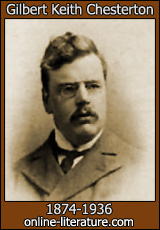
Gilbert Keith Chesterton
G.K. Chesterton was born in London into a middle-class family on May 29, 1874. He studied at University College and the Slade School of Art (1893-96). Around 1893 he had gone through a crisis of skepticism and depression and during this period he experimented with the Ouija board and grew fascinated with diabolism. In 1895 Chesterton left University College without a degree and worked for the London publisher Redway, and T. Fisher Unwin (1896-1902). Chesterton later renewed his Christian faith; the courtship of his future wife, Frances Blogg, whom he married in 1901 also helped him to pull himself out of his spiritual crisis.
In 1900 appeared Greybeards At Play, Chesterton's first collection of poems. Robert Browning (1903) and Charles Dickens (1906) were literary biographies. The Napoleon Of Notting Hill (1904) was Chesterton's first novel, a political fantasy, in which London is seen as a city of hidden fairytale glitter. In The Man Who Was Thursday (1908) Chesterton depicted fin-de-siècle decadence.
In 1909 Chesterton moved with his wife to Beaconsfield, a village twenty-five miles west of London, and continued to write, lecture, and travel energetically. Between 1913 and 1914 Chesterton was a regular contributor for the Daily Herald. In 1914 he suffered a physical and nervous breakdown. After World War I Chesterton became leader of the Distributist movement and later the President of the Distributist League, promoting the idea that private property should be divided into smallest possible freeholds and then distributed throughout society..
In 1922 Chesterton was converted from Anglicanism to Roman Catholicism, and thereafter he wrote several theologically oriented works, including lives of Francis of Assisi and Thomas Aquinas. He received honorary degrees from Edinburgh, Dublin, and Notre Dame universities. Chesterton died on June 14, 1936, at his home in Beaconsfield.
The above biography is copyrighted. Do not republish it without permission.
Forum Discussions on Gilbert Keith ChestertonRecent Forum Posts on Gilbert Keith Chesterton
Please submit a quiz here.
Here is where you find links to related content on this site or other sites, possibly including full books or essays about Gilbert Keith Chesterton written by other authors featured on this site.
Sorry, no links available.

G.K. Chesteron - a forefather of steam-punk?
I have been reading a steam-punk novel called The Affinity Bridge by George Mann. It is not great literature, but the imagery is good. One of the plot strands revolves around mechanized men, termed 'automatons' - note, not robots. That reminded me of a Father Brown story in which there was a shop full of automatons. In The Man Who Was Thursday there are episodes reminiscent of steam-punk. In one chapter, a secret policeman is sitting down at a table in a tavern, when the whole table descends into an underground system of tunnels. Even without this science fiction stuff, the Edwardian era, when, I guess, Chesterton wrote much of the best stuff, was one in which there was an inte...
Posted By kev67 in Chesterton, Gilbert Keith || 2 Replies
Orwell's criticism of Chesterton
I have recently read two George Orwell essays which criticized G.K. Chesterton. Both essays were superb btw. In his essay Antisemitism in Britain , he accuses Chesteron of antisemitism. In another, Notes on Nationalism, he accuses him of uncritically lavishing Latin countries, such as Italy and France, with the sort of jingoistic praise he would have been embarrassed to hear about his own country. Orwell supposed that his motive in both cases was his support for the Catholic church. Chesterton was not the only writer or thinker that Orwell criticizes, but I am not very familiar with many of the others. I am not entirely surprised. The impression I get is that G.K. Chesteron ...
Posted By kev67 in Chesterton, Gilbert Keith || 1 Reply
G.K. Chesterton - any good?
I have recently started reading some Father Brown stories. I am sorry to say, so far, I am not too bowled over. Father Brown seems to be one in the history of eccentric detectives, this time a Roman Catholic priest. The crimes are flashy but improbable. A puzzle is outlined and we all wait around until Father Brown clears it up for us. No attempt is made to get under his skin of the characters. The Wire, it is not. It is a bit like Sherlock Holmes or Agatha Christie, but not as good. I will continue reading them, but I was a bit disappointed. I wondered whether Father Brown was typical of Chesterton's writing. I noticed one of G.K. Chesterton's books being promoted in a branch of Wate...
Posted By kev67 in Chesterton, Gilbert Keith || 20 Replies
Christmas
Hi there, in his article "Christmas", Chesterton includes this rather obscure paragraph: Another instance of the same illogicality I observed the other day at some kind of "At Home." I saw what appeared to be a human being dressed in a black evening-coat, black dress-waistcoat, and black dress-trousers, but with a shirt-front made of Jaeger wool. What can be the sense of this sort of thing? If a man thinks hygiene more important than convention (a selfish and heathen view, for the beasts that perish are more hygienic than man, and man is only above them because he is more conventional), if, I say, a man thinks that hygiene is more important than convention, what on earth is there to oblige...
Posted By Juan in Chesterton, Gilbert Keith || 0 Replies
A Christmas Carol poem by G.K.Chesterton
The Christ-child lay on Mary's lap, His hair was like a light. (O weary, weary were the world, But here is all aright.) The Christ-child lay on Mary's breast His hair was like a star. (O stern and cunning are the kings, But here the true hearts are.) The Christ-child lay on Mary's heart, His hair was like a fire. (O weary, weary is the world, But here the world's desire.) The Christ-child stood on Mary's knee, His hair was like a crown, And all the flowers looked up at Him, And all the stars looked down...
Posted By jigz in Chesterton, Gilbert Keith || 0 Replies
Chesterton - Therefore your doom is on you
Hello "Therefore your doom is on you, Is on you and your kings" From which works of Chesterton?...
Posted By konohazuku in Chesterton, Gilbert Keith || 3 Replies
Missing works
I'm a fan of G.K. Chesterton as an author, and searched for several works of his which returned no results. To wit: Heretics, Orthodoxy, Eugenics and Other Evils, and probably more. The reason I think these are interesting is because of the apparent recursive recapitulation of History in the nature of events which men choose to manage in order to dispose of their responsibilities. These dispositions have tended to separate individuals on more than mere personal issues, but rather on moral issues affecting the innocent and the experienced. It seems Mr. Chesterton has sufficient nails on his literary fingers to dig into the oily skin of reptillian hypocrites.:)...
Posted By hillhopper in Chesterton, Gilbert Keith || 1 Reply
Post a New Comment/Question on Chesterton