
Subscribe for ad free access & additional features for teachers. Authors: 267, Books: 3,607, Poems & Short Stories: 4,435, Forum Members: 71,154, Forum Posts: 1,238,602, Quizzes: 344
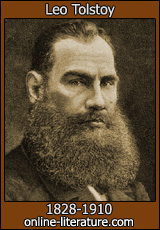
Leo Tolstoy
Leo Tolstoy (1828-1910), Russian author, essayist and philosopher wrote the epic novel War and Peace (1865-69),
Man in connection with the general life of humanity appears subject to laws which determine that life. But the same man apart from that connection appears to be free. How should the past life of nations and of humanity be regarded—as the result of the free, or as the result of the constrained, activity of man? That is a question for history. (Epilogue 2, Ch. VIII)
Anonymously narrated, the novel is set during the Napoleonic wars, the era which forms the backdrop of Tolstoy’s painstakingly detailed depiction of early 19th century Tsarist Russia under Alexander I: her archetypes and anti-heroes. Through his masterful development of characters Pierre, Andrew, Natasha, Nicholas, Mary and the rest, War and Peace examines the absurdity, hypocrisy, and shallowness of war and aristocratic society. It all comes to a climax during the Battle of Borodino. Initially Tolstoy’s friends including Ivan S. Turgenev and Gustave Flaubert decided that the novels’ ‘formlessness’ weakened the overall potential for its success, but they were soon proved wrong. Almost one hundred years after his death, in January of 2007, Tolstoy’s Anna Karenina (1878) and War and Peace were placed on Time magazine’s ten greatest novels of all time, first and third place respectively.
Childhood: days of idyll, Moscow and Kazan University
Lev Nikolayevich Tolstoy was born on 28 August 1828 into a long line of Russian nobility. He was the fourth child of Countess Maria Volkonsky (who Tolstoy does not remember, as she died after giving birth to his sister Mariya in 1830) and Count Nicolay Ilyich Tolstoy (1797-1837) a Lieutenant Colonel who was awarded the order of St. Vladimir for his service. At the age of sixteen he had fathered a son with a servant girl, Leo’s half-brother Mishenka. When Count Tolstoy resigned from his last post with the Military Orphanage, a marriage was arranged between him and Maria Volkonsky. After her death the Count’s distant cousin Tatyana Aleksandrovna Yergolskaya ‘Aunt Tatyana’, who already lived with them helped him in running the household, raising the children and overseeing their tutoring. Leo’s paternal grandfather Count Ilya Andreyevich Tolstoy (d.1820) had been an overly generous and trusting man; by the time Leo was born the Tolstoy fortunes had dwindled and the newlyweds settled at the Volkonsky family estate ‘Yasnaya Polyana’ (meaning ‘Clear Glade’) located in Tula Region, Shchekino District of central Russia. Leo’s maternal great grandfather Prince Nikolas Sergeyevich Volkonsky had established it in the early 1800s; upon his death his daughter Countess Volkonsky inherited it. It is now preserved as a State Memorial and National Preserve.
From Leo’s Introduction to biographer Paul Birukoff’s Leo Tolstoy: Childhood and Early Manhood (1906) we gather the very clear and fond memories he has of his early years and his loved ones: my father never humbled himself before any one, nor altered his brisk, merry, and often chaffing tone. Count Tolstoy was a gentle, easy going man. Quick to tell a joke, he was reluctant to mete out corporal punishment that was so common at the time to the hundreds of serfs on their estate. He disliked wolf-baiting and fox-hunting, preferring to ride in the fields and forests, or walking with his children and their pack of romping greyhounds. Leo recounts outings with his siblings, friends, and paternal grandmother Pelageya Nikolayevna Tolstoy (d.1838) to pick hazelnuts; she seemed a dreamy magical figure to him. Sometimes he spent the evening in her bedroom while their blind story-teller Lev Stepanovich narrated lengthy, enchanting tales.
Leo greatly admired his oldest brother Nikolay ‘Koko’ (1823-1860). In recollecting their childhood Leo revered him, along with his mother, as saintly in their modesty, humility, and unwillingness to condemn or judge others. His other siblings were Sergey (b.1826), Dmitriy (1827-1855) and Mariya (b1830). The Tolstoy House was a bustling household, often with extended family members and friends visiting for dinner or staying for days at a time. The children and adults played Patience, the piano, put on plays, sang Russian and Gypsy folk songs and read stories and poetry aloud. A voracious reader, Leo would visit his father in his study as he read and smoked his pipe. Sometimes the Count would have young Leo recite memorised passages from Alexander Pushkin. The family home still contains the library of over twenty thousand books in over thirty languages. When not indoors, there was no shortage of outdoor activities for the children: tobogganing in winter, horseback riding, playing in the orchards, forests, formal gardens, greenhouses and bathing in the large pond which Leo loved to do all his life.
Days in the country however were to come to an end when, in 1836, the Tolstoys moved to Moscow so that the boys could attend school. The following summer Count Tolstoy died suddenly. He was buried at Tula. Leo had a hard time accepting this inevitability of life; the loss of his father was a profound experience to such a young boy and as he watched his beloved grandmother Pelageya (who died two years later) suffer through her grief, he had his first spiritual questionings. His father’s sister, Countess Aleksandra Osten Saken ‘Aunt Aline’ became the children’s guardian and Nikolay and Sergey stayed with her in Moscow while Leo and his sister Mariya and Dmitriy moved back to Yasnaya Polyana to live with Aunt Tatyana.
When Aunt Aline died in 1841, Leo, now aged thirteen traveled with his brothers to Kazan where their next guardians lived, Aunt and Uncle Yushkof. Despite the pall of death, loss of innocence and upheavals in living arrangements, Leo started preparations for the entrance examinations to Kazan University, wanting to enter the faculty of Oriental languages. He studied Arabic, Turkish, Latin, German, English, and French, and geography, history, and religion. He also began in earnest studying the literary works of English, Russian and French authors including Charles Dickens, Nikolai Vasilievich Gogol, Mikhail Lermontov, Jean Jacques Rousseau, Laurence Sterne, Friedrich Schiller, and Francois-Marie Arouet Voltaire.
Boyhood: military service and first writings
In 1844, at the age of sixteen and the end of what Tolstoy says was his childhood, and the beginning of his youth, he entered the University of Kazan to study Turco-Arabic literature. While he did not graduate beyond the second year (he would later attempt to study law) this period of his life also corresponded with his coming out into society. He and his brothers moved out of their uncle’s home and secured their own rooms. No longer the provincial, there were balls and galas to attend and other such manly pursuits as drinking, gambling and visiting brothels. Tolstoy did not have much success as a student, but he would become a polyglot with at least some working knowledge of a dozen languages. He did not respond to the universities’ conventional system of learning and left in 1847 without obtaining his degree.Back at Yasnya Polyana and during the next few years Tolstoy agonized about what next to do with his life. He expressed his aspirations, confusion and disappointments in his diary and correspondence with his brothers and friends. He attempted to set the estates’ affairs in order but again was caught up in the life of a young nobleman, travelling between the estate and Moscow and St. Petersburg. He was addicted to gambling, racking up huge debts and having to sell possessions to pay them off including parts of his estate. He would go on drinking binges, associating with various characters of ill-repute that his Aunt Tatyana repeatedly warned him about. To her and a few other confidantes he often confessed his remorse when sober and wrote in his diary; I am living a completely brutish life….I have abandoned almost all my occupations and have greatly fallen in spirit. (ibid, Ch. VI) He took to wearing peasant clothes including a style of blouse that would later be named after him, ‘tolstovkas’. He again attempted university exams in the hope that he would obtain a position with the government, but also pondered the alternative, to serve in the army.
When his brother Nikolay, who was now an officer in the Caucasian army, came to visit Yasnya Polyana for a short while, Tolstoy seized the opportunity to change his life. In the spring of 1851 they left for the Caucasus region at the southern edge of Russia. The unglamorous nomadic life they led, travelling through or staying in Cossack and Caucasian villages, meeting the simple folk who populated them, exalting in the mountainous vistas, and meeting the hardy souls who traversed and defended these regions left their indelible mark on Tolstoy. Having long corresponded with his Aunts, he now turned his pen to writing fiction. The first novel of his autobiographical trilogy Childhood (1852) was published in the magazine Sovremennik which would serialise many more of his works. It was highly lauded and Tolstoy was encouraged to continue with Boyhood (1854) and Youth (1857), although, after his religious conversion he admitted that the series was insincere and a clumsy confusion of truth with fiction (ibid, Introduction).
In 1854, during the Crimean War Tolstoy transferred to Wallachia to fight against the French, British and Ottoman Empire to defend Sevastapol. The battle inspired Sevastopol Sketches written between 1855 and 1856, published in three installments in The Contemporary magazine. In 1855 he left the army, the same year he heard about his brother Dmitry’s illness. He arrived at his beside just before he succumbed to tuberculosis, the same disease to take his brother Nikolay’s life on 20 September 1860. Again Tolstoy was in limbo, torn between his ‘unrestrained passions’ and setting forth a realistic plan for his life. He had tried unsuccessfully to educate the hundreds of muzhiks or peasants who tended his fields, founding a school for the children in the family estate’s Kuzminsky House, but it proved to be frustrating and ultimately unsuccessful. He set off on travels throughout Western Europe. By this time Childhood had been translated to English and Tolstoy was a well-known author, enjoying a Counts’ life as a bachelor. When he was unable to pay a gambling debt of 1,000 rubles to publisher Katkov, incurred while playing billiards with him, Tolstoy relinquished his unfinished manuscript of The Cossacks which was printed as-is in the January 1863 issue of the magazine The Russian Messenger. Again Tolstoy vacillated between bouts of sobriety and debauch;
I put men to death in war, I fought duels to slay others. I lost at cards, wasted the substance wrung from the sweat of peasants, punished the latter cruelly, rioted with loose women, and deceived men. Lying, robbery, adultery of all kinds, drunkenness, violence, and murder, all were committed by me, not one crime omitted, and yet I was not the less considered by my equals to be a comparatively moral man. Such was my life for ten years. (ibid, Ch. VI)
At times in these dark days he turned to the figure of his mother and all the good she represented and to which he aspired, for;
Such was the figure of my mother in my imagination. She appeared to me a creature so elevated, pure, and spiritual that often in the middle period of my life, during my struggle with overwhelming temptations, I prayed to her soul, begging her to aid me, and this prayer always helped me much. (ibid, Introduction)
But times were to change and things were soon to rapidly settle: Tolstoy fell in love.
Youth: marriage, children, War and Peace and Anna Karenina
In September of 1862, at the age of thirty four, Tolstoy married the sister of one of his friends, nineteen year old Sofia ‘Sonya’ Andreyevna Behrs (b.1844). Their children were: Sergey (b.1863), Tatiana (b.1864), Ilya (b.1866), Leo (b.1869), Marya ‘Masha’ (1871-1906), Petya (1872-1873), Nicholas (1874-1875), unnamed daughter who died shortly after birth in 1875, Andrey (b.1877), Alexis (1881-1886), Alexandra ‘Sasha’ (b.1884), and Ivan (1888-1895).
Wanting her to understand everything about him before they married, Tolstoy had given Sonya his diaries to read. Even though she consented to marriage it took her some time to get over the initial shock of their content. However, the tension and jealousy they sparked between them never clearly dissipated. In other matters Countess Tolstoy proved helpful to her husband’s writing career: she organised his rough notes, copied out drafts, and assisted with his correspondence and business affairs of the estate. Thus Tolstoy plunged into his writing: he started War and Peace in 1862 and its six volumes were published between 1863 and 1869. Listless and depressed even though it was met with much enthusiasm, Tolstoy travelled to Samara in the steppes where he bought land and built an estate he could stay at in the summer.
He started writing his next epic Anna Karenina with the opening line that gloomily alluded to his own life Happy families are all alike; every unhappy family is unhappy in its own way in 1873. The first chapters appeared in the Russian Herald in 1876. The same year it was published in its entirety, 1878, Count Tolstoy suffered the most intense bout of self-doubt and spiritual introspection yet; he became depressed and suicidal; his usually rational outlook on life became muddled with what he thought was a morally upright life as husband and father. He harshly examined his motives and criticised himself for his egotistical family cares….concern for the increase of wealth, the attainment of literary success, and the enjoyment of every kind of pleasure (ibid, Intro.).
So Tolstoy wrote his Confessions (1879) and began the last period of my awakening to the truth which has given me the highest well-being in life and joyous peace in view of approaching death. (ibid) A number of his non-fiction articles and novels outlining his ideology and harshly criticising the government and church followed including “The Census in Moscow”, A Criticism of Dogmatic Theology (1880), A Short Exposition of the Gospels (1881), What I Believe (1882), What Then Must We Do? (1886), and On Life and Death (1892). The Death of Ivan Ilych (1886), his drama The Power of Darkness (1888), The Kreutzer Sonata (1890), Father Sergius (written between 1890-98), Hadji Murad (written between 1896 and 1904), The Young Czar (1894), What Is Art? (1897), The Forged Coupon (1904), Diary of Alexander I (1905), and The Law of Love and the Law of Violence (1908) were also written around this time. With the publication of Resurrection (1901) Tolstoy was excommunicated by the Russian Orthodox Church; but his popularity with the public was unwavering. Tolstoy the author now had a large following of disciples devoted to ‘Tolstoyism’.
Conversion and Last Years
Tolstoy’s main follower was a wealthy army officer, Vladimir Chertkov (1854-1910). Sonya would soon be caught in a bitter battle with him for her husband’s private diaries. Having embraced the pacifist doctrine of non-resistance as per the teachings of Jesus outlined in the gospels, Tolstoy gave up meat, tobacco, alcohol and preached chastity. He wrote The Kingdom of God Is Within You (1893), titled after Luke’s Gospel in the New Testament. When Mahatma Gandhi read it he was profoundly moved and wrote to Tolstoy regarding the Passive Resistance movement. They started a correspondence and soon became friends. Tolstoy wrote “A Letter to a Hindu” in 1908. Admiring their ideals of a simple life of hard work, living off the land and following the teachings of Jesus, Tolstoy offered his friendship and moral and financial support to the Doukhobors. A Christian sect persecuted in Russia, many Tolstoyans assisted them in their mass emigration to Canada in 1899. Tolstoy was involved with many other causes including appealing to the Tsar to avoid civil war at all costs. In 1902 he moved back to Yasnya Polyana.
In January of 1903, as he writes in his diary, Tolstoy still struggled with his identity: where he had come from and who he had become;
I am now suffering the torments of hell: I am calling to mind all the infamies of my former life—these reminiscences do not pass away and they poison my existence. Generally people regret that the individuality does not retain memory after death. What a happiness that it does not! What an anguish it would be if I remembered in this life all the evil, all that is painful to the conscience, committed by me in a previous life….What a happiness that reminiscences disappear with death and that there only remains consciousness
The ruminations were prompted by his friend Paul Biryukov asking him for his assistance in penning his biography. His literary executor Chertkov would write The Last Days of Leo Tolstoy (1911). For as the last days of Tolstoy were playing out, he still at times agonised over his self-worth and regretted his actions from decades earlier. Having renounced his ancestral claim to his estate and all of his worldly goods, all in his family but his youngest daughter Alexandra scorned him. He was intent on starting a new life and did so on 28 October 1910, making it as far as the stationmaster’s home at the Astapovo train station. Leo Tolstoy died there of pneumonia on 20 November 1910. Although he wanted no ceremony or ritual, thousands showed up to pay their respects. He was buried in a simple wooden coffin near Nikolay’s ‘place of the little green stick’ by the ravine in the Stary Zakaz Wood on the Yasnya Polyana estate; returned to that place of idylls where Nikolay told him one could find the secret to happiness and the end to all suffering.
Biography written by C. D. Merriman for Jalic Inc. Copyright Jalic Inc. 2007. All Rights Reserved.
The above biography is copyrighted. Do not republish it without permission.
Forum Discussions on Leo TolstoyRecent Forum Posts on Leo Tolstoy
Please submit a quiz here.
Here is where you find links to related content on this site or other sites, possibly including full books or essays about Leo Tolstoy written by other authors featured on this site.

Happy Birthday!
Check out Google to see a slide slow for Tolstoy today. Yes, I know it's late but nonetheless, Happy Birthday Lev!...
Posted By redfox1111 in Tolstoy, Leo || 0 Replies
Two Hussars (Two Jacks) Movie
I just found out about this movie on a magazine. It's directed by Bernard Rose, who directed some other Tolstoy adopted movies including my favorite Ivansxtc. Is there anyone who have been able to watch this movie? If so, what do you think of it? The only thing I know is that its trailer looks great. https://www.facebook.com/twojacksfilm?fref=ts www.youtube.com/watch?v=LwtVEnRMzUM...
Posted By hhsevis in Tolstoy, Leo || 0 Replies
War and Peace/Napoleon
I'm just about finished with War and Peace and have found it to quite possibly be the best book I've ever read. I especially enjoy Tolstoy's takes on both Napoleon and Kutuzov. I was wondering what biographies on Napoleon would be worth taking a look at and if any of them share the same view on him as Tolstoy did. I'd also be interested in books on just the invasion of Russia. I really don't know that much about Napoleon but from just some brief searches on the internet, it seems many still regard Napoleon as a military genius; is this what the academic community believes today? I felt Tolstoy makes a good case that he shouldn't be thought of in such high regard and he really makes you like...
Posted By jthix in Tolstoy, Leo || 0 Replies
Source of the text
Hi, First post here, and looking for a source of a quote attributed to Tolstoy. I came across the following text in an old 1950-ish book, which only mentioned Tolstoy's name next to the quote without any references. Since the book itself had questionable content (WWII propaganda) I was wondering if the text is genuine, and if it is, what is the source? There is a yellowish grey wolf, who, winters, joins the pack, roaming the icy tundras of Siberia, sparing neither man, animal, nor child. In the heat of the summer, however, when the brush is dry and lifeless, he crawls into the peasant's back yard, licking his hand, whining for food. Such is the nature of man and the brevi...
Posted By parrhesiastes in Tolstoy, Leo || 0 Replies
What do you think of the cast of Anna Karenina (2012)?
http://www.online-literature.com/forums/showthread.php?t=63470...
Posted By kelby_lake in Tolstoy, Leo || 2 Replies
Indifferent to Tolstoy: What's Wrong With Me?
Now, I've read a smattering of Tolstoy - several of the short stories and War and Peace - and from the first I found myself indifferent. It's not that I find him boring. I read, engaged, but am not really affected. It's obviously good writing. No doubts there. At times Tolstoy is philosophically profound too. Still, I just finish with a shrug. So, what's wrong with me? (I generally like Russian literature by the way. Dostoevsky is one of my favourite novelists, Gogol makes me laugh, Chekhov plays appeal to me . . . )...
Posted By Climacus in Tolstoy, Leo || 19 Replies
need help...
i just finish read "an old acquaintance" this is embarrassing :blush2: i couldnt understand what this story want to tell me, is Guskov lie to prince nekhiludof or idk...why prince nekhiludof hide when guskov shouting in the from of his tent...please anyone help me to get me understand this....thank you...
Posted By annie_we in Tolstoy, Leo || 0 Replies
Reminiscences of Tolstoy
Anna Karenina is one of the best books I have ever read. Recently I also read "Reminiscences of Tolstoy" (published by Sparkling Books). It's a biography written by his son Ilya Tolstoy. I really enjoed it: it reveals very interesting details of Toltoy's personality. For example it seems that Tolstoy's wife has written passages of Anna Karenina and corrected her husband's grammar....
Posted By Laura00 in Tolstoy, Leo || 0 Replies
Learning the Russian language...
Does anyone know of a good program or set of books that would work well for learning Russian? I intend to apply myself and become an advanced reader of the language. Reasonably priced systems would be appreciated, but please recommend all. I am pursuing this field of study due to the fact that I generally cannot stand translated literature. Also, I'm new to the forums and I would simply like to say hello to everyone!...
Posted By < James Joyce in Tolstoy, Leo || 6 Replies
Help - quote!
Hello, lads! I am writing paper for my university (civil engineering) and I want to quote Tolstoy, but I am not sure from where is it: Anna Karenina or War and Peace (probably W&P), others are excluded surely. Quote goes something like: When two are in fight/quarrel, they are always both wrong. I've tried boolean search, but nothing comes up. I can write that it's from W&P, but it just wouldn't be fair :D Thanks!...
Posted By bazarov in Tolstoy, Leo || 1 Reply
Name of book by leo
Main character name is illiana and she goes to monk named Rasputin for advice or something and he molest the women. I thought the book name was "love and war" but there is no such book by Leo. And the character is not even mentioned in War and Peace. Plz help. Thxx...
Posted By Midniter in Tolstoy, Leo || 0 Replies
Ana Karenina
Everyone, please read this book, it holds a deep moral to it; if you get deep into what you arereading, this is the book for you!!! :D...
Posted By LiteratureGeekk in Tolstoy, Leo || 6 Replies
Post a New Comment/Question on Tolstoy