
Subscribe for ad free access & additional features for teachers. Authors: 267, Books: 3,607, Poems & Short Stories: 4,435, Forum Members: 71,154, Forum Posts: 1,238,602, Quizzes: 344
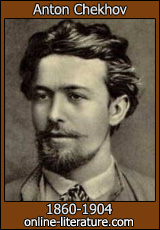
Anton Chekhov
Anton Chekhov (1860-1904), Russian physician, renowned short story author and playwright wrote Uncle Vanya (1899);
We must live our lives. Yes, we shall live, Uncle Vanya. We shall live through the long procession of days before us, and through the long evenings; we shall patiently bear the trials that fate imposes on us; we shall work for others without rest, both now and when we are old; and when our last hour comes we shall meet it humbly, and there, beyond the grave, we shall say that we have suffered and wept, that our life was bitter, and God will have pity on us. Ah, then dear, dear Uncle, we shall see that bright and beautiful life; we shall rejoice and look back upon our sorrow here; a tender smile--and--we shall rest. I have faith, Uncle, fervent, passionate faith. We shall rest. We shall hear the angels. We shall see heaven shining like a jewel. We shall see all evil and all our pain sink away in the great compassion that shall enfold the world. Our life will be as peaceful and tender and sweet as a caress. I have faith; I have faith.--Sonia, Act I
Often ambiguous, at times humorous, gritty, haunting, ironic, anecdotal, facetious, lyrical, apathetic, bizarre, passionate and tragic, Chekhov's works explore the entire range of the human spirit. Through his use of such Chekhovian elements as subjective observation, stream of consciousness, character epiphanies, and juxtapositions of pessimism and humour we are immersed in the lives of Chekhov's complex characters. He spurned the more traditional story as moral lesson found in the style of Fyodor Dostoevsky. He wanted his works to ask the reader questions, not to provide answers. While he started out with more comedic sketches and doggerel published under pseudonyms such as Antosha Chekhonte, Chekov went on to write dozens of stories, many critically acclaimed as fine exemplars of the craft and still studied today. His autobiographical journey as seen through the eyes of a child "The Steppe" earned him the Pushkin Prize in 1888. His works have inspired countless contemporary authors and playwrights including George Bernard Shaw, James Joyce, Raymond Carver, Ernest Hemingway, and Virginia Woolf. Chekhov's plays are said to be second only to those of William Shakespeare in stage popularity.
Anton Pavlovich Chekhov was born on 29 January 1860 in the port town of Taganrog (at the northern tip of the Black Sea between Ukraine and Russia) in Rostov Oblast, Southern Russia, the third of six children born to Yevgenia Yakovlevna Morozov, daughter of a well-traveled cloth merchant and Pavel Yegorovitch (1825-1898), a grocer. Their home is now a museum. Anton's grandfather had been a serf who worked on the estate of Vladimir Grigorievitch Tchertkov before buying his own freedom in 1841.
Growing up in a middle-class family on the shores of the Sea of Azov in pre-Revolution Russia, Anton and his sister and five brothers went fishing, played tennis, and spent leisurely days in the country at their grandfather's. A great lover of nature, young Anton was robust with activity and intelligence, always making jokes, affectionate and playful with his siblings. They also worked hard in their father's shop (now a museum, the "Chekhov Shop") where Anton collected memories and ideas for future stories based on the people he met there. He studied music and was a voracious reader, spending afternoons at the Taganrog town library (now named after him). For many years until his death he sent books to be added to its collections. He read literature and the Greek classics including Homer, and also works by Miguel de Cervantes, Ivan Goncharov, William Shakespeare, Ivan Turgenev and Uncle Tom's Cabin by Harriet Beecher Stowe. A French governess taught the children languages. To add to his already vivid imagination, Anton's nurse entertained the children with fantastical tales while their mother told them of her travels around the world with her father as a young girl. "Our talents we got from our father, but our soul from our mother." (from The Letters of Anton Chekhov, translated by Constance Clara Garnett, 1861-1946). Anton's father, born into serfdom, had a great love for music. He was a very strict, religious man but they were a close-knit family, sharing evenings after school singing, playing musical instruments, and singing in the church choir and attending Mass on Saturday evenings and Sunday mornings.
Taganrog was a bustling port and trading town until the railway was built. By the year 1867 Pavel had hit financial ruin. He closed the shop, their home and contents were auctioned off and the family moved to Moscow to start over. Anton stayed in Taganrog to continue his studies at the high school, paying his way by tutoring. In 1879 he joined his family in Moscow and entered the University of Moscow to study medicine. He graduated in 1884 and practiced medicine for the rest of his life. His family were then living in the town of Voskresensk, outside of Moscow. Anton joined them but soon moved to a town close by called Zvenigorod where he met fellow doctor Upensky and practiced medicine. The family's financial struggles continued but the ever-humble Anton became a great support to his family, as a doctor and as a freelance writer. "Medicine is my lawful wife and literature is my mistress. When I get tired of one I spend the night with the other." (letter to Alexei Suvorin, 11 September 1888.)
These years of living in the country again became fruitful for Chekhov: he had a strict schedule of writing but also had time for a social life; he became acquainted with numerous literary and artistic people of the day including Leo Tolstoy, Aleksandr Ivanovich Kuprin and Maxim Gorky. He wrote many stories during this time and his first drama Ivanov (1887) which he wrote in two weeks. Chekhov always delighted in being in the country with family and friends, spending time outdoors canoeing, fishing, gardening and talking about literature. It served his imagination well and also helped him focus on his writing. But despite his cheerful and outgoing demeanour he was suffering from onset of tuberculosis. It did not stop him however from traveling throughout Europe and Russia, including an arduous 6,500 mile journey to the island of Sakhalin or Sahalin to study the Tsar's penal colony there and the brutal conditions suffered by the 10,000 imprisoned. His report on his journey across Siberia and extensive three month research and census of the peoples of the island "enough for three dissertations" (letter to Alexei Suvorin, 27 September 1890) was published as The Island of Sakhalin in 1890. His story "In Exile" (1892) was also inspired by this experience. Chekhov also traveled frequently to Moscow and St. Petersburg visiting friends and overseeing the production of his plays. The death of his brother Nikolay, while under his care and who died of tuberculosis inspired his "A Dreary Story" ("A Boring Story" or "A Dull Story", 1889).
In the late 1880's Chekhov established his own country estate of Melikhovo (now a museum) where the rest of his family joined him. He also worked arduously as a doctor to help those far and wide against the cholera epidemic. His home was always full of visitors and the sick were welcomed while Chekhov himself continued to downplay his own illness. With seeming unending amouts of energy and lust for life, he had numerous philanthropic projects to take care of while he continued to write plays, many of them performed in Moscow's Art Theatre. On 25 May 1901 Chekhov married Olga Knipper (1868-1959) an actress who starred in many of his plays. They settled at Chekhov's new estate in Autka, Yalta. With increasing health problems, Chekhov continued to travel, seeking healthier climates. But after such a short life of giving so selflessly to others, at the age of forty-four Chekhov died while staying at a spa in the Black Forest. He died in Badenweiler, Germany on 2 July, 1904. He was buried in the family plot in Moscow's Novodevichy Cemetery next to the convent. Many famous Russians are buried there including musical composer Sergei Prokofiev, poet Vladimir Mayakovsky, and writers Mikhail Bulgakov and Nikolai Vasilievich Gogol. In honour of Chekhov in 1954 the formerly named town of Lopasnya (after the Lopasnya Rive), was re-named in Chehov's honour. The town of Chekhov, administrative center Chekhovsky District is located in Moscow Oblast, Russia. Among the many monuments dedicated to Chekhov worldwide stands an impressive bronze statue in Chekhov Square in Taganrog.
Along with his prolific output of letters to friends and family and his four most popular plays The Seagull (1894), Uncle Vanya (1899), The Three Sisters (1900) and The Cherry Orchard (1903), further works by Chekhov include his plays;
The Boor or The Bear (1881),
That Worthless Fellow Platonov (1881),
On the Harmful Effects of Tobacco (1886),
Swansong (1887),
Ivanov (1887),
A Marriage Proposal (1888),
The Wedding (1889),
The Wood Demon (1889),
A Tragedian in Spite of Himself or A Reluctant Tragic Hero (1889),
The Festivities (1891),
Peasants (1897), and
Gooseberries (1898).
Biography written by C. D. Merriman for Jalic Inc. Copyright Jalic Inc. 2014. All Rights Reserved.
The above biography is copyrighted. Do not republish it without permission.
Forum Discussions on Anton ChekhovRecent Forum Posts on Anton Chekhov
Here is where you find links to related content on this site or other sites, possibly including full books or essays about Anton Chekhov written by other authors featured on this site.
Sorry, no links available.

Questions about Chekhov
Does anyone have some recommendations for Chekhov stories? I recently read "The Lady with the Little Dog," and I really enjoyed it. Are there any stories similar to that one? Thanks for your help! Bookworm3.14...
Posted By Bookworm3.14 in Chekhov, Anton || 0 Replies
The Kiss
recently I have read the kiss by Chekhov. it was both interesting and boring in my opinion. it was nice because there was a big suspense in the story. from the begging to the end you wanted to know who kissed him, in the other hand he explained a lot and make the story so long that i got tired and a little angry. actually most of Chekhov works are like that for example the diary of a teacher is the same. the story somehow had some unnecessary events that really made me to leave the story. it could be shorter than that. i can say that he talked until he was blue in the face. but generally the story was nice, but i prefer the bet i think the bet was more interesting than the kiss. what is ...
Posted By mohammadali in Chekhov, Anton || 1 Reply
Critical Analysis of Chekhov's Works
Hello, I'm researching the development of realism in the 19th century and Chekhov profoundly furthered its progression. However, I am currently trying to find how his medical background influenced his realistic writing. I'm also trying to locate some primary sources to cite. Any help would be greatly appreciated!!...
Posted By vanderj2 in Chekhov, Anton || 0 Replies
Naive Chekhov Reader
Ok, so don't pelt me with stones. I've heard of Chekhov but I simply haven't been engaged much in reading lately. So I have bought a book of selected stories by Anton Chekhov. The titles are: Overseasoned The Night before Easter At Home Champagne The Malefactor Murder Will Out The Trousseau The Decoration The Man in a Case Little Jack Dreams The Death of an Official Agatha The Beggar Children The Troublesome Guest Not Wanted The Robbers Lean and Fat On the Way The Head Gardener's Tale Hush! Without a Title In the Ravine I must admit, I like how Chekhov plunges straight into a story, without any real deliberation. Bang! first couple of lines and I'm already in...
Posted By Delta40 in Chekhov, Anton || 8 Replies
How Does Chekhov Compare to Other Russian Authors?
I realize this is kind of an open ended question; however, as a person that has read some Tolstoy and a good portion of Dostoevsky how does Chekhov compare? What are his important themes that he tends to address? Thanks :)...
Posted By Lionheart in Chekhov, Anton || 6 Replies
Looking for "The Bride"/ "Betrothed"/"The Fiancee"
Hello, (I just registered here and this is my first post. Hi!) So, I just finished a book called Forty Stories by Anton Chekhov, translated by Robert Payne. Well, in reality, I didn't quite finish it: I returned it to the library before I finished the last story. I figured I could find it online and read off the screen. Robert Payne translated the title as "The Bride"; however, Wikipedia has it listed as "Betrothed ." I have not been able to locate it under any of those names. Hopefully you can help. One more little clue: It was published...
Posted By Abras in Chekhov, Anton || 0 Replies
Anton's "A Problem" Reviews?
I need a few reviews on his short story, "A Problem." so if anyone could elaborate on their feelings after reading "A Problem" It would be much appreciated! Thanks in advance!...
Posted By meredith in Chekhov, Anton || 1 Reply
About Love
About Love is seriously neglected when it comes to simple discussion and literary criticism. If someone would kindly enlighten me as to why Chekhov's other stories take precedent over and above About Love? I know so little about About Love and would like more insight into the characters and shape of this much-ignored short story. Mostly I am coming to know the characters through Gooseberries and The Man in A Case. I believe Gooseberries is the first story and The Man in A Case is the second story with About Love completing the little Trilogy, is this correct? Meanwhile it's great to see so many like-minded persons interested in Chekhov. I hope you will welcome and bear with me while...
Posted By Kalavorakh in Chekhov, Anton || 1 Reply
Recordings of Chekhov Stories and Plays?
As a daily commuter with a newly gifted iPod, I'd like to begin listening to the great wealth of Chekhov's works. (Who has time to read these days!?) There seem to be almost too many audiobook collections to choose from, with a lot of duplication. I'd be interested in hearing any recommendations on what people have found worthwhile. Thank you....
Posted By sakalin in Chekhov, Anton || 0 Replies
"The Lady with the Pet Dog" Discussion
I know this was discussed already in the 'Chekhov Short Story Thread', but after just having read it, I would like to open another discussion of the story. Anyone interested, perhaps?...
Posted By Dori in Chekhov, Anton || 0 Replies
Good intro. to Chekhov??
I've read some stories by Chekhov in the past (a very long time ago), but I never really took to them. However, I've heard enough raving about Chekhov on this site, that I would like to try to revisit his work. Does anyone have recommendations on where I should start? What stories/novels do you consider to be particularly good representations of his work? Thanks for your help....
Posted By K.K. in Chekhov, Anton || 3 Replies
Chekhov Short Story Quotes
I have a few great Chekhov quotes in a notebook and have no clue what stories they are from. I know by the notebook that they are from his stories, not his plays. The variations in translations makes this more difficult. Perusing his collections has yielded nothing so far. Similiarly, all internet searches came up dry. Some of the passages were more or less obvious, particularly ones with key details and words/phrases that jogged my memory. Here are a few tough ones: “I’m surrounded by nothing but vulgarity, nothing but boring, insignificant people, pots of sour cream, jugs of milk, cockroaches, stupid women... There’s nothing more terrible, more damaging to one’s pride, more depres...
Posted By donkeygospel in Chekhov, Anton || 0 Replies
Post a New Comment/Question on Chekhov