
Subscribe for ad free access & additional features for teachers. Authors: 267, Books: 3,607, Poems & Short Stories: 4,435, Forum Members: 71,154, Forum Posts: 1,238,602, Quizzes: 344
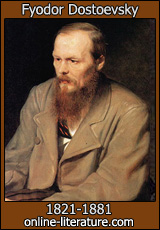
Fyodor Dostoevsky
Dostoevsky was born in Moscow, as the second son of a former army doctor. He was educated at home and at a private school. Shortly after the death of his mother in 1837 he was sent to St. Petersburg, where he entered the Army Engineering College. In 1839 Dostoevsky's father died probably of apoplexy but there were strong rumors that he was murdered by his own serfs. Dostoevsky graduated as a military engineer, but resigned in 1844 to devote himself to writing. His first novel, Poor Folk appeared in 1846. It was followed by The Double, which depicted a man who was haunted by a look-alike who eventually usurps his position.
In 1846 he joined a group of utopian socialists. He was arrested in 1849 and sentenced to death. The sentence was commuted to imprisonment in Siberia. Dostoevsky spent four years in hard labor and four years as a soldier in Semipalatinsk.
Dostoevsky returned to St. Petersburg in 1854 as a writer with a religious mission and published three works that derive in different ways from his Siberia experiences: The House of the Dead, (1860) a fictional account of prison life, The Insulted and Injured, which reflects the author's refutation of naive Utopianism in the face of evil, and Winter Notes on Summer Impressions, his account of a trip to Western Europe.
In 1857 Dostoevsky married Maria Isaev, a 29-year old widow. He resigned from the army two years later. Between the years 1861 and 1863 he served as editor of the monthly periodical Time, which was later suppressed because of an article on the Polish uprising.
In 1864-65 his wife and brother died and he was burdened with debts, and his situation was made even worse by gambling. From the turmoil of the 1860s emerged Notes from the Underground, psychological study of an outsider, which marked a watershed in Dostoevsky's artistic development. The novel starts with the confessions of a mentally ill narrator and continues with the promise of spiritual rebirth. It was followed by Crime and Punishment, (1866) an account of an individual's fall and redemption, The Idiot, (1868) depicting a Christ-like figure, Prince Myshkin, and The Possessed, (1871) an exploration of philosophical nihilism.
In 1867 Dostoevsky married Anna Snitkin, his 22-year old stenographer, who seems to have understood her husband's manias and rages. They traveled abroad and returned in 1871. By the time of The Brothers Karamazov, which appeared in 1879-80, Dostoevsky was recognized in his own country as one of its great writers.
An epileptic all his life, Dostoevsky died in St. Petersburg on February 9, 1881. He was buried in the Aleksandr Nevsky monastery, St. Petersburg.
The above biography is copyrighted. Do not republish it without permission.
Forum Discussions on Fyodor DostoevskyRecent Forum Posts on Fyodor Dostoevsky
- Quiz: Dostoevsky's The Idiot: 10 questions
- Quiz: Fyodor Dostoevsky's Works: 20 Questions
- Quiz: Dostoevsky's Crime and Punishment: 10 questions
- Quiz: Dostoevsky: 14 Questions
- Quiz: Dostoevsky's Poor Folk: 20 Q's
- Quiz: Dostoevsky's The Brothers Karamazov: 20 Questions
- Quiz: Dostoevsky's Notes From The Underground: 20 Questions
Please submit a quiz here.
Here is where you find links to related content on this site or other sites, possibly including full books or essays about Fyodor Dostoevsky written by other authors featured on this site.
Sorry, no links available.

The Crocodile- Dostoevskys satyrical side
A very funny video based on Dostoevskys short story "The Crocodile": https://www.youtube.com/watch?time_continue=6&v=JEFu34g2CZk...
Posted By Danik 2016 in Dostoevsky, Fyodor || 0 Replies
Ranking of Dostoevskij novels
Hi, I`m thinking about reading some Dostoevskij novels. It would be nice if some people could share their personal ranking of the Dostoevskij novels or could give some reasons why to read a specific novel. :) Greetings, Benjy...
Posted By Benjy in Dostoevsky, Fyodor || 44 Replies
Was Dostoevsky a poor stylist?
Was Fyodor Dostoevsky, the great Russian author and master, a bad stylist? The thought often comes up in some circles that, while Dostoevsky was a genius when it came to creating great stories and rich characters, he was a bad stylist, and some who read Russian have claimed that Dostoevsky was a sloppy stylist and that his real genius was in storytelling and characterization rather than in style (another of the "storytelling vs style" issues). However, there are also those who argue that while his style is flawed, it's actually genius due to its handle of polyphony, its convulsive tone, its raw passion. Richard Pevear, one of the most respected translators of Russian literature, had this...
Posted By ajvenigalla in Dostoevsky, Fyodor || 1 Reply
Translations of Dostoyevsky
I am reading Crime and Punishment for the third time but this time in German translation from the old Piper Verlag edition of the 1920's. The novel is called Raskomlikov and not Crime and Punishment. It has started me thinking about all the translations of Dostoyevsky in different languages and how different translations can affect one's view of any great writer. My initial impression (only an impression-I have made no scientific comparison of specific extracts yet) at the moment is that the characters in the German version do not seem to be not quite so mad and peremptory as they appear in the two English translations and the characters are easier to identitfy and remember! I cannot say why...
Posted By Yorick Jenkins in Dostoevsky, Fyodor || 0 Replies
Question about a quote!
Hello my friends. I would like to ask you from which book is a quotation related to the no existence of time. There is a discussion between two people and one of them asks the other why he has a watch that is broken. The other answers that time does not exist. Thank you in advance for your answer!...
Posted By lio13 in Dostoevsky, Fyodor || 0 Replies
Dostoevsky's question...
Does anyone have an answer? =) Don't you think there are many more men in the world thieves than not thieves, and that there isn't a man in the world so honest that he has never once in his life stolen anything? That's my idea, from which I don't conclude, however, that all men are thieves; though, goodness knows, I've often been tempted to. What do you think? #The Idiot - Fyodor Dostoevsky...
Posted By Nazish in Dostoevsky, Fyodor || 9 Replies
Notes From Underground Translations
For a while now I have been wanting to get more into Russian literature, particularly Dostoevsky and Tolstoy. All I have read before is Crime and Punishment, which I very much want to read again. I have been a little anxious, if truth be told, about finding the right translations of these works. I read all the translation threads that show up on the forums, and I recognize that there will never be a perfect solution to this problem besides learning Russian (or any other language) So, to try to compare for myself, I just read two different translations of Notes From Underground back to back. First I read the Pevear/Volokhonsky version, then Garnett. The differences I n...
Posted By KilgoreT in Dostoevsky, Fyodor || 0 Replies
Dostoevsky and beauty
One thing i remember noticing in Dostoevsky's work is that he appears to have at the same time a pre-occupation with beauty, and also one which is not analysed at all. Some examples of beauty playing a part in his characters: Raskolnicov is described as very beautiful. I always thought that he made it that way so as to have the readers avoid some explanation of his misery by means of frustration with women. In the "pitiful tale" there is a character who is almost only described as "very good looking boy". He acts in an angelic way. The narrator of The Underground introduces himself by claiming he is repulsive (i trust physically as well as ethically). In the vast ocean of his wo...
Posted By Kyriakos in Dostoevsky, Fyodor || 2 Replies
Non Volokhonsky/Pevear translations?
The couple have translated 9 novels * The Brothers Karamazov (1990) * Crime and Punishment (1992) * Notes from Underground (1993) * Demons (1994) * The Eternal Husband and Other Stories (1997) * The Idiot (2002) * The Adolescent (2003) * The Double (2005) * The Gambler (2005) But what about the 6 novels the pair haven't translated, can anyone assist me with recommendations for the best English translations for the following 6 Dostoevsky novels (if there is a English translation available)? 1846 Poor Folk (also called Poor People) short novel 1849 Netochka Nezvanovna medium novel 1859 The Uncle's Dream [/...
Posted By DonovanTalbot in Dostoevsky, Fyodor || 2 Replies
The Eternal Husband
What are we to make of the ending of this novella? The Eternal Husband, a late work of Dostoevsky, alludes to an affair a decade earlier between Velchaninov and a married woman, the siren Natalia, and the subsequent relationship between the man and her husband, Pavel Pavlovich, who knowingly has brought along 'his' young daughter, Liza, almost certainly a product of the affair. Every scene starts with Velchaninov, and none ends before he and Pavel Pavlovich interact. We tend to see the action though Velchaninov's eyes, but Pavel Pavlovich viewpoint is perhaps the more fascinating. Towards the end, can we assume that Pavel Pavlovich, having returned Liza to her genetic fath...
Posted By Gladys in Dostoevsky, Fyodor || 4 Replies
Best Book- in your opinion, of course
I finished reading Crime and Punishment a few months ago, and I really liked it. Maybe because the main character was the perfect portrayal of someone who is somewhat crazy and incredibly sad(I know, he acted just like my dad). Maybe because poor people are exemplified. Maybe because I could relate a little bit to the plot. Maybe because many of the characters(Porfiry, Raskolnikov, Sonya, Marmelodov, Svidrigailov) were very interesting to me. Maybe just because it was a good book. So anyway, I want to know what is considered Dostoyevsky's greatest work, so that I don't read it yet. I don't want to read it because I think it must be the greatest work in all of literature, and I don't want to ...
Posted By Oniw17 in Dostoevsky, Fyodor || 7 Replies
My Island; Crime & Punishment vs. Brothers Karamazov
A wee bit of a confessional here folks. I was more moved by C&P than BK. There, I've said it. Hardly the most intimate of feelings, yet I do feel as if I've been stranded on a bit of an island for the aforementioned opinion. Perhaps defining 'moved' would be apropos. C&P is hardly uplifting, yet I'd be remiss to not extol its visceral virtues. I've never felt such sheer intensely for the written word as I have than when I'd been tugged inside the tormented mind of Raskolnikov. His narrowed world was such a dizzying, unrelenting one, and one of the least pleasurable ones to boot. While literature at its finest can be provocative and pleasurable, the frenetic tone & depth to this story...
Posted By Brad Coelho in Dostoevsky, Fyodor || 5 Replies
Post a New Comment/Question on Dostoevsky