
Subscribe for ad free access & additional features for teachers. Authors: 267, Books: 3,607, Poems & Short Stories: 4,435, Forum Members: 71,154, Forum Posts: 1,238,602, Quizzes: 344
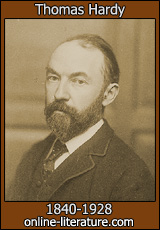
Thomas Hardy
Thomas Hardy (1840-1928), English poet and author of the naturalism movement wrote Jude the Obscure (1895);
What brains they must have in Christminster and the great schools, he presently thought, to learn words one by one up to tens of thousands! .... he wished he had never seen a book, that he might never see another, that he had never been born.Somebody might have come along that way who would have asked him his trouble, and might have cheered him by saying that his notions were further advanced than those of his grammarian. But nobody did come, because nobody does; and under the crushing recognition of his gigantic error Jude continued to wish himself out of the world.--Ch. 4
and Tess of the d'Urbervilles (1891);
Moreover she, and Clare also, stood as yet on the debatable land between predilection and love; where no profundities have been reached; no reflections have set in, awkwardly inquiring, "Whither does this new current tend to carry me? What does it mean to my future? How does it stand towards my past?"--Ch. 20
Tess and Jude received many criticisms upon publication, for in examinations of the fallen woman, sin, the class system, and the vagaries of religion and marriage,--".... a marriage should be dissolvable as soon as it becomes a cruelty to either of the parties--being then essentially and morally no marriage...." they shocked Hardy's Victorian readers' sensibilities. His tragic characters lives' earned the labels "immoral" and "obscene". Hardy muses in his Preface to the 1912 edition of Jude about a bishop who burnt a copy of his book "probably in his despair at not being able to burn me." The controversy drew much attention to the novels as well, and they were soon being read in Europe and North America, although Hardy never wrote another; he turned his pen to plays and poetry instead.
Hardy's fictional Wessex is based upon the environs where he grew up and loved so much and where he lived and worked for a large part of his life; he always had a dream to be a poet and was well connected emotionally to his environment through interaction and observation, but the more practical occupation of architect and the experience of travelling and working on various restoration projects allowed him time to pen some of the most notable contributions to 20th Century literature. Inspiring many other authors including Virginia Woolf and D.H. Lawrence, many of Hardy's works have been adapted to the stage and screen are still widely read.
Thomas Hardy was born on 2 June 1840 in the village of Higher [Upper] Bockhampton in Stinsford parish near the town of Dorchester in Dorset County, England, the first of four children born to Jemima nee Hand (1814-1904) and Thomas Hardy Sr. (1811-1892), builder and stonemason. His birthplace, built by his great grandfather, is now a museum owned by the National Trust. Young Thomas was given to quieter childhood pursuits, often spending time alone wandering the countryside, exploring the flora and fauna, gaining a profound connection with nature and the familiar sights and sounds of his rural home county. His mother had a great influence on his imagination, entertaining him with stories and songs, many of which would later inspire his Wessex tales.
As a young boy Hardy attended the Stinson church with his family, was a voracious reader, learned to play the violin and attended local schools studying Latin, Greek, French, classical literature, and assisted his father in his various building projects. At the age of sixteen he was taken on as apprentice to John Hicks, an architect in Dorchester. He conducted surveys and excelled as draughtsman, working for Hicks until 1862 when he left for London to work with architect Arthur Blomfield. Around this time he met Henry Moule (1801-1880) who would become a friend and mentor. He also immersed himself in the city's vibrant literary and cultural atmosphere, studying art, visiting the National Gallery, attending the theatre, and writing prose and poetry. His first published story "How I Built Myself A House" appeared in Chamber's Journal in 1865. His wrote his first, but never published novel The Poor Man and the Lady in 1867. Back in Bockhampton due to ill-health he secured a position with Hicks where in 1870 he met Emma Lavinia Gifford (1840-1912). She was working at the rectory in St. Juliot, Cornwall, a building project he was working on. They married in London in 1874 and would have no children. Emma died suddenly on 27 November 1912.
Hardy worked on his next novel Desperate Remedies (1871);
In the long and intricately inwrought chain of circumstance which renders worthy of record some experiences of Cytherea Graye, Edward Springrove, and others, the first event directly influencing the issue was a Christmas visit.--Ch. 1
which was followed by Under the Greenwood Tree (1872) and A Pair of Blue Eyes (1873). After the success of Far From the Madding Crowd (1874) Hardy turned to writing full time. Now living in London and frequenting the Saville Club, he continued his prodigious output; The Trumpet Major (1880) was followed by A Laodicean (1881), The Romantic Adventures of a Milkmaid (1883), Our Exploits At West Poley (1883), The Mayor of Casterbridge (1886), and The Woodlanders (1887). In 1885 he had designed and built his cottage "Max Gate" in Dorchester (now a museum owned by the National Trust); it would provide a quiet haven where he wrote some of his most enduring classics; Tess of the d'Urbervilles (1891), Life's Little Ironies (1894), Jude the Obscure (1895), Two on a Tower (1895), The Return of the Native (1895), The Hand of Ethelberta (1895), A Group of Noble Dames (1896), and A Changed Man and Other Tales (1913). After the storm of controversy surrounding Tess and Jude he tried his hand at plays including The Dynasts (1904), The Well-Beloved (1912), Human Shows (1925), and Winter Words (1928). He also found time for that which he is not so well-known today, poetry, published in such collections as Wessex Poems and Other Verses (1898), Poems: 1912-1913, Moments of Vision (1917), and Late Lyrics and Earlier (1922).
In 1914 Thomas married his secretary, Florence Emily Dugdale (1879-1937) who would later publish The Early Life of Thomas Hardy, 1840-1891 and The Later Years of Thomas Hardy, 1892-1928 (1930). Thomas Hardy was bestowed many honours during his lifetime, including being nominated President of the Society of Authors in 1909; the Order of Merit from King George V in 1910; the Gold Medal from the Royal Society of Literature in 1912; an honorary degree from Cambridge University, and an honorary fellowship of Magdalene College, Cambridge. He died at his home Max Gate in Dorchester on 11 January 1928; his heart is buried in the cemetery of St. Michael's Church in Stinsford, Dorset, where Emma and Florence also now rest and his ashes were interred in Poet's Corner of Westminster Abbey, London, England.
The poetry of motion is a phrase much in use, and to enjoy the epic form of that gratification it is necessary to stand on a hill at a small hour of the night, and, having first expanded with a sense of difference from the mass of civilised mankind, who are dreamwrapt and disregardful of all such proceedings at this time, long and quietly watch your stately progress through the stars. After such a nocturnal reconnoitre it is hard to get back to earth, and to believe that the consciousness of such majestic speeding is derived from a tiny human frame.--Far From the Madding Crowd, Ch. 2
Biography written by C. D. Merriman for Jalic Inc. Copyright Jalic Inc. 2008. All Rights Reserved.
The above biography is copyrighted. Do not republish it without permission.
Forum Discussions on Thomas HardyRecent Forum Posts on Thomas Hardy
Here is where you find links to related content on this site or other sites, possibly including full books or essays about Thomas Hardy written by other authors featured on this site.

Thomas Hardy's influence on pulic houses
Taken with my not very good camera phone yesterday at a local pub. Aldbrickham is Thomas Hardy's name for Reading. Neither the barman or the two locals knew anything about it, but the landlady did know the Hardy connection. It's a beer award for beer in the wood, whatever that is. 8922 The locals told me the pub had another tenuous claim to fame. The widow of ex-soccer legend Robin Friday worked there as barmaid till recently. There was a biography written of Robin Friday called The Greatest Footballer You Never Knew....
Posted By kev67 in Hardy, Thomas || 6 Replies
Hardy's revisions of his books
I was bothered to find that Hardy seems to have revised his novels quite radically after they had first been published. It is understandable that he might wish to restore his stories to how he originally meant them to be, after they had first been published serially in magazines. Magazine publishers would often want to censor anything that might be controversial. In a way, serialization in magazine format is like one media and book form another. You would not expect a film adaption to be exactly like the book. However the problem is that between one edition of one of his books and another there can be significant changes. The book I am thinking of in particular is Tess of the d'Urberville...
Posted By kev67 in Hardy, Thomas || 2 Replies
Which of Hardy's minor novels is the best?
I reckon into the major category we can lump: Tess, Jude, Far From The Madding Crowd, The Mayor of Casterbridge, The Return of the Native. Which of Hardy's obscurer novels is the best?...
Posted By kelby_lake in Hardy, Thomas || 0 Replies
Who were Hardy's constituency?
Hardy doesn't make many compromises. For a start, he writes sad stories. He peppers his chapters with religious and classical references that you presumably would have needed a private education to appreciate, and also a lot of obscure latinate words, yet also a lot of West Country diaiect that you'd need to be country person to know. His writing is sympathetic to working country people, but I doubt most of them would have been able to understand his work. I have heard that Dickens' stories could be seen being read by butcher's boys, well not Hardy's. In Tess of the d'Urbervilles he wrote a chapter in which Tess kills some pheasants that had spent the night in pain after being injured by a s...
Posted By kev67 in Hardy, Thomas || 1 Reply
Reasons for liking Hardy
I am a member of a running club. One evening we listened to a guest speaker who had written a book about her experiences running around the world (all the way). One of my clubmates bought a copy. When I asked her about it later, she said it was alright, but that she had been reading Thomas Hardy recently and the quality of writing suffered by comparison. I thought it was interesting that she liked Thomas Hardy. Later it occurred to me that this clubmember had been a shop steward, was a feminist, and a local, standup poet. Hardy seems very sympathetic to working class men and women at the wrong end of power relationships. He was a renowned poet too. The fact this club member spends a lot of ...
Posted By kev67 in Hardy, Thomas || 11 Replies
Hardy's place names
Why did Hardy decide to rename most the towns and cities in south-west England? Looking at the map at the front of my copy of Tess, I notice even Reading, the town where I live, seems to have been re-named Aldbrickham. That seems to be a reference to one of Reading's previous industries - bricks. Reading used to be known for the 3B's: bulbs, bricks and biscuits. Of the other nearby towns, Oxford seems to have been renamed Christminster. Wantage seems to have been renamed Alfredston, probably after Alfred the Great, who is said to be born there. Windsor has been renamed Castle Royal. I guess Quartershot is Aldershot, while Kennetbridge is Newbury. I wouldn't like to say for sure where Gay...
Posted By kev67 in Hardy, Thomas || 5 Replies
Thomas Hardy: Aye or Nay?
Let's discuss....
Posted By Scheherazade in Hardy, Thomas || 23 Replies
New amateur here
Just found the site and have a couple of poems I have written, currently working ( very slowly ) on a novel, really like to be able to say I have written one. Anyway...... Hidden Love She has great magic within her control, to make me smile and feel so full of glee, yet says that I have set her spirit free. I have no true power over her soul, my feelings for her have no hidden goal. It’s hard to hide and surely all can see that my lonely heart grows inside of me. Her love has made me feel that I am whole. The future is not for us to yet know, so we steal our moments and live in them. From these stolen times forbidden hopes stem and we fearfully ask “Can this love grow...
Posted By Strongman in Hardy, Thomas || 2 Replies
Was Thomas Hardy really a poet or a novelist?
Thomas Hardy really was a poet. But when he began to write poems in 1862, there were nobody to read them. Therefore, to attract an audience and to gain a good financial position he began to write novels with a determination. As he was trained as an architect in his life and pursued this profession for 11 years till he abandoned it in 1873, he showed the same skill in building his plots which made Under the Greenwood Tree, A Pair Of Blue Eyes, Far From The Maddening Crowd, The Return Of The Native, The Trumpet-Major, Two On A Tower and The Mayor Of Caster bridge unforgettable successes. The money gained thus from his novels made his life successful and this architect built a beautiful home fo...
Posted By PSRemeshChandra in Hardy, Thomas || 5 Replies
Thomas Hardy Poetry
For AS Level, we had to study Thomas Hardy's poetry in a lot of depth, and I must admit, though we found the poet himself interesting, the poetry lacked something. I found quite a few of them very pessimistic. Most of them full of doubt, cynicism. They got even worse after 1912, when his wife, Emma died. I mean it's understandable to be pretty distraught when suffering a loss like that, but he wrote so many poems depicting his own guilt (they weren't speaking much to each other, and he didn't believe she was that ill), which, to some extent is quite sweet, but to some, it seems a little over the top, and very depressing. I will say something for Hardy,...
Posted By BookWorm_x in Hardy, Thomas || 2 Replies
themes of Thomas Hardy`s novels.
could anyone give me some instructions?...
Posted By la-vier in Hardy, Thomas || 18 Replies
Help with: She, to Him; by Thomas Hardy (1840-1928)
Good morning everybody, I don't know if I am posting on the right forum, so I am sorry if it is not the case. Also sorry for my bad English, French is my first language but I fell in love with British and American poetry so I try to read, analyse a lot of them. I have been trying to understand this poem for more than 10 days, but I can't see the deep meaning, the structure, or the images used here. I don't get the references. Every line is a mytery to me. I've done searches on the author, nothing helped me. And I really want to understand. Here you are the poem: When you shall see me in the toils of Time, My lauded beauties carried off from me, My eyes no longer star...
Posted By antoine in Hardy, Thomas || 4 Replies
Post a New Comment/Question on Hardy