
Subscribe for ad free access & additional features for teachers. Authors: 267, Books: 3,607, Poems & Short Stories: 4,435, Forum Members: 71,154, Forum Posts: 1,238,602, Quizzes: 344
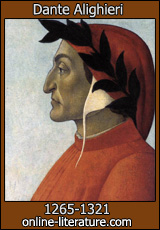
Dante Alighieri
Dante Alighieri (1265-1321), Italian poet wrote La Divina Commedia (The Divine Comedy), his allegory of life and God as revealed to a pilgrim, written in terza rima; Inferno (Hell), Purgatorio (Purgatory), and Paradiso (Paradise), written between 1307 and 1321.
The dates of when Dante’s works were written are inexact and many are unfinished, although there is no doubt that Dante is known as the source of modern Italian. Inspired by Virgil and Aristotle and inspiring other such poets as Geoffrey Chaucer and William Blake, Dante has affected a profound influence on numerous poets, playwrights, and authors right into the 21st century.
Although his exact birth date is not known, Dante Alighieri was born in Florence, Italy in the year 1265. His mother Donna Gabriella degli Abati died when he was very young. His father was Alighiero di Bellincione Alighieri, a notary from a family loyal to the Guelphs. The Guelphs supported the Papacy, while the other predominant family of the neighboring area in Tuscany, the Ghibellines, supported the German emperor, thus spurring many power struggles between the two.
It is said that Dante fought with the Guelphs as a cavalryman in the battle of Campaldino (1289), referred to in Purgatorio, which led to the defeat of the Ghibellines. The constitution of the Republic of Florence was reformed and around 1295 it was necessary for Dante to matriculate into the Guild of Physicians and Apothecaries in order to be active in government affairs as diplomat and magistrate. However by 1300 the Guelphs were themselves bitterly divided into two factions, Bianchi and Neri, the Black Guelphs and the White Guelphs. When the Black Guelphs seized power in Florence, all White Guelphs were banished in 1302, including Dante, with the threat of being burned alive if he ever returned.
Dante had married Gemma di Manetto Donati, with whom he had four children; Jacopo, Pietro, Giovanni and Antonia. Gemma remained in Florence after his exile. Years before his marriage it is said that Dante had fallen in love with Beatrice Portinari (d.1290) the young woman in his autobiographical Vita nuova (c1293) (The New Life);
“At that very moment, and I speak the truth, the vital spirit, the one that dwells in the most secret chamber of the heart, began to tremble so violently that even the most minute veins of my body were strangely affected; and trembling, it spoke these words: Ecce deus fortior me, qui veniens dominabitur michi.”
Dante traveled throughout Italy, for a time a guest of Malaspina, and there is some evidence that he also visited Paris and England. De vulgari eloquentia (1304) (On the Eloquence of Vernacular), though unfinished, is Dante’s Latin treatise on and support of the use of the vernacular in poetry. Convivio (c1304) (The Banquet) is a philosophical treatise;
“Since knowledge is the ultimate perfection of our soul, in which resides our ultimate happiness, we are all therefore by nature subject to a desire for it.” —Canto I
Dante’s autobiographical Inferno contains one of the most detailed and influential literary descriptions of Hell. Descending into a dark wood where the sun is silent and sinful temptations abound, he is guided by Virgil through the nine circles of Hell, the Gates which read;
“Through me the way is to the city dolent;
Through me the way is to eternal dole;
Through me the way among the people lost.
Justice incited my sublime Creator;
Created me divine Omnipotence,
The highest Wisdom and the primal Love.
Before me there were no created things,
Only eterne, and I eternal last.
All hope abandon, ye who enter in!” —Canto III
Having survived the torments of Hell Dante and Virgil set out for Purgatorio, ascending its mountain and seven terraces representing the Seven Deadly Sins. Beatrice joins him and together they journey through the nine spheres of Paradiso which ends;
“ But my own wings were not enough for this,
Had it not been that then my mind there smote
A flash of lightning, wherein came its wish.
Here vigour failed the lofty fantasy:
But now was turning my desire and will,
Even as a wheel that equally is moved,
The Love which moves the sun and the other stars.” —Canto XXXIII
De Monarchia (On Monarchy) (c1317) is Dante’s treatise on the relationship between Church and Empire;
“It is indeed an arduous task, and one beyond my strength, that I embark on, trusting not so much in my own powers as in the light of that Giver who "giveth to all men liberally, and upbraideth not”.—Canto I
Dante Alighieri died when living in the city of Ravenna in central Italy in 1321.
Biography written by C.D. Merriman for Jalic Inc. Copyright Jalic Inc. 2006. All Rights Reserved.
The above biography is copyrighted. Do not republish it without permission.
Forum Discussions on Dante AlighieriRecent Forum Posts on Dante Alighieri
Please submit a quiz here.
Here is where you find links to related content on this site or other sites, possibly including full books or essays about Dante Alighieri written by other authors featured on this site.

How does Dante's language compare to modern Italian
I am slowly reading through Inferno in the Penguin Kirkpatrick version which give the Italian text in parallel with the English translation. I know enough Italian to order a pizza and know which words in Dante correspond to the translation, but not enough to feel how different the grammar and the language are from modern Italian. I can read Chaucer, but I'm aware that it is not modern English. Because I don't really know modern Italian, I am not aware that Dante isn't modern, but clearly he isn't. Does a modern Italian reader find Dante's language as archaic as a modern English reader finds Chaucer?...
Posted By Jackson Richardson in Alighieri, Dante || 8 Replies
Just some reflections
Man, I just finished reading The Divine Comedie for the first time. Although, truth be told I read the "Inferno" a long time ago, when I was really too young to get much of it. Anyway, I was really surprised with how much I enjoyed the Purgatorio. It was by far my favorite section of the three major divisions of the poem. Maybe it was because it used the seven deadly sins as divisions, maybe it was that it was the section where Dante, the narrator himself, was most noticablly altered by the events in the poem, maybe it was the assent to Eden, the conversations with the most worldly of sins, maybe it was the idea of redemption or purging of sin, . . . . but I was just...
Posted By The Comedian in Alighieri, Dante || 1 Reply
Purgatorio a Let Down
Note: The thread title is supposed to read "Paradiso a Let Down." My mistake. I'm continuing this conversation from another thread (the list the books you read this year thread), where the following conversation has started, and since not everyone sees that thread, I thought I'd make this so maybe we can get input on some of the Dante scholars we have on this board. 7. Inferno by Dante -- 9/10. I love hell, so I loved this. A must read if there ever was one. 8. Purgatorio by Dante -- 8/10. Not as enjoyable a read as Inferno. 13. Paradiso by Dante -- 7/10. Just couldn't get into it. The 7 is mostly for the beautif...
Posted By Mutatis-Mutandis in Alighieri, Dante || 6 Replies
Would YOU Do It?
Would do go through all of what Dante did? I would. I asked my dad, who read the book in high school and is a fan of it, he said absolutely not. I would. I would have a man that died about 100-200 years ago guide me through it, I don't know who though. I don't know why I would like to, for some reason it just interests me to go through it myself. Then, of course, end up in Heaven (Paradise) at the end of the journey. What about you?...
Posted By misterreplicant in Alighieri, Dante || 5 Replies
Best Edition of "Divine Comedy"?
I have heard that Mandelbaum's prose translation of Divine Comedy is probably the most reliable and safe choice (outside of Pinsky's version of Inferno...but he never completed the rest of the trilogy, so I am not considering that). I have also heard that it's good to read this poem in a facing-page version, where you have the Italian on one side of the page and the English translation on the other. I don't speak any Italian, but I am willing to try this out. I haven't seen any Mandelbaum versions that have this feature, however. Do you guys know of any? If you had to narrow it down to one version of the Divine Comedy for a beginner, what would it be? Something els...
Posted By Vladimir777 in Alighieri, Dante || 6 Replies
Original Italian
I am currently attempting to read this in the original tongue as I wish to study the terza rima as it was first penned and use it myself in my own personal poetry. My Italian is not terribly great, but I was wondering if anyone else out there had tried the same thing or is trying the same thing. Perhaps we might work on it together?...
Posted By isidro in Alighieri, Dante || 3 Replies
Why is Dante considered a great?
I don't want to seem like an ignorant teenager but I don't understand why Dante is considered as one of the 'greats'. Maybe I just read a bad translation but reading The Divine Comedy felt more like a chore than an enjoyable or enlightening read. :brickwall...
Posted By Homers_child in Alighieri, Dante || 24 Replies
Dantesque Movie Please
I think there should be some talented cinema director )it could be italian or american italian) could be doing a great movie by intance of Tha Divine Commedy. We are living turbulent times all sins are untied and shown.All crimes are justified ..all aberrations forgived...(by human justice) The Divine Commedy its about God Justice...understanding justice from an absolute perspective... misericordy isnt negligence... I would love to see a good movie inspired on Dantes ideas.the director could chose actors, the bests from all the countries...making universal casting to have only the best. Good brasilian, mexican, spanish, italian, greek,french, german,american a...
Posted By Ludmila607 in Alighieri, Dante || 12 Replies
Robin Kirkpatrick's translation of the Divine Comedy?
I have been meaning to read Dante's Divine Comedy for a good couple of years, and recently received the Inferno for Christmas. Anyway, the edition I have is the relatively new Penguin Classics edition translated by Robin Kirkpatrick. I was just wondering if anyone here had encountered this translation, and if it was good\bad in comparison to other translations. Anyway I’m off to begin the (rather long) introduction......
Posted By crjs1 in Alighieri, Dante || 0 Replies
Favorite Quotes from Dante's 'The Divine Comedy'
"Envy and Arrogance and Avarice Are the three sparks that have all hearts enkindled." (Canto VI, lines 74-75, page 33 "Lost are we, and are only so far punished, That without hope we live on in desire." (Canto IV, lines 41-42, page 20) Translation by Henry Wadsworth Longfellow...
Posted By HunterBrown1968 in Alighieri, Dante || 7 Replies
An English Translation Recommendation for 'La Divina Commedia'
I have hitherto perused both the Mendelbaum and the Carlyle-Wicksteed translations of 'La Divina Commedia'. The Mendlebaum translation is rather too modern and unpoetic for my fastidious self to ever relish. The Carlyle-Wicksteed translation, on the contrary, bears an essence that is far more antiquated (which I prefer), yet, is slightly more prosaic and less intelligible withal. Would anyone happen to know who penned the eldest translation of 'La Divina Commedia', and, moreover, the translation that may, to some degree, boast the following criteria: antiquated language, a semi-poetic essence, and, a pre-twentieth century production? Merci Grammaticus [/FO...
Posted By Grammaticus in Alighieri, Dante || 12 Replies
Should I read Virgil first?
I have all three part of the Divine Comedy in the John Cardi translation, and I have started the Inferno a couple of time a few years ago, but I have never finished it. I was wondering, should I read Virgil's Aeneid first?...
Posted By TrickyRick in Alighieri, Dante || 12 Replies
Post a New Comment/Question on Alighieri