 Subscribe for ad free access & additional features for teachers. Authors: 267, Books: 3,607, Poems & Short Stories: 4,435, Forum Members: 71,154, Forum Posts: 1,238,602, Quizzes: 344
-A Ballad to the tune of the Cutpurse
[1] WRITTEN IN AUGUST, 1702
IOnce on a time, as old stories rehearse, A friar would need show his talent in Latin; But was sorely put to 't in the midst of a verse, Because he could find no word to come pat in; Then all in the place He left a void space, And so went to bed in a desperate case: When behold the next morning a wonderful riddle! He found it was strangely fill'd up in the middle. CHO. Let censuring critics then think what they list on't; Who would not write verses with such an assistant?
II
This put me the friar into an amazement; For he wisely consider'd it must be a sprite; That he came through the keyhole, or in at the casement; And it needs must be one that could both read and write; Yet he did not know, If it were friend or foe, Or whether it came from above or below; Howe'er, it was civil, in angel or elf, For he ne'er could have fill'd it so well of himself. CHO. Let censuring, &c.
III
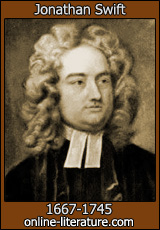
Even so Master Doctor had puzzled his brains In making a ballad, but was at a stand; He had mixt little wit with a great deal of pains, When he found a new help from invisible hand. Then, good Doctor Swift Pay thanks for the gift, For you freely must own you were at a dead lift; And, though some malicious young spirit did do't, You may know by the hand it had no cloven foot. CHO. Let censuring, &c.
[Footnote 1: Lady Betty Berkeley, finding the preceding verses in the author's room unfinished, wrote under them the concluding stanza, which gave occasion to this ballad, written by the author in a counterfeit hand, as if a third person had done it.--Swift.
The Cut-Purse is a ballad sung by Nightingale, the ballad-singer, in Ben Jonson's "Bartholomew Fair," Act III, Sc. I. The burthen of the ballad is:
"Youth, youth, thou had'st better been starv'd by thy nurse
Than live to be hang'd for cutting a purse."--W. E. B.]
| Art of Worldly Wisdom Daily In the 1600s, Balthasar Gracian, a jesuit priest wrote 300 aphorisms on living life called "The Art of Worldly Wisdom." Join our newsletter below and read them all, one at a time. |
Sonnet-a-Day Newsletter Shakespeare wrote over 150 sonnets! Join our Sonnet-A-Day Newsletter and read them all, one at a time. |
