Subscribe for ad free access & additional features for teachers. Authors: 267, Books: 3,607, Poems & Short Stories: 4,435, Forum Members: 71,154, Forum Posts: 1,238,602, Quizzes: 344
When We Dead Awaken
Original Norwegian title: Når vi døde vågner
(1899)
Translated and with an Introduction by Scottish critic and author William Archer (1856-1924).
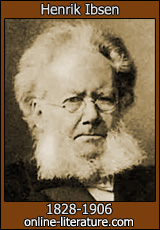
This is the last play written by Henrik Ibsen. It was published in December 1899. The first act takes place outside a spa overlooking a fjord. Sculptor Arnold Rubek and his wife Maia have just enjoyed breakfast and are reading newspapers and drinking champagne. They marvel at how quiet the spa is. Their conversation is lighthearted, but Arnold hints at a general unhappiness with his life. Maia also hints at disappointment. Arnold had promised to take her to a mountaintop to see the whole world as it is, but they have never done so.
The play is dominated by images of stone and petrification. The play charts a progression up into the mountains, and Rubek is a sculptor. One of Ibsen's most dreamlike plays, it is also one of his most despairing. "When we dead awaken," Irene explains, "we find that we have never lived." The play is suffused by an intense desire for life, but whether it can be achieved is left problematic, given the play's ironic conclusion (which is, incidentally, reminiscent of the first of Ibsen's two major verse dramas, Brand, and one of his last works in prose, The Master Builder. Some critics suggest that the dark romance in the play is based on sculptor Auguste Rodin's relationship with Camille Claudel.
Fan of this book? Help us introduce it to others by writing a better introduction for it. It's quick and easy, click here.
Recent Forum Posts on When We Dead Awaken
The nun who watches
Life's hard. Some like Irene and Rubek are drained empty in the midst of life. For these, authentic action may only be accessible in the jaws of death: by hypothermia or through an avalanche. But who is the nun uttering, "pax vobiscum"?
Please submit a quiz here.
Here is where you find links to related content on this site or other sites, possibly including full books or essays about Henrik Ibsen written by other authors featured on this site.
Sorry, no links available.