
Subscribe for ad free access & additional features for teachers. Authors: 267, Books: 3,607, Poems & Short Stories: 4,435, Forum Members: 71,154, Forum Posts: 1,238,602, Quizzes: 344
Emily Dickinson
About Our Emily Dickinson Collection
On the left you will find 3 poetry books published by Emily’s family after her death. Many in the academic community feel that these books were poorly edited and are not true to Dickinson’s vision. Regardless, these are the most familiar versions for the public at large, the versions most often taught in school. We have also listed some of her more popular poems individually. In total, our Emily Dickinson collection consists of over 400 poems.
Emily Dickinson Biography
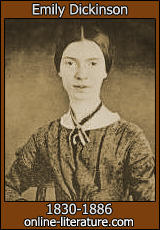
Emily Dickinson (1830-1886), ‘The Belle of Amherst’, American poet, wrote hundreds of poems including “Because I Could Not Stop for Death”, “Heart, we will forget him!”, “I'm Nobody! Who are You?”, and “Wild Nights! Wild Nights!”;
Wild Nights! Wild Nights!
Were I with thee,
Wild Nights should be
Our luxury!
Futile the winds
To a heart in port, --
Done with the compass,
Done with the chart!
Rowing in Eden!
Ah! the sea!
Might I but moor
To-night in Thee!
Among the ranks of other such acclaimed poets as Walt Whitman, Emily Dickinson is considered one of the most original 19th Century American poets. She is noted for her unconventional broken rhyming meter and use of dashes and random capitalisation as well as her creative use of metaphor and overall innovative style. She was a deeply sensitive woman who questioned the puritanical background of her Calvinist family and soulfully explored her own spirituality, often in poignant, deeply personal poetry. She admired the works of John Keats and Elizabeth Barrett Browning, but avoided the florid and romantic style of her time, creating poems of pure and concise imagery, at times witty and sardonic, often boldly frank and illuminating the keen insight she had into the human condition. At times characterised as a semi-invalid, a hermit, a heartbroken introvert, or a neurotic agoraphobic, her poetry is sometimes brooding and sometimes joyous and celebratory. Her sophistication and profound intellect has been lauded by laymen and scholars alike and influenced many other authors and poets into the 21st Century. There has been much speculation and controversy over details of Dickinson’s life including her sexual orientation, romantic attachments, her later reclusive years, and the editing and publication of various volumes of her poems. This biography serves only as an overview of her life and poetry and leaves the in-depth analysis to the many scholars who have devoted years to the study of Emily Dickinson, the woman and her works.
Emily Dickinson was born into one of Amherst, Massachusetts’ most prominent families on 10 December 1830. She was the second of three children born to Emily Norcross (1804-1882) and Edward Dickinson (1803-1874), a Yale graduate, successful lawyer, Treasurer for Amherst College and a United States Congressman. Her grandfather Samuel Fowler Dickinson (1775-1838) was a Dartmouth graduate, accomplished lawyer and one of the founders of Amherst College. He also built one of the first brick homes in the New England town on Main Street, which is now a National Historic Landmark ‘The Homestead’ and one of the now preserved Dickinson homes in the Emily Dickinson Historic District.
Emily had an older brother named William Austin Dickinson (1829-1895) (known as Austin) who would marry her most intimate friend Susan Gilbert in 1856. Her younger sister’s name was Lavinia ‘Vinnie’ Norcross Dickinson (1833-1899). The Dickinsons were strong advocates for education and Emily too benefited from an early education in classic literature, studying the writings of Virgil and Latin, mathematics, history, and botany. Until she was ten years old, she and her family lived with her grandfather Samuel and his family on Main Street. In 1840 they moved to North Pleasant Street, Emily’s window overlooking the West Street Cemetery where daily burials occurred. The same year, Emily entered Amherst Academy under the tutelage of scientist and theologian, Edward Hitchcock.
Dickinson proved to be a dazzling student and in 1847, though she was already somewhat of a ‘homebody’, at the age of seventeen Emily left for South Hadley, Massachusetts to attend the Mount Holyoke Female Seminary. She stayed there less than a year and some of the theories as to why she left are homesickness and poor health. Another reason some speculate is that when she refused to sign an oath publicly professing her faith in Christ, her ensuing chastisement from Mary Lyon proved to be too much humiliation. Back home in the patriarchal household of aspiring politicians, Emily started to write her first poems. She was in the midst of the college town’s society and bustle although she started to spend more time alone, reading and maintaining lively correspondences with friends and relatives.
In 1855 Emily and her sister spent time in the cities of Washington, D.C. and Philadelphia, Pennsylvania, the same year her father bought the Main Street home where she was born. He built an addition to The Homestead, replete with gardens and conservatory. Thereafter he held a yearly reception for Amherst College’s commencement, to which Emily made an appearance as the gracious hostess. In 1856 Emily’s brother, now himself a successful Harvard graduate and Amherst lawyer, married her best friend Susan Gilbert. They moved into their home nearby ‘The Evergreens’, a wedding gift from his father. They frequently entertained such guests as Ralph Waldo Emerson and Samuel Bowles III (1826-1878), journalist and editor of the Springfield Republican, who would publish a few of Emily’s poems and become a great friend to her and possible object of affection in some of her poems. In 1862 Dickinson answered a call for poetry submissions in the Atlantic Monthly. She struck up a correspondence with its editor, Thomas Wentworth Higginson. He had tried to correct her work, but she refused to alter it, though they soon became friends and it is speculated that Emily also had romantic feelings for him.
Dark times were soon to fall on Emily. In 1864 and 1865 she went to stay with her Norcross cousins in Boston to see an eye doctor whereupon she was forbidden to read or write. It would be the last time she ventured from Amherst. By the early 1870’s Emily’s ailing mother was confined to her bed and Emily and her sister cared for her. Around the time her father Edward died suddenly in 1874 she stopped going out in public though she still kept up her social contacts via correspondence, writing at her desk in her austere bedroom, and seemed to have enjoyed her solitude. She regularly tended the homestead’s gardens and loved to bake, and the neighborhood children sometimes visited her with their rambunctious games. In 1878 her friend Samuel Bowles died and another of her esteemed friends Charles Wadsworth died in 1882, the same year her mother succumbed to her lengthy illness. A year later her brother Austin’s son Gilbert died. Dickinson herself had been afflicted for some time with her own illness affecting the kidneys, Bright’s Disease, symptoms of which include chronic pain and edema, which may have contributed to her seclusion from the outside world.
‘Called Back’: Emily Dickinson died on 15 May 1886, at the age of fifty-six. She now rests in the West Cemetery of Amherst, Hampshire County, Massachusetts. Not wishing a church service, a gathering was held at The Homestead. She was buried in one of the white dresses she had taken to wearing in her later years, violets pinned to her collar by Lavinia.
Although many friends including Helen Hunt Jackson had encouraged Dickinson to publish her poetry, only a handful of them appeared publicly during her lifetime. Upon her death her sister Lavinia found hundreds of them tied into ‘fascicles’ stitched together by Emily’s own hand. Some were written in pencil, only a few titled, many unfinished. Lavinia enlisted the aid of Higginson and Mabel Loomis Todd to edit them and roughly arrange them chronologically into collections: Poems, Series 1 in 1890, Poems, Series 2 in 1891, and Poems, Series 3 in 1896. The edits were aggressive to standardise punctuation and capitalisation and some poems re-worded, but by and large it was a labour of love. From Thomas Wentworth Higginson's Preface to Poems, Series 1;
--flashes of wholly original and profound insight into nature and life; words and phrases exhibiting an extraordinary vividness of descriptive and imaginative power, yet often set in a seemingly whimsical or even rugged frame....the main quality of these poems is that of extraordinary grasp and insight.
In 1914 Emily’s niece Martha Dickinson Bianchi published another of the many collections to follow. Even with the first few volumes her work attracted much attention, though not without its critics. In 1892, Thomas Bailey Aldrich published a scathing review in the Atlantic Monthly; She was deeply tinged by the mysticism of Blake, and strongly influenced by the mannerism of Emerson....but the incoherence and formlessness of her—versicles are fatal. In 1955, Thomas H. Johnson published the first comprehensive collection of her poems in three volumes titled The Poems of Emily Dickinson, Including Variant Readings Critically Compared With all Known Manuscripts. Johnson’s The Letters of Emily Dickinson appeared in 1958.
This Is My Letter To The World
This is my letter to the world,
That never wrote to me,--
The simple news that Nature told,
With tender majesty.
Her message is committed
To hands I cannot see;
For love of her, sweet countrymen,
Judge tenderly of me!
Biography written by C.D. Merriman for Jalic Inc. Copyright Jalic Inc. 2006. All Rights Reserved.
The above biography is copyrighted. Do not republish it without permission.
Forum Discussions on Emily DickinsonRecent Forum Posts on Emily Dickinson
Here is where you find links to related content on this site or other sites, possibly including full books or essays about Emily Dickinson written by other authors featured on this site.
Sorry, no links available.

Emily Dickinson's poems as song lyrics
Hi there, I'm curious to hear opinions about these songs, in which Emily Dickinson's poems are presented as sung lyrics: Each that we lose takes part of us; A crescent still abides, Which like the moon, some turbid night, is summoned by the tides https://www.youtube.com/watch?v=h3eega6xzHU and: Nature rarer uses Yellow Than another Hue. Saves she all of that for Sunsets Prodigal of Blue Spending Scarlet, like a Woman Yellow she affords Only scantly and selectly Like a Lover's Words. https://www.youtube.com/watch?v=hTdkiMYE7rs Thx! Bee...
Posted By Bee in Dickinson, Emily || 5 Replies
Belief's Delight: Emily Dickinson
BELIEF’S DELIGHT Part 1: Anyone who has followed my poetic oeuvre over the last 25 years, 1990 to 2015, will realize that Emily Dickinson provides, for me, an inspiration perhaps exceeding any other poet. I first come across the work of Emily Dickinson in the 1980s thanks to Canadian poet Roger White. In the year before White’s passing, 1992, Roger sent me a copy of Dickinson’s The Complete Poems edited by Thomas Johnson. At the time I was teaching English Literature to matriculation students in Perth Western Australia. The poem below in this prose-poem, came as a result of reading Dickinson’s number 518. I’m not sure what Dickinson is trying to say in this poem but, general...
Posted By Ron Price in Dickinson, Emily || 2 Replies
Does This Ring A Bell?
I read a poem by Emily Dickinson several years ago. I don't remember the title. If I describe the gist of it maybe someone will recognize what poem it is and tell me. In the poem she went for an outing, took a walk to the top of a hill overlooking her town. I believe there was mention of wind, trees, sun, flowers. She had a quiet, lovely day, then she set off again down the hill to home. That's it, the whole story. Sweet and simple. It was a short poem. I hope someone knows which poem it is. Thanks in advance for any help you can offer in this regard. Bye for now. :)...
Posted By DianaLeeG in Dickinson, Emily || 0 Replies
need help locating quote source, please!
Hi everyone, I am trying to put together an essay outline comparing the poetry of EDickinson and CRossetti for a female in literature course I am taking atm. I read an infamous quote somewhere that I need to locate but cannot seem to find in any of my notes. I am hoping perhaps someone might be familiar with the quote and know a reputable source for it as my potential thesis will partly revolve around it. The quote is something along the lines of: ED's poetry could be considered more seriously had she written in iambic pentameter or perhaps ED's poetry cannot be taken seriously because she did not write in iambic pentameter. Something along thos...
Posted By naphelge in Dickinson, Emily || 2 Replies
Poem 531
Hey, guys, I’ve been evaluating a wide number of Dickinson poems and have found a few that are often neglected by the criterion of the typical Dickinson “canon.” One poem in particular that I think deserves more attention is poem 531. Its examination of consciousness in response to the mainstream romantic thought of the after life and the present life is gracious and profound. There is such beautiful diction in this poem that encapsulate her concern for the changing consciousness in the maneuvering from dreamscape to reality and finally to death (e.g. “shafts of granite,” Drama, and so forth). Even the introduction of “Egyptian” brings into question a certain exoticism derived from the ancie...
Posted By MoverandShaker in Dickinson, Emily || 0 Replies
Poem 624
So, I recently wrote a brief paper interpretting one of Emily's poems in relation to several other poems, with a brief emphasis on consciousness. I would fully appreciate any type of feedback or thoughts as part of my class requirement! --------------- 624 Forever—is composed of Nows— ‘Tis not a different time— Except for Infiniteness— And Latitude of Home— From this—experienced Here— Removed the Dates—to These— Let Months dissolve in further Months— And Years—exhale in Years— Without Debate—or Pause— Or Celebrated Days— No different Our Years would be From Anno Domini’s— As timeless as Emily Dickinson’s poetry has become, one integral theme to many of her poems...
Posted By ElementaryProse in Dickinson, Emily || 0 Replies
Poem Interpretation; What do you think?
As a requirement for a class, I need to get more involved online and post some discussion about Emily Dickinson for our class unit. I would be interested in discussing further, my interpretation of a Johnson numbered poem. I'm going to attempt to dissect posm 1197. "I should not dare to be so sad So many Years again -- A Load is first impossible When we have put it down -- The Superhuman then withdraws And we who never saw The Giant at the other side Begin to perish now." This poem first struck me as something (as Emily Dickinson is so good at) intangibly truthful and appealing. It contains a very raw particle of human nature. In a general summary, my first impressi...
Posted By ElementaryProse in Dickinson, Emily || 1 Reply
Emily Dickinson Short Film
Hello! My name is Ladd Wendelin. I'm a resident of Lincoln, Nebraska, a high school language arts teacher, and a filmmaker. I'm no big-time filmmaker. Just a guy with a camera and a story to tell, and this is where Emily Dickinson comes in. But first, a bit of backstory. Back in the summer of 2010, I was unemployed and in school to become a teacher. Days lagged by, and in the midst of the summer heat and endless coursework, my mind drifted. This tedium only fueled my creative impulses, and as they say, I followed where the spirit led me. I remembered a story my sister, Greta, once told me. It wasn't so much a story really as a nugget of an idea - Emily Dickinson running around in a din...
Posted By laddman in Dickinson, Emily || 2 Replies
Favourite Dickinson Category?
Of Emily's five categories (Life, Nature, Love, Time and Eternity, and The Single Hound) which was your favourite?? I'd also like to know people's favourite poem from each section. I've only read Life, Love, and bits and pieces of the others, but I'm pretty sure Life would be my favourite even if I read them all. It's almost too hard to choose a favourite: Perhaps "Every Life Converges to Some Centre" for Life And then I don't know about the rest....
Posted By lawrencelaica in Dickinson, Emily || 3 Replies
Poetry Inspired by Emily Dickinson
Okay, I know that it is technically against forum rules to advertise one's personal website, but I really hope Admin will make an exception in this case. I'm not trying to sell anything, or make my website really popular or anything like that, I just want to share the poetry I have written that is on my website. Emily Dickinson is in my opinion the greatest poet ever. And a lot of my poetry is inspired by her work or has similar themes. My Poetry: Click Here. My Favourite Poems And Favourite Dickinson Poems: Click Here. I encourage all comments on my p...
Posted By lawrencelaica in Dickinson, Emily || 5 Replies
emily dickinson poetry
Hi everyone i am interested in emily dickinson poetry, i want to know about the use of color in her poetry. Can you help me to find such kind of symbols in her poems. what are the most important poems in which she used the color purple and why? what does purple refer to in these poems?...
Posted By hazha hassan in Dickinson, Emily || 2 Replies
The Soul has Bandaged moments - interpretation?
I'm having some difficulties trying to figure out what the Goblin actually stands for ..? The Soul has Bandaged moments - When too appalled to stir - She feels some gastly Fright come up And stop to look at her - Salute her - with long fingers- Caress her freezing hair - Sip, Goblin, from the very lips The Lover - hovered - o'er - Unworthy, that a thought so mean accost a Theme - so - fair - I figured that the Goblin could be her sexual desire or of some sort which she has been suppressing during the course of her love life (i.e. The Lover) But then, I thought she lived in recluse so I can't figure out who might this Lover be? Als...
Posted By neptune in Dickinson, Emily || 1 Reply
Post a New Comment/Question on Dickinson