 Subscribe for ad free access & additional features for teachers. Authors: 267, Books: 3,607, Poems & Short Stories: 4,435, Forum Members: 71,154, Forum Posts: 1,238,602, Quizzes: 344
Appreciations of Sun Tzu
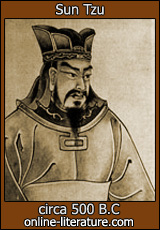
Sun Tzu has exercised a potent fascination over the minds of some of China's greatest men. Among the famous generals who are known to have studied his pages with enthusiasm may be mentioned Han Hsin (d. 196 B.C.), [49] Feng I (d. 34 A.D.), [50] Lu Meng (d. 219), [51] and Yo Fei (1103-1141). [52] The opinion of Ts`ao Kung, who disputes with Han Hsin the highest place in Chinese military annals, has already been recorded. [53] Still more remarkable, in one way, is the testimony of purely literary men, such as Su Hsun (the father of Su Tung-p`o), who wrote several essays on military topics, all of which owe their chief inspiration to Sun Tzu. The following short passage by him is preserved in the YU HAI: [54] --
Sun Wu's saying, that in war one cannot make certain of conquering, [55] is very different indeed from what other books tell us. [56] Wu Ch`i was a man of the same stamp as Sun Wu: they both wrote books on war, and they are linked together in popular speech as "Sun and Wu." But Wu Ch`i's remarks on war are less weighty, his rules are rougher and more crudely stated, and there is not the same unity of plan as in Sun Tzu's work, where the style is terse, but the meaning fully brought out.
The following is an extract from the "Impartial Judgments in the Garden of Literature" by Cheng Hou: --
Sun Tzu's 13 chapters are not only the staple and base of all military men's training, but also compel the most careful attention of scholars and men of letters. His sayings are terse yet elegant, simple yet profound, perspicuous and eminently practical. Such works as the LUN YU, the I CHING and the great Commentary, [57] as well as the writings of Mencius, Hsun K`uang and Yang Chu, all fall below the level of Sun Tzu.
Chu Hsi, commenting on this, fully admits the first part of the criticism, although he dislikes the audacious comparison with the venerated classical works. Language of this sort, he says, "encourages a ruler's bent towards unrelenting warfare and reckless militarism."
| Art of Worldly Wisdom Daily In the 1600s, Balthasar Gracian, a jesuit priest wrote 300 aphorisms on living life called "The Art of Worldly Wisdom." Join our newsletter below and read them all, one at a time. |
Sonnet-a-Day Newsletter Shakespeare wrote over 150 sonnets! Join our Sonnet-A-Day Newsletter and read them all, one at a time. |
