 Subscribe for ad free access & additional features for teachers. Authors: 267, Books: 3,607, Poems & Short Stories: 4,435, Forum Members: 71,154, Forum Posts: 1,238,602, Quizzes: 344
Ch. 2 - A Woman Without a Heart
After a moment's silence, Raphael said with a careless gesture:
"Perhaps it is an effect of the fumes of punch--I really cannot tell
--this clearness of mind that enables me to comprise my whole life in a
single picture, where figures and hues, lights, shades, and half-tones
are faithfully rendered. I should not have been so surprised at this
poetical play of imagination if it were not accompanied with a sort of
scorn for my past joys and sorrows. Seen from afar, my life appears to
contract by some mental process. That long, slow agony of ten years'
duration can be brought to memory to-day in some few phrases, in which
pain is resolved into a mere idea, and pleasure becomes a
philosophical reflection. Instead of feeling things, I weigh and
consider them----"
"You are as tiresome as the explanation of an amendment," cried Emile.
"Very likely," said Raphael submissively. "I spare you the first
seventeen years of my life for fear of abusing a listener's patience.
Till that time, like you and thousands of others, I had lived my life
at school or the lycee, with its imaginary troubles and genuine
happinesses, which are so pleasant to look back upon. Our jaded
palates still crave for that Lenten fare, so long as we have not tried
it afresh. It was a pleasant life, with the tasks that we thought so
contemptible, but which taught us application for all that. . . ."
"Let the drama begin," said Emile, half-plaintively, half-comically.
"When I left school," Raphael went on, with a gesture that claimed the
right of speaking, "my father submitted me to a strict discipline; he
installed me in a room near his own study, and I had to rise at five
in the morning and be in bed by nine at night. He meant me to take my
law studies seriously. I attended the Schools, and read with an
advocate as well, but my lectures and work were so narrowly
circumscribed by the laws of time and space, and my father required
such a strict account of my doings, at dinner, that . . ."
"What is this to me?" asked Emile.
"The devil take you!" said Raphael. "How are you to enter into my
feelings if I do not relate the facts that insensibly shaped my
character, made me timid, and prolonged the period of youthful
simplicity? In this manner I cowered under as strict a despotism as a
monarch's till I came of age. To depict the tedium of my life, it will
be perhaps enough to portray my father to you. He was tall, thin, and
slight, with a hatchet face, and pale complexion; a man of few words,
fidgety as an old maid, exacting as a senior clerk. His paternal
solicitude hovered over my merriment and gleeful thoughts, and seemed
to cover them with a leaden pall. Any effusive demonstration on my
part was received by him as a childish absurdity. I was far more
afraid of him than I had been of any of our masters at school.
"I seem to see him before me at this moment. In his chestnut-brown
frock-coat he looked like a red herring wrapped up in the cover of a
pamphlet, and he held himself as erect as an Easter candle. But I was
fond of my father, and at heart he was right enough. Perhaps we never
hate severity when it has its source in greatness of character and
pure morals, and is skilfully tempered with kindness. My father, it is
true, never left me a moment to myself, and only when I was twenty
years old gave me so much as ten francs of my own, ten knavish
prodigals of francs, such a hoard as I had long vainly desired, which
set me a-dreaming of unutterable felicity; yet, for all that he sought
to procure relaxations for me. When he had promised me a treat
beforehand, he would take me to Les Boufoons, or to a concert or ball,
where I hoped to find a mistress. . . . A mistress! that meant
independence. But bashful and timid as I was, knowing nobody, and
ignorant of the dialect of drawing-rooms, I always came back as
awkward as ever, and swelling with unsatisfied desires, to be put in
harness like a troop horse next day by my father, and to return with
morning to my advocate, the Palais de Justice, and the law. To have
swerved from the straight course which my father had mapped out for
me, would have drawn down his wrath upon me; at my first delinquency,
he threatened to ship me off as a cabin-boy to the Antilles. A
dreadful shiver ran through me if I had ventured to spend a couple of
hours in some pleasure party.
"Imagine the most wandering imagination and passionate temperament,
the tenderest soul and most artistic nature, dwelling continually in
the presence of the most flint-hearted, atrabilious, and frigid man on
earth; think of me as a young girl married to a skeleton, and you will
understand the life whose curious scenes can only be a hearsay tale to
you; the plans for running away that perished at the sight of my
father, the despair soothed by slumber, the dark broodings charmed
away by music. I breathed my sorrows forth in melodies. Beethoven or
Mozart would keep my confidences sacred. Nowadays, I smile at
recollections of the scruples which burdened my conscience at that
epoch of innocence and virtue.
"If I set foot in a restaurant, I gave myself up for lost; my fancy
led me to look on a cafe as a disreputable haunt, where men lost their
characters and embarrassed their fortunes; as for engaging in play, I
had not the money to risk. Oh, if I needed to send you to sleep, I
would tell you about one of the most frightful pleasures of my life,
one of those pleasures with fangs that bury themselves in the heart as
the branding-iron enters the convict's shoulder. I was at a ball at
the house of the Duc de Navarreins, my father's cousin. But to make my
position the more perfectly clear, you must know that I wore a
threadbare coat, ill-fitting shoes, a tie fit for a stableman, and a
soiled pair of gloves. I shrank into a corner to eat ices and watch
the pretty faces at my leisure. My father noticed me. Actuated by some
motive that I did not fathom, so dumfounded was I by this act of
confidence, he handed me his keys and purse to keep. Ten paces away
some men were gambling. I heard the rattling of gold; I was twenty
years old; I longed to be steeped for one whole day in the follies of
my time of life. It was a license of the imagination that would find a
parallel neither in the freaks of courtesans, nor in the dreams of
young girls. For a year past I had beheld myself well dressed, in a
carriage, with a pretty woman by my side, playing the great lord,
dining at Very's, deciding not to go back home till the morrow; but
was prepared for my father with a plot more intricate than the
Marriage of Figaro, which he could not possibly have unraveled. All
this bliss would cost, I estimated, fifty crowns. Was it not the
artless idea of playing truant that still had charms for me?
"I went into a small adjoining room, and when alone counted my
father's money with smarting eyes and trembling fingers--a hundred
crowns! The joys of my escapade rose before me at the thought of the
amount; joys that flitted about me like Macbeth's witches round their
caldron; joys how alluring! how thrilling! how delicious! I became a
deliberate rascal. I heeded neither my tingling ears nor the violent
beating of my heart, but took out two twenty-franc pieces that I seem
to see yet. The dates had been erased, and Bonaparte's head simpered
upon them. After I had put back the purse in my pocket, I returned to
the gaming-table with the two pieces of gold in the palms of my damp
hands, prowling about the players like a sparrow-hawk round a coop of
chickens. Tormented by inexpressible terror, I flung a sudden
clairvoyant glance round me, and feeling quite sure that I was seen by
none of my acquaintance, betted on a stout, jovial little man, heaping
upon his head more prayers and vows than are put up during two or
three storms at sea. Then, with an intuitive scoundrelism, or
Machiavelism, surprising in one of my age, I went and stood in the
door, and looked about me in the rooms, though I saw nothing; for both
mind and eyes hovered about that fateful green cloth.
"That evening fixes the date of a first observation of a physiological
kind; to it I owe a kind of insight into certain mysteries of our
double nature that I have since been enabled to penetrate. I had my
back turned on the table where my future felicity lay at stake, a
felicity but so much the more intense that it was criminal. Between me
and the players stood a wall of onlookers some five feet deep, who
were chatting; the murmur of voices drowned the clinking of gold,
which mingled in the sounds sent up by this orchestra; yet, despite
all obstacles, I distinctly heard the words of the two players by a
gift accorded to the passions, which enables them to annihilate time
and space. I saw the points they made; I knew which of the two turned
up the king as well as if I had actually seen the cards; at a distance
of ten paces, in short, the fortunes of play blanched my face.
"My father suddenly went by, and then I knew what the Scripture meant
by 'The Spirit of God passed before his face.' I had won. I slipped
through the crowd of men who had gathered about the players with the
quickness of an eel escaping through a broken mesh in a net. My nerves
thrilled with joy instead of anguish. I felt like some criminal on the
way to torture released by a chance meeting with the king. It happened
that a man with a decoration found himself short by forty francs.
Uneasy eyes suspected me; I turned pale, and drops of perspiration
stood on my forehead, I was well punished, I thought, for having
robbed my father. Then the kind little stout man said, in a voice like
an angel's surely, 'All these gentlemen have paid their stakes,' and
put down the forty francs himself. I raised my head in triumph upon
the players. After I had returned the money I had taken from it to my
father's purse, I left my winnings with that honest and worthy
gentleman, who continued to win. As soon as I found myself possessed
of a hundred and sixty francs, I wrapped them up in my handkerchief,
so that they could neither move or rattle on the way back; and I
played no more.
"'What were you doing at the card-table?' said my father as we
stepped into the carriage.
"'I was looking on,' I answered, trembling.
"'But it would have been nothing out of the common if you had been
prompted by self-love to put some money down on the table. In the eyes
of men of the world you are quite old enough to assume the right to
commit such follies. So I should have pardoned you, Raphael, if you
had made use of my purse. . . . .'
"I did not answer. When we reached home, I returned the keys and money
to my father. As he entered his study, he emptied out his purse on the
mantelpiece, counted the money, and turned to me with a kindly look,
saying with more or less long and significant pauses between each
phrase:
"'My boy, you are very nearly twenty now. I am satisfied with you.
You ought to have an allowance, if only to teach you how to lay it
out, and to gain some acquaintance with everyday business.
Henceforward I shall let you have a hundred francs each month. Here is
your first quarter's income for this year,' he added, fingering a pile
of gold, as if to make sure that the amount was correct. 'Do what you
please with it.'
"I confess that I was ready to fling myself at his feet, to tell him
that I was a thief, a scoundrel, and, worse than all, a liar! But a
feeling of shame held me back. I went up to him for an embrace, but he
gently pushed me away.
"'You are a man now, _my child_,' he said. 'What I have just done was a
very proper and simple thing, for which there is no need to thank me.
If I have any claim to your gratitude, Raphael,' he went on, in a kind
but dignified way, 'it is because I have preserved your youth from the
evils that destroy young men in Paris. We will be two friends
henceforth. In a year's time you will be a doctor of law. Not without
some hardship and privations you have acquired the sound knowledge and
the love of, and application to, work that is indispensable to public
men. You must learn to know me, Raphael. I do not want to make either
an advocate or a notary of you, but a statesman, who shall be the
pride of our poor house. . . . Good-night,' he added.
"From that day my father took me fully into confidence. I was an only
son; and ten years before, I had lost my mother. In time past my
father, the head of a historic family remembered even now in Auvergne,
had come to Paris to fight against his evil star, dissatisfied at the
prospect of tilling the soil, with his useless sword by his side. He
was endowed with the shrewdness that gives the men of the south of
France a certain ascendency when energy goes with it. Almost unaided,
he made a position for himself near the fountain of power. The
revolution brought a reverse of fortune, but he had managed to marry
an heiress of good family, and, in the time of the Empire, appeared to
be on the point of restoring to our house its ancient splendor.
"The Restoration, while it brought back considerable property to my
mother, was my father's ruin. He had formerly purchased several
estates abroad, conferred by the Emperor on his generals; and now for
ten years he struggled with liquidators, diplomatists, and Prussian
and Bavarian courts of law, over the disputed possession of these
unfortunate endowments. My father plunged me into the intricate
labyrinths of law proceedings on which our future depended. We might
be compelled to return the rents, as well as the proceeds arising from
sales of timber made during the years 1814 to 1817; in that case my
mother's property would have barely saved our credit. So it fell out
that the day on which my father in a fashion emancipated me, brought
me under a most galling yoke. I entered on a conflict like a
battlefield; I must work day and night; seek interviews with
statesmen, surprise their convictions, try to interest them in our
affairs, and gain them over, with their wives and servants, and their
very dogs; and all this abominable business had to take the form of
pretty speeches and polite attentions. Then I knew the mortifications
that had left their blighting traces on my father's face. For about a
year I led outwardly the life of a man of the world, but enormous
labors lay beneath the surface of gadding about, and eager efforts to
attach myself to influential kinsmen, or to people likely to be useful
to us. My relaxations were lawsuits, and memorials still furnished the
staple of my conversation. Hitherto my life had been blameless, from
the sheer impossibility of indulging the desires of youth; but now I
became my own master, and in dread of involving us both in ruin by
some piece of negligence, I did not dare to allow myself any pleasure
or expenditure.
"While we are young, and before the world has rubbed off the delicate
bloom from our sentiments, the freshness of our impressions, the noble
purity of conscience which will never allow us to palter with evil,
the sense of duty is very strong within us, the voice of honor clamors
within us, and we are open and straightforward. At that time I was all
these things. I wished to justify my father's confidence in me. But
lately I would have stolen a paltry sum from him, with secret delight;
but now that I shared the burden of his affairs, of his name and of
his house, I would secretly have given up my fortune and my hopes for
him, as I was sacrificing my pleasures, and even have been glad of the
sacrifice! So when M. de Villele exhumed, for our special benefit, an
imperial decree concerning forfeitures, and had ruined us, I
authorized the sale of my property, only retaining an island in the
middle of the Loire where my mother was buried. Perhaps arguments and
evasions, philosophical, philanthropic, and political considerations
would not fail me now, to hinder the perpetration of what my solicitor
termed a 'folly'; but at one-and-twenty, I repeat, we are all aglow
with generosity and affection. The tears that stood in my father's
eyes were to me the most splendid of fortunes, and the thought of
those tears has often soothed my sorrow. Ten months after he had paid
his creditors, my father died of grief; I was his idol, and he had
ruined me! The thought killed him. Towards the end of the autumn of
1826, at the age of twenty-two, I was the sole mourner at his
graveside--the grave of my father and my earliest friend. Not many
young men have found themselves alone with their thoughts as they
followed a hearse, or have seen themselves lost in crowded Paris, and
without money or prospects. Orphans rescued by public charity have at
any rate the future of the battlefield before them, and find a shelter
in some institution and a father in the government or in the _procureur
du roi_. I had nothing.
"Three months later, an agent made over to me eleven hundred and
twelve francs, the net proceeds of the winding up of my father's
affairs. Our creditors had driven us to sell our furniture. From my
childhood I had been used to set a high value on the articles of
luxury about us, and I could not help showing my astonishment at the
sight of this meagre balance.
"'Oh, rococo, all of it!' said the auctioneer. A terrible word that
fell like a blight on the sacred memories of my childhood, and
dispelled my earliest illusions, the dearest of all. My entire fortune
was comprised in this 'account rendered,' my future lay in a linen bag
with eleven hundred and twelve francs in it, human society stood
before me in the person of an auctioneer's clerk, who kept his hat on
while he spoke. Jonathan, an old servant who was much attached to me,
and whom my mother had formerly pensioned with an annuity of four
hundred francs, spoke to me as I was leaving the house that I had so
often gaily left for a drive in my childhood.
"'Be very economical, Monsieur Raphael!'
"The good fellow was crying.
"Such were the events, dear Emile, that ruled my destinies, moulded my
character, and set me, while still young, in an utterly false social
position," said Raphael after a pause. "Family ties, weak ones, it is
true, bound me to a few wealthy houses, but my own pride would have
kept me aloof from them if contempt and indifference had not shut
their doors on me in the first place. I was related to people who were
very influential, and who lavished their patronage on strangers; but I
found neither relations nor patrons in them. Continually circumscribed
in my affections, they recoiled upon me. Unreserved and simple by
nature, I must have appeared frigid and sophisticated. My father's
discipline had destroyed all confidence in myself. I was shy and
awkward; I could not believe that my opinion carried any weight
whatever; I took no pleasure in myself; I thought myself ugly, and was
ashamed to meet my own eyes. In spite of the inward voice that must be
the stay of a man with anything in him, in all his struggles, the
voice that cries, 'Courage! Go forward!' in spite of sudden
revelations of my own strength in my solitude; in spite of the hopes
that thrilled me as I compared new works, that the public admired so
much, with the schemes that hovered in my brain,--in spite of all
this, I had a childish mistrust of myself.
"An overweening ambition preyed upon me; I believed that I was meant
for great things, and yet I felt myself to be nothing. I had need of
other men, and I was friendless. I found I must make my way in the
world, where I was quite alone, and bashful, rather than afraid.
"All through the year in which, by my father's wish, I threw myself
into the whirlpool of fashionable society, I came away with an
inexperienced heart, and fresh in mind. Like every grown child, I
sighed in secret for a love affair. I met, among young men of my own
age, a set of swaggerers who held their heads high, and talked about
trifles as they seated themselves without a tremor beside women who
inspired awe in me. They chattered nonsense, sucked the heads of their
canes, gave themselves affected airs, appropriated the fairest women,
and laid, or pretended that they had laid their heads on every pillow.
Pleasure, seemingly, was at their beck and call; they looked on the
most virtuous and prudish as an easy prey, ready to surrender at a
word, at the slightest impudent gesture or insolent look. I declare,
on my soul and conscience, that the attainment of power, or of a great
name in literature, seemed to me an easier victory than a success with
some young, witty, and gracious lady of high degree.
"So I found the tumult of my heart, my feelings, and my creeds all at
variance with the axioms of society. I had plenty of audacity in my
character, but none in my manner. Later, I found out that women did
not like to be implored. I have from afar adored many a one to whom I
devoted a soul proof against all tests, a heart to break, energy that
shrank from no sacrifice and from no torture; _they_ accepted fools whom
I would not have engaged as hall porters. How often, mute and
motionless, have I not admired the lady of my dreams, swaying in the
dance; given up my life in thought to one eternal caress, expressed
all my hopes in a look, and laid before her, in my rapture, a young
man's love, which should outstrip all fables. At some moments I was
ready to barter my whole life for one single night. Well, as I could
never find a listener for my impassioned proposals, eyes to rest my
own upon, a heart made for my heart, I lived on in all the sufferings
of impotent force that consumes itself; lacking either opportunity or
courage or experience. I despaired, maybe, of making myself
understood, or I feared to be understood but too well; and yet the
storm within me was ready to burst at every chance courteous look. In
spite of my readiness to take the semblance of interest in look or
word for a tenderer solicitude, I dared neither to speak nor to be
silent seasonably. My words grew insignificant, and my silence stupid,
by sheer stress of emotion. I was too ingenuous, no doubt, for that
artificial life, led by candle-light, where every thought is expressed
in conventional phrases, or by words that fashion dictates; and not
only so, I had not learned how to employ speech that says nothing, and
silence that says a great deal. In short, I concealed the fires that
consumed me, and with such a soul as women wish to find, with all the
elevation of soul that they long for, and a mettle that fools plume
themselves upon, all women have been cruelly treacherous to me.
"So in my simplicity I admired the heroes of this set when they
bragged about their conquests, and never suspected them of lying. No
doubt it was a mistake to wish for a love that springs for a word's
sake; to expect to find in the heart of a vain, frivolous woman,
greedy for luxury and intoxicated with vanity, the great sea of
passion that surged tempestuously in my own breast. Oh! to feel that
you were born to love, to make some woman's happiness, and yet to find
not one, not even a noble and courageous Marceline, not so much as an
old Marquise! Oh! to carry a treasure in your wallet, and not find
even some child, or inquisitive young girl, to admire it! In my
despair I often wished to kill myself."
"Finely tragical to-night!" cried Emile.
"Let me pass sentence on my life," Raphael answered. "If your
friendship is not strong enough to bear with my elegy, if you cannot
put up with half an hour's tedium for my sake, go to sleep! But, then,
never ask again for the reason of suicide that hangs over me, that
comes nearer and calls to me, that I bow myself before. If you are to
judge a man, you must know his secret thoughts, sorrows, and feelings;
to know merely the outward events of a man's life would only serve to
make a chronological table--a fool's notion of history."
Emile was so much struck with the bitter tones in which these words
were spoken, that he began to pay close attention to Raphael, whom he
watched with a bewildered expression.
"Now," continued the speaker, "all these things that befell me appear
in a new light. The sequence of events that I once thought so
unfortunate created the splendid powers of which, later, I became so
proud. If I may believe you, I possess the power of readily expressing
my thoughts, and I could take a forward place in the great field of
knowledge; and is not this the result of scientific curiosity, of
excessive application, and a love of reading which possessed me from
the age of seven till my entry on life? The very neglect in which I
was left, and the consequent habits of self-repression and
self-concentration; did not these things teach me how to consider and
reflect? Nothing in me was squandered in obedience to the exactions of
the world, which humble the proudest soul and reduce it to a mere
husk; and was it not this very fact that refined the emotional part of
my nature till it became the perfected instrument of a loftier purpose
than passionate desires? I remember watching the women who mistook me
with all the insight of contemned love.
"I can see now that my natural sincerity must have been displeasing to
them; women, perhaps, even require a little hypocrisy. And I, who in
the same hour's space am alternately a man and a child, frivolous and
thoughtful, free from bias and brimful of superstition, and oftentimes
myself as much a woman as any of them; how should they do otherwise
than take my simplicity for cynicism, my innocent candor for
impudence? They found my knowledge tiresome; my feminine languor,
weakness. I was held to be listless and incapable of love or of steady
purpose; a too active imagination, that curse of poets, was no doubt
the cause. My silence was idiotic; and as I daresay I alarmed them by
my efforts to please, women one and all have condemned me. With tears
and mortification, I bowed before the decision of the world; but my
distress was not barren. I determined to revenge myself on society; I
would dominate the feminine intellect, and so have the feminine soul
at my mercy; all eyes should be fixed upon me, when the servant at the
door announced my name. I had determined from my childhood that I
would be a great man; I said with Andre Chenier, as I struck my
forehead, 'There is something underneath that!' I felt, I believed,
the thought within me that I must express, the system I must
establish, the knowledge I must interpret.
"Let me pour out my follies, dear Emile; to-day I am barely twenty-six
years old, certain of dying unrecognized, and I have never been the
lover of the woman I dreamed of possessing. Have we not all of us,
more or less, believed in the reality of a thing because we wished it?
I would never have a young man for my friend who did not place himself
in dreams upon a pedestal, weave crowns for his head, and have
complaisant mistresses. I myself would often be a general, nay,
emperor; I have been a Byron, and then a nobody. After this sport on
these pinnacles of human achievement, I became aware that all the
difficulties and steeps of life were yet to face. My exuberant
self-esteem came to my aid; I had that intense belief in my destiny,
which perhaps amounts to genius in those who will not permit themselves
to be distracted by contact with the world, as sheep that leave their
wool on the briars of every thicket they pass by. I meant to cover
myself with glory, and to work in silence for the mistress I hoped to
have one day. Women for me were resumed into a single type, and this
woman I looked to meet in the first that met my eyes; but in each and
all I saw a queen, and as queens must make the first advances to their
lovers, they must draw near to me--to me, so sickly, shy, and poor.
For her, who should take pity on me, my heart held in store such
gratitude over and beyond love, that I had worshiped her her whole
life long. Later, my observations have taught me bitter truths.
"In this way, dear Emile, I ran the risk of remaining companionless
for good. The incomprehensible bent of women's minds appears to lead
them to see nothing but the weak points in a clever man, and the
strong points of a fool. They feel the liveliest sympathy with the
fool's good qualities, which perpetually flatter their own defects;
while they find the man of talent hardly agreeable enough to
compensate for his shortcomings. All capacity is a sort of
intermittent fever, and no woman is anxious to share in its
discomforts only; they look to find in their lovers the wherewithal to
gratify their own vanity. It is themselves that they love in us! But
the artist, poor and proud, along with his endowment of creative
power, is furnished with an aggressive egotism! Everything about him
is involved in I know not what whirlpool of his ideas, and even his
mistress must gyrate along with them. How is a woman, spoilt with
praise, to believe in the love of a man like that? Will she go to seek
him out? That sort of lover has not the leisure to sit beside a sofa
and give himself up to the sentimental simperings that women are so
fond of, and on which the false and unfeeling pride themselves. He
cannot spare the time from his work, and how can he afford to humble
himself and go a-masquerading! I was ready to give my life once and
for all, but I could not degrade it in detail. Besides, there is
something indescribably paltry in a stockbroker's tactics, who runs on
errands for some insipid affected woman; all this disgusts an artist.
Love in the abstract is not enough for a great man in poverty; he has
need of its utmost devotion. The frivolous creatures who spend their
lives in trying on cashmeres, or make themselves into clothes-pegs to
hang the fashions from, exact the devotion which is not theirs to
give; for them, love means the pleasure of ruling and not of obeying.
She who is really a wife, one in heart, flesh, and bone, must follow
wherever he leads, in whom her life, her strength, her pride, and
happiness are centered. Ambitious men need those Oriental women whose
whole thought is given to the study of their requirements; for
unhappiness means for them the incompatibility of their means with
their desires. But I, who took myself for a man of genius, must needs
feel attracted by these very she-coxcombs. So, as I cherished ideas so
different from those generally received; as I wished to scale the
heavens without a ladder, was possessed of wealth that could not
circulate, and of knowledge so wide and so imperfectly arranged and
digested that it overtaxed my memory; as I had neither relations nor
friends in the midst of this lonely and ghastly desert, a desert of
paving stones, full of animation, life, and thought, wherein every one
is worse than inimical, indifferent to wit; I made a very natural if
foolish resolve, which required such unknown impossibilities, that my
spirits rose. It was as if I had laid a wager with myself, for I was
at once the player and the cards.
"This was my plan. The eleven hundred francs must keep life in me for
three years--the time I allowed myself in which to bring to light a
work which should draw attention to me, and make me either a name or a
fortune. I exulted at the thought of living on bread and milk, like a
hermit in the Thebaid, while I plunged into the world of books and
ideas, and so reached a lofty sphere beyond the tumult of Paris, a
sphere of silent labor where I would entomb myself like a chrysalis to
await a brilliant and splendid new birth. I imperiled my life in order
to live. By reducing my requirements to real needs and the barest
necessaries, I found that three hundred and sixty-five francs sufficed
for a year of penury; and, in fact, I managed to exist on that slender
sum, so long as I submitted to my own claustral discipline."
"Impossible!" cried Emile.
"I lived for nearly three years in that way," Raphael answered, with a
kind of pride. "Let us reckon it out. Three sous for bread, two for
milk, and three for cold meat, kept me from dying of hunger, and my
mind in a state of peculiar lucidity. I have observed, as you know,
the wonderful effects produced by diet upon the imagination. My
lodgings cost me three sous daily; I burnt three sous more in oil at
night; I did my own housework, and wore flannel shirts so as to reduce
the laundress' bill to two sous per day. The money I spent yearly in
coal, if divided up, never cost more than two sous for each day. I had
three years' supply of clothing, and I only dressed when going out to
some library or public lecture. These expenses, all told, only
amounted to eighteen sous, so two were left over for emergencies. I
cannot recollect, during that long period of toil, either crossing the
Pont des Arts, or paying for water; I went out to fetch it every
morning from the fountain in the Place Saint Michel, at the corner of
the Rue de Gres. Oh, I wore my poverty proudly. A man urged on towards
a fair future walks through life like an innocent person to his death;
he feels no shame about it.
"I would not think of illness. Like Aquilina, I faced the hospital
without terror. I had not a moment's doubt of my health, and besides,
the poor can only take to their beds to die. I cut my own hair till
the day when an angel of love and kindness . . . But I do not want to
anticipate the state of things that I shall reach later. You must
simply know that I lived with one grand thought for a mistress, a
dream, an illusion which deceives us all more or less at first. To-day
I laugh at myself, at that self, holy perhaps and heroic, which is now
no more. I have since had a closer view of society and the world, of
our manners and customs, and seen the dangers of my innocent credulity
and the superfluous nature of my fervent toil. Stores of that sort are
quite useless to aspirants for fame. Light should be the baggage of
seekers after fortune!
"Ambitious men spend their youth in rendering themselves worthy of
patronage; it is their great mistake. While the foolish creatures are
laying in stores of knowledge and energy, so that they shall not sink
under the weight of responsible posts that recede from them, schemers
come and go who are wealthy in words and destitute in ideas, astonish
the ignorant, and creep into the confidence of those who have a little
knowledge. While the first kind study, the second march ahead; the one
sort is modest, and the other impudent; the man of genius is silent
about his own merits, but these schemers make a flourish of theirs,
and they are bound to get on. It is so strongly to the interest of men
in office to believe in ready-made capacity, and in brazen-faced
merit, that it is downright childish of the learned to expect material
rewards. I do not seek to paraphrase the commonplace moral, the song
of songs that obscure genius is for ever singing; I want to come, in a
logical manner, by the reason of the frequent successes of mediocrity.
Alas! study shows us such a mother's kindness that it would be a sin
perhaps to ask any other reward of her than the pure and delightful
pleasures with which she sustains her children.
"Often I remember soaking my bread in milk, as I sat by the window to
take the fresh air; while my eyes wandered over a view of roofs
--brown, gray, or red, slated or tiled, and covered with yellow or
green mosses. At first the prospect may have seemed monotonous, but I
very soon found peculiar beauties in it. Sometimes at night, streams of
light through half-closed shutters would light up and color the dark
abysses of this strange landscape. Sometimes the feeble lights of the
street lamps sent up yellow gleams through the fog, and in each street
dimly outlined the undulations of a crowd of roofs, like billows in a
motionless sea. Very occasionally, too, a face appeared in this gloomy
waste; above the flowers in some skyey garden I caught a glimpse of an
old woman's crooked angular profile as she watered her nasturtiums;
or, in a crazy attic window, a young girl, fancying herself quite
alone as she dressed herself--a view of nothing more than a fair
forehead and long tresses held above her by a pretty white arm.
"I liked to see the short-lived plant-life in the gutters--poor weeds
that a storm soon washed away. I studied the mosses, with their colors
revived by showers, or transformed by the sun into a brown velvet that
fitfully caught the light. Such things as these formed my recreations
--the passing poetic moods of daylight, the melancholy mists, sudden
gleams of sunlight, the silence and the magic of night, the mysteries
of dawn, the smoke wreaths from each chimney; every chance event, in
fact, in my curious world became familiar to me. I came to love this
prison of my own choosing. This level Parisian prairie of roofs,
beneath which lay populous abysses, suited my humor, and harmonized
with my thoughts.
"Sudden descents into the world from the divine height of scientific
meditation are very exhausting; and, besides, I had apprehended
perfectly the bare life of the cloister. When I made up my mind to
carry out this new plan of life, I looked for quarters in the most
out-of-the-way parts of Paris. One evening, as I returned home to the
Rue des Cordiers from the Place de l'Estrapade, I saw a girl of
fourteen playing with a battledore at the corner of the Rue de Cluny,
her winsome ways and laughter amused the neighbors. September was not
yet over; it was warm and fine, so that women sat chatting before
their doors as if it were a fete-day in some country town. At first I
watched the charming expression of the girl's face and her graceful
attitudes, her pose fit for a painter. It was a pretty sight. I looked
about me, seeking to understand this blithe simplicity in the midst of
Paris, and saw that the street was a blind alley and but little
frequented. I remembered that Jean Jacques had once lived here, and
looked up the Hotel Saint-Quentin. Its dilapidated condition awakened
hopes of a cheap lodging, and I determined to enter.
"I found myself in a room with a low ceiling; the candles, in
classic-looking copper candle-sticks, were set in a row under each key.
The predominating cleanliness of the room made a striking contrast to
the usual state of such places. This one was as neat as a bit of genre;
there was a charming trimness about the blue coverlet, the cooking
pots and furniture. The mistress of the house rose and came to me. She
seemed to be about forty years of age; sorrows had left their traces
on her features, and weeping had dimmed her eyes. I deferentially
mentioned the amount I could pay; it seemed to cause her no surprise;
she sought out a key from the row, went up to the attics with me, and
showed me a room that looked out on the neighboring roofs and courts;
long poles with linen drying on them hung out of the window.
"Nothing could be uglier than this garret, awaiting its scholar, with
its dingy yellow walls and odor of poverty. The roofing fell in a
steep slope, and the sky was visible through chinks in the tiles.
There was room for a bed, a table, and a few chairs, and beneath the
highest point of the roof my piano could stand. Not being rich enough
to furnish this cage (that might have been one of the _Piombi_ of
Venice), the poor woman had never been able to let it; and as I had
saved from the recent sale the furniture that was in a fashion
peculiarly mine, I very soon came to terms with my landlady, and moved
in on the following day.
"For three years I lived in this airy sepulchre, and worked
unflaggingly day and night; and so great was the pleasure that study
seemed to me the fairest theme and the happiest solution of life. The
tranquillity and peace that a scholar needs is something as sweet and
exhilarating as love. Unspeakable joys are showered on us by the
exertion of our mental faculties; the quest of ideas, and the tranquil
contemplation of knowledge; delights indescribable, because purely
intellectual and impalpable to our senses. So we are obliged to use
material terms to express the mysteries of the soul. The pleasure of
striking out in some lonely lake of clear water, with forests, rocks,
and flowers around, and the soft stirring of the warm breeze,--all
this would give, to those who knew them not, a very faint idea of the
exultation with which my soul bathed itself in the beams of an unknown
light, hearkened to the awful and uncertain voice of inspiration, as
vision upon vision poured from some unknown source through my
throbbing brain.
"No earthly pleasure can compare with the divine delight of watching
the dawn of an idea in the space of abstractions as it rises like the
morning sun; an idea that, better still, attains gradually like a
child to puberty and man's estate. Study lends a kind of enchantment
to all our surroundings. The wretched desk covered with brown leather
at which I wrote, my piano, bed, and armchair, the odd wall-paper and
furniture seemed to have for me a kind of life in them, and to be
humble friends of mine and mute partakers of my destiny. How often
have I confided my soul to them in a glance! A warped bit of beading
often met my eyes, and suggested new developments,--a striking proof
of my system, or a felicitous word by which to render my all but
inexpressible thought. By sheer contemplation of the things about me I
discerned an expression and a character in each. If the setting sun
happened to steal in through my narrow window, they would take new
colors, fade or shine, grow dull or gay, and always amaze me with some
new effect. These trifling incidents of a solitary life, which escape
those preoccupied with outward affairs, make the solace of prisoners.
And what was I but the captive of an idea, imprisoned in my system,
but sustained also by the prospect of a brilliant future? At each
obstacle that I overcame, I seemed to kiss the soft hands of a woman
with a fair face, a wealthy, well-dressed woman, who should some day
say softly, while she caressed my hair:
"'Poor Angel, how thou hast suffered!'
"I had undertaken two great works--one a comedy that in a very short
time must bring me wealth and fame, and an entry into those circles
whither I wished to return, to exercise the royal privileges of a man
of genius. You all saw nothing in that masterpiece but the blunder of
a young man fresh from college, a babyish fiasco. Your jokes clipped
the wings of a throng of illusions, which have never stirred since
within me. You, dear Emile, alone brought soothing to the deep wounds
that others had made in my heart. You alone will admire my 'Theory of
the Will.' I devoted most of my time to that long work, for which I
studied Oriental languages, physiology and anatomy. If I do not
deceive myself, my labors will complete the task begun by Mesmer,
Lavater, Gall, and Bichat, and open up new paths in science.
"There ends that fair life of mine, the daily sacrifice, the
unrecognized silkworm's toil, that is, perhaps, its own sole
recompense. Since attaining years of discretion, until the day when I
finished my 'Theory,' I observed, learned, wrote, and read
unintermittingly; my life was one long imposition, as schoolboys say.
Though by nature effeminately attached to Oriental indolence, sensual
in tastes, and a wooer of dreams, I worked incessantly, and refused to
taste any of the enjoyments of Parisian life. Though a glutton, I
became abstemious; and loving exercise and sea voyages as I did, and
haunted by the wish to visit many countries, still child enough to
play at ducks and drakes with pebbles over a pond, I led a sedentary
life with a pen in my fingers. I liked talking, but I went to sit and
mutely listen to professors who gave public lectures at the
_Bibliotheque_ or the Museum. I slept upon my solitary pallet like a
Benedictine brother, though woman was my one chimera, a chimera that
fled from me as I wooed it! In short, my life has been a cruel
contradiction, a perpetual cheat. After that, judge a man!
"Sometimes my natural propensities broke out like a fire long
smothered. I was debarred from the women whose society I desired,
stripped of everything and lodged in an artist's garret, and by a sort
of mirage or calenture I was surrounded by captivating mistresses. I
drove through the streets of Paris, lolling on the soft cushions of a
fine equipage. I plunged into dissipation, into corroding vice, I
desired and possessed everything, for fasting had made me light-headed
like the tempted Saint Anthony. Slumber, happily, would put an end at
last to these devastating trances; and on the morrow science would
beckon me, smiling, and I was faithful to her. I imagine that women
reputed virtuous, must often fall a prey to these insane tempests of
desire and passion, which rise in us in spite of ourselves. Such
dreams have a charm of their own; they are something akin to evening
gossip round the winter fire, when one sets out for some voyage in
China. But what becomes of virtue during these delicious excursions,
when fancy overleaps all difficulties?
"During the first ten months of seclusion I led the life of poverty
and solitude that I have described to you; I used to steal out
unobserved every morning to buy my own provisions for the day; I
tidied my room; I was at once master and servant, and played the
Diogenes with incredible spirit. But afterwards, while my hostess and
her daughter watched my ways and behavior, scrutinized my appearance
and divined my poverty, there could not but be some bonds between us;
perhaps because they were themselves so very poor. Pauline, the
charming child, whose latent and unconscious grace had, in a manner,
brought me there, did me many services that I could not well refuse.
All women fallen on evil days are sisters; they speak a common
language; they have the same generosity--the generosity that possesses
nothing, and so is lavish of its affection, of its time, and of its
very self.
"Imperceptibly Pauline took me under her protection, and would do
things for me. No kind of objection was made by her mother, whom I
even surprised mending my linen; she blushed for the charitable
occupation. In spite of myself, they took charge of me, and I accepted
their services.
"In order to understand the peculiar condition of my mind, my
preoccupation with work must be remembered, the tyranny of ideas, and
the instinctive repugnance that a man who leads an intellectual life
must ever feel for the material details of existence. Could I well
repulse the delicate attentions of Pauline, who would noiselessly
bring me my frugal repast, when she noticed that I had taken nothing
for seven or eight hours? She had the tact of a woman and the
inventiveness of a child; she would smile as she made sign to me that
I must not see her. Ariel glided under my roof in the form of a sylph
who foresaw every want of mine.
"One evening Pauline told me her story with touching simplicity. Her
father had been a major in the horse grenadiers of the Imperial Guard.
He had been taken prisoner by the Cossacks, at the passage of
Beresina; and when Napoleon later on proposed an exchange, the Russian
authorities made search for him in Siberia in vain; he had escaped
with a view of reaching India, and since then Mme. Gaudin, my
landlady, could hear no news of her husband. Then came the disasters
of 1814 and 1815; and, left alone and without resource, she had
decided to let furnished lodgings in order to keep herself and her
daughter.
"She always hoped to see her husband again. Her greatest trouble was
about her daughter's education; the Princess Borghese was her
Pauline's godmother; and Pauline must not be unworthy of the fair
future promised by her imperial protectress. When Mme. Gaudin confided
to me this heavy trouble that preyed upon her, she said, with sharp
pain in her voice, 'I would give up the property and the scrap of
paper that makes Gaudin a baron of the empire, and all our rights to
the endowment of Wistchnau, if only Pauline could be brought up at
Saint-Denis?' Her words struck me; now I could show my gratitude for
the kindnesses expended on me by the two women; all at once the idea
of offering to finish Pauline's education occurred to me; and the
offer was made and accepted in the most perfect simplicity. In this
way I came to have some hours of recreation. Pauline had natural
aptitude; she learned so quickly, that she soon surpassed me at the
piano. As she became accustomed to think aloud in my presence, she
unfolded all the sweet refinements of a heart that was opening itself
out to life, as some flower-cup opens slowly to the sun. She listened
to me, pleased and thoughtful, letting her dark velvet eyes rest upon
me with a half smile in them; she repeated her lessons in soft and
gentle tones, and showed childish glee when I was satisfied with her.
Her mother grew more and more anxious every day to shield the young
girl from every danger (for all the beauty promised in early life was
developing in the crescent moon), and was glad to see her spend whole
days indoors in study. My piano was the only one she could use, and
while I was out she practised on it. When I came home, Pauline would
be in my room, in her shabby dress, but her slightest movement
revealed her slender figure in its attractive grace, in spite of the
coarse materials that she wore. As with the heroine of the fable of
'_Peau-d'Ane_,' a dainty foot peeped out of the clumsy shoes. But all
her wealth of girlish beauty was as lost upon me. I had laid commands
upon myself to see a sister only in Pauline. I dreaded lest I should
betray her mother's faith in me. I admired the lovely girl as if she
had been a picture, or as the portrait of a dead mistress; she was at
once my child and my statue. For me, another Pygmalion, the maiden
with the hues of life and the living voice was to become a form of
inanimate marble. I was very strict with her, but the more I made her
feel my pedagogue's severity, the more gentle and submissive she grew.
"If a generous feeling strengthened me in my reserve and
self-restraint, prudent considerations were not lacking beside.
Integrity of purpose cannot, I think, fail to accompany integrity in
money matters. To my mind, to become insolvent or to betray a woman is
the same sort of thing. If you love a young girl, or allow yourself to
be beloved by her, a contract is implied, and its conditions should be
thoroughly understood. We are free to break with the woman who sells
herself, but not with the young girl who has given herself to us and
does not know the extent of her sacrifice. I must have married
Pauline, and that would have been madness. Would it not have given
over that sweet girlish heart to terrible misfortunes? My poverty made
its selfish voice heard, and set an iron barrier between that gentle
nature and mine. Besides, I am ashamed to say, that I cannot imagine
love in the midst of poverty. Perhaps this is a vitiation due to that
malady of mankind called civilization; but a woman in squalid poverty
would exert no fascination over me, were she attractive as Homer's
Galatea, the fair Helen.
"Ah, _vive l'amour_! But let it be in silk and cashmere, surrounded with
the luxury which so marvelously embellishes it; for is it not perhaps
itself a luxury? I enjoy making havoc with an elaborate erection of
scented hair; I like to crush flowers, to disarrange and crease a
smart toilette at will. A bizarre attraction lies for me in burning
eyes that blaze through a lace veil, like flame through cannon smoke.
My way of love would be to mount by a silken ladder, in the silence of
a winter night. And what bliss to reach, all powdered with snow, a
perfumed room, with hangings of painted silk, to find a woman there,
who likewise shakes away the snow from her; for what other name can be
found for the white muslin wrappings that vaguely define her, like
some angel form issuing from a cloud! And then I wish for furtive
joys, for the security of audacity. I want to see once more that woman
of mystery, but let it be in the throng, dazzling, unapproachable,
adored on all sides, dressed in laces and ablaze with diamonds, laying
her commands upon every one; so exalted above us, that she inspires
awe, and none dares to pay his homage to her.
"She gives me a stolen glance, amid her court, a look that exposes the
unreality of all this; that resigns for me the world and all men in
it! Truly I have scorned myself for a passion for a few yards of lace,
velvet, and fine lawn, and the hairdresser's feats of skill; a love of
wax-lights, a carriage and a title, a heraldic coronet painted on
window panes, or engraved by a jeweler; in short, a liking for all
that is adventitious and least woman in woman. I have scorned and
reasoned with myself, but all in vain.
"A woman of rank with her subtle smile, her high-born air, and
self-esteem captivates me. The barriers she erects between herself
and the world awaken my vanity, a good half of love. There would be
more relish for me in bliss that all others envied. If my mistress
does nothing that other women do, and neither lives nor conducts
herself like them, wears a cloak that they cannot attain, breathes a
perfume of her own, then she seems to rise far above me. The further
she rises from earth, even in the earthlier aspects of love, the
fairer she becomes for me.
"Luckily for me we have had no queen in France these twenty years, for
I should have fallen in love with her. A woman must be wealthy to
acquire the manners of a princess. What place had Pauline among these
far-fetched imaginings? Could she bring me the love that is death,
that brings every faculty into play, the nights that are paid for by
life? We hardly die, I think, for an insignificant girl who gives
herself to us; and I could never extinguish these feelings and poet's
dreams within me. I was born for an inaccessible love, and fortune has
overtopped my desire.
"How often have I set satin shoes on Pauline's tiny feet, confined her
form, slender as a young poplar, in a robe of gauze, and thrown a
loose scarf about her as I saw her tread the carpets in her mansion
and led her out to her splendid carriage! In such guise I should have
adored her. I endowed her with all the pride she lacked, stripped her
of her virtues, her natural simple charm, and frank smile, in order to
plunge her heart in our Styx of depravity that makes invulnerable,
load her with our crimes, make of her the fantastical doll of our
drawing-rooms, the frail being who lies about in the morning and comes
to life again at night with the dawn of tapers. Pauline was
fresh-hearted and affectionate--I would have had her cold and formal.
"In the last days of my frantic folly, memory brought Pauline before
me, as it brings the scenes of our childhood, and made me pause to
muse over past delicious moments that softened my heart. I sometimes
saw her, the adorable girl who sat quietly sewing at my table, wrapped
in her meditations; the faint light from my window fell upon her and
was reflected back in silvery rays from her thick black hair;
sometimes I heard her young laughter, or the rich tones of her voice
singing some canzonet that she composed without effort. And often my
Pauline seemed to grow greater, as music flowed from her, and her face
bore a striking resemblance to the noble one that Carlo Dolci chose
for the type of Italy. My cruel memory brought her back athwart the
dissipations of my existence, like a remorse, or a symbol of purity.
But let us leave the poor child to her own fate. Whatever her troubles
may have been, at any rate I protected her from a menacing tempest--I
did not drag her down into my hell.
"Until last winter I led the uneventful studious life of which I have
given you some faint picture. In the earliest days of December 1829, I
came across Rastignac, who, in spite of the shabby condition of my
wardrobe, linked his arm in mine, and inquired into my affairs with a
quite brotherly interest. Caught by his engaging manner, I gave him a
brief account of my life and hopes; he began to laugh, and treated me
as a mixture of a man of genius and a fool. His Gascon accent and
knowledge of the world, the easy life his clever management procured
for him, all produced an irresistible effect upon me. I should die an
unrecognized failure in a hospital, Rastignac said, and be buried in a
pauper's grave. He talked of charlatanism. Every man of genius was a
charlatan, he plainly showed me in that pleasant way of his that makes
him so fascinating. He insisted that I must be out of my senses, and
would be my own death, if I lived on alone in the Rue des Cordiers.
According to him, I ought to go into society, to accustom people to
the sound of my name, and to rid myself of the simple title of
'monsieur' which sits but ill on a great man in his lifetime.
"'Those who know no better,' he cried, 'call this sort of business
_scheming_, and moral people condemn it for a "dissipated life." We need
not stop to look at what people think, but see the results. You work,
you say? Very good, but nothing will ever come of that. Now, I am
ready for anything and fit for nothing. As lazy as a lobster? Very
likely, but I succeed everywhere. I go out into society, I push myself
forward, the others make way before me; I brag and am believed; I
incur debts which somebody else pays! Dissipation, dear boy, is a
methodical policy. The life of a man who deliberately runs through his
fortune often becomes a business speculation; his friends, his
pleasures, patrons, and acquaintances are his capital. Suppose a
merchant runs a risk of a million, for twenty years he can neither
sleep, eat, nor amuse himself, he is brooding over his million, it
makes him run about all over Europe; he worries himself, goes to the
devil in every way that man has invented. Then comes a liquidation,
such as I have seen myself, which very often leaves him penniless and
without a reputation or a friend. The spendthrift, on the other hand,
takes life as a serious game and sees his horses run. He loses his
capital, perhaps, but he stands a chance of being nominated
Receiver-General, of making a wealthy marriage, or of an appointment of
attache to a minister or ambassador; and he has his friends left and
his name, and he never wants money. He knows the standing of everybody,
and uses every one for his own benefit. Is this logical, or am I a
madman after all? Haven't you there all the moral of the comedy that
goes on every day in this world? . . . Your work is completed' he went
on after a pause; 'you are immensely clever! Well, you have only
arrived at my starting-point. Now, you had better look after its
success yourself; it is the surest way. You will make allies in every
clique, and secure applause beforehand. I mean to go halves in your
glory myself; I shall be the jeweler who set the diamonds in your
crown. Come here to-morrow evening, by way of a beginning. I will
introduce you to a house where all Paris goes, all OUR Paris, that is
--the Paris of exquisites, millionaires, celebrities, all the folk who
talk gold like Chrysostom. When they have taken up a book, that book
becomes the fashion; and if it is something really good for once, they
will have declared it to be a work of genius without knowing it. If you
have any sense, my dear fellow, you will ensure the success of your
"Theory," by a better understanding of the theory of success. To-morrow
evening you shall go to see that queen of the moment--the beautiful
Countess Foedora. . . .'
"'I have never heard of her. . . .'
"'You Hottentot!' laughed Rastignac; 'you do not know Foedora? A
great match with an income of nearly eighty thousand livres, who has
taken a fancy to nobody, or else no one has taken a fancy to her. A
sort of feminine enigma, a half Russian Parisienne, or a half Parisian
Russian. All the romantic productions that never get published are
brought out at her house; she is the handsomest woman in Paris, and
the most gracious! You are not even a Hottentot; you are something
between the Hottentot and the beast. . . . Good-bye till to-morrow.'
"He swung round on his heel and made off without waiting for my
answer. It never occurred to him that a reasoning being could refuse
an introduction to Foedora. How can the fascination of a name be
explained? FOEDORA haunted me like some evil thought, with which you
seek to come to terms. A voice said in me, 'You are going to see
Foedora!' In vain I reasoned with that voice, saying that it lied to
me; all my arguments were defeated by the name 'Foedora.' Was not the
name, and even the woman herself, the symbol of all my desires, and
the object of my life?
"The name called up recollections of the conventional glitter of the
world, the upper world of Paris with its brilliant fetes and the
tinsel of its vanities. The woman brought before me all the problems
of passion on which my mind continually ran. Perhaps it was neither
the woman nor the name, but my own propensities, that sprang up within
me and tempted me afresh. Here was the Countess Foedora, rich and
loveless, proof against the temptations of Paris; was not this woman
the very incarnation of my hopes and visions? I fashioned her for
myself, drew her in fancy, and dreamed of her. I could not sleep that
night; I became her lover; I overbrimmed a few hours with a whole
lifetime--a lover's lifetime; the experience of its prolific delights
burned me.
"The next day I could not bear the tortures of delay; I borrowed a
novel, and spent the whole day over it, so that I could not possibly
think nor keep account of the time till night. Foedora's name echoed
through me even as I read, but only as a distant sound; though it
could be heard, it was not troublesome. Fortunately, I owned a fairly
creditable black coat and a white waistcoat; of all my fortune there
now remained abut thirty francs, which I had distributed about among
my clothes and in my drawers, so as to erect between my whims and the
spending of a five-franc piece a thorny barrier of search, and an
adventurous peregrination round my room. While I as dressing, I dived
about for my money in an ocean of papers. This scarcity of specie will
give you some idea of the value of that squandered upon gloves and
cab-hire; a month's bread disappeared at one fell swoop. Alas! money
is always forthcoming for our caprices; we only grudge the cost of
things that are useful or necessary. We recklessly fling gold to an
opera-dancer, and haggle with a tradesman whose hungry family must
wait for the settlement of our bill. How many men are there that wear
a coat that cost a hundred francs, and carry a diamond in the head of
their cane, and dine for twenty-five SOUS for all that! It seems as
though we could never pay enough for the pleasures of vanity.
"Rastignac, punctual to his appointment, smiled at the transformation,
and joked about it. On the way he gave me benevolent advice as to my
conduct with the countess; he described her as mean, vain, and
suspicious; but though mean, she was ostentatious, her vanity was
transparent, and her mistrust good-humored.
"'You know I am pledged,' he said, 'and what I should lose, too, if I
tried a change in love. So my observation of Foedora has been quite
cool and disinterested, and my remarks must have some truth in them. I
was looking to your future when I thought of introducing you to her;
so mind very carefully what I am about to say. She has a terrible
memory. She is clever enough to drive a diplomatist wild; she would
know it at once if he spoke the truth. Between ourselves, I fancy that
her marriage was not recognized by the Emperor, for the Russian
ambassador began to smile when I spoke of her; he does not receive her
either, and only bows very coolly if he meets her in the Bois. For all
that, she is in Madame de Serizy's set, and visits Mesdames de
Nucingen and de Restaud. There is no cloud over her here in France;
the Duchesse de Carigliano, the most-strait-laced marechale in the
whole Bonapartist coterie, often goes to spend the summer with her at
her country house. Plenty of young fops, sons of peers of France, have
offered her a title in exchange for her fortune, and she has politely
declined them all. Her susceptibilities, maybe, are not to be touched
by anything less than a count. Aren't you a marquis? Go ahead if you
fancy her. This is what you may call receiving your instructions.'
"His raillery made me think that Rastignac wished to joke and excite
my curiosity, so that I was in a paroxysm of my extemporized passion
by the time that we stopped before a peristyle full of flowers. My
heart beat and my color rose as we went up the great carpeted
staircase, and I noticed about me all the studied refinements of
English comfort; I was infatuatedly bourgeois; I forgot my origin and
all my personal and family pride. Alas! I had but just left a garret,
after three years of poverty, and I could not just then set the
treasures there acquired above such trifles as these. Nor could I
rightly estimate the worth of the vast intellectual capital which
turns to riches at the moment when opportunity comes within our reach,
opportunity that does not overwhelm, because study has prepared us for
the struggles of public life.
"I found a woman of about twenty-two years of age; she was of average
height, was dressed in white, and held a feather fire-screen in her
hand; a group of men stood around her. She rose at the sight of
Rastignac, and came towards us with a gracious smile and a
musically-uttered compliment, prepared no doubt beforehand, for me. Our
friend had spoken of me as a rising man, and his clever way of making
the most of me had procured me this flattering reception. I was
confused by the attention that every one paid to me; but Rastignac had
luckily mentioned my modesty. I was brought in contact with scholars,
men of letters, ex-ministers, and peers of France. The conversation,
interrupted a while by my coming, was resumed. I took courage, feeling
that I had a reputation to maintain, and without abusing my privilege,
I spoke when it fell to me to speak, trying to state the questions at
issue in words more or less profound, witty or trenchant, and I made a
certain sensation. Rastignac was a prophet for the thousandth time in
his life. As soon as the gathering was large enough to restore freedom
to individuals, he took my arm, and we went round the rooms.
"'Don't look as if you were too much struck by the princess,' he
said, 'or she will guess your object in coming to visit her.'
"The rooms were furnished in excellent taste. Each apartment had a
character of its own, as in wealthy English houses; and the silken
hangings, the style of the furniture, and the ornaments, even the most
trifling, were all subordinated to the original idea. In a gothic
boudoir the doors were concealed by tapestried curtains, and the
paneling by hangings; the clock and the pattern of the carpet were
made to harmonize with the gothic surroundings. The ceiling, with its
carved cross-beams of brown wood, was full of charm and originality;
the panels were beautifully wrought; nothing disturbed the general
harmony of the scheme of decoration, not even the windows with their
rich colored glass. I was surprised by the extensive knowledge of
decoration that some artist had brought to bear on a little modern
room, it was so pleasant and fresh, and not heavy, but subdued with
its dead gold hues. It had all the vague sentiment of a German ballad;
it was a retreat fit for some romance of 1827, perfumed by the exotic
flowers set in their stands. Another apartment in the suite was a
gilded reproduction of the Louis Quatorze period, with modern
paintings on the walls in odd but pleasant contrast.
"'You would not be so badly lodged,' was Rastignac's slightly
sarcastic comment. 'It is captivating, isn't it?' he added, smiling as
he sat down. Then suddenly he rose, and led me by the hand into a
bedroom, where the softened light fell upon the bed under its canopy
of muslin and white watered silk--a couch for a young fairy betrothed
to one of the genii.
"'Isn't it wantonly bad taste, insolent and unbounded coquetry,' he
said, lowering his voice, 'that allows us to see this throne of love?
She gives herself to no one, and anybody may leave his card here. If I
were not committed, I should like to see her at my feet all tears and
submission.'
"'Are you so certain of her virtue?'
"'The boldest and even the cleverest adventurers among us,
acknowledge themselves defeated, and continue to be her lovers and
devoted friends. Isn't that woman a puzzle?'
"His words seemed to intoxicate me; I had jealous fears already of the
past. I leapt for joy, and hurried back to the countess, whom I had
seen in the gothic boudoir. She stopped me by a smile, made me sit
beside her, and talked about my work, seeming to take the greatest
interest in it, and all the more when I set forth my theories
amusingly, instead of adopting the formal language of a professor for
their explanation. It seemed to divert her to be told that the human
will was a material force like steam; that in the moral world nothing
could resist its power if a man taught himself to concentrate it, to
economize it, and to project continually its fluid mass in given
directions upon other souls. Such a man, I said, could modify all
things relatively to man, even the peremptory laws of nature. The
questions Foedora raised showed a certain keenness of intellect. I
took a pleasure in deciding some of them in her favor, in order to
flatter her; then I confuted her feminine reasoning with a word, and
roused her curiosity by drawing her attention to an everyday matter
--to sleep, a thing so apparently commonplace, that in reality is an
insoluble problem for science. The countess sat in silence for a
moment when I told her that our ideas were complete organic beings,
existing in an invisible world, and influencing our destinies; and for
witnesses I cited the opinions of Descartes, Diderot, and Napoleon,
who had directed, and still directed, all the currents of the age.
"So I had the honor of amusing this woman; who asked me to come to see
her when she left me; giving me _les grande entrees_, in the language of
the court. Whether it was by dint of substituting polite formulas for
genuine expressions of feeling, a commendable habit of mine, or
because Foedora hailed in me a coming celebrity, an addition to her
learned menagerie; for some reason I thought that I had pleased her. I
called all my previous physiological studies and knowledge of woman to
my aid, and minutely scrutinized this singular person and her ways all
evening. I concealed myself in the embrasure of a window, and sought
to discover her thoughts from her bearing. I studied the tactics of
the mistress of the house, as she came and went, sat and chatted,
beckoned to this one or that, asked questions, listened to the
answers, as she leaned against the frame of the door; I detected a
languid charm in her movements, a grace in the flutterings of her
dress, remarked the nature of the feelings she so powerfully excited,
and became very incredulous as to her virtue. If Foedora would none of
love to-day, she had had strong passions at some time; past experience
of pleasure showed itself in the attitudes she chose in conversation,
in her coquettish way of leaning against the panel behind her; she
seemed scarcely able to stand alone, and yet ready for flight from too
bold a glance. There was a kind of eloquence about her lightly folded
arms, which, even for benevolent eyes, breathed sentiment. Her fresh
red lips sharply contrasted with her brilliantly pale complexion. Her
brown hair brought out all the golden color in her eyes, in which blue
streaks mingled as in Florentine marble; their expression seemed to
increase the significance of her words. A studied grace lay in the
charms of her bodice. Perhaps a rival might have found the lines of
the thick eyebrows, which almost met, a little hard; or found a fault
in the almost invisible down that covered her features. I saw the
signs of passion everywhere, written on those Italian eyelids, on the
splendid shoulders worthy of the Venus of Milo, on her features, in
the darker shade of down above a somewhat thick under-lip. She was not
merely a woman, but a romance. The whole blended harmony of lines, the
feminine luxuriance of her frame, and its passionate promise, were
subdued by a constant inexplicable reserve and modesty at variance
with everything else about her. It needed an observation as keen as my
own to detect such signs as these in her character. To explain myself
more clearly; there were two women in Foedora, divided perhaps by the
line between head and body: the one, the head alone, seemed to be
susceptible, and the other phlegmatic. She prepared her glance before
she looked at you, something unspeakably mysterious, some inward
convulsion seemed revealed by her glittering eyes.
"So, to be brief, either my imperfect moral science had left me a good
deal to learn in the moral world, or a lofty soul dwelt in the
countess, lent to her face those charms that fascinated and subdued
us, and gave her an ascendency only the more complete because it
comprehended a sympathy of desire.
"I went away completely enraptured with this woman, dazzled by the
luxury around her, gratified in every faculty of my soul--noble and
base, good and evil. When I felt myself so excited, eager, and elated,
I thought I understood the attraction that drew thither those artists,
diplomatists, men in office, those stock-jobbers encased in triple
brass. They came, no doubt, to find in her society the delirious
emotion that now thrilled through every fibre in me, throbbing through
my brain, setting the blood a-tingle in every vein, fretting even the
tiniest nerve. And she had given herself to none, so as to keep them
all. A woman is a coquette so long as she knows not love.
"'Well,' I said to Rastignac, 'they married her, or sold her perhaps,
to some old man, and recollections of her first marriage have caused
her aversion for love.'
"I walked home from the Faubourg St. Honore, where Foedora lived.
Almost all the breadth of Paris lies between her mansion and the Rue
des Cordiers, but the distance seemed short, in spite of the cold. And
I was to lay siege to Foedora's heart, in winter, and a bitter winter,
with only thirty francs in my possession, and such a distance as that
lay between us! Only a poor man knows what such a passion costs in
cab-hire, gloves, linen, tailor's bills, and the like. If the Platonic
stage lasts a little too long, the affair grows ruinous. As a matter
of fact, there is many a Lauzun among students of law, who finds it
impossible to approach a ladylove living on a first floor. And I,
sickly, thin, poorly dressed, wan and pale as any artist convalescent
after a work, how could I compete with other young men, curled,
handsome, smart, outcravatting Croatia; wealthy men, equipped with
tilburys, and armed with assurance?
"'Bah, death or Foedora!' I cried, as I went round by a bridge; 'my
fortune lies in Foedora.'
"That gothic boudoir and Louis Quatorze salon came before my eyes. I
saw the countess again in her white dress with its large graceful
sleeves, and all the fascinations of her form and movements. These
pictures of Foedora and her luxurious surroundings haunted me even in
my bare, cold garret, when at last I reached it, as disheveled as any
naturalist's wig. The contrast suggested evil counsel; in such a way
crimes are conceived. I cursed my honest, self-respecting poverty, my
garret where such teeming fancies had stirred within me. I trembled
with fury, I reproached God, the devil, social conditions, my own
father, the whole universe, indeed, with my fate and my misfortunes. I
went hungry to bed, muttering ludicrous imprecations, but fully
determined to win Foedora. Her heart was my last ticket in the
lottery, my fortune depended upon it.
"I spare you the history of my earlier visits, to reach the drama the
sooner. In my efforts to appeal to her, I essayed to engage her
intellect and her vanity on my side; in order to secure her love, I
gave her any quantity of reasons for increasing her self-esteem; I
never left her in a state of indifference; women like emotions at any
cost, I gave them to her in plenty; I would rather have had her angry
with me than indifferent.
"At first, urged by a strong will and a desire for her love, I assumed
a little authority, but my own feelings grew stronger and mastered me;
I relapsed into truth, I lost my head, and fell desperately in love.
"I am not very sure what we mean by the word love in our poetry and
our talk; but I know that I have never found in all the ready
rhetorical phrases of Jean-Jacques Rousseau, in whose room perhaps I
was lodging; nor among the feeble inventions of two centuries of our
literature, nor in any picture that Italy has produced, a
representation of the feelings that expanded all at once in my double
nature. The view of the lake of Bienne, some music of Rossini's, the
Madonna of Murillo's now in the possession of General Soult,
Lescombat's letters, a few sayings scattered through collections of
anecdotes; but most of all the prayers of religious ecstatics, and
passages in our _fabliaux_,--these things alone have power to carry me
back to the divine heights of my first love.
"Nothing expressed in human language, no thought reproducible in
color, marble, sound, or articulate speech, could ever render the
force, the truth, the completeness, the suddenness with which love
awoke in me. To speak of art, is to speak of illusion. Love passes
through endless transformations before it passes for ever into our
existence and makes it glow with its own color of flame. The process
is imperceptible, and baffles the artist's analysis. Its moans and
complaints are tedious to an uninterested spectator. One would need to
be very much in love to share the furious transports of Lovelace, as
one reads _Clarissa Harlowe_. Love is like some fresh spring, that
leaves its cresses, its gravel bed and flowers to become first a
stream and then a river, changing its aspect and its nature as it
flows to plunge itself in some boundless ocean, where restricted
natures only find monotony, but where great souls are engulfed in
endless contemplation.
"How can I dare to describe the hues of fleeting emotions, the
nothings beyond all price, the spoken accents that beggar language,
the looks that hold more than all the wealth of poetry? Not one of the
mysterious scenes that draw us insensibly nearer and nearer to a
woman, but has depths in it which can swallow up all the poetry that
ever was written. How can the inner life and mystery that stirs in our
souls penetrate through our glozes, when we have not even words to
describe the visible and outward mysteries of beauty? What enchantment
steeped me for how many hours in unspeakable rapture, filled with the
sight of Her! What made me happy? I know not. That face of hers
overflowed with light at such times; it seemed in some way to glow
with it; the outlines of her face, with the scarcely perceptible down
on its delicate surface, shone with a beauty belonging to the far
distant horizon that melts into the sunlight. The light of day seemed
to caress her as she mingled in it; rather it seemed that the light of
her eyes was brighter than the daylight itself; or some shadow passing
over that fair face made a kind of change there, altering its hues and
its expression. Some thought would often seem to glow on her white
brows; her eyes appeared to dilate, and her eyelids trembled; a smile
rippled over her features; the living coral of her lips grew full of
meaning as they closed and unclosed; an indistinguishable something in
her hair made brown shadows on her fair temples; in each new phase
Foedora spoke. Every slight variation in her beauty made a new
pleasure for my eyes, disclosed charms my heart had never known
before; I tried to read a separate emotion or a hope in every change
that passed over her face. This mute converse passed between soul and
soul, like sound and answering echo; and the short-lived delights then
showered upon me have left indelible impressions behind. Her voice
would cause a frenzy in me that I could hardly understand. I could
have copied the example of some prince of Lorraine, and held a live
coal in the hollow of my hand, if her fingers passed caressingly
through my hair the while. I felt no longer mere admiration and
desire: I was under the spell; I had met my destiny. When back again
under my own roof, I still vaguely saw Foedora in her own home, and
had some indefinable share in her life; if she felt ill, I suffered
too. The next day I used to say to her:
"'You were not well yesterday.'
"How often has she not stood before me, called by the power of
ecstasy, in the silence of the night! Sometimes she would break in
upon me like a ray of light, make me drop my pen, and put science and
study to flight in grief and alarm, as she compelled my admiration by
the alluring pose I had seen but a short time before. Sometimes I went
to seek her in the spirit world, and would bow down to her as to a
hope, entreating her to let me hear the silver sounds of her voice,
and I would wake at length in tears.
"Once, when she had promised to go to the theatre with me, she took it
suddenly into her head to refuse to go out, and begged me to leave her
alone. I was in such despair over the perversity which cost me a day's
work, and (if I must confess it) my last shilling as well, that I went
alone where she was to have been, desiring to see the play she had
wished to see. I had scarcely seated myself when an electric shock
went through me. A voice told me, 'She is here!' I looked round, and
saw the countess hidden in the shadow at the back of her box in the
first tier. My look did not waver; my eyes saw her at once with
incredible clearness; my soul hovered about her life like an insect
above its flower. How had my senses received this warning? There is
something in these inward tremors that shallow people find
astonishing, but the phenomena of our inner consciousness are produced
as simple as those of external vision; so I was not surprised, but
much vexed. My studies of our mental faculties, so little understood,
helped me at any rate to find in my own excitement some living proofs
of my theories. There was something exceedingly odd in this
combination of lover and man of science, of downright idolatry of a
woman with the love of knowledge. The causes of the lover's despair
were highly interesting to the man of science; and the exultant lover,
on the other hand, put science far away from him in his joy. Foedora
saw me, and grew grave: I annoyed her. I went to her box during the
first interval, and finding her alone, I stayed there. Although we had
not spoken of love, I foresaw an explanation. I had not told her my
secret, still there was a kind of understanding between us. She used
to tell me her plans for amusement, and on the previous evening had
asked with friendly eagerness if I meant to call the next day. After
any witticism of hers, she would give me an inquiring glance, as if
she had sought to please me alone by it. She would soothe me if I was
vexed; and if she pouted, I had in some sort a right to ask an
explanation. Before she would pardon any blunder, she would keep me a
suppliant for long. All these things that we so relished, were so many
lovers' quarrels. What arch grace she threw into it all! and what
happiness it was to me!
"But now we stood before each other as strangers, with the close
relation between us both suspended. The countess was glacial: a
presentiment of trouble filled me.
"'Will you come home with me?' she said, when the play was over.
"There had been a sudden change in the weather, and sleet was falling
in showers as we went out. Foedora's carriage was unable to reach the
doorway of the theatre. At the sight of a well-dressed woman about to
cross the street, a commissionaire held an umbrella above us, and
stood waiting at the carriage-door for his tip. I would have given ten
years of life just then for a couple of halfpence, but I had not a
penny. All the man in me and all my vainest susceptibilities were
wrung with an infernal pain. The words, 'I haven't a penny about me,
my good fellow!' came from me in the hard voice of thwarted passion;
and yet I was that man's brother in misfortune, as I knew too well;
and once I had so lightly paid away seven hundred thousand francs! The
footman pushed the man aside, and the horses sprang forward. As we
returned, Foedora, in real or feigned abstraction, answered all my
questions curtly and by monosyllables. I said no more; it was a
hateful moment. When we reached her house, we seated ourselves by the
hearth, and when the servant had stirred the fire and left us alone,
the countess turned to me with an inexplicable expression, and spoke.
Her manner was almost solemn.
"'Since my return to France, more than one young man, tempted by my
money, has made proposals to me which would have satisfied my pride. I
have come across men, too, whose attachment was so deep and sincere
that they might have married me even if they had found me the
penniless girl I used to be. Besides these, Monsieur de Valentin, you
must know that new titles and newly-acquired wealth have been also
offered to me, and that I have never received again any of those who
were so ill-advised as to mention love to me. If my regard for you was
but slight, I would not give you this warning, which is dictated by
friendship rather than by pride. A woman lays herself open to a rebuff
of some kind, if she imagines herself to be loved, and declines,
before it is uttered, to listen to language which in its nature
implies a compliment. I am well acquainted with the parts played by
Arsinoe and Araminta, and with the sort of answer I might look for
under such circumstances; but I hope to-day that I shall not find
myself misconstrued by a man of no ordinary character, because I have
frankly spoken my mind.'
"She spoke with the cool self-possession of some attorney or solicitor
explaining the nature of a contract or the conduct of a lawsuit to a
client. There was not the least sign of feeling in the clear soft
tones of her voice. Her steady face and dignified bearing seemed to me
now full of diplomatic reserve and coldness. She had planned this
scene, no doubt, and carefully chosen her words beforehand. Oh, my
friend, there are women who take pleasure in piercing hearts, and
deliberately plunge the dagger back again into the wound; such women
as these cannot but be worshiped, for such women either love or would
fain be loved. A day comes when they make amends for all the pain they
gave us; they repay us for the pangs, the keenness of which they
recognize, in joys a hundred-fold, even as God, they tell us,
recompenses our good works. Does not their perversity spring from the
strength of their feelings? But to be so tortured by a woman, who
slaughters you with indifference! was not the suffering hideous?
"Foedora did not know it, but in that minute she trampled all my hopes
beneath her feet; she maimed my life and she blighted my future with
the cool indifference and unconscious barbarity of an inquisitive
child who plucks its wings from a butterfly.
"'Later on,' resumed Foedora, 'you will learn, I hope, the stability
of the affection that I keep for my friends. You will always find that
I have devotion and kindness for them. I would give my life to serve
my friends; but you could only despise me, if I allowed them to make
love to me without return. That is enough. You are the only man to
whom I have spoken such words as these last.'
"At first I could not speak, or master the tempest that arose within
me; but I soon repressed my emotions in the depths of my soul, and
began to smile.
"'If I own that I love you,' I said, 'you will banish me at once; if
I plead guilty to indifference, you will make me suffer for it. Women,
magistrates, and priests never quite lay the gown aside. Silence is
non-committal; be pleased then, madame, to approve my silence. You
must have feared, in some degree, to lose me, or I should not have
received this friendly admonition; and with that thought my pride
ought to be satisfied. Let us banish all personal considerations. You
are perhaps the only woman with whom I could discuss rationally a
resolution so contrary to the laws of nature. Considered with regard
to your species, you are a prodigy. Now let us investigate, in good
faith, the causes of this psychological anomaly. Does there exist in
you, as in many women, a certain pride in self, a love of your own
loveliness, a refinement of egoism which makes you shudder at the idea
of belonging to another; is it the thought of resigning your own will
and submitting to a superiority, though only of convention, which
displeases you? You would seem to me a thousand times fairer for it.
Can love formerly have brought you suffering? You probably set some
value on your dainty figure and graceful appearance, and may perhaps
wish to avoid the disfigurements of maternity. Is not this one of your
strongest reasons for refusing a too importunate love? Some natural
defect perhaps makes you insusceptible in spite of yourself? Do not be
angry; my study, my inquiry is absolutely dispassionate. Some are born
blind, and nature may easily have formed women who in like manner are
blind, deaf, and dumb to love. You are really an interesting subject
for medical investigation. You do not know your value. You feel
perhaps a very legitimate distaste for mankind; in that I quite concur
--to me they all seem ugly and detestable. And you are right,' I
added, feeling my heart swell within me; 'how can you do otherwise
than despise us? There is not a man living who is worthy of you.'
"I will not repeat all the biting words with which I ridiculed her. In
vain; my bitterest sarcasms and keenest irony never made her wince nor
elicited a sign of vexation. She heard me, with the customary smile
upon her lips and in her eyes, the smile that she wore as a part of
her clothing, and that never varied for friends, for mere
acquaintances, or for strangers.
"'Isn't it very nice of me to allow you to dissect me like this?' she
said at last, as I came to a temporary standstill, and looked at her
in silence. 'You see,' she went on, laughing, 'that I have no foolish
over-sensitiveness about my friendship. Many a woman would shut her
door on you by way of punishing you for your impertinence.'
"'You could banish me without needing to give me the reasons for your
harshness.' As I spoke I felt that I could kill her if she dismissed
me.
"'You are mad,' she said, smiling still.
"'Did you never think,' I went on, 'of the effects of passionate
love? A desperate man has often murdered his mistress.'
"'It is better to die than to live in misery,' she said coolly. 'Such
a man as that would run through his wife's money, desert her, and
leave her at last in utter wretchedness.'
"This calm calculation dumfounded me. The gulf between us was made
plain; we could never understand each other.
"'Good-bye,' I said proudly.
"'Good-bye, till to-morrow,' she answered, with a little friendly
bow.
"For a moment's space I hurled at her in a glance all the love I must
forego; she stood there with than banal smile of hers, the detestable
chill smile of a marble statue, with none of the warmth in it that it
seemed to express. Can you form any idea, my friend, of the pain that
overcame me on the way home through rain and snow, across a league of
icy-sheeted quays, without a hope left? Oh, to think that she not only
had not guessed my poverty, but believed me to be as wealthy as she
was, and likewise borne as softly over the rough ways of life! What
failure and deceit! It was no mere question of money now, but of the
fate of all that lay within me.
"I went at haphazard, going over the words of our strange conversation
with myself. I got so thoroughly lost in my reflections that I ended
by doubts as to the actual value of words and ideas. But I loved her
all the same; I loved this woman with the untouched heart that might
surrender at any moment--a woman who daily disappointed the
expectations of the previous evening, by appearing as a new mistress
on the morrow.
"As I passed under the gateway of the Institute, a fevered thrill ran
through me. I remembered that I was fasting, and that I had not a
penny. To complete the measure of my misfortune, my hat was spoiled by
the rain. How was I to appear in the drawing-room of a woman of
fashion with an unpresentable hat? I had always cursed the inane and
stupid custom that compels us to exhibit the lining of our hats, and
to keep them always in our hands, but with anxious care I had so far
kept mine in a precarious state of efficiency. It had been neither
strikingly new, nor utterly shabby, neither napless nor over-glossy,
and might have passed for the hat of a frugally given owner, but its
artificially prolonged existence had now reached the final stage, it
was crumpled, forlorn, and completely ruined, a downright rag, a
fitting emblem of its master. My painfully preserved elegance must
collapse for want of thirty sous.
"What unrecognized sacrifices I had made in the past three months for
Foedora! How often I had given the price of a week's sustenance to see
her for a moment! To leave my work and go without food was the least
of it! I must traverse the streets of Paris without getting splashed,
run to escape showers, and reach her rooms at last, as neat and spruce
as any of the coxcombs about her. For a poet and a distracted wooer
the difficulties of this task were endless. My happiness, the course
of my love, might be affected by a speck of mud upon my only white
waistcoat! Oh, to miss the sight of her because I was wet through and
bedraggled, and had not so much as five sous to give to a shoeblack
for removing the least little spot of mud from my boot! The petty
pangs of these nameless torments, which an irritable man finds so
great, only strengthened my passion.
"The unfortunate must make sacrifices which they may not mention to
women who lead refined and luxurious lives. Such women see things
through a prism that gilds all men and their surroundings. Egoism
leads them to take cheerful views, and fashion makes them cruel; they
do not wish to reflect, lest they lose their happiness, and the
absorbing nature of their pleasures absolves their indifference to the
misfortunes of others. A penny never means millions to them; millions,
on the contrary, seem a mere trifle. Perhaps love must plead his cause
by great sacrifices, but a veil must be lightly drawn across them,
they must go down into silence. So when wealthy men pour out their
devotion, their fortunes, and their lives, they gain somewhat by these
commonly entertained opinions, an additional lustre hangs about their
lovers' follies; their silence is eloquent; there is a grace about the
drawn veil; but my terrible distress bound me over to suffer fearfully
or ever I might speak of my love or of dying for her sake.
"Was it a sacrifice after all? Was I not richly rewarded by the joy I
took in sacrificing everything to her? There was no commonest event of
my daily life to which the countess had not given importance, had not
overfilled with happiness. I had been hitherto careless of my clothes,
now I respected my coat as if it had been a second self. I should not
have hesitated between bodily harm and a tear in that garment. You
must enter wholly into my circumstances to understand the stormy
thoughts, the gathering frenzy, that shook me as I went, and which,
perhaps, were increased by my walk. I gloated in an infernal fashion
which I cannot describe over the absolute completeness of my
wretchedness. I would have drawn from it an augury of my future, but
there is no limit to the possibilities of misfortune. The door of my
lodging-house stood ajar. A light streamed from the heart-shaped
opening cut in the shutters. Pauline and her mother were sitting up
for me and talking. I heard my name spoken, and listened.
"'Raphael is much nicer-looking than the student in number seven,'
said Pauline; 'his fair hair is such a pretty color. Don't you think
there is something in his voice, too, I don't know what it is, that
gives you a sort of a thrill? And, then, though he may be a little
proud, he is very kind, and he has such fine manners; I am sure that
all the ladies must be quite wild about him.'
"'You might be fond of him yourself, to hear you talk,' was Madame
Gaudin's comment.
"'He is just as dear to me as a brother,' she laughed. 'I should be
finely ungrateful if I felt no friendship for him. Didn't he teach me
music and drawing and grammar, and everything I know in fact? You
don't much notice how I get on, dear mother; but I shall know enough,
in a while, to give lessons myself, and then we can keep a servant.'
"I stole away softly, made some noise outside, and went into their
room to take the lamp, that Pauline tried to light for me. The dear
child had just poured soothing balm into my wounds. Her outspoken
admiration had given me fresh courage. I so needed to believe in
myself and to come by a just estimate of my advantages. This revival
of hope in me perhaps colored my surroundings. Perhaps also I had
never before really looked at the picture that so often met my eyes,
of the two women in their room; it was a scene such as Flemish
painters have reproduced so faithfully for us, that I admired in its
delightful reality. The mother, with the kind smile upon her lips,
sat knitting stockings by the dying fire; Pauline was painting
hand-screens, her brushes and paints, strewn over the tiny table,
made bright spots of color for the eye to dwell on. When she had left
her seat and stood lighting my lamp, one must have been under the
yoke of a terrible passion indeed, not to admire her faintly flushed
transparent hands, the girlish charm of her attitude, the ideal grace
of her head, as the lamplight fell full on her pale face. Night and
silence added to the charms of this industrious vigil and peaceful
interior. The light-heartedness that sustained such continuous toil
could only spring from devout submission and the lofty feelings that
it brings.
"There was an indescribable harmony between them and their
possessions. The splendor of Foedora's home did not satisfy; it called
out all my worst instincts; something in this lowly poverty and
unfeigned goodness revived me. It may have been that luxury abased me
in my own eyes, while here my self-respect was restored to me, as I
sought to extend the protection that a man is so eager to make felt,
over these two women, who in the bare simplicity of the existence in
their brown room seemed to live wholly in the feelings of their
hearts. As I came up to Pauline, she looked at me in an almost
motherly way; her hands shook a little as she held the lamp, so that
the light fell on me and cried:
"'_Dieu_! how pale you are! and you are wet through! My mother will try
to wipe you dry. Monsieur Raphael,' she went on, after a little pause,
'you are so very fond of milk, and to-night we happen to have some
cream. Here, will you not take some?'
"She pounced like a kitten, on a china bowl full of milk. She did it
so quickly, and put it before me so prettily, that I hesitated.
"'You are going to refuse me?' she said, and her tones changed.
"The pride in each felt for the other's pride. It was Pauline's
poverty that seemed to humiliate her, and to reproach me with my want
of consideration, and I melted at once and accepted the cream that
might have been meant for her morning's breakfast. The poor child
tried not to show her joy, but her eyes sparkled.
"'I needed it badly,' I said as I sat down. (An anxious look passed
over her face.) 'Do you remember that passage, Pauline, where Bossuet
tells how God gave more abundant reward for a cup of cold water than
for a victory?'
"'Yes,' she said, her heart beating like some wild bird's in a
child's hands.
"'Well, as we shall part very soon, now,' I went on in an unsteady
voice, 'you must let me show my gratitude to you and to your mother
for all the care you have taken of me.'
"'Oh, don't let us cast accounts,' she said laughing. But her
laughter covered an agitation that gave me pain. I went on without
appearing to hear her words:
"'My piano is one of Erard's best instruments; and you must take it.
Pray accept it without hesitation; I really could not take it with me
on the journey I am about to make.'
"Perhaps the melancholy tones in which I spoke enlightened the two
women, for they seemed to understand, and eyed me with curiosity and
alarm. Here was the affection that I had looked for in the glacial
regions of the great world, true affection, unostentatious but tender,
and possibly lasting.
"'Don't take it to heart so,' the mother said; 'stay on here. My
husband is on his way towards us even now,' she went on. 'I looked
into the Gospel of St. John this evening while Pauline hung our
door-key in a Bible from her fingers. The key turned; that means that
Gaudin is in health and doing well. Pauline began again for you and
for the young man in number seven--it turned for you, but not for him.
We are all going to be rich. Gaudin will come back a millionaire. I
dreamed once that I saw him in a ship full of serpents; luckily the
water was rough, and that means gold or precious stones from
over-sea.'
"The silly, friendly words were like the crooning lullaby with which a
mother soothes her sick child; they in a manner calmed me. There was a
pleasant heartiness in the worthy woman's looks and tones, which, if
it could not remove trouble, at any rate soothed and quieted it, and
deadened the pain. Pauline, keener-sighted than her mother, studied me
uneasily; her quick eyes seemed to read my life and my future. I
thanked the mother and daughter by an inclination of the head, and
hurried away; I was afraid I should break down.
"I found myself alone under my roof, and laid myself down in my
misery. My unhappy imagination suggested numberless baseless projects,
and prescribed impossible resolutions. When a man is struggling in the
wreck of his fortunes, he is not quite without resources, but I was
engulfed. Ah, my dear fellow, we are too ready to blame the wretched.
Let us be less harsh on the results of the most powerful of all social
solvents. Where poverty is absolute there exist no such things as
shame or crime, or virtue or intelligence. I knew not what to do; I
was as defenceless as a maiden on her knees before a beast of prey. A
penniless man who has no ties to bind him is master of himself at any
rate, but a luckless wretch who is in love no longer belongs to
himself, and may not take his own life. Love makes us almost sacred in
our own eyes; it is the life of another that we revere within us; then
and so it begins for us the cruelest trouble of all--the misery with a
hope in it, a hope for which we must even bear our torments. I thought
I would go to Rastignac on the morrow to confide Foedora's strange
resolution to him, and with that I slept.
"'Ah, ha!' cried Rastignac, as he saw me enter his lodging at nine
o'clock in the morning. 'I know what brings you here. Foedora has
dismissed you. Some kind souls, who were jealous of your ascendency
over the countess, gave out that you were going to be married. Heaven
only knows what follies your rivals have equipped you with, and what
slanders have been directed at you.'
"'That explains everything!' I exclaimed. I remembered all my
presumptuous speeches, and gave the countess credit for no little
magnanimity. It pleased me to think that I was a miscreant who had not
been punished nearly enough, and I saw nothing in her indulgence but
the long-suffering charity of love.
"'Not quite so fast,' urged the prudent Gascon; 'Foedora has all the
sagacity natural to a profoundly selfish woman; perhaps she may have
taken your measure while you still coveted only her money and her
splendor; in spite of all your care, she could have read you through
and through. She can dissemble far too well to let any dissimulation
pass undetected. I fear,' he went on, 'that I have brought you into a
bad way. In spite of her cleverness and her tact, she seems to me a
domineering sort of person, like every woman who can only feel
pleasure through her brain. Happiness for her lies entirely in a
comfortable life and in social pleasures; her sentiment is only
assumed; she will make you miserable; you will be her head footman.'
"He spoke to the deaf. I broke in upon him, disclosing, with an
affectation of light-heartedness, the state of my finances.
"'Yesterday evening,' he rejoined, 'luck ran against me, and that
carried off all my available cash. But for that trivial mishap, I
would gladly have shared my purse with you. But let us go and
breakfast at the restaurant; perhaps there is good counsel in
oysters.'
"He dressed, and had his tilbury brought round. We went to the Cafe de
Paris like a couple of millionaires, armed with all the audacious
impertinence of the speculator whose capital is imaginary. That devil
of a Gascon quite disconcerted me by the coolness of his manners and
his absolute self-possession. While we were taking coffee after an
excellent and well-ordered repast, a young dandy entered, who did not
escape Rastignac. He had been nodding here and there among the crowd
to this or that young man, distinguished both by personal attractions
and elegant attire, and now he said to me:
"'Here's your man,' as he beckoned to this gentleman with a wonderful
cravat, who seemed to be looking for a table that suited his ideas.
"'That rogue has been decorated for bringing out books that he
doesn't understand a word of,' whispered Rastignac; 'he is a chemist,
a historian, a novelist, and a political writer; he has gone halves,
thirds, or quarters in the authorship of I don't know how many plays,
and he is as ignorant as Dom Miguel's mule. He is not a man so much as
a name, a label that the public is familiar with. So he would do well
to avoid shops inscribed with the motto, "_Ici l'on peut ecrire
soi-meme_." He is acute enough to deceive an entire congress of
diplomatists. In a couple of words, he is a moral half-caste, not
quite a fraud, nor entirely genuine. But, hush! he has succeeded
already; nobody asks anything further, and every one calls him an
illustrious man.'
"'Well, my esteemed and excellent friend, and how may Your
Intelligence be?' So Rastignac addressed the stranger as he sat down
at a neighboring table.
"'Neither well nor ill; I am overwhelmed with work. I have all the
necessary materials for some very curious historical memoirs in my
hands, and I cannot find any one to whom I can ascribe them. It
worries me, for I shall have to be quick about it. Memoirs are falling
out of fashion.'
"'What are the memoirs--contemporaneous, ancient, or memoirs of the
court, or what?'
"'They relate to the Necklace affair.'
"'Now, isn't that a coincidence?' said Rastignac, turning to me and
laughing. He looked again to the literary speculation, and said,
indicating me:
"'This is M. de Valentin, one of my friends, whom I must introduce to
you as one of our future literary celebrities. He had formerly an
aunt, a marquise, much in favor once at court, and for about two years
he has been writing a Royalist history of the Revolution.'
"Then, bending over this singular man of business, he went on:
"'He is a man of talent, and a simpleton that will do your memoirs
for you, in his aunt's name, for a hundred crowns a volume.'
"'It's a bargain,' said the other, adjusting his cravat. 'Waiter, my
oysters.'
"'Yes, but you must give me twenty-five louis as commission, and you
will pay him in advance for each volume,' said Rastignac.
"'No, no. He shall only have fifty crowns on account, and then I
shall be sure of having my manuscript punctually.'
"Rastignac repeated this business conversation to me in low tones; and
then, without giving me any voice in the matter, he replied:
"'We agree to your proposal. When can we call upon you to arrange the
affair?'
"'Oh, well! Come and dine here to-morrow at seven o'clock.'
"We rose. Rastignac flung some money to the waiter, put the bill in
his pocket, and we went out. I was quite stupified by the flippancy
and ease with which he had sold my venerable aunt, la Marquise de
Montbauron.
"'I would sooner take ship for the Brazils, and give the Indians
lessons in algebra, though I don't know a word of it, than tarnish my
family name.'
"Rastignac burst out laughing.
"'How dense you are! Take the fifty crowns in the first instance, and
write the memoirs. When you have finished them, you will decline to
publish them in your aunt's name, imbecile! Madame de Montbauron, with
her hooped petticoat, her rank and beauty, rouge and slippers, and her
death upon the scaffold, is worth a great deal more than six hundred
francs. And then, if the trade will not give your aunt her due, some
old adventurer, or some shady countess or other, will be found to put
her name to the memoirs.'
"'Oh,' I groaned; 'why did I quit the blameless life in my garret?
This world has aspects that are very vilely dishonorable.'
"'Yes,' said Rastignac, 'that is all very poetical, but this is a
matter of business. What a child you are! Now, listen to me. As to
your work, the public will decide upon it; and as for my literary
middle-man, hasn't he devoted eight years of his life to obtaining a
footing in the book-trade, and paid heavily for his experience? You
divide the money and the labor of the book with him very unequally,
but isn't yours the better part? Twenty-five louis means as much to
you as a thousand francs does to him. Come, you can write historical
memoirs, a work of art such as never was, since Diderot once wrote six
sermons for a hundred crowns!'
"'After all,' I said, in agitation, 'I cannot choose but do it. So,
my dear friend, my thanks are due to you. I shall be quite rich with
twenty-five louis.'
"'Richer than you think,' he laughed. 'If I have my commission from
Finot in this matter, it goes to you, can't you see? Now let us go to
the Bois de Boulogne,' he said; 'we shall see your countess there, and
I will show you the pretty little widow that I am to marry--a charming
woman, an Alsacienne, rather plump. She reads Kant, Schiller, Jean
Paul, and a host of lachrymose books. She has a mania for continually
asking my opinion, and I have to look as if I entered into all this
German sensibility, and to know a pack of ballads--drugs, all of them,
that my doctor absolutely prohibits. As yet I have not been able to
wean her from her literary enthusiasms; she sheds torrents of tears as
she reads Goethe, and I have to weep a little myself to please her,
for she has an income of fifty thousand livres, my dear boy, and the
prettiest little hand and foot in the world. Oh, if she would only say
_mon ange_ and _brouiller_ instead of _mon anche_ and _prouiller_, she
would be perfection!'
"We saw the countess, radiant amid the splendors of her equipage. The
coquette bowed very graciously to us both, and the smile she gave me
seemed to me to be divine and full of love. I was very happy; I
fancied myself beloved; I had money, a wealth of love in my heart, and
my troubles were over. I was light-hearted, blithe, and content. I
found my friend's lady-love charming. Earth and air and heaven--all
nature--seemed to reflect Foedora's smile for me.
"As we returned through the Champs-Elysees, we paid a visit to
Rastignac's hatter and tailor. Thanks to the 'Necklace,' my
insignificant peace-footing was to end, and I made formidable
preparations for a campaign. Henceforward I need not shrink from a
contest with the spruce and fashionable young men who made Foedora's
circle. I went home, locked myself in, and stood by my dormer window,
outwardly calm enough, but in reality I bade a last good-bye to the
roofs without. I began to live in the future, rehearsed my life drama,
and discounted love and its happiness. Ah, how stormy life can grow to
be within the four walls of a garret! The soul within us is like a
fairy; she turns straw into diamonds for us; and for us, at a touch of
her wand, enchanted palaces arise, as flowers in the meadows spring up
towards the sun.
"Towards noon, next day, Pauline knocked gently at my door, and
brought me--who could guess it?--a note from Foedora. The countess
asked me to take her to the Luxembourg, and to go thence to see with
her the Museum and Jardin des Plantes.
"'The man is waiting for an answer,' said Pauline, after quietly
waiting for a moment.
"I hastily scrawled my acknowledgements, and Pauline took the note. I
changed my dress. When my toilette was ended, and I looked at myself
with some complaisance, an icy shiver ran through me as I thought:
"'Will Foedora walk or drive? Will it rain or shine?--No matter,
though,' I said to myself; 'whichever it is, can one ever reckon with
feminine caprice? She will have no money about her, and will want to
give a dozen francs to some little Savoyard because his rags are
picturesque.'
"I had not a brass farthing, and should have no money till the evening
came. How dearly a poet pays for the intellectual prowess that method
and toil have brought him, at such crises of our youth! Innumerable
painfully vivid thoughts pierced me like barbs. I looked out of my
window; the weather was very unsettled. If things fell out badly, I
might easily hire a cab for the day; but would not the fear lie on me
every moment that I might not meet Finot in the evening? I felt too
weak to endure such fears in the midst of my felicity. Though I felt
sure that I should find nothing, I began a grand search through my
room; I looked for imaginary coins in the recesses of my mattress; I
hunted about everywhere--I even shook out my old boots. A nervous
fever seized me; I looked with wild eyes at the furniture when I had
ransacked it all. Will you understand, I wonder, the excitement that
possessed me when, plunged deep in the listlessness of despair, I
opened my writing-table drawer, and found a fair and splendid
ten-franc piece that shone like a rising star, new and sparkling, and
slily hiding in a cranny between two boards? I did not try to account
for its previous reserve and the cruelty of which it had been guilty
in thus lying hidden; I kissed it for a friend faithful in adversity,
and hailed it with a cry that found an echo, and made me turn sharply,
to find Pauline with a face grown white.
"'I thought,' she faltered, 'that you had hurt yourself! The man who
brought the letter----' (she broke off as if something smothered her
voice). 'But mother has paid him,' she added, and flitted away like a
wayward, capricious child. Poor little one! I wanted her to share in
my happiness. I seemed to have all the happiness in the world within
me just then; and I would fain have returned to the unhappy, all that
I felt as if I had stolen from them.
"The intuitive perception of adversity is sound for the most part; the
countess had sent away her carriage. One of those freaks that pretty
women can scarcely explain to themselves had determined her to go on
foot, by way of the boulevards, to the Jardin des Plantes.
"'It will rain,' I told her, and it pleased her to contradict me.
"As it fell out, the weather was fine while we went through the
Luxembourg; when we came out, some drops fell from a great cloud,
whose progress I had watched uneasily, and we took a cab. At the
Museum I was about to dismiss the vehicle, and Foedora (what agonies!)
asked me not to do so. But it was like a dream in broad daylight for
me, to chat with her, to wander in the Jardin des Plantes, to stray
down the shady alleys, to feel her hand upon my arm; the secret
transports repressed in me were reduced, no doubt, to a fixed and
foolish smile upon my lips; there was something unreal about it all.
Yet in all her movements, however alluring, whether we stood or
whether we walked, there was nothing either tender or lover-like. When
I tried to share in a measure the action of movement prompted by her
life, I became aware of a check, or of something strange in her that I
cannot explain, or an inner activity concealed in her nature. There is
no suavity about the movements of women who have no soul in them. Our
wills were opposed, and we did not keep step together. Words are
wanting to describe this outward dissonance between two beings; we are
not accustomed to read a thought in a movement. We instinctively feel
this phenomenon of our nature, but it cannot be expressed.
"I did not dissect my sensations during those violent seizures of
passion," Raphael went on, after a moment of silence, as if he were
replying to an objection raised by himself. "I did not analyze my
pleasures nor count my heartbeats then, as a miser scrutinizes and
weighs his gold pieces. No; experience sheds its melancholy light over
the events of the past to-day, and memory brings these pictures back,
as the sea-waves in fair weather cast up fragment after fragment of
the debris of a wrecked vessel upon the strand.
"'It is in your power to render me a rather important service,' said
the countess, looking at me in an embarrassed way. 'After confiding in
you my aversion to lovers, I feel myself more at liberty to entreat
your good offices in the name of friendship. Will there not be very
much more merit in obliging me to-day?' she asked, laughing.
"I looked at her in anguish. Her manner was coaxing, but in no wise
affectionate; she felt nothing for me; she seemed to be playing a
part, and I thought her a consummate actress. Then all at once my
hopes awoke once more, at a single look and word. Yet if reviving love
expressed itself in my eyes, she bore its light without any change in
the clearness of her own; they seemed, like a tiger's eyes, to have a
sheet of metal behind them. I used to hate her in such moments.
"'The influence of the Duc de Navarreins would be very useful to me,
with an all-powerful person in Russia,' she went on, persuasion in
every modulation of her voice, 'whose intervention I need in order to
have justice done me in a matter that concerns both my fortune and my
position in the world, that is to say, the recognition of my marriage
by the Emperor. Is not the Duc de Navarreins a cousin of yours? A
letter from him would settle everything.'
"'I am yours,' I answered; 'command me.'
"'You are very nice,' she said, pressing my hand. 'Come and have
dinner with me, and I will tell you everything, as if you were my
confessor.'
"So this discreet, suspicious woman, who had never been heard to speak
a word about her affairs to any one, was going to consult me.
"'Oh, how dear to me is this silence that you have imposed on me!' I
cried; 'but I would rather have had some sharper ordeal still.' And
she smiled upon the intoxication in my eyes; she did not reject my
admiration in any way; surely she loved me!
"Fortunately, my purse held just enough to satisfy her cab-man. The
day spent in her house, alone with her, was delicious; it was the
first time that I had seen her in this way. Hitherto we had always
been kept apart by the presence of others, and by her formal
politeness and reserved manners, even during her magnificent dinners;
but now it was as if I lived beneath her own roof--I had her all to
myself, so to speak. My wandering fancy broke down barriers, arranged
the events of life to my liking, and steeped me in happiness and love.
I seemed to myself her husband, I liked to watch her busied with
little details; it was a pleasure to me even to see her take off her
bonnet and shawl. She left me alone for a little, and came back,
charming, with her hair newly arranged; and this dainty change of
toilette had been made for me!
"During the dinner she lavished attention upon me, and put charm
without end into those numberless trifles to all seeming, that make up
half of our existence nevertheless. As we sat together before a
crackling fire, on silken cushions surrounded by the most desirable
creations of Oriental luxury; as I saw this woman whose famous beauty
made every heart beat, so close to me; an unapproachable woman who was
talking and bringing all her powers of coquetry to bear upon me; then
my blissful pleasure rose almost to the point of suffering. To my
vexation, I recollected the important business to be concluded; I
determined to go to keep the appointment made for me for this evening.
"'So soon?' she said, seeing me take my hat.
"She loved me, then! or I thought so at least, from the bland tones in
which those two words were uttered. I would then have bartered a
couple of years of life for every hour she chose to grant to me, and
so prolong my ecstasy. My happiness was increased by the extent of the
money I sacrificed. It was midnight before she dismissed me. But on
the morrow, for all that, my heroism cost me a good many remorseful
pangs; I was afraid the affair of the Memoirs, now of such importance
for me, might have fallen through, and rushed off to Rastignac. We
found the nominal author of my future labors just getting up.
"Finot read over a brief agreement to me, in which nothing whatever
was said about my aunt, and when it had been signed he paid me down
fifty crowns, and the three of us breakfasted together. I had only
thirty francs left over, when I had paid for my new hat, for sixty
tickets at thirty sous each, and settled my debts; but for some days
to come the difficulties of living were removed. If I had but listened
to Rastignac, I might have had abundance by frankly adopting the
'English system.' He really wanted to establish my credit by setting
me to raise loans, on the theory that borrowing is the basis of
credit. To hear him talk, the future was the largest and most secure
kind of capital in the world. My future luck was hypothecated for the
benefit of my creditors, and he gave my custom to his tailor, an
artist, and a young man's tailor, who was to leave me in peace until I
married.
"The monastic life of study that I had led for three years past ended
on this day. I frequented Foedora's house very diligently, and tried
to outshine the heroes or the swaggerers to be found in her circle.
When I believed that I had left poverty for ever behind me, I regained
my freedom of mind, humiliated my rivals, and was looked upon as a
very attractive, dazzling, and irresistible sort of man. But acute
folk used to say with regard to me, 'A fellow as clever as that will
keep all his enthusiasms in his brain,' and charitably extolled my
faculties at the expense of my feelings. 'Isn't he lucky, not to be in
love!' they exclaimed. 'If he were, could he be so light-hearted and
animated?' Yet in Foedora's presence I was as dull as love could make
me. When I was alone with her, I had not a word to say, or if I did
speak, I renounced love; and I affected gaiety but ill, like a
courtier who has a bitter mortification to hide. I tried in every way
to make myself indispensable in her life, and necessary to her vanity
and to her comfort; I was a plaything at her pleasure, a slave always
at her side. And when I had frittered away the day in this way, I went
back to my work at night, securing merely two or three hours' sleep in
the early morning.
"But I had not, like Rastignac, the 'English system' at my
finger-ends, and I very soon saw myself without a penny. I fell at once
into that precarious way of life which industriously hides cold and
miserable depths beneath an elusive surface of luxury; I was a coxcomb
without conquests, a penniless fop, a nameless gallant. The old
sufferings were renewed, but less sharply; no doubt I was growing used
to the painful crisis. Very often my sole diet consisted of the scanty
provision of cakes and tea that is offered in drawing-rooms, or one of
the countess' great dinners must sustain me for two whole days. I used
all my time, and exerted every effort and all my powers of
observation, to penetrate the impenetrable character of Foedora.
Alternate hope and despair had swayed my opinions; for me she was
sometimes the tenderest, sometimes the most unfeeling of women. But
these transitions from joy to sadness became unendurable; I sought to
end the horrible conflict within me by extinguishing love. By the
light of warning gleams my soul sometimes recognized the gulfs that
lay between us. The countess confirmed all my fears; I had never yet
detected any tear in her eyes; an affecting scene in a play left her
smiling and unmoved. All her instincts were selfish; she could not
divine another's joy or sorrow. She had made a fool of me, in fact!
"I had rejoiced over a sacrifice to make for her, and almost
humiliated myself in seeking out my kinsman, the Duc de Navarreins, a
selfish man who was ashamed of my poverty, and had injured me too
deeply not to hate me. He received me with the polite coldness that
makes every word and gesture seem an insult; he looked so ill at ease
that I pitied him. I blushed for this pettiness amid grandeur, and
penuriousness surrounded by luxury. He began to talk to me of his
heavy losses in the three per cents, and then I told him the object of
my visit. The change in his manners, hitherto glacial, which now
gradually, became affectionate, disgusted me.
"Well, he called upon the countess, and completely eclipsed me with
her.
"On him Foedora exercised spells and witcheries unheard of; she drew
him into her power, and arranged her whole mysterious business with
him; I was left out, I heard not a word of it; she had made a tool of
me! She did not seem to be aware of my existence while my cousin was
present; she received me less cordially perhaps than when I was first
presented to her. One evening she chose to mortify me before the duke
by a look, a gesture, that it is useless to try to express in words. I
went away with tears in my eyes, planning terrible and outrageous
schemes of vengeance without end.
"I often used to go with her to the theatre. Love utterly absorbed me
as I sat beside her; as I looked at her I used to give myself up to
the pleasure of listening to the music, putting all my soul into the
double joy of love and of hearing every emotion of my heart translated
into musical cadences. It was my passion that filled the air and the
stage, that was triumphant everywhere but with my mistress. Then I
would take Foedora's hand. I used to scan her features and her eyes,
imploring of them some indication that one blended feeling possessed
us both, seeking for the sudden harmony awakened by the power of
music, which makes our souls vibrate in unison; but her hand was
passive, her eyes said nothing.
"When the fire that burned in me glowed too fiercely from the face I
turned upon her, she met it with that studied smile of hers, the
conventional expression that sits on the lips of every portrait in
every exhibition. She was not listening to the music. The divine pages
of Rossini, Cimarosa, or Zingarelli called up no emotion, gave no
voice to any poetry in her life; her soul was a desert.
"Foedora presented herself as a drama before a drama. Her lorgnette
traveled restlessly over the boxes; she was restless too beneath the
apparent calm; fashion tyrannized over her; her box, her bonnet, her
carriage, her own personality absorbed her entirely. My merciless
knowledge thoroughly tore away all my illusions. If good breeding
consists in self-forgetfulness and consideration for others, in
constantly showing gentleness in voice and bearing, in pleasing
others, and in making them content in themselves, all traces of her
plebeian origin were not yet obliterated in Foedora, in spite of her
cleverness. Her self-forgetfulness was a sham, her manners were not
innate but painfully acquired, her politeness was rather subservient.
And yet for those she singled out, her honeyed words expressed natural
kindness, her pretentious exaggeration was exalted enthusiasm. I alone
had scrutinized her grimacings, and stripped away the thin rind that
sufficed to conceal her real nature from the world; her trickery no
longer deceived me; I had sounded the depths of that feline nature. I
blushed for her when some donkey or other flattered and complimented
her. And yet I loved her through it all! I hoped that her snows would
melt with the warmth of a poet's love. If I could only have made her
feel all the greatness that lies in devotion, then I should have seen
her perfected, she would have been an angel. I loved her as a man, a
lover, and an artist; if it had been necessary not to love her so that
I might win her, some cool-headed coxcomb, some self-possessed
calculator would perhaps have had an advantage over me. She was so
vain and sophisticated, that the language of vanity would appeal to
her; she would have allowed herself to be taken in the toils of an
intrigue; a hard, cold nature would have gained a complete ascendency
over her. Keen grief had pierced me to my very soul, as she
unconsciously revealed her absolute love of self. I seemed to see her
as she one day would be, alone in the world, with no one to whom she
could stretch her hand, with no friendly eyes for her own to meet and
rest upon. I was bold enough to set this before her one evening; I
painted in vivid colors her lonely, sad, deserted old age. Her comment
on this prospect of so terrible a revenge of thwarted nature was
horrible.
"'I shall always have money,' she said; 'and with money we can always
inspire such sentiments as are necessary for our comfort in those
about us.'
"I went away confounded by the arguments of luxury, by the reasoning
of this woman of the world in which she lived; and blamed myself for
my infatuated idolatry. I myself had not loved Pauline because she was
poor; and had not the wealthy Foedora a right to repulse Raphael?
Conscience is our unerring judge until we finally stifle it. A
specious voice said within me, 'Foedora is neither attracted to nor
repulses any one; she has her liberty, but once upon a time she sold
herself to the Russian count, her husband or her lover, for gold. But
temptation is certain to enter into her life. Wait till that moment
comes!' She lived remote from humanity, in a sphere apart, in a hell
or a heaven of her own; she was neither frail nor virtuous. This
feminine enigma in embroideries and cashmeres had brought into play
every emotion of the human heart in me--pride, ambition, love,
curiosity.
"There was a craze just then for praising a play at a little Boulevard
theatre, prompted perhaps by a wish to appear original that besets us
all, or due to some freak of fashion. The countess showed some signs
of a wish to see the floured face of the actor who had so delighted
several people of taste, and I obtained the honor of taking her to a
first presentation of some wretched farce or other. A box scarcely
cost five francs, but I had not a brass farthing. I was but half-way
through the volume of Memoirs; I dared not beg for assistance of
Finot, and Rastignac, my providence, was away. These constant
perplexities were the bane of my life.
"We had once come out of the theatre when it was raining heavily,
Foedora had called a cab for me before I could escape from her show of
concern; she would not admit any of my excuses--my liking for wet
weather, and my wish to go to the gaming-table. She did not read my
poverty in my embarrassed attitude, or in my forced jests. My eyes
would redden, but she did not understand a look. A young man's life is
at the mercy of the strangest whims! At every revolution of the wheels
during the journey, thoughts that burned stirred in my heart. I tried
to pull up a plank from the bottom of the vehicle, hoping to slip
through the hole into the street; but finding insuperable obstacles, I
burst into a fit of laughter, and then sat stupefied in calm
dejection, like a man in a pillory. When I reached my lodging, Pauline
broke in through my first stammering words with:
"'If you haven't any money----?'
"Ah, the music of Rossini was as nothing compared with those words.
But to return to the performance at the Funambules.
"I thought of pawning the circlet of gold round my mother's portrait
in order to escort the countess. Although the pawnbroker loomed in my
thoughts as one of the doors of a convict's prison, I would rather
myself have carried my bed thither than have begged for alms. There is
something so painful in the expression of a man who asks money of you!
There are loans that mulct us of our self-respect, just as some
rebuffs from a friend's lips sweep away our last illusion.
"Pauline was working; her mother had gone to bed. I flung a stealthy
glance over the bed; the curtains were drawn back a little; Madame
Gaudin was in a deep sleep, I thought, when I saw her quiet, sallow
profile outlined against the pillow.
"'You are in trouble?' Pauline said, dipping her brush into the
coloring.
"'It is in your power to do me a great service, my dear child,' I
answered.
"The gladness in her eyes frightened me.
"'Is it possible that she loves me?' I thought. 'Pauline,' I began. I
went and sat near to her, so as to study her. My tones had been so
searching that she read my thought; her eyes fell, and I scrutinized
her face. It was so pure and frank that I fancied I could see as
clearly into her heart as into my own.
"'Do you love me?' I asked.
"'A little,--passionately--not a bit!' she cried.
"Then she did not love me. Her jesting tones, and a little gleeful
movement that escaped her, expressed nothing beyond a girlish, blithe
goodwill. I told her about my distress and the predicament in which I
found myself, and asked her to help me.
"'You do not wish to go to the pawnbroker's yourself, M. Raphael,'
she answered, 'and yet you would send me!'
"I blushed in confusion at the child's reasoning. She took my hand in
hers as if she wanted to compensate for this home-truth by her light
touch upon it.
"'Oh, I would willingly go,' she said, 'but it is not necessary. I
found two five-franc pieces at the back of the piano, that had slipped
without your knowledge between the frame and the keyboard, and I laid
them on your table.'
"'You will soon be coming into some money, M. Raphael,' said the kind
mother, showing her face between the curtains, 'and I can easily lend
you a few crowns meanwhile.'
"'Oh, Pauline!' I cried, as I pressed her hand, 'how I wish that I
were rich!'
"'Bah! why should you?' she said petulantly. Her hand shook in mine
with the throbbing of her pulse; she snatched it away, and looked at
both of mine.
"'You will marry a rich wife,' she said, 'but she will give you a
great deal of trouble. Ah, _Dieu_! she will be your death,--I am sure of
it.'
"In her exclamation there was something like belief in her mother's
absurd superstitions.
"'You are very credulous, Pauline!'
"'The woman whom you will love is going to kill you--there is no
doubt of it,' she said, looking at me with alarm.
"She took up her brush again and dipped it in the color; her great
agitation was evident; she looked at me no longer. I was ready to give
credence just then to superstitious fancies; no man is utterly
wretched so long as he is superstitious; a belief of that kind is
often in reality a hope.
"I found that those two magnificent five-franc pieces were lying, in
fact, upon my table when I reached my room. During the first confused
thoughts of early slumber, I tried to audit my accounts so as to
explain this unhoped-for windfall; but I lost myself in useless
calculations, and slept. Just as I was leaving my room to engage a box
the next morning, Pauline came to see me.
"'Perhaps your ten francs is not enough,' said the amiable,
kind-hearted girl; 'my mother told me to offer you this money. Take
it, please, take it!'
"She laid three crowns upon the table, and tried to escape, but I
would not let her go. Admiration dried the tears that sprang to my
eyes.
"'You are an angel, Pauline,' I said. 'It is not the loan that
touches me so much as the delicacy with which it is offered. I used to
wish for a rich wife, a fashionable woman of rank; and now, alas! I
would rather possess millions, and find some girl, as poor as you are,
with a generous nature like your own; and I would renounce a fatal
passion which will kill me. Perhaps what you told me will come true.'
"'That is enough,' she said, and fled away; the fresh trills of her
birdlike voice rang up the staircase.
"'She is very happy in not yet knowing love,' I said to myself,
thinking of the torments I had endured for many months past.
"Pauline's fifteen francs were invaluable to me. Foedora, thinking of
the stifling odor of the crowded place where we were to spend several
hours, was sorry that she had not brought a bouquet; I went in search
of flowers for her, as I had laid already my life and my fate at her
feet. With a pleasure in which compunction mingled, I gave her a
bouquet. I learned from its price the extravagance of superficial
gallantry in the world. But very soon she complained of the heavy
scent of a Mexican jessamine. The interior of the theatre, the bare
bench on which she was to sit, filled her with intolerable disgust;
she upbraided me for bringing her there. Although she sat beside me,
she wished to go, and she went. I had spent sleepless nights, and
squandered two months of my life for her, and I could not please her.
Never had that tormenting spirit been more unfeeling or more
fascinating.
"I sat beside her in the cramped back seat of the vehicle; all the way
I could feel her breath on me and the contact of her perfumed glove; I
saw distinctly all her exceeding beauty; I inhaled a vague scent of
orris-root; so wholly a woman she was, with no touch of womanhood.
Just then a sudden gleam of light lit up the depths of this mysterious
life for me. I thought all at once of a book just published by a poet,
a genuine conception of the artist, in the shape of the statue of
Polycletus.
"I seemed to see that monstrous creation, at one time an officer,
breaking in a spirited horse; at another, a girl, who gives herself up
to her toilette and breaks her lovers' hearts; or again, a false lover
driving a timid and gentle maid to despair. Unable to analyze Foedora
by any other process, I told her this fanciful story; but no hint of
her resemblance to this poetry of the impossible crossed her--it
simply diverted her; she was like a child over a story from the
_Arabian Nights_.
"'Foedora must be shielded by some talisman,' I thought to myself as
I went back, 'or she could not resist the love of a man of my age, the
infectious fever of that splendid malady of the soul. Is Foedora, like
Lady Delacour, a prey to a cancer? Her life is certainly an unnatural
one.'
"I shuddered at the thought. Then I decided on a plan, at once the
wildest and the most rational that lover ever dreamed of. I would
study this woman from a physical point of view, as I had already
studied her intellectually, and to this end I made up my mind to spend
a night in her room without her knowledge. This project preyed upon me
as a thirst for revenge gnaws at the heart of a Corsican monk. This is
how I carried it out. On the days when Foedora received, her rooms
were far too crowded for the hall-porter to keep the balance even
between goers and comers; I could remain in the house, I felt sure,
without causing a scandal in it, and I waited the countess' coming
soiree with impatience. As I dressed I put a little English penknife
into my waistcoat pocket, instead of a poniard. That literary
implement, if found upon me, could awaken no suspicion, but I knew not
whither my romantic resolution might lead, and I wished to be
prepared.
"As soon as the rooms began to fill, I entered the bedroom and
examined the arrangements. The inner and outer shutters were closed;
this was a good beginning; and as the waiting-maid might come to draw
back the curtains that hung over the windows, I pulled them together.
I was running great risks in venturing to manoeuvre beforehand in this
way, but I had accepted the situation, and had deliberately reckoned
with its dangers.
"About midnight I hid myself in the embrasure of the window. I tried
to scramble on to a ledge of the wainscoting, hanging on by the
fastening of the shutters with my back against the wall, in such a
position that my feet could not be visible. When I had carefully
considered my points of support, and the space between me and the
curtains, I had become sufficiently acquainted with all the
difficulties of my position to stay in it without fear of detection if
undisturbed by cramp, coughs, or sneezings. To avoid useless fatigue,
I remained standing until the critical moment, when I must hang
suspended like a spider in its web. The white-watered silk and muslin
of the curtains spread before me in great pleats like organ-pipes.
With my penknife I cut loopholes in them, through which I could see.
"I heard vague murmurs from the salons, the laughter and the louder
tones of the speakers. The smothered commotion and vague uproar
lessened by slow degrees. One man and another came for his hat from
the countess' chest of drawers, close to where I stood. I shivered, if
the curtains were disturbed, at the thought of the mischances
consequent on the confused and hasty investigations made by the men in
a hurry to depart, who were rummaging everywhere. When I experienced
no misfortunes of this kind, I augured well of my enterprise. An old
wooer of Foedora's came for the last hat; he thought himself quite
alone, looked at the bed, and heaved a great sigh, accompanied by some
inaudible exclamation, into which he threw sufficient energy. In the
boudoir close by, the countess, finding only some five or six intimate
acquaintances about her, proposed tea. The scandals for which existing
society has reserved the little faculty of belief that it retains,
mingled with epigrams and trenchant witticisms, and the clatter of
cups and spoons. Rastignac drew roars of laughter by merciless
sarcasms at the expense of my rivals.
"'M. de Rastignac is a man with whom it is better not to quarrel,'
said the countess, laughing.
"'I am quite of that opinion,' was his candid reply. 'I have always
been right about my aversions--and my friendships as well,' he added.
'Perhaps my enemies are quite as useful to me as my friends. I have
made a particular study of modern phraseology, and of the natural
craft that is used in all attack or defence. Official eloquence is one
of our perfect social products.
"'One of your friends is not clever, so you speak of his integrity
and his candor. Another's work is heavy; you introduce it as a piece
of conscientious labor; and if the book is ill written, you extol the
ideas it contains. Such an one is treacherous and fickle, slips
through your fingers every moment; bah! he is attractive, bewitching,
he is delightful! Suppose they are enemies, you fling every one, dead
or alive, in their teeth. You reverse your phraseology for their
benefit, and you are as keen in detecting their faults as you were
before adroit in bringing out the virtues of your friends. This way of
using the mental lorgnette is the secret of conversation nowadays, and
the whole art of the complete courtier. If you neglect it, you might
as well go out as an unarmed knight-banneret to fight against men in
armor. And I make use of it, and even abuse it at times. So we are
respected--I and my friends; and, moreover, my sword is quite as sharp
as my tongue.'
"One of Foedora's most fervid worshipers, whose presumption was
notorious, and who even made it contribute to his success, took up the
glove thrown down so scornfully by Rastignac. He began an unmeasured
eulogy of me, my performances, and my character. Rastignac had
overlooked this method of detraction. His sarcastic encomiums misled
the countess, who sacrificed without mercy; she betrayed my secrets,
and derided my pretensions and my hopes, to divert her friends.
"'There is a future before him,' said Rastignac. 'Some day he may be
in a position to take a cruel revenge; his talents are at least equal
to his courage; and I should consider those who attack him very rash,
for he has a good memory----'
"'And writes Memoirs,' put in the countess, who seemed to object to
the deep silence that prevailed.
"'Memoirs of a sham countess, madame,' replied Rastignac. 'Another
sort of courage is needed to write that sort of thing.'
"'I give him credit for plenty of courage,' she answered; 'he is
faithful to me.'
"I was greatly tempted to show myself suddenly among the railers, like
the shade of Banquo in Macbeth. I should have lost a mistress, but I
had a friend! But love inspired me all at once, with one of those
treacherous and fallacious subtleties that it can use to soothe all
our pangs.
"If Foedora loved me, I thought, she would be sure to disguise her
feelings by some mocking jest. How often the heart protests against a
lie on the lips!
"Well, very soon my audacious rival, left alone with the countess,
rose to go.
"'What! already?' asked she in a coaxing voice that set my heart
beating. 'Will you not give me a few more minutes? Have you nothing
more to say to me? will you never sacrifice any of your pleasures for
me?'
"He went away.
"'Ah!' she yawned; 'how very tiresome they all are!'
"She pulled a cord energetically till the sound of a bell rang through
the place; then, humming a few notes of _Pria che spunti_, the countess
entered her room. No one had ever heard her sing; her muteness had
called forth the wildest explanations. She had promised her first
lover, so it was said, who had been held captive by her talent, and
whose jealousy over her stretched beyond his grave, that she would
never allow others to experience a happiness that he wished to be his
and his alone.
"I exerted every power of my soul to catch the sounds. Higher and
higher rose the notes; Foedora's life seemed to dilate within her; her
throat poured forth all its richest tones; something well-nigh divine
entered into the melody. There was a bright purity and clearness of
tone in the countess' voice, a thrilling harmony which reached the
heart and stirred its pulses. Musicians are seldom unemotional; a
woman who could sing like that must know how to love indeed. Her
beautiful voice made one more puzzle in a woman mysterious enough
before. I beheld her then, as plainly as I see you at this moment. She
seemed to listen to herself, to experience a secret rapture of her
own; she felt, as it were, an ecstasy like that of love.
"She stood before the hearth during the execution of the principal
theme of the _rondo_; and when she ceased her face changed. She looked
tired; her features seemed to alter. She had laid the mask aside; her
part as an actress was over. Yet the faded look that came over her
beautiful face, a result either of this performance or of the
evening's fatigues, had its charms, too.
"'This is her real self,' I thought.
"She set her foot on a bronze bar of the fender as if to warm it, took
off her gloves, and drew over her head the gold chain from which her
bejeweled scent-bottle hung. It gave me a quite indescribable pleasure
to watch the feline grace of every movement; the supple grace a cat
displays as it adjusts its toilette in the sun. She looked at herself
in the mirror and said aloud ill-humoredly--'I did not look well this
evening, my complexion is going with alarming rapidity; perhaps I
ought to keep earlier hours, and give up this life of dissipation.
Does Justine mean to trifle with me?' She rang again; her maid hurried
in. Where she had been I cannot tell; she came in by a secret
staircase. I was anxious to make a study of her. I had lodged
accusations, in my romantic imaginings, against this invisible
waiting-woman, a tall, well-made brunette.
"'Did madame ring?'
"'Yes, twice,' answered Foedora; 'are you really growing deaf
nowadays?'
"'I was preparing madame's milk of almonds.'
"Justine knelt down before her, unlaced her sandals and drew them off,
while her mistress lay carelessly back on her cushioned armchair
beside the fire, yawned, and scratched her head. Every movement was
perfectly natural; there was nothing whatever to indicate the secret
sufferings or emotions with which I had credited her.
"'George must be in love!' she remarked. 'I shall dismiss him. He has
drawn the curtains again to-night. What does he mean by it?'
"All the blood in my veins rushed to my heart at this observation, but
no more was said about curtains.
"'Life is very empty,' the countess went on. 'Ah! be careful not to
scratch me as you did yesterday. Just look here, I still have the
marks of your nails about me,' and she held out a silken knee. She
thrust her bare feet into velvet slippers bound with swan's-down, and
unfastened her dress, while Justine prepared to comb her hair.
"'You ought to marry, madame, and have children.'
"'Children!' she cried; 'it wants no more than that to finish me at
once; and a husband! What man is there to whom I could----? Was my
hair well arranged to-night?'
"'Not particularly.'
"'You are a fool!'
"'That way of crimping your hair too much is the least becoming way
possible for you. Large, smooth curls suit you a great deal better.'
"'Really?'
"'Yes, really, madame; that wavy style only looks nice in fair hair.'
"'Marriage? never, never! Marriage is a commercial arrangement, for
which I was never made.'
"What a disheartening scene for a lover! Here was a lonely woman,
without friends or kin, without the religion of love, without faith in
any affection. Yet however slightly she might feel the need to pour
out her heart, a craving that every human being feels, it could only
be satisfied by gossiping with her maid, by trivial and indifferent
talk. . . . I grieved for her.
"Justine unlaced her. I watched her carefully when she was at last
unveiled. Her maidenly form, in its rose-tinged whiteness, was visible
through her shift in the taper light, as dazzling as some silver
statue behind its gauze covering. No, there was no defect that need
shrink from the stolen glances of love. Alas, a fair form will
overcome the stoutest resolutions!
"The maid lighted the taper in the alabaster sconce that hung before
the bed, while her mistress sat thoughtful and silent before the fire.
Justine went for a warming-pan, turned down the bed, and helped to lay
her mistress in it; then, after some further time spent in
punctiliously rendering various services that showed how seriously
Foedora respected herself, her maid left her. The countess turned to
and fro several times, and sighed; she was ill at ease; faint, just
perceptible sounds, like sighs of impatience, escaped from her lips.
She reached out a hand to the table, and took a flask from it, from
which she shook four or five drops of some brown liquid into some milk
before taking it; again there followed some painful sighs, and the
exclamation, '_Mon Dieu_!'
"The cry, and the tone in which it was uttered, wrung my heart. By
degrees she lay motionless. This frightened me; but very soon I heard
a sleeper's heavy, regular breathing. I drew the rustling silk
curtains apart, left my post, went to the foot of the bed, and gazed
at her with feelings that I cannot define. She was so enchanting as
she lay like a child, with her arm above her head; but the sweetness
of the fair, quiet visage, surrounded by the lace, only irritated me.
I had not been prepared for the torture to which I was compelled to
submit.
"'_Mon Dieu_!' that scrap of a thought which I understood not, but must
even take as my sole light, had suddenly modified my opinion of
Foedora. Trite or profoundly significant, frivolous or of deep import,
the words might be construed as expressive of either pleasure or pain,
of physical or of mental suffering. Was it a prayer or a malediction,
a forecast or a memory, a fear or a regret? A whole life lay in that
utterance, a life of wealth or of penury; perhaps it contained a
crime!
"The mystery that lurked beneath this fair semblance of womanhood grew
afresh; there were so many ways of explaining Foedora, that she became
inexplicable. A sort of language seemed to flow from between her lips.
I put thoughts and feelings into the accidents of her breathing,
whether weak or regular, gentle, or labored. I shared her dreams; I
would fain have divined her secrets by reading them through her
slumber. I hesitated among contradictory opinions and decisions
without number. I could not deny my heart to the woman I saw before
me, with the calm, pure beauty in her face. I resolved to make one
more effort. If I told her the story of my life, my love, my
sacrifices, might I not awaken pity in her or draw a tear from her who
never wept?
"As I set all my hopes on this last experiment, the sounds in the
streets showed that day was at hand. For a moment's space I pictured
Foedora waking to find herself in my arms. I could have stolen softly
to her side and slipped them about her in a close embrace. Resolved to
resist the cruel tyranny of this thought, I hurried into the salon,
heedless of any sounds I might make; but, luckily, I came upon a
secret door leading to a little staircase. As I expected, the key was
in the lock; I slammed the door, went boldly out into the court, and
gained the street in three bounds, without looking round to see
whether I was observed.
"A dramatist was to read a comedy at the countess' house in two days'
time; I went thither, intending to outstay the others, so as to make a
rather singular request to her; I meant to ask her to keep the
following evening for me alone, and to deny herself to other comers;
but when I found myself alone with her, my courage failed. Every tick
of the clock alarmed me. It wanted only a quarter of an hour of
midnight.
"'If I do not speak,' I thought to myself, 'I must smash my head
against the corner of the mantelpiece.'
"I gave myself three minutes' grace; the three minutes went by, and I
did not smash my head upon the marble; my heart grew heavy, like a
sponge with water.
"'You are exceedingly amusing,' said she.
"'Ah, madame, if you could but understand me!' I answered.
"'What is the matter with you?' she asked. 'You are turning pale.'
"'I am hesitating to ask a favor of you.'
"Her gesture revived my courage. I asked her to make the appointment
with me.
"'Willingly,' she answered' 'but why will you not speak to me now?'
"'To be candid with you, I ought to explain the full scope of your
promise: I want to spend this evening by your side, as if we were
brother and sister. Have no fear; I am aware of your antipathies; you
must have divined me sufficiently to feel sure that I should wish you
to do nothing that could be displeasing to you; presumption, moreover,
would not thus approach you. You have been a friend to me, you have
shown me kindness and great indulgence; know, therefore, that
to-morrow I must bid you farewell.--Do not take back your word,' I
exclaimed, seeing her about to speak, and I went away.
"At eight o'clock one evening towards the end of May, Foedora and I
were alone together in her gothic boudoir. I feared no longer; I was
secure of happiness. My mistress should be mine, or I would seek a
refuge in death. I had condemned my faint-hearted love, and a man who
acknowledges his weakness is strong indeed.
"The countess, in her blue cashmere gown, was reclining on a sofa,
with her feet on a cushion. She wore an Oriental turban such as
painters assign to early Hebrews; its strangeness added an
indescribable coquettish grace to her attractions. A transitory charm
seemed to have laid its spell on her face; it might have furnished the
argument that at every instant we become new and unparalleled beings,
without any resemblance to the _us_ of the future or of the past. I had
never yet seen her so radiant.
"'Do you know that you have piqued my curiosity?' she said, laughing.
"'I will not disappoint it,' I said quietly, as I seated myself near
to her and took the hand that she surrendered to me. 'You have a very
beautiful voice!'
"'You have never heard me sing!' she exclaimed, starting
involuntarily with surprise.
"'I will prove that it is quite otherwise, whenever it is necessary.
Is your delightful singing still to remain a mystery? Have no fear, I
do not wish to penetrate it.'
"We spent about an hour in familiar talk. While I adopted the attitude
and manner of a man to whom Foedora must refuse nothing, I showed her
all a lover's deference. Acting in this way, I received a favor--I was
allowed to kiss her hand. She daintily drew off the glove, and my
whole soul was dissolved and poured forth in that kiss. I was steeped
in the bliss of an illusion in which I tried to believe.
"Foedora lent herself most unexpectedly to my caress and my
flatteries. Do not accuse me of faint-heartedness; if I had gone a
step beyond these fraternal compliments, the claws would have been out
of the sheath and into me. We remained perfectly silent for nearly ten
minutes. I was admiring her, investing her with the charms she had
not. She was mine just then, and mine only,--this enchanting being was
mine, as was permissible, in my imagination; my longing wrapped her
round and held her close; in my soul I wedded her. The countess was
subdued and fascinated by my magnetic influence. Ever since I have
regretted that this subjugation was not absolute; but just then I
yearned for her soul, her heart alone, and for nothing else. I longed
for an ideal and perfect happiness, a fair illusion that cannot last
for very long. At last I spoke, feeling that the last hours of my
frenzy were at hand.
"'Hear me, madame. I love you, and you know it; I have said so a
hundred times; you must have understood me. I would not take upon me
the airs of a coxcomb, nor would I flatter you, nor urge myself upon
you like a fool; I would not owe your love to such arts as these! so I
have been misunderstood. What sufferings have I not endured for your
sake! For these, however, you were not to blame; but in a few minutes
you shall decide for yourself. There are two kinds of poverty, madame.
One kind openly walks the street in rags, an unconscious imitator of
Diogenes, on a scanty diet, reducing life to its simplest terms; he is
happier, maybe, than the rich; he has fewer cares at any rate, and
accepts such portions of the world as stronger spirits refuse. Then
there is poverty in splendor, a Spanish pauper, concealing the life of
a beggar by his title, his bravery, and his pride; poverty that wears
a white waistcoat and yellow kid gloves, a beggar with a carriage,
whose whole career will be wrecked for lack of a halfpenny. Poverty of
the first kind belongs to the populace; the second kind is that of
blacklegs, of kings, and of men of talent. I am neither a man of the
people, nor a king, nor a swindler; possibly I have no talent either,
I am an exception. With the name I bear I must die sooner than beg.
Set your mind at rest, madame,' I said; 'to-day I have abundance, I
possess sufficient of the clay for my needs'; for the hard look passed
over her face which we wear whenever a well-dressed beggar takes us by
surprise. 'Do you remember the day when you wished to go to the
Gymnase without me, never believing that I should be there?' I went
on.
"She nodded.
"'I had laid out my last five-franc piece that I might see you there.
--Do you recollect our walk in the Jardin des Plantes? The hire of
your cab took everything I had.'
"I told her about my sacrifices, and described the life I led; heated
not with wine, as I am to-day, but by the generous enthusiasm of my
heart, my passion overflowed in burning words; I have forgotten how
the feelings within me blazed forth; neither memory nor skill of mine
could possibly reproduce it. It was no colorless chronicle of blighted
affections; my love was strengthened by fair hopes; and such words
came to me, by love's inspiration, that each had power to set forth a
whole life--like echoes of the cries of a soul in torment. In such
tones the last prayers ascend from dying men on the battlefield. I
stopped, for she was weeping. _Grand Dieu_! I had reaped an actor's
reward, the success of a counterfeit passion displayed at the cost of
five francs paid at the theatre door. I had drawn tears from her.
"'If I had known----' she said.
"'Do not finish the sentence,' I broke in. 'Even now I love you well
enough to murder you----'
"She reached for the bell-pull. I burst into a roar of laughter.
"'Do not call any one,' I said. 'I shall leave you to finish your
life in peace. It would be a blundering kind of hatred that would
murder you! You need not fear violence of any kind; I have spent a
whole night at the foot of your bed without----'
"'Monsieur----' she said, blushing; but after that first impulse of
modesty that even the most hardened women must surely own, she flung a
scornful glance at me, and said:
"'You must have been very cold.'
"'Do you think that I set such value on your beauty, madame,' I
answered, guessing the thoughts that moved her. 'Your beautiful face
is for me a promise of a soul yet more beautiful. Madame, those to
whom a woman is merely a woman can always purchase odalisques fit for
the seraglio, and achieve their happiness at a small cost. But I
aspired to something higher; I wanted the life of close communion of
heart and heart with you that have no heart. I know that now. If you
were to belong to another, I could kill him. And yet, no; for you
would love him, and his death might hurt you perhaps. What agony this
is!' I cried.
"'If it is any comfort to you,' she retorted cheerfully, 'I can
assure you that I shall never belong to any one----'
"'So you offer an affront to God Himself,' I interrupted; 'and you
will be punished for it. Some day you will lie upon your sofa
suffering unheard-of ills, unable to endure the light or the slightest
sound, condemned to live as it were in the tomb. Then, when you seek
the causes of those lingering and avenging torments, you will remember
the woes that you distributed so lavishly upon your way. You have sown
curses, and hatred will be your reward. We are the real judges, the
executioners of a justice that reigns here below, which overrules the
justice of man and the laws of God.'
"'No doubt it is very culpable in me not to love you,' she said,
laughing. 'Am I to blame? No. I do not love you; you are a man, that
is sufficient. I am happy by myself; why should I give up my way of
living, a selfish way, if you will, for the caprices of a master?
Marriage is a sacrament by virtue of which each imparts nothing but
vexations to the other. Children, moreover, worry me. Did I not
faithfully warn you about my nature? Why are you not satisfied to have
my friendship? I wish I could make you amends for all the troubles I
have caused you, through not guessing the value of your poor
five-franc pieces. I appreciate the extent of your sacrifices; but your
devotion and delicate tact can be repaid by love alone, and I care so
little for you, that this scene has a disagreeable effect upon me.'
"'I am fully aware of my absurdity,' I said, unable to restrain my
tears. 'Pardon me,' I went on, 'it was a delight to hear those cruel
words you have just uttered, so well I love you. O, if I could testify
my love with every drop of blood in me!'
"'Men always repeat these classic formulas to us, more or less
effectively,' she answered, still smiling. 'But it appears very
difficult to die at our feet, for I see corpses of that kind about
everywhere. It is twelve o'clock. Allow me to go to bed.'
"'And in two hours' time you will cry to yourself, _Ah, mon Dieu_!'
"'Like the day before yesterday! Yes,' she said, 'I was thinking of
my stockbroker; I had forgotten to tell him to convert my five per
cent stock into threes, and the three per cents had fallen during the
day.'
"I looked at her, and my eyes glittered with anger. Sometimes a crime
may be a whole romance; I understood that just then. She was so
accustomed, no doubt, to the most impassioned declarations of this
kind, that my words and my tears were forgotten already.
"'Would you marry a peer of France?' I demanded abruptly.
"'If he were a duke, I might.'
"I seized my hat and made her a bow.
"'Permit me to accompany you to the door,' she said, cutting irony in
her tones, in the poise of her head, and in her gesture.
"'Madame----'
"'Monsieur?'
"'I shall never see you again.'
"'I hope not,' and she insolently inclined her head.
"'You wish to be a duchess?' I cried, excited by a sort of madness
that her insolence roused in me. 'You are wild for honors and titles?
Well, only let me love you; bid my pen write and my voice speak for
you alone; be the inmost soul of my life, my guiding star! Then, only
accept me for your husband as a minister, a peer of France, a duke. I
will make of myself whatever you would have me be!'
"'You made good use of the time you spent with the advocate,' she
said smiling. 'There is a fervency about your pleadings.'
"'The present is yours,' I cried, 'but the future is mine! I only
lose a woman; you are losing a name and a family. Time is big with my
revenge; time will spoil your beauty, and yours will be a solitary
death; and glory waits for me!'
"'Thanks for your peroration!' she said, repressing a yawn; the wish
that she might never see me again was expressed in her whole bearing.
"That remark silenced me. I flung at her a glance full of hatred, and
hurried away.
"Foedora must be forgotten; I must cure myself of my infatuation, and
betake myself once more to my lonely studies, or die. So I set myself
tremendous tasks; I determined to complete my labors. For fifteen days
I never left my garret, spending whole nights in pallid thought. I
worked with difficulty, and by fits and starts, despite my courage and
the stimulation of despair. The music had fled. I could not exorcise
the brilliant mocking image of Foedora. Something morbid brooded over
every thought, a vague longing as dreadful as remorse. I imitated the
anchorites of the Thebaid. If I did not pray as they did, I lived a
life in the desert like theirs, hewing out my ideas as they were wont
to hew their rocks. I could at need have girdled my waist with spikes,
that physical suffering might quell mental anguish.
"One evening Pauline found her way into my room.
"'You are killing yourself,' she said imploringly; 'you should go out
and see your friends----'
"'Pauline, you were a true prophet; Foedora is killing me, I want to
die. My life is intolerable.'
"'Is there only one woman in the world?' she asked, smiling. 'Why
make yourself so miserable in so short a life?'
"I looked at Pauline in bewilderment. She left me before I noticed her
departure; the sound of her words had reached me, but not their sense.
Very soon I had to take my Memoirs in manuscript to my
literary-contractor. I was so absorbed by my passion, that I could not
remember how I had managed to live without money; I only knew that the
four hundred and fifty francs due to me would pay my debts. So I went
to receive my salary, and met Rastignac, who thought me changed and
thinner.
"'What hospital have you been discharged from?' he asked.
"'That woman is killing me,' I answered; 'I can neither despise her
nor forget her.'
"'You had much better kill her, then perhaps you would think no more
of her,' he said, laughing.
"'I have often thought of it,' I replied; 'but though sometimes the
thought of a crime revives my spirits, of violence and murder, either
or both, I am really incapable of carrying out the design. The
countess is an admirable monster who would crave for pardon, and not
every man is an Othello.'
"'She is like every woman who is beyond our reach,' Rastignac
interrupted.
"'I am mad,' I cried; 'I can feel the madness raging at times in my
brain. My ideas are like shadows; they flit before me, and I cannot
grasp them. Death would be preferable to this life, and I have
carefully considered the best way of putting an end to the struggle. I
am not thinking of the living Foedora in the Faubourg Saint Honore,
but of my Foedora here,' and I tapped my forehead. 'What to you say to
opium?'
"'Pshaw! horrid agonies,' said Rastignac.
"'Or charcoal fumes?'
"'A low dodge.'
"'Or the Seine?'
"'The drag-nets, and the Morgue too, are filthy.'
"'A pistol-shot?'
"'And if you miscalculate, you disfigure yourself for life. Listen to
me,' he went on, 'like all young men, I have pondered over suicide.
Which of us hasn't killed himself two or three times before he is
thirty? I find there is no better course than to use existence as a
means of pleasure. Go in for thorough dissipation, and your passion or
you will perish in it. Intemperance, my dear fellow, commands all
forms of death. Does she not wield the thunderbolt of apoplexy?
Apoplexy is a pistol-shot that does not miscalculate. Orgies are
lavish in all physical pleasures; is not that the small change for
opium? And the riot that makes us drink to excess bears a challenge to
mortal combat with wine. That butt of Malmsey of the Duke of
Clarence's must have had a pleasanter flavor than Seine mud. When we
sink gloriously under the table, is not that a periodical death by
drowning on a small scale? If we are picked up by the police and
stretched out on those chilly benches of theirs at the police-station,
do we not enjoy all the pleasures of the Morgue? For though we are not
blue and green, muddy and swollen corpses, on the other hand we have
the consciousness of the climax.
"'Ah,' he went on, 'this protracted suicide has nothing in common
with the bankrupt grocer's demise. Tradespeople have brought the river
into disrepute; they fling themselves in to soften their creditors'
hearts. In your place I should endeavor to die gracefully; and if you
wish to invent a novel way of doing it, by struggling with life after
this manner, I will be your second. I am disappointed and sick of
everything. The Alsacienne, whom it was proposed that I should marry,
had six toes on her left foot; I cannot possibly live with a woman who
has six toes! It would get about to a certainty, and then I should be
ridiculous. Her income was only eighteen thousand francs; her fortune
diminished in quantity as her toes increased. The devil take it; if we
begin an outrageous sort of life, we may come on some bit of luck,
perhaps!'
"Rastignac's eloquence carried me away. The attractions of the plan
shone too temptingly, hopes were kindled, the poetical aspects of the
matter appealed to a poet.
"'How about money?' I said.
"'Haven't you four hundred and fifty francs?'
"'Yes, but debts to my landlady and the tailor----'
"'You would pay your tailor? You will never be anything whatever, not
so much as a minister.'
"'But what can one do with twenty louis?'
"'Go to the gaming-table.'
"I shuddered.
"'You are going to launch out into what I call systematic
dissipation,' said he, noticing my scruples, 'and yet you are afraid
of a green table-cloth.'
"'Listen to me,' I answered. 'I promised my father never to set foot
in a gaming-house. Not only is that a sacred promise, but I still feel
an unconquerable disgust whenever I pass a gambling-hell; take the
money and go without me. While our fortune is at stake, I will set my
own affairs straight, and then I will go to your lodgings and wait for
you.'
"That was the way I went to perdition. A young man has only to come
across a woman who will not love him, or a woman who loves him too
well, and his whole life becomes a chaos. Prosperity swallows up our
energy just as adversity obscures our virtues. Back once more in my
Hotel de Saint-Quentin, I gazed about me a long while in the garret
where I had led my scholar's temperate life, a life which would
perhaps have been a long and honorable one, and that I ought not to
have quitted for the fevered existence which had urged me to the brink
of a precipice. Pauline surprised me in this dejected attitude.
"'Why, what is the matter with you?' she asked.
"I rose and quietly counted out the money owing to her mother, and
added to it sufficient to pay for six months' rent in advance. She
watched me in some alarm.
"'I am going to leave you, dear Pauline.'
"'I knew it!' she exclaimed.
"'Listen, my child. I have not given up the idea of coming back. Keep
my room for me for six months. If I do not return by the fifteenth of
November, you will come into possession of my things. This sealed
packet of manuscript is the fair copy of my great work on "The
Will,"' I went on, pointing to a package. 'Will you deposit it in the
King's Library? And you may do as you wish with everything that is
left here.'
"Her look weighed heavily on my heart; Pauline was an embodiment of
conscience there before me.
"'I shall have no more lessons,' she said, pointing to the piano.
"I did not answer that.
"'Will you write to me?'
"'Good-bye, Pauline.'
"I gently drew her towards me, and set a kiss on that innocent fair
brow of hers, like snow that has not yet touched the earth--a father's
or a brother's kiss. She fled. I would not see Madame Gaudin, hung my
key in its wonted place, and departed. I was almost at the end of the
Rue de Cluny when I heard a woman's light footstep behind me.
"'I have embroidered this purse for you,' Pauline said; 'will you
refuse even that?'
"By the light of the street lamp I thought I saw tears in Pauline's
eyes, and I groaned. Moved perhaps by a common impulse, we parted in
haste like people who fear the contagion of the plague.
"As I waited with dignified calmness for Rastignac's return, his room
seemed a grotesque interpretation of the sort of life I was about to
enter upon. The clock on the chimney-piece was surmounted by a Venus
resting on her tortoise; a half-smoked cigar lay in her arms. Costly
furniture of various kinds--love tokens, very likely--was scattered
about. Old shoes lay on a luxurious sofa. The comfortable armchair
into which I had thrown myself bore as many scars as a veteran; the
arms were gnashed, the back was overlaid with a thick, stale deposit
of pomade and hair-oil from the heads of all his visitors. Splendor
and squalor were oddly mingled, on the walls, the bed, and everywhere.
You might have thought of a Neapolitan palace and the groups of
lazzaroni about it. It was the room of a gambler or a mauvais sujet,
where the luxury exists for one individual, who leads the life of the
senses and does not trouble himself over inconsistencies.
"There was a certain imaginative element about the picture it
presented. Life was suddenly revealed there in its rags and spangles
as the incomplete thing it really is, of course, but so vividly and
picturesquely; it was like a den where a brigand has heaped up all the
plunder in which he delights. Some pages were missing from a copy of
Byron's poems: they had gone to light a fire of a few sticks for this
young person, who played for stakes of a thousand francs, and had not
a faggot; he kept a tilbury, and had not a whole shirt to his back.
Any day a countess or an actress or a run of luck at ecarte might set
him up with an outfit worthy of a king. A candle had been stuck into
the green bronze sheath of a vestaholder; a woman's portrait lay
yonder, torn out of its carved gold setting. How was it possible that
a young man, whose nature craved excitement, could renounce a life so
attractive by reason of its contradictions; a life that afforded all
the delights of war in the midst of peace? I was growing drowsy when
Rastignac kicked the door open and shouted:
"'Victory! Now we can take our time about dying.'
"He held out his hat filled with gold to me, and put it down on the
table; then we pranced round it like a pair of cannibals about to eat
a victim; we stamped, and danced, and yelled, and sang; we gave each
other blows fit to kill an elephant, at sight of all the pleasures of
the world contained in that hat.
"'Twenty-seven thousand francs,' said Rastignac, adding a few
bank-notes to the pile of gold. 'That would be enough for other folk
to live upon; will it be sufficient for us to die on? Yes! we will
breathe our last in a bath of gold--hurrah!' and we capered afresh.
"We divided the windfall. We began with double-napoleons, and came
down to the smaller coins, one by one. 'This for you, this for me,' we
kept saying, distilling our joy drop by drop.
"'We won't go to sleep,' cried Rastignac. 'Joseph! some punch!'
"He threw gold to his faithful attendant.
"'There is your share,' he said; 'go and bury yourself if you can.'
"Next day I went to Lesage and chose my furniture, took the rooms that
you know in the Rue Taitbout, and left the decoration to one of the
best upholsterers. I bought horses. I plunged into a vortex of
pleasures, at once hollow and real. I went in for play, gaining and
losing enormous sums, but only at friends' houses and in ballrooms;
never in gaming-houses, for which I still retained the holy horror of
my early days. Without meaning it, I made some friends, either through
quarrels or owing to the easy confidence established among those who
are going to the bad together; nothing, possibly, makes us cling to
one another so tightly as our evil propensities.
"I made several ventures in literature, which were flatteringly
received. Great men who followed the profession of letters, having
nothing to fear from me, belauded me, not so much on account of my
merits as to cast a slur on those of their rivals.
"I became a 'free-liver,' to make use of the picturesque expression
appropriated by the language of excess. I made it a point of honor not
to be long about dying, and that my zeal and prowess should eclipse
those displayed by all others in the jolliest company. I was always
spruce and carefully dressed. I had some reputation for cleverness.
There was no sign about me of the fearful way of living which makes a
man into a mere disgusting apparatus, a funnel, a pampered beast.
"Very soon Debauch rose before me in all the majesty of its horror,
and I grasped all that it meant. Those prudent, steady-going
characters who are laying down wine in bottles for their heirs, can
barely conceive, it is true, of so wide a theory of life, nor
appreciate its normal condition; but when will you instill poetry into
the provincial intellect? Opium and tea, with all their delights, are
merely drugs to folk of that calibre.
"Is not the imperfect sybarite to be met with even in Paris itself,
that intellectual metropolis? Unfit to endure the fatigues of
pleasure, this sort of person, after a drinking bout, is very much
like those worthy bourgeois who fall foul of music after hearing a new
opera by Rossini. Does he not renounce these courses in the same frame
of mind that leads an abstemious man to forswear Ruffec pates, because
the first one, forsooth, gave him the indigestion?
"Debauch is as surely an art as poetry, and is not for craven spirits.
To penetrate its mysteries and appreciate its charms, conscientious
application is required; and as with every path of knowledge, the way
is thorny and forbidding at the outset. The great pleasures of
humanity are hedged about with formidable obstacles; not its single
enjoyments, but enjoyment as a system, a system which establishes
seldom experienced sensations and makes them habitual, which
concentrates and multiplies them for us, creating a dramatic life
within our life, and imperatively demanding a prompt and enormous
expenditure of vitality. War, Power, Art, like Debauch, are all forms
of demoralization, equally remote from the faculties of humanity,
equally profound, and all are alike difficult of access. But when man
has once stormed the heights of these grand mysteries, does he not
walk in another world? Are not generals, ministers, and artists
carried, more or less, towards destruction by the need of violent
distractions in an existence so remote from ordinary life as theirs?
"War, after all, is the Excess of bloodshed, as the Excess of
self-interest produces Politics. Excesses of every sort are brothers.
These social enormities possess the attraction of the abyss; they draw
towards themselves as St. Helena beckoned Napoleon; we are fascinated,
our heads swim, we wish to sound their depths though we cannot account
for the wish. Perhaps the thought of Infinity dwells in these
precipices, perhaps they contain some colossal flattery for the soul
of man; for is he not, then, wholly absorbed in himself?
"The wearied artist needs a complete contrast to his paradise of
imaginings and of studious hours; he either craves, like God, the
seventh day of rest, or with Satan, the pleasures of hell; so that his
senses may have free play in opposition to the employment of his
faculties. Byron could never have taken for his relaxation to the
independent gentleman's delights of boston and gossip, for he was a
poet, and so must needs pit Greece against Mahmoud.
"In war, is not man an angel of extirpation, a sort of executioner on
a gigantic scale? Must not the spell be strong indeed that makes us
undergo such horrid sufferings so hostile to our weak frames,
sufferings that encircle every strong passion with a hedge of thorns?
The tobacco smoker is seized with convulsions, and goes through a kind
of agony consequent upon his excesses; but has he not borne a part in
delightful festivals in realms unknown? Has Europe ever ceased from
wars? She has never given herself time to wipe the stains from her
feet that are steeped in blood to the ankle. Mankind at large is
carried away by fits of intoxication, as nature has its accessions of
love.
"For men in private life, for a vegetating Mirabeau dreaming of storms
in a time of calm, Excess comprises all things; it perpetually
embraces the whole sum of life; it is something better still--it is a
duel with an antagonist of unknown power, a monster, terrible at first
sight, that must be seized by the horns, a labor that cannot be
imagined.
"Suppose that nature has endowed you with a feeble stomach or one of
limited capacity; you acquire a mastery over it and improve it; you
learn to carry your liquor; you grow accustomed to being drunk; you
pass whole nights without sleep; at last you acquire the constitution
of a colonel of cuirassiers; and in this way you create yourself
afresh, as if to fly in the face of Providence.
"A man transformed after this sort is like a neophyte who has at last
become a veteran, has accustomed his mind to shot and shell and his
legs to lengthy marches. When the monster's hold on him is still
uncertain, and it is not yet known which will have the better of it,
they roll over and over, alternately victor and vanquished, in a world
where everything is wonderful, where every ache of the soul is laid to
sleep, where only the shadows of ideas are revived.
"This furious struggle has already become a necessity for us. The
prodigal has struck a bargain for all the enjoyments with which life
teems abundantly, at the price of his own death, like the mythical
persons in legends who sold themselves to the devil for the power of
doing evil. For them, instead of flowing quietly on in its monotonous
course in the depths of some counting-house or study, life is poured
out in a boiling torrent.
"Excess is, in short, for the body what the mystic's ecstasy is for
the soul. Intoxication steeps you in fantastic imaginings every whit
as strange as those of ecstatics. You know hours as full of rapture as
a young girl's dreams; you travel without fatigue; you chat pleasantly
with your friends; words come to you with a whole life in each, and
fresh pleasures without regrets; poems are set forth for you in a few
brief phrases. The coarse animal satisfaction, in which science has
tried to find a soul, is followed by the enchanted drowsiness that men
sigh for under the burden of consciousness. Is it not because they all
feel the need of absolute repose? Because Excess is a sort of toll
that genius pays to pain?
"Look at all great men; nature made them pleasure-loving or base,
every one. Some mocking or jealous power corrupted them in either soul
or body, so as to make all their powers futile, and their efforts of
no avail.
"All men and all things appear before you in the guise you choose, in
those hours when wine has sway. You are lord of all creation; you
transform it at your pleasure. And throughout this unceasing delirium,
Play may pour, at your will, its molten lead into your veins.
"Some day you will fall into the monster's power. Then you will have,
as I had, a frenzied awakening, with impotence sitting by your pillow.
Are you an old soldier? Phthisis attacks you. A diplomatist? An
aneurism hangs death in your heart by a thread. It will perhaps be
consumption that will cry out to me, 'Let us be going!' as to Raphael
of Urbino, in old time, killed by an excess of love.
"In this way I have existed. I was launched into the world too early
or too late. My energy would have been dangerous there, no doubt, if I
had not have squandered it in such ways as these. Was not the world
rid of an Alexander, by the cup of Hercules, at the close of a
drinking bout?
"There are some, the sport of Destiny, who must either have heaven or
hell, the hospice of St. Bernard or riotous excess. Only just now I
lacked the heart to moralize about those two," and he pointed to
Euphrasia and Aquilina. "They are types of my own personal history,
images of my life! I could scarcely reproach them; they stood before
me like judges.
"In the midst of this drama that I was enacting, and while my
distracting disorder was at its height, two crises supervened; each
brought me keen and abundant pangs. The first came a few days after I
had flung myself, like Sardanapalus, on my pyre. I met Foedora under
the peristyle of the Bouffons. We both were waiting for our carriages.
"'Ah! so you are living yet?'
"That was the meaning of her smile, and probably of the spiteful words
she murmured in the ear of her cicisbeo, telling him my history no
doubt, rating mine as a common love affair. She was deceived, yet she
was applauding her perspicacity. Oh, that I should be dying for her,
must still adore her, always see her through my potations, see her
still when I was overcome with wine, or in the arms of courtesans; and
know that I was a target for her scornful jests! Oh, that I should be
unable to tear the love of her out of my breast and to fling it at her
feet!
"Well, I quickly exhausted my funds, but owing to those three years of
discipline, I enjoyed the most robust health, and on the day that I
found myself without a penny I felt remarkably well. In order to carry
on the process of dying, I signed bills at short dates, and the day
came when they must be met. Painful excitements! but how they quicken
the pulses of youth! I was not prematurely aged; I was young yet, and
full of vigor and life.
"At my first debt all my virtues came to life; slowly and despairingly
they seemed to pace towards me; but I could compound with them--they
were like aged aunts that begin with a scolding and end by bestowing
tears and money upon you.
"Imagination was less yielding; I saw my name bandied about through
every city in Europe. 'One's name is oneself' says Eusebe Salverte.
After these excursions I returned to the room I had never quitted,
like a doppelganger in a German tale, and came to myself with a start.
"I used to see with indifference a banker's messenger going on his
errands through the streets of Paris, like a commercial Nemesis,
wearing his master's livery--a gray coat and a silver badge; but now I
hated the species in advance. One of them came one morning to ask me
to meet some eleven bills that I had scrawled my name upon. My
signature was worth three thousand francs! Taking me altogether, I
myself was not worth that amount. Sheriff's deputies rose up before
me, turning their callous faces upon my despair, as the hangman
regards the criminal to whom he says, 'It has just struck half-past
three.' I was in the power of their clerks; they could scribble my
name, drag it through the mire, and jeer at it. I was a defaulter. Has
a debtor any right to himself? Could not other men call me to account
for my way of living? Why had I eaten puddings _a la chipolata_? Why had
I iced my wine? Why had I slept, or walked, or thought, or amused
myself when I had not paid them?
"At any moment, in the middle of a poem, during some train of thought,
or while I was gaily breakfasting in the pleasant company of my
friends, I might look to see a gentleman enter in a coat of
chestnut-brown, with a shabby hat in his hand. This gentleman's
appearance would signify my debt, the bill I had drawn; the spectre
would compel me to leave the table to speak to him, blight my spirits,
despoil me of my cheerfulness, of my mistress, of all I possessed,
down to my very bedstead.
"Remorse itself is more easily endured. Remorse does not drive us into
the street nor into the prison of Sainte-Pelagie; it does not force us
into the detestable sink of vice. Remorse only brings us to the
scaffold, where the executioner invests us with a certain dignity; as
we pay the extreme penalty, everybody believes in our innocence; but
people will not credit a penniless prodigal with a single virtue.
"My debts had other incarnations. There is the kind that goes about on
two feet, in a green cloth coat, and blue spectacles, carrying
umbrellas of various hues; you come face to face with him at the
corner of some street, in the midst of your mirth. These have the
detestable prerogative of saying, 'M. de Valentin owes me something,
and does not pay. I have a hold on him. He had better not show me any
offensive airs!' You must bow to your creditors, and moreover bow
politely. 'When are you going to pay me?' say they. And you must lie,
and beg money of another man, and cringe to a fool seated on his
strong-box, and receive sour looks in return from these horse-leeches;
a blow would be less hateful; you must put up with their crass
ignorance and calculating morality. A debt is a feat of the
imaginative that they cannot appreciate. A borrower is often carried
away and over-mastered by generous impulses; nothing great, nothing
magnanimous can move or dominate those who live for money, and
recognize nothing but money. I myself held money in abhorrence.
"Or a bill may undergo a final transformation into some meritorious
old man with a family dependent upon him. My creditor might be a
living picture for Greuze, a paralytic with his children round him, a
soldier's widow, holding out beseeching hands to me. Terrible
creditors are these with whom we are forced to sympathize, and when
their claims are satisfied we owe them a further debt of assistance.
"The night before the bills fell due, I lay down with the false calm
of those who sleep before their approaching execution, or with a duel
in prospect, rocked as they are by delusive hopes. But when I woke,
when I was cool and collected, when I found myself imprisoned in a
banker's portfolio, and floundering in statements covered with red ink
--then my debts sprang up everywhere, like grasshoppers, before my
eyes. There were my debts, my clock, my armchairs; my debts were
inlaid in the very furniture which I liked best to use. These gentle
inanimate slaves were to fall prey to the harpies of the Chatelet,
were to be carried off by the broker's men, and brutally thrown on the
market. Ah, my property was a part of myself!
"The sound of the door-bell rang through my heart; while it seemed to
strike at me, where kings should be struck at--in the head. Mine was a
martyrdom, without heaven for its reward. For a magnanimous nature,
debt is a hell, and a hell, moreover, with sheriff's officers and
brokers in it. An undischarged debt is something mean and sordid; it
is a beginning of knavery; it is something worse, it is a lie; it
prepares the way for crime, and brings together the planks for the
scaffold. My bills were protested. Three days afterwards I met them,
and this is how it happened.
"A speculator came, offering to buy the island in the Loire belonging
to me, where my mother lay buried. I closed with him. When I went to
his solicitor to sign the deeds, I felt a cavern-like chill in the
dark office that made me shudder; it was the same cold dampness that
had laid hold upon me at the brink of my father's grave. I looked upon
this as an evil omen. I seemed to see the shade of my mother, and to
hear her voice. What power was it that made my own name ring vaguely
in my ears, in spite of the clamor of bells?
"The money paid down for my island, when all my debts were discharged,
left me in possession of two thousand francs. I could now have
returned to the scholar's tranquil life, it is true; I could have gone
back to my garret after having gained an experience of life, with my
head filled with the results of extensive observation, and with a
certain sort of reputation attaching to me. But Foedora's hold upon
her victim was not relaxed. We often met. I compelled her admirers to
sound my name in her ears, by dint of astonishing them with my
cleverness and success, with my horses and equipages. It all found her
impassive and uninterested; so did an ugly phrase of Rastignac's, 'He
is killing himself for you.'
"I charged the world at large with my revenge, but I was not happy.
While I was fathoming the miry depths of life, I only recognized the
more keenly at all times the happiness of reciprocal affection; it was
a shadow that I followed through all that befell me in my
extravagance, and in my wildest moments. It was my misfortune to be
deceived in my fairest beliefs, to be punished by ingratitude for
benefiting others, and to receive uncounted pleasures as the reward of
my errors--a sinister doctrine, but a true one for the prodigal!
"The contagious leprosy of Foedora's vanity had taken hold of me at
last. I probed my soul, and found it cankered and rotten. I bore the
marks of the devil's claw upon my forehead. It was impossible to me
thenceforward to do without the incessant agitation of a life fraught
with danger at every moment, or to dispense with the execrable
refinements of luxury. If I had possessed millions, I should still
have gambled, reveled, and racketed about. I wished never to be alone
with myself, and I must have false friends and courtesans, wine and
good cheer to distract me. The ties that attach a man to family life
had been permanently broken for me. I had become a galley-slave of
pleasure, and must accomplish my destiny of suicide. During the last
days of my prosperity, I spent every night in the most incredible
excesses; but every morning death cast me back upon life again. I
would have taken a conflagration with as little concern as any man
with a life annuity. However, I at last found myself alone with a
twenty-franc piece; I bethought me then of Rastignac's luck----
"Eh, eh!----" Raphael exclaimed, interrupting himself, as he
remembered the talisman and drew it from his pocket. Perhaps he was
wearied by the long day's strain, and had no more strength left
wherewith to pilot his head through the seas of wine and punch; or
perhaps, exasperated by this symbol of his own existence, the torrent
of his own eloquence gradually overwhelmed him. Raphael became excited
and elated and like one completely deprived of reason.
"The devil take death!" he shouted, brandishing the skin; "I mean to
live! I am rich, I have every virtue; nothing will withstand me. Who
would not be generous, when everything is in his power? Aha! Aha! I
wished for two hundred thousand livres a year, and I shall have them.
Bow down before me, all of you, wallowing on the carpets like swine in
the mire! You all belong to me--a precious property truly! I am rich;
I could buy you all, even the deputy snoring over there. Scum of
society, give me your benediction! I am the Pope."
Raphael's vociferations had been hitherto drowned by a thorough-bass
of snores, but now they became suddenly audible. Most of the sleepers
started up with a cry, saw the cause of the disturbance on his feet,
tottering uncertainly, and cursed him in concert for a drunken
brawler.
"Silence!" shouted Raphael. "Back to your kennels, you dogs! Emile, I
have riches, I will give you Havana cigars!"
"I am listening," the poet replied. "Death or Foedora! On with you!
That silky Foedora deceived you. Women are all daughters of Eve. There
is nothing dramatic about that rigmarole of yours."
"Ah, but you were sleeping, slyboots."
"No--'Death or Foedora!'--I have it!"
"Wake up!" Raphael shouted, beating Emile with the piece of shagreen
as if he meant to draw electric fluid out of it.
"_Tonnerre_!" said Emile, springing up and flinging his arms round
Raphael; "my friend, remember the sort of women you are with."
"I am a millionaire!"
"If you are not a millionaire, you are most certainly drunk."
"Drunk with power. I can kill you!--Silence! I am Nero! I am
Nebuchadnezzar!"
"But, Raphael, we are in queer company, and you ought to keep quiet
for the sake of your own dignity."
"My life has been silent too long. I mean to have my revenge now on
the world at large. I will not amuse myself by squandering paltry
five-franc pieces; I will reproduce and sum up my epoch by absorbing
human lives, human minds, and human souls. There are the treasures of
pestilence--that is no paltry kind of wealth, is it? I will wrestle
with fevers--yellow, blue, or green--with whole armies, with gibbets.
I can possess Foedora--Yet no, I do not want Foedora; she is a
disease; I am dying of Foedora. I want to forget Foedora."
"If you keep on calling out like this, I shall take you into the
dining-room."
"Do you see this skin? It is Solomon's will. Solomon belongs to me--a
little varlet of a king! Arabia is mine, Arabia Petraea to boot; and
the universe, and you too, if I choose. If I choose-- Ah! be careful.
I can buy up all our journalist's shop; you shall be my valet. You
shall be my valet, you shall manage my newspaper. Valet! _valet_, that
is to say, free from aches and pains, because he has no brains."
At the word, Emile carried Raphael off into the dining-room.
"All right," he remarked; "yes, my friend, I am your valet. But you
are about to be editor-in-chief of a newspaper; so be quiet, and
behave properly, for my sake. Have you no regard for me?"
"Regard for you! You shall have Havana cigars, with this bit of
shagreen: always with this skin, this supreme bit of shagreen. It is a
cure for corns, and efficacious remedy. Do you suffer? I will remove
them."
"Never have I known you so senseless----"
"Senseless, my friend? Not at all. This skin contracts whenever I form
a wish--'tis a paradox. There is a Brahmin underneath it! The Brahmin
must be a droll fellow, for our desires, look you, are bound to
expand----"
"Yes, yes----"
"I tell you----"
"Yes, yes, very true, I am quite of your opinion--our desires
expand----"
"The skin, I tell you."
"Yes."
"You don't believe me. I know you, my friend; you are as full of lies
as a new-made king."
"How can you expect me to follow your drunken maunderings?"
"I will bet you I can prove it. Let us measure it----"
"Goodness! he will never get off to sleep," exclaimed Emile, as he
watched Raphael rummaging busily in the dining-room.
Thanks to the peculiar clearness with which external objects are
sometimes projected on an inebriated brain, in sharp contrast to its
own obscure imaginings, Valentin found an inkstand and a table-napkin,
with the quickness of a monkey, repeating all the time:
"Let us measure it! Let us measure it!"
"All right," said Emile; "let us measure it!"
The two friends spread out the table-napkin and laid the Magic Skin
upon it. As Emile's hand appeared to be steadier than Raphael's, he
drew a line with pen and ink round the talisman, while his friend
said:
"I wished for an income of two hundred thousand livres, didn't I?
Well, when that comes, you will observe a mighty diminution of my
chagrin."
"Yes--now go to sleep. Shall I make you comfortable on that sofa? Now
then, are you all right?"
"Yes, my nursling of the press. You shall amuse me; you shall drive
the flies away from me. The friend of adversity should be the friend
of prosperity. So I will give you some Hava--na--cig----"
"Come, now, sleep. Sleep off your gold, you millionaire!"
"You! sleep off your paragraphs! Good-night! Say good-night to
Nebuchadnezzar!--Love! Wine! France!--glory and tr--treas----"
Very soon the snorings of the two friends were added to the music with
which the rooms resounded--an ineffectual concert! The lights went out
one by one, their crystal sconces cracking in the final flare. Night
threw dark shadows over this prolonged revelry, in which Raphael's
narrative had been a second orgy of speech, of words without ideas, of
ideas for which words had often been lacking.
Towards noon, next day, the fair Aquilina bestirred herself. She
yawned wearily. She had slept with her head upon a painted velvet
footstool, and her cheeks were mottled over by contact with the
surface. Her movement awoke Euphrasia, who suddenly sprang up with a
hoarse cry; her pretty face, that had been so fresh and fair in the
evening, was sallow now and pallid; she looked like a candidate for
the hospital. The rest awoke also by degrees, with portentous
groanings, to feel themselves over in every stiffened limb, and to
experience the infinite varieties of weariness that weighed upon them.
A servant came in to throw back the shutters and open the windows.
There they all stood, brought back to consciousness by the warm rays
of sunlight that shone upon the sleepers' heads. Their movements
during slumber had disordered the elaborately arranged hair and
toilettes of the women. They presented a ghastly spectacle in the
bright daylight. Their hair fell ungracefully about them; their eyes,
lately so brilliant, were heavy and dim; the expression of their faces
was entirely changed. The sickly hues, which daylight brings out so
strongly, were frightful. An olive tint had crept over the lymphatic
faces, so fair and soft when in repose; the dainty red lips were grown
pale and dry, and bore tokens of the degradation of excess. Each
disowned his mistress of the night before; the women looked wan and
discolored, like flowers trampled under foot by a passing procession.
The men who scorned them looked even more horrible. Those human faces
would have made you shudder. The hollow eyes with the dark circles
round them seemed to see nothing; they were dull with wine and
stupefied with heavy slumbers that had been exhausting rather than
refreshing. There was an indescribable ferocious and stolid bestiality
about these haggard faces, where bare physical appetite appeared shorn
of all the poetical illusion with which the intellect invests it. Even
these fearless champions, accustomed to measure themselves with
excess, were struck with horror at this awakening of vice, stripped of
its disguises, at being confronted thus with sin, the skeleton in
rags, lifeless and hollow, bereft of the sophistries of the intellect
and the enchantments of luxury. Artists and courtesans scrutinized in
silence and with haggard glances the surrounding disorder, the rooms
where everything had been laid waste, at the havoc wrought by heated
passions.
Demoniac laughter broke out when Taillefer, catching the smothered
murmurs of his guests, tried to greet them with a grin. His darkly
flushed, perspiring countenance loomed upon this pandemonium, like the
image of a crime that knows no remorse (see _L'Auberge rouge_). The
picture was complete. A picture of a foul life in the midst of luxury,
a hideous mixture of the pomp and squalor of humanity; an awakening
after the frenzy of Debauch has crushed and squeezed all the fruits of
life in her strong hands, till nothing but unsightly refuse is left to
her, and lies in which she believes no longer. You might have thought
of Death gloating over a family stricken with the plague.
The sweet scents and dazzling lights, the mirth and the excitement
were all no more; disgust with its nauseous sensations and searching
philosophy was there instead. The sun shone in like truth, the pure
outer air was like virtue; in contrast with the heated atmosphere,
heavy with the fumes of the previous night of revelry.
Accustomed as they were to their life, many of the girls thought of
other days and other wakings; pure and innocent days when they looked
out and saw the roses and honeysuckle about the casement, and the
fresh countryside without enraptured by the glad music of the skylark;
while earth lay in mists, lighted by the dawn, and in all the
glittering radiance of dew. Others imagined the family breakfast, the
father and children round the table, the innocent laughter, the
unspeakable charm that pervaded it all, the simple hearts and their
meal as simple.
An artist mused upon his quiet studio, on his statue in its severe
beauty, and the graceful model who was waiting for him. A young man
recollected a lawsuit on which the fortunes of a family hung, and an
important transaction that needed his presence. The scholar regretted
his study and that noble work that called for him. Emile appeared just
then as smiling, blooming, and fresh as the smartest assistant in a
fashionable shop.
"You are all as ugly as bailiffs. You won't be fit for anything
to-day, so this day is lost, and I vote for breakfast."
At this Taillefer went out to give some orders. The women went
languidly up to the mirrors to set their toilettes in order. Each one
shook herself. The wilder sort lectured the steadier ones. The
courtesans made fun of those who looked unable to continue the
boisterous festivity; but these wan forms revived all at once, stood
in groups, and talked and smiled. Some servants quickly and adroitly
set the furniture and everything else in its place, and a magnificent
breakfast was got ready.
The guests hurried into the dining-room. Everything there bore
indelible marks of yesterday's excess, it is true, but there were at
any rate some traces of ordinary, rational existence, such traces as
may be found in a sick man's dying struggles. And so the revelry was
laid away and buried, like carnival of a Shrove Tuesday, by masks
wearied out with dancing, drunk with drunkenness, and quite ready to
be persuaded of the pleasures of lassitude, lest they should be forced
to admit their exhaustion.
As soon as these bold spirits surrounded the capitalist's
breakfast-table, Cardot appeared. He had left the rest to make a night
of it after the dinner, and finished the evening after his own fashion
in the retirement of domestic life. Just now a sweet smile wandered
over his features. He seemed to have a presentiment that there would be
some inheritance to sample and divide, involving inventories and
engrossing; an inheritance rich in fees and deeds to draw up, and
something as juicy as the trembling fillet of beef in which their host
had just plunged his knife.
"Oh, ho! we are to have breakfast in the presence of a notary," cried
Cursy.
"You have come here just at the right time," said the banker,
indicating the breakfast; "you can jot down the numbers, and initial
off all the dishes."
"There is no will to make here, but contracts of marriage there may
be, perhaps," said the scholar, who had made a satisfactory
arrangement for the first time in twelve months.
"Oh! Oh!"
"Ah! Ah!"
"One moment," cried Cardot, fairly deafened by a chorus of wretched
jokes. "I came here on serious business. I am bringing six millions
for one of you." (Dead silence.) "Monsieur," he went on, turning to
Raphael, who at the moment was unceremoniously wiping his eyes on a
corner of the table-napkin, "was not your mother a Mlle. O'Flaharty?"
"Yes," said Raphael mechanically enough; "Barbara Marie."
"Have you your certificate of birth about you," Cardot went on, "and
Mme. de Valentin's as well?"
"I believe so."
"Very well then, monsieur; you are the sole heir of Major O'Flaharty,
who died in August 1828 at Calcutta."
"An _incalcuttable_ fortune," said the critic.
"The Major having bequeathed several amounts to public institutions in
his will, the French Government sent in a claim for the remainder to
the East India Company," the notary continued. "The estate is clear
and ready to be transferred at this moment. I have been looking in
vain for the heirs and assigns of Mlle. Barbara Marie O'Flaharty for a
fortnight past, when yesterday at dinner----"
Just then Raphael suddenly staggered to his feet; he looked like a man
who has just received a blow. Acclamation took the form of silence,
for stifled envy had been the first feeling in every breast, and all
eyes devoured him like flames. Then a murmur rose, and grew like the
voice of a discontented audience, or the first mutterings of a riot,
as everybody made some comment on this news of great wealth brought by
the notary.
This abrupt subservience of fate brought Raphael thoroughly to his
senses. He immediately spread out the table-napkin with which he had
lately taken the measure of the piece of shagreen. He heeded nothing
as he laid the talisman upon it, and shuddered involuntarily at the
sight of a slight difference between the present size of the skin and
the outline traced upon the linen.
"Why, what is the matter with him?' Taillefer cried. "He comes by his
fortune very cheaply."
"_Soutiens-le Chatillon_!" said Bixiou to Emile. "The joy will kill
him."
A ghastly white hue overspread every line of the wan features of the
heir-at-law. His face was drawn, every outline grew haggard; the
hollows in his livid countenance grew deeper, and his eyes were fixed
and staring. He was facing Death.
The opulent banker, surrounded by faded women, and faces with satiety
written on them, the enjoyment that had reached the pitch of agony,
was a living illustration of his own life.
Raphael looked thrice at the talisman, which lay passively within the
merciless outlines on the table-napkin; he tried not to believe it,
but his incredulity vanished utterly before the light of an inner
presentiment. The whole world was his; he could have all things, but
the will to possess them was utterly extinct. Like a traveler in the
midst of the desert, with but a little water left to quench his
thirst, he must measure his life by the draughts he took of it. He saw
what every desire of his must cost him in the days of his life. He
believed in the powers of the Magic Skin at last, he listened to every
breath he drew; he felt ill already; he asked himself:
"Am I not consumptive? Did not my mother die of a lung complaint?"
"Aha, Raphael! what fun you will have! What will you give me?" asked
Aquilina.
"Here's to the death of his uncle, Major O'Flaharty! There is a man
for you."
"He will be a peer of France."
"Pooh! what is a peer of France since July?" said the amateur critic.
"Are you going to take a box at the Bouffons?"
"You are going to treat us all, I hope?" put in Bixiou.
"A man of his sort will be sure to do things in style," said Emile.
The hurrah set up by the jovial assembly rang in Valentin's ears, but
he could not grasp the sense of a single word. Vague thoughts crossed
him of the Breton peasant's life of mechanical labor, without a wish
of any kind; he pictured him burdened with a family, tilling the soil,
living on buckwheat meal, drinking cider out of a pitcher, believing
in the Virgin and the King, taking the sacrament at Easter, dancing of
a Sunday on the green sward, and understanding never a word of the
rector's sermon. The actual scene that lay before him, the gilded
furniture, the courtesans, the feast itself, and the surrounding
splendors, seemed to catch him by the throat and made him cough.
"Do you wish for some asparagus?" the banker cried.
"_I wish for nothing_!" thundered Raphael.
"Bravo!" Taillefer exclaimed; "you understand your position; a fortune
confers the privilege of being impertinent. You are one of us.
Gentlemen, let us drink to the might of gold! M. Valentin here, six
times a millionaire, has become a power. He is a king, like all the
rich; everything is at his disposal, everything lies under his feet.
From this time forth the axiom that 'all Frenchmen are alike in the
eyes of the law,' is for him a fib at the head of the Constitutional
Charter. He is not going to obey the law--the law is going to obey
him. There are neither scaffolds nor executioners for millionaires."
"Yes, there are," said Raphael; "they are their own executioners."
"Here is another victim of prejudices!" cried the banker.
"Let us drink!" Raphael said, putting the talisman into his pocket.
"What are you doing?" said Emile, checking his movement. "Gentlemen,"
he added, addressing the company, who were rather taken aback by
Raphael's behavior, "you must know that our friend Valentin here--what
am I saying?--I mean my Lord Marquis de Valentin--is in the possession
of a secret for obtaining wealth. His wishes are fulfilled as soon as
he knows them. He will make us all rich together, or he is a flunkey,
and devoid of all decent feeling."
"Oh, Raphael dear, I should like a set of pearl ornaments!" Euphrasia
exclaimed.
"If he has any gratitude in him, he will give me a couple of carriages
with fast steppers," said Aquilina.
"Wish for a hundred thousand a year for me!"
"Indian shawls!"
"Pay my debts!"
"Send an apoplexy to my uncle, the old stick!"
"Ten thousand a year in the funds, and I'll cry quits with you,
Raphael!"
"Deeds of gift and no mistake," was the notary's comment.
"He ought, at least, to rid me of the gout!"
"Lower the funds!" shouted the banker.
These phrases flew about like the last discharge of rockets at the end
of a display of fireworks; and were uttered, perhaps, more in earnest
than in jest.
"My good friend," Emile said solemnly, "I shall be quite satisfied
with an income of two hundred thousand livres. Please to set about it
at once."
"Do you not know the cost, Emile?" asked Raphael.
"A nice excuse!" the poet cried; "ought we not to sacrifice ourselves
for our friends?"
"I have almost a mind to wish that you all were dead," Valentin made
answer, with a dark, inscrutable look at his boon companions.
"Dying people are frightfully cruel," said Emile, laughing. "You are
rich now," he went on gravely; "very well, I will give you two months
at most before you grow vilely selfish. You are so dense already that
you cannot understand a joke. You have only to go a little further to
believe in your Magic Skin."
Raphael kept silent, fearing the banter of the company; but he drank
immoderately, trying to drown in intoxication the recollection of his
fatal power.
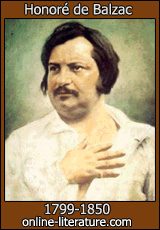
| Art of Worldly Wisdom Daily In the 1600s, Balthasar Gracian, a jesuit priest wrote 300 aphorisms on living life called "The Art of Worldly Wisdom." Join our newsletter below and read them all, one at a time. |
Sonnet-a-Day Newsletter Shakespeare wrote over 150 sonnets! Join our Sonnet-A-Day Newsletter and read them all, one at a time. |
