 Subscribe for ad free access & additional features for teachers. Authors: 267, Books: 3,607, Poems & Short Stories: 4,435, Forum Members: 71,154, Forum Posts: 1,238,602, Quizzes: 344
Act I
N.B.--There is a point of some technical interest to be noted
in this play. The customary division into acts and scenes has
been disused, and a return made to unity of time and place, as
observed in the ancient Greek drama. In the foregoing tragedy,
The Doctor's Dilemma, there are five acts; the place is altered
five times; and the time is spread over an undetermined period
of more than a year. No doubt the strain on the attention of
the audience and on the ingenuity of the playwright is much
less; but I find in practice that the Greek form is inevitable
when drama reaches a certain point in poetic and intellectual
evolution. Its adoption was not, on my part, a deliberate
display of virtuosity in form, but simply the spontaneous
falling of a play of ideas into the form most suitable to it,
which turned out to be the classical form. Getting Married, in
several acts and scenes, with the time spread over a long
period, would be impossible.
**
On a fine morning in the spring of 1908 the Norman kitchen in the
Palace of the Bishop of Chelsea looks very spacious and clean and
handsome and healthy.
The Bishop is lucky enough to have a XII century palace. The
palace itself has been lucky enough to escape being carved up
into XV century Gothic, or shaved into XVIII century ashlar, or
"restored" by a XIX century builder and a Victorian architect
with a deep sense of the umbrella-like gentlemanliness of XIV
century vaulting. The present occupant, A. Chelsea, unofficially
Alfred Bridgenorth, appreciates Norman work. He has, by adroit
complaints of the discomfort of the place, induced the
Ecclesiastical Commissioners to give him some money to spend on
it; and with this he has got rid of the wall papers, the paint,
the partitions, the exquisitely planed and moulded casings with
which the Victorian cabinetmakers enclosed and hid the huge black
beams of hewn oak, and of all other expedients of his
predecessors to make themselves feel at home and respectable in a
Norman fortress. It is a house built to last for ever. The walls
and beams are big enough to carry the tower of Babel, as if the
builders, anticipating our modern ideas and instinctively defying
them, had resolved to show how much material they could lavish on
a house built for the glory of God, instead of keeping a
competitive eye on the advantage of sending in the lowest tender,
and scientifically calculating how little material would be
enough to prevent the whole affair from tumbling down by its own
weight.
The kitchen is the Bishop's favorite room. This is not at all
because he is a man of humble mind; but because the kitchen is
one of the finest rooms in the house. The Bishop has neither the
income nor the appetite to have his cooking done there. The
windows, high up in the wall, look north and south. The north
window is the largest; and if we look into the kitchen through it
we see facing us the south wall with small Norman windows and an
open door near the corner to the left. Through this door we have
a glimpse of the garden, and of a garden chair in the sunshine.
In the right-hand corner is an entrance to a vaulted circular
chamber with a winding stair leading up through a tower to the
upper floors of the palace. In the wall to our right is the
immense fireplace, with its huge spit like a baby crane, and a
collection of old iron and brass instruments which pass as the
original furniture of the fire, though as a matter of fact they
have been picked up from time to time by the Bishop at secondhand
shops. In the near end of the left hand wall a small Norman door
gives access to the Bishop's study, formerly a scullery. Further
along, a great oak chest stands against the wall. Across the
middle of the kitchen is a big timber table surrounded by eleven
stout rush-bottomed chairs: four on the far side, three on the
near side, and two at each end. There is a big chair with railed
back and sides on the hearth. On the floor is a drugget of thick
fibre matting. The only other piece of furniture is a clock with
a wooden dial about as large as the bottom of a washtub, the
weights, chains, and pendulum being of corresponding magnitude;
but the Bishop has long since abandoned the attempt to keep it
going. It hangs above the oak chest.
The kitchen is occupied at present by the Bishop's lady, Mrs
Bridgenorth, who is talking to Mr William Collins, the
greengrocer. He is in evening dress, though it is early forenoon.
Mrs Bridgenorth is a quiet happy-looking woman of fifty or
thereabouts, placid, gentle, and humorous, with delicate features
and fine grey hair with many white threads. She is dressed as for
some festivity; but she is taking things easily as she sits in
the big chair by the hearth, reading The Times.
Collins is an elderly man with a rather youthful waist. His
muttonchop whiskers have a coquettish touch of Dundreary at their
lower ends. He is an affable man, with those perfect manners
which can be acquired only in keeping a shop for the sale of
necessaries of life to ladies whose social position is so
unquestionable that they are not anxious about it. He is a
reassuring man, with a vigilant grey eye, and the power of saying
anything he likes to you without offence, because his tone always
implies that he does it with your kind permission. Withal by no
means servile: rather gallant and compassionate, but never
without a conscientious recognition, on public grounds, of social
distinctions. He is at the oak chest counting a pile of napkins.
**
Mrs Bridgenorth reads placidly: Collins counts: a blackbird sings
in the garden. Mrs Bridgenorth puts The Times down in her lap and
considers Collins for a moment.
MRS BRIDGENORTH. Do you never feel nervous on these occasions,
Collins?
COLLINS. Lord bless you, no, maam. It would be a joke, after
marrying five of your daughters, if I was to get nervous over
marrying the last of them.
MRS BRIDGENORTH. I have always said you were a wonderful man,
Collins.
COLLINS [almost blushing] Oh, maam!
MRS BRIDGENORTH. Yes. I never could arrange anything--a wedding
or even dinner--without some hitch or other.
COLLINS. Why should you give yourself the trouble, maam? Send for
the greengrocer, maam: thats the secret of easy housekeeping.
Bless you, it's his business. It pays him and you, let alone the
pleasure in a house like this [Mrs Bridgenorth bows in
acknowledgment of the compliment]. They joke about the
greengrocer, just as they joke about the mother-in-law. But they
cant get on without both.
MRS BRIDGENORTH. What a bond between us, Collins!
COLLINS. Bless you, maam, theres all sorts of bonds between all
sorts of people. You are a very affable lady, maam, for a
Bishop's lady. I have known Bishop's ladies that would fairly
provoke you to up and cheek them; but nobody would ever forget
himself and his place with you, maam.
MRS BRIDGENORTH. Collins: you are a flatterer. You will
superintend the breakfast yourself as usual, of course, wont you?
COLLINS. Yes, yes, bless you, maam, of course. I always do. Them
fashionable caterers send down such people as I never did set
eyes on. Dukes you would take them for. You see the relatives
shaking hands with them and asking them about the family--
actually ladies saying "Where have we met before?" and all sorts
of confusion. Thats my secret in business, maam. You can always
spot me as the greengrocer. It's a fortune to me in these days,
when you cant hardly tell who any one is or isnt. [He goes out
through the tower, and immediately returns for a moment to
announce] The General, maam.
Mrs Bridgenorth rises to receive her brother-in-law, who enters
resplendent in full-dress uniform, with many medals and orders.
General Bridgenorth is a well set up man of fifty, with large
brave nostrils, an iron mouth, faithful dog's eyes, and much
natural simplicity and dignity of character. He is ignorant,
stupid, and prejudiced, having been carefully trained to be so;
and it is not always possible to be patient with him when his
unquestionably good intentions become actively mischievous; but
one blames society, not himself, for this. He would be no worse a
man than Collins, had he enjoyed Collins's social opportunities.
He comes to the hearth, where Mrs Bridgenorth is standing with
her back to the fireplace.
MRS BRIDGENORTH. Good morning, Boxer. [They shake hands]. Another
niece to give away. This is the last of them.
THE GENERAL [very gloomy] Yes, Alice. Nothing for the old warrior
uncle to do but give away brides to luckier men than himself.
Has--[he chokes] has your sister come yet?
MRS BRIDGENORTH. Why do you always call Lesbia my sister? Dont
you know that it annoys her more than any of the rest of your
tricks?
THE GENERAL. Tricks! Ha! Well, I'll try to break myself of it;
but I think she might bear with me in a little thing like that.
She knows that her name sticks in my throat. Better call her your
sister than try to call her L-- [he almost breaks down] L-- well,
call her by her name and make a fool of myself by crying. [He
sits down at the near end of the table].
MRS BRIDGENORTH [going to him and rallying him] Oh come, Boxer!
Really, really! We are no longer boys and girls. You cant keep up
a broken heart all your life. It must be nearly twenty years
since she refused you. And you know that it's not because she
dislikes you, but only that she's not a marrying woman.
THE GENERAL. It's no use. I love her still. And I cant help
telling her so whenever we meet, though I know it makes her avoid
me. [He all but weeps].
MRS BRIDGENORTH. What does she say when you tell her?
THE GENERAL. Only that she wonders when I am going to grow out of
it. I know now that I shall never grow out of it.
MRS BRIDGENORTH. Perhaps you would if you married her. I
believe youre better as you are, Boxer.
THE GENERAL. I'm a miserable man. I'm really sorry to be a
ridiculous old bore, Alice; but when I come to this house for a
wedding--to these scenes--to--to recollections of the past--
always to give the bride to somebody else, and never to have my
bride given to me--[he rises abruptly] May I go into the garden
and smoke it off?
MRS BRIDGENORTH. Do, Boxer.
Collins returns with the wedding cake.
MRS BRIDGENORTH. Oh, heres the cake. I believe it's the same one
we had for Florence's wedding.
THE GENERAL. I cant bear it [he hurries out through the garden
door].
COLLINS [putting the cake on the table] Well, look at that,
maam! Aint it odd that after all the weddings he's given away at,
the General cant stand the sight of a wedding cake yet. It always
seems to give him the same shock.
MRS BRIDGENORTH. Well, it's his last shock. You have married the
whole family now, Collins. [She takes up The Times again and
resumes her seat].
COLLINS. Except your sister, maam. A fine character of a lady,
maam, is Miss Grantham. I have an ambition to arrange her wedding
breakfast.
MRS BRIDGENORTH. She wont marry, Collins.
COLLINS. Bless you, maam, they all say that. You and me said it,
I'll lay. I did, anyhow.
MRS BRIDGENORTH. No: marriage came natural to me. I should have
thought it did to you too.
COLLINS [pensive] No, maam: it didnt come natural. My wife had to
break me into it. It came natural to her: she's what you might
call a regular old hen. Always wants to have her family within
sight of her. Wouldnt go to bed unless she knew they was all safe
at home and the door locked, and the lights out. Always wants her
luggage in the carriage with her. Always goes and makes the
engine driver promise her to be careful. She's a born wife and
mother, maam. Thats why my children all ran away from home.
MRS BRIDGENORTH. Did you ever feel inclined to run away, Collins?
COLLINS. Oh yes, maam, yes: very often. But when it came to the
point I couldnt bear to hurt her feelings. Shes a sensitive,
affectionate, anxious soul; and she was never brought up to know
what freedom is to some people. You see, family life is all the
life she knows: she's like a bird born in a cage, that would die
if you let it loose in the woods. When I thought how little it
was to a man of my easy temper to put up with her, and how deep
it would hurt her to think it was because I didnt care for her, I
always put off running away till next time; and so in the end I
never ran away at all. I daresay it was good for me to be took
such care of; but it cut me off from all my old friends something
dreadful, maam: especially the women, maam. She never gave them a
chance: she didnt indeed. She never understood that married
people should take holidays from one another if they are to keep
at all fresh. Not that I ever got tired of her, maam; but my! how
I used to get tired of home life sometimes. I used to catch
myself envying my brother George: I positively did, maam.
MRS BRIDGENORTH. George was a bachelor then, I suppose?
COLLINS. Bless you, no, maam. He married a very fine figure of a
woman; but she was that changeable and what you might call
susceptible, you would not believe. She didnt seem to have any
control over herself when she fell in love. She would mope for a
couple of days, crying about nothing; and then she would up and
say--no matter who was there to hear her--"I must go to him,
George"; and away she would go from her home and her husband
without with-your-leave or by-your-leave.
MRS BRIDGENORTH. But do you mean that she did this more than
once? That she came back?
COLLINS. Bless you, maam, she done it five times to my own
knowledge; and then George gave up telling us about it, he got so
used to it.
MRS BRIDGENORTH. But did he always take her back?
COLLINS. Well, what could he do, maam? Three times out of four
the men would bring her back the same evening and no harm done.
Other times theyd run away from her. What could any man with a
heart do but comfort her when she came back crying at the way
they dodged her when she threw herself at their heads, pretending
they was too noble to accept the sacrifice she was making. George
told her again and again that if she'd only stay at home and hold
off a bit theyd be at her feet all day long. She got sensible at
last and took his advice. George always liked change of company.
MRS BRIDGENORTH. What an odious woman, Collins! Dont you think
so?
COLLINS [judicially] Well, many ladies with a domestic turn
thought so and said so, maam. But I will say for Mrs George that
the variety of experience made her wonderful interesting. Thats
where the flighty ones score off the steady ones, maam. Look at
my old woman! She's never known any man but me; and she cant
properly know me, because she dont know other men to compare me
with. Of course she knows her parents in--well, in the way one
does know one's parents not knowing half their lives as you might
say, or ever thinking that they was ever young; and she knew her
children as children, and never thought of them as independent
human beings till they ran away and nigh broke her heart for a
week or two. But Mrs George she came to know a lot about men of
all sorts and ages; for the older she got the younger she liked
em; and it certainly made her interesting, and gave her a lot of
sense. I have often taken her advice on things when my own poor
old woman wouldnt have been a bit of use to me.
MRS BRIDGENORTH. I hope you dont tell your wife that you go
elsewhere for advice.
COLLINS. Lord bless you, maam, I'm that fond of my old Matilda
that I never tell her anything at all for fear of hurting her
feelings. You see, she's such an out-and-out wife and mother that
she's hardly a responsible human being out of her house, except
when she's marketing.
MRS BRIDGENORTH. Does she approve of Mrs George?
COLLINS. Oh, Mrs George gets round her. Mrs George can get round
anybody if she wants to. And then Mrs George is very particular
about religion. And shes a clairvoyant.
MRS BRIDGENORTH [surprised] A clairvoyant!
COLLINS [calm] Oh yes, maam, yes. All you have to do is to
mesmerize her a bit; and off she goes into a trance, and says the
most wonderful things! not things about herself, but as if it was
the whole human race giving you a bit of its mind. Oh, wonderful,
maam, I assure you. You couldnt think of a game that Mrs George
isnt up to.
Lesbia Grantham comes in through the tower. She is a tall,
handsome, slender lady in her prime; that is, between 36 and 55.
She has what is called a well-bred air, dressing very carefully
to produce that effect without the least regard for the latest
fashions, sure of herself, very terrifying to the young and shy,
fastidious to the ends of her long finger-tips, and tolerant and
amused rather than sympathetic.
LESBIA. Good morning, dear big sister.
MRS BRIDGENORTH. Good morning, dear little sister. [They kiss].
LESBIA. Good morning, Collins. How well you are looking! And how
young! [She turns the middle chair away from the table and sits
down].
COLLINS. Thats only my professional habit at a wedding, Miss. You
should see me at a political dinner. I look nigh seventy.
[Looking at his watch] Time's getting along, maam. May I send up
word from you to Miss Edith to hurry a bit with her dressing?
MRS BRIDGENORTH. Do, Collins.
Collins goes out through the tower, taking the cake with him.
LESBIA. Dear old Collins! Has he told you any stories this
morning?
MRS BRIDGENORTH. Yes. You were just late for a particularly
thrilling invention of his.
LESBIA. About Mrs George?
MRS BRIDGENORTH. Yes. He says she's a clairvoyant.
LESBIA. I wonder whether he really invented George, or stole her
out of some book.
MRS BRIDGENORTH. I wonder!
LESBIA. Wheres the Barmecide?
MRS BRIDGENORTH. In the study, working away at his new book. He
thinks no more now of having a daughter married than of having an
egg for breakfast.
The General, soothed by smoking, comes in from the garden.
THE GENERAL [with resolute bonhomie] Ah, Lesbia!
MRS BRIDGENORTH. How do you do? [They shake hands; and he takes
the chair on her right].
Mrs Bridgenorth goes out through the tower.
LESBIA. How are you, Boxer? You look almost as gorgeous as the
wedding cake.
THE GENERAL. I make a point of appearing in uniform whenever I
take part in any ceremony, as a lesson to the subalterns. It is
not the custom in England; but it ought to be.
LESBIA. You look very fine, Boxer. What a frightful lot of
bravery all these medals must represent!
THE GENERAL. No, Lesbia. They represent despair and cowardice. I
won all the early ones by trying to get killed. You know why.
LESBIA. But you had a charmed life?
THE GENERAL. Yes, a charmed life. Bayonets bent on my buckles.
Bullets passed through me and left no trace: thats the worst of
modern bullets: Ive never been hit by a dum-dum. When I was only
a company officer I had at least the right to expose myself to
death in the field. Now I'm a General even that resource is cut
off. [Persuasively drawing his chair nearer to her] Listen to me,
Lesbia. For the tenth and last time--
LESBIA [interrupting] On Florence's wedding morning, two years
ago, you said "For the ninth and last time."
THE GENERAL. We are two years older, Lesbia. I'm fifty: you
are--
LESBIA. Yes, I know. It's no use, Boxer. When will you be old
enough to take no for an answer?
THE GENERAL. Never, Lesbia, never. You have never given me a real
reason for refusing me yet. I once thought it was somebody else.
There were lots of fellows after you; but now theyve all given it
up and married. [Bending still nearer to her] Lesbia: tell me
your secret. Why--
LESBIA [sniffing disgustedly] Oh! Youve been smoking. [She rises
and goes to the chair on the hearth] Keep away, you wretch.
THE GENERAL. But for that pipe, I could not have faced you
without breaking down. It has soothed me and nerved me.
LESBIA [sitting down with The Times in her hand] Well, it has
nerved me to tell you why I'm going to be an old maid.
THE GENERAL [impulsively approaching her] Dont say that, Lesbia.
It's not natural: it's not right: it's--
LESBIA. [fanning him off] No: no closer, Boxer, please. [He
retreats, discouraged]. It may not be natural; but it happens all
the time. Youll find plenty of women like me, if you care to look
for them: women with lots of character and good looks and money
and offers, who wont and dont get married. Cant you guess why?
THE GENERAL. I can understand when there is another.
LESBIA. Yes; but there isnt another. Besides, do you suppose I
think, at my time of life, that the difference between one decent
sort of man and another is worth bothering about?
THE GENERAL. The heart has its preferences, Lesbia. One image,
and one only, gets indelibly--
LESBIA. Yes. Excuse my interrupting you so often; but your
sentiments are so correct that I always know what you are going
to say before you finish. You see, Boxer, everybody is not like
you. You are a sentimental noodle: you dont see women as they
really are. You dont see me as I really am. Now I do see men as
they really are. I see you as you really are.
THE GENERAL [murmuring] No: dont say that, Lesbia.
LESBIA. I'm a regular old maid. I'm very particular about my
belongings. I like to have my own house, and to have it to
myself. I have a very keen sense of beauty and fitness and
cleanliness and order. I am proud of my independence and jealous
for it. I have a sufficiently well-stocked mind to be very good
company for myself if I have plenty of books and music. The one
thing I never could stand is a great lout of a man smoking all
over my house and going to sleep in his chair after dinner, and
untidying everything. Ugh!
THE GENERAL. But love--
LESBIA. Ob, love! Have you no imagination? Do you think I have
never been in love with wonderful men? heroes! archangels!
princes! sages! even fascinating rascals! and had the strangest
adventures with them? Do you know what it is to look at a mere
real man after that? a man with his boots in every corner, and
the smell of his tobacco in every curtain?
THE GENERAL [somewhat dazed] Well but--excuse my mentioning
it--dont you want children?
LESBIA. I ought to have children. I should be a good mother to
children. I believe it would pay the country very well to pay me
very well to have children. But the country tells me that I cant
have a child in my house without a man in it too; so I tell the
country that it will have to do without my children. If I am to
be a mother, I really cannot have a man bothering me to be a wife
at the same time.
THE GENERAL. My dear Lesbia: you know I dont wish to be
impertinent; but these are not the correct views for an English
lady to express.
LESBIA. That is why I dont express them, except to gentlemen who
wont take any other answer. The difficulty, you see, is that I
really am an English lady, and am particularly proud of being
one.
THE GENERAL. I'm sure of that, Lesbia: quite sure of it. I never
meant--
LESBIA [rising impatiently] Oh, my dear Boxer, do please try to
think of something else than whether you have offended me, and
whether you are doing the correct thing as an English gentleman.
You are faultless, and very dull. [She shakes her shoulders
intolerantly and walks across to the other side of the kitchen].
THE GENERAL [moodily] Ha! thats whats the matter with me. Not
clever. A poor silly soldier man.
LESBIA. The whole matter is very simple. As I say, I am an
English lady, by which I mean that I have been trained to do
without what I cant have on honorable terms, no matter what it
is.
THE GENERAL. I really dont understand you, Lesbia.
LESBIA [turning on him] Then why on earth do you want to marry a
woman you dont understand?
THE GENERAL. I dont know. I suppose I love you.
LESBIA. Well, Boxer, you can love me as much as you like,
provided you look happy about it and dont bore me. But you cant
marry me; and thats all about it.
THE GENERAL. It's so frightfully difficult to argue the matter
fairly with you without wounding your delicacy by overstepping
the bounds of good taste. But surely there are calls of nature--
LESBIA. Dont be ridiculous, Boxer.
THE GENERAL. Well, how am I to express it? Hang it all, Lesbia,
dont you want a husband?
LESBIA. No. I want children; and I want to devote myself entirely
to my children, and not to their father. The law will not allow
me to do that; so I have made up my mind to have neither husband
nor children.
THE GENERAL. But, great Heavens, the natural appetites--
LESBIA. As I said before, an English lady is not the slave of her
appetites. That is what an English gentleman seems incapable of
understanding. [She sits down at the end of the table, near the
study door].
THE GENERAL [huffily] Oh well, if you refuse, you refuse. I shall
not ask you again. I'm sorry I returned to the subject. [He
retires to the hearth and plants himself there, wounded and
lofty].
LESBIA. Dont be cross, Boxer.
THE GENERAL. I'm not cross, only wounded, Lesbia. And when you
talk like that, I dont feel convinced: I only feel utterly at a
loss.
LESBIA. Well, you know our family rule. When at a loss consult
the greengrocer. [Opportunely Collins comes in through the
tower]. Here he is.
COLLINS. Sorry to be so much in and out, Miss. I thought Mrs
Bridgenorth was here. The table is ready now for the breakfast,
if she would like to see it.
LESBIA. If you are satisfied, Collins, I am sure she will be.
THE GENERAL. By the way, Collins: I thought theyd made you an
alderman.
COLLINS. So they have, General.
THE GENERAL. Then wheres your gown?
COLLINS. I dont wear it in private life, General.
THE GENERAL. Why? Are you ashamed of it?
COLLINS. No, General. To tell you the truth, I take a pride in
it. I cant help it.
THE GENERAL. Attention, Collins. Come here. [Collins comes to
him]. Do you see my uniform--all my medals?
COLLINS. Yes, General. They strike the eye, as it were.
THE GENERAL. They are meant to. Very well. Now you know, dont
you, that your services to the community as a greengrocer are as
important and as dignified as mine as a soldier?
COLLINS. I'm sure it's very honorable of you to say so, General.
THE GENERAL [emphatically] You know also, dont you, that any man
who can see anything ridiculous, or unmanly, or unbecoming in
your work or in your civic robes is not a gentleman, but a
jumping, bounding, snorting cad?
COLLINS. Well, strictly between ourselves, that is my opinion,
General.
THE GENERAL. Then why not dignify my niece's wedding by wearing
your robes?
COLLINS. A bargain's a bargain, General. Mrs Bridgenorth sent for
the greengrocer, not for the alderman. It's just as unpleasant to
get more than you bargain for as to get less.
THE GENERAL. I'm sure she will agree with me. I attach importance
to this as an affirmation of solidarity in the service of the
community. The Bishop's apron, my uniform, your robes: the
Church, the Army, and the Municipality.
COLLINS [retiring] Very well, General. [He turns dubiously to
Lesbia on his way to the tower]. I wonder what my wife will say,
Miss?
THE GENERAL. What! Is your, wife ashamed of your robes?
COLLINS. No, sir, not ashamed of them. But she grudged the money
for them; and she will be afraid of my sleeves getting into the
gravy.
Mrs Bridgenorth, her placidity quite upset, comes in with a
letter; hurries past Collins; and comes between Lesbia and the
General.
MRS BRIDGENORTH. Lesbia: Boxer: heres a pretty mess!
Collins goes out discreetly.
THE GENERAL. Whats the matter?
MRS BRIDGENORTH. Reginald's in London, and wants to come to the
wedding.
THE GENERAL [stupended] Well, dash my buttons!
LESBIA. Oh, all right, let him come.
THE GENERAL. Let him come! Why, the decree has not been made
absolute yet. Is he to walk in here to Edith's wedding, reeking
from the Divorce Court?
MRS BRIDGENORTH [vexedly sitting down in the middle chair] It's
too bad. No: I cant forgive him, Lesbia, really. A man of
Reginald's age, with a young wife--the best of girls, and as
pretty as she can be--to go off with a common woman from the
streets! Ugh!
LESBIA. You must make allowances. What can you expect? Reginald
was always weak. He was brought up to be weak. The family
property was all mortgaged when he inherited it. He had to
struggle along in constant money difficulties, hustled by his
solicitors, morally bullied by the Barmecide, and physically
bullied by Boxer, while they two were fighting their own way and
getting well trained. You know very well he couldnt afford to
marry until the mortgages were cleared and he was over fifty. And
then of course he made a fool of himself marrying a child like
Leo.
THE GENERAL. But to hit her! Absolutely to hit her! He knocked
her down--knocked her flat down on a flowerbed in the presence of
his gardener. He! the head of the family! the man that stands
before the Barmecide and myself as Bridgenorth of Bridgenorth! to
beat his wife and go off with a low woman and be divorced for it
in the face of all England! in the face of my uniform and
Alfred's apron! I can never forget what I felt: it was only the
King's personal request--virtually a command--that stopped me
from resigning my commission. I'd cut Reginald dead if I met him
in the street.
MRS BRIDGENORTH. Besides, Leo's coming. Theyd meet. It's
impossible, Lesbia.
LESBIA. Oh, I forgot that. That settles it. He mustnt come.
THE GENERAL. Of course he mustnt. You tell him that if he enters
this house, I'll leave it; and so will every decent man and woman
in it.
COLLINS [returning for a moment to announce] Mr Reginald, maam.
[He withdraws when Reginald enters].
THE GENERAL [beside himself] Well, dash my buttons!!
Reginald is just the man Lesbia has described. He is hardened and
tough physically, and hasty and boyish in his manner and speech,
belonging as he does to the large class of English gentlemen of
property (solicitor-managed) who have never developed
intellectually since their schooldays. He is a muddled,
rebellious, hasty, untidy, forgetful, always late sort of man,
who very evidently needs the care of a capable woman, and has
never been lucky or attractive enough to get it. All the same, a
likeable man, from whom nobody apprehends any malice nor expects
any achievement. In everything but years he is younger than his
brother the General.
REGINALD [coming forward between the General and Mrs Bridgenorth]
Alice: it's no use. I cant stay away from Edith's wedding. Good
morning, Lesbia. How are you, Boxer? [He offers the General his
hand].
THE GENERAL [with crushing stiffness] I was just telling Alice,
sir, that if you entered this house, I should leave it.
REGINALD. Well, dont let me detain you, old chap. When you start
calling people Sir, youre not particularly good company.
LESBIA. Dont you begin to quarrel. That wont improve the
situation.
MRS BRIDGENORTH. I think you might have waited until you got my
answer, Rejjy.
REGINALD. It's so jolly easy to say No in a letter. Wont you let
me stay?
MRS BRIDGENORTH. How can I? Leo's coming.
REGINALD. Well, she wont mind.
THE GENERAL. Wont mind!!!!
LESBIA. Dont talk nonsense, Rejjy; and be off with you.
THE GENERAL [with biting sarcasm] At school you lead a theory
that women liked being knocked down, I remember.
REGINALD. Youre a nice, chivalrous, brotherly sort of swine, you
are.
THE GENERAL. Mr Bridgenorth: are you going to leave this house or
am I?
REGINALD. You are, I hope. [He emphasizes his intention to stay
by sitting down].
THE GENERAL. Alice: will you allow me to be driven from Edith's
wedding by this--
LESBIA [warningly] Boxer!
THE GENERAL. --by this Respondent? Is Edith to be given away by
him?
MRS BRIDGENORTH. Certainly not. Reginald: you were not asked to
come; and I have asked you to go. You know how fond I am of Leo;
and you know what she would feel if she came in and found you
here.
COLLINS [again appearing in the tower] Mrs Reginald, maam.
LESBIA            {No, no. Ask her to--   } [All three
MRS BRIDGENORTH   {Oh,  how unfortunate!  } clamoring
THE GENERAL       {Well, dash my buttons! } together].
It is too late: Leo is already in the kitchen. Collins goes out,
mutely abandoning a situation which he deplores but has been
unable to save.
Leo is very pretty, very youthful, very restless, and
consequently very charming to people who are touched by youth and
beauty, as well as to those who regard young women as more or
less appetizing lollipops, and dont regard old women at all.
Coldly studied, Leo's restlessness is much less lovable than the
kittenishness which comes from a rich and fresh vitality. She is
a born fusser about herself and everybody else for whom she feels
responsible; and her vanity causes her to exaggerate her
responsibilities officiously. All her fussing is about little
things; but she often calls them by big names, such as Art, the
Divine Spark, the world, motherhood, good breeding, the Universe,
the Creator, or anything else that happens to strike her
imagination as sounding intellectually important. She has more
than common imagination and no more than common conception and
penetration; so that she is always on the high horse about words
and always in the perambulator about things. Considering herself
clever, thoughtful, and superior to ordinary weaknesses and
prejudices, she recklessly attaches herself to clever men on that
understanding, with the result that they are first delighted,
then exasperated, and finally bored. When marrying Reginald she
told her friends that there was a great deal in him which needed
bringing out. If she were a middle-aged man she would be the
terror of his club. Being a pretty young woman, she is forgiven
everything, proving that "Tout comprendre, c'est tout pardonner"
is an error, the fact being that the secret of forgiving
everything is to understand nothing.
She runs in fussily, full of her own importance, and swoops on
Lesbia, who is much less disposed to spoil her than Mrs
Bridgenorth is. But Leo affects a special intimacy with Lesbia,
as of two thinkers among the Philistines.
LEO [to Lesbia, kissing her] Good morning. [Coming to Mrs
Bridgenorth] How do, Alice? [Passing on towards the hearth] Why
so gloomy, General? [Reginald rises between her and the General]
Oh, Rejjy! What will the King's Proctor say?
REGINALD. Damn the King's Proctor!
LEO. Naughty. Well, I suppose I must kiss you; but dont any of
you tell. [She kisses him. They can hardly believe their eyes].
Have you kept all your promises?
REGINALD. Oh, dont begin bothering about those--
LEO [insisting] Have? You? Kept? Your? Promises? Have you rubbed
your head with the lotion every night?
REGINALD. Yes, yes. Nearly every night.
LEO. Nearly! I know what that means. Have you worn your liver
pad?
THE GENERAL [solemnly] Leo: forgiveness is one of the most
beautiful traits in a woman's nature; but there are things that
should not be forgiven to a man. When a man knocks a woman down
[Leo gives a little shriek of laughter and collapses on a chair
next Mrs Bridgenorth, on her left]
REGINALD [sardonically] The man that would raise his hand to a
woman, save in the way of a kindness, is unworthy the name of
Bridgenorth. [He sits down at the end of the table nearest the
hearth].
THE GENERAL [much huffed] Oh, well, if Leo does not mind, of
course I have no more to say. But I think you might, out of
consideration for the family, beat your wife in private and not
in the presence of the gardener.
REGINALD [out of patience] Whats the good of beating your wife
unless theres a witness to prove it afterwards? You dont suppose
a man beats his wife for the fun of it, do you? How could she
have got her divorce if I hadnt beaten her? Nice state of things,
that!
THE GENERAL [gasping] Do you mean to tell me that you did it in
cold blood? simply to get rid of your wife?
REGINALD. No, I didn't: I did it to get her rid of me. What would
you do if you were fool enough to marry a woman thirty years
younger than yourself, and then found that she didnt care for
you, and was in love with a young fellow with a face like a
mushroom.
LEO. He has not. [Bursting into tears] And you are most unkind to
say I didnt care for you. Nobody could have been fonder of you.
REGINALD. A nice way of shewing your fondness! I had to go out
and dig that flower bed all over with my own hands to soften it.
I had to pick all the stones out of it. And then she complained
that I hadnt done it properly, because she got a worm down her
neck. I had to go to Brighton with a poor creature who took a
fancy to me on the way down, and got conscientious scruples about
committing perjury after dinner. I had to put her down in the
hotel book as Mrs Reginald Bridgenorth: Leo's name! Do you know
what that feels like to a decent man? Do you know what a decent
man feels about his wife's name? How would you like to go into a
hotel before all the waiters and people with--with that on your
arm? Not that it was the poor girl's fault, of course; only she
started crying because I couldnt stand her touching me; and now
she keeps writing to me. And then I'm held up in the public court
for cruelty and adultery, and turned away from Edith's wedding by
Alice, and lectured by you! a bachelor, and a precious green one
at that. What do you know about it?
THE GENERAL. Am I to understand that the whole case was one of
collusion?
REGINALD. Of course it was. Half the cases are collusions: what
are people to do? [The General, passing his hand dazedly over his
bewildered brow, sinks into the railed chair]. And what do you
take me for, that you should have the cheek to pretend to believe
all that rot about my knocking Leo about and leaving her for--for
a--a-- Ugh! you should have seen her.
THE GENERAL. This is perfectly astonishing to me. Why did you do
it? Why did Leo allow it?
REGINALD. Youd better ask her.
LEO [still in tears] I'm sure I never thought it would be so
horrid for Rejjy. I offered honorably to do it myself, and let
him divorce me; but he wouldnt. And he said himself that it was
the only way to do it--that it was the law that he should do it
that way. I never saw that hateful creature until that day in
Court. If he had only shewn her to me before, I should never have
allowed it.
MRS BRIDGENORTH. You did all this for Leo's sake, Rejjy?
REGINALD [with an unbearable sense of injury] I shouldnt mind a
bit if it were for Leo's sake. But to have to do it to make room
for that mushroom-faced serpent--!
THE GENERAL [jumping up] What right had he to be made room for?
Are you in your senses? What right?
REGINALD. The right of being a young man, suitable to a young
woman. I had no right at my age to marry Leo: she knew no more
about life than a child.
LEO. I knew a great deal more about it than a great baby like
you. I'm sure I dont know how youll get on with no one to take
care of you: I often lie awake at night thinking about it. And
now youve made me thoroughly miserable.
REGINALD. Serve you right! [She weeps]. There: dont get into a
tantrum, Leo.
LESBIA. May one ask who is the mushroom-faced serpent?
LEO. He isnt.
REGINALD. Sinjon Hotchkiss, of course.
MRS BRIDGENORTH. Sinjon Hotchkiss! Why, he's coming to the
wedding!
REGINALD. What! In that case I'm off [he makes for the tower].
LEO          }                 { [seizing him] No you shant.
                                 You promised to be nice to
                 (all four       him.
THE GENERAL  }    rushing      { No, dont go, old chap. Not
                  after him      from Edith's wedding.
                  and capturing
                  him on the
MRS. BRIDGE-      threshold)
NORTH        }                 { Oh, do stay, Benjjy. I shall
                                 really be hurt if you desert
                                 us.
LESBIA       }                 { Better stay, Reginald. You must
                                 meet him sooner or later.
REGINALD. A moment ago, when I wanted to stay, you were all
shoving me out of the house. Now that I want to go, you wont let
me.
MRS BRIDGENORTH. I shall send a note to Mr Hotchkiss not to come.
LEO [weeping again] Oh, Alice! [She comes back to her chair,
heartbroken].
REGINALD [out of patience] Oh well, let her have her way. Let her
have her mushroom. Let him come. Let them all come.
He crosses the kitchen to the oak chest and sits sulkily on it.
Mrs Bridgenorth shrugs her shoulders and sits at the table in
Reginald's neighborhood listening in placid helplessness. Lesbia,
out of patience with Leo's tears, goes into the garden and sits
there near the door, snuffing up the open air in her relief from
the domestic stuffness of Reginald's affairs.
LEO. It's so cruel of you to go on pretending that I dont care
for you, Rejjy.
REGINALD [bitterly] She explained to me that it was only that she
had exhausted my conversation.
THE GENERAL [coming paternally to Leo] My dear girl: all the
conversation in the world has been exhausted long ago. Heaven
knows I have exhausted the conversation of the British Army these
thirty years; but I dont leave it on that account.
LEO. It's not that Ive exhausted it; but he will keep on
repeating it when I want to read or go to sleep. And Sinjon
amuses me. He's so clever.
THE GENERAL [stung] Ha! The old complaint. You all want geniuses
to marry. This demand for clever men is ridiculous. Somebody must
marry the plain, honest, stupid fellows. Have you thought of
that?
LEO. But there are such lots of stupid women to marry. Why do
they want to marry us? Besides, Rejjy knows that I'm quite fond
of him. I like him because he wants me; and I like Sinjon because
I want him. I feel that I have a duty to Rejjy.
THE GENERAL. Precisely: you have.
LEO. And, of course, Sinjon has the same duty to me.
THE GENERAL. Tut, tut!
LEO. Oh, how silly the law is! Why cant I marry them both?
THE GENERAL [shocked] Leo!
LEO. Well, I love them both. I should like to marry a lot of men.
I should like to have Rejjy for every day, and Sinjon for
concerts and theatres and going out in the evenings, and some
great austere saint for about once a year at the end of the
season, and some perfectly blithering idiot of a boy to be quite
wicked with. I so seldom feel wicked; and, when I do, it's such a
pity to waste it merely because it's too silly to confess to a
real grown-up man.
REGINALD. This is the kind of thing, you know [Helplessly] Well,
there it is!
THE GENERAL [decisively] Alice: this is a job for the Barmecide.
He's a Bishop: it's his duty to talk to Leo. I can stand a good
deal; but when it comes to flat polygamy and polyandry, we ought
to do something.
MRS BRIDGENORTH [going to the study door] Do come here a moment,
Alfred. We're in a difficulty.
THE BISHOP [within] Ask Collins, I'm busy.
MRS BRIDGENORTH. Collins wont do. It's something very serious. Do
come just a moment, dear. [When she hears him coming she takes a
chair at the nearest end of the table].
The Bishop comes out of his study. He is still a slim active man,
spare of flesh, and younger by temperament than his brothers. He
has a delicate skin, fine hands, a salient nose with chin to
match, a short beard which accentuates his sharp chin by
bristling forward, clever humorous eyes, not without a glint of
mischief in them, ready bright speech, and the ways of a
successful man who is always interested in himself and generally
rather well pleased with himself. When Lesbia hears his voice she
turns her chair towards him, and presently rises and stands in
the doorway listening to the conversation.
THE BISHOP [going to Leo] Good morning, my dear. Hullo! Youve
brought Reginald with you. Thats very nice of you. Have you
reconciled them, Boxer?
THE GENERAL. Reconciled them! Why, man, the whole divorce was a
put-up job. She wants to marry some fellow named Hotchkiss.
REGINALD. A fellow with a face like--
LEO. You shant, Rejjy. He has a very fine face.
MRS BRIDGENORTH. And now she says she wants to marry both of
them, and a lot of other people as well.
LEO. I didnt say I wanted to marry them: I only said I should
like to marry them.
THE BISHOP. Quite a nice distinction, Leo.
LEO. Just occasionally, you know.
THE BISHOP [sitting down cosily beside her] Quite so. Sometimes a
poet, sometimes a Bishop, sometimes a fairy prince, sometimes
somebody quite indescribable, and sometimes nobody at all.
LEO. Yes: thats just it. How did you know?
THE BISHOP. Oh, I should say most imaginative and cultivated
young women feel like that. I wouldnt give a rap for one who
didnt. Shakespear pointed out long ago that a woman wanted a
Sunday husband as well as a weekday one. But, as usual, he didnt
follow up the idea.
THE GENERAL [aghast] Am I to understand--
THE BISHOP [cutting him short] Now, Boxer, am I the Bishop or are
you?
THE GENERAL [sulkily] You.
THE BISHOP. Then dont ask me are you to understand. "Yours not to
reason why: yours but to do and die"--
THE GENERAL. Oh, very well: go on. I'm not clever. Only a silly
soldier man. Ha! Go on. [He throws himself into the railed chair,
as one prepared for the worst].
MRS BRIDGENORTH. Alfred: dont tease Boxer.
THE BISHOP. If we are going to discuss ethical questions we must
begin by giving the devil fair play. Boxer never does. England
never does. We always assume that the devil is guilty; and we
wont allow him to prove his innocence, because it would be
against public morals if he succeeded. We used to do the same
with prisoners accused of high treason. And the consequence is
that we overreach ourselves; and the devil gets the better of us
after all. Perhaps thats what most of us intend him to do.
THE GENERAL. Alfred: we asked you here to preach to Leo. You are
preaching at me instead. I am not conscious of having said or
done anything that calls for that unsolicited attention.
THE BISHOP. But poor little Leo has only told the simple truth;
whilst you, Boxer, are striking moral attitudes.
THE GENERAL. I suppose thats an epigram. I dont understand
epigrams. I'm only a silly soldier man. Ha! But I can put a plain
question. Is Leo to be encouraged to be a polygamist?
THE BISHOP. Remember the British Empire, Boxer. Youre a British
General, you know.
THE GENERAL. What has that to do with polygamy?
THE BISHOP. Well, the great majority of our fellow-subjects are
polygamists. I cant as a British Bishop insult them by speaking
disrespectfully of polygamy. It's a very interesting question.
Many very interesting men have been polygamists: Solomon,
Mahomet, and our friend the Duke of--of--hm! I never can remember
his name.
THE GENERAL. It would become you better, Alfred, to send that
silly girl back to her husband and her duty than to talk clever
and mock at your religion. "What God hath joined together let no
man put asunder." Remember that.
THE BISHOP. Dont be afraid, Boxer. What God hath joined together
no man ever shall put asunder: God will take care of that. [To
Leo] By the way, who was it that joined you and Reginald, my
dear?
LEO. It was that awful little curate that afterwards drank, and
travelled first class with a third-class ticket, and then tried
to go on the stage. But they wouldnt have him. He called himself
Egerton Fotheringay.
THE BISHOP. Well, whom Egerton Fotheringay hath joined, let Sir
Gorell Barnes put asunder by all means.
THE GENERAL. I may be a silly soldier man; but I call this
blasphemy.
THE BISHOP [gravely] Better for me to take the name of Mr Egerton
Fotheringay in earnest than for you to take a higher name in
vain.
LESBIA. Cant you three brothers ever meet without quarrelling?
THE BISHOP [mildly] This is not quarrelling, Lesbia: it's only
English family life. Good morning.
LEO. You know, Bishop, it's very dear of you to take my part; but
I'm not sure that I'm not a little shocked.
THE BISHOP. Then I think Ive been a little more successful than
Boxer in getting you into a proper frame of mind.
THE GENERAL [snorting] Ha!
LEO. Not a bit; for now I'm going to shock you worse than ever.
I think Solomon was an old beast.
THE BISHOP. Precisely what you ought to think of him, my dear.
Dont apologize.
THE GENERAL [more shocked] Well, but hang it! Solomon was in the
Bible. And, after all, Solomon was Solomon.
LEO. And I stick to it: I still want to have a lot of interesting
men to know quite intimately--to say everything I think of to
them, and have them say everything they think of to me.
THE BISHOP. So you shall, my dear, if you are lucky. But you know
you neednt marry them all. Think of all the buttons you would
have to sew on. Besides, nothing is more dreadful than a husband
who keeps telling you everything he thinks, and always wants to
know what you think.
LEO [struck by this] Well, thats very true of Rejjy: In fact,
thats why I had to divorce him.
THE BISHOP [condoling] Yes: he repeats himself dreadfully, doesnt
he?
REGINALD. Look here, Alfred. If I have my faults, let her find
them out for herself without your help.
THE BISHOP. She has found them all out already, Reginald.
LEO [a little huffily] After all, there are worse men than
Reginald. I daresay he's not so clever as you; but still he's not
such a fool as you seem to think him!
THE BISHOP. Quite right, dear: stand up for your husband. I hope
you will always stand up for all your husbands. [He rises and
goes to the hearth, where he stands complacently with his back to
the fireplace, beaming at them all as at a roomful of children].
LEO. Please dont talk as if I wanted to marry a whole regiment.
For me there can never be more than two. I shall never love
anybody but Rejjy and Sinjon.
REGINALD. A man with a face like a--
LEO. I wont have it, Rejjy. It's disgusting.
THE BISHOP. You see, my dear, youll exhaust Sinjon's conversation
too in a week or so. A man is like a phonograph with half-a-dozen
records. You soon get tired of them all; and yet you have to sit
at table whilst he reels them off to every new visitor. In the
end you have to be content with his common humanity; and when you
come down to that, you find out about men what a great English
poet of my acquaintance used to say about women: that they all
taste alike. Marry whom you please: at the end of a month he'll
be Reginald over again. It wasnt worth changing: indeed it wasnt.
LEO. Then it's a mistake to get married.
THE BISHOP. It is, my dear; but it's a much bigger mistake not to
get married.
THE GENERAL [rising] Ha! You hear that, Lesbia? [He joins her at
the garden door].
LESBIA. Thats only an epigram, Boxer.
THE GENERAL. Sound sense, Lesbia. When a man talks rot, thats
epigram: when he talks sense, then I agree with him.
REGINALD [coming off the oak chest and looking at his watch] It's
getting late. Wheres Edith? Hasnt she got into her veil and
orange blossoms yet?
MRS BRIDGENORTH. Do go and hurry her, Lesbia.
LESBIA [going out through the tower] Come with me, Leo.
LEO [following Lesbia out] Yes, certainly.
The Bishop goes over to his wife and sits down, taking her hand
and kissing it by way of beginning a conversation with her.
THE BISHOP. Alice: Ive had another letter from the mysterious
lady who cant spell. I like that woman's letters. Theres an
intensity of passion in them that fascinates me.
MRS BRIDGENORTH. Do you mean Incognita Appassionata?
THE BISHOP. Yes.
THE GENERAL [turning abruptly; he has been looking out into the
garden] Do you mean to say that women write love-letters to you?
THE BISHOP. Of course.
THE GENERAL. They never do to me.
THE BISHOP. The army doesnt attract women: the Church does.
REGINALD. Do you consider it right to let them? They may be
married women, you know.
THE BISHOP. They always are. This one is. [To Mrs Bridgenorth]
Dont you think her letters are quite the best love-letters I get?
[To the two men] Poor Alice has to read my love-letters aloud to
me at breakfast, when theyre worth it.
MRS BRIDGENORTH. There really is something fascinating about
Incognita. She never gives her address. Thats a good sign.
THE GENERAL. Mf! No assignations, you mean?
THE Bishop. Oh yes: she began the correspondence by making a very
curious but very natural assignation. She wants me to meet her in
heaven. I hope I shall.
THE GENERAL. Well, I must say I hope not, Alfred. I hope not.
MRS BRIDGENORTH. She says she is happily married, and that love
is a necessary of life to her, but that she must have, high above
all her lovers--
THE BISHOP. She has several apparently--
MRS BRIDGENORTH. --some great man who will never know her, never
touch her, as she is on earth, but whom she can meet in Heaven
when she has risen above all the everyday vulgarities of earthly
love.
THE BISHOP [rising] Excellent. Very good for her; and no trouble
to me. Everybody ought to have one of these idealizations, like
Dante's Beatrice. [He clasps his hands behind him, and strolls to
the hearth and back, singing].
Lesbia appears in the tower, rather perturbed.
LESBIA. Alice: will you come upstairs? Edith is not dressed.
MRS BRIDGENORTH [rising] Not dressed! Does she know what hour it
is?
LESBIA. She has locked herself into her room, reading.
The Bishop's song ceases; he stops dead in his stroll.
THE GENERAL. Reading!
THE BISHOP. What is she reading?
LESBIA. Some pamphlet that came by the eleven o'clock post. She
wont come out. She wont open the door. And she says she doesnt
know whether she's going to be married or not till she's finished
the pamphlet. Did you ever hear such a thing? Do come and speak
to her.
MRS BRIDGENORTH. Alfred: you had better go.
THE BISHOP. Try Collins.
LESBIA. Weve tried Collins already. He got all that Ive told you
out of her through the keyhole. Come, Alice. [She vanishes. Mrs
Bridgenorth hurries after her].
THE BISHOP. This means a delay. I shall go back to my work [he
makes for the study door].
REGINALD. What are you working at now?
THE BISHOP [stopping] A chapter in my history of marriage. I'm
just at the Roman business, you know.
THE GENERAL [coming from the garden door to the chair Mrs
Bridgenorth has just left, and sitting down] Not more Ritualism,
I hope, Alfred?
THE BISHOP. Oh no. I mean ancient Rome. [He seats himself on the
edge of the table]. Ive just come to the period when the
propertied classes refused to get married and went in for
marriage settlements instead. A few of the oldest families stuck
to the marriage tradition so as to keep up the supply of vestal
virgins, who had to be legitimate; but nobody else dreamt of
getting married. It's all very interesting, because we're coming
to that here in England; except that as we dont require any
vestal virgins, nobody will get married at all, except the poor,
perhaps.
THE GENERAL. You take it devilishly coolly. Reginald: do you
think the Barmecide's quite sane?
REGINALD. No worse than ever he was.
THE GENERAL [to the Bishop] Do you mean to say you believe such a
thing will ever happen in England as that respectable people will
give up being married?
THE BISHOP. In England especially they will. In other countries
the introduction of reasonable divorce laws will save the
situation; but in England we always let an institution strain
itself until it breaks. Ive told our last four Prime Ministers
that if they didnt make our marriage laws reasonable there would
be a strike against marriage, and that it would begin among the
propertied classes, where no Government would dare to interfere
with it.
REGINALD. What did they say to that?
THE BISHOP. The usual thing. Quite agreed with me, but were sure
that they were the only sensible men in the world, and that the
least hint of marriage reform would lose them the next election.
And then lost it all the same: on cordite, on drink, on Chinese
labor in South Africa, on all sorts of trumpery.
REGINALD [lurching across the kitchen towards the hearth with his
hands in his pockets] It's no use: they wont listen to our sort.
[Turning on them] Of course they have to make you a Bishop and
Boxer a General, because, after all, their blessed rabble of
snobs and cads and half-starved shopkeepers cant do government
work; and the bounders and week-enders are too lazy and vulgar.
Theyd simply rot without us; but what do they ever do for us?
what attention do they ever pay to what we say and what we want?
I take it that we Bridgenorths are a pretty typical English
family of the sort that has always set things straight and stuck
up for the right to think and believe according to our
conscience. But nowadays we are expected to dress and eat as the
week-end bounders do, and to think and believe as the converted
cannibals of Central Africa do, and to lie down and let every
snob and every cad and every halfpenny journalist walk over us.
Why, theres not a newspaper in England today that represents what
I call solid Bridgenorth opinion and tradition. Half of them read
as if they were published at the nearest mother's meeting, and
the other half at the nearest motor garage. Do you call these
chaps gentlemen? Do you call them Englishmen? I dont.[He throws
himself disgustedly into the nearest chair].
THE GENERAL [excited by Reginald's eloquence] Do you see my
uniform? What did Collins say? It strikes the eye. It was meant
to. I put it on expressly to give the modern army bounder a smack
in the eye. Somebody has to set a right example by beginning.
Well, let it be a Bridgenorth. I believe in family blood and
tradition, by George.
THE BISHOP [musing] I wonder who will begin the stand against
marriage. It must come some day. I was married myself before I'd
thought about it; and even if I had thought about it I was too
much in love with Alice to let anything stand in the way. But,
you know, Ive seen one of our daughters after another--Ethel,
Jane, Fanny, and Christina and Florence--go out at that door in
their veils and orange blossoms; and Ive always wondered whether
theyd have gone quietly if theyd known what they were doing. Ive
a horrible misgiving about that pamphlet. All progress means war
with Society. Heaven forbid that Edith should be one of the
combatants!
St John Hotchkiss comes into the tower ushered by Collins. He is
a very smart young gentleman of twenty-nine or thereabouts,
correct in dress to the last thread of his collar, but too much
preoccupied with his ideas to be embarrassed by any concern as to
his appearance. He talks about himself with energetic gaiety. He
talks to other people with a sweet forbearance (implying a kindly
consideration for their stupidity) which infuriates those whom he
does not succeed in amusing. They either lose their tempers with
him or try in vain to snub him.
COLLINS [announcing] Mr Hotchkiss. [He withdraws].
HOTCHKISS [clapping Reginald gaily on the shoulder as he passes
him] Tootle loo, Rejjy.
REGINALD [curtly, without rising or turning his head] Morning.
HOTCHKISS. Good morning, Bishop.
THE BISHOP [coming off the table]. What on earth are you doing
here, Sinjon? You belong to the bridegroom's party: youve no
business here until after the ceremony.
HOTCHKISS. Yes, I know: thats just it. May I have a word with you
in private? Rejjy or any of the family wont matter; but--[he
glances at the General, who has risen rather stiffly, as he
strongly disapproves of the part played by Hotchkiss in
Reginald's domestic affairs].
THE BISHOP. All right, Sinjon. This is our brother, General
Bridgenorth. [He goes to the hearth and posts himself there, with
his hands clasped behind him].
HOTCHKISS. Oh, good! [He turns to the General, and takes out a
card-case]. As you are in the service, allow me to introduce
myself. Read my card, please. [He presents his card to the
astonished General].
THE GENERAL [reading] "Mr St John Hotchkiss, the Celebrated
Coward, late Lieutenant in the 165th Fusiliers."
REGINALD [with a chuckle] He was sent back from South Africa
because he funked an order to attack, and spoiled his commanding
officer's plan.
THE GENERAL [very gravely] I remember the case now. I had
forgotten the name. I'll not refuse your acquaintance, Mr
Hotchkiss; partly because youre my brother's guest, and partly
because Ive seen too much active service not to know that every
man's nerve plays him false at one time or another, and that some
very honorable men should never go into action at all, because
theyre not built that way. But if I were you I should not use
that visiting card. No doubt it's an honorable trait in your
character that you dont wish any man to give you his hand in
ignorance of your disgrace; but you had better allow us to
forget. We wish to forget. It isnt your disgrace alone: it's a
disgrace to the army and to all of us. Pardon my plain speaking.
HOTCHKISS [sunnily] My dear General, I dont know what fear means
in the military sense of the word. Ive fought seven duels with
the sabre in Italy and Austria, and one with pistols in France,
without turning a hair. There was no other way in which I could
vindicate my motives in refusing to make that attack at
Smutsfontein. I dont pretend to be a brave man. I'm afraid of
wasps. I'm afraid of cats. In spite of the voice of reason, I'm
afraid of ghosts; and twice Ive fled across Europe from false
alarms of cholera. But afraid to fight I am not. [He turns gaily
to Reginald and slaps him on the shoulder]. Eh, Rejjy? [Reginald
grunts].
THE GENERAL. Then why did you not do your duty at Smutsfontein?
HOTCHKISS. I did my duty--my higher duty. If I had made that
attack, my commanding officer's plan would have been successful,
and he would have been promoted. Now I happen to think that the
British Army should be commanded by gentlemen, and by gentlemen
alone. This man was not a gentleman. I sacrificed my military
career--I faced disgrace and social ostracism rather than give
that man his chance.
THE GENERAL [generously indignant] Your commanding officer, sir,
was my friend Major Billiter.
HOTCHKISS. Precisely. What a name!
THE GENERAL. And pray, sir, on what ground do you dare allege
that Major Billiter is not a gentleman?
HOTCHKISS. By an infallible sign: one of those trifles that stamp
a man. He eats rice pudding with a spoon.
THE GENERAL [very angry] Confound you, _I_ eat rice pudding with
a spoon. Now!
HOTCHKISS. Oh, so do I, frequently. But there are ways of doing
these things. Billiter's way was unmistakable.
THE GENERAL. Well, I'll tell you something now. When I thought
you were only a coward, I pitied you, and would have done what I
could to help you back to your place in Society--
HOTCHKISS [interrupting him] Thank you: I havnt lost it. My
motives have been fully appreciated. I was made an honorary
member of two of the smartest clubs in London when the truth came
out.
THE GENERAL. Well, sir, those clubs consist of snobs; and you are
a jumping, bounding, prancing, snorting snob yourself.
THE BISHOP [amused, but hospitably remonstrant] My dear Boxer!
HOTCHKISS [delighted] How kind of you to say so, General! Youre
quite right: I am a snob. Why not? The whole strength of England
lies in the fact that the enormous majority of the English people
are snobs. They insult poverty. They despise vulgarity. They love
nobility. They admire exclusiveness. They will not obey a man
risen from the ranks. They never trust one of their own class. I
agree with them. I share their instincts. In my undergraduate
days I was a Republican-a Socialist. I tried hard to feel toward
a common man as I do towards a duke. I couldnt. Neither can you.
Well, why should we be ashamed of this aspiration towards what is
above us? Why dont I say that an honest man's the noblest work of
God? Because I dont think so. If he's not a gentleman, I dont
care whether he's honest or not: I shouldnt let his son marry my
daughter. And thats the test, mind. Thats the test. You feel as I
do. You are a snob in fact: I am a snob, not only in fact, but on
principle. I shall go down in history, not as the first snob, but
as the first avowed champion of English snobbery, and its first
martyr in the army. The navy boasts two such martyrs in Captains
Kirby and Wade, who were shot for refusing to fight under Admiral
Benbow, a promoted cabin boy. I have always envied them their
glory.
THE GENERAL. As a British General, Sir, I have to inform you that
if any officer under my command violated the sacred equality of
our profession by putting a single jot of his duty or his risk on
the shoulders of the humblest drummer boy, I'd shoot him with my
own hand.
HOTCHKISS. That sentiment is not your equality, General, but your
superiority. Ask the Bishop. [He seats himself on the edge of the
table].
THE BISHOP. I cant support you, Sinjon. My profession also
compels me to turn my back on snobbery. You see, I have to do
such a terribly democratic thing to every child that is brought
to me. Without distinction of class I have to confer on it a rank
so high and awful that all the grades in Debrett and Burke seem
like the medals they give children in Infant Schools in
comparison. I'm not allowed to make any class distinction. They
are all soldiers and servants, not officers and masters.
HOTCHKISS. Ah, youre quoting the Baptism service. Thats not a bit
real, you know. If I may say so, you would both feel so much more
at peace with yourselves if you would acknowledge and confess
your real convictions. You know you dont really think a Bishop
the equal of a curate, or a lieutenant in a line regiment the
equal of a general.
THE BISHOP. Of course I do. I was a curate myself.
THE GENERAL. And I was a lieutenant in a line regiment.
REGINALD. And I was nothing. But we're all our own and one
another's equals, arnt we? So perhaps when youve quite done
talking about yourselves, we shall get to whatever business
Sinjon came about.
HOTCHKISS [coming off the table hastily] my dear fellow. I beg a
thousand pardons. Oh! true, It's about the wedding?
THE GENERAL. What about the wedding?
HOTCHKISS. Well, we cant get our man up to the scratch. Cecil has
locked himself in his room and wont see or speak to any one. I
went up to his room and banged at the door. I told him I should
look through the keyhole if he didnt answer. I looked through the
keyhole. He was sitting on his bed, reading a book. [Reginald
rises in consternation. The General recoils]. I told him not to
be an ass, and so forth. He said he was not going to budge until
he had finished the book. I asked him did he know what time it
was, and whether he happened to recollect that he had a rather
important appointment to marry Edith. He said the sooner I
stopped interrupting him, the sooner he'd be ready. Then he
stuffed his fingers in his ears; turned over on his elbows; and
buried himself in his beastly book. I couldnt get another word
out of him; so I thought I'd better come here and warn you.
REGINALD. This looks to me like theyve arranged it between them.
THE BISHOP. No. Edith has no sense of humor. And Ive never seen a
man in a jocular mood on his wedding morning.
Collins appears in the tower, ushering in the bridegroom, a young
gentleman with good looks of the serious kind, somewhat careworn
by an exacting conscience, and just now distracted by insoluble
problems of conduct.
COLLINS [announcing] Mr Cecil Sykes. [He retires].
HOTCHKISS. Look here, Cecil: this is all wrong. Youve no business
here until after the wedding. Hang it, man! youre the bridegroom.
SYKES [coming to the Bishop, and addressing him with dogged
desperation] Ive come here to say this. When I proposed to Edith
I was in utter ignorance of what I was letting myself in for
legally. Having given my word, I will stand to it. You have me at
your mercy: marry me if you insist. But take notice that I
protest. [He sits down distractedly in the railed chair].
THE GENERAL   {both    } What the devil do you mean by
              {highly  } This? What the--
REGINALD      {incensed} Confound your impertinence,
                             what do you--HOTCHKISS   {  }  Easy, Rejjy. Easy, old man. Steady, steady.
            {  }  [Reginald subsides into his chair. Hotchkiss
            {  }  sits on his right, appeasing him.]
THE BISHOP  {  }  No, please, Rej. Control yourself, Boxer, I
                  beg you.
THE GENERAL. I tell you I cant control myself. Ive been
controlling myself for the last half-hour until I feel like
bursting. [He sits down furiously at the end of the table next
the study].
SYKES [pointing to the simmering Reginald and the boiling
General] Thats just it, Bishop. Edith is her uncle's niece. She
cant control herself any more than they can. And she's a Bishop's
daughter. That means that she's engaged in social work of all
sorts: organizing shop assistants and sweated work girls and all
that. When her blood boils about it (and it boils at least once a
week) she doesnt care what she says.
REGINALD. Well: you knew that when you proposed to her.
SYKES. Yes; but I didnt know that when we were married I should
be legally responsible if she libelled anybody, though all her
property is protected against me as if I were the lowest thief
and cadger. This morning somebody sent me Belfort Bax's essays on
Men's Wrongs; and they have been a perfect eye-opener to me.
Bishop: I'm not thinking of myself: I would face anything for
Edith. But my mother and sisters are wholly dependent on my
property. I'd rather have to cut off an inch from my right arm
than a hundred a year from my mother's income. I owe everything
to her care of me. Edith, in dressing-jacket and petticoat, comes
in through the tower, swiftly and determinedly, pamphlet in hand,
principles up in arms, more of a bishop than her father, yet as
much a gentlewoman as her mother. She is the typical spoilt child
of a clerical household: almost as terrible a product as the
typical spoilt child of a Bohemian household: that is, all her
childish affectations of conscientious scruple and religious
impulse have been applauded and deferred to until she has become
an ethical snob of the first water. Her father's sense of humor
and her mother's placid balance have done something to save her
humanity; but her impetuous temper and energetic will,
unrestrained by any touch of humor or scepticism, carry
everything before them. Imperious and dogmatic, she takes command
of the party at once.
EDITH [standing behind Cecil's chair] Cecil: I heard your voice.
I must speak to you very particularly. Papa: go away. Go away
everybody.
THE BISHOP [crossing to the study door] I think there can be no
doubt that Edith wishes us to retire. Come. [He stands in the
doorway, waiting for them to follow].
SYKES. Thats it, you see. It's just this outspokenness that makes
my position hard, much as I admire her for it.
EDITH. Do you want me to flatter and be untruthful?
SYKES. No, not exactly that.
EDITH. Does anybody want me to flatter and be untruthful?
HOTCHKISS. Well, since you ask me, I do. Surely it's the very
first qualification for tolerable social intercourse.
THE GENERAL [markedly] I hope you will always tell ME the truth,
my darling, at all events.
EDITH [complacently coming to the fireplace] You can depend on me
for that, Uncle Boxer.
HOTCHKISS. Are you sure you have any adequate idea of what the
truth about a military man really is?
REGINALD [aggressively] Whats the truth about you, I wonder?
HOTCHKISS. Oh, quite unfit for publication in its entirety. If
Miss Bridgenorth begins telling it, I shall have to leave the
room.
REGINALD. I'm not at all surprised to hear it. [Rising] But whats
it got to do with our business here to-day? Is it you thats going
to be married or is it Edith?
HOTCHKISS. I'm so sorry, I get so interested in myself that I
thrust myself into the front of every discussion in the most
insufferable way. [Reginald, with an exclamation of disgust,
crosses the kitchen towards the study door]. But, my dear
Rejjy, are you quite sure that Miss Bridgenorth is going to be
married? Are you, Miss Bridgenorth?
Before Edith has time to answer her mother returns with Leo and
Lesbia.
LEO. Yes, here she is, of course. I told you I heard her dash
downstairs. [She comes to the end of the table next the
fireplace].
MRS BRIDGENORTH [transfixed in the middle of the kitchen] And
Cecil!!
LESBIA. And Sinjon!
THE BISHOP. Edith wishes to speak to Cecil. [Mrs Bridgenorth
comes to him. Lesbia goes into the garden, as before]. Let us go
into my study.
LEO. But she must come and dress. Look at the hour!
MRS BRIDGENORTH. Come, Leo dear. [Leo follows her reluctantly.
They are about to go into the study with the Bishop].
HOTCHKISS. Do you know, Miss Bridgenorth, I should most awfully
like to hear what you have to say to poor Cecil.
REGINALD [scandalized] Well!
EDITH. Who is poor Cecil, pray?
HOTCHKISS. One always calls a man that on his wedding morning: I
dont know why. I'm his best man, you know. Dont you think it
gives me a certain right to be present in Cecil's interest?
THE GENERAL [gravely] There is such a thing as delicacy, Mr
Hotchkiss.
HOTCHKISS. There is such a thing as curiosity, General.
THE GENERAL [furious] Delicacy is thrown away here, Alfred.
Edith: you had better take Sykes into the study.
The group at the study door breaks up. The General flings himself
into the last chair on the long side of the table, near the
garden door. Leo sits at the end, next him, and Mrs Bridgenorth
next Leo. Reginald returns to the oak chest, to be near Leo; and
the Bishop goes to his wife and stands by her.
HOTCHKISS [to Edith] Of course I'll go if you wish me to. But
Cecil's objection to go through with it was so entirely on public
grounds--
EDITH [with quick suspicion] His objection?
SYKES. Sinjon: you have no right to say that. I expressly said
that I'm ready to go through with it.
EDITH. Cecil: do you mean to say that you have been raising
difficulties about our marriage?
SYKES. I raise no difficulty. But I do beg you to be careful what
you say about people. You must remember, my dear, that when we
are married I shall be responsible for everything you say. Only
last week you said on a public platform that Slattox and Chinnery
were scoundrels. They could have got a thousand pounds damages
apiece from me for that if we'd been married at the time.
EDITH [austerely] I never said anything of the sort. I never
stoop to mere vituperation: what would my girls say of me if I
did? I chose my words most carefully. I said they were tyrants,
liars, and thieves; and so they are. Slattox is even worse.
HOTCHKISS. I'm afraid that would be at least five thousand
pounds.
SYKES. If it were only myself, I shouldnt care. But my mother and
sisters! Ive no right to sacrifice them.
EDITH. You neednt be alarmed. I'm not going to be married.
ALL THE REST. Not!
SYKES [in consternation] Edith! Are you throwing me over?
EDITH. How can I? you have been beforehand with me.
SYKES. On my honor, no. All I said was that I didnt know the law
when I asked you to be my wife.
EDITH. And you wouldnt have asked me if you had. Is that it?
SYKES. No. I should have asked you for my sake be a little more
careful--not to ruin me uselessly.
EDITH. You think the truth useless?
HOTCHKISS. Much worse than useless, I assure you. Frequently most
mischievous.
EDITH. Sinjon: hold your tongue. You are a chatterbox and a fool!
MRS BRIDGENORTH }  [shocked] { Edith!
THE BISHOP      }            { My love!
HOTCHKISS [mildly] I shall not take an action, Cecil.
EDITH [to Hotchkiss] Sorry; but you are old enough to know
better. [To the others] And now since there is to be no wedding,
we had better get back to our work. Mamma: will you tell Collins
to cut up the wedding cake into thirty-three pieces for the club
girls? My not being married is no reason why they should be
disappointed. [She turns to go].
HOTCHKISS [gallantly] If youll allow me to take Cecil's place,
Miss Bridgenorth--
LEO. Sinjon!
HOTCHKISS. Oh, I forgot. I beg your pardon. [To Edith,
apologetically] A prior engagement.
EDITH. What! You and Leo! I thought so. Well, hadnt you two
better get married at once? I dont approve of long engagements.
The breakfast's ready: the cake's ready: everything's ready. I'll
lend Leo my veil and things.
THE BISHOP. I'm afraid they must wait until the decree is made
absolute, my dear. And the license is not transferable.
EDITH. Oh well, it cant be helped. Is there anything else before
I go off to the Club?
SYKES. You dont seem much disappointed, Edith. I cant help saying
that much.
EDITH. And you cant help looking enormously relieved, Cecil. We
shant be any worse friends, shall we?
SYKES [distractedly] Of course not. Still--I'm perfectly ready--
at least--if it were not for my mother--Oh, I dont know what to
do. Ive been so fond of you; and when the worry of the wedding
was over I should have been so fond of you again--
EDITH [petting him] Come, come! dont make a scene, dear. Youre
quite right. I dont think a woman doing public work ought to get
married unless her husband feels about it as she does. I dont
blame you at all for throwing me over.
REGINALD [bouncing off the chest, and passing behind the General
to the other end of the table] No: dash it! I'm not going to
stand this. Why is the man always to be put in the wrong? Be
honest, Edith. Why werent you dressed? Were you going to throw
him over? If you were, take your fair share of the blame; and
dont put it all on him.
HOTCHKISS [sweetly] Would it not be better--
REGINALD [violently] Now look here, Hotchkiss. Who asked you to
cut in? Is your name Edith? Am I your uncle?
HOTCHKISS. I wish you were: I should like to have an uncle,
Reginald.
REGINALD. Yah! Sykes: are you ready to marry Edith or are you
not?
SYKES. Ive already said that I'm quite ready. A promise is a
promise.
REGINALD. We dont want to know whether a promise is a promise or
not. Cant you answer yes or no without spoiling it and setting
Hotchkiss here grinning like a Cheshire cat? If she puts on her
veil and goes to Church, will you marry her?
SYKES. Certainly. Yes.
REGINALD. Thats all right. Now, Edie, put on your veil and off
with you to the church. The bridegroom's waiting. [He sits down
at the table].
EDITH. Is it understood that Slattox and Chinnery are liars and
thieves, and that I hope by next Wednesday to have in my hands
conclusive evidence that Slattox is something much worse?
SYKES. I made no conditions as to that when I proposed to you;
and now I cant go back. I hope Providence will spare my poor
mother. I say again I'm ready to marry you.
EDITH. Then I think you shew great weakness of character; and
instead of taking advantage of it I shall set you a better
example. I want to know is this true. [She produces a pamphlet
and takes it to the Bishop; then sits down between Hotchkiss and
her mother].
THE BISHOP [reading the title] Do YOU KNOW WHAT YOU ARE GOING TO
DO? BY A WOMAN WHO HAS DONE IT. May I ask, my dear, what she did?
EDITH. She got married. When she had three children--the eldest
only four years old--her husband committed a murder, and then
attempted to commit suicide, but only succeeded in disfiguring
himself. Instead of hanging him, they sent him to penal servitude
for life, for the sake, they said, of his wife and infant
children. And she could not get a divorce from that horrible
murderer. They would not even keep him imprisoned for life. For
twenty years she had to live singly, bringing up her children by
her own work, and knowing that just when they were grown up and
beginning life, this dreadful creature would be let out to
disgrace them all, and prevent the two girls getting decently
married, and drive the son out of the country perhaps. Is that
really the law? Am I to understand that if Cecil commits a mur-
der, or forges, or steals, or becomes an atheist, I cant get
divorced from him?
THE BISHOP. Yes, my dear. That is so. You must take him for
better for worse.
EDITH. Then I most certainly refuse to enter into any such wicked
contract. What sort of servants? what sort of friends? what sort
of Prime Ministers should we have if we took them for better for
worse for all their lives? We should simply encourage them in
every sort of wickedness. Surely my husband's conduct is of more
importance to me than Mr Balfour's or Mr Asquith's. If I had
known the law I would never have consented. I dont believe any
woman would if she realized what she was doing.
SYKES. But I'm not going to commit murder.
EDITH. How do you know? Ive sometimes wanted to murder Slattox.
Have you never wanted to murder somebody, Uncle Rejjy?
REGINALD [at Hotchkiss, with intense expression] Yes.
LEO. Rejjy!
REGINALD. I said yes; and I mean yes. There was one night,
Hotchkiss, when I jolly near shot you and Leo and finished up
with myself; and thats the truth.
LEO [suddenly whimpering] Oh Rejjy [she runs to him and kisses
him].
REGINALD [wrathfully] Be off. [She returns weeping to her seat].
MRS BRIDGENORTH [petting Leo, but speaking to the company at
large] But isnt all this great nonsense? What likelihood is there
of any of us committing a crime?
HOTCHKISS. Oh yes, I assure you. I went into the matter once very
carefully; and I found things I have actually done--things that
everybody does, I imagine--would expose me, if I were found out
and prosecuted, to ten years' penal servitude, two years hard
labor, and the loss of all civil rights. Not counting that I'm a
private trustee, and, like all private trustees, a fraudulent
one. Otherwise, the widow for whom I am trustee would starve
occasionally, and the children get no education. And I'm probably
as honest a man as any here.
THE GENERAL [outraged] Do you imply that I have been guilty of
conduct that would expose me to penal servitude?
HOTCHKISS. I should think it quite likely, but of course I dont
know.
MRS BRIDGENORTH. But bless me! marriage is not a question of law,
is it? Have you children no affection for one another? Surely
thats enough?
HOTCHKISS. If it's enough, why get married?
MRS BRIDGENORTH. Stuff, Sinjon! Of course people must get
married. [Uneasily] Alfred: why dont you say something? Surely
youre not going to let this go on.
THE GENERAL. Ive been waiting for the last twenty minutes,
Alfred, in amazement! in stupefaction! to hear you put a stop to
all this. We look to you: it's your place, your office, your
duty. Exert your authority at once.
THE BISHOP. You must give the devil fair play, Boxer. Until you
have heard and weighed his case you have no right to condemn him.
I'm sorry you have been kept waiting twenty minutes; but I myself
have waited twenty years for this to happen. Ive often wrestled
with the temptation to pray that it might not happen in my own
household. Perhaps it was a presentiment that it might become a
part of our old Bridgenorth burden that made me warn our
Governments so earnestly that unless the law of marriage were
first made human, it could never become divine.
MRS BRIDGENORTH. Oh, do be sensible about this. People must get
married. What would you have said if Cecil's parents had not been
married?
THE BISHOP. They were not, my dear.
HOTCHKISS        } { Hallo!
REGINALD         } { What d'ye mean?
THE GENERAL      } { Eh?
LEO              } { Not married!
MRS. BRIDGENORTH } { What?
SYKES [rising in amazement] What on earth do you mean, Bishop? My
parents were married.
HOTCHKISS. You cant remember, Cecil.
SYKES. Well, I never asked my mother to shew me her marriage
lines, if thats what you mean. What man ever has? I never
suspected--I never knew--Are you joking? Or have we all gone mad?
THE BISHOP. Dont be alarmed, Cecil. Let me explain. Your parents
were not Anglicans. You were not, I think, Anglican yourself,
until your second year at Oxford. They were Positivists. They
went through the Positivist ceremony at Newton Hall in Fetter
Lane after entering into the civil contract before the Registrar
of the West Strand District. I ask you, as an Anglican Catholic,
was that a marriage?
SYKES [overwhelmed] Great Heavens, no! a thousand times, no. I
never thought of that. I'm a child of sin. [He collapses into the
railed chair].
THE BISHOP. Oh, come, come! You are no more a child of sin than
any Jew, or Mohammedan, or Nonconformist, or anyone else born
outside the Church. But you see how it affects my view of the
situation. To me there is only one marriage that is holy: the
Church's sacrament of marriage. Outside that, I can recognize no
distinction between one civil contract and another. There was a
time when all marriages were made in Heaven. But because the
Church was unwise and would not make its ordinances reasonable,
its power over men and women was taken away from it; and
marriages gave place to contracts at a registry office. And now
that our Governments refuse to make these contracts reasonable,
those whom we in our blindness drove out of the Church will be
driven out of the registry office; and we shall have the history
of Ancient Rome repeated. We shall be joined by our solicitors
for seven, fourteen, or twenty-one years--or perhaps months.
Deeds of partnership will replace the old vows.
THE GENERAL. Would you, a Bishop, approve of such partnerships?
THE BISHOP. Do you think that I, a Bishop, approve of the
Deceased Wife's Sister Act? That did not prevent its becoming
law.
THE GENERAL. But when the Government sounded you as to whether
youd marry a man to his deceased wife's sister you very naturally
and properly told them youd see them damned first.
THE BISHOP [horrified] No, no, really, Boxer! You must not--
THE GENERAL [impatiently] Oh, of course I dont mean that you used
those words. But that was the meaning and the spirit of it.
THE BISHOP. Not the spirit, Boxer, I protest. But never mind
that. The point is that State marriage is already divorced from
Church marriage. The relations between Leo and Rejjy and Sinjon
are perfectly legal; but do you expect me, as a Bishop, to
approve of them?
THE GENERAL. I dont defend Reginald. He should have kicked you
out of the house, Mr. Hotchkiss.
REGINALD [rising] How could I kick him out of the house? He's
stronger than me: he could have kicked me out if it came to that.
He did kick me out: what else was it but kicking out, to take my
wife's affections from me and establish himself in my place? [He
comes to the hearth].
HOTCHKISS. I protest, Reginald, I said all that a man could to
prevent the smash.
REGINALD. Oh, I know you did: I dont blame you: people dont do
these things to one another: they happen and they cant be helped.
What was I to do? I was old: she was young. I was dull: he was
brilliant. I had a face like a walnut: he had a face like a
mushroom. I was as glad to have him in the house as she was: he
amused me. And we were a couple of fools: he gave us good advice
--told us what to do when we didnt know. She found out that I
wasnt any use to her and he was; so she nabbed him and gave me
the chuck.
LEO. If you dont stop talking in that disgraceful way about our
married life, I'll leave the room and never speak to you again.
REGINALD. Youre not going to speak to me again, anyhow, are you?
Do you suppose I'm going to visit you when you marry him?
HOTCHKISS. I hope so. Surely youre not going to be vindictive,
Rejjy. Besides, youll have all the advantages I formerly enjoyed.
Youll be the visitor, the relief, the new face, the fresh news,
the hopeless attachment: I shall only be the husband.
REGINALD [savagely] Will you tell me this, any of you? how is it
that we always get talking about Hotchkiss when our business is
about Edith? [He fumes up the kitchen to the tower and back to
his chair].
MRS BRIDGENORTH. Will somebody tell me how the world is to go on
if nobody is to get married?
SYKES. Will somebody tell me what an honorable man and a sincere
Anglican is to propose to a woman whom he loves and who loves him
and wont marry him?
LEO. Will somebody tell me how I'm to arrange to take care of
Rejjy when I'm married to Sinjon. Rejjy must not be allowed to
marry anyone else, especially that odious nasty creature that
told all those wicked lies about him in Court.
HOTCHKISS. Let us draw up the first English partnership deed.
LEO. For shame, Sinjon!
THE BISHOP. Somebody must begin, my dear. Ive a very strong
suspicion that when it is drawn up it will be so much worse than
the existing law that you will all prefer getting married. We
shall therefore be doing the greatest possible service to
morality by just trying how the new system would work.
LESBIA [suddenly reminding them of her forgotten presence as she
stands thoughtfully in the garden doorway] Ive been thinking.
THE BISHOP [to Hotchkiss] Nothing like making people think: is
there, Sinjon?
LESBIA [coming to the table, on the General's left] A woman has
no right to refuse motherhood. That is clear, after the
statistics given in The Times by Mr Sidney Webb.
THE GENERAL. Mr Webb has nothing to do with it. It is the Voice
of Nature.
LESBIA. But if she is an English lady it is her right and her
duty to stand out for honorable conditions. If we can agree on
the conditions, I am willing to enter into an alliance with
Boxer.
The General staggers to his feet, momentarily stupent and
speechless.
EDITH [rising] And I with Cecil.
LEO [rising] And I with Rejjy and St John.
THE GENERAL [aghast] An alliance! Do you mean a--a--a--
REGINALD. She only means bigamy, as I understand her.
THE GENERAL. Alfred: how long more are you going to stand there
and countenance this lunacy? Is it a horrible dream or am I
awake? In the name of common sense and sanity, let us go back to
real life--
Collins comes in through the tower, in alderman's robes. The
ladies who are standing sit down hastily, and look as unconcerned
as possible.
COLLINS. Sorry to hurry you, my lord; but the Church has been
full this hour past; and the organist has played all the wedding
music in Lohengrin three times over.
THE GENERAL. The very man we want. Alfred: I'm not equal to this
crisis. You are not equal to it. The Army has failed. The Church
has failed. I shall put aside all idle social distinctions and
appeal to the Municipality.
MRS BRIDGENORTH. Do, Boxer. He is sure to get us out of this
difficulty.
Collins, a little puzzled, comes forward affably to Hotchkiss's
left.
HOTCHKISS [rising, impressed by the aldermanic gown] Ive not had
the pleasure. Will you introduce me?
COLLINS [confidentially] All right, sir. Only the greengrocer,
sir, in charge of the wedding breakfast. Mr Alderman Collins,
sir, when I'm in my gown.
HOTCHKISS [staggered] Very pleased indeed [he sits down again].
THE BISHOP. Personally I value the counsel of my old friend, Mr
Alderman Collins, very highly. If Edith and Cecil will allow him--
EDITH. Collins has known me from my childhood: I'm sure he will
agree with me.
COLLINS. Yes, miss: you may depend on me for that. Might I ask
what the difficulty is?
EDITH. Simply this. Do you expect me to get married in the
existing state of the law?
SYKES [rising and coming to Collin's left elbow] I put it to you
as a sensible man: is it any worse for her than for me?
REGINALD [leaving his place and thrusting himself between Collins
and Sykes, who returns to his chair] Thats not the point. Let
this be understood, Mr Collins. It's not the man who is backing
out: it's the woman. [He posts himself on the hearth].
LESBIA. We do not admit that, Collins. The women are perfectly
ready to make a reasonable arrangement.
LEO. With both men.
THE GENERAL. The case is now before you, Mr Collins. And I put it
to you as one man to another: did you ever hear such crazy
nonsense?
MRS BRIDGENORTH. The world must go on, mustnt it, Collins?
COLLINS [snatching at this, the first intelligible proposition he
has heard] Oh, the world will go on, maam dont you be afraid of
that. It aint so easy to stop it as the earnest kind of people
think.
EDITH. I knew you would agree with me, Collins. Thank you.
HOTCHKISS. Have you the least idea of what they are talking
about, Mr Alderman?
COLLINS. Oh, thats all right, Sir. The particulars dont matter. I
never read the report of a Committee: after all, what can they
say, that you dont know? You pick it up as they go on talking.[He
goes to the corner of the table and speaks across it to the
company]. Well, my Lord and Miss Edith and Madam and Gentlemen,
it's like this. Marriage is tolerable enough in its way if youre
easygoing and dont expect too much from it. But it doesnt bear
thinking about. The great thing is to get the young people tied
up before they know what theyre letting themselves in for. Theres
Miss Lesbia now. She waited till she started thinking about it;
and then it was all over. If you once start arguing, Miss Edith
and Mr Sykes, youll never get married. Go and get married first:
youll have plenty of arguing afterwards, miss, believe me.
HOTCHKISS. Your warning comes too late. Theyve started arguing
already.
THE GENERAL. But you dont take in the full--well, I dont wish to
exaggerate; but the only word I can find is the full horror of
the situation. These ladies not only refuse our honorable
offers, but as I understand it--and I'm sure I beg your pardon
most heartily, Lesbia, if I'm wrong, as I hope I am--they
actually call on us to enter into--I'm sorry to use the
expression; but what can I say?--into ALLIANCES with them under
contracts to be drawn up by our confounded solicitors.
COLLINS. Dear me, General: thats something new when the parties
belong to the same class.
THE BISHOP. Not new, Collins. The Romans did it.
COLLINS. Yes: they would, them Romans. When youre in Rome do as
the Romans do, is an old saying. But we're not in Rome at
present, my lord.
THE BISHOP. We have got into many of their ways. What do you
think of the contract system, Collins?
COLLINS. Well, my lord, when theres a question of a contract, I
always say, shew it to me on paper. If it's to be talk, let it be
talk; but if it's to be a contract, down with it in black and
white; and then we shall know what we're about.
HOTCHKISS. Quite right, Mr Alderman. Let us draft it at once. May
I go into the study for writing materials, Bishop?
THE BISHOP. Do, Sinjon.
Hotchkiss goes into the library.
COLLINS. If I might point out a difficulty, my lord--
THE BISHOP. Certainly. [He goes to the fourth chair from the
General's left, but before sitting down, courteously points to
the chair at the end of the table next the hearth]. Wont you sit
down, Mr Alderman? [Collins, very appreciative of the Bishop's
distinguished consideration, sits down. The Bishop then takes his
seat].
COLLINS. We are at present six men to four ladies. Thats not
fair.
REGINALD. Not fair to the men, you mean.
LEO. Oh! Rejjy has said something clever! Can I be mistaken in
him?
Hotchkiss comes back with a blotter and some paper. He takes the
vacant place in the middle of the table between Lesbia and the
Bishop.
COLLINS. I tell you the truth, my lord and ladies and gentlemen:
I dont trust my judgment on this subject. Theres a certain lady
that I always consult on delicate points like this. She has a
very exceptional experience, and a wonderful temperament and
instinct in affairs of the heart.
HOTCHKISS. Excuse me, Mr Alderman: I'm a snob; and I warn you
that theres no use consulting anyone who will not advise us
frankly on class lines. Marriage is good enough for the lower
classes: they have facilities for desertion that are denied to
us. What is the social position of this lady?
COLLINS. The highest in the borough, sir. She is the Mayoress.
But you need not stand in awe of her, sir. She is my sister-in-
law. [To the Bishop] Ive often spoken of her to your lady, my
lord. [To Mrs Bridgenorth] Mrs George, maam.
MRS BRIDGENORTH [startled] Do you mean to say, Collins, that Mrs
George is a real person?
COLLINS [equally startled] Didnt you believe in her, maam?
MRS BRIDGENORTH. Never for a moment.
THE BISHOP. We always thought that Mrs George was too good to be
true. I still dont believe in her, Collins. You must produce her
if you are to convince me.
COLLINS [overwhelmed] Well, I'm so taken aback by this that--Well
I never!!! Why! shes at the church at this moment, waiting to see
the wedding.
THE BISHOP. Then produce her. [Collins shakes his head].Come,
Collins! confess. Theres no such person.
COLLINS. There is, my lord: there is, I assure you. You ask
George. It's true I cant produce her; but you can, my lord.
THE BISHOP. I!
COLLINS. Yes, my lord, you. For some reason that I never could
make out, she has forbidden me to talk about you, or to let her
meet you. Ive asked her to come here of a wedding morning to help
with the flowers or the like; and she has always refused. But if
you order her to come as her Bishop, she'll come. She has some
very strange fancies, has Mrs George. Send your ring to her, my
lord--he official ring--send it by some very stylish gentleman--
perhaps Mr Hotchkiss here would be good enough to take it--and
she'll come.
THE BISHOP [taking off his ring and handing it to Hotchkiss]
Oblige me by undertaking the mission.
HOTCHKISS. But how am I to know the lady?
COLLINS. She has gone to the church in state, sir, and will be
attended by a Beadle with a mace. He will point her out to you;
and he will take the front seat of the carriage on the way back.
HOTCHKISS. No, by heavens! Forgive me, Bishop; but you are asking
too much. I ran away from the Boers because I was a snob. I run
away from the Beadle for the same reason. I absolutely decline
the mission.
THE GENERAL [rising impressively] Be good enough to give me that
ring, Mr Hotchkiss.
HOTCHKISS. With pleasure. [He hands it to him].
THE GENERAL. I shall have the great pleasure, Mr Alderman, in
waiting on the Mayoress with the Bishop's orders; and I shall be
proud to return with municipal honors. [He stalks out gallantly,
Collins rising for a moment to bow to him with marked dignity].
REGINALD. Boxer is rather a fine old josser in his way.
HOTCHKISS. His uniform gives him an unfair advantage. He will
take all the attention off the Beadle.
COLLINS. I think it would be as well, my lord, to go on with the
contract while we're waiting. The truth is, we shall none of us
have much of a look-in when Mrs George comes; so we had better
finish the writing part of the business before she arrives.
HOTCHKISS. I think I have the preliminaries down all right.
[Reading] 'Memorandum of Agreement made this day of blank blank
between blank blank of blank blank in the County of blank,
Esquire, hereinafter called the Gentleman, of the one part, and
blank blank of blank in the County of blank, hereinafter called
the Lady, of the other part, whereby it is declared and agreed as
follows.'
LEO [rising] You might remember your manners, Sinjon. The lady
comes first. [She goes behind him and stoops to look at the draft
over his shoulder].
HOTCHKISS. To be sure. I beg your pardon. [He alters the draft].
LEO. And you have got only one lady and one gentleman. There
ought to be two gentlemen.
COLLINS. Oh, thats a mere matter of form, maam. Any number of
ladies or gentlemen can be put in.
LEO. Not any number of ladies. Only one lady. Besides, that
creature wasnt a lady.
REGINALD. You shut your head, Leo. This is a general sort of
contract for everybody: it's not your tract.
LEO. Then what use is it to me?
HOTCHKISS. You will get some hints from it for your own contract.
EDITH. I hope there will be no hinting. Let us have the plain
straightforward truth and nothing but the truth.
COLLINS. Yes, yes, miss: it will be all right. Theres nothing
underhand, I assure you. It's a model agreement, as it were.
EDITH [unconvinced] I hope so.
HOTCHKISS. What is the first clause in an agreement, usually? You
know, Mr Alderman.
COLLINS [at a loss] Well, Sir, the Town Clerk always sees to
that. Ive got out of the habit of thinking for myself in these
little matters. Perhaps his lordship knows.
THE BISHOP. I'm sorry to say I dont. Soames will know. Alice,
where is Soames?
HOTCHKISS. He's in there [pointing to the study].
THE BISHOP [to his wife] Coax him to join us, my love. [Mrs
Bridgenorth goes into the study]. Soames is my chaplain, Mr
Collins. The great difficulty about Bishops in the Church of
England to-day is that the affairs of the diocese make it
necessary that a Bishop should be before everything a man of
business, capable of sticking to his desk for sixteen hours a
day. But the result of having Bishops of this sort is that the
spiritual interests of the Church, and its influence on the souls
and imaginations of the people, very soon begins to go rapidly to
the devil--
EDITH [shocked] Papa!
THE BISHOP. I am speaking technically, not in Boxer's manner.
Indeed the Bishops themselves went so far in that direction that
they gained a reputation for being spiritually the stupidest men
in the country and commercially the sharpest. I found a way out
of this difficulty. Soames was my solicitor. I found that Soames,
though a very capable man of business, had a romantic secret his-
tory. His father was an eminent Nonconformist divine who
habitually spoke of the Church of England as The Scarlet Woman.
Soames became secretly converted to Anglicanism at the age of
fifteen. He longed to take holy orders, but didnt dare to,
because his father had a weak heart and habitually threatened to
drop dead if anybody hurt his feelings. You may have noticed that
people with weak hearts are the tyrants of English family life.
So poor Soames had to become a solicitor. When his father died--
by a curious stroke of poetic justice he died of scarlet fever,
and was found to have had a perfectly sound heart--I ordained
Soames and made him my chaplain. He is now quite happy. He is a
celibate; fasts strictly on Fridays and throughout Lent; wears a
cassock and biretta; and has more legal business to do than ever
he had in his old office in Ely Place. And he sets me free for
the spiritual and scholarly pursuits proper to a Bishop.
MRS BRIDGENORTH [coming back from the study with a knitting
basket] Here he is. [She resumes her seat, and knits].
Soames comes in in cassock and biretta. He salutes the company by
blessing them with two fingers.
HOTCHKISS. Take my place, Mr Soames. [He gives up his chair to
him, and retires to the oak chest, on which he seats himself].
THE BISHOP. No longer Mr Soames, Sinjon. Father Anthony.
SOAMES [taking his seat] I was christened Oliver Cromwell Soames.
My father had no right to do it. I have taken the name of
Anthony. When you become parents, young gentlemen, be very
careful not to label a helpless child with views which it may
come to hold in abhorrence.
THE BISHOP. Has Alice explained to you the nature of the document
we are drafting?
SOAMES. She has indeed.
LESBIA. That sounds as if you disapproved.
SOAMES. It is not for me to approve or disapprove. I do the work
that comes to my hand from my ecclesiastical superior.
THE BISHOP. Dont be uncharitable, Anthony. You must give us your
best advice.
SOAMES. My advice to you all is to do your duty by taking the
Christian vows of celibacy and poverty. The Church was founded
to put an end to marriage and to put an end to property.
MRS BRIDGENORTH. But how could the world go on, Anthony?
SOAMES. Do your duty and see. Doing your duty is your business:
keeping the world going is in higher hands.
LESBIA. Anthony: youre impossible.
SOAMES [taking up his pen] You wont take my advice. I didnt
expect you would. Well, I await your instructions.
REGINALD. We got stuck on the first clause. What should we begin
with?
SOAMES. It is usual to begin with the term of the contract.
EDITH. What does that mean?
SOAMES. The term of years for which it is to hold good.
LEO. But this is a marriage contract.
SOAMES. Is the marriage to be for a year, a week, or a day?
REGINALD. Come, I say, Anthony! Youre worse than any of us. A
day!
SOAMES. Off the path is off the path. An inch or a mile: what
does it matter?
LEO. If the marriage is not to be for ever, I'll have nothing to
do with it. I call it immoral to have a marriage for a term of
years. If the people dont like it they can get divorced.
REGINALD. It ought to be for just as long as the two people like.
Thats what I say.
COLLINS. They may not agree on the point, sir. It's often fast
with one and loose with the other.
LESBIA. I should say for as long as the man behaves himself.
THE BISHOP. Suppose the woman doesnt behave herself?
MRS BRIDGENORTH. The woman may have lost all her chances of a
good marriage with anybody else. She should not be cast adrift.
REGINALD. So may the man! What about his home?
LEO. The wife ought to keep an eye on him, and see that he is
comfortable and takes care of himself properly. The other man
wont want her all the time.
LESBIA. There may not be another man.
LEO. Then why on earth should she leave him?
LESBIA. Because she wants to.
LEO. Oh, if people are going to be let do what they want to,
then I call it simple immorality. [She goes indignantly to the
oak chest, and perches herself on it close beside Hotchkiss].
REGINALD [watching them sourly] You do it yourself, dont you?
LEO. Oh, thats quite different. Dont make foolish witticisms,
Rejjy.
THE BISHOP. We dont seem to be getting on. What do you say, Mr
Alderman?
COLLINS. Well, my lord, you see people do persist in talking as
if marriages was all of one sort. But theres almost as many
different sorts of marriages as theres different sorts of people.
Theres the young things that marry for love, not knowing what
theyre doing, and the old things that marry for money and comfort
and companionship. Theres the people that marry for children.
Theres the people that dont intend to have children and that arnt
fit to have them. Theres the people that marry because theyre so
much run after by the other sex that they have to put a stop to
it somehow. Theres the people that want to try a new experience,
and the people that want to have done with experiences. How are
you to please them all? Why, youll want half a dozen different
sorts of contract.
THE BISHOP. Well, if so, let us draw them all up. Let us face it.
REGINALD. Why should we be held together whether we like it or
not? Thats the question thats at the bottom of it all.
MRS BRIDGENORTH. Because of the children, Rejjy.
COLLINS. But even then, maam, why should we be held together when
thats all over--when the girls are married and the boys out in
the world and in business for themselves? When thats done with,
the real work of the marriage is done with. If the two like to
stay together, let them stay together. But if not, let them part,
as old people in the workhouses do. Theyve had enough of one
another. Theyve found one another out. Why should they be tied
together to sit there grudging and hating and spiting one another
like so many do? Put it twenty years from the birth of the
youngest child.
SOAMES. How if there be no children?
COLLINS. Let em take one another on liking.
MRS BRIDGENORTH. Collins!
LEO. You wicked old man--
THE BISHOP [remonstrating] My dear, my dear!
LESBIA. And what is a woman to live on, pray, when she is no
longer liked, as you call it?
SOAMES [with sardonic formality] It is proposed that the term of
the agreement be twenty years from the birth of the youngest
child when there are children. Any amendment?
LEO. I protest. It must be for life. It would not be a marriage
at all if it were not for life.
SOAMES. Mrs Reginald Bridgenorth proposes life. Any seconder?
LEO. Dont be soulless, Anthony.
LESBIA. I have a very important amendment. If there are any
children, the man must be cleared completely out of the house for
two years on each occasion. At such times he is superfluous,
importunate, and ridiculous.
COLLINS. But where is he to go, miss?
LESBIA. He can go where he likes as long as he does not bother
the mother.
REGINALD. And is she to be left lonely--
LESBIA. Lonely! With her child. The poor woman would be only too
glad to have a moment to herself. Dont be absurd, Rejjy.
REGINALD. That father is to be a wandering wretched outcast,
living at his club, and seeing nobody but his friends' wives!
LESBIA [ironically] Poor fellow!
HOTCHKISS. The friends' wives are perhaps the solution of the
problem. You see, their husbands will also be outcasts; and the
poor ladies will occasionally pine for male society.
LESBIA. There is no reason why a mother should not have male
society. What she clearly should not have is a husband.
SOAMES. Anything else, Miss Grantham?
LESBIA. Yes: I must have my own separate house, or my own
separate part of a house. Boxer smokes: I cant endure tobacco.
Boxer believes that an open window means death from cold and
exposure to the night air: I must have fresh air always. We can
be friends; but we cant live together; and that must be put in
the agreement.
EDITH. Ive no objection to smoking; and as to opening the
windows, Cecil will of course have to do what is best for his
health.
THE BISHOP. Who is to be the judge of that, my dear? You or he?
EDITH. Neither of us. We must do what the doctor orders.
REGINALD. Doctor be--!
LEO [admonitorily] Rejjy!
REGINALD [to Soames] You take my tip, Anthony. Put a clause into
that agreement that the doctor is to have no say in the job. It's
bad enough for the two people to be married to one another
without their both being married to the doctor as well.
LESBIA. That reminds me of something very important. Boxer
believes in vaccination: I do not. There must be a clause that I
am to decide on such questions as I think best.
LEO [to the Bishop] Baptism is nearly as important as
vaccination: isnt it?
THE BISHOP. It used to be considered so, my dear.
LEO. Well, Sinjon scoffs at it: he says that godfathers are
ridiculous. I must be allowed to decide.
REGINALD. Theyll be his children as well as yours, you know.
LEO. Dont be indelicate, Rejjy.
EDITH. You are forgetting the very important matter of money.
COLLINS. Ah! Money! Now we're coming to it!
EDITH. When I'm married I shall have practically no money except
what I shall earn.
THE BISHOP. I'm sorry, Cecil. A Bishop's daughter is a poor man's
daughter.
SYKES. But surely you dont imagine that I'm going to let Edith
work when we're married. I'm not a rich man; but Ive enough to
spare her that; and when my mother dies--
EDITH. What nonsense! Of course I shall work when I'm married. I
shall keep your house.
SYKES. Oh, that!
REGINALD. You call that work?
EDITH. Dont you? Leo used to do it for nothing; so no doubt you
thought it wasnt work at all. Does your present housekeeper do it
for nothing?
REGINALD. But it will be part of your duty as a wife.
EDITH. Not under this contract. I'll not have it so. If I'm to
keep the house, I shall expect Cecil to pay me at least as well
as he would pay a hired housekeeper. I'll not go begging to him
every time I want a new dress or a cab fare, as so many women
have to do.
SYKES. You know very well I would grudge you nothing, Edie.
EDITH. Then dont grudge me my self-respect and independence. I
insist on it in fairness to you, Cecil, because in this way there
will be a fund belonging solely to me; and if Slattox takes an
action against you for anything I say, you can pay the damages
and stop the interest out of my salary.
SOAMES. You forget that under this contract he will not be
liable, because you will not be his wife in law.
EDITH. Nonsense! Of course I shall be his wife.
COLLINS [his curiosity roused] Is Slattox taking an action
against you, miss? Slattox is on the Council with me. Could I
settle it?
EDITH. He has not taken an action; but Cecil says he will.
COLLINS. What for, miss, if I may ask?
EDITH. Slattox is a liar and a thief; and it is my duty to expose
him.
COLLINS. You surprise me, miss. Of course Slattox is in a manner
of speaking a liar. If I may say so without offence, we're all
liars, if it was only to spare one another's feelings. But I
shouldnt call Slattox a thief. He's not all that he should be,
perhaps; but he pays his way.
EDITH. If that is only your nice way of saying that Slattox is
entirely unfit to have two hundred girls in his power as absolute
slaves, then I shall say that too about him at the very next
public meeting I address. He steals their wages under pretence of
fining them. He steals their food under pretence of buying it for
them. He lies when he denies having done it. And he does other
things, as you evidently know, Collins. Therefore I give you
notice that I shall expose him before all England without the
least regard to the consequences to myself.
SYKES. Or to me?
EDITH. I take equal risks. Suppose you felt it to be your duty to
shoot Slattox, what would become of me and the children? I'm sure
I dont want anybody to be shot: not even Slattox; but if the
public never will take any notice of even the most crying evil
until somebody is shot, what are people to do but shoot somebody?
SOAMES [inexorably] I'm waiting for my instructions as to the
term of the agreement.
REGINALD [impatiently, leaving the hearth and going behind
Soames] It's no good talking all over the shop like this. We
shall be here all day. I propose that the agreement holds good
until the parties are divorced.
SOAMES. They cant be divorced. They will not be married.
REGINALD. But if they cant be divorced, then this will be worse
than marriage.
MRS BRIDGENORTH. Of course it will. Do stop this nonsense. Why,
who are the children to belong to?
LESBIA. We have already settled that they are to belong to the
mother.
REGINALD. No: I'm dashed if you have. I'll fight for the
ownership of my own children tooth and nail; and so will a good
many other fellows, I can tell you.
EDITH. It seems to me that they should be divided between the
parents. If Cecil wishes any of the children to be his
exclusively, he should pay a certain sum for the risk and trouble
of bringing them into the world: say a thousand pounds apiece.
The interest on this could go towards the support of the child as
long as we live together. But the principal would be my property.
In that way, if Cecil took the child away from me, I should at
least be paid for what it had cost me.
MRS BRIDGENORTH [putting down her knitting in amazement] Edith!
Who ever heard of such a thing!!
EDITH. Well, how else do you propose to settle it?
THE BISHOP. There is such a thing as a favorite child. What about
the youngest child--the Benjamin--the child of its parents'
matured strength and charity, always better treated and better
loved than the unfortunate eldest children of their youthful
ignorance and wilfulness? Which parent is to own the youngest
child, payment or no payment?
COLLINS. Theres a third party, my lord. Theres the child itself.
My wife is so fond of her children that they cant call their
lives their own. They all run away from home to escape from her.
A child hasnt a grown-up person's appetite for affection. A
little of it goes a long way with them; and they like a good
imitation of it better than the real thing, as every nurse knows.
SOAMEs. Are you sure that any of us, young or old, like the real
thing as well as we like an artistic imitation of it? Is not the
real thing accursed? Are not the best beloved always the good
actors rather than the true sufferers? Is not love always
falsified in novels and plays to make it endurable? I have
noticed in myself a great delight in pictures of the Saints and
of Our Lady; but when I fall under that most terrible curse of
the priest's lot, the curse of Joseph pursued by the wife of
Potiphar, I am invariably repelled and terrified.
HOTCHKISS. Are you now speaking as a saint, Father Anthony, or as
a solicitor?
SOAMES. There is no difference. There is not one Christian rule
for solicitors and another for saints. Their hearts are alike;
and their way of salvation is along the same road.
THE BISHOP. But "few there be that find it." Can you find it for
us, Anthony?
SOAMES. It lies broad before you. It is the way to destruction
that is narrow and tortuous. Marriage is an abomination which the
Church has founded to cast out and replace by the communion of
saints. I learnt that from every marriage settlement I drew up as
a solicitor no less than from inspired revelation. You have set
yourselves here to put your sin before you in black and white;
and you cant agree upon or endure one article of it.
SYKES. It's certainly rather odd that the whole thing seems to
fall to pieces the moment you touch it.
THE BISHOP. You see, when you give the devil fair play he loses
his case. He has not been able to produce even the first clause
of a working agreement; so I'm afraid we cant wait for him any
longer.
LESBIA. Then the community will have to do without my children.
EDITH. And Cecil will have to do without me.
LEO [getting off the chest] And I positively will not marry
Sinjon if he is not clever enough to make some provision for my
looking after Rejjy. [She leaves Hotchkiss, and goes back to her
chair at the end of the table behind Mrs Bridgenorth].
MRS BRIDGENORTH. And the world will come to an end with this
generation, I suppose.
COLLINS. Cant nothing be done, my lord?
THE BISHOP. You can make divorce reasonable and decent: that is
all.
LESBIA. Thank you for nothing. If you will only make marriage
reasonable and decent, you can do as you like about divorce. I
have not stated my deepest objection to marriage; and I dont
intend to. There are certain rights I will not give any person
over me.
REGINALD. Well, I think it jolly hard that a man should support
his wife for years, and lose the chance of getting a really good
wife, and then have her refuse to be a wife to him.
LESBIA. I'm not going to discuss it with you, Rejjy. If your
sense of personal honor doesnt make you understand, nothing will.
SOAMES [implacably] I'm still awaiting my instructions.
They look at one another, each waiting for one of the others to
suggest something. Silence.
REGINALD [blankly] I suppose, after all, marriage is better than
--well, than the usual alternative.
SOAMES [turning fiercely on him] What right have you to say so?
You know that the sins that are wasting and maddening this
unhappy nation are those committed in wedlock.
COLLINS. Well, the single ones cant afford to indulge their
affections the same as married people.
SOAMES. Away with it all, I say. You have your Master's
commandments. Obey them.
HOTCHKISS [rising and leaning on the back of the chair left
vacant by the General] I really must point out to you, Father
Anthony, that the early Christian rules of life were not made to
last, because the early Christians did not believe that the world
itself was going to last. Now we know that we shall have to go
through with it. We have found that there are millions of years
behind us; and we know that that there are millions before us.
Mrs Bridgenorth's question remains unanswered. How is the world
to go on? You say that that is our business--that it is the
business of Providence. But the modern Christian view is that we
are here to do the business of Providence and nothing else. The
question is, how. Am I not to use my reason to find out why? Isnt
that what my reason is for? Well, all my reason tells me at
present is that you are an impracticable lunatic.
SOAMEs. Does that help?
HOTCHKISS. No.
SOAMEs. Then pray for light.
HOTCHKISS. No: I am a snob, not a beggar. [He sits down in the
General's chair].
COLLINS. We dont seem to be getting on, do we? Miss Edith: you
and Mr Sykes had better go off to church and settle the right and
wrong of it afterwards. Itll ease your minds, believe me: I speak
from experience. You will burn your boats, as one might say.
SOAMES. We should never burn our boats. It is death in life.
COLLINS. Well, Father, I will say for you that you have views of
your own and are not afraid to out with them. But some of us are
of a more cheerful disposition. On the Borough Council now, you
would be in a minority of one. You must take human nature as it
is.
SOAMES. Upon what compulsion must I? I'll take divine nature as
it is. I'll not hold a candle to the devil.
THE BISHOP. Thats a very unchristian way of treating the devil.
REGINALD. Well, we dont seem to be getting any further, do we?
THE BISHOP. Will you give it up and get married, Edith?
EDITH. No. What I propose seems to me quite reasonable.
THE BISHOP. And you, Lesbia?
LESBIA. Never.
MRS BRIDGENORTH. Never is a long word, Lesbia. Dont say it.
LESBIA [with a flash of temper] Dont pity me, Alice, please. As I
said before, I am an English lady, quite prepared to do without
anything I cant have on honorable conditions.
SOAMES [after a silence expressive of utter deadlock] I am still
awaiting my instructions.
REGINALD. Well, we dont seem to be getting along, do we?
LEO [out of patience] You said that before, Rejjy. Do not repeat
yourself.
REGINALD. Oh, bother! [He goes to the garden door and looks out
gloomily].
SOAMES [rising with the paper in his hands] Psha! [He tears it in
pieces]. So much for the contract!
THE VOICE OF THE BEADLE. By your leave there, gentlemen. Make way
for the Mayoress. Way for the worshipful the Mayoress, my lords
and gentlemen. [He comes in through the tower, in cocked hat and
goldbraided overcoat, bearing the borough mace, and posts himself
at the entrance]. By your leave, gentlemen, way for the
worshipful the Mayoress.
COLLINS [moving back towards the wall] Mrs George, my lord.
Mrs George is every inch a Mayoress in point of stylish dressing;
and she does it very well indeed. There is nothing quiet about
Mrs George; she is not afraid of colors, and knows how to make
the most of them. Not at all a lady in Lesbia's use of the term
as a class label, she proclaims herself to the first glance as
the triumphant, pampered, wilful, intensely alive woman who has
always been rich among poor people. In a historical museum she
would explain Edward the Fourth's taste for shopkeepers' wives.
Her age, which is certainly 40, and might be 50, is carried off
by her vitality, her resilient figure, and her confident
carriage. So far, a remarkably well-preserved woman. But her
beauty is wrecked, like an ageless landscape ravaged by long and
fierce war. Her eyes are alive, arresting and haunting; and there
is still a turn of delicate beauty and pride in her indomitable
chin; but her cheeks are wasted and lined, her mouth writhen and
piteous. The whole face is a battlefield of the passions, quite
deplorable until she speaks, when an alert sense of fun
rejuvenates her in a moment, and makes her company irresistible.
All rise except Soames, who sits down. Leo joins Reginald at the
garden door. Mrs Bridgenorth hurries to the tower to receive her
guest, and gets as far as Soames's chair when Mrs George appears.
Hotchkiss, apparently recognizing her, recoils in consternation
to the study door at the furthest corner of the room from her.
MRS GEORGE [coming straight to the Bishop with the ring in her
hand] Here is your ring, my lord; and here am I. It's your doing,
remember: not mine.
THE BISHOP. Good of you to come.
MRS BRIDGENORTH. How do you do, Mrs Collins?
MRS GEORGE [going to her past the Bishop, and gazing intently at
her] Are you his wife?
MRS BRIDGENORTH. The Bishop's wife? Yes.
MRS GEORGE. What a destiny! And you look like any other woman!
MRS BRIDGENORTH [introducing Lesbia] My sister, Miss Grantham.
MRS GEORGE. So strangely mixed up with the story of the General's
life?
THE BISHOP. You know the story of his life, then?
MRS GEORGE. Not all. We reached the house before he brought it up
to the present day. But enough to know the part played in it by
Miss Grantham.
MRS BRIDGENORTH [introducing Leo] Mrs Reginald Bridgenorth.
REGINALD. The late Mrs Reginald Bridgenorth.
LEO. Hold your tongue, Rejjy. At least have the decency to wait
until the decree is made absolute.
MRS GEORGE [to Leo] Well, youve more time to get married again
than he has, havnt you?
MRS BRIDGENORTH [introducing Hotchkiss] Mr St John Hotchkiss.
Hotchkiss, still far aloof by the study door, bows.
MRS GEORGE. What! That! [She makes a half tour of the kitchen and
ends right in front of him]. Young man: do you remember coming
into my shop and telling me that my husband's coals were out of
place in your cellar, as Nature evidently intended them for the
roof?
HOTCHKISS. I remember that deplorable impertinence with shame and
confusion. You were kind enough to answer that Mr Collins was
looking out for a clever young man to write advertisements, and
that I could take the job if I liked.
MRS GEORGE. It's still open. [She turns to Edith].
MRS BRIDGENORTH. My daughter Edith. [She comes towards the study
door to make the introduction].
MRS GEORGE. The bride! [Looking at Edith's dressing-jacket] Youre
not going to get married like that, are you?
THE BISHOP [coming round the table to Edith's left] Thats just
what we are discussing. Will you be so good as to join us and
allow us the benefit of your wisdom and experience?
MRS GEORGE. Do you want the Beadle as well? He's a married man.
They all turn, involuntarily and contemplate the Beadle, who
sustains their gaze with dignity.
THE BISHOP. We think there are already too many men to be quite
fair to the women.
MRS GEORGE. Right, my lord. [She goes back to the tower and
addresses the Beadle] Take away that bauble, Joseph. Wait for me
wherever you find yourself most comfortable in the neighborhood.
[The Beadle withdraws. She notices Collins for the first time].
Hullo, Bill: youve got em all on too. Go and hunt up a drink for
Joseph: theres a dear. [Collins goes out. She looks at Soames's
cassock and biretta] What! Another uniform! Are you the sexton?
[He rises].
THE BISHOP. My chaplain, Father Anthony.
MRS GEORGE. Oh Lord! [To Soames, coaxingly] You dont mind, do
you?
SOAMES. I mind nothing but my duties.
THE BISHOP. You know everybody now, I think.
MRS GEORGE [turning to the railed chair] Who's this?
THE BISHOP. Oh, I beg your pardon, Cecil. Mr Sykes. The
bridegroom.
MRS GEORGE [to Sykes] Adorned for the sacrifice, arnt you?
SYKES. It seems doubtful whether there is going to be any
sacrifice.
MRS GEORGE. Well, I want to talk to the women first. Shall we go
upstairs and look at the presents and dresses?
MRS BRIDGENORTH. If you wish, certainly.
REGINALD. But the men want to hear what you have to say too.
MRS GEORGE. I'll talk to them afterwards: one by one.
HOTCHKISS [to himself] Great heavens!
MRS BRIDGENORTH. This way, Mrs Collins. [She leads the way out
through the tower, followed by Mrs George, Lesbia, Leo, and
Edith].
THE BISHOP. Shall we try to get through the last batch of letters
whilst they are away, Soames?
SOAMES. Yes, certainly. [To Hotchkiss, who is in his way] Excuse
me.
The Bishop and Soames go into the study, disturbing Hotchkiss,
who, plunged in a strange reverie, has forgotten where he is.
Awakened by Soames, he stares distractedly; then, with sudden
resolution, goes swiftly to the middle of the kitchen.
HOTCHKISS. Cecil. Rejjy. [Startled by his urgency, they hurry to
him]. I'm frightfully sorry to desert on this day; but I must
bolt. This time it really is pure cowardice. I cant help it.
REGINALD. What are you afraid of?
HOTCHKISS. I dont know. Listen to me. I was a young fool living
by myself in London. I ordered my first ton of coals from that
woman's husband. At that time I did not know that it is not true
economy to buy the lowest priced article: I thought all coals
were alike, and tried the thirteen shilling kind because it
seemed cheap. It proved unexpectedly inferior to the family
Silkstone; and in the irritation into which the first scuttle
threw me, I called at the shop and made an idiot of myself as she
described.
SYKES. Well, suppose you did! Laugh at it, man.
HOTCHKISS. At that, yes. But there was something worse. Judge of
my horror when, calling on the coal merchant to make a trifling
complaint at finding my grate acting as a battery of quick-firing
guns, and being confronted by his vulgar wife, I felt in her
presence an extraordinary sensation of unrest, of emotion, of
unsatisfied need. I'll not disgust you with details of the
madness and folly that followed that meeting. But it went as far
as this: that I actually found myself prowling past the shop at
night under a sort of desperate necessity to be near some place
where she had been. A hideous temptation to kiss the doorstep
because her foot had pressed it made me realize how mad I was. I
tore myself away from London by a supreme effort; but I was on
the point of returning like a needle to the lodestone when the
outbreak of the war saved me. On the field of battle the
infatuation wore off. The Billiter affair made a new man of me: I
felt that I had left the follies and puerilities of the old days
behind me for ever. But half-an-hour ago--when the Bishop sent
off that ring--a sudden grip at the base of my heart filled me
with a nameless terror--me, the fearless! I recognized its cause
when she walked into the room. Cecil: this woman is a harpy, a
siren, a mermaid, a vampire. There is only one chance for me:
flight, instant precipitate flight. Make my excuses.
Forget me. Farewell. [He makes for the door and is confronted by
Mrs George entering]. Too late: I'm lost. [He turns back and
throws himself desperately into the chair nearest the study door;
that being the furthest away from her].
MRS GEORGE [coming to the hearth and addressing Reginald] Mr
Bridgenorth: will you oblige me by leaving me with this young
man. I want to talk to him like a mother, on YOUR business.
REGINALD. Do, maam. He needs it badly. Come along, Sykes. [He
goes into the study].
SYKES [looks irresolutely at Hotchkiss]--?
HOTCHKISS. Too late: you cant save me now, Cecil. Go.
Sykes goes into the study. Mrs George strolls across to Hotchkiss
and contemplates him curiously.
HOTCHKISS. Useless to prolong this agony. [Rising] Fatal woman--
if woman you are indeed and not a fiend in human form--
MRS GEORGE. Is this out of a book? Or is it your usual society
small talk?
HOTCHKISS [recklessly] Jibes are useless: the force that is
sweeping me away will not spare you. I must know the worst at
once. What was your father?
MRS GEORGE. A licensed victualler who married his barmaid. You
would call him a publican, most likely.
HOTCHKISS. Then you are a woman totally beneath me. Do you deny
it? Do you set up any sort of pretence to be my equal in rank, in
age, or in culture?
MRS GEORGE. Have you eaten anything that has disagreed with you?
HOTCHKISS [witheringly] Inferior!
MRS GEORGE. Thank you. Anything else?
HOTCHKISS. This. I love you. My intentions are not honorable.
[She shows no dismay]. Scream. Ring the bell. Have me turned out
of the house.
MRS GEORGE [with sudden depth of feeling] Oh, if you could
restore to this wasted exhausted heart one ray of the passion
that once welled up at the glance at the touch of a lover! It's
you who would scream then, young man. Do you see this face, once
fresh and rosy like your own, now scarred and riven by a hundred
burnt-out fires?
HOTCHKISS [wildly] Slate fires. Thirteen shillings a ton. Fires
that shoot out destructive meteors, blinding and burning, sending
men into the streets to make fools of themselves.
MRS GEORGE. You seem to have got it pretty bad, Sinjon.
HOTCHKISS. Dont dare call me Sinjon.
MRS GEORGE. My name is Zenobia Alexandrina. You may call me Polly
for short.
HOTCHKISS. Your name is Ashtoreth--Durga--there is no name yet
invented malign enough for you.
MRS GEORGE [sitting down comfortably] Come! Do you really think
youre better suited to that young sauce box than her husband? You
enjoyed her company when you were only the friend of the family--
when there was the husband there to shew off against and to take
all the responsibility. Are you sure youll enjoy it as much when
you are the husband? She isnt clever, you know. She's only silly-
clever.
HOTCHKISS [uneasily leaning against the table and holding on to
it to control his nervous movements] Need you tell me? fiend that
you are!
MRS GEORGE. You amused the husband, didnt you?
HOTCHKISS. He has more real sense of humor than she. He's better
bred. That was not my fault.
MRS GEORGE. My husband has a sense of humor too.
HOTCHKISS. The coal merchant?--I mean the slate merchant.
MRS GEORGE [appreciatively] He would just love to hear you talk.
He's been dull lately for want of a change of company and a bit
of fresh fun.
HOTCHKISS [flinging a chair opposite her and sitting down with an
overdone attempt at studied insolence] And pray what is your
wretched husband's vulgar conviviality to me?
MRS GEORGE. You love me?
HOTCHKISS. I loathe you.
MRS GEORGE. It's the same thing.
HOTCHKISS. Then I'm lost.
MRS GEORGE. You may come and see me if you promise to amuse
George.
HOTCHKISS. I'll insult him, sneer at him, wipe my boots on him.
MRS GEORGE. No you wont, dear boy. Youll be a perfect gentleman.
HOTCHKISS [beaten; appealing to her mercy] Zenobia--
MRS GEORGE. Polly, please.
HOTCHKISS. Mrs Collins--
MRS GEORGE. Sir?
HOTCHKISS. Something stronger than my reason and common sense is
holding my hands and tearing me along. I make no attempt to deny
that it can drag me where you please and make me do what you
like. But at least let me know your soul as you seem to know
mine. Do you love this absurd coal merchant?
MRS GEORGE. Call him George.
HOTCHKISS. Do you love your Jorjy Porjy?
MRS GEORGE. Oh, I dont know that I love him. He's my husband, you
know. But if I got anxious about George's health, and I thought
it would nourish him, I would fry you with onions for his
breakfast and think nothing of it. George and I are good friends.
George belongs to me. Other men may come and go; but George goes
on for ever.
HOTCHKISS. Yes: a husband soon becomes nothing but a habit.
Listen: I suppose this detestable fascination you have for me is
love.
MRS GEORGE. Any sort of feeling for a woman is called love
nowadays.
HOTCHKISS. Do you love me?
MRS GEORGE [promptly] My love is not quite so cheap an article as
that, my lad. I wouldnt cross the street to have another look at
you--not yet. I'm not starving for love like the robins in
winter, as the good ladies youre accustomed to are. Youll have to
be very clever, and very good, and very real, if you are to
interest me. If George takes a fancy to you, and you amuse him
enough, I'll just tolerate you coming in and out occasionally
for--well, say a month. If you can make a friend of me in that
time so much the better for you. If you can touch my poor dying
heart even for an instant, I'll bless you, and never forget you.
You may try--if George takes to you.
HOTCHKISS. I'm to come on liking for the month?
MRS GEORGE. On condition that you drop Mrs Reginald.
HOTCHKISS. But she wont drop me. Do you suppose I ever wanted to
marry her? I was a homeless bachelor; and I felt quite happy at
their house as their friend. Leo was an amusing little devil; but
I liked Reginald much more than I liked her. She didnt
understand. One day she came to me and told me that the
inevitable bad happened. I had tact enough not to ask her what
the inevitable was; and I gathered presently that she had told
Reginald that their marriage was a mistake and that she loved me
and could no longer see me breaking my heart for her in suffering
silence. What could I say? What could I do? What can I say now?
What can I do now?
MRS GEORGE. Tell her that the habit of falling in love with other
men's wives is growing on you; and that I'm your latest.
HOTCHKISS. What! Throw her over when she has thrown Reginald over
for me!
MRS GEORGE [rising] You wont then? Very well. Sorry we shant meet
again: I should have liked to see more of you for George's sake.
Good-bye [she moves away from him towards the hearth].
HOTCHKISS [appealing] Zenobia--
MRS. GEORGE. I thought I lead made a difficult conquest. Now I
see you are only one of those poor petticoat-hunting creatures
that any woman can pick up. Not for me, thank you. [Inexorable,
she turns towards the tower to go].
HOTCHKISS [following] Dont be an ass, Polly.
MRS GEORGE [stopping] Thats better.
HOTCHKISS. Cant you see that I maynt throw Leo over just because
I should be only too glad to. It would be dishonorable.
MRS GEORGE. Will you be happy if you marry her?
HOTCHKISS. No, great heaven, NO!
MRS GEORGE. Will she be happy when she finds you out?
HOTCHKISS. She's incapable of happiness. But she's not incapable
of the pleasure of holding a man against his will.
MRS GEORGE. Right, young man. You will tell her, please, that you
love me: before everybody, mind, the very next time you see her.
HOTCHKISS. But--
MRS GEORGE. Those are my orders, Sinjon. I cant have you marry
another woman until George is tired of you.
HOTCHKISS. Oh, if I only didnt selfishly want to obey you!
The General comes in from the garden. Mrs George goes half way to
the garden door to speak to him. Hotchkiss posts himself on the
hearth.
MRS GEORGE. Where have you been all this time?
THE GENERAL. I'm afraid my nerves were a little upset by our
conversation. I just went into the garden and had a smoke. I'm
all right now [he strolls down to the study door and presently
takes a chair at that end of the big table].
MRS GEORGE. A smoke! Why, you said she couldnt bear it.
THE GENERAL. Good heavens! I forgot! It's such a natural thing to
do, somehow.
Lesbia comes in through the tower.
MRS GEORGE. He's been smoking again.
LESBIA. So my nose tells me. [She goes to the end of the table
nearest the hearth, and sits down].
THE GENERAL. Lesbia: I'm very sorry. But if I gave it up, I
should become so melancholy and irritable that you would be the
first to implore me to take to it again.
MRS GEORGE. Thats true. Women drive their husbands into all sorts
of wickedness to keep them in good humor. Sinjon: be off with
you: this doesnt concern you.
LESBIA. Please dont disturb yourself, Sinjon. Boxer's broken
heart has been worn on his sleeve too long for any pretence of
privacy.
THE GENERAL. You are cruel, Lesbia: devilishly cruel. [He sits
down, wounded].
LESBIA. You are vulgar, Boxer.
HOTCHKISS. In what way? I ask, as an expert in vulgarity.
LESBIA. In two ways. First, he talks as if the only thing of any
importance in life was which particular woman he shall marry.
Second, he has no self-control.
THE GENERAL. Women are not all the same to me, Lesbia.
MRS GEORGE. Why should they be, pray? Women are all different:
it's the men who are all the same. Besides, what does Miss
Grantham know about either men or women? She's got too much self-
control.
LESBIA [widening her eyes and lifting her chin haughtily] And
pray how does that prevent me from knowing as much about men and
women as people who have no self-control?
MRS GEORGE. Because it frightens people into behaving themselves
before you; and then how can you tell what they really are? Look
at me! I was a spoilt child. My brothers and sisters were well
brought up, like all children of respectable publicans. So should
I have been if I hadnt been the youngest: ten years younger than
my youngest brother. My parents were tired of doing their duty by
their children by that time; and they spoilt me for all they were
worth. I never knew what it was to want money or anything that
money could buy. When I wanted my own way, I had nothing to do
but scream for it till I got it. When I was annoyed I didnt
control myself: I scratched and called names. Did you ever, after
you were grown up, pull a grown-up woman's hair? Did you ever
bite a grown-up man? Did you ever call both of them every name
you could lay your tongue to?
LESBIA [shivering with disgust] No.
MRS GEORGE. Well, I did. I know what a woman is like when her
hair's pulled. I know what a man is like when he's bit. I know
what theyre both like when you tell them what you really feel
about them. And thats how I know more of the world than you.
LESBIA. The Chinese know what a man is like when he is cut into a
thousand pieces, or boiled in oil. That sort of knowledge is of
no use to me. I'm afraid we shall never get on with one another,
Mrs George. I live like a fencer, always on guard. I like to be
confronted with people who are always on guard. I hate sloppy
people, slovenly people, people who cant sit up straight,
sentimental people.
MRS GEORGE. Oh, sentimental your grandmother! You dont learn to
hold your own in the world by standing on guard, but by
attacking, and getting well hammered yourself.
LESBIA. I'm not a prize-fighter, Mrs. Collins. If I cant get a
thing without the indignity of fighting for it, I do without it.
MRS GEORGE. Do you? Does it strike you that if we were all as
clever as you at doing without, there wouldnt be much to live
for, would there?
TAE GENERAL. I'm afraid, Lesbia, the things you do without are
the things you dont want.
LESBIA [surprised at his wit] Thats not bad for the silly soldier
man. Yes, Boxer: the truth is, I dont want you enough to make the
very unreasonable sacrifices required by marriage. And yet that
is exactly why I ought to be married. Just because I have the
qualities my country wants most I shall go barren to my grave;
whilst the women who have neither the strength to resist marriage
nor the intelligence to understand its infinite dishonor will
make the England of the future. [She rises and walks towards the
study].
THE GENERAL [as she is about to pass him] Well, I shall not ask
you again, Lesbia.
LESBIA. Thank you, Boxer. [She passes on to the study door].
MRS GEORGE. Youre quite done with him, are you?
LESBIA. As far as marriage is concerned, yes. The field is clear
for you, Mrs George. [She goes into the study].
The General buries his face in his hands. Mrs George comes round
the table to him.
MRS GEORGE [sympathetically] She's a nice woman, that. And a
sort of beauty about her too, different from anyone else.
THE GENERAL [overwhelmed] Oh Mrs Collins, thank you, thank you a
thousand times. [He rises effusively]. You have thawed the long-
frozen springs [he kisses her hand]. Forgive me; and thank you:
bless you--[he again takes refuge in the garden, choked with
emotion].
MRS GEORGE [looking after him triumphantly] Just caught the dear
old warrior on the bounce, eh?
HOTCHKISS. Unfaithful to me already!
MRS GEORGE. I'm not your property, young man dont you think it.
[She goes over to him and faces him]. You understand that? [He
suddenly snatches her into his arms and kisses her]. Oh! You.
dare do that again, you young blackguard; and I'll jab one of
these chairs in your face [she seizes one and holds it in
readiness]. Now you shall not see me for another month.
HOTCHKISS [deliberately] I shall pay my first visit to your
husband this afternoon.
MRS GEORGE. Youll see what he'll say to you when I tell him what
youve just done.
HOTCHKISS. What can he say? What dare he say?
MRS GEORGE. Suppose he kicks you out of the house?
HOTCHKISS. How can he? Ive fought seven duels with sabres. Ive
muscles of iron. Nothing hurts me: not even broken bones.
Fighting is absolutely uninteresting to me because it doesnt
frighten me or amuse me; and I always win. Your husband is in all
these respects an average man, probably. He will be horribly
afraid of me; and if under the stimulus of your presence, and for
your sake, and because it is the right thing to do among vulgar
people, he were to attack me, I should simply defeat him and
humiliate him [he gradually gets his hands on the chair and takes
it from her, as his words go home phrase by phrase]. Sooner than
expose him to that, you would suffer a thousand stolen kisses,
wouldnt you?
MRS GEORGE [in utter consternation] You young viper!
HOTCHKISS. Ha ha! You are in my power. That is one of the
oversights of your code of honor for husbands: the man who can
bully them can insult their wives with impunity. Tell him if you
dare. If I choose to take ten kisses, how will you prevent me?
MRS GEORGE. You come within reach of me and I'll not leave a hair
on your head.
HOTCHKISS [catching her wrists dexterously] Ive got your hands.
MRS GEORGE. Youve not got my teeth. Let go; or I'll bite. I will,
I tell you. Let go.
HOTCHKISS. Bite away: I shall taste quite as nice as George.
MRS GEORGE. You beast. Let me go. Do you call yourself a
gentleman, to use your brute strength against a woman?
HOTCHKISS. You are stronger than me in every way but this. Do you
think I will give up my one advantage? Promise youll receive me
when I call this afternoon.
MRS GEORGE. After what youve just done? Not if it was to save my
life.
HOTCHKISS. I'll amuse George.
MRS GEORGE. He wont be in.
HOTCHKISS [taken aback] Do you mean that we should be alone?
MRS GEORGE [snatching away her hands triumphantly as his grasp
relaxes] Aha! Thats cooled you, has it?
HOTCHKISS [anxiously] When will George be at home?
MRS GEORGE. It wont matter to you whether he's at home or not.
The door will be slammed in your face whenever you call.
HOTCHKISS. No servant in London is strong enough to close a door
that I mean to keep open. You cant escape me. If you persist,
I'll go into the coal trade; make George's acquaintance on the
coal exchange; and coax him to take me home with him to make your
acquaintance.
MRS GEORGE. We have no use for you, young man: neither George nor
I [she sails away from him and sits down at the end of the table
near the study door].
HOTCHKISS [following her and taking the next chair round the
corner of the table] Yes you have. George cant fight for you: I
can.
MRS GEORGE [turning to face him] You bully. You low bully.
HOTCHKISS. You have courage and fascination: I have courage and a
pair of fists. We're both bullies, Polly.
MRS GEORGE. You have a mischievous tongue. Thats enough to keep
you out of my house.
HOTCHKISS. It must be rather a house of cards. A word from me to
George--just the right word, said in the right way--and down
comes your house.
MRS GEORGE. Thats why I'll die sooner than let you into it.
HOTCHKISS. Then as surely as you live, I enter the coal trade to-
morrow. George's taste for amusing company will deliver him into
my hands. Before a month passes your home will be at my mercy.
MRS GEORGE [rising, at bay] Do you think I'll let myself be
driven into a trap like this?
HOTCHKISS. You are in it already. Marriage is a trap. You are
married. Any man who has the power to spoil your marriage has the
power to spoil your life. I have that power over you.
MRS GEORGE [desperate] You mean it?
HOTCHKISS. I do.
MRS GEORGE [resolutely] Well, spoil my marriage and be--
HOTCHKISS [springing up] Polly!
MRS GEORGE. Sooner than be your slave I'd face any unhappiness.
HOTCHKISS. What! Even for George?
MRS GEORGE. There must be honor between me and George, happiness
or no happiness. Do your worst.
HOTCHKISS [admiring her] Are you really game, Polly? Dare you
defy me?
MRS GEORGE. If you ask me another question I shant be able to
keep my hands off you [she dashes distractedly past him to the
other end of the table, her fingers crisping].
HOTCHKISS. That settles it. Polly: I adore you: we were born for
one another. As I happen to be a gentleman, I'll never do
anything to annoy or injure you except that I reserve the right
to give you a black eye if you bite me; but youll never get rid
of me now to the end of your life.
MRS GEORGE. I shall get rid of you if the beadle has to brain you
with the mace for it [she makes for the tower].
HOTCHKISS [running between the table and the oak chest and across
to the tower to cut her off] You shant.
MRS GEORGE [panting] Shant I though?
HOTCHKISS. No you shant. I have one card left to play that youve
forgotten. Why were you so unlike yourself when you spoke to the
Bishop?
MRS GEORGE [agitated beyond measure] Stop. Not that. You shall
respect that if you respect nothing else. I forbid you. [He
kneels at her feet]. What are you doing? Get up: dont be a fool.
HOTCHKISS. Polly: I ask you on my knees to let me make George's
acquaintance in his home this afternoon; and I shall remain on my
knees till the Bishop comes in and sees us. What will he think of
you then?
MRS GEORGE [beside herself] Wheres the poker? She rushes to the
fireplace; seizes the poker; and makes for Hotchkiss, who flies
to the study door. The Bishop enters just then and finds himself
between them, narrowly escaping a blow from the poker.
THE BISHOP. Dont hit him, Mrs Collins. He is my guest.
Mrs George throws down the poker; collapses into the nearest
chair; and bursts into tears. The Bishop goes to her and pats her
consolingly on the shoulder. She shudders all through at his
touch.
THE BISHOP. Come! you are in the house of your friends. Can we
help you?
MRS GEORGE [to Hotchkiss, pointing to the study] Go in there,
you. Youre not wanted here.
HOTCHKISS. You understand, Bishop, that Mrs Collins is not to
blame for this scene. I'm afraid Ive been rather irritating.
THE BISHOP. I can quite believe it, Sinjon.
Hotchkiss goes into the study.
THE BISHOP [turning to Mrs George with great kindness of manner]
I'm sorry you have been worried [he sits down on her left]. Never
mind him. A little pluck, a little gaiety of heart, a little
prayer; and youll be laughing at him.
MRS GEORGE. Never fear. I have all that. It was as much my fault
as his; and I should have put him in his place with a clip of
that poker on the side of his head if you hadnt come in.
THE BISHOP. You might have put him in his coffin that way, Mrs
Collins. And I should have been very sorry; because we are all
fond of Sinjon.
MRS GEORGE. Yes: it's your duty to rebuke me. But do you think I
dont know?
THE BISHOP. I dont rebuke you. Who am I that I should rebuke you?
Besides, I know there are discussions in which the poker is the
only possible argument.
MRS GEORGE. My lord: be earnest with me. I'm a very funny woman,
I daresay; but I come from the same workshop as you. I heard you
say that yourself years ago.
THE BISHOP. Quite so; but then I'm a very funny Bishop. Since we
are both funny people, let us not forget that humor is a divine
attribute.
MRS GEORGE. I know nothing about divine attributes or whatever
you call them; but I can feel when I am being belittled. It was
from you that I learnt first to respect myself. It was through
you that I came to be able to walk safely through many wild and
wilful paths. Dont go back on your own teaching.
THE BISHOP. I'm not a teacher: only a fellow-traveller of whom
you asked the way. I pointed ahead--ahead of myself as well as of
you.
MRS GEORGE [rising and standing over him almost threateningly] As
I'm a living woman this day, if I find you out to be a fraud,
I'll kill myself.
THE BISHOP. What! Kill yourself for finding out something! For
becoming a wiser and therefore a better woman! What a bad reason!
MRS GEORGE. I have sometimes thought of killing you, and then
killing myself.
THE BISHOP. Why on earth should you kill yourself--not to mention
me?
MRS GEORGE. So that we might keep our assignation in Heaven.
THE BISHOP [rising and facing her, breathless] Mrs. Collins! YOU
are Incognita Appassionata!
MRS GEORGE. You read my letters, then? [With a sigh of grateful
relief, she sits down quietly, and says] Thank you.
THE BISHOP [remorsefully] And I have broken the spell by making
you come here [sitting down again]. Can you ever forgive me?
MRS GEORGE. You couldnt know that it was only the coal merchant's
wife, could you?
THE BISHOP. Why do you say only the coal merchant's wife?
MRS GEORGE. Many people would laugh at it.
THE BISHOP. Poor people! It's so hard to know the right place to
laugh, isnt it?
MRS GEORGE. I didnt mean to make you think the letters were from
a fine lady. I wrote on cheap paper; and I never could spell.
THE BISHOP. Neither could I. So that told me nothing.
MRS GEORGE. One thing I should like you to know.
THE BISHOP. Yes?
MRS GEORGE. We didnt cheat your friend. They were as good as we
could do at thirteen shillings a ton.
THE BISHOP. Thats important. Thank you for telling me.
MRS GEORGE. I have something else to say; but will you please ask
somebody to come and stay here while we talk? [He rises and turns
to the study door]. Not a woman, if you dont mind. [He nods
understandingly and passes on]. Not a man either.
THE BISHOP [stopping] Not a man and not a woman! We have no
children left, Mrs Collins. They are all grown up and married.
MRS GEORGE. That other clergyman would do.
THE BISHOP. What! The sexton?
MRS GEORGE. Yes. He didnt mind my calling him that, did he? It
was only my ignorance.
THE BISHOP. Not at all. [He opens the study door and calls]
Soames! Anthony! [To Mrs George] Call him Father: he likes it.
[Soames appears at the study door]. Mrs Collins wishes you to join
us, Anthony.
Soames looks puzzled.
MRS GEORGE. You dont mind, Dad, do you? [As this greeting visibly
gives him a shock that hardly bears out the Bishop's advice, she
says anxiously] That was what you told me to call him, wasnt it?
SOAMES. I am called Father Anthony, Mrs Collins. But it does not
matter what you call me. [He comes in, and walks past her to the
hearth].
THE BISHOP. Mrs Collins has something to say to me that she wants
you to hear.
SOAMES. I am listening.
THE BISHOP [going back to his seat next her] Now.
MRS GEORGE. My lord: you should never have married.
SOAMES. This woman is inspired. Listen to her, my lord.
THE BISHOP [taken aback by the directness of the attack] I
married because I was so much in love with Alice that all the
difficulties and doubts and dangers of marriage seemed to me the
merest moonshine.
MRS GEORGE. Yes: it's mean to let poor things in for so much
while theyre in that state. Would you marry now that you know
better if you were a widower?
THE BISHOP. I'm old now. It wouldnt matter.
MRS GEORGE. But would you if it did matter?
THE BISHOP. I think I should marry again lest anyone should
imagine I had found marriage unhappy with Alice.
SOAMES [sternly] Are you fonder of your wife than of your
salvation?
THE BISHOP. Oh, very much. When you meet a man who is very
particular about his salvation, look out for a woman who is very
particular about her character; and marry them to one another:
theyll make a perfect pair. I advise you to fall in love;
Anthony.
SOAMES [with horror] I!!
THE BISHOP. Yes, you! think of what it would do for you. For her
sake you would come to care unselfishly and diligently for money
instead of being selfishly and lazily indifferent to it. For her
sake you would come to care in the same way for preferment. For
her sake you would come to care for your health, your appearance,
the good opinion of your fellow creatures, and all the really
important things that make men work and strive instead of mooning
and nursing their salvation.
SOAMES. In one word, for the sake of one deadly sin I should come
to care for all the others.
THE BISHOP. Saint Anthony! Tempt him, Mrs Collins: tempt him.
MRS GEORGE [rising and looking strangely before her] Take care,
my lord: you still have the power to make me obey your commands.
And do you, Mr Sexton, beware of an empty heart.
THE BISHOP. Yes. Nature abhors a vacuum, Anthony. I would not
dare go about with an empty heart: why, the first girl I met
would fly into it by mere atmospheric pressure. Alice keeps them
out now. Mrs Collins knows.
MRS GEORGE [a faint convulsion passing like a wave over her] I
know more than either of you. One of you has not yet exhausted
his first love: the other has not yet reached it. But I--I--[she
reels and is again convulsed].
THE BISHOP [saving her from falling] Whats the matter? Are you
ill, Mrs Collins? [He gets her back into her chair]. Soames:
theres a glass of water in the study--quick. [Soames hurries to
the study door.]
MRS. GEORGE. No. [Soames stops]. Dont call. Dont bring anyone.
Cant you hear anything?
THE BISHOP. Nothing unusual. [He sits by her, watching her with
intense surprise and interest].
MRS GEORGE. No music?
SOAMES. No. [He steals to the end of the table and sits on her
right, equally interested].
MRS GEORGE. Do you see nothing--not a great light?
THE BISHOP. We are still walking in darkness.
MRS GEORGE. Put your hand on my forehead: the hand with the ring.
[He does so. Her eyes close].
SOAMES [inspired to prophesy] There was a certain woman, the wife
of a coal merchant, which had been a great sinner . . .
The Bishop, startled, takes his hand away. Mrs George's eyes open
vividly as she interrupts Soames.
MRS GEORGE. You prophesy falsely, Anthony: never in all my life
have I done anything that was not ordained for me. [More quietly]
Ive been myself. Ive not been afraid of myself. And at last I
have escaped from myself, and am become a voice for them that are
afraid to speak, and a cry for the hearts that break in silence.
SOAMES [whispering] Is she inspired?
THE BISHOP. Marvellous. Hush.
MRS GEORGE. I have earned the right to speak. I have dared: I
have gone through: I have not fallen withered in the fire: I have
come at last out beyond, to the back of Godspeed?
THE BISHOP. And what do you see there, at the back of Godspeed?
SOAMES [hungrily] Give us your message.
MRS GEORGE [with intensely sad reproach] When you loved me I gave
you the whole sun and stars to play with. I gave you eternity in
a single moment, strength of the mountains in one clasp of your
arms, and the volume of all the seas in one impulse of your
souls. A moment only; but was it not enough? Were you not paid
then for all the rest of your struggle on earth? Must I mend your
clothes and sweep your floors as well? Was it not enough? I paid
the price without bargaining: I bore the children without
flinching: was that a reason for heaping fresh burdens on me? I
carried the child in my arms: must I carry the father too? When I
opened the gates of paradise, were you blind? was it nothing to
you? When all the stars sang in your ears and all the winds swept
you into the heart of heaven, were you deaf? were you dull? was I
no more to you than a bone to a dog? Was it not enough? We spent
eternity together; and you ask me for a little lifetime more. We
possessed all the universe together; and you ask me to give you
my scanty wages as well. I have given you the greatest of all
things; and you ask me to give you little things. I gave you your
own soul: you ask me for my body as a plaything. Was it not
enough? Was it not enough?
SOAMES. Do you understand this, my lord?
THE BISHOP. I have that advantage over you, Anthony, thanks to
Alice. [He takes Mrs George's hand]. Your hand is very cold. Can
you come down to earth? Do you remember who I am, and who you
are?
MRS GEORGE. It was enough for me. I did not ask to meet you--to
touch you--[the Bishop quickly releases her hand]. When you spoke
to my soul years ago from your pulpit, you opened the doors of my
salvation to me; and now they stand open for ever. It was enough:
I have asked you for nothing since: I ask you for nothing now. I
have lived: it is enough. I have had my wages; and I am ready for
my work. I thank you and bless you and leave you. You are happier
in that than I am; for when I do for men what you did for me, I
have no thanks, and no blessing: I am their prey; and there is
no rest from their loving and no mercy from their loathing.
THE BISHOP. You must take us as we are, Mrs Collins.
SOAMES. No. Take us as we are capable of becoming.
MRS GEORGE. Take me as I am: I ask no more. [She turns her head
to the study door and cries] Yes: come in, come in.
Hotchkiss comes softly in from the study.
HOTCHKISS. Will you be so kind as to tell me whether I am
dreaming? In there I have heard Mrs Collins saying the strangest
things, and not a syllable from you two.
SOAMES. My lord; is this possession by the devil?
THE BISHOP. Or the ecstasy of a saint?
HOTCHKISS. Or the convulsion of the pythoness on the tripod?
THE BISHOP. May not the three be one?
MRS GEORGE [troubled] You are paining and tiring me with idle
questions. You are dragging me back to myself. You are tormenting
me with your evil dreams of saints and devils and--what was it?--
[striving to fathom it] the pythoness--the pythoness--[giving it
up] I dont understand. I am a woman: a human creature like
yourselves. Will you not take me as I am?
SOAMES. Yes; but shall we take you and burn you?
THE BISHOP. Or take you and canonize you?
HOTCHKISS [gaily] Or take you as a matter of course? [Swiftly to
the Bishop] We must get her out of this: it's dangerous. [Aloud
to her] May I suggest that you shall be Anthony's devil and the
Bishop's saint and my adored Polly? [Slipping behind her, he
picks up her hand from her lap and kisses it over her shoulder].
MRS GEORGE [waking] What was that? Who kissed my hand? [To the
Bishop, eagerly] Was it you? [He shakes his head. She is
mortified]. I beg your pardon.
THE BISHOP. Not at all. I'm not repudiating that honor. Allow me
[he kisses her hand].
MRS GEORGE. Thank you for that. It was not the sexton, was it?
SOAMES. I!
HOTCHKISS. It was I, Polly, your ever faithful.
MRS GEORGE [turning and seeing him] Let me catch you doing it
again: thats all. How do you come there? I sent you away. [With
great energy, becoming quite herself again] What the goodness
gracious has been happening?
HOTCHKISS. As far as I can make out, you have been having a very
charming and eloquent sort of fit.
MRS GEORGE [delighted] What! My second sight! [To the Bishop] Oh,
how I have prayed that it might come to me if ever I met you! And
now it has come. How stunning! You may believe every word I said:
I cant remember it now; but it was something that was just
bursting to be said; and so it laid hold of me and said itself.
Thats how it is, you see.
Edith and Cecil Sykes come in through the tower. She has her hat
on. Leo follows. They have evidently been out together. Sykes,
with an unnatural air, half foolish, half rakish, as if he had
lost all his self-respect and were determined not to let it prey
on his spirits, throws himself into a chair at the end of the
table near the hearth and thrusts his hands into his pockets,
like Hogarth's Rake, without waiting for Edith to sit down. She
sits in the railed chair. Leo takes the chair nearest the tower
on the long side of the table, brooding, with closed lips.
THE BISHOP. Have you been out, my dear?
EDITH. Yes.
THE BISHOP. With Cecil?
EDITH. Yes.
THE BISHOP. Have you come to an understanding?
No reply. Blank silence.
SYKES. You had better tell them, Edie.
EDITH. Tell them yourself.
The General comes in from the garden.
THE GENERAL [coming forward to the table] Can anybody oblige me
with some tobacco? Ive finished mine; and my nerves are still far
from settled.
THE BISHOP. Wait a moment, Boxer. Cecil has something important
to tell us.
SYKES. Weve done it. Thats all.
HOTCHKISS. Done what, Cecil?
SYKES. Well, what do you suppose?
EDITH. Got married, of course.
THE GENERAL. Married! Who gave you away?
SYKES [jerking his head towards the tower] This gentleman
did.[Seeing that they do not understand, he looks round and sees
that there is no one there]. Oh! I thought he came in with us.
Hes gone downstairs, I suppose. The Beadle.
THE GENERAL. The Beadle! What the devil did he do that for?
SYKES. Oh, I dont know: I didnt make any bargain with him. [To
Mrs George] How much ought I to give him, Mrs Collins?
MRS GEORGE. Five shillings. [To the Bishop] I want to rest for a
moment: there! in your study. I saw it here [she touches her
forehead].
THE BISHOP [opening the study door for her] By all means. Turn my
brother out if he disturbs you. Soames: bring the letters out
here.
SYKES. He wont be offended at my offering it, will he?
MRS GEORGE. Not he! He touches children with the mace to cure
them of ringworm for fourpence apiece. [She goes into the study.
Soames follows her].
THE GENERAL. Well, Edith, I'm a little disappointed, I must
say. However, I'm glad it was done by somebody in a public
uniform.
Mrs Bridgenorth and Lesbia come in through the tower. Mrs
Bridgenorth makes for the Bishop. He goes to her, and they meet
near the oak chest. Lesbia comes between Sykes and Edith.
THE BISHOP. Alice, my love, theyre married.
MRS BRIDGENORTH [placidly] Oh, well, thats all right. Better tell
Collins.
Soames comes back from the study with his writing materials. He
seats himself at the nearest end of the table and goes on with
his work. Hotchkiss sits down in the next chair round the table
corner, with his back to him.
LESBIA. You have both given in, have you?
EDITH. Not at all. We have provided for everything.
SOAMES. How?
EDITH. Before going to the church, we went to the office of that
insurance company--whats its name, Cecil?
SYKES. The British Family Insurance Corporation. It insures you
against poor relations and all sorts of family contingencies.
EDITH. It has consented to insure Cecil against libel actions
brought against him on my account. It will give us specially low
terms because I am a Bishop's daughter.
SYKES. And I have given Edie my solemn word that if I ever commit
a crime I'll knock her down before a witness and go off to
Brighton with another lady.
LESBIA. Thats what you call providing for everything! [She goes
to the middle of the table on the garden side and sits down].
LEO. Do make him see there are no worms before he knocks you
down, Edith. Wheres Rejjy?
REGINALD [coming in from the study] Here. Whats the matter?
LEO [springing up and flouncing round to him] Whats the matter!
You may well ask. While Edie and Cecil were at the insurance
office I took a taxy and went off to your lodgings; and a nice
mess I found everything in. Your clothes are in a disgraceful
state. Your liver pad has been made into a kettle-holder. Youre
no more fit to be left to yourself than a one-year old baby.
REGINALD. Oh, I cant be bothered looking after things like that.
I'm all right.
LEO. Youre not: youre a disgrace. You never consider that youre a
disgrace to me: you think only of yourself. You must come home
with me and be taken proper care of: my conscience will not allow
me to let you live like a pig. [She arranges his necktie]. You
must stay with me until I marry St John; and then we can adopt
you or something.
REGINALD [breaking loose from her and stumping off past Hotchkiss
towards the hearth] No, I'm dashed if I'll be adopted by St John.
You can adopt him if you like.
HOTCHKISS [rising] I suggest that that would really be the better
plan, Leo. Ive a confession to make to you. I'm not the man you
took me for. Your objection to Rejjy was that he had low tastes.
REGINALD [turning] Was it? by George!
LEO. I said slovenly habits. I never thought he had really low
tastes until I saw that woman in court. How he could have chosen
such a creature and let her write to him after--
REGINALD. Is this fair? I never--
HOTCHKISS. Of course you didnt, Rejjy. Dont be silly, Leo. It's I
who really have low tastes.
LEO. You!
HOTCHKISS. Ive fallen in love with a coal merchant's wife. I
adore her. I would rather have one of her boot-laces than a lock
of your hair. [He folds his arms and stands like a rock].
REGINALD. You damned scoundrel, how dare you throw my wife over
like that before my face? [He seems on the point of assaulting
Hotchkiss when Leo gets between them and draws Reginald away
towards the study door].
LEO. Dont take any notice of him, Rejjy. Go at once and get that
odious decree demolished or annulled or whatever it is. Tell Sir
Gorell Barnes that I have changed my mind. [To Hotchkiss] I might
have known that you were too clever to be really a gentleman.
[She takes Reginald away to the oak chest and seats him there. He
chuckles. Hotchkiss resumes his seat, brooding].
THE BISHOP. All the problems appear to be solving themselves.
LESBIA. Except mine.
THE GENERAL. But, my dear Lesbia, you see what has happened here
to-day. [Coming a little nearer and bending his face towards
hers] Now I put it to you, does it not show you the folly of not
marrying?
LESBIA. No: I cant say it does. And [rising] you have been
smoking again.
THE GENERAL. You drive me to it, Lesbia. I cant help it.
LESBIA [standing behind her chair with her hands on the back of
it and looking radiant] Well, I wont scold you to-day. I feel in
particularly good humor just now.
TIE GENERAL. May I ask why, Lesbia?
LESBIA. [drawing a large breath] To think that after all the
dangers of the morning I am still unmarried! still independent!
still my own mistress! still a glorious strong-minded old maid of
old England!
Soames silently springs up and makes a long stretch from his end
of the table to shake her hand across it.
THE GENERAL. Do you find any real happiness in being your own
mistress? Would it not be more generous--would you not be happier
as some one else's mistress--
LESBIA. Boxer!
THE GENERAL [rising, horrified] No, no, you must know, my dear
Lesbia, that I was not using the word in its improper sense. I am
sometimes unfortunate in my choice of expressions; but you know
what I mean. I feel sure you would be happier as my wife.
LESBIA. I daresay I should, in a frowsy sort of way. But I prefer
my dignity and my independence. I'm afraid I think this rage for
happiness rather vulgar.
THE GENERAL. Oh, very well, Lesbia. I shall not ask you again.
[He sits down huffily].
LESBIA. You will, Boxer; but it will be no use. [She also sits
down again and puts her hand almost affectionately on his]. Some
day I hope to make a friend of you; and then we shall get on very
nicely.
THE GENERAL [starting up again] Ha! I think you are hard, Lesbia.
I shall make a fool of myself if I remain here. Alice: I shall go
into the garden for a while.
COLLINS [appearing in the tower] I think everything is in order
now, maam.
THE GENERAL [going to him] Oh, by the way, could you oblige me
[the rest of the sentence is lost in a whisper].
COLLINS. Certainly, General. [He takes out a tobacco pouch and
hands it to the General, who takes it and goes into the garden].
LESBIA. I dont believe theres a man in England who really and
truly loves his wife as much as he loves his pipe.
THE BISHOP. By the way, what has happened to the wedding party?
SYKES. I dont know. There wasnt a soul in the church when we were
married except the pew opener and the curate who did the job.
EDITH. They had all gone home.
MRS BRIDGENORTH. But the bridesmaids?
COLLINS. Me and the beadle have been all over the place in a
couple of taxies, maam; and weve collected them all. They were a
good deal disappointed on account of their dresses, and thought
it rather irregular; but theyve agreed to come to the breakfast.
The truth is, theyre wild with curiosity to know how it all
happened. The organist held on until the organ was nigh worn out,
and himself worse than the organ. He asked me particularly to
tell you, my lord, that he held back Mendelssohn till the very
last; but when that was gone he thought he might as well go too.
So he played God Save The King and cleared out the church. He's
coming to the breakfast to explain.
LEO. Please remember, Collins, that there is no truth whatever
in the rumor that I am separated from my husband, or that there
is, or ever has been, anything between me and Mr Hotchkiss.
COLLINS. Bless you, maam! one could always see that. [To Mrs
Bridgenorth] Will you receive here or in the hall, maam?
MRS BRIDGENORTH. In the hall. Alfred: you and Boxer must go there
and be ready to keep the first arrivals talking till we come. We
have to dress Edith. Come, Lesbia: come, Leo: we must all help.
Now, Edith. [Lesbia, Leo, and Edith go out through the tower].
Collins: we shall want you when Miss Edith's dressed to look over
her veil and things and see that theyre all right.
COLLINS. Yes, maam. Anything you would like mentioned about Miss
Lesbia, maam?
MRS BRIDGENORTH. No. She wont have the General. I think you may
take that as final.
COLLINS. What a pity, maam! A fine lady wasted, maam. [They shake
their heads sadly; and Mrs Bridgenorth goes out through the
tower].
THE BISHOP. I'm going to the hall, Collins, to receive. Rejjy: go
and tell Boxer; and come both of you to help with the small talk.
Come, Cecil. [He goes out through the tower, followed by Sykes].
REGINALD [to Hotchkiss] Youve always talked a precious lot about
behaving like a gentleman. Well, if you think youve behaved like
a gentleman to Leo, youre mistaken. And I shall have to take her
part, remember that.
HOTCHKISS. I understand. Your doors are closed to me.
REGINALD [quickly] Oh no. Dont be hasty. I think I should like
you to drop in after a while, you know. She gets so cross and
upset when theres nobody to liven up the house a bit.
HOTCHKISS. I'll do my best.
REGINALD [relieved] Righto. You wont mind, old chap, do you?
HOTCHKISS. It's Fate. Ive touched coal; and my hands are black;
but theyre clean. So long, Rejjy. [They shake hands; and Reginald
goes into the garden to collect Boxer].
COLLINS. Excuse me, sir; but do you stay to breakfast? Your name
is on one of the covers; and I should like to change it if youre
not remaining.
HOTCHKISS. How do I know? Is my destiny any longer in my own
hands? Go: ask SHE WHO MUST BE OBEYED.
COLLINS [awestruck] Has Mrs George taken a fancy to you, sir?
HOTCHKISS. Would she had! Worse, man, worse: Ive taken a fancy to
Mrs George.
COLLINS. Dont despair, sir: if George likes your conversation
youll find their house a very pleasant one--livelier than Mr
Reginald's was, I daresay.
HOTCHKISS [calling] Polly.
COLLINS [promptly] Oh, if it's come to Polly already, sir, I
should say you were all right.
Mrs George appears at the door of the study.
HOTCHKISS. Your brother-in-law wishes to know whether I'm to stay
for the wedding breakfast. Tell him.
MRS GEORGE. He stays, Bill, if he chooses to behave himself.
HOTCHKISS [to Collins] May I, as a friend of the family, have the
privilege of calling you Bill?
COLLINS. With pleasure, sir, I'm sure, sir.
HOTCHKISS. My own pet name in the bosom of my family is Sonny.
MRS GEORGE. Why didnt you tell me that before? Sonny is just the
name I wanted for you. [She pats his cheek familiarly; he rises
abruptly and goes to the hearth, where he throws himself moodily
into the railed chair] Bill: I'm not going into the hall until
there are enough people there to make a proper little court for
me. Send the Beadle for me when you think it looks good enough.
COLLINS. Right, maam. [He goes out through the tower].
Mrs George left alone with Hotchkiss and Soames, suddenly puts
her hands on Soames's shoulders and bends over him.
MRS GEORGE. The Bishop said I was to tempt you, Anthony.
SOAMES [without looking round] Woman: go away.
MRS GEORGE. Anthony:
                "When other lips and other hearts
                 Their tale of love shall tellHOTCHKISS [sardonically]
                 In language whose excess imparts
                 The power they feel so well.MRS GEORGE.
                 Though hollow hearts may wear a mask,
                 Twould break your own to see
                 In such a moment I but ask
                 That youll remember me."
And you will, Anthony. I shall put my spell on you.
SOAMES. Do you think that a man who has sung the Magnificat and
adored the Queen of Heaven has any ears for such trash as that or
any eyes for such trash as you--saving your poor little soul's
presence. Go home to your duties, woman.
MRS GEORGE [highly approving his fortitude] Anthony: I adopt you
as my father. Thats the talk! Give me a man whose whole life
doesnt hang on some scrubby woman in the next street; and I'll
never let him go [she slaps him heartily on the back].
SOAMES. Thats enough. You have another man to talk to. I'm busy.
MRS GEORGE [leaving Soames and going a step or two nearer
Hotchkiss] Why arnt you like him, Sonny? Why do you hang on to a
scrubby woman in the next street?
HOTCHKISS [thoughtfully] I must apologize to Billiter.
MRS GEORGE. Who is Billiter?
HOTCHKISS. A man who eats rice pudding with a spoon. Ive been
eating rice pudding with a spoon ever since I saw you first.[He
rises]. We all eat our rice pudding with a spoon, dont we,
Soames?
SOAMES. We are members of one another. There is no need to refer
to me. In the first place, I'm busy: in the second, youll find it
all in the Church Catechism, which contains most of the new
discoveries with which the age is bursting. Of course you should
apologize to Billiter. He is your equal. He will go to the same
heaven if he behaves himself and to the same hell if he doesnt.
MRS GEORGE [sitting down] And so will my husband the coal
merchant.
HOTCHKISS. If I were your husband's superior here I should be his
superior in heaven or hell: equality lies deeper than that. The
coal merchant and I are in love with the same woman. That settles
the question for me for ever. [He prowls across the kitchen to
the garden door, deep in thought].
SOAMES. Psha!
MRS GEORGE. You dont believe in women, do you, Anthony? He might
as well say that he and George both like fried fish.
HOTCHKISS. I do not like fried fish. Dont be low, Polly.
SOAMES. Woman: do not presume to accuse me of unbelief. And do
you, Hotchkiss, not despise this woman's soul because she speaks
of fried fish. Some of the victims of the Miraculous Draught of
Fishes were fried. And I eat fried fish every Friday and like it.
You are as ingrained a snob as ever.
HOTCHKISS [impatiently] My dear Anthony: I find you merely
ridiculous as a preacher, because you keep referring me to places
and documents and alleged occurrences in which, as a matter of
fact, I dont believe. I dont believe in anything but my own will
and my own pride and honor. Your fishes and your catechisms and
all the rest of it make a charming poem which you call your
faith. It fits you to perfection; but it doesnt fit me. I happen,
like Napoleon, to prefer Mohammedanism. [Mrs George, associating
Mohammedanism with polygamy, looks at him with quick suspicion].
I believe the whole British Empire will adopt a reformed
Mohammedanism before the end of the century. The character of
Mahomet is congenial to me. I admire him, and share his views of
life to a considerable extent. That beats you, you see, Soames.
Religion is a great force--the only real motive force in the world;
but what you fellows dont understand is that you must get at a man
through his own religion and not through yours. Instead of facing
that fact, you persist in trying to convert all men to your own
little sect, so that you can use it against them afterwards. You
are all missionaries and proselytizers trying to uproot the
native religion from your neighbor's flowerbeds and plant your
own in its place. You would rather let a child perish in
ignorance than have it taught by a rival sectary. You can talk to
me of the quintessential equality of coal merchants and British
officers; and yet you cant see the quintessential equality of all
the religions. Who are you, anyhow, that you should know better
than Mahomet or Confucius or any of the other Johnnies who have
been on this job since the world existed?
MRS GEORGE [admiring his eloquence] George will like you, Sonny.
You should hear him talking about the Church.
SOAMES. Very well, then: go to your doom, both of you. There is
only one religion for me: that which my soul knows to be true;
but even irreligion has one tenet; and that is the sacredness of
marriage. You two are on the verge of deadly sin. Do you deny
that?
HOTCHKISS. You forget, Anthony: the marriage itself is the deadly
sin according to you.
SOAMES. The question is not now what I believe, but what you
believe. Take the vows with me; and give up that woman if you
have the strength and the light. But if you are still in the grip
of this world, at least respect its institutions. Do you believe
in marriage or do you not?
HOTCHKISS. My soul is utterly free from any such superstition. I
solemnly declare that between this woman, as you impolitely call
her, and me, I see no barrier that my conscience bids me respect.
I loathe the whole marriage morality of the middle classes with
all my instincts. If I were an eighteenth century marquis I could
feel no more free with regard to a Parisian citizen's wife than I
do with regard to Polly. I despise all this domestic purity
business as the lowest depth of narrow, selfish, sensual, wife-
grabbing vulgarity.
MRS GEORGE [rising promptly] Oh, indeed. Then youre not coming
home with me, young man. I'm sorry; for its refreshing to have
met once in my life a man who wasnt frightened by my wedding
ring; but I'm looking out for a friend and not for a French
marquis; so youre not coming home with me.
HOTCHKISS [inexorably] Yes, I am.
MRS GEORGE. No.
HOTCHKISS. Yes. Think again. You know your set pretty well, I
suppose, your petty tradesmen's set. You know all its scandals
and hypocrisies, its jealousies and squabbles, its hundred of
divorce cases that never come into court, as well as its tens
that do.
MRS GEORGE. We're not angels. I know a few scandals; but most of
us are too dull to be anything but good.
HOTCHKISS. Then you must have noticed that just an all murderers,
judging by their edifying remarks on the scaffold, seem to be
devout Christians, so all Christians, both male and female, are
invariably people over-flowing with domestic sentimentality and
professions of respect for the conventions they violate in
secret.
MRS GEORGE. Well, you dont expect them to give themselves away,
do you?
HOTCHKISS. They are people of sentiment, not of honor. Now, I'm
not a man of sentiment, but a man of honor. I know well what will
happen to me when once I cross the threshold of your husband's
house and break bread with him. This marriage bond which I
despise will bind me as it never seems to bind the people who
believe in it, and whose chief amusement it is to go to the
theatres where it is laughed at. Soames: youre a Communist, arnt
you?
SOAMES. I am a Christian. That obliges me to be a Communist.
HOTCHKISS. And you believe that many of our landed estates were
stolen from the Church by Henry the eighth?
SOAMES. I do not merely believe that: I know it as a lawyer.
HOTCHKISS. Would you steal a turnip from one of the landlords of
those stolen lands?
SOAMES [fencing with the question] They have no right to their
lands.
HOTCHKISS. Thats not what I ask you. Would you steal a turnip
from one of the fields they have no right to?
SOAMES. I do not like turnips.
HOTCHKISS. As you are a lawyer, answer me.
SOAMES. I admit that I should probably not do so. I should
perhaps be wrong not to steal the turnip: I cant defend my
reluctance to do so; but I think I should not do so. I know I
should not do so.
HOTCHKISS. Neither shall I be able to steal George's wife. I have
stretched out my hand for that forbidden fruit before; and I know
that my hand will always come back empty. To disbelieve in
marriage is easy: to love a married woman is easy; but to betray
a comrade, to be disloyal to a host, to break the covenant of
bread and salt, is impossible. You may take me home with you,
Polly: you have nothing to fear.
MRS GEORGE. And nothing to hope?
HOTCHKISS. Since you put it in that more than kind way, Polly,
absolutely nothing.
MRS GEORGE. Hm! Like most men, you think you know everything a
woman wants, dont you? But the thing one wants most has nothing
to do with marriage at all. Perhaps Anthony here has a glimmering
of it. Eh, Anthony?
SOAMES. Christian fellowship?
MRS GEORGE. You call it that, do you?
SOAMES. What do you call it?
COLLINS [appearing in the tower with the Beadle]. Now, Polly, the
hall's full; and theyre waiting for you.
THE BEADLE. Make way there, gentlemen, please. Way for the
worshipful the Mayoress. If you please, my lords and gentlemen.
By your leave, ladies and gentlemen: way for the Mayoress.
Mrs George takes Hotchkiss's arm, and goes out, preceded by the
Beadle.
Soames resumes his writing tranquilly.
THE END.
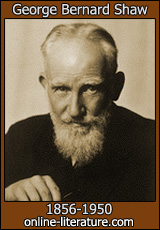
| Art of Worldly Wisdom Daily In the 1600s, Balthasar Gracian, a jesuit priest wrote 300 aphorisms on living life called "The Art of Worldly Wisdom." Join our newsletter below and read them all, one at a time. |
Sonnet-a-Day Newsletter Shakespeare wrote over 150 sonnets! Join our Sonnet-A-Day Newsletter and read them all, one at a time. |
