
Subscribe for ad free access & additional features for teachers. Authors: 267, Books: 3,607, Poems & Short Stories: 4,435, Forum Members: 71,154, Forum Posts: 1,238,602, Quizzes: 344
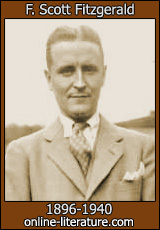
F. Scott Fitzgerald
F. Scott Fitzgerald (1896-1940), American author wrote The Great Gatsby (1925);
When they met again, two days later, it was Gatsby who was breathless, who was, somehow, betrayed.Her porch was bright with the bought luxury of star-shine; the wicker of the settee squeaked fashionably as she turned toward him and he kissed her curious and lovely mouth. She had caught a cold, and it made her voice huskier and more charming than ever, and Gatsby was overwhelmingly aware of the youth and mystery that wealth imprisons and preserves, of the freshness of many clothes, and of Daisy, gleaming like silver, safe and proud above the hot struggles of the poor.--Ch. 8
Fitzgerald's own tempestuous relationship with his wife Zelda would be reflected in his many short stories and novels, first serialised in such literary journals as Scribner's and the Saturday Evening Post. Their lives are a classic study of the American Dream in all its highs, lows, excesses, and joys. Highly lauded as a writer, Fitzgerald was often mired in debt because of his and Zelda's lavish lifestyle, living beyond their means. The Great Gatsby and Fitzgerald's characters Daisy and Tom Buchanan, Myrtle, Jay Gatsby, and Nick Carraway epitomise the Jazz Age but is has also remained timeless in its examination of man's obsessions with and need for money, power, knowledge, and hope.
Francis Scott Key Fitzgerald (named after Francis Scott Key, author of the United States' national anthem "The Star Spangled Banner") was born into an upper-middle class family on 24 September 1896 in St. Paul, Minnesota. He was the only son of Edward Fitzgerald (1853-1931) and Mary 'Mollie' McQuillan (1860-1936), but had one sister, Annabel, born in 1901. In 1898 the Fitzgeralds moved to Buffalo, New York where Edward obtained a job as salesman with Proctor and Gamble after his furniture-making company foundered. It was the first move of many that Francis would make during his lifetime. When Edward lost his job in 1908 they were back in St. Paul.
That same year, young Francis was enrolled in the St. Paul Academy. Early on he showed a love of the theatre and writing--his first work to appear in print was a detective story The Mystery of the Raymond Mortgage (1909) in the Academy's student paper Now and Then. He next attended The Newman School, a Catholic prep school in Hackensack, New Jersey. It was there that he met mentor, friend and Monsignor Darcy's real-life model, Father Cyril Webster Sigourney Fay (1875-1919). In 1913 he entered Princeton University and his love of theatre came to the fore--he wrote many scripts for the Princeton Triangle Club's musicals including Fie! Fie! Fi-Fi! (1914). He also had stories printed in The Princeton Tiger and the Nassau Literary Magazine. Fitzgerald met many lifelong friends at Princeton including John Peale Bishop and Edmund Wilson. His amateur play titles include The Girl From Lazy J (1911), Coward (1913), and Assorted Spirits (1914).
In 1917 Fitzgerald left Princeton to join the army. While in Montgomery, Alabama in 1918 he met Zelda Sayre (1900-1948). A year later they were engaged, but Zelda broke it off a few months later. After his discharge from the army in 1919, Fitzgerald moved to New York City. While working in advertising, he also found time to develop his first novel The Romantic Egoist. It was rejected by Charles Scribner but after three revisions they published it to great success as This Side Of Paradise (1920). Examining the morality of, and trials and tribulations of, early twentieth century youth, Fitzgerald's voice spoke to many of his contemporaries. He gained much esteem from fellow authors including Ring Lardner and Ernest Hemingway, although years later Hemingway would viciously criticise him.
Fitzgerald now finally got a taste of his own paradise; he and Zelda married on 3 April 1920 at St Patrick's Cathedral in New York City. Their daughter Frances Scott 'Scottie' was born in 1922. The Fitzgeralds honeymooned at the Biltmore Hotel but were asked to leave because of what would become a pattern, their notoriously raucous parties. They settled at a home in Westport, Connecticut and continued the lifestyle of the rich and famous, constantly entertaining. Zelda was flirtatious, Fitzgerald was jealous, and it was the beginning of a turbulent life together. While he continued to write short stories for magazines, his next major published work was a collection of short stories, Flappers and Philosophers (1920). Zelda embraced the flapper lifestyle dressing provocatively and smoking cigarettes, and she and her husband enjoyed the free-thinking, hedonistic pursuits of the roaring twenties when the post-war American economy was booming. Although it was a time of prohibition, there was no deficit of alcohol in the Fitzgerald household.
Tales of the Jazz Age (1922), Fitzgerald's second collection of shorts contains one of his most famous short stories "The Diamond As Big As the Ritz". His second novel, also adapted to the screen, was published the same year, The Beautiful and The Damned (1922);
"I love it," she said frankly. It was impossible to doubt her. .... At her happiness, a gorgeous sentiment welled into his eyes, choked him up, set his nerves a-tingle, and filled his throat with husky and vibrant emotion. There was a hush upon the room. The careless violins and saxophones, the shrill rasping complaint of a child near by, the voice of the violet-hatted girl at the next table, all moved slowly out, receded, and fell away like shadowy reflections on the shining floor--and they two, it seemed to him, were alone and infinitely remote, quiet. Surely the freshness of her cheeks was a gossamer projection from a land of delicate and undiscovered shades; her hand gleaming on the stained table-cloth was a shell from some far and wildly virginal sea....--Ch. 2
Like Armory Blaine in This Side Of Paradise, Anthony Patch and Gloria Gilbert, like many of his stories to come, reflect autobiographical elements to Fitzgerald and Zelda's life. Zelda herself wrote; many of her stories and reviews, some of them of her husband's works were published in the same magazines as Fitzgerald's. Titles include her short story "The Original Follies Girl" (1929), Scandalabra (play, 1933), and her only novel Save Me the Waltz (1932). Zelda was also a talented painter.
After the immense success of The Great Gatsby, Fitzgerald's All the Sad Young Men (1926) prophetically harkened things to come. While his short stories and another collection Taps at Reveille (1934) continued to appear in magazines, and he started "The Crack Up" essays for Esquire magazine, it was not until 1934 that Fitzgerald published his next book Tender is the Night. Zelda was profoundly upset to discover that Nicole Diver was modeled after her, but the late 1920's and early 1930's provided much fodder for the novel. In 1927 the Fitzgeralds rented the 27 bedroom mansion Ellerslie, near Wilmington, Delaware and drunken parties ensued. Fitzgerald was increasingly turning to alcohol, sometimes becoming abusive. Zelda often acted out impetuously, embarrassing herself in front of friends and strangers. She became fixated on her old love, ballet, often practicing to the point of physical and emotional collapse. For the next three years the couple travelled back and forth between New York, Montgomery, and Baltimore. They also travelled to and stayed in Europe for months at a time, sometimes with fellow Americans in Paris, the Riviera, Cannes, St. Raphaël, Capri, Antibes, and Rome. In 1930 they were in North Africa, the same year Zelda had a nervous breakdown. For the next few years she was in and out of clinics in Switzerland.
Fitzgerald continued to use his wife's mental breakdowns and their overall dysfunctional relationship in his writings including "The Last of the Belles" (1929), "Babylon Revisited" (1930), "Emotional Bankruptcy" (1931), "Crazy Sunday" (1932), and "Trouble" (1937). Back in America in 1931, Fitzgerald went to California to work on scripts for the Metro Goldwyn Meyer film company. "Red-Headed Woman", "A Yank at Oxford", "Marie Antoinette", and "Three Comrades" are among the scripts he worked on. He moved there in 1938, having fallen in love with writer and movie critic Sheilah Graham. While his contract with MGM was not renewed, a number of other film companies hired him to do freelance work. But Fitzgerald's alcoholism continually interfered with his life and work, requiring hospitalisation at times.
Still struggling with her illness, Zelda moved back to America and went to live with her mother in Montgomery in 1940. The same year, Fitzgerald had a heart attack; a month later, on 21 December 1940 he died of a second heart attack at Sheilah Graham's apartment in Hollywood, California. He now rests in Rockville Union Cemetery in Rockville, Maryland, with Zelda by his side. She survived him by eight years, until she died in a fire at the Highland Hospital in Asheville, North Carolina. In 1975 they were re-interred in Scott's family plot at St. Mary's Catholic Church Cemetery, Rockville, Maryland, where their daughter Scottie was buried in 1986.
"I know myself," he cried, "but that is all."--Armory Blaine, This Side of Paradise--Ch. 9
Biography written by C. D. Merriman for Jalic Inc. Copyright Jalic Inc. 2007. All Rights Reserved.
The above biography is copyrighted. Do not republish it without permission.
Forum Discussions on F. Scott FitzgeraldRecent Forum Posts on F. Scott Fitzgerald
Here is where you find links to related content on this site or other sites, possibly including full books or essays about F. Scott Fitzgerald written by other authors featured on this site.
Sorry, no links available.

F. Scott Fitzgerald and Sheila Graham: A Personal Retrospective
Baz Luhrmann, the audacious director of The Great Gatsby, is packing enough box office muscle to knock even Iron Man from the No 1 spot. He got off the plane this week in Australia from Cannes to be greeted by the news that his $180 million adaptation of F. Scott Fitzgerald's literary classic was at the top of the international box office. This was 10 days before its Australian release on May 30. With this film in the air this week, I thought I’d post a few items, several personal perspectives, which I’ve written over the last few years about this famous novel and novelist. The context for my remarks are some social-historical, some sociological and psychological perspectives....
Posted By Ron Price in Fitzgerald, F. Scott || 13 Replies
Does Fitzgerald create any likable characters?
Within The Great Gatsby does Fitzgerald create any "likeable" characters? I feel like this could be a technique used to show the corruption within American society pre-crash, but I'd love to hear some ideas?...
Posted By emilyallenson in Fitzgerald, F. Scott || 13 Replies
Themes of contradiction in Great Gatsby (anyone else see them?)
I'm reading through Gatsby for the second time. I might be reading into this too deep but it seems to me there is a theme of contradiction, perhaps relating to racism and how America was founded on immigration. Anyways I haven't finished re-reading it but I found two big examples. The first is Daisy's statement about never leaving New York then upon hearing Nick's joke seems to take it seriously and then yearns to go back. The second is Tom telling Not to believe everything he hears then Daisy telling Nick she believes he was engaged because she "heard it from three people". I think there are a few little examples scattered about as well but I can't be sure if I'm crazy and just over...
Posted By winslowevan in Fitzgerald, F. Scott || 3 Replies
Bugger, is all copyrighted!
Got myself a medium-sized cup of Joe, came in, sat down, got already to read the Great Gatsby. Waah, waah ERROR – "you must be destroyed". I guess one of the rich grandchildren was smart enough to renew the copyright! :nopity:...
Posted By Captain Pike in Fitzgerald, F. Scott || 5 Replies
"Tender is the Night" Group Reading
I am planning to start reading Tender is the Night on March 7th. If you would like to join, please make sure your copies are ready! I have also found a free e-copy available for those who are interested: http://www.planetebook.com/Tender-is-the-Night.asp...
Posted By Scheherazade in Fitzgerald, F. Scott || 0 Replies
The Curious Case of Benjamin Button
What an amazing story! This is by far one of my all-time favorite short stories. I wanted to ask everyone what they thought of the story and I wanted to know if anyone had any awesome thoughts into the concept of age and how it defines us!:biggrinjester:...
Posted By irishpixieb in Fitzgerald, F. Scott || 0 Replies
Dick Diver in Tender is the Night
I really enjoyed reading Tender is the Night, but the main character, Dick Diver, confuses me. What confuses me is how Fitzgerald intended to make the reader feel about Dick Diver. Were we supposed to sympathie with him? Were we supposed to like him? Dislike him? Etc. SPOILERS Personally, I found him a very dislikable character. I found him arrogant and self-absorbed, a man who, when it came down to it, was selfish. And he's a blatant racist, which really sealed how I felt towards him. I don't know if I am supposed to just think, "he was a product of his time, everyone was a racist, it's no big deal," but I can't do that (one reason being that line of thought not being in any wa...
Posted By Mutatis-Mutandis in Fitzgerald, F. Scott || 15 Replies
Firstzgerald Tough for Anyone Else?
I'm just wanting to know what everyone thinks about the assertion that Fitzgerald is a tough writer, as in hard to read. I read The Great Gatsby and now Tender is the Night (about a third of the way through, so no spoilers please, haha), and his prose just seems to get me lost every now and then. I think it's just because of his beautifully elegant descriptions; Fitzgerald takes the idea of "show, don't tell" to its highest level, even in the dialogue. Rarely does a character ever say something that makes the reader understand something better, it's usually the opposite. So, I guess I'm asking, is this common for Fitzgerald? I guess I'm just letting my insecurity show, but ...
Posted By Mutatis-Mutandis in Fitzgerald, F. Scott || 16 Replies
Female Charcaters in The Great Gatsby
Hi All, I have just joined this forum and believe it could be very beneficial towards work related to my EPQ. I am currently an alevel student in my last year at college and I am doin an Extended Project Qualification based around the subject of English. Last year for my AS i studied the Great Gatsby for my English Literature course. I really think this is a truly amazing book and Fitzgerald is most certanly a splendid writer! Seein as i enjoyed studying this text so much I figured I would focus my EPQ around this. For my EPQ i have decided to focus on the female characters within the Novel. One thing i must do inorder to complete my EPQ is carry out primary research for my proje...
Posted By ysmith91 in Fitzgerald, F. Scott || 2 Replies
The Great Gatsby and Tender is the Night
There have recently been a couple of interesting comments on this forum regarding the superiority of Scott Fitzgerald's Tender is the Night over that of Gatsby. Having recently read Tender is the Night, I would disagree with that proposition, although I think it is much more autobiographical and the protagonist is obviously based on Fitzgerald himself. Does anyone else have a view on these two very different books?...
Posted By Emil Miller in Fitzgerald, F. Scott || 16 Replies
Fitzgerald's Baseball Cards Mystery?
Hello folks! I'm a new member here and plan to use the Forums for my interest in Great Literature. It's actually a sidebar type literary search which pointed me here and I'm hoping some of the knowledgeable scholars on Fitzgerald may be able to solve a mystery for me with some substantive, verifiable information. Here's my question. There have been some largely unverifiable indications that Fitzgerald may have had a collection of tobacco style baseball cards as a youth and young adult which supposedly were still in his posession until his death. With Fitzgerald's evident disdain for the social stratum that the game of baseball attracted in the early 20th century (he would often chast...
Posted By RayB in Fitzgerald, F. Scott || 0 Replies
Tender is the Night
I finished reading this gem about one week ago. I could not get too attached to the first few chapters, but the pages definitely sucked me in by the end of the first part. It tells a tale of success, frivolity, insanity, adultery, and deceit; not once did I see the ending within sight, and its result seems remiscient upon Lady Chatterly's Lover, Anna Karenina, or even Madame Bovary, yet has the same hauntings of Macbeth. Does anyone have any thoughts? ***SPOILERS*** The irony of Dr. Dick Diver basically having a reciprocation with the situation of his wife, Nicole, seemed especially psychologically surprising. The doctor ended up as the patient, aff...
Posted By mono in Fitzgerald, F. Scott || 23 Replies
Post a New Comment/Question on Fitzgerald