
Subscribe for ad free access & additional features for teachers. Authors: 267, Books: 3,607, Poems & Short Stories: 4,435, Forum Members: 71,154, Forum Posts: 1,238,602, Quizzes: 344
The Faerie Queene
THE FAERIE
QVEENE.
Disposed into Twelue Bookes
Fashioning
XII. Morall vertues
LONDON
Printed for William Ponsonbie
(1596)
TO
THE MOST HIGH,
MIGHTIE
and
MAGNIFICENT
EMPRESSE RENOVVMED FOR PIETIE, VERTVE, AND ALL GRATIOVS
GOVERNMENT ELIZABETH BY
THE GRACE OF GOD QVEENE
OF ENGLAND FRAVNCE AND
IRELAND AND OF VIRGINIA-
DEFENDOVR OF THE
FAITH, &. HER MOST
HVMBLE SERVANT
EDMVND SPENSER
DOTH IN ALL HVMILITIE
DEDICATE, PRESENT
AND CONSECRATE THESE
HIS LABOVRS TO LIVE
VVITH THE ETERNITIE OF HER
FAME.
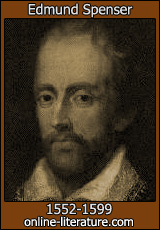
Edmund Spenser was born in London, England in 1552. We know relatively little about his family and early life. We know he graduated with masters from Cambridge in 1576, and from there he began writing poetry to publish. Sometime around 1580 Spenser started The Faerie Queene, and though he devoted most of his time to it, he still managed to publish other works in the meanwhile.
Originally intended to be a total length of twenty-four books, The Faerie Queene is incomplete. Notwithstanding its grave incompletion, however, it is still one of the longest poems in the English language. In its day, The Faerie Queene found political favor and was quite successful; it became Spenser’s defining work (and still is), and it found such favor that Spenser was granted a pension for life by the monarch of 50 pounds per year.
The poem is a moral allegory, written in praise of Elizabeth I, intending, through each book, to emphasize twenty-four different virtues. The first twelve would follow different knights who epitomized one of the twelve different “private virtues.” We speculate that the last twelve would have centered on King Arthur epitomizing the twelve “public virtues.” Spenser gives Aristotle as his source for these virtues, although the influence of other philosophers, namely Thomas Aquinas, is ostensible. By the time Spenser died, with the first three books published in 1590 and the next three in 1596, he only managed to cover six of the virtues: Holiness, Temperament, Chastity, Friendship, Justice, and Courtesy. The incomplete seventh book appears to represent the virtue of Consistency. Of the six books completed, the first and third are most often read.
Beyond the virtues the themes explored include politics and, perhaps most importantly, religion. In post Lutheran Protestant reformation, there was vehement protest between the still many Roman Catholics and Protestants occupying England. As an extremely devout Protestant, Spenser was especially annoyed by slanderous material against the Queen; moreover, Spenser saw the Roman Catholic Church full of idolatry and corruption. Thus, while his Protestant sensibilities and sentiments towards the Roman Catholic Church color the entire work, they are principally displayed in the “battles” of The Faerie Queene, which often symbolize “battles” between Rome and London.
The poem exhibits Spenser’s solid grasp of literature, emulating many themes and ideas presented in other epics. The Faerie Queene celebrates Queen Elizabeth I and the Tudor dynasty, much like Virgil’s Aeneid, which celebrates Augustus Caesar and Rome; where the Aeneid tells that Caesar descended from the sons of Troy, The Faerie Queene proposes that Queen Elizabeth and the Tudor dynasty are descendants of King Arthur. The poem, while outwardly about King Arthur, also draws much in the way of language and style from Italian poetry, notably Ludovico Ariosto's Orlando Furioso and Torquato Tasso's Jerusalem Delivered.--Submitted by Forum member Cunninglinguist.
Fan of this book? Help us introduce it to others by writing a better introduction for it. It's quick and easy, click here.
Recent Forum Posts on The Faerie Queene
No active discussions on Spenser found. Why not post a question or comment yourself? Just click the link below.
Please submit a quiz here.
Here is where you find links to related content on this site or other sites, possibly including full books or essays about Edmund Spenser written by other authors featured on this site.
Sorry, no links available.
Book I
Book II
Book III
Book IV
Book V
Book VI
Mutabilitie Cantos
Other
Sorry, no summary available yet.
