 Subscribe for ad free access & additional features for teachers. Authors: 267, Books: 3,607, Poems & Short Stories: 4,435, Forum Members: 71,154, Forum Posts: 1,238,602, Quizzes: 344
Chapter 3
THE SINS OF THE OTHERS
ABOUT A WEEK had passed, and the position had begun to grow more complicated.
I may mention in passing that I suffered a great deal during that unhappy week, as I scarcely left the side of my affianced friend, in the capacity of his most intimate confidant. What weighed upon him most was the feeling of shame, though we saw no one all that week, and sat indoors alone. But he was even ashamed before me, and so much so that the more he confided to me the more vexed he was with me for it. He was so morbidly apprehensive that he expected that every one knew about it already, the whole town, and was afraid to show himself, not only at the club, but even in his circle of friends. He positively would not go out to take his constitutional till well after dusk, when it was quite dark.
A week passed and he still did not know whether he were betrothed or not, and could not find out for a fact, however much he tried. He had not yet seen his future bride, and did not know whether she was to be his bride or not; did not, in fact, know whether there was anything serious in it at all. Varvara Petrovna, for some reason, resolutely refused to admit him to her presence. In answer to one of his first letters to her (and he wrote a great number of them) she begged him plainly to spare her all communications with him for a time, because she was very busy, and having a great deal of the utmost importance to communicate to him she was waiting for a more free moment to do so, and that she would let him know in time when he could come to see her. She declared she would send back his letters unopened, as they were �simple self-indulgence.� I read that letter myself�he showed it me.
Yet all this harshness and indefiniteness were nothing compared with his chief anxiety. That anxiety tormented him to the utmost and without ceasing. He grew thin and dispirited through it. It was something of which he was more ashamed than of anything else, and of which he would not on any account speak, even to me; on the contrary, he lied on occasion, and shuffled before me like a little boy; and at the same time he sent for me himself every day, could not stay two hours without me, needing me as much as air or water.
Such conduct rather wounded my vanity. I need hardly say that I had long ago privately guessed this great secret of his, and saw through it completely. It was my firmest conviction at the time that the revelation of this secret, this chief anxiety of Stepan Trofimovitch's would not have redounded to his credit, and, therefore, as I was still young, I was rather indignant at the coarseness of his feelings and the ugliness of some of his suspicions. In my warmth�and, I must confess, in my weariness of being his confidant�I perhaps blamed him too much. I was so cruel as to try and force him to confess it all to me himself, though I did recognise that it might be difficult to confess some things. He, too, saw through me; that is, he clearly perceived that I saw through him, and that I was angry with him indeed, and he was angry with me too for being angry with him and seeing through him. My irritation was perhaps petty and stupid; but the unrelieved solitude of two friends together is sometimes extremely prejudicial to true friendship. From a certain point of view he had a very true understanding of some aspects of his position, and defined it, indeed, very subtly on those points about which he did not think it necessary to be secret.
�Oh, how different she was then!� he would sometimes say to me about Varvara Petrovna. �How different she was in the old days when we used to talk together. . . . Do you know that she could talk in those days! Can you believe that she had ideas in those days, original ideas! Now, everything has changed! She says all that's only old-fashioned twaddle. She despises the past. . . . Now she's like some shopman or cashier, she has grown hard-hearted, and she's always cross. . . .�
�Why is she cross now if you are carrying out her 'orders'?� I answered.
He looked at me subtly.
�Cher ami; if I had not agreed she would have been dreadfully angry, dread-ful-ly! But yet less than now that I have consented.�
He was pleased with this saying of his, and we emptied a bottle between us that evening. But that was only for a moment, next day he was worse and more ill-humoured than ever.
But what I was most vexed with him for was that he could not bring himself to call on the Drozdovs, as he should have done on their arrival, to renew the acquaintance of which, so we heard they were themselves desirous, since they kept asking about him. It was a source of daily distress to him. He talked of Lizaveta Nikolaevna with an ecstasy which I was at a loss to understand. No doubt he remembered in her the child whom he had once loved. But besides that, he imagined for some unknown reason that he would at once find in her company a solace for his present misery, and even the solution of his more serious doubts. He expected to meet in Lizaveta Nikolaevna an extraordinary being. And yet he did not go to see her though he meant to do so every day. The worst of it was that I was desperately anxious to be presented to her and to make her acquaintance, and I could look to no one but Stepan Trofimovitch to effect this. I was frequently meeting her, in the street of course, when she was out riding, wearing a riding-habit and mounted on a fine horse, and accompanied by her cousin, so-called, a handsome officer, the nephew of the late General Drozdov�and these meetings made an extraordinary impression on me at the time. My infatuation lasted only a moment, and I very soon afterwards recognised the impossibility of my dreams myself�but though it was a fleeting impression it was a very real one, and so it may well be imagined how indignant I was at the time with my poor friend for keeping so obstinately secluded.
All the members of our circle had been officially informed from the beginning that Stepan Trofimovitch would see nobody for a time, and begged them to leave him quite alone. He insisted on sending round a circular notice to this effect, though I tried to dissuade him. I went round to every one at his request and told everybody that Varvara Petrovna had given �our old man� (as we all used to call Stepan Trofimovitch among ourselves) a special job, to arrange in order some correspondence lasting over many years; that he had shut himself up to do it and I was helping him. Liputin was the only one I did not have time to visit, and I kept putting it off�to tell the real truth I was afraid to go to him. I knew beforehand that he would not believe one word of my story, that he would certainly imagine that there was some secret at the bottom of it, which they were trying to hide from him alone, and as soon as I left him he would set to work to make inquiries and gossip all over the town. While I was picturing all this to myself I happened to run across him in the street. It turned out that he had heard all about it from our friends, whom I had only just informed. But, strange to say, instead of being inquisitive and asking questions about Stepan Trofimovitch, he interrupted me, when I began apologising for not having come to him before, and at once passed to other subjects. It is true that he had a great deal stored up to tell me. He was in a state of great excitement, and was delighted to have got hold of me for a listener. He began talking of the news of the town, of the arrival of the governor's wife, �with new! topics of conversation,� of an opposition party already formed in the club, of how they were all in a hubbub over the new ideas, and how charmingly this suited him, and so on. He talked for a quarter of an hour and so amusingly that I could not tear myself away. Though I could not endure him, yet I must admit he had the gift of making one listen to him, especially when he was very angry at something. This man was, in my opinion, a regular spy from his very nature. At every moment he knew the very latest gossip and all the trifling incidents of our town, especially the unpleasant ones, and it was surprising to me how he took things to heart that were sometimes absolutely no concern of his. It always seemed to me that the leading feature of his character was envy. When I told Stepan Trofimovitch the same evening of my meeting Liputin that morning and our conversation, the latter to my amazement became greatly agitated, and asked me the wild question: �Does Liputin know or not?"
I began trying to prove that there was no possibility of his finding it out so soon, and that there was nobody from whom he could hear it. But Stepan Trofimovitch was not to be shaken. �Well, you may believe it or not,� he concluded unexpectedly at last, �but I'm convinced that he not only knows every detail of 'our' position, but that he knows something else besides, something neither you nor I know yet, and perhaps never shall, or shall only know when it's too late, when there's no turning back! . . .�
I said nothing, but these words suggested a great deal. For five whole days after that we did not say one word about Liputin; it was clear to me that Stepan Trofimovitch greatly regretted having let his tongue run away with him, and having revealed such suspicions before me.
II
One morning, on the seventh or eighth day after Stepan Trofimovitch had consented to become �engaged,� about eleven o'clock, when I was hurrying as usual to my afflicted friend, I had an adventure on the way.
I met Karmazinov, �the great writer,� as Liputin called him. I had read Karmazinov from a child. His novels and tales were well known to the past and even to the present generation. I revelled in them; they were the great enjoyment of my childhood and youth. Afterwards I grew rather less enthusiastic over his work. I did not care so much for the novels with a purpose which he had been writing of late as for his first, early works, which were so full of spontaneous poetry, and his latest publications I had not . liked at all. Speaking generally, if I may venture to express my opinion on so delicate a subject, all these talented gentlemen of the middling sort who are sometimes in their lifetime accepted almost as geniuses, pass out of memory quite suddenly and without a trace when they die, and what's more, it often happens that even during their lifetime, as soon as a new generation grows up and takes the place of the one in which they have flourished, they are forgotten and neglected by every one in an incredibly short time. This somehow happens among us quite suddenly, like the shifting of the scenes on the stage. Oh, it's not at all the same as with Pushkin, Gogol, Moliere, Voltaire, all those great men who really had a new original word to say! It's true, too, that these talented gentlemen of the middling sort in the decline of their venerable years usually write themselves out in the most pitiful way, though they don't observe the fact themselves. It happens not infrequently that a writer who has been for a long time credited with extraordinary profundity and expected to exercise a great and serious influence on the progress of society, betrays in the end such poverty, such insipidity in his fundamental ideas that no one regrets that he succeeded in writing himself out so soon. But the old grey-beards don't notice this, and are angry. Their vanity sometimes, especially towards the end of their career, reaches proportions that may well provoke wonder. God knows what they begin to take themselves for�for gods at least! People used to say about Karmazinov that his connections with aristocratic society and powerful personages were dearer to him than his own soul, people used to say that on meeting you he would be cordial, that he would fascinate and enchant you with his open-heartedness, especially if you were of use to him in some way, and if you came to him with some preliminary recommendation. But that before any stray prince, any stray countess, anyone that he was afraid of, he would regard it as his sacred duty to forget your existence with the most insulting carelessness, like a chip of wood, like a fly, before you had even time to get out of his sight; he seriously considered this the best and most aristocratic style. In spite of the best of breeding and perfect knowledge of good manners he is, they say, vain to such an hysterical pitch that he cannot conceal his irritability as an author even in. those circles of society where little interest is taken in literature. If anyone were to surprise him by being indifferent, he would be morbidly chagrined, and try to revenge himself.
A year before, I had read an article of his in a review, written with an immense affectation of naive poetry, and psychology too. He described the wreck of some steamer on the English coast, of which he had been the witness, and how he had seen the drowning people saved, and the dead bodies brought ashore. All this rather long and verbose article was written solely with the object of self-display. One seemed to read between the lines: �Concentrate yourselves on me. Behold what I was like at those moments. What are the sea, the storm, the rocks, the splinters of wrecked ships to you? I have described all that sufficiently to you with my mighty pen. Why look at that drowned woman with the dead child in her dead arms? Look rather at me, see how I was unable to bear that sight and turned away from it. Here I stood with my back to it; here I was horrified and could not bring myself to look; I blinked my eyes�isn't that interesting?� When I told Stepan Trofimovitch my opinion of Karmazinov's article he quite agreed with me.
When rumours had reached us of late that Karmazinov was coming to the neighbourhood I was, of course, very eager to see him, and, if possible, to make his acquaintance. I knew that this might be done through Stepan Trofimovitch, they had once been friends. And now I suddenly met him at the cross-roads. I knew him at once. He had been pointed out to me two or three days before when he drove past with the governor's wife. He was a short, stiff-looking old man, though not over fifty-five, with a rather red little face, with thick grey locks of hair clustering under his chimney-pot hat, and curling round his clean little pink ears. His clean little face was not altogether handsome with its thin, long, crafty-looking lips, with its rather fleshy nose, and its sharp, shrewd little eyes. He was dressed somewhat shabbily in a sort of cape such as would be worn in Switzerland or North Italy at that time of year. But, at any rate, all the minor details of his costume, the little studs, and collar, the buttons, the tortoise-shell lorgnette on a narrow black ribbon, the signet-ring, were all such as are worn by persons of the most irreproachable good form. I am certain that in summer he must have worn light prunella shoes with mother-of-pearl buttons at the side. When we met he was standing still at the turning and looking about him, attentively. Noticing that I was looking at him with interest, he asked me in a sugary, though rather shrill voice:
�Allow me to ask, which is my nearest way to Bykovy Street?�
�To Bykovy Street? Oh, that's here, close by,� I cried in great excitement. �Straight on along this street and the second turning to the left.�
�Very much obliged to you.�
A curse on that minute! I fancy I was shy, and looked cringing. He instantly noticed all that, and of course realised it all at once; that is, realised that I knew who he was, that I had read him and revered him from a child, and that I was shy and looked at him cringingly. He smiled, nodded again, and walked on as I had directed him. I don't know why I turned back to follow him; I don't know why I ran for ten paces beside him. He suddenly stood still again.
�And could you tell me where is- the nearest cab-stand?� he shouted out to me again.
It was a horrid shout! A horrid voice!
�A cab-stand? The nearest cab-stand is ... by the Cathedral; there are always cabs standing there,� and I almost turned to run for a cab for him. I almost believe that that was what he expected me to do. Of course I checked myself at once, and stood still, but he had noticed my movement and was still watching me with the same horrid smile. Then something happened which I shall never forget.
He suddenly dropped a tiny bag, which he was holding in his left hand; though indeed it was not a bag, but rather a little box, or more probably some part of a pocket-book, or to be more accurate a little reticule, rather like an old-fashioned lady's reticule, though I really don't know what it was. I only know that I flew to pick it up.
I am convinced that I did not really pick it up, but my first motion was unmistakable. I could not conceal it, and, like a fool, I turned crimson. The cunning fellow at once got all that could be got out of the circumstance.
�Don't trouble, I'll pick it up,� he pronounced charmingly; that is, when he was quite sure that I was not going to pick up the reticule, he picked it up as though forestalling me, nodded once more, and went his way, leaving me to look like a fool. It was as good as though I had picked it up myself. For five minutes I considered myself utterly disgraced for ever, but as I reached Stepan Trofimovitch's house I suddenly burst out laughing; the meeting struck me as so amusing that I immediately resolved to entertain Stepan Trofimovitch with an account of it, and even to act the whole scene to him.
III
But this time to my surprise I found an extraordinary change in him. He pounced on me with a sort of avidity, it is true, as soon as I went in, and began listening to me, but with such a distracted air that at first he evidently did not take in my words. But as soon as I pronounced the name of Karmazinov he suddenly flew into a frenzy.
�Don't speak of him! Don't pronounce that name!� he exclaimed, almost in a fury. �Here, look, read it! Read it!�
He opened the drawer and threw on the table three small sheets of paper, covered with a hurried pencil scrawl, all from Varvara Petrovna. The first letter was dated the day before yesterday, the second had come yesterday, and the last that day, an hour before. Their contents were quite trivial, and all referred to Karmazinov and betrayed the vain and fussy uneasiness of Varvara Petrovna and her apprehension that Karmazinov might forget to pay her a visit. Here is the first one dating from two days before. (Probably there had been one also three days before, and possibly another four days before as well.)
�If he deigns to visit you to-day, not a word about me, I beg. Not the faintest hint. Don't speak of me, don't mention me.�V. S.�
The letter of the day before:
�If he decides to pay you a visit this morning, I think the most dignified thing would be not to receive him. That's what I think about it; I don't know what you think.�V. S.�
To-day's, the last:
�I feel sure that you're in a regular litter and clouds of tobacco smoke. I'm sending you Marya and Fomushka. They'll tidy you up in half an hour. And don't hinder them, but go and sit in the kitchen while they clear up. I'm sending you a Bokhara rug and two china vases. I've long been meaning to make you a present of them, and I'm sending you my Teniers, too, for a time.! You can put the vases in the window and hang the Teniers on the right under the portrait of Goethe; it will be more conspicuous there and it's always light there in the morning. If he does turn up at last, receive him with the utmost courtesy but try and talk of trifling matters, of some intellectual subject, and behave as though you had seen each other lately. Not a word about me. Perhaps I may look in on you in the evening.�V. S.
�P.S.�If he does not come to-day he won't come at all.�
I read and was amazed that he was in such excitement over such trifles. Looking at him inquiringly, I noticed that he had had time while I was reading to change the everlasting white tie he always wore, for a red one. His hat and stick lay on the table. He was pale, and his hands were positively trembling.
�I don't care a hang about her anxieties,� he cried frantically, in response to my inquiring look. �Je m'en fiche! She has the face to be excited about Karmazinov, and she does not answer my letters. Here is my unopened letter which she sent me back yesterday, here on the table under the book, under L'Homme qui rit. What is it to me that she's wearing herself out over Nikolay! Je m'en fiche, et je proclame ma liberte! Au diable le Karmazinov! Au diable la Lembke! I've hidden the vases in the entry, and the Teniers in the chest of drawers, and I have demanded that she is to see me at once. Do you hear. I've insisted! I've sent her just such a scrap of paper, a pencil scrawl, unsealed, by Nastasya, and I'm waiting. I want Darya Pavlovna to speak to me with her own lips, before the face of Heaven, or at least before you. Vous me seconderez, n'est-ce pas, comme ami et timoin. I don't want to have to blush, to lie, I don't want secrets, I won't have secrets in this matter. Let them confess everything to me openly, frankly, honourably and then . . . then perhaps I may surprise the whole generation by my magnanimity. . . . Am I a scoundrel or not, my dear sir?� he concluded suddenly, looking menacingly at me, as though I'd considered him a scoundrel.
I offered him a sip of water; I had never seen him like this before. All the while he was talking he kept running from one end of the room to the other, but he suddenly stood still before me in an extraordinary attitude.
�Can you suppose,� he began again with hysterical haughtiness, looking me up and down, �can you imagine that I, Stepan Verhovensky, cannot find in myself the moral strength to take my bag�my beggar's bag�and laying it on my feeble shoulders to go out at the gate and vanish for ever, when honour and the great principle of independence demand it I It's not the first time that Stepan Verhovensky has had to repel despotism by moral force, even though it be the despotism of a crazy woman, that is, the most cruel and insulting despotism which can exist on earth, although you have, I fancy, forgotten yourself so much as to laugh at my phrase, my dear sir! Oh, you don't believe that I can find the moral strength in myself to end my life as a tutor in a merchant's family, or to die of hunger in a ditch! Answer me, answer at once; do you believe it, or don't you believe it?�
But I was purposely silent. I even affected to hesitate to wound him by answering in the negative, but to be unable to answer affirmatively. In all this nervous excitement of his there was something which really did offend me, and not personally, oh, no! But ... I will explain later on. He positively turned pale.
�Perhaps you are bored with me, G��v (this is my surname),
and you would like . . . not to come and see me at all?� he said in that tone of pale composure which usually precedes some extraordinary outburst. I jumped up in alarm. At that moment Nastasya came in, and, without a word, handed Stepan Trofimovitch a piece of paper, on which something was written in pencil. He glanced at it and flung it to me. On the paper, in Varvara Petrovna's hand three words were written: �Stay at home.�
Stepan Trofimovitch snatched up his hat and stick in silence and went quickly out of the room. Mechanically I followed him. Suddenly voices and sounds of rapid footsteps were heard in the passage. He stood still, as though thunder-struck.
�It's Liputin; I am lost!� he whispered, clutching at my arm.
At the same instant Liputin walked into the room.
IV
Why he should be lost owing to Liputin I did not know, and indeed I did not attach much significance to the words; I put it all down to his nerves. His terror, however, was remarkable, and I made up my mind to keep a careful watch on him.
The very appearance of Liputin as he came in assured us that he had on this occasion a special right to come in, in spite of the prohibition. He brought with him an unknown gentleman, who must have been a new arrival in the town. In reply to the senseless stare of my petrified friend, he called out immediately in a-loud voice:
�I'm bringing you a visitor, a special one! I make bold to intrude on your solitude. Mr. Kirillov, a very distinguished civil engineer. And what's more he knows your son, the much esteemed Pyotr Stepanovitch, very intimately; and he has a message from him. He's only just arrived.�
�The message is your own addition,� the visitor observed curtly. �There's no message at all. But I certainly do know Verhovensky. I left him in the X. province, ten days ahead of us.�
Stepan Trofimovitch mechanically offered his hand and motioned him to sit down. He looked at me* he looked at Liputin, and then as though suddenly recollecting himself sat down himself, though he still kept his hat and stick in his hands without being aware of it.
�Bah, but you were going out yourself! I was told that you were quite knocked up with work.�
�Yes, I'm ill, and you see, I meant to go for a walk, I ...� Stepan Trofimovitch checked himself, quickly flung his hat and stick on the sofa and�turned crimson.
Meantime, I was hurriedly examining the visitor. He was a young man, about twenty-seven, decently dressed, well made, slender and dark, with a pale, rather muddy-coloured face and black lustreless eyes. He seemed rather thoughtful and absent-minded, spoke jerkily and ungrammatically, transposing words in rather a strange way, and getting muddled if he attempted a sentence of any length. Liputin was perfectly aware of Stepan Trofimovitch's alarm, and was obviously pleased at it. He sat down in a wicker chair which he dragged almost into the middle of the room, so as to be at an equal distance between his host and the visitor, who had installed themselves on sofas on opposite sides of the room. His sharp eyes darted inquisitively from one corner of the room to another.
�It's .... a long while since I've seen Petrusha. . . . You met abroad?� Stepan Trofimovitch managed to mutter to the visitor.
�Both here and abroad.�
�Alexey Nilitch has only just returned himself after living four years abroad,� put in Liputin. �He has been travelling to perfect himself in his speciality and has come to us because he has good reasons to expect a job on the building of our railway bridge, and he's now waiting for an answer about it. He knows the Drozdovs and Lizaveta Nikolaevna, through Pyotr Stepanovitch.�
The engineer sat, as it were, with a ruffled air, and listened with awkward impatience. It seemed to me that he was angry about something.
�He knows Nikolay Vsyevolodovitch too.�
�Do you know Nikolay Vsyevolodovitch?� inquired Stepan Trofimovitch.
�I know him too.�
�It's . . . it's a very long time since I've seen Petrusha, and ... I feel I have so little right to call myself a father . . . c'est le mot; I . . . how did you leave him?�
�Oh, yes, I left him ... he comes himself,� replied Mr. Kirillov, in haste to be rid of the question again. He certainly was angry.
�He's coming! At last I ... you see, it's very long since I've see Petrusha!� Stepan Trofimovitch could not get away from this phrase. �Now I expect my poor boy to whom . . . to whom I have been so much to blame! That is, I mean to say, when I left him in Petersburg, I ... in short, I looked on him as a nonentity, quelque chose dans ce genre. He was a very nervous boy, you know, emotional, and . . . very timid. When he said his prayers going to bed he used to bow down to the ground, and make the sign of the cross on his pillow that he might not die in the night. . . . Je m'en souviens. Enfin, no artistic feeling whatever, not a sign of anything higher, of anything fundamental, no embryo of a future ideal . . . c'etait comma un petit idiot, but I'm afraid I am incoherent; excuse me . . . you came upon me . . .�
�You say seriously that he crossed his pillow?� the engineer asked suddenly with marked curiosity.
�Yes, he used to . . .�
�All right. I just asked. Go on.�
Stepan Trofimovitch looked interrogatively at Liputin.
�I'm very grateful to you for your visit. But I must confess I'm ... not in a condition . . . just now . . . But allow me to ask where you are lodging.�
�At Filipov's, in Bogoyavlensky Street.�
�Ach, that's where Shatov lives,� I observed involuntarily.
�Just so, in the very same house,� cried Liputin, �only Shatov lodges above, in the attic, while he's down below, at Captain Lebyadkin's. He knows Shatov too, and he knows Shatov's wife. He was very intimate with her, abroad.�
�Comment! Do you really know anything about that unhappy marriage de ce pauvre ami and that woman,� cried Stepan Trofimovitch, carried away by sudden feeling. �You are the first man I've met who has known her personally; and if only ...�
�What nonsense!� the engineer snapped out, flushing all over. �How you add to things, Liputin! I've not seen Shatov's wife; I've only once seen her in the distance and not at all close... . I know Shatov. Why do you add things of all sorts?�
He turned round sharply on the sofa, clutched his hat, then laid it down again, and settling himself down once more as before, fixed his angry black eyes on Stepan Trofimovitch with a sort of defiance. I was at a loss to understand such strange irritability.
�Excuse me,� Stepan Trofimovitch observed impressively. �I understand that it may be a very delicate subject. ...���'
�No sort of delicate subject in it, and indeed it's shameful, and I didn't shout at you that it's nonsense, but at Liputin, because he adds things. Excuse me if you took it to yourself. I know Shatov, but I don't know his wife at all ... I don't know her at all!�
�I understand. I understand. And if I insisted, it's only because I'm very fond of our poor friend, noire irascible ami, and have always taken an interest in him. ... In my opinion that man changed his former, possibly over-youthful but yet sound ideas, too abruptly. And now he says all sorts of things about notre Sainte Russie to such a degree that I've long explained this upheaval in his whole constitution, I can only call it that, to some violent shock in his family life, and, in fact, to his unsuccessful marriage. I, who know my poor Russia like the fingers on my hand, and have devoted my whole life to the Russian people, I can assure you that he does not know the Russian people, and what's more . . .�
�I don't know the Russian people at all, either, and I haven't time to study them,� the engineer snapped out again, and again he turned sharply on the sofa. Stepan Trofimovitch was pulled up in the middle of his speech.
�He is studying them, he is studying them,� interposed Liputin. �He has already begun the study of them, and is writing a very interesting article dealing with the causes of the increase of suicide in Russia, and, generally speaking, the causes that lead to the increase or decrease of suicide in society. He has reached amazing results.�
The engineer became dreadfully excited. �You have no right at all,� he muttered wrathfully. �I'm not writing an article. I'm not going to do silly things. I asked you confidentially, quite by chance. There's no article at all. I'm not publishing, and you haven't the right . . .� Liputin was obviously enjoying himself.
�I beg your pardon, perhaps I made a mistake in calling your literary work an article. He is only collecting observations, and the essence of the question, or, so to say, its moral aspect he is not touching at all. And, indeed, he rejects morality itself altogether, and holds with the last new principle of general destruction for the sake of ultimate good. He demands already more than a hundred million heads for the establishment of common sense in Europe; many more than they demanded at the last Peace Congress. Alexey Nilitch goes further than anyone in that sense.� The engineer listened with a pale and contemptuous smile. For half a minute every one was silent.
�All this is stupid, Liputin,� Mr. Kirillov observed at last, with a certain dignity. �If I by chance had said some things to you, and you caught them up again, as you like. But you have no right, for I never speak to anyone. I scorn to talk. . . . If one has a conviction then it's clear to me. . . . But you're doing foolishly. I don't argue about things when everything's settled. I can't bear arguing. I never want to argue. . . .�
�And perhaps you are very wise,� Stepan Trofimovitch could not resist saying.
�I apologise to you, but I am not angry with anyone here,� the visitor went on, speaking hotly and rapidly. '' I have seen few people for four years. For four years I have talked little and have tried to see no one, for my own objects which do not concern anyone else, for four years. Liputin found this out and is laughing. I understand and don't mind. I'm not ready to take offence, only annoyed at his liberty. And if I don't explain my ideas to you,� he concluded unexpectedly, scanning us all with resolute eyes, �it's not at all that I'm afraid of your giving information to the government; that's not so; please do not imagine nonsense of that sort.�
No one made any reply to these words. We only looked at each other. Even Liputin forgot to snigger.
�Gentlemen, I'm very sorry��Stepan Trofimovitch got up resolutely from the sofa�� but I feel ill and upset. Excuse me.�
�Ach, that's for us to go.� Mr. Kirillov started, snatching up his cap. �It's a good thing you told us. I'm so forgetful.�
He rose, and with a good-natured air went up to Stepan Trofimovitch, holding out his hand.
�I'm sorry you're not well, and I came,�
�I wish you every success among us,� answered Stepan Trofimovitch, shaking hands with him heartily and without haste. 'I understand that, if as you say you have lived so long abroad, cutting yourself off from people for objects of your own and forgetting Russia, you must inevitably look with wonder on us who are Russians to the backbone, and we must feel the same about you. Mais cela passera. I'm only puzzled at one thing: you want to build our bridge and at the same time you declare that you hold with the principle of universal destruction. They won't let you build our bridge.�
�What! What's that you said? Ach, I say!� Kirillov cried, much struck, and he suddenly broke into the most frank and good-humoured laughter. For a moment his face took a quite childlike expression, which I thought suited him particularly. Liputin rubbed his hand with delight at Stepan Trofimovitch's witty remark. I kept wondering to myself why Stepan Trofimovitch was so frightened of Liputin, and why he had cried out �I am lost� when he heard him coming. We were all standing in the doorway. It was the moment when hosts and guests hurriedly exchange the last and most cordial words, and then part to their mutual gratification.
�The reason he's so cross to-day,� Liputin dropped all at once, as it were casually, when he was just going out of the room, �is because he had a disturbance to-day with Captain Lebyadkin over his sister. Captain Lebyadkin thrashes that precious sister of his, the mad girl, every day with a whip, a real Cossack whip, every morning and evening. So Alexey Nilibch has positively taken the lodge so as not to be present. Well, good-bye.�
�A sister? An invalid? With a whip?� Stepan Trofimovitch cried out, as though he had suddenly been lashed with a whip himself. �What sister? What Lebyadkin?� All his former terror came back in an instant. �Lebyadkin! Oh, that's the retired captain; he used only to call himself a lieutenant before. ...�
�Oh, what is his rank to me? What sister? Good heavens! . . . You say Lebyadkin? But there used to be a Lebyadkin here. . . .�
�That's the very man. 'Our' Lebyadkin, at Virginsky's, you remember?�
�But he was caught with forged papers?�
�Well, now he's come back. He's been here almost three weeks and under the most peculiar circumstances.�
�Why, but he's a scoundrel?�
�As though no one could be a scoundrel among us,� Liputin grinned suddenly, his knavish little eyes seeming to peer into Stepan Trofimovitch's soul.
�Good heavens! I didn't mean that at all ... though I quite agree with you about that, with you particularly. But what then, what then? What did you mean by that? You certainly meant something by that.�
�Why, it's all so trivial. . . . This captain to all appearances went away from us at that time; not because of the forged papers, but simply to look for his sister, who was in hiding from him somewhere, it seems; well, and now he's brought her and that's the whole story. Why do you seem frightened, Stepan Trofimovitch? I only tell this from his drunken chatter though, he doesn't speak of it himself when he's sober. He's an irritable man, and, so to speak, aesthetic in a military style; only he has bad taste. And this sister is lame as well as mad. She seems to have been seduced by some one, and Mr. Lebyadkin has, it seems, for many years received a yearly grant from the seducer by way of compensation for the wound to his honour, so it would seem at least from his chatter, though I believe it's only drunken talk. It's simply his brag. Besides, that sort of thing is done much cheaper. But that he has a sum of money is perfectly certain. Ten days ago he was walking barefoot, and now I've seen hundreds in his hands. His sister has fits of some sort every day, she shrieks and he 'keeps her in order' with the whip. You must inspire a woman with respect, he says. What I can't understand is how Shatov goes on living above him. Alexey Nilitch has only been three days with them. They were acquainted in Petersburg, and now he's taken the lodge to get away from the disturbance.�
�Is this all true?� said Stepan Trofimovitch, addressing the engineer.
�You do gossip a lot, Liputin,� the latter muttered wrathfully.
�Mysteries, secrets! Where have all these mysteries and secrets among us sprung from?� Stepan Trofimovitch could not refrain from exclaiming.
The engineer frowned, flushed red, shrugged his shoulders and went out of the room.
�Alexey Nilitch positively snatched the whip out of his hand, broke it and threw it out of the window, and they had a violent quarrel,� added Liputin.
�Why are you chattering, Liputin; it's stupid. What for?� Alexey Nilitch turned again instantly.
�Why be so modest and conceal the generous impulses of one's soul; that is, of your soul? I'm not speaking of my own.�
�How stupid it is ... and quite unnecessary. Lebyadkin's stupid and quite worthless�and no use to the cause, and . . . utterly mischievous. Why do you keep babbling all sorts of things? I'm going.�
�Oh, what a pity!� cried Liputin with a candid smile, �or I'd have amused you with another little story, Stepan Trofimovitch. I came, indeed, on purpose to tell you, though I dare say you've heard it already. Well, till another time, Alexey Nilitch is in such a hurry. Good-bye for the present. The story concerns Varvara Petrovna. She amused me the day before yesterday; she sent for me on purpose. It's simply killing. Good-bye.�
But at this Stepan Trofimovitch absolutely would not let him go. He seized him by the shoulders, turned him sharply back into the room, and sat him down in a chair. Liputin was positively scared.
�Why, to be sure,� he began, looking warily at Stepan Trofimovitch from his chair, �she suddenly sent for me and asked me 'confidentially' my private opinion, whether Nikolay Vsyevolodovitch is mad or in his right mind. Isn't that astonishing?�
�You're out of your mind!� muttered Stepan Trofimovitch, and suddenly, as though he were beside himself: �Liputin, you know perfectly well that you only came here to tell me something insulting of that sort and . . . something worse!�
In a flash, I recalled his conjecture that Liputin knew not only more than we did about our affair, but something else which we should never know.
�Upon my word, Stepan Trofimovitch,� muttered Liputin, seeming greatly alarmed, �upon my word . . .�
�Hold your tongue and begin! I beg you, Mr. Kirillov, to come back too, and be present. I earnestly beg you! Sit down, and you, Liputin, begin directly, simply and without any excuses.�
�If I had only known it would upset you so much I wouldn't have begun at all. And of course I thought you knew all about it from Varvara Petrovna herself.�
�You didn't think that at all. Begin, begin, I tell you.�
�Only do me the favour to sit down yourself, or how can I sit here when you are running about before me in such excitement. I can't speak coherently.�
Stepan Trofimovitch restrained himself and sank impressively into an easy chair. The engineer stared gloomily at the floor. Liputin looked at them with intense enjoyment,
�How am I to begin? . . . I'm too overwhelmed. . . .�
VI
The day before yesterday a servant was suddenly sent to me: 'You are asked to call at twelve o'clock,' said he. Can you fancy such a thing? I threw aside my work, and precisely at midday yesterday I was ringing at the bell. I was let into the drawing, room; I waited a minute�she came in; she made me sit down and sat down herself, opposite. I sat down, and I couldn't believe it; you know how she has always treated me. She began at once without beating about the bush, you know her way. 'You remember,' she said, 'that four years ago when Nikolay Vsyevolodovitch was ill he did some strange things which made all the town wonder till the position was explained. One of those actions concerned you personally. When Nikolay Vsyevolodovitch recovered he went at my request to call on you. I know that he talked to you several times before, too. Tell me openly and candidly what you . . . (she faltered a little at this point) what you thought of Nikolay Vsyevolodovitch then . . . what was your view of him altogether . . . what idea you were able to form of him at that time . . . and, still have? '
�Here she was completely confused, so that she paused for a whole minute, and suddenly flushed. I was alarmed. She began again�touchingly is not quite the word, it's not applicable to her�but in a very impressive tone:
�' I want you,' she said, 'to understand me clearly and without mistake. I've sent for you now because I look upon you as a keen-sighted and quick-witted man, qualified to make accurate observations.' (What compliments!) 'You'll understand too,' she said, 'that I am a mother appealing to you. . . . Nikolay Vsyevolodovitch has suffered some calamities and has passed through many changes of fortune in his life. All that,' she said, 'might well have affected the state of his mind. I'm not speaking of madness, of course,' she said, 'that's quite out of the question!' (This was uttered proudly and resolutely.) 'But there might be something strange, something peculiar, some turn of thought, a tendency to some particular way of looking at things.' (Those were her exact words, and I admired, Stepan Trofimovitch, the exactness with which Varvara Petrovna can put things. She's a lady of superior intellect!) 'I have noticed in him, anyway,' she said,' a perpetual restlessness and a tendency to peculiar impulses. But I am a mother and you are an impartial spectator, and therefore qualified with your intelligence to form a more impartial opinion. I implore you, in fact' (yes, that word, 'implore' was uttered!), 'to tell me the whole truth, without mincing matters. And if you will give me your word never to forget that I have spoken to you in confidence, you may reckon upon my always being ready to seize every opportunity in the future to show my gratitude.' Well, what do you say to that?�
�You have ... so amazed me . . .� faltered Stepan Trofimovitch, �that I don't believe you.�
�Yes, observe, observe,� cried Liputin, as though he had not heard Stepan Trofimovitch, �observe what must be her agitation and uneasiness if she stoops from her grandeur to appeal to a man like me, and even condescends to beg me to keep it secret. What do you call that? Hasn't she received some news of Nikolay Vsyevolodovitch, something unexpected?�
�I don't know ... of news of any sort ... I haven't seen her for some days, but . . . but I must say ...� lisped Stepan Trofimovitch, evidently hardly able to think clearly, �but I must say, Liputin, that if it was said to you in confidence, and here you're telling it before every one . . .�
�Absolutely in confidence! But God strike me dead if I . . . But as for telling it here . . . what does it matter I Are we strangers, even Alexey Nilitch?�
�I don't share that attitude. No doubt we three here will keep the secret, but I'm afraid of the fourth, you, and wouldn't trust you in anything. ...�
�What do you mean by that? Why it's more to my interest than anyone's, seeing I was promised eternal gratitude! What I wanted was to point out in this connection one extremely strange incident, rather to say, psychological than simply strange. Yesterday evening, under the influence of my conversation with Varvara Petrovna�you can fancy yourself what an impression it made on me�I approached Alexey Nilitch with a discreet question: 'You knew Nikolay Vsyevolodovitch abroad,' said I, 'and used to know him before in Petersburg too. What do you think of his mind and his abilities?' said I. He answered laconically, as his way is, that he was a man of subtle intellect and sound judgment. 'And have you never noticed in the course of years,' said I, 'any turn of ideas or peculiar way of looking at things, or any, so to say, insanity?' In fact, I repeated Varvara Petrovna's own question. And would you believe it, Alexey Nilitch suddenly grew thoughtful, and scowled, just as he's doing now. 'Yes,' said he, 'I have sometimes thought there was something strange.' Take note, too, that if anything could have seemed strange even to Alexey Nilitch, it must really have been something, mustn't it?�
�Is that true?� said Stepan Trofimovitch, turning to Alexey Nilitch.
�I should prefer not to speak of it,� answered Alexey Nilitch, suddenly raising his head, and looking at him with flashing eyes. �I wish to contest your right to do this, Liputin. You've no right to drag me into this. I did not give my whole opinion at all. Though I knew Nikolay Stavrogin in Petersburg that was long ago, and though I've met him since I know him very little. I beg you to leave me out and . . . All this is something like scandal.�
Liputin threw up his hands with an air of oppressed innocence.
�A scandal-monger! Why not say a spy while you're about it? It's all very well for you, Alexey Nilitch, to criticise when you stand aloof from everything. But you wouldn't believe it, Stepan Trofimovitch�take Captain Lebyadkin, he is stupid enough, one may say ... in fact, one's ashamed to say how stupid he is; there is a Russian comparison, to signify the degree of it; and do you know he considers himself injured by Nikolay Vsyevolodovitch, though he is full of admiration for his wit. 'I'm amazed,' said he, 'at that man. He's a subtle serpent.' His own words. And I said to him (still under the influence of my conversation, and after I had spoken to Alexey Nilitch), 'What do you think, captain, is your subtle serpent mad or not?' Would you believe it, it was just as if I'd given him a sudden lash from behind. He simply leapt up from his seat. 'Yes,' said he, '. . . yes, only that,' he said, 'cannot affect . . .' 'Affect what?' He didn't finish. Yes, and then he fell to thinking so bitterly, thinking so much, that his drunkenness dropped off him. We were sitting in Filipov's restaurant. And it wasn't till half an hour later that he suddenly struck the table with his fist. 'Yes,' said he, 'maybe he's mad, but that can't affect it. . . .' Again he didn't say what it couldn't affect. Of course I'm only giving you an extract of the conversation, but one can understand the sense of it. You may ask whom you like, they all have the same idea in their heads, though it never entered anyone's head before. 'Yes,' they say, 'he's mad; he's very clever, but perhaps he's mad too.' �
Stepan Trofimovitch sat pondering, and thought intently.
�And how does Lebyadkin know?�
�Do you mind inquiring about that of Alexey Nilitch, who has just called me a spy? I'm a spy, yet I don't know, but Alexey Nilitch knows all the ins and outs of it, and holds his tongue.�
�I know nothing about it, or hardly anything,� answered the engineer with the same irritation. �You make Lebyadkin drank to find out. You brought me here to find out and to make me say. And so you must be a spy.�
�I haven't made him drunk yet, and he's not worth the money either, with all his secrets. They are not worth that to me. I don't know what they are to you. On the contrary, he is scattering the money, though twelve days ago he begged fifteen kopecks of me, and it's he treats me to champagne, not I him. But you've given me an idea, and if there should be occasion I will make him drunk, just to get to the bottom of it and maybe I shall find out . . . all your little secrets,� Liputin snapped back spitefully.
Stepan Trofimovitch looked in bewilderment at the two disputants. Both were giving themselves away, and what's more, were not standing on ceremony. The thought crossed my mind that Liputin had brought this Alexey Nilitch to us with the simple object of drawing him into a conversation through a third person for purposes of his own�his favourite manoauvre.
�Alexey Nilitch knows Nikolay Vsyevolodovitch quite well,� he went on, irritably, �only he conceals it. And as to your question about Captain Lebyadkin, he made his acquaintance before any of us did, six years ago in Petersburg, in that obscure, if one may so express it, epoch in the life of Nikolay Vsyevolodovitch, before he had dreamed of rejoicing our hearts by coming here. Our prince, one must conclude, surrounded himself with . rather a queer selection of acquaintances. It was at that time, it seems, that he made acquaintance with this gentleman here.�
�Take care, Liputin. I warn you, Nikolay Vsyevolodovitch meant to be here soon himself, and he knows how to defend himself.�
�Why warn me? I am the first to cry out that he is a man of the most subtle and refined intelligence, and I quite reassured Varvara Petrovna yesterday on that score. 'It's his character,' I said to her, 'that I can't answer for.' Lebyadkin said the same thing yesterday: 'A lot of harm has come to me from his character,' he said. Stepan Trofimovitch, it's all very well for you to cry out about slander and spying, and at the very time observe that you wring it all out of me, and with such immense curiosity too. Now, Varvara Petrovna went straight to the point yesterday. 'You have had a personal interest in the business,' she said, 'that's why I appeal to you.' I should say so! What need to look for motives when I've swallowed a personal insult from his excellency before the whole society of the place. I should think I have grounds to be interested, not merely for the sake of gossip. He shakes hands with you one day, and next day, for no earthly reason, he returns your hospitality by slapping you on the cheeks in the face of all decent society, if the fancy takes him, out of sheer wantonness. And what's more, the fair sex is everything for them, these butterflies and mettlesome-cocks! Grand gentlemen with little wings like the ancient cupids, lady-killing Petchorins! It's all very well for you, Stepan Trofimovitch, a confirmed bachelor, to talk like that, stick up for his excellency and call me a slanderer. But if you married a pretty young wife�as you're still such a fine fellow� then I dare say you'd bolt your door against our prince, and throw up barricades in your house! Why, if only that Mademoiselle Lebyadkin, who is thrashed with a whip, were not mad and bandy-legged, by Jove, I should fancy she was the victim of the passions of our general, and that it was from him that Captain Lebyadkin had suffered 'in his family dignity,' as he expresses it himself. Only perhaps that is inconsistent with his refined taste, though, indeed, even that's no hindrance to him. Every berry is worth picking if only he's in the mood for it. You talk of slander, but I'm not crying this aloud though the whole town is ringing with it; I only listen and assent. That's not prohibited.�
�The town's ringing with it? What's the town ringing with?�
�That is, Captain Lebyadkin is shouting for all the town to hear, and isn't that just the same as the market-place ringing with it? How am I to blame? I interest myself in it only among friends, for, after all, I consider myself among friends here.� He looked at us with an innocent air. �Something's happened, only consider: they say his excellency has sent three hundred roubles from Switzerland by a most honourable young lady, and, so to say, modest orphan, whom I have the honour of knowing, to be handed over to Captain Lebyadkin. And Lebyadkin, a little later, was told as an absolute fact also by a very honourable and therefore trustworthy person, I won't say whom, that not three hundred but a thousand roubles had been sent! . . . And so, Lebyadkin keeps crying out' the young lady has grabbed seven hundred roubles belonging to me,' and he's almost ready to call in the police; he threatens to, anyway, and he's making an uproar all over the town.�
�This is vile, vile of you!� cried the engineer, leaping up suddenly from his chair.
�But I say, you are yourself the honourable person who brought word to Lebyadkin from Nikolay Vsyevolodovitch that a thousand roubles were sent, not three hundred. Why, the captain told me so himself when he was drunk.�
�It's . . . it's an unhappy misunderstanding. Some one's made a mistake and it's led to ... It's nonsense, and it's base of you.�
�But I'm ready to believe that it's nonsense, and I'm distressed at the story, for, take it as you will, a girl of an honourable reputation is implicated first over the seven hundred roubles, and secondly in unmistakable intimacy with Nikolay Vsyevolodovitch. For how much does it mean to his excellency to disgrace a girl of good character, or put to shame another man's wife, like that incident with me? If he comes across a generous-hearted man he'll force him to cover the sins of others under the shelter of his honourable name. That's just what I had to put up with, I'm speaking of myself. . . .�
�Be careful, Liputin.� Stepan Trofimovitch got up from his easy chair and turned pale.
�Don't believe it, don't believe it! Somebody has made a mistake and Lebyadkin's drunk ...� exclaimed the engineer in indescribable excitement. �It will all be explained, but I can't. . . . And I think it's low. . . . And that's enough, enough!�
He ran out of the room.
�What are you about? Why, I'm going with you!� cried Liputin, startled. He jumped up and ran after Alexey Nilitch.
VII
Stepan Trofimovitch stood a moment reflecting, looked at me as though he did not see me, took up his hat and stick and walked quietly out of the room. I followed him again, as before. As we went out of the gate, noticing that I was accompanying him, he said:
�Oh yes, you may serve as a witness . . . de I'accident. Vous m'accompagnerez, riest-ce pas?"
�Stepan Trofimovitch, surely you're not going there again? Think what may come of it!�
With a pitiful and distracted smile, a smile of shame and utter despair, and at the same time of a sort of strange ecstasy, he whispered to me, standing still for an instant:
�I can't marry to cover 'another man's sins'!�
These words were just what I was expecting. At last that fatal sentence that he had kept hidden from me was uttered aloud, after a whole week of shuffling and pretence. I was positively enraged.
�And you, Stepan Verhovensky, with your luminous mind, your kind heart, can harbour such a dirty, such a low idea . . . and could before Liputin came!�
He looked at me, made no answer and walked on in the same direction. I did not want to be left behind. I wanted to give Varvara Petrovna my version. I could have forgiven him if he had simply with his womanish faint-heartedness believed Liputin, but now it was clear that he had thought of it all himself long before, and that Liputin had only confirmed his suspicions and poured oil on the flames. He had not hesitated to suspect the girl from the very first day, before he had any kind of grounds, even Liputin's words, to go upon. Varvara Petrovna's despotic behaviour he had explained to himself as due to her haste to cover up the aristocratic misdoings of her precious ''Nicolas� by marrying the girl to an honourable man! I longed for him to be punished for it.
�Oh, Dieu, qui est si grand et si ban! Oh, who will comfort me!� he exclaimed, halting suddenly again, after walking a hundred paces.
�Come straight home and I'll make everything clear to you,� I cried, turning him by force towards home.
�It's he! Stepan Trofimovitch, it's you? You?� A fresh, joyous young voice rang out like music behind us.
We had seen nothing, but a lady on horseback suddenly made her appearance beside us�Lizaveta Nikolaevna with her invariable companion. She pulled up her horse.
�Come here, come here quickly!� she called to us, loudly and merrily. �It's twelve years since I've seen him, and I know him, while he. . . . Do you really not know me?�
Stepan Trofimovitch clasped the hand held out to him and kissed it reverently. He gazed at her as though he were praying and could not utter a word.
�He knows me, and is glad! Mavriky Nikolaevitch, he's delighted to see me! Why is it you haven't been to see us all this fortnight? Auntie tried to persuade me you were ill and must not be disturbed; but I know Auntie tells lies. I kept stamping and swearing at you, but I had made up my mind, quite made up my mind, that you should come to me first, that was why I didn't send to you. Heavens, why he hasn't changed a bit!� She scrutinised him, bending down from the saddle. �He's absurdly unchanged. Oh, yes, he has wrinkles, a lot of wrinkles, round his eyes and on his cheeks some grey hair, but his eyes are just the same. And have I changed? Have I changed? Why don't you say something?�
I remembered at that moment the story that she had been almost ill when she was taken away to Petersburg at eleven years old, and that she had cried during her illness and asked for Stepan Trofimovitch.
�You ... I ...� he faltered now in a voice breaking with joy. �I was just crying out 'who will comfort me?' and I heard your voice. I look on it as a miracle etje commence d croire.�
�En Dieu! En Dieu qui est la-haut et qui est si grand et si bon? You see, I know all your lectures by heart. Mavriky Nikolaevitch, what faith he used to preach to me then, en Dieu qui est si grand et si bon! And do you remember your story of how Columbus discovered America, and they all cried out, 'Land! land!'? My nurse Alyona Frolovna says I was light-headed at night afterwards, and kept crying out 'land! land!' in my sleep. And do you remember how you told me the story of Prince Hamlet? And do you remember how you described to me how the poor emigrants were transported from Europe to America? And it was all untrue; I found out afterwards how they were transited. But what beautiful fibs he used to tell me then, Mavriky Nikolaevitch! They were better than the truth. Why do you look at Mavriky Nikolaevitch like that? He is the best and �best man on the face of the globe and you must like him just you do me! Il fait tout ce que je veux. But, dear Stepan Trofimovitch, you must be unhappy again, since you cry out in the middle of the street asking who will comfort you. Unhappy, aren't you? Aren't you?�
�Now I'm happy. . . .�
�Aunt is horrid to you?� she went on, without listening. �She's just the same as ever, cross, unjust, and always our precious aunt! And do you remember how you threw yourself into my arms in the garden and I comforted you and cried� don't be afraid of Mavriky Nikolaevitch; he has known all about you, everything, for ever so long; you can weep on his shoulder as long as you like, and he'll stand there as long as you like! . . . Lift up your hat, take it off altogether for a minute, lift up your head, stand on tiptoe, I want to kiss you on the forehead as I kissed you for the last time when we parted. Do you see that young lady's admiring us out of the window? Come closer, closer! Heavens! How grey he is!�
And bending over in the saddle she kissed him on the forehead.
�Come, now to your home! I know where you live. I'll be with you directly, in a minute. I'll make you the first visit, you stubborn man, and then I must have you for a whole day at home. You can go and make ready for me.�
And she galloped off with her cavalier. We returned. Stepan Trofimovitch sat down on the sofa and began to cry.
�Dieu, Dieu.'� he exclaimed, �enftn une minute de bonheur!�
Not more than ten minutes afterwards she reappeared according to her promise, escorted by her Mavriky Nikolaevitch.
�Vous et le bonheur, vous arrivez en meme temps!� He got up to meet her.
�Here's a nosegay for you; I rode just now to Madame Chevalier's, she has flowers all the winter for name-days. Here's Mavriky Nikolaevitch, please make friends. I wanted to bring you a cake instead of a nosegay, but Mavriky Nikolaevitch declares that is not in the Russian spirit.�
Mavriky Nikolaevitch was an artillery captain, a tall and handsome man of thirty-three, irreproachably correct in appearance, with an imposing and at first sight almost stern countenance, in spite of his wonderful and delicate kindness which no one could fail to perceive almost the first moment of making his acquaintance. He was taciturn, however, seemed very self-possessed and made no efforts to gain friends. Many of us said later that he was by no means clever; but this was not altogether just.
I won't attempt to describe the beauty of Lizaveta Nikolaevna. The whole town was talking of it, though some of our ladies and young girls indignantly differed on the subject. There were some among them who already detested her, and principally for her pride. The Drozdovs had scarcely begun to pay calls, which mortified them, though the real reason for the delay was Praskovya Ivanovna's invalid state. They detested her in the second place because she was a relative of the governor's wife, and thirdly because she rode out every day on horseback. We had never had young ladies who rode on horseback before; it was only natural that the appearance of Lizaveta Nikolaevna oh horseback and her neglect to pay calls was bound to offend local society. Yet every one knew that riding was prescribed her by the doctor's orders, and they talked sarcastically of her illness. She really was ill. What struck me at first sight in her was her abnormal, nervous, incessant restlessness. Alas, the poor girl was very unhappy, and everything was explained later. To-day, recalling the past, I should not say she was such a beauty as she seemed to me then. Perhaps she was really not pretty at all. Tall, slim, but strong and supple, she struck one by the irregularities of the lines of her face. Her eyes were set somewhat like a Kalmuck's, slanting; she was pale and thin in the face with high cheek-bones, but there was something in the face that conquered and fascinated! There was something powerful in the ardent glance of her dark eyes. She always made her appearance �like a Conquering heroine, and to spread her conquests.� She seemed proud and at times even arrogant. I don't know whether she succeeded in being kind, but I know that she wanted to, and made terrible efforts to force herself to be a little kind. There were, no doubt, many fine impulses and the very best elements in her character, but everything in her seemed perpetually seeking its balance and unable to find it; everything was in chaos, in agitation, in uneasiness. Perhaps the demands she made upon herself were too severe, and she was never able to find in herself the strength to satisfy them.
She sat on the sofa and looked round the room.
�Why do I always begin to feel sad at such moments; explain that mystery, you learned person? I've been thinking all my life that I should be goodness knows how pleased at seeing you and recalling everything, and here I somehow don't feel pleased at all, although I do love you. . . . Ach, heavens! He has my portrait on the wall! Give it here. I remember it! I remember it!�
An exquisite miniature in water-colour of Liza at twelve years old had been sent nine years before to Stepan Trofimovitch from Petersburg by the Drozdovs. He had kept it hanging on his wall ever since.
�Was I such a pretty child? Can that really have been my face?�
She stood up, and with the portrait in her hand looked in the looking-glass.
�Make haste, take it!� she cried, giving back the portrait. �Don't hang it up now, afterwards. I don't want to look at it.�
She sat down on the sofa again. �One life is over and another is begun, then that one is over�a third begins, and so on, endlessly. All the ends are snipped off as it were with scissors. See what stale things I'm telling you. Yet how much truth there is in them!�
She looked at me, smiling; she had glanced at me several times already, but in his excitement Stepan Trofimovitch forgot: that he had promised to introduce me.
�And why have you hung my portrait under those daggers? And why have you got so many daggers and sabres?�
He had as a fact hanging on the wall, I don't know why, two crossed daggers and above them a genuine Circassian sabre. As she asked this question she looked so directly at me that I wanted to answer, but hesitated to speak. Stepan Trofimovitch grasped the position at last and introduced me.
�I know, I know,� she said, �I'm delighted to meet you. Mother has heard a great deal about you, too. Let me introduce you to Mavriky Nikolaevitch too, he's a splendid person. I had formed a funny notion of you already. You're Stepan Trofimovitch's confidant, aren't you?�
I turned rather red.
�Ach, forgive me, please. I used quite the wrong word: not funny at all, but only . . .� She was confused and blushed. '' Why be ashamed though at your being a splendid person? Well, it's time we were going, Mavriky Nikolaevitch! Stepan Trofimovitch, you must be with us in half an hour. Mercy, what a lot we shall talk! Now I'm your confidante, and about everything, everything, you understand?�
Stepan Trofimovitch was alarmed at once.
�Oh, Mavriky Nikolaevitch knows everything, don't mind him!�
�What does he know?�
�Why, what do you mean?� she cried in astonishment. �Bah, why it's true then that they're hiding it! I wouldn't believe it! And they're hiding Dasha, too. Aunt wouldn't let me go in to see Dasha to-day. She says she's got a headache.�
�But . . . but how did you find out?�
�My goodness, like every one else. That needs no cunning!�
�But does every one else . . .?�
�Why, of course. Mother, it's true, heard it first through Alyona Frolovna, my nurse; your Nastasya ran round to tell her. You told Nastasya, didn't you? She says you told her yourself.�
�I ... I did once speak,� Stepan Trofimovitch faltered, crimsoning all over, �but ... I only hinted . . . j'etais si nerveux et malade, et puis ...�
She laughed.
�And your confidant didn't happen to be at hand, and Nastasya turned up. Well that was enough! And the whole town's full of her cronies! Come, it doesn't matter, let them know; it's all the better. Make haste and come to us, we dine early. . . . Oh, I forgot,� she added, sitting down again; �listen, what sort of person is Shatov?�
�Shatov? He's the brother of Darya Pavlovna.�
�I know he's her brother! What a person you are, really,� she interrupted impatiently. �I want to know what he's like; what sort of man he is.�
�C'est un pense-creux d'ici. C'est le meilleur et le plus irascible l'homme, du monde.�
�I've heard that he's rather queer. But that wasn't what I meant. I've heard that he knows three languages, one of them English, and can do literary work. In that case I've a lot of work for him. I want some one to help me and the sooner the better. Would he take the work or not? He's been recommended to me. ...�
�Oh, most certainly he will. Et vous ferez un bienfait. . . .�
�I'm not doing it as a bienfait. I need some one to help me.�
�I know Shatov pretty well,� I said, �and if you will trust me with a message to him I'll go to him this minute.�
�Tell him to come to me at twelve o'clock to-morrow morning. Capital! Thank you. Mavriky Nikolaevitch, are you ready?�
They went away. I ran at once, of course, to Shatov.
�Man ami!� said Stepan Trofimovitch, overtaking me on the steps. �Be sure to be at my lodging at ten or eleven o'clock when I come back. Oh, I've acted very wrongly in my conduct to you and to every one.�
VIII
I did not find Shatov at home. I ran round again, two hours later. He was still out. At last, at eight o'clock I went to him again, meaning to leave a note if I did not find him; again I failed to find him. His lodging was shut up, and he lived alone without a servant of any sort. I did think of knocking at Captain Lebyadkin's down below to ask about Shatov; but it was all shut up below, too, and there was no sound or light as though the place were empty. I passed by Lebyadkin's door with curiosity, remembering the stories I had heard that day. Finally, I made up my mind to come very early next morning: To tell the truth I did not put much confidence in the effect of a note. Shatov might take no notice of it; he was so obstinate and shy. Cursing my want of success, I was going out of the gate when all at once I stumbled on Mr. Kirillov. He was going into the house and he recognised me first. As he began questioning me of himself, I told him how things were, and that I had a note.
�Let us go in,� said he, �I will do everything.�
I remembered that Liputin had told us hp had taken the wooden lodge in the yard that morning. In the lodge, which was too large for him, a deaf old woman who waited upon him was living too. The owner of the house had moved into a new house in another street, where he kept a restaurant, and this old woman, a relation of his, I believe, was left behind to look after everything in the old house. The rooms in the lodge were fairly clean, though the wall-papers were dirty. In the one we went into the furniture was of different sorts, picked up here and there, and all utterly worthless. There were two card-tables, a chest of drawers made of elder, a big deal table that must have come from some peasant hut or kitchen, chairs and a sofa with trellis-work back and hard leather cushions. In one corner there was an old-fashioned ikon, in front of which the old woman had lighted a lamp before we came in, and on the walls hung two dingy oil-paintings, one, a portrait of the Tsar Nikolas I, painted apparently between 1820 and 1830; the other the portrait of some bishop. Mr. Kirillov lighted a candle and took out of his trunk, which stood not yet unpacked in a corner, an envelope, sealing-wax, and a glass seal.
�Seal your note and address the envelope.�
I would have objected that this was unnecessary, but he insisted. When I had addressed the envelope I took my cap.
�I was thinking you'd have tea,� he said. �I have bought tea. Will you?�
I could not refuse. The old woman soon brought in the tea, that is, a very large tea-pot of boiling water, a little tea-pot full of strong tea, two large earthenware cups, coarsely decorated, a fancy loaf, and a whole deep saucer of lump sugar.
�I love tea at night,� said he. �I walk much and drink it till daybreak. Abroad tea at night is inconvenient.�
�You go to bed at daybreak?�
�Always; for a long while. I eat little; always tea. Liputin's sly, but impatient.�
I was surprised at his wanting to talk; I made up my mind to take advantage of the opportunity. �There were unpleasant misunderstandings this morning,� I observed.
He scowled.
�That's foolishness; that's great nonsense. All this is nonsense because Lebyadkin is drunk. I did not tell Liputin, but only explained the nonsense, because he got it all wrong. Liputin has a great deal of fantasy, he built up a mountain out of nonsense. I trusted Liputin yesterday.�
�And me to-day?� I said, laughing.
�But you see, you knew all about it already this morning; Liputin is weak or impatient, or malicious or ... he's envious.�
The last word struck me.
�You've mentioned so many adjectives, however, that it would be strange if one didn't describe him.�
�Or all at once.�
�Yes, and that's what Liputin really is�he's a chaos. He was lying this morning when he said you were writing something, wasn't he?
�Why should he?� he said, scowling again and staring at the floor.
I apologised, and began assuring him that I was not inquisitive. He flushed.
�He told the truth; I am writing. Only that's no matter.�
We were silent for a minute. He suddenly smiled with the childlike smile I had noticed that morning.
�He invented that about heads himself out of a book, and told me first himself, and understands badly. But I only seek the causes why men dare not kill themselves; that's all. And it's all no matter.�
�How do you mean they don't dare? Are there so few suicides?�
�Very few.�
�Do you really think so?�
He made no answer, got up, and began walking to and fro lost in thought.
�What is it restrains people from suicide, do you think?� I asked.
He looked at me absent-mindedly, as though trying to remember what we were talking about.
�I . . . I don't know much yet. . . . Two prejudices restrain them, two things; only two, one very little, the other very big.�
�What is the little thing?�
�Pain.�
�Pain? Can that be of importance at such a moment?�
�Of the greatest. There are two sorts: those who kill themselves either from great sorrow or from spite, or being mad, or no matter what . . . they do it suddenly. They think little about the pain, but kill themselves suddenly. But some do it from reason�they think a great deal.�
�Why, are there people who do it from reason?�
�Very many. If it were not for superstition there would be more, very many, all.�
�What, all?�
He did not answer.
�But aren't there means of dying without pain?�
�Imagine��he stopped before me�� imagine a stone as big as a great house; it hangs and you are under it; if it falls on you, on your head, will it hurt you?�
�A stone as big as a house? Of course it would be fearful.�
�I speak not of the fear. Will it hurt?�
�A stone as big as a mountain, weighing millions of tons? Of course it wouldn't hurt.�
�But really stand there and while it hangs you will fear very much that it will hurt. The most learned man, the greatest doctor, all, all will be very much frightened. Every one will know that it won't hurt, and every one will be afraid that it will hurt.�
�Well, and the second cause, the big one?�
�The other world!�
�You mean punishment?�
�That's no matter. The other world; only the other world.�
�Are there no atheists, such as don't believe in the other world at all?�
Again he did not answer.
�You judge from yourself, perhaps.�
�Every one cannot judge except from himself,� he said, reddening. �There will be full freedom when it will be just the same to live or not to live. That's the goal for all.�
�The goal? But perhaps no one will care to live then?�
�No one,� he pronounced with decision.
�Man fears death because he loves life. That's how I understand it,� I observed, �and that's determined by nature.�
�That's abject; and that's where the deception comes in.� His eyes flashed. �Life is pain, life is terror, and man is unhappy. Now all is pain and terror. Now man loves life, because he loves pain and terror, and so they have done according. Life is given now for pain and terror, and that's the deception. Now man is not yet what he will be. There will be a new man, happy and proud. For whom it will be the same to live or not to live, he will be the new man. He who will conquer pain and terror will himself be a god. And this God will not be.�
�Then this God does exist according to you?�
�He does not exist, but He is. In the stone there is no pain, but in the fear of the stone is the pain. God is the pain of the fear of death. He who will conquer pain and terror will become himself a god. Then there will be a new life, a new man; everything will be new . . . then they will divide history into two parts: from the gorilla to the annihilation of God, and from the annihilation of God to . . .�
�To the gorilla?�
�... To the transformation of the earth, and of man physically. Man will be God, and will be transformed physically, and the world will be transformed and things will be transformed and thoughts and all feelings. What do you think: will man be changed physically then?�
�If it will be just the same living or not living, all will kill themselves, and perhaps that's what the change will be?�
�That's no matter. They will kill deception. Every one who wants the supreme freedom must dare to kill himself. He who dares to kill himself has found out the secret of the deception. There is no freedom beyond; that is all, and there is nothing beyond. He who dares kill himself is God. Now every one can do so that there shall be no God and shall be nothing. But no one has once done it yet.�
�There have been millions of suicides.�
�But always not for that; always with terror and not for that object. Not to kill fear. He who kills himself only to kill fear will become a god at once.�
�He won't have time, perhaps,� I observed.
�That's no matter,� he answered softly, with calm pride, almost disdain. �I'm sorry that you seem to be laughing,� he added half a minute later.
�It seems strange to me that you were so irritable this morning and are now so calm, though you speak with warmth.�
�This morning? It was funny this morning,� he answered with a smile. �I don't like scolding, and I never laugh,� he added mournfully.
�Yes, you don't spend your nights very cheerfully over your tea.�
I got up and took my cap.
�You think not?� he smiled with some surprise. �Why? No, I ... I don't know.� He was suddenly confused. �I know not how it is with the others, and I feel that I cannot do as others. Everybody thinks and then at once thinks of something else. I can't think of something else. I think all my life of one thing. God has tormented me all my life,� he ended up suddenly with astonishing expansiveness.
�And tell me, if I may ask, why is it you speak Russian not quite correctly? Surely you haven't forgotten it after five years abroad?�
�Don't I speak correctly? I don't know. No, it's not because of abroad. I have talked like that all my life . . . it's no matter to me.�
�Another question, a more delicate one. I quite�believe you that you're disinclined to meet people and talk very little. Why have you talked to me now?�
�To you? This morning you sat so nicely and you . . . but it's all no matter . . . you are like my brother, very much, extremely,� he added, flushing. �He has been dead seven years. He was older, very, very much.�
�I suppose he had a great influence on your way of thinking?�
�N-no. He said little; he said nothing. I'll give your note.�
He saw me to the gate with a lantern, to lock it after me. �Of course he's mad,� I decided. In the gateway I met with another encounter.
IX
I had only just lifted my leg over the high barrier across the bottom of the gateway, when suddenly a strong hand clutched at my chest.
�Who's this?� roared a voice, �a friend or an enemy? Own up!�
�He's one of us; one of us!� Liputin's voice squealed near by. �It's Mr. G��v, a young man of classical education, in touch with the highest society.�
�I love him if he's in society, clas-si . . . that means he's high-ly ed-u-cated. The retired Captain Ignat Lebyadkin, at the service of the world and his friends ... if they're true ones, if they're true ones, the scoundrels.�
Captain Lebyadkin, a stout, fleshy man over six feet in height, with curly hair and a red face, was so extremely drunk that he could scarcely stand up before me, and articulated with difficulty. I had seen him before, however, in the distance.
�And this one!� he roared again, noticing Kirillov, who was still standing with the lantern; he raised his fist, but let it fall again at once.
�I forgive you for your learning! Ignat Lebyadkin� high-ly ed-u-cated. . . .
'A bomb of love with stinging smart
Exploded in Ignaty's heart.
In anguish dire I weep again
The arm that at Sevastopol
I lost in bitter pain!'
Not that I ever was at Sevastopol, or ever lost my arm, but you know what rhyme is.� He pushed up to me with his ugly, tipsy face.
�Pie is in a hurry, he is going home!� Liputin tried to persuade him. �He'll tell Lizaveta Nikolaevna to-morrow.�
�Lizaveta!� he yelled again. �Stay, don't go! A variation;
'Among the Amazons a star,
Upon her steed she flashes by,
And smiles upon me from afar,
The child of aris-to-cra-cy!
To a Starry Amazon.'
You know that's a hymn. It's a hymn, if you're not an ass! The duffers, they don't understand! Stay!�
He caught hold of my coat, though I pulled myself away with all my might.
�Tell her I'm a knight and the soul of honour, and as for that Dasha . . . I'd pick her up and chuck her out. . . . She's only a serf, she daren't ...�
At this point he fell down, for I pulled myself violently out of his hands and ran into the street. Liputin clung on to me.
�Alexey Nilitch will pick him up. Do you know what I've just found out from him?� he babbled in desperate haste. �Did you hear his verses? He's sealed those verses to the 'Starry Amazon' in an envelope and is going to send them to-morrow to Lizaveta Nikolaevna, signed with his name in full. What a fellow!�
�I bet you suggested it to him yourself.�
�You'll lose your bet,� laughed Liputin. �He's in love, in love like a cat, and do you know it began with hatred. He hated Lizaveta Nikolaevna at first so much, for riding on horseback that he almost swore aloud at her in the street. Yes, he did abuse her! Only the day before yesterday he swore at her when she rode by�luckily she didn't hear. And, suddenly, to-day �poetry! Do you know he means to risk a proposal? Seriously! Seriously!�
�I wonder at you, Liputin; whenever there's anything nasty going on you're always on the spot taking a leading part in it,� I said angrily.
�You're going rather far, Mr. G��v. Isn't your poor little
heart quaking, perhaps, in terror of a rival?�
�Wha-at!� I cried, standing still.
�Well, now to punish you I won't say anything more, and wouldn't you like to know though? Take this alone, that that lout is not a simple captain now but a landowner of our province, and rather an important one, too, for Nikolay Vsyevolodovitch sold him all his estate the other day, formerly of two hundred serfs; and as God's above, I'm not lying. I've only just heard it, but it was from a most reliable source. And now you can ferret it out for yourself; I'll say nothing more; good-bye.�
Stepan Trofimovitch was awaiting me with hysterical impatience. It was an hour since he had returned. I found him in a state resembling intoxication; for the first five minutes at least I thought he was drunk. Alas, the visit to the Drozdovs had been the finishing-stroke.
�Mon ami! I have completely lost the thread . . . Lise . . . I love and respect that angel as before; just as before; but it seems to me they both asked me simply to find out something from me, that is more simply to get something out of me, and then to get rid of me. . . . That's how it is.�
�You ought to be ashamed!� I couldn't help exclaiming. �My friend, now I am utterly alone. Enfin, c'est ridicule. Would you believe it, the place is positively packed with mysteries there too. They simply flew at me about those ears and noses, and some mysteries in Petersburg too. You know they hadn't heard till they came about the tricks Nicolas played here four years ago. 'You were here, you saw it, is it true that he is mad?' Where they got the idea I can't make out. Why is it that Praskovya is so anxious Nicolas should be mad? The woman will have it so, she will. Ce Maurice, or what's his name, Mavriky Nikolaevitch, brave homme tout de meme . . . but can it be for his sake, and after she wrote herself from Paris to cette pauvre amie? . . . Enfin, this Praskovya, as cette chere amie calls her, is a type. She's Gogol's Madame Box, of immortal memory, only she's a spiteful Madame Box, a malignant Box, and in an immensely exaggerated form.�
�That's making her out a regular packing-case if it's an exaggerated form.�
�Well, perhaps it's the opposite; it's all the same, only don't interrupt me, for I'm all in a whirl. They are all at loggerheads, except Lise, she keeps on with her 'Auntie, auntie!' but Lise's sly, and there's something behind it too. Secrets. She has quarrelled with the old lady. Cette pauvre auntie tyrannises over every one it's true, and then there's the governor's wife, and the rudeness of local society, and Karmazinov's 'rudeness'; and then this idea of madness, ce Lipoutine, ce que je ne comprends pas . . . and . . . and they say she's been putting vinegar on her head, and here are we with our complaints and letters. . . . Oh, how I have tormented her and at such a time! Je suis un ingrat! Only imagine, I come back and find a letter from her; read it, read it! Oh, how ungrateful it was of me!�
He gave me a letter he had just received from Varvara Petrovna. She seemed to have repented of her �stay at home.� The letter was amiable but decided in tone, and brief. She invited Stepan Trofimovitch to come to her the day after to-morrow, which was Sunday, at twelve o'clock, and advised him to bring one of his friends with him. (My name was mentioned in parenthesis). She promised on her side to invite Shatov, as the brother of Darya Pavlovna. �You can obtain a final answer from her: will that be enough for you? Is this the formality you were so anxious for?�
�Observe that irritable phrase about formality. Poor thing, poor thing, the friend of my whole life! I confess the sudden determination of my whole future almost crushed me. ... I confess I still had hopes, but now tout est dit. I know now that all is over. C'est terrible! Oh, that that Sunday would never come and everything would go on in the old way. You would have gone on coming and I'd have gone on here. . . .�
�You've been upset by all those nasty things Liputin said, those slanders.�
�My dear, you have touched on another sore spot with your friendly finger. Such friendly fingers are generally merciless and sometimes unreasonable; pardon, you may riot believe it, but I'd almost forgotten all that, all that nastiness, not that I forgot it, indeed, but in my foolishness I tried all the while I was with Lise to be happy and persuaded myself I was happy. But now . . . Oh, now I'm thinking of that generous, humane woman, so long-suffering with my contemptible failings�not that she's been altogether long-suffering, but what have I been with my horrid, worthless character! I'm a capricious child, with all the egoism of a child and none of the innocence. For the last twenty years she's been looking after me like a nurse, cette pauvre auntie, as Lise so charmingly calls her. . . . And now, after twenty years, the child clamours to be married, sending letter after letter, while her head's in a vinegar-compress and . . . now he's got it� on Sunday I shall be a married man, that's no joke. . . . And why did I keep insisting myself, what did I write those letters for? Oh, I forgot. Lise idolizes Darya Pavlovna, she says so anyway; she says of her 'c'est un ange, only rather a reserved one.' They both advised me, even Praskovya. . . . Praskovya didn't advise me though. Oh, what venom lies concealed in that 'Box'! And Lise didn't exactly advise me: 'What do you want to get married for,' she said, 'your intellectual pleasures ought to be enough for you.' She laughed. I forgive her for laughing, for there's an ache in her own heart. You can't get on without a woman though, they said to me. The infirmities of age are coming upon you, and she will tuck you up, or whatever it is. ... Ma foi, I've been thinking myself all this time I've been sitting with you that Providence was sending her to me in the decline of my stormy years and that she would tuck me up, or whatever they call it ... enfin, she'll be handy for the housekeeping. See what a litter there is, look how everything's lying about. I said it must be cleared up this morning, and look at the book on the floor! La pauvre amie was always angry at the untidiness here. . . . Ah, now I shall no longer hear her voice! Vingt ans! And it seems they've had anonymous letters. Only fancy, it's said that Nicolas has sold Lebyadkin his property. C'est un monstre; et enfin what is Lebyadkin? Lise listens, and listens, ooh, how she listens! I forgave her laughing. I saw her face as she listened, and ce Maurice ... I shouldn't care to be in his shoes now, brave homme tout de meme, but rather shy; but never mind him. . . .�
He paused. He was tired and upset, and sat with drooping head, staring at the floor with his tired eyes. I took advantage of the interval to tell him of my visit to Filipov's house, and curtly and dryly expressed my opinion that Lebyadkin's sister (whom I had never seen) really might have been somehow Victimised by Nicolas at some time during that mysterious period of his life, as Liputin had called it, and that it was very possible that Lebyadkin received sums of money from Nicolas for some reason, but that was all. As for the scandal about Darya Pavlovna, that was all nonsense, all that brute Liputin's misrepresentations, that this was anyway what Alexey Nilitch warmly maintained, and we had no grounds for disbelieving him. Stepan Trofimovitch listened to my assurances with an absent air, as though they did not concern him. I mentioned by the way my conversation with Kirillov, and added that he might be mad.
�He's not mad, but one of those shallow-minded people,� he mumbled listlessly. �Ces gens-il supposent la nature et la societe humaine autres que Dieu ne les a faites et qu'elles ne sont reellement. People try to make up to them, but Stepan Verhovensky does not, anyway. I saw them that time in Petersburg avec cette chere amie (oh, how I used to wound her then), and I wasn't afraid of their abuse or even of their praise. I'm not afraid now either. Mais parlous d'autre chose. ... I believe I have done dreadful things. Only fancy, I sent a letter yesterday to Darya Pavlovna and . . . how I curse myself for it!�
�What did you write about?�
�Oh, my friend, believe me, it was all done in' a noble spirit. I let her know that I had written to Nicolas five days before, also in a noble spirit.�
�I understand now!� I cried with heat. �And what right had you to couple their names like that?�
�But, mon cher, don't crush me completely, don't shout at me; as it is I'm utterly squashed like ... a black-beetle. And, after all, I thought it was all so honourable. Suppose that something really happened . . . en Suisse ... or was beginning. I was bound to question their hearts beforehand that I . . enfin, that I might not constrain their hearts, and be a stumbling-block in their paths. I acted simply from honourable feeling.�
�Oh, heavens! What a stupid thing you've done!� I cried involuntarily.
�Yes, yes,� he assented with positive eagerness. �You have never said anything more just, c'etait bete, mais que faire? Tout est dit. I shall marry her just the same even if it be to cover 'another's sins.' So there was no object in writing, was there?�
�You're at that idea again!�
�Oh, you won't frighten me with your shouts now. You see a different Stepan Verhovensky before you now. The man I was is buried. Enfin, tout est dit. And why do you cry out? Simply because you're not getting married, and you won't have to wear a certain decoration on your head. Does that shock you again? My poor friend, you don't know woman, while I have done nothing but study her. 'If you want to conquer the world, conquer yourself�the one good thing that another romantic like you, my bride's brother, Shatov, has succeeded in saying. I would gladly borrow from him his phrase. Well, here I am ready to conquer myself, and I'm getting married. And what am I conquering by way of the whole world? Oh, my friend, marriage is the moral death of every proud soul, of all independence. Married life will corrupt me, it will sap my energy, my courage in the service of the cause. Children will come, probably not my own either�certainly not my own: a wise man is not afraid to face the truth. Liputin proposed this morning putting up barricades to keep out Nicolas; Liputin's a fool. A woman would deceive the all-seeing eye itself. Le bon Dieu knew what He was in for when He was creating woman, but I'm sure that she meddled in it herself and forced Him to create her such as she is ... and with such attributes: for who would have incurred so much trouble for nothing? I know Nastasya may be angry with me for free-thinking, but . . . enfin, taut est dit.�
He wouldn't have been himself if he could have dispensed with the cheap gibing free-thought which was in vogue in his day. Now, at any rate, he comforted himself with a gibe, but not for long.
�Oh, if that day after to-morrow, that Sunday, might never come!� he exclaimed suddenly, this time in utter despair. �Why could not this one week be without a Sunday�si le miracle exists? What would it be to Providence to blot out one Sunday from the calendar? If only to prove His power to the atheists et que tout soit dit! Oh, how I loved her! Twenty years, these twenty years, and she has never understood me!�
�But of whom are you talking? Even I don't understand you!� I asked, wondering.
�Vingt ans! And she has not once understood me; oh, it's cruel! And can she really believe that I am marrying from fear, from poverty? Oh, the shame of it! Oh, Auntie, Auntie, I do it for you! . . . Oh, let her know, that Auntie, that she is the one woman I have adored for twenty years! She must learn this, it must be so, if not they will need force to drag me under ce qu'on appelle le wedding-crown.�
It was the first time I had heard this confession, and so vigorously uttered. I won't conceal the fact that I was terribly tempted to laugh. I was wrong.
�He is the only one left me now, the only one, my one hope!� he cried suddenly, clasping his hands as though struck by a new idea. �Only he, my poor boy, can save me now, and, oh, why doesn't he come! Oh, my son, oh, my Petrusha. . . . And though I do not deserve the name of father, but rather that of tiger, yet . . . Laissez-moi, mon ami, I'll lie down a little, to collect my ideas. I am so tired, so tired. And I think it's time you were in bed. Voyez vous, it's twelve o'clock. . . .�
ABOUT A WEEK had passed, and the position had begun to grow more complicated.
I may mention in passing that I suffered a great deal during that unhappy week, as I scarcely left the side of my affianced friend, in the capacity of his most intimate confidant. What weighed upon him most was the feeling of shame, though we saw no one all that week, and sat indoors alone. But he was even ashamed before me, and so much so that the more he confided to me the more vexed he was with me for it. He was so morbidly apprehensive that he expected that every one knew about it already, the whole town, and was afraid to show himself, not only at the club, but even in his circle of friends. He positively would not go out to take his constitutional till well after dusk, when it was quite dark.
A week passed and he still did not know whether he were betrothed or not, and could not find out for a fact, however much he tried. He had not yet seen his future bride, and did not know whether she was to be his bride or not; did not, in fact, know whether there was anything serious in it at all. Varvara Petrovna, for some reason, resolutely refused to admit him to her presence. In answer to one of his first letters to her (and he wrote a great number of them) she begged him plainly to spare her all communications with him for a time, because she was very busy, and having a great deal of the utmost importance to communicate to him she was waiting for a more free moment to do so, and that she would let him know in time when he could come to see her. She declared she would send back his letters unopened, as they were �simple self-indulgence.� I read that letter myself�he showed it me.
Yet all this harshness and indefiniteness were nothing compared with his chief anxiety. That anxiety tormented him to the utmost and without ceasing. He grew thin and dispirited through it. It was something of which he was more ashamed than of anything else, and of which he would not on any account speak, even to me; on the contrary, he lied on occasion, and shuffled before me like a little boy; and at the same time he sent for me himself every day, could not stay two hours without me, needing me as much as air or water.
Such conduct rather wounded my vanity. I need hardly say that I had long ago privately guessed this great secret of his, and saw through it completely. It was my firmest conviction at the time that the revelation of this secret, this chief anxiety of Stepan Trofimovitch's would not have redounded to his credit, and, therefore, as I was still young, I was rather indignant at the coarseness of his feelings and the ugliness of some of his suspicions. In my warmth�and, I must confess, in my weariness of being his confidant�I perhaps blamed him too much. I was so cruel as to try and force him to confess it all to me himself, though I did recognise that it might be difficult to confess some things. He, too, saw through me; that is, he clearly perceived that I saw through him, and that I was angry with him indeed, and he was angry with me too for being angry with him and seeing through him. My irritation was perhaps petty and stupid; but the unrelieved solitude of two friends together is sometimes extremely prejudicial to true friendship. From a certain point of view he had a very true understanding of some aspects of his position, and defined it, indeed, very subtly on those points about which he did not think it necessary to be secret.
�Oh, how different she was then!� he would sometimes say to me about Varvara Petrovna. �How different she was in the old days when we used to talk together. . . . Do you know that she could talk in those days! Can you believe that she had ideas in those days, original ideas! Now, everything has changed! She says all that's only old-fashioned twaddle. She despises the past. . . . Now she's like some shopman or cashier, she has grown hard-hearted, and she's always cross. . . .�
�Why is she cross now if you are carrying out her 'orders'?� I answered.
He looked at me subtly.
�Cher ami; if I had not agreed she would have been dreadfully angry, dread-ful-ly! But yet less than now that I have consented.�
He was pleased with this saying of his, and we emptied a bottle between us that evening. But that was only for a moment, next day he was worse and more ill-humoured than ever.
But what I was most vexed with him for was that he could not bring himself to call on the Drozdovs, as he should have done on their arrival, to renew the acquaintance of which, so we heard they were themselves desirous, since they kept asking about him. It was a source of daily distress to him. He talked of Lizaveta Nikolaevna with an ecstasy which I was at a loss to understand. No doubt he remembered in her the child whom he had once loved. But besides that, he imagined for some unknown reason that he would at once find in her company a solace for his present misery, and even the solution of his more serious doubts. He expected to meet in Lizaveta Nikolaevna an extraordinary being. And yet he did not go to see her though he meant to do so every day. The worst of it was that I was desperately anxious to be presented to her and to make her acquaintance, and I could look to no one but Stepan Trofimovitch to effect this. I was frequently meeting her, in the street of course, when she was out riding, wearing a riding-habit and mounted on a fine horse, and accompanied by her cousin, so-called, a handsome officer, the nephew of the late General Drozdov�and these meetings made an extraordinary impression on me at the time. My infatuation lasted only a moment, and I very soon afterwards recognised the impossibility of my dreams myself�but though it was a fleeting impression it was a very real one, and so it may well be imagined how indignant I was at the time with my poor friend for keeping so obstinately secluded.
All the members of our circle had been officially informed from the beginning that Stepan Trofimovitch would see nobody for a time, and begged them to leave him quite alone. He insisted on sending round a circular notice to this effect, though I tried to dissuade him. I went round to every one at his request and told everybody that Varvara Petrovna had given �our old man� (as we all used to call Stepan Trofimovitch among ourselves) a special job, to arrange in order some correspondence lasting over many years; that he had shut himself up to do it and I was helping him. Liputin was the only one I did not have time to visit, and I kept putting it off�to tell the real truth I was afraid to go to him. I knew beforehand that he would not believe one word of my story, that he would certainly imagine that there was some secret at the bottom of it, which they were trying to hide from him alone, and as soon as I left him he would set to work to make inquiries and gossip all over the town. While I was picturing all this to myself I happened to run across him in the street. It turned out that he had heard all about it from our friends, whom I had only just informed. But, strange to say, instead of being inquisitive and asking questions about Stepan Trofimovitch, he interrupted me, when I began apologising for not having come to him before, and at once passed to other subjects. It is true that he had a great deal stored up to tell me. He was in a state of great excitement, and was delighted to have got hold of me for a listener. He began talking of the news of the town, of the arrival of the governor's wife, �with new! topics of conversation,� of an opposition party already formed in the club, of how they were all in a hubbub over the new ideas, and how charmingly this suited him, and so on. He talked for a quarter of an hour and so amusingly that I could not tear myself away. Though I could not endure him, yet I must admit he had the gift of making one listen to him, especially when he was very angry at something. This man was, in my opinion, a regular spy from his very nature. At every moment he knew the very latest gossip and all the trifling incidents of our town, especially the unpleasant ones, and it was surprising to me how he took things to heart that were sometimes absolutely no concern of his. It always seemed to me that the leading feature of his character was envy. When I told Stepan Trofimovitch the same evening of my meeting Liputin that morning and our conversation, the latter to my amazement became greatly agitated, and asked me the wild question: �Does Liputin know or not?"
I began trying to prove that there was no possibility of his finding it out so soon, and that there was nobody from whom he could hear it. But Stepan Trofimovitch was not to be shaken. �Well, you may believe it or not,� he concluded unexpectedly at last, �but I'm convinced that he not only knows every detail of 'our' position, but that he knows something else besides, something neither you nor I know yet, and perhaps never shall, or shall only know when it's too late, when there's no turning back! . . .�
I said nothing, but these words suggested a great deal. For five whole days after that we did not say one word about Liputin; it was clear to me that Stepan Trofimovitch greatly regretted having let his tongue run away with him, and having revealed such suspicions before me.
II
One morning, on the seventh or eighth day after Stepan Trofimovitch had consented to become �engaged,� about eleven o'clock, when I was hurrying as usual to my afflicted friend, I had an adventure on the way.
I met Karmazinov, �the great writer,� as Liputin called him. I had read Karmazinov from a child. His novels and tales were well known to the past and even to the present generation. I revelled in them; they were the great enjoyment of my childhood and youth. Afterwards I grew rather less enthusiastic over his work. I did not care so much for the novels with a purpose which he had been writing of late as for his first, early works, which were so full of spontaneous poetry, and his latest publications I had not . liked at all. Speaking generally, if I may venture to express my opinion on so delicate a subject, all these talented gentlemen of the middling sort who are sometimes in their lifetime accepted almost as geniuses, pass out of memory quite suddenly and without a trace when they die, and what's more, it often happens that even during their lifetime, as soon as a new generation grows up and takes the place of the one in which they have flourished, they are forgotten and neglected by every one in an incredibly short time. This somehow happens among us quite suddenly, like the shifting of the scenes on the stage. Oh, it's not at all the same as with Pushkin, Gogol, Moliere, Voltaire, all those great men who really had a new original word to say! It's true, too, that these talented gentlemen of the middling sort in the decline of their venerable years usually write themselves out in the most pitiful way, though they don't observe the fact themselves. It happens not infrequently that a writer who has been for a long time credited with extraordinary profundity and expected to exercise a great and serious influence on the progress of society, betrays in the end such poverty, such insipidity in his fundamental ideas that no one regrets that he succeeded in writing himself out so soon. But the old grey-beards don't notice this, and are angry. Their vanity sometimes, especially towards the end of their career, reaches proportions that may well provoke wonder. God knows what they begin to take themselves for�for gods at least! People used to say about Karmazinov that his connections with aristocratic society and powerful personages were dearer to him than his own soul, people used to say that on meeting you he would be cordial, that he would fascinate and enchant you with his open-heartedness, especially if you were of use to him in some way, and if you came to him with some preliminary recommendation. But that before any stray prince, any stray countess, anyone that he was afraid of, he would regard it as his sacred duty to forget your existence with the most insulting carelessness, like a chip of wood, like a fly, before you had even time to get out of his sight; he seriously considered this the best and most aristocratic style. In spite of the best of breeding and perfect knowledge of good manners he is, they say, vain to such an hysterical pitch that he cannot conceal his irritability as an author even in. those circles of society where little interest is taken in literature. If anyone were to surprise him by being indifferent, he would be morbidly chagrined, and try to revenge himself.
A year before, I had read an article of his in a review, written with an immense affectation of naive poetry, and psychology too. He described the wreck of some steamer on the English coast, of which he had been the witness, and how he had seen the drowning people saved, and the dead bodies brought ashore. All this rather long and verbose article was written solely with the object of self-display. One seemed to read between the lines: �Concentrate yourselves on me. Behold what I was like at those moments. What are the sea, the storm, the rocks, the splinters of wrecked ships to you? I have described all that sufficiently to you with my mighty pen. Why look at that drowned woman with the dead child in her dead arms? Look rather at me, see how I was unable to bear that sight and turned away from it. Here I stood with my back to it; here I was horrified and could not bring myself to look; I blinked my eyes�isn't that interesting?� When I told Stepan Trofimovitch my opinion of Karmazinov's article he quite agreed with me.
When rumours had reached us of late that Karmazinov was coming to the neighbourhood I was, of course, very eager to see him, and, if possible, to make his acquaintance. I knew that this might be done through Stepan Trofimovitch, they had once been friends. And now I suddenly met him at the cross-roads. I knew him at once. He had been pointed out to me two or three days before when he drove past with the governor's wife. He was a short, stiff-looking old man, though not over fifty-five, with a rather red little face, with thick grey locks of hair clustering under his chimney-pot hat, and curling round his clean little pink ears. His clean little face was not altogether handsome with its thin, long, crafty-looking lips, with its rather fleshy nose, and its sharp, shrewd little eyes. He was dressed somewhat shabbily in a sort of cape such as would be worn in Switzerland or North Italy at that time of year. But, at any rate, all the minor details of his costume, the little studs, and collar, the buttons, the tortoise-shell lorgnette on a narrow black ribbon, the signet-ring, were all such as are worn by persons of the most irreproachable good form. I am certain that in summer he must have worn light prunella shoes with mother-of-pearl buttons at the side. When we met he was standing still at the turning and looking about him, attentively. Noticing that I was looking at him with interest, he asked me in a sugary, though rather shrill voice:
�Allow me to ask, which is my nearest way to Bykovy Street?�
�To Bykovy Street? Oh, that's here, close by,� I cried in great excitement. �Straight on along this street and the second turning to the left.�
�Very much obliged to you.�
A curse on that minute! I fancy I was shy, and looked cringing. He instantly noticed all that, and of course realised it all at once; that is, realised that I knew who he was, that I had read him and revered him from a child, and that I was shy and looked at him cringingly. He smiled, nodded again, and walked on as I had directed him. I don't know why I turned back to follow him; I don't know why I ran for ten paces beside him. He suddenly stood still again.
�And could you tell me where is- the nearest cab-stand?� he shouted out to me again.
It was a horrid shout! A horrid voice!
�A cab-stand? The nearest cab-stand is ... by the Cathedral; there are always cabs standing there,� and I almost turned to run for a cab for him. I almost believe that that was what he expected me to do. Of course I checked myself at once, and stood still, but he had noticed my movement and was still watching me with the same horrid smile. Then something happened which I shall never forget.
He suddenly dropped a tiny bag, which he was holding in his left hand; though indeed it was not a bag, but rather a little box, or more probably some part of a pocket-book, or to be more accurate a little reticule, rather like an old-fashioned lady's reticule, though I really don't know what it was. I only know that I flew to pick it up.
I am convinced that I did not really pick it up, but my first motion was unmistakable. I could not conceal it, and, like a fool, I turned crimson. The cunning fellow at once got all that could be got out of the circumstance.
�Don't trouble, I'll pick it up,� he pronounced charmingly; that is, when he was quite sure that I was not going to pick up the reticule, he picked it up as though forestalling me, nodded once more, and went his way, leaving me to look like a fool. It was as good as though I had picked it up myself. For five minutes I considered myself utterly disgraced for ever, but as I reached Stepan Trofimovitch's house I suddenly burst out laughing; the meeting struck me as so amusing that I immediately resolved to entertain Stepan Trofimovitch with an account of it, and even to act the whole scene to him.
III
But this time to my surprise I found an extraordinary change in him. He pounced on me with a sort of avidity, it is true, as soon as I went in, and began listening to me, but with such a distracted air that at first he evidently did not take in my words. But as soon as I pronounced the name of Karmazinov he suddenly flew into a frenzy.
�Don't speak of him! Don't pronounce that name!� he exclaimed, almost in a fury. �Here, look, read it! Read it!�
He opened the drawer and threw on the table three small sheets of paper, covered with a hurried pencil scrawl, all from Varvara Petrovna. The first letter was dated the day before yesterday, the second had come yesterday, and the last that day, an hour before. Their contents were quite trivial, and all referred to Karmazinov and betrayed the vain and fussy uneasiness of Varvara Petrovna and her apprehension that Karmazinov might forget to pay her a visit. Here is the first one dating from two days before. (Probably there had been one also three days before, and possibly another four days before as well.)
�If he deigns to visit you to-day, not a word about me, I beg. Not the faintest hint. Don't speak of me, don't mention me.�V. S.�
The letter of the day before:
�If he decides to pay you a visit this morning, I think the most dignified thing would be not to receive him. That's what I think about it; I don't know what you think.�V. S.�
To-day's, the last:
�I feel sure that you're in a regular litter and clouds of tobacco smoke. I'm sending you Marya and Fomushka. They'll tidy you up in half an hour. And don't hinder them, but go and sit in the kitchen while they clear up. I'm sending you a Bokhara rug and two china vases. I've long been meaning to make you a present of them, and I'm sending you my Teniers, too, for a time.! You can put the vases in the window and hang the Teniers on the right under the portrait of Goethe; it will be more conspicuous there and it's always light there in the morning. If he does turn up at last, receive him with the utmost courtesy but try and talk of trifling matters, of some intellectual subject, and behave as though you had seen each other lately. Not a word about me. Perhaps I may look in on you in the evening.�V. S.
�P.S.�If he does not come to-day he won't come at all.�
I read and was amazed that he was in such excitement over such trifles. Looking at him inquiringly, I noticed that he had had time while I was reading to change the everlasting white tie he always wore, for a red one. His hat and stick lay on the table. He was pale, and his hands were positively trembling.
�I don't care a hang about her anxieties,� he cried frantically, in response to my inquiring look. �Je m'en fiche! She has the face to be excited about Karmazinov, and she does not answer my letters. Here is my unopened letter which she sent me back yesterday, here on the table under the book, under L'Homme qui rit. What is it to me that she's wearing herself out over Nikolay! Je m'en fiche, et je proclame ma liberte! Au diable le Karmazinov! Au diable la Lembke! I've hidden the vases in the entry, and the Teniers in the chest of drawers, and I have demanded that she is to see me at once. Do you hear. I've insisted! I've sent her just such a scrap of paper, a pencil scrawl, unsealed, by Nastasya, and I'm waiting. I want Darya Pavlovna to speak to me with her own lips, before the face of Heaven, or at least before you. Vous me seconderez, n'est-ce pas, comme ami et timoin. I don't want to have to blush, to lie, I don't want secrets, I won't have secrets in this matter. Let them confess everything to me openly, frankly, honourably and then . . . then perhaps I may surprise the whole generation by my magnanimity. . . . Am I a scoundrel or not, my dear sir?� he concluded suddenly, looking menacingly at me, as though I'd considered him a scoundrel.
I offered him a sip of water; I had never seen him like this before. All the while he was talking he kept running from one end of the room to the other, but he suddenly stood still before me in an extraordinary attitude.
�Can you suppose,� he began again with hysterical haughtiness, looking me up and down, �can you imagine that I, Stepan Verhovensky, cannot find in myself the moral strength to take my bag�my beggar's bag�and laying it on my feeble shoulders to go out at the gate and vanish for ever, when honour and the great principle of independence demand it I It's not the first time that Stepan Verhovensky has had to repel despotism by moral force, even though it be the despotism of a crazy woman, that is, the most cruel and insulting despotism which can exist on earth, although you have, I fancy, forgotten yourself so much as to laugh at my phrase, my dear sir! Oh, you don't believe that I can find the moral strength in myself to end my life as a tutor in a merchant's family, or to die of hunger in a ditch! Answer me, answer at once; do you believe it, or don't you believe it?�
But I was purposely silent. I even affected to hesitate to wound him by answering in the negative, but to be unable to answer affirmatively. In all this nervous excitement of his there was something which really did offend me, and not personally, oh, no! But ... I will explain later on. He positively turned pale.
�Perhaps you are bored with me, G��v (this is my surname),
and you would like . . . not to come and see me at all?� he said in that tone of pale composure which usually precedes some extraordinary outburst. I jumped up in alarm. At that moment Nastasya came in, and, without a word, handed Stepan Trofimovitch a piece of paper, on which something was written in pencil. He glanced at it and flung it to me. On the paper, in Varvara Petrovna's hand three words were written: �Stay at home.�
Stepan Trofimovitch snatched up his hat and stick in silence and went quickly out of the room. Mechanically I followed him. Suddenly voices and sounds of rapid footsteps were heard in the passage. He stood still, as though thunder-struck.
�It's Liputin; I am lost!� he whispered, clutching at my arm.
At the same instant Liputin walked into the room.
IV
Why he should be lost owing to Liputin I did not know, and indeed I did not attach much significance to the words; I put it all down to his nerves. His terror, however, was remarkable, and I made up my mind to keep a careful watch on him.
The very appearance of Liputin as he came in assured us that he had on this occasion a special right to come in, in spite of the prohibition. He brought with him an unknown gentleman, who must have been a new arrival in the town. In reply to the senseless stare of my petrified friend, he called out immediately in a-loud voice:
�I'm bringing you a visitor, a special one! I make bold to intrude on your solitude. Mr. Kirillov, a very distinguished civil engineer. And what's more he knows your son, the much esteemed Pyotr Stepanovitch, very intimately; and he has a message from him. He's only just arrived.�
�The message is your own addition,� the visitor observed curtly. �There's no message at all. But I certainly do know Verhovensky. I left him in the X. province, ten days ahead of us.�
Stepan Trofimovitch mechanically offered his hand and motioned him to sit down. He looked at me* he looked at Liputin, and then as though suddenly recollecting himself sat down himself, though he still kept his hat and stick in his hands without being aware of it.
�Bah, but you were going out yourself! I was told that you were quite knocked up with work.�
�Yes, I'm ill, and you see, I meant to go for a walk, I ...� Stepan Trofimovitch checked himself, quickly flung his hat and stick on the sofa and�turned crimson.
Meantime, I was hurriedly examining the visitor. He was a young man, about twenty-seven, decently dressed, well made, slender and dark, with a pale, rather muddy-coloured face and black lustreless eyes. He seemed rather thoughtful and absent-minded, spoke jerkily and ungrammatically, transposing words in rather a strange way, and getting muddled if he attempted a sentence of any length. Liputin was perfectly aware of Stepan Trofimovitch's alarm, and was obviously pleased at it. He sat down in a wicker chair which he dragged almost into the middle of the room, so as to be at an equal distance between his host and the visitor, who had installed themselves on sofas on opposite sides of the room. His sharp eyes darted inquisitively from one corner of the room to another.
�It's .... a long while since I've seen Petrusha. . . . You met abroad?� Stepan Trofimovitch managed to mutter to the visitor.
�Both here and abroad.�
�Alexey Nilitch has only just returned himself after living four years abroad,� put in Liputin. �He has been travelling to perfect himself in his speciality and has come to us because he has good reasons to expect a job on the building of our railway bridge, and he's now waiting for an answer about it. He knows the Drozdovs and Lizaveta Nikolaevna, through Pyotr Stepanovitch.�
The engineer sat, as it were, with a ruffled air, and listened with awkward impatience. It seemed to me that he was angry about something.
�He knows Nikolay Vsyevolodovitch too.�
�Do you know Nikolay Vsyevolodovitch?� inquired Stepan Trofimovitch.
�I know him too.�
�It's . . . it's a very long time since I've seen Petrusha, and ... I feel I have so little right to call myself a father . . . c'est le mot; I . . . how did you leave him?�
�Oh, yes, I left him ... he comes himself,� replied Mr. Kirillov, in haste to be rid of the question again. He certainly was angry.
�He's coming! At last I ... you see, it's very long since I've see Petrusha!� Stepan Trofimovitch could not get away from this phrase. �Now I expect my poor boy to whom . . . to whom I have been so much to blame! That is, I mean to say, when I left him in Petersburg, I ... in short, I looked on him as a nonentity, quelque chose dans ce genre. He was a very nervous boy, you know, emotional, and . . . very timid. When he said his prayers going to bed he used to bow down to the ground, and make the sign of the cross on his pillow that he might not die in the night. . . . Je m'en souviens. Enfin, no artistic feeling whatever, not a sign of anything higher, of anything fundamental, no embryo of a future ideal . . . c'etait comma un petit idiot, but I'm afraid I am incoherent; excuse me . . . you came upon me . . .�
�You say seriously that he crossed his pillow?� the engineer asked suddenly with marked curiosity.
�Yes, he used to . . .�
�All right. I just asked. Go on.�
Stepan Trofimovitch looked interrogatively at Liputin.
�I'm very grateful to you for your visit. But I must confess I'm ... not in a condition . . . just now . . . But allow me to ask where you are lodging.�
�At Filipov's, in Bogoyavlensky Street.�
�Ach, that's where Shatov lives,� I observed involuntarily.
�Just so, in the very same house,� cried Liputin, �only Shatov lodges above, in the attic, while he's down below, at Captain Lebyadkin's. He knows Shatov too, and he knows Shatov's wife. He was very intimate with her, abroad.�
�Comment! Do you really know anything about that unhappy marriage de ce pauvre ami and that woman,� cried Stepan Trofimovitch, carried away by sudden feeling. �You are the first man I've met who has known her personally; and if only ...�
�What nonsense!� the engineer snapped out, flushing all over. �How you add to things, Liputin! I've not seen Shatov's wife; I've only once seen her in the distance and not at all close... . I know Shatov. Why do you add things of all sorts?�
He turned round sharply on the sofa, clutched his hat, then laid it down again, and settling himself down once more as before, fixed his angry black eyes on Stepan Trofimovitch with a sort of defiance. I was at a loss to understand such strange irritability.
�Excuse me,� Stepan Trofimovitch observed impressively. �I understand that it may be a very delicate subject. ...���'
�No sort of delicate subject in it, and indeed it's shameful, and I didn't shout at you that it's nonsense, but at Liputin, because he adds things. Excuse me if you took it to yourself. I know Shatov, but I don't know his wife at all ... I don't know her at all!�
�I understand. I understand. And if I insisted, it's only because I'm very fond of our poor friend, noire irascible ami, and have always taken an interest in him. ... In my opinion that man changed his former, possibly over-youthful but yet sound ideas, too abruptly. And now he says all sorts of things about notre Sainte Russie to such a degree that I've long explained this upheaval in his whole constitution, I can only call it that, to some violent shock in his family life, and, in fact, to his unsuccessful marriage. I, who know my poor Russia like the fingers on my hand, and have devoted my whole life to the Russian people, I can assure you that he does not know the Russian people, and what's more . . .�
�I don't know the Russian people at all, either, and I haven't time to study them,� the engineer snapped out again, and again he turned sharply on the sofa. Stepan Trofimovitch was pulled up in the middle of his speech.
�He is studying them, he is studying them,� interposed Liputin. �He has already begun the study of them, and is writing a very interesting article dealing with the causes of the increase of suicide in Russia, and, generally speaking, the causes that lead to the increase or decrease of suicide in society. He has reached amazing results.�
The engineer became dreadfully excited. �You have no right at all,� he muttered wrathfully. �I'm not writing an article. I'm not going to do silly things. I asked you confidentially, quite by chance. There's no article at all. I'm not publishing, and you haven't the right . . .� Liputin was obviously enjoying himself.
�I beg your pardon, perhaps I made a mistake in calling your literary work an article. He is only collecting observations, and the essence of the question, or, so to say, its moral aspect he is not touching at all. And, indeed, he rejects morality itself altogether, and holds with the last new principle of general destruction for the sake of ultimate good. He demands already more than a hundred million heads for the establishment of common sense in Europe; many more than they demanded at the last Peace Congress. Alexey Nilitch goes further than anyone in that sense.� The engineer listened with a pale and contemptuous smile. For half a minute every one was silent.
�All this is stupid, Liputin,� Mr. Kirillov observed at last, with a certain dignity. �If I by chance had said some things to you, and you caught them up again, as you like. But you have no right, for I never speak to anyone. I scorn to talk. . . . If one has a conviction then it's clear to me. . . . But you're doing foolishly. I don't argue about things when everything's settled. I can't bear arguing. I never want to argue. . . .�
�And perhaps you are very wise,� Stepan Trofimovitch could not resist saying.
�I apologise to you, but I am not angry with anyone here,� the visitor went on, speaking hotly and rapidly. '' I have seen few people for four years. For four years I have talked little and have tried to see no one, for my own objects which do not concern anyone else, for four years. Liputin found this out and is laughing. I understand and don't mind. I'm not ready to take offence, only annoyed at his liberty. And if I don't explain my ideas to you,� he concluded unexpectedly, scanning us all with resolute eyes, �it's not at all that I'm afraid of your giving information to the government; that's not so; please do not imagine nonsense of that sort.�
No one made any reply to these words. We only looked at each other. Even Liputin forgot to snigger.
�Gentlemen, I'm very sorry��Stepan Trofimovitch got up resolutely from the sofa�� but I feel ill and upset. Excuse me.�
�Ach, that's for us to go.� Mr. Kirillov started, snatching up his cap. �It's a good thing you told us. I'm so forgetful.�
He rose, and with a good-natured air went up to Stepan Trofimovitch, holding out his hand.
�I'm sorry you're not well, and I came,�
�I wish you every success among us,� answered Stepan Trofimovitch, shaking hands with him heartily and without haste. 'I understand that, if as you say you have lived so long abroad, cutting yourself off from people for objects of your own and forgetting Russia, you must inevitably look with wonder on us who are Russians to the backbone, and we must feel the same about you. Mais cela passera. I'm only puzzled at one thing: you want to build our bridge and at the same time you declare that you hold with the principle of universal destruction. They won't let you build our bridge.�
�What! What's that you said? Ach, I say!� Kirillov cried, much struck, and he suddenly broke into the most frank and good-humoured laughter. For a moment his face took a quite childlike expression, which I thought suited him particularly. Liputin rubbed his hand with delight at Stepan Trofimovitch's witty remark. I kept wondering to myself why Stepan Trofimovitch was so frightened of Liputin, and why he had cried out �I am lost� when he heard him coming. We were all standing in the doorway. It was the moment when hosts and guests hurriedly exchange the last and most cordial words, and then part to their mutual gratification.
�The reason he's so cross to-day,� Liputin dropped all at once, as it were casually, when he was just going out of the room, �is because he had a disturbance to-day with Captain Lebyadkin over his sister. Captain Lebyadkin thrashes that precious sister of his, the mad girl, every day with a whip, a real Cossack whip, every morning and evening. So Alexey Nilibch has positively taken the lodge so as not to be present. Well, good-bye.�
�A sister? An invalid? With a whip?� Stepan Trofimovitch cried out, as though he had suddenly been lashed with a whip himself. �What sister? What Lebyadkin?� All his former terror came back in an instant. �Lebyadkin! Oh, that's the retired captain; he used only to call himself a lieutenant before. ...�
�Oh, what is his rank to me? What sister? Good heavens! . . . You say Lebyadkin? But there used to be a Lebyadkin here. . . .�
�That's the very man. 'Our' Lebyadkin, at Virginsky's, you remember?�
�But he was caught with forged papers?�
�Well, now he's come back. He's been here almost three weeks and under the most peculiar circumstances.�
�Why, but he's a scoundrel?�
�As though no one could be a scoundrel among us,� Liputin grinned suddenly, his knavish little eyes seeming to peer into Stepan Trofimovitch's soul.
�Good heavens! I didn't mean that at all ... though I quite agree with you about that, with you particularly. But what then, what then? What did you mean by that? You certainly meant something by that.�
�Why, it's all so trivial. . . . This captain to all appearances went away from us at that time; not because of the forged papers, but simply to look for his sister, who was in hiding from him somewhere, it seems; well, and now he's brought her and that's the whole story. Why do you seem frightened, Stepan Trofimovitch? I only tell this from his drunken chatter though, he doesn't speak of it himself when he's sober. He's an irritable man, and, so to speak, aesthetic in a military style; only he has bad taste. And this sister is lame as well as mad. She seems to have been seduced by some one, and Mr. Lebyadkin has, it seems, for many years received a yearly grant from the seducer by way of compensation for the wound to his honour, so it would seem at least from his chatter, though I believe it's only drunken talk. It's simply his brag. Besides, that sort of thing is done much cheaper. But that he has a sum of money is perfectly certain. Ten days ago he was walking barefoot, and now I've seen hundreds in his hands. His sister has fits of some sort every day, she shrieks and he 'keeps her in order' with the whip. You must inspire a woman with respect, he says. What I can't understand is how Shatov goes on living above him. Alexey Nilitch has only been three days with them. They were acquainted in Petersburg, and now he's taken the lodge to get away from the disturbance.�
�Is this all true?� said Stepan Trofimovitch, addressing the engineer.
�You do gossip a lot, Liputin,� the latter muttered wrathfully.
�Mysteries, secrets! Where have all these mysteries and secrets among us sprung from?� Stepan Trofimovitch could not refrain from exclaiming.
The engineer frowned, flushed red, shrugged his shoulders and went out of the room.
�Alexey Nilitch positively snatched the whip out of his hand, broke it and threw it out of the window, and they had a violent quarrel,� added Liputin.
�Why are you chattering, Liputin; it's stupid. What for?� Alexey Nilitch turned again instantly.
�Why be so modest and conceal the generous impulses of one's soul; that is, of your soul? I'm not speaking of my own.�
�How stupid it is ... and quite unnecessary. Lebyadkin's stupid and quite worthless�and no use to the cause, and . . . utterly mischievous. Why do you keep babbling all sorts of things? I'm going.�
�Oh, what a pity!� cried Liputin with a candid smile, �or I'd have amused you with another little story, Stepan Trofimovitch. I came, indeed, on purpose to tell you, though I dare say you've heard it already. Well, till another time, Alexey Nilitch is in such a hurry. Good-bye for the present. The story concerns Varvara Petrovna. She amused me the day before yesterday; she sent for me on purpose. It's simply killing. Good-bye.�
But at this Stepan Trofimovitch absolutely would not let him go. He seized him by the shoulders, turned him sharply back into the room, and sat him down in a chair. Liputin was positively scared.
�Why, to be sure,� he began, looking warily at Stepan Trofimovitch from his chair, �she suddenly sent for me and asked me 'confidentially' my private opinion, whether Nikolay Vsyevolodovitch is mad or in his right mind. Isn't that astonishing?�
�You're out of your mind!� muttered Stepan Trofimovitch, and suddenly, as though he were beside himself: �Liputin, you know perfectly well that you only came here to tell me something insulting of that sort and . . . something worse!�
In a flash, I recalled his conjecture that Liputin knew not only more than we did about our affair, but something else which we should never know.
�Upon my word, Stepan Trofimovitch,� muttered Liputin, seeming greatly alarmed, �upon my word . . .�
�Hold your tongue and begin! I beg you, Mr. Kirillov, to come back too, and be present. I earnestly beg you! Sit down, and you, Liputin, begin directly, simply and without any excuses.�
�If I had only known it would upset you so much I wouldn't have begun at all. And of course I thought you knew all about it from Varvara Petrovna herself.�
�You didn't think that at all. Begin, begin, I tell you.�
�Only do me the favour to sit down yourself, or how can I sit here when you are running about before me in such excitement. I can't speak coherently.�
Stepan Trofimovitch restrained himself and sank impressively into an easy chair. The engineer stared gloomily at the floor. Liputin looked at them with intense enjoyment,
�How am I to begin? . . . I'm too overwhelmed. . . .�
VI
The day before yesterday a servant was suddenly sent to me: 'You are asked to call at twelve o'clock,' said he. Can you fancy such a thing? I threw aside my work, and precisely at midday yesterday I was ringing at the bell. I was let into the drawing, room; I waited a minute�she came in; she made me sit down and sat down herself, opposite. I sat down, and I couldn't believe it; you know how she has always treated me. She began at once without beating about the bush, you know her way. 'You remember,' she said, 'that four years ago when Nikolay Vsyevolodovitch was ill he did some strange things which made all the town wonder till the position was explained. One of those actions concerned you personally. When Nikolay Vsyevolodovitch recovered he went at my request to call on you. I know that he talked to you several times before, too. Tell me openly and candidly what you . . . (she faltered a little at this point) what you thought of Nikolay Vsyevolodovitch then . . . what was your view of him altogether . . . what idea you were able to form of him at that time . . . and, still have? '
�Here she was completely confused, so that she paused for a whole minute, and suddenly flushed. I was alarmed. She began again�touchingly is not quite the word, it's not applicable to her�but in a very impressive tone:
�' I want you,' she said, 'to understand me clearly and without mistake. I've sent for you now because I look upon you as a keen-sighted and quick-witted man, qualified to make accurate observations.' (What compliments!) 'You'll understand too,' she said, 'that I am a mother appealing to you. . . . Nikolay Vsyevolodovitch has suffered some calamities and has passed through many changes of fortune in his life. All that,' she said, 'might well have affected the state of his mind. I'm not speaking of madness, of course,' she said, 'that's quite out of the question!' (This was uttered proudly and resolutely.) 'But there might be something strange, something peculiar, some turn of thought, a tendency to some particular way of looking at things.' (Those were her exact words, and I admired, Stepan Trofimovitch, the exactness with which Varvara Petrovna can put things. She's a lady of superior intellect!) 'I have noticed in him, anyway,' she said,' a perpetual restlessness and a tendency to peculiar impulses. But I am a mother and you are an impartial spectator, and therefore qualified with your intelligence to form a more impartial opinion. I implore you, in fact' (yes, that word, 'implore' was uttered!), 'to tell me the whole truth, without mincing matters. And if you will give me your word never to forget that I have spoken to you in confidence, you may reckon upon my always being ready to seize every opportunity in the future to show my gratitude.' Well, what do you say to that?�
�You have ... so amazed me . . .� faltered Stepan Trofimovitch, �that I don't believe you.�
�Yes, observe, observe,� cried Liputin, as though he had not heard Stepan Trofimovitch, �observe what must be her agitation and uneasiness if she stoops from her grandeur to appeal to a man like me, and even condescends to beg me to keep it secret. What do you call that? Hasn't she received some news of Nikolay Vsyevolodovitch, something unexpected?�
�I don't know ... of news of any sort ... I haven't seen her for some days, but . . . but I must say ...� lisped Stepan Trofimovitch, evidently hardly able to think clearly, �but I must say, Liputin, that if it was said to you in confidence, and here you're telling it before every one . . .�
�Absolutely in confidence! But God strike me dead if I . . . But as for telling it here . . . what does it matter I Are we strangers, even Alexey Nilitch?�
�I don't share that attitude. No doubt we three here will keep the secret, but I'm afraid of the fourth, you, and wouldn't trust you in anything. ...�
�What do you mean by that? Why it's more to my interest than anyone's, seeing I was promised eternal gratitude! What I wanted was to point out in this connection one extremely strange incident, rather to say, psychological than simply strange. Yesterday evening, under the influence of my conversation with Varvara Petrovna�you can fancy yourself what an impression it made on me�I approached Alexey Nilitch with a discreet question: 'You knew Nikolay Vsyevolodovitch abroad,' said I, 'and used to know him before in Petersburg too. What do you think of his mind and his abilities?' said I. He answered laconically, as his way is, that he was a man of subtle intellect and sound judgment. 'And have you never noticed in the course of years,' said I, 'any turn of ideas or peculiar way of looking at things, or any, so to say, insanity?' In fact, I repeated Varvara Petrovna's own question. And would you believe it, Alexey Nilitch suddenly grew thoughtful, and scowled, just as he's doing now. 'Yes,' said he, 'I have sometimes thought there was something strange.' Take note, too, that if anything could have seemed strange even to Alexey Nilitch, it must really have been something, mustn't it?�
�Is that true?� said Stepan Trofimovitch, turning to Alexey Nilitch.
�I should prefer not to speak of it,� answered Alexey Nilitch, suddenly raising his head, and looking at him with flashing eyes. �I wish to contest your right to do this, Liputin. You've no right to drag me into this. I did not give my whole opinion at all. Though I knew Nikolay Stavrogin in Petersburg that was long ago, and though I've met him since I know him very little. I beg you to leave me out and . . . All this is something like scandal.�
Liputin threw up his hands with an air of oppressed innocence.
�A scandal-monger! Why not say a spy while you're about it? It's all very well for you, Alexey Nilitch, to criticise when you stand aloof from everything. But you wouldn't believe it, Stepan Trofimovitch�take Captain Lebyadkin, he is stupid enough, one may say ... in fact, one's ashamed to say how stupid he is; there is a Russian comparison, to signify the degree of it; and do you know he considers himself injured by Nikolay Vsyevolodovitch, though he is full of admiration for his wit. 'I'm amazed,' said he, 'at that man. He's a subtle serpent.' His own words. And I said to him (still under the influence of my conversation, and after I had spoken to Alexey Nilitch), 'What do you think, captain, is your subtle serpent mad or not?' Would you believe it, it was just as if I'd given him a sudden lash from behind. He simply leapt up from his seat. 'Yes,' said he, '. . . yes, only that,' he said, 'cannot affect . . .' 'Affect what?' He didn't finish. Yes, and then he fell to thinking so bitterly, thinking so much, that his drunkenness dropped off him. We were sitting in Filipov's restaurant. And it wasn't till half an hour later that he suddenly struck the table with his fist. 'Yes,' said he, 'maybe he's mad, but that can't affect it. . . .' Again he didn't say what it couldn't affect. Of course I'm only giving you an extract of the conversation, but one can understand the sense of it. You may ask whom you like, they all have the same idea in their heads, though it never entered anyone's head before. 'Yes,' they say, 'he's mad; he's very clever, but perhaps he's mad too.' �
Stepan Trofimovitch sat pondering, and thought intently.
�And how does Lebyadkin know?�
�Do you mind inquiring about that of Alexey Nilitch, who has just called me a spy? I'm a spy, yet I don't know, but Alexey Nilitch knows all the ins and outs of it, and holds his tongue.�
�I know nothing about it, or hardly anything,� answered the engineer with the same irritation. �You make Lebyadkin drank to find out. You brought me here to find out and to make me say. And so you must be a spy.�
�I haven't made him drunk yet, and he's not worth the money either, with all his secrets. They are not worth that to me. I don't know what they are to you. On the contrary, he is scattering the money, though twelve days ago he begged fifteen kopecks of me, and it's he treats me to champagne, not I him. But you've given me an idea, and if there should be occasion I will make him drunk, just to get to the bottom of it and maybe I shall find out . . . all your little secrets,� Liputin snapped back spitefully.
Stepan Trofimovitch looked in bewilderment at the two disputants. Both were giving themselves away, and what's more, were not standing on ceremony. The thought crossed my mind that Liputin had brought this Alexey Nilitch to us with the simple object of drawing him into a conversation through a third person for purposes of his own�his favourite manoauvre.
�Alexey Nilitch knows Nikolay Vsyevolodovitch quite well,� he went on, irritably, �only he conceals it. And as to your question about Captain Lebyadkin, he made his acquaintance before any of us did, six years ago in Petersburg, in that obscure, if one may so express it, epoch in the life of Nikolay Vsyevolodovitch, before he had dreamed of rejoicing our hearts by coming here. Our prince, one must conclude, surrounded himself with . rather a queer selection of acquaintances. It was at that time, it seems, that he made acquaintance with this gentleman here.�
�Take care, Liputin. I warn you, Nikolay Vsyevolodovitch meant to be here soon himself, and he knows how to defend himself.�
�Why warn me? I am the first to cry out that he is a man of the most subtle and refined intelligence, and I quite reassured Varvara Petrovna yesterday on that score. 'It's his character,' I said to her, 'that I can't answer for.' Lebyadkin said the same thing yesterday: 'A lot of harm has come to me from his character,' he said. Stepan Trofimovitch, it's all very well for you to cry out about slander and spying, and at the very time observe that you wring it all out of me, and with such immense curiosity too. Now, Varvara Petrovna went straight to the point yesterday. 'You have had a personal interest in the business,' she said, 'that's why I appeal to you.' I should say so! What need to look for motives when I've swallowed a personal insult from his excellency before the whole society of the place. I should think I have grounds to be interested, not merely for the sake of gossip. He shakes hands with you one day, and next day, for no earthly reason, he returns your hospitality by slapping you on the cheeks in the face of all decent society, if the fancy takes him, out of sheer wantonness. And what's more, the fair sex is everything for them, these butterflies and mettlesome-cocks! Grand gentlemen with little wings like the ancient cupids, lady-killing Petchorins! It's all very well for you, Stepan Trofimovitch, a confirmed bachelor, to talk like that, stick up for his excellency and call me a slanderer. But if you married a pretty young wife�as you're still such a fine fellow� then I dare say you'd bolt your door against our prince, and throw up barricades in your house! Why, if only that Mademoiselle Lebyadkin, who is thrashed with a whip, were not mad and bandy-legged, by Jove, I should fancy she was the victim of the passions of our general, and that it was from him that Captain Lebyadkin had suffered 'in his family dignity,' as he expresses it himself. Only perhaps that is inconsistent with his refined taste, though, indeed, even that's no hindrance to him. Every berry is worth picking if only he's in the mood for it. You talk of slander, but I'm not crying this aloud though the whole town is ringing with it; I only listen and assent. That's not prohibited.�
�The town's ringing with it? What's the town ringing with?�
�That is, Captain Lebyadkin is shouting for all the town to hear, and isn't that just the same as the market-place ringing with it? How am I to blame? I interest myself in it only among friends, for, after all, I consider myself among friends here.� He looked at us with an innocent air. �Something's happened, only consider: they say his excellency has sent three hundred roubles from Switzerland by a most honourable young lady, and, so to say, modest orphan, whom I have the honour of knowing, to be handed over to Captain Lebyadkin. And Lebyadkin, a little later, was told as an absolute fact also by a very honourable and therefore trustworthy person, I won't say whom, that not three hundred but a thousand roubles had been sent! . . . And so, Lebyadkin keeps crying out' the young lady has grabbed seven hundred roubles belonging to me,' and he's almost ready to call in the police; he threatens to, anyway, and he's making an uproar all over the town.�
�This is vile, vile of you!� cried the engineer, leaping up suddenly from his chair.
�But I say, you are yourself the honourable person who brought word to Lebyadkin from Nikolay Vsyevolodovitch that a thousand roubles were sent, not three hundred. Why, the captain told me so himself when he was drunk.�
�It's . . . it's an unhappy misunderstanding. Some one's made a mistake and it's led to ... It's nonsense, and it's base of you.�
�But I'm ready to believe that it's nonsense, and I'm distressed at the story, for, take it as you will, a girl of an honourable reputation is implicated first over the seven hundred roubles, and secondly in unmistakable intimacy with Nikolay Vsyevolodovitch. For how much does it mean to his excellency to disgrace a girl of good character, or put to shame another man's wife, like that incident with me? If he comes across a generous-hearted man he'll force him to cover the sins of others under the shelter of his honourable name. That's just what I had to put up with, I'm speaking of myself. . . .�
�Be careful, Liputin.� Stepan Trofimovitch got up from his easy chair and turned pale.
�Don't believe it, don't believe it! Somebody has made a mistake and Lebyadkin's drunk ...� exclaimed the engineer in indescribable excitement. �It will all be explained, but I can't. . . . And I think it's low. . . . And that's enough, enough!�
He ran out of the room.
�What are you about? Why, I'm going with you!� cried Liputin, startled. He jumped up and ran after Alexey Nilitch.
VII
Stepan Trofimovitch stood a moment reflecting, looked at me as though he did not see me, took up his hat and stick and walked quietly out of the room. I followed him again, as before. As we went out of the gate, noticing that I was accompanying him, he said:
�Oh yes, you may serve as a witness . . . de I'accident. Vous m'accompagnerez, riest-ce pas?"
�Stepan Trofimovitch, surely you're not going there again? Think what may come of it!�
With a pitiful and distracted smile, a smile of shame and utter despair, and at the same time of a sort of strange ecstasy, he whispered to me, standing still for an instant:
�I can't marry to cover 'another man's sins'!�
These words were just what I was expecting. At last that fatal sentence that he had kept hidden from me was uttered aloud, after a whole week of shuffling and pretence. I was positively enraged.
�And you, Stepan Verhovensky, with your luminous mind, your kind heart, can harbour such a dirty, such a low idea . . . and could before Liputin came!�
He looked at me, made no answer and walked on in the same direction. I did not want to be left behind. I wanted to give Varvara Petrovna my version. I could have forgiven him if he had simply with his womanish faint-heartedness believed Liputin, but now it was clear that he had thought of it all himself long before, and that Liputin had only confirmed his suspicions and poured oil on the flames. He had not hesitated to suspect the girl from the very first day, before he had any kind of grounds, even Liputin's words, to go upon. Varvara Petrovna's despotic behaviour he had explained to himself as due to her haste to cover up the aristocratic misdoings of her precious ''Nicolas� by marrying the girl to an honourable man! I longed for him to be punished for it.
�Oh, Dieu, qui est si grand et si ban! Oh, who will comfort me!� he exclaimed, halting suddenly again, after walking a hundred paces.
�Come straight home and I'll make everything clear to you,� I cried, turning him by force towards home.
�It's he! Stepan Trofimovitch, it's you? You?� A fresh, joyous young voice rang out like music behind us.
We had seen nothing, but a lady on horseback suddenly made her appearance beside us�Lizaveta Nikolaevna with her invariable companion. She pulled up her horse.
�Come here, come here quickly!� she called to us, loudly and merrily. �It's twelve years since I've seen him, and I know him, while he. . . . Do you really not know me?�
Stepan Trofimovitch clasped the hand held out to him and kissed it reverently. He gazed at her as though he were praying and could not utter a word.
�He knows me, and is glad! Mavriky Nikolaevitch, he's delighted to see me! Why is it you haven't been to see us all this fortnight? Auntie tried to persuade me you were ill and must not be disturbed; but I know Auntie tells lies. I kept stamping and swearing at you, but I had made up my mind, quite made up my mind, that you should come to me first, that was why I didn't send to you. Heavens, why he hasn't changed a bit!� She scrutinised him, bending down from the saddle. �He's absurdly unchanged. Oh, yes, he has wrinkles, a lot of wrinkles, round his eyes and on his cheeks some grey hair, but his eyes are just the same. And have I changed? Have I changed? Why don't you say something?�
I remembered at that moment the story that she had been almost ill when she was taken away to Petersburg at eleven years old, and that she had cried during her illness and asked for Stepan Trofimovitch.
�You ... I ...� he faltered now in a voice breaking with joy. �I was just crying out 'who will comfort me?' and I heard your voice. I look on it as a miracle etje commence d croire.�
�En Dieu! En Dieu qui est la-haut et qui est si grand et si bon? You see, I know all your lectures by heart. Mavriky Nikolaevitch, what faith he used to preach to me then, en Dieu qui est si grand et si bon! And do you remember your story of how Columbus discovered America, and they all cried out, 'Land! land!'? My nurse Alyona Frolovna says I was light-headed at night afterwards, and kept crying out 'land! land!' in my sleep. And do you remember how you told me the story of Prince Hamlet? And do you remember how you described to me how the poor emigrants were transported from Europe to America? And it was all untrue; I found out afterwards how they were transited. But what beautiful fibs he used to tell me then, Mavriky Nikolaevitch! They were better than the truth. Why do you look at Mavriky Nikolaevitch like that? He is the best and �best man on the face of the globe and you must like him just you do me! Il fait tout ce que je veux. But, dear Stepan Trofimovitch, you must be unhappy again, since you cry out in the middle of the street asking who will comfort you. Unhappy, aren't you? Aren't you?�
�Now I'm happy. . . .�
�Aunt is horrid to you?� she went on, without listening. �She's just the same as ever, cross, unjust, and always our precious aunt! And do you remember how you threw yourself into my arms in the garden and I comforted you and cried� don't be afraid of Mavriky Nikolaevitch; he has known all about you, everything, for ever so long; you can weep on his shoulder as long as you like, and he'll stand there as long as you like! . . . Lift up your hat, take it off altogether for a minute, lift up your head, stand on tiptoe, I want to kiss you on the forehead as I kissed you for the last time when we parted. Do you see that young lady's admiring us out of the window? Come closer, closer! Heavens! How grey he is!�
And bending over in the saddle she kissed him on the forehead.
�Come, now to your home! I know where you live. I'll be with you directly, in a minute. I'll make you the first visit, you stubborn man, and then I must have you for a whole day at home. You can go and make ready for me.�
And she galloped off with her cavalier. We returned. Stepan Trofimovitch sat down on the sofa and began to cry.
�Dieu, Dieu.'� he exclaimed, �enftn une minute de bonheur!�
Not more than ten minutes afterwards she reappeared according to her promise, escorted by her Mavriky Nikolaevitch.
�Vous et le bonheur, vous arrivez en meme temps!� He got up to meet her.
�Here's a nosegay for you; I rode just now to Madame Chevalier's, she has flowers all the winter for name-days. Here's Mavriky Nikolaevitch, please make friends. I wanted to bring you a cake instead of a nosegay, but Mavriky Nikolaevitch declares that is not in the Russian spirit.�
Mavriky Nikolaevitch was an artillery captain, a tall and handsome man of thirty-three, irreproachably correct in appearance, with an imposing and at first sight almost stern countenance, in spite of his wonderful and delicate kindness which no one could fail to perceive almost the first moment of making his acquaintance. He was taciturn, however, seemed very self-possessed and made no efforts to gain friends. Many of us said later that he was by no means clever; but this was not altogether just.
I won't attempt to describe the beauty of Lizaveta Nikolaevna. The whole town was talking of it, though some of our ladies and young girls indignantly differed on the subject. There were some among them who already detested her, and principally for her pride. The Drozdovs had scarcely begun to pay calls, which mortified them, though the real reason for the delay was Praskovya Ivanovna's invalid state. They detested her in the second place because she was a relative of the governor's wife, and thirdly because she rode out every day on horseback. We had never had young ladies who rode on horseback before; it was only natural that the appearance of Lizaveta Nikolaevna oh horseback and her neglect to pay calls was bound to offend local society. Yet every one knew that riding was prescribed her by the doctor's orders, and they talked sarcastically of her illness. She really was ill. What struck me at first sight in her was her abnormal, nervous, incessant restlessness. Alas, the poor girl was very unhappy, and everything was explained later. To-day, recalling the past, I should not say she was such a beauty as she seemed to me then. Perhaps she was really not pretty at all. Tall, slim, but strong and supple, she struck one by the irregularities of the lines of her face. Her eyes were set somewhat like a Kalmuck's, slanting; she was pale and thin in the face with high cheek-bones, but there was something in the face that conquered and fascinated! There was something powerful in the ardent glance of her dark eyes. She always made her appearance �like a Conquering heroine, and to spread her conquests.� She seemed proud and at times even arrogant. I don't know whether she succeeded in being kind, but I know that she wanted to, and made terrible efforts to force herself to be a little kind. There were, no doubt, many fine impulses and the very best elements in her character, but everything in her seemed perpetually seeking its balance and unable to find it; everything was in chaos, in agitation, in uneasiness. Perhaps the demands she made upon herself were too severe, and she was never able to find in herself the strength to satisfy them.
She sat on the sofa and looked round the room.
�Why do I always begin to feel sad at such moments; explain that mystery, you learned person? I've been thinking all my life that I should be goodness knows how pleased at seeing you and recalling everything, and here I somehow don't feel pleased at all, although I do love you. . . . Ach, heavens! He has my portrait on the wall! Give it here. I remember it! I remember it!�
An exquisite miniature in water-colour of Liza at twelve years old had been sent nine years before to Stepan Trofimovitch from Petersburg by the Drozdovs. He had kept it hanging on his wall ever since.
�Was I such a pretty child? Can that really have been my face?�
She stood up, and with the portrait in her hand looked in the looking-glass.
�Make haste, take it!� she cried, giving back the portrait. �Don't hang it up now, afterwards. I don't want to look at it.�
She sat down on the sofa again. �One life is over and another is begun, then that one is over�a third begins, and so on, endlessly. All the ends are snipped off as it were with scissors. See what stale things I'm telling you. Yet how much truth there is in them!�
She looked at me, smiling; she had glanced at me several times already, but in his excitement Stepan Trofimovitch forgot: that he had promised to introduce me.
�And why have you hung my portrait under those daggers? And why have you got so many daggers and sabres?�
He had as a fact hanging on the wall, I don't know why, two crossed daggers and above them a genuine Circassian sabre. As she asked this question she looked so directly at me that I wanted to answer, but hesitated to speak. Stepan Trofimovitch grasped the position at last and introduced me.
�I know, I know,� she said, �I'm delighted to meet you. Mother has heard a great deal about you, too. Let me introduce you to Mavriky Nikolaevitch too, he's a splendid person. I had formed a funny notion of you already. You're Stepan Trofimovitch's confidant, aren't you?�
I turned rather red.
�Ach, forgive me, please. I used quite the wrong word: not funny at all, but only . . .� She was confused and blushed. '' Why be ashamed though at your being a splendid person? Well, it's time we were going, Mavriky Nikolaevitch! Stepan Trofimovitch, you must be with us in half an hour. Mercy, what a lot we shall talk! Now I'm your confidante, and about everything, everything, you understand?�
Stepan Trofimovitch was alarmed at once.
�Oh, Mavriky Nikolaevitch knows everything, don't mind him!�
�What does he know?�
�Why, what do you mean?� she cried in astonishment. �Bah, why it's true then that they're hiding it! I wouldn't believe it! And they're hiding Dasha, too. Aunt wouldn't let me go in to see Dasha to-day. She says she's got a headache.�
�But . . . but how did you find out?�
�My goodness, like every one else. That needs no cunning!�
�But does every one else . . .?�
�Why, of course. Mother, it's true, heard it first through Alyona Frolovna, my nurse; your Nastasya ran round to tell her. You told Nastasya, didn't you? She says you told her yourself.�
�I ... I did once speak,� Stepan Trofimovitch faltered, crimsoning all over, �but ... I only hinted . . . j'etais si nerveux et malade, et puis ...�
She laughed.
�And your confidant didn't happen to be at hand, and Nastasya turned up. Well that was enough! And the whole town's full of her cronies! Come, it doesn't matter, let them know; it's all the better. Make haste and come to us, we dine early. . . . Oh, I forgot,� she added, sitting down again; �listen, what sort of person is Shatov?�
�Shatov? He's the brother of Darya Pavlovna.�
�I know he's her brother! What a person you are, really,� she interrupted impatiently. �I want to know what he's like; what sort of man he is.�
�C'est un pense-creux d'ici. C'est le meilleur et le plus irascible l'homme, du monde.�
�I've heard that he's rather queer. But that wasn't what I meant. I've heard that he knows three languages, one of them English, and can do literary work. In that case I've a lot of work for him. I want some one to help me and the sooner the better. Would he take the work or not? He's been recommended to me. ...�
�Oh, most certainly he will. Et vous ferez un bienfait. . . .�
�I'm not doing it as a bienfait. I need some one to help me.�
�I know Shatov pretty well,� I said, �and if you will trust me with a message to him I'll go to him this minute.�
�Tell him to come to me at twelve o'clock to-morrow morning. Capital! Thank you. Mavriky Nikolaevitch, are you ready?�
They went away. I ran at once, of course, to Shatov.
�Man ami!� said Stepan Trofimovitch, overtaking me on the steps. �Be sure to be at my lodging at ten or eleven o'clock when I come back. Oh, I've acted very wrongly in my conduct to you and to every one.�
VIII
I did not find Shatov at home. I ran round again, two hours later. He was still out. At last, at eight o'clock I went to him again, meaning to leave a note if I did not find him; again I failed to find him. His lodging was shut up, and he lived alone without a servant of any sort. I did think of knocking at Captain Lebyadkin's down below to ask about Shatov; but it was all shut up below, too, and there was no sound or light as though the place were empty. I passed by Lebyadkin's door with curiosity, remembering the stories I had heard that day. Finally, I made up my mind to come very early next morning: To tell the truth I did not put much confidence in the effect of a note. Shatov might take no notice of it; he was so obstinate and shy. Cursing my want of success, I was going out of the gate when all at once I stumbled on Mr. Kirillov. He was going into the house and he recognised me first. As he began questioning me of himself, I told him how things were, and that I had a note.
�Let us go in,� said he, �I will do everything.�
I remembered that Liputin had told us hp had taken the wooden lodge in the yard that morning. In the lodge, which was too large for him, a deaf old woman who waited upon him was living too. The owner of the house had moved into a new house in another street, where he kept a restaurant, and this old woman, a relation of his, I believe, was left behind to look after everything in the old house. The rooms in the lodge were fairly clean, though the wall-papers were dirty. In the one we went into the furniture was of different sorts, picked up here and there, and all utterly worthless. There were two card-tables, a chest of drawers made of elder, a big deal table that must have come from some peasant hut or kitchen, chairs and a sofa with trellis-work back and hard leather cushions. In one corner there was an old-fashioned ikon, in front of which the old woman had lighted a lamp before we came in, and on the walls hung two dingy oil-paintings, one, a portrait of the Tsar Nikolas I, painted apparently between 1820 and 1830; the other the portrait of some bishop. Mr. Kirillov lighted a candle and took out of his trunk, which stood not yet unpacked in a corner, an envelope, sealing-wax, and a glass seal.
�Seal your note and address the envelope.�
I would have objected that this was unnecessary, but he insisted. When I had addressed the envelope I took my cap.
�I was thinking you'd have tea,� he said. �I have bought tea. Will you?�
I could not refuse. The old woman soon brought in the tea, that is, a very large tea-pot of boiling water, a little tea-pot full of strong tea, two large earthenware cups, coarsely decorated, a fancy loaf, and a whole deep saucer of lump sugar.
�I love tea at night,� said he. �I walk much and drink it till daybreak. Abroad tea at night is inconvenient.�
�You go to bed at daybreak?�
�Always; for a long while. I eat little; always tea. Liputin's sly, but impatient.�
I was surprised at his wanting to talk; I made up my mind to take advantage of the opportunity. �There were unpleasant misunderstandings this morning,� I observed.
He scowled.
�That's foolishness; that's great nonsense. All this is nonsense because Lebyadkin is drunk. I did not tell Liputin, but only explained the nonsense, because he got it all wrong. Liputin has a great deal of fantasy, he built up a mountain out of nonsense. I trusted Liputin yesterday.�
�And me to-day?� I said, laughing.
�But you see, you knew all about it already this morning; Liputin is weak or impatient, or malicious or ... he's envious.�
The last word struck me.
�You've mentioned so many adjectives, however, that it would be strange if one didn't describe him.�
�Or all at once.�
�Yes, and that's what Liputin really is�he's a chaos. He was lying this morning when he said you were writing something, wasn't he?
�Why should he?� he said, scowling again and staring at the floor.
I apologised, and began assuring him that I was not inquisitive. He flushed.
�He told the truth; I am writing. Only that's no matter.�
We were silent for a minute. He suddenly smiled with the childlike smile I had noticed that morning.
�He invented that about heads himself out of a book, and told me first himself, and understands badly. But I only seek the causes why men dare not kill themselves; that's all. And it's all no matter.�
�How do you mean they don't dare? Are there so few suicides?�
�Very few.�
�Do you really think so?�
He made no answer, got up, and began walking to and fro lost in thought.
�What is it restrains people from suicide, do you think?� I asked.
He looked at me absent-mindedly, as though trying to remember what we were talking about.
�I . . . I don't know much yet. . . . Two prejudices restrain them, two things; only two, one very little, the other very big.�
�What is the little thing?�
�Pain.�
�Pain? Can that be of importance at such a moment?�
�Of the greatest. There are two sorts: those who kill themselves either from great sorrow or from spite, or being mad, or no matter what . . . they do it suddenly. They think little about the pain, but kill themselves suddenly. But some do it from reason�they think a great deal.�
�Why, are there people who do it from reason?�
�Very many. If it were not for superstition there would be more, very many, all.�
�What, all?�
He did not answer.
�But aren't there means of dying without pain?�
�Imagine��he stopped before me�� imagine a stone as big as a great house; it hangs and you are under it; if it falls on you, on your head, will it hurt you?�
�A stone as big as a house? Of course it would be fearful.�
�I speak not of the fear. Will it hurt?�
�A stone as big as a mountain, weighing millions of tons? Of course it wouldn't hurt.�
�But really stand there and while it hangs you will fear very much that it will hurt. The most learned man, the greatest doctor, all, all will be very much frightened. Every one will know that it won't hurt, and every one will be afraid that it will hurt.�
�Well, and the second cause, the big one?�
�The other world!�
�You mean punishment?�
�That's no matter. The other world; only the other world.�
�Are there no atheists, such as don't believe in the other world at all?�
Again he did not answer.
�You judge from yourself, perhaps.�
�Every one cannot judge except from himself,� he said, reddening. �There will be full freedom when it will be just the same to live or not to live. That's the goal for all.�
�The goal? But perhaps no one will care to live then?�
�No one,� he pronounced with decision.
�Man fears death because he loves life. That's how I understand it,� I observed, �and that's determined by nature.�
�That's abject; and that's where the deception comes in.� His eyes flashed. �Life is pain, life is terror, and man is unhappy. Now all is pain and terror. Now man loves life, because he loves pain and terror, and so they have done according. Life is given now for pain and terror, and that's the deception. Now man is not yet what he will be. There will be a new man, happy and proud. For whom it will be the same to live or not to live, he will be the new man. He who will conquer pain and terror will himself be a god. And this God will not be.�
�Then this God does exist according to you?�
�He does not exist, but He is. In the stone there is no pain, but in the fear of the stone is the pain. God is the pain of the fear of death. He who will conquer pain and terror will become himself a god. Then there will be a new life, a new man; everything will be new . . . then they will divide history into two parts: from the gorilla to the annihilation of God, and from the annihilation of God to . . .�
�To the gorilla?�
�... To the transformation of the earth, and of man physically. Man will be God, and will be transformed physically, and the world will be transformed and things will be transformed and thoughts and all feelings. What do you think: will man be changed physically then?�
�If it will be just the same living or not living, all will kill themselves, and perhaps that's what the change will be?�
�That's no matter. They will kill deception. Every one who wants the supreme freedom must dare to kill himself. He who dares to kill himself has found out the secret of the deception. There is no freedom beyond; that is all, and there is nothing beyond. He who dares kill himself is God. Now every one can do so that there shall be no God and shall be nothing. But no one has once done it yet.�
�There have been millions of suicides.�
�But always not for that; always with terror and not for that object. Not to kill fear. He who kills himself only to kill fear will become a god at once.�
�He won't have time, perhaps,� I observed.
�That's no matter,� he answered softly, with calm pride, almost disdain. �I'm sorry that you seem to be laughing,� he added half a minute later.
�It seems strange to me that you were so irritable this morning and are now so calm, though you speak with warmth.�
�This morning? It was funny this morning,� he answered with a smile. �I don't like scolding, and I never laugh,� he added mournfully.
�Yes, you don't spend your nights very cheerfully over your tea.�
I got up and took my cap.
�You think not?� he smiled with some surprise. �Why? No, I ... I don't know.� He was suddenly confused. �I know not how it is with the others, and I feel that I cannot do as others. Everybody thinks and then at once thinks of something else. I can't think of something else. I think all my life of one thing. God has tormented me all my life,� he ended up suddenly with astonishing expansiveness.
�And tell me, if I may ask, why is it you speak Russian not quite correctly? Surely you haven't forgotten it after five years abroad?�
�Don't I speak correctly? I don't know. No, it's not because of abroad. I have talked like that all my life . . . it's no matter to me.�
�Another question, a more delicate one. I quite�believe you that you're disinclined to meet people and talk very little. Why have you talked to me now?�
�To you? This morning you sat so nicely and you . . . but it's all no matter . . . you are like my brother, very much, extremely,� he added, flushing. �He has been dead seven years. He was older, very, very much.�
�I suppose he had a great influence on your way of thinking?�
�N-no. He said little; he said nothing. I'll give your note.�
He saw me to the gate with a lantern, to lock it after me. �Of course he's mad,� I decided. In the gateway I met with another encounter.
IX
I had only just lifted my leg over the high barrier across the bottom of the gateway, when suddenly a strong hand clutched at my chest.
�Who's this?� roared a voice, �a friend or an enemy? Own up!�
�He's one of us; one of us!� Liputin's voice squealed near by. �It's Mr. G��v, a young man of classical education, in touch with the highest society.�
�I love him if he's in society, clas-si . . . that means he's high-ly ed-u-cated. The retired Captain Ignat Lebyadkin, at the service of the world and his friends ... if they're true ones, if they're true ones, the scoundrels.�
Captain Lebyadkin, a stout, fleshy man over six feet in height, with curly hair and a red face, was so extremely drunk that he could scarcely stand up before me, and articulated with difficulty. I had seen him before, however, in the distance.
�And this one!� he roared again, noticing Kirillov, who was still standing with the lantern; he raised his fist, but let it fall again at once.
�I forgive you for your learning! Ignat Lebyadkin� high-ly ed-u-cated. . . .
'A bomb of love with stinging smart
Exploded in Ignaty's heart.
In anguish dire I weep again
The arm that at Sevastopol
I lost in bitter pain!'
Not that I ever was at Sevastopol, or ever lost my arm, but you know what rhyme is.� He pushed up to me with his ugly, tipsy face.
�Pie is in a hurry, he is going home!� Liputin tried to persuade him. �He'll tell Lizaveta Nikolaevna to-morrow.�
�Lizaveta!� he yelled again. �Stay, don't go! A variation;
'Among the Amazons a star,
Upon her steed she flashes by,
And smiles upon me from afar,
The child of aris-to-cra-cy!
To a Starry Amazon.'
You know that's a hymn. It's a hymn, if you're not an ass! The duffers, they don't understand! Stay!�
He caught hold of my coat, though I pulled myself away with all my might.
�Tell her I'm a knight and the soul of honour, and as for that Dasha . . . I'd pick her up and chuck her out. . . . She's only a serf, she daren't ...�
At this point he fell down, for I pulled myself violently out of his hands and ran into the street. Liputin clung on to me.
�Alexey Nilitch will pick him up. Do you know what I've just found out from him?� he babbled in desperate haste. �Did you hear his verses? He's sealed those verses to the 'Starry Amazon' in an envelope and is going to send them to-morrow to Lizaveta Nikolaevna, signed with his name in full. What a fellow!�
�I bet you suggested it to him yourself.�
�You'll lose your bet,� laughed Liputin. �He's in love, in love like a cat, and do you know it began with hatred. He hated Lizaveta Nikolaevna at first so much, for riding on horseback that he almost swore aloud at her in the street. Yes, he did abuse her! Only the day before yesterday he swore at her when she rode by�luckily she didn't hear. And, suddenly, to-day �poetry! Do you know he means to risk a proposal? Seriously! Seriously!�
�I wonder at you, Liputin; whenever there's anything nasty going on you're always on the spot taking a leading part in it,� I said angrily.
�You're going rather far, Mr. G��v. Isn't your poor little
heart quaking, perhaps, in terror of a rival?�
�Wha-at!� I cried, standing still.
�Well, now to punish you I won't say anything more, and wouldn't you like to know though? Take this alone, that that lout is not a simple captain now but a landowner of our province, and rather an important one, too, for Nikolay Vsyevolodovitch sold him all his estate the other day, formerly of two hundred serfs; and as God's above, I'm not lying. I've only just heard it, but it was from a most reliable source. And now you can ferret it out for yourself; I'll say nothing more; good-bye.�
Stepan Trofimovitch was awaiting me with hysterical impatience. It was an hour since he had returned. I found him in a state resembling intoxication; for the first five minutes at least I thought he was drunk. Alas, the visit to the Drozdovs had been the finishing-stroke.
�Mon ami! I have completely lost the thread . . . Lise . . . I love and respect that angel as before; just as before; but it seems to me they both asked me simply to find out something from me, that is more simply to get something out of me, and then to get rid of me. . . . That's how it is.�
�You ought to be ashamed!� I couldn't help exclaiming. �My friend, now I am utterly alone. Enfin, c'est ridicule. Would you believe it, the place is positively packed with mysteries there too. They simply flew at me about those ears and noses, and some mysteries in Petersburg too. You know they hadn't heard till they came about the tricks Nicolas played here four years ago. 'You were here, you saw it, is it true that he is mad?' Where they got the idea I can't make out. Why is it that Praskovya is so anxious Nicolas should be mad? The woman will have it so, she will. Ce Maurice, or what's his name, Mavriky Nikolaevitch, brave homme tout de meme . . . but can it be for his sake, and after she wrote herself from Paris to cette pauvre amie? . . . Enfin, this Praskovya, as cette chere amie calls her, is a type. She's Gogol's Madame Box, of immortal memory, only she's a spiteful Madame Box, a malignant Box, and in an immensely exaggerated form.�
�That's making her out a regular packing-case if it's an exaggerated form.�
�Well, perhaps it's the opposite; it's all the same, only don't interrupt me, for I'm all in a whirl. They are all at loggerheads, except Lise, she keeps on with her 'Auntie, auntie!' but Lise's sly, and there's something behind it too. Secrets. She has quarrelled with the old lady. Cette pauvre auntie tyrannises over every one it's true, and then there's the governor's wife, and the rudeness of local society, and Karmazinov's 'rudeness'; and then this idea of madness, ce Lipoutine, ce que je ne comprends pas . . . and . . . and they say she's been putting vinegar on her head, and here are we with our complaints and letters. . . . Oh, how I have tormented her and at such a time! Je suis un ingrat! Only imagine, I come back and find a letter from her; read it, read it! Oh, how ungrateful it was of me!�
He gave me a letter he had just received from Varvara Petrovna. She seemed to have repented of her �stay at home.� The letter was amiable but decided in tone, and brief. She invited Stepan Trofimovitch to come to her the day after to-morrow, which was Sunday, at twelve o'clock, and advised him to bring one of his friends with him. (My name was mentioned in parenthesis). She promised on her side to invite Shatov, as the brother of Darya Pavlovna. �You can obtain a final answer from her: will that be enough for you? Is this the formality you were so anxious for?�
�Observe that irritable phrase about formality. Poor thing, poor thing, the friend of my whole life! I confess the sudden determination of my whole future almost crushed me. ... I confess I still had hopes, but now tout est dit. I know now that all is over. C'est terrible! Oh, that that Sunday would never come and everything would go on in the old way. You would have gone on coming and I'd have gone on here. . . .�
�You've been upset by all those nasty things Liputin said, those slanders.�
�My dear, you have touched on another sore spot with your friendly finger. Such friendly fingers are generally merciless and sometimes unreasonable; pardon, you may riot believe it, but I'd almost forgotten all that, all that nastiness, not that I forgot it, indeed, but in my foolishness I tried all the while I was with Lise to be happy and persuaded myself I was happy. But now . . . Oh, now I'm thinking of that generous, humane woman, so long-suffering with my contemptible failings�not that she's been altogether long-suffering, but what have I been with my horrid, worthless character! I'm a capricious child, with all the egoism of a child and none of the innocence. For the last twenty years she's been looking after me like a nurse, cette pauvre auntie, as Lise so charmingly calls her. . . . And now, after twenty years, the child clamours to be married, sending letter after letter, while her head's in a vinegar-compress and . . . now he's got it� on Sunday I shall be a married man, that's no joke. . . . And why did I keep insisting myself, what did I write those letters for? Oh, I forgot. Lise idolizes Darya Pavlovna, she says so anyway; she says of her 'c'est un ange, only rather a reserved one.' They both advised me, even Praskovya. . . . Praskovya didn't advise me though. Oh, what venom lies concealed in that 'Box'! And Lise didn't exactly advise me: 'What do you want to get married for,' she said, 'your intellectual pleasures ought to be enough for you.' She laughed. I forgive her for laughing, for there's an ache in her own heart. You can't get on without a woman though, they said to me. The infirmities of age are coming upon you, and she will tuck you up, or whatever it is. ... Ma foi, I've been thinking myself all this time I've been sitting with you that Providence was sending her to me in the decline of my stormy years and that she would tuck me up, or whatever they call it ... enfin, she'll be handy for the housekeeping. See what a litter there is, look how everything's lying about. I said it must be cleared up this morning, and look at the book on the floor! La pauvre amie was always angry at the untidiness here. . . . Ah, now I shall no longer hear her voice! Vingt ans! And it seems they've had anonymous letters. Only fancy, it's said that Nicolas has sold Lebyadkin his property. C'est un monstre; et enfin what is Lebyadkin? Lise listens, and listens, ooh, how she listens! I forgave her laughing. I saw her face as she listened, and ce Maurice ... I shouldn't care to be in his shoes now, brave homme tout de meme, but rather shy; but never mind him. . . .�
He paused. He was tired and upset, and sat with drooping head, staring at the floor with his tired eyes. I took advantage of the interval to tell him of my visit to Filipov's house, and curtly and dryly expressed my opinion that Lebyadkin's sister (whom I had never seen) really might have been somehow Victimised by Nicolas at some time during that mysterious period of his life, as Liputin had called it, and that it was very possible that Lebyadkin received sums of money from Nicolas for some reason, but that was all. As for the scandal about Darya Pavlovna, that was all nonsense, all that brute Liputin's misrepresentations, that this was anyway what Alexey Nilitch warmly maintained, and we had no grounds for disbelieving him. Stepan Trofimovitch listened to my assurances with an absent air, as though they did not concern him. I mentioned by the way my conversation with Kirillov, and added that he might be mad.
�He's not mad, but one of those shallow-minded people,� he mumbled listlessly. �Ces gens-il supposent la nature et la societe humaine autres que Dieu ne les a faites et qu'elles ne sont reellement. People try to make up to them, but Stepan Verhovensky does not, anyway. I saw them that time in Petersburg avec cette chere amie (oh, how I used to wound her then), and I wasn't afraid of their abuse or even of their praise. I'm not afraid now either. Mais parlous d'autre chose. ... I believe I have done dreadful things. Only fancy, I sent a letter yesterday to Darya Pavlovna and . . . how I curse myself for it!�
�What did you write about?�
�Oh, my friend, believe me, it was all done in' a noble spirit. I let her know that I had written to Nicolas five days before, also in a noble spirit.�
�I understand now!� I cried with heat. �And what right had you to couple their names like that?�
�But, mon cher, don't crush me completely, don't shout at me; as it is I'm utterly squashed like ... a black-beetle. And, after all, I thought it was all so honourable. Suppose that something really happened . . . en Suisse ... or was beginning. I was bound to question their hearts beforehand that I . . enfin, that I might not constrain their hearts, and be a stumbling-block in their paths. I acted simply from honourable feeling.�
�Oh, heavens! What a stupid thing you've done!� I cried involuntarily.
�Yes, yes,� he assented with positive eagerness. �You have never said anything more just, c'etait bete, mais que faire? Tout est dit. I shall marry her just the same even if it be to cover 'another's sins.' So there was no object in writing, was there?�
�You're at that idea again!�
�Oh, you won't frighten me with your shouts now. You see a different Stepan Verhovensky before you now. The man I was is buried. Enfin, tout est dit. And why do you cry out? Simply because you're not getting married, and you won't have to wear a certain decoration on your head. Does that shock you again? My poor friend, you don't know woman, while I have done nothing but study her. 'If you want to conquer the world, conquer yourself�the one good thing that another romantic like you, my bride's brother, Shatov, has succeeded in saying. I would gladly borrow from him his phrase. Well, here I am ready to conquer myself, and I'm getting married. And what am I conquering by way of the whole world? Oh, my friend, marriage is the moral death of every proud soul, of all independence. Married life will corrupt me, it will sap my energy, my courage in the service of the cause. Children will come, probably not my own either�certainly not my own: a wise man is not afraid to face the truth. Liputin proposed this morning putting up barricades to keep out Nicolas; Liputin's a fool. A woman would deceive the all-seeing eye itself. Le bon Dieu knew what He was in for when He was creating woman, but I'm sure that she meddled in it herself and forced Him to create her such as she is ... and with such attributes: for who would have incurred so much trouble for nothing? I know Nastasya may be angry with me for free-thinking, but . . . enfin, taut est dit.�
He wouldn't have been himself if he could have dispensed with the cheap gibing free-thought which was in vogue in his day. Now, at any rate, he comforted himself with a gibe, but not for long.
�Oh, if that day after to-morrow, that Sunday, might never come!� he exclaimed suddenly, this time in utter despair. �Why could not this one week be without a Sunday�si le miracle exists? What would it be to Providence to blot out one Sunday from the calendar? If only to prove His power to the atheists et que tout soit dit! Oh, how I loved her! Twenty years, these twenty years, and she has never understood me!�
�But of whom are you talking? Even I don't understand you!� I asked, wondering.
�Vingt ans! And she has not once understood me; oh, it's cruel! And can she really believe that I am marrying from fear, from poverty? Oh, the shame of it! Oh, Auntie, Auntie, I do it for you! . . . Oh, let her know, that Auntie, that she is the one woman I have adored for twenty years! She must learn this, it must be so, if not they will need force to drag me under ce qu'on appelle le wedding-crown.�
It was the first time I had heard this confession, and so vigorously uttered. I won't conceal the fact that I was terribly tempted to laugh. I was wrong.
�He is the only one left me now, the only one, my one hope!� he cried suddenly, clasping his hands as though struck by a new idea. �Only he, my poor boy, can save me now, and, oh, why doesn't he come! Oh, my son, oh, my Petrusha. . . . And though I do not deserve the name of father, but rather that of tiger, yet . . . Laissez-moi, mon ami, I'll lie down a little, to collect my ideas. I am so tired, so tired. And I think it's time you were in bed. Voyez vous, it's twelve o'clock. . . .�
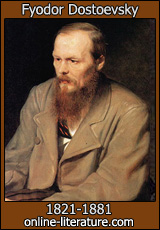
| Art of Worldly Wisdom Daily In the 1600s, Balthasar Gracian, a jesuit priest wrote 300 aphorisms on living life called "The Art of Worldly Wisdom." Join our newsletter below and read them all, one at a time. |
Sonnet-a-Day Newsletter Shakespeare wrote over 150 sonnets! Join our Sonnet-A-Day Newsletter and read them all, one at a time. |
