Subscribe for ad free access & additional features for teachers. Authors: 267, Books: 3,607, Poems & Short Stories: 4,435, Forum Members: 71,154, Forum Posts: 1,238,602, Quizzes: 344
The Poetics
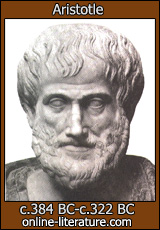
Aristotle, who lived between 384-322BC, wrote 'Poetics' but the work is not known to have been widely circulated or published in his lifetime. But Poetics has helped improve understanding about the dynamics of writing drama and poetry since its discovery years after his death.
Poetics was properly translated in Italy during the Italian Renaissance and the time of Shakespeare in 1600. An Oriental version existed in 935AD.
Poetics looks at the fundamentals of writing great tragedy. Aristotle believes the art of good dramatic tragedy is personified by the works of the popular Greek playwright Sophocles.
Poetics considers tragedy to be the dramatisation of a sequence of events which cause a situation to go from good to bad in a logical and surprising way. The dramatic events must show not tell what actually happens and must function according to the laws of logical probability or necessity. The events must evoke strong emotions such as pity caused by the character facing 'unmerited misfortune' or fear caused by relating to the character in adverse circumstances.
The plot is an arrangement of events derived from an unbroken chain of cause and effect. The beginning, middle and end must have causal connections comprising a holistic whole to ensure audiences do not suffer from a suspension of disbelief or become disengaged from the plot.
Aristotle insists characters must be complex not stereotypes. The character like all human beings must have a flaw or make a mistake. This must cause their situation to go from good to bad where they lose something of importance be it power, status or their lives. Aristotle believes a good character has to be highly renowned and prosperous for the fall to be tragic but this view may not be shared today.
The character's speech or action must express their character and their personal motivations must support the plot and its overall holistic theme.
The written character must be relevant to the role, provide a picture of their morality, be true to life and show consistency through necessity and probability. This realism must also show an otherness which shows the representation of perhaps what may be a greater capacity in all human beings. Today, we may describe this as our human ideals but these will be universally recognised as heros and heroines.
Poetics is the basis of Western drama and is used by playwrights and screenwriters alike and is a standard text book in Hollywood. Therefore, most of us know the classic structure of all drama but may now choose to watch the drama at the Cinema or on TV rather than the theatre.--Submitted by drama Bal
~
Fan of this book? Help us introduce it to others by writing a better introduction for it. It's quick and easy, click here.
Recent Forum Posts on The Poetics
Articles on Aristotle's Poetics
I have a college assignment to find a good article that discusses Aristotle's Poetics and to write a summary of that article. I'm not really sure where to begin looking. Anybody have any ideas or know of any enlightening articles discussing the Poetics?
Aristotle's Poetics
Anyone care to discuss?
Aristotle's Poetics
It is amazing how sophisticated Aristotle's analysis of literature, theatre, poetry is and what far reaching influence it has, down to the present day. faculty.goucher.edu/eng211/aristotle_poetics_examples.htm A perfect tragedy should imitate complex actions (see #12) that excite pity and fear (#4) while leading a man who is extraordinarily good and just to misfortune by some error of judgment or frailty of character. That "frailty of character" is the famous "tragic flaw" or hamartia , actually something closer to a "tragic imbalance" The ancient Greek word, "hamartia", which Aristotle uses for a hero's tragic flaw becomes the sole word used in the Christian New Testament for sin. Yet, the primordial meaning of "hamartia" comes from the notion of an archer who shoots his arrow but misses the mark; hence, a falling short, or a shortcoming. the meaning of the word Regarding the notion of "sin" in the Bible. In Hebrew, KHATAUAU, in Greek hAMARTIA. The Greek term has the sense of a missing of the goal, or a straying away from the right path. "Hamartia" brings to mind the image of an archery target "bullseye." The mark is the exact center of the target. To hit an outer ring is "hamartanein," to miss the mark. Applied to the category of sin, anything less than absolute perfection in performance would be "missing the mark." The Hebrew word "cHata", on the other hand, is related much more closely to a lifestyle perspective. "Walking the wrong path" is less concerned about individual actions than overall ways of living. I understand that the OT is also concerned with actions of the individual, but the emphasis seems to be centered around how a person lives life, not on the specific things that he or she does. "cHata" reflects this. We see this emphasis also in the Hebrew word for repentance, "shub." "Shub" means "to turn around," which is what one does when correcting for walking the wrong path. The New Testament word, "metanoein" (to repent) also carries the connotation of change, lit. "changing one's mind," but Hebrew is a more visual language. In college, St. John's in Annapolis, I was impressed with the notion that the word "Satan" comes from a word which means "to turn away" or "be misled". We once had a visiting lecturer from another school spend the entire Friday evening lecturing about "The Apotreptic Moment". "Apotrepsis" is another word that means "turning about". Socrates would use refutation to back someone into the motionless cul-de-sac of "aporia" or no way out, and sometimes, they would suddenly "turn about" in an apotreptic moment.
Here is where you find links to related content on this site or other sites, possibly including full books or essays about Aristotle written by other authors featured on this site.
Sorry, no links available.