
Subscribe for ad free access & additional features for teachers. Authors: 267, Books: 3,607, Poems & Short Stories: 4,435, Forum Members: 71,154, Forum Posts: 1,238,602, Quizzes: 344
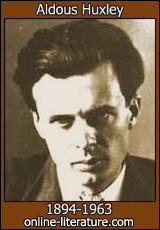
Aldous Huxley
Aldous Huxley was born in Godalming, Surrey on July 26, 1894, into a well-to-do upper-middle-class family. His father, Leonard Huxley, was a biographer, editor, and poet. He first studied at Eton College, Berkshire (1908-13). When Huxley was fourteen his mother died. At the age of 16 Huxley suffered an attack of keratitis punctata and became for a period of about 18 months totally blind. By using special glasses and one eye recovered sufficiently he was able to read and he also learned Braille. Despite a condition of near-blindness, Huxley continued his studies at Balliol College, Oxford (1913-15), receiving his B.A. in English in 1916. Unable to pursue his chosen career as a scientist - or fight in World War on the front - Huxley turned to writing. His first collection of poetry appeared in 1916 and two more volumes followed by 1920.
Huxley's first novel, Crome Yellow (1921), a witty criticism of society, appeared in 1921. Huxley's style, a combination of brilliant dialogue, cynicism, and social criticism, made him one of the most fashionable literary figures of the decade. In eight years he published a dozen books, among them Point Counter Point (1928) and Do What You Will (1929).
During the 1920s Huxley formed a close friendship with D.H. Lawrence with whom he traveled in Italy and France. For most of the 1920s Huxley lived in Italy. In the 1930s he moved to Sanary, near Toulon, where he wrote Brave New World, a dark vision of a highly technological society of the future. In the1930s Huxley was deeply concerned with the Peace Pledge Union. He moved in 1937 with the guru-figure Gerald Heard to the United States, believing that the Californian climate would help his eyesight, a constant burden. After this turning point in his life, Huxley abandoned pure fictional writing and chose the essay as the vehicle for expressing his ideas.
Brave New World Revisited appeared in 1958. Huxley's other later works include The Devils Of Loudon (1952), depicting mass-hysteria and exorcism in the 17th-century France. Island (1962) was an utopian novel and a return to the territory of Brave New World, in which a journalist shipwrecks on Pala, the fabled island, and discovers there a kind and happy people. But the earthly paradise is not immune to the harsh realities of oil policy. In 1963 appeared Literature And Science, a collection of essays.
In 1954 Huxley published an influential study of consciousness expansion through mescaline, The Doors Of Perception and became later a guru among Californian hippies. He also started to use LSD and showed interest in Hindu philosophy. In 1961 Huxley suffered a severe loss when his house and his papers were totally destroyed in a bush-fire. Huxley died in Los Angeles on November 22, 1963.
The above biography is copyrighted. Do not republish it without permission.
Forum Discussions on Aldous HuxleyRecent Forum Posts on Aldous Huxley
Here is where you find links to related content on this site or other sites, possibly including full books or essays about Aldous Huxley written by other authors featured on this site.
Sorry, no links available.

Searching for source of quote attributed to Aldous Huxley
The quote 'Every man’s memory is his private literature' is attributed to Aldous Huxley but I have been unable to find the source. Please let me know if you know where it came from. thank in anticipation Michelle...
Posted By MichelleRoberts in Huxley, Aldous || 0 Replies
Searching for reference to Huxley quotation
I have been searching for some time and in vain for the origin of a quote from Huxley that I read years and years ago - I cannot recall where, or from which of his writings this phrase came - nor its precise wording, unfortunately! The line conveys that there are moments in the depth of human despair when one considers the works of even the greatest artists and masters in history and asks - "is this it?" Shakespeare is specifically cited as the final example, although I do not recall the other examples. There comes a time when one looks at .........., at ........ at Shakespeare even and must ask - is this it? I am aware that this is not a great deal to go on - I thought I wou...
Posted By LHS in Huxley, Aldous || 0 Replies
Aldous Huxley
Let's talk about my friend and mentor Aldous Huxley. Doors Of Perception was one of the first books that greatly influenced me. I read that followed by his other essay Heaven and Hell. Such great insight. I read Brave New World and I can truly understand how he see's that as the future. Here especially in America we are willingly giving up our freedom for comfort. I also read Brave New World Revisited and it is striking how he talks of the world in 1956, and the future as he predicts it if we do not change, and how the world is today. A true visionary and a remarkable soul. Please tell me someone else reads Huxley....
Posted By E.A Rumfield in Huxley, Aldous || 7 Replies
Two views of human nature Huxley and Orwell present? I need this ASAP.Social hm help!
Who says you can’t correctly predict the future? Aldous Huxley and George Orwell did. Hear Neil Postman: What Huxley feared was that there would be no reason to ban a book, for there would be no one who wanted to read one. Orwell feared those who would deprive us of information. Huxley feared those who would give us so much that we would be reduced to passivity and egoism. Orwell feared that the truth would be concealed from us. Huxley feared the truth would be drowned in a sea of irrelevance. Orwell feared we would become a captive culture. Huxley feared we would become a trivial culture, preoccupied with some equivalent of the feelies, the orgy porgy, and the centrifugal bumble-puppy. A...
Posted By fatty005005 in Huxley, Aldous || 6 Replies
What books/articles/journals ...
What books, journals, or articles discuss Aldous' Huxley's writing. It would help if you could point me in the the right direction. I'm analyzing his use of themes, the change of tone and styles in some of his works....
Posted By pyler in Huxley, Aldous || 0 Replies
Contemporary writers that Huxley looked up to
Bertrand Russell might have been one since he did a review of his (Bertrand's book) Which Way to Peace? "The Pacifist Case." The Listener. Alexander Mathias could be another writer given that Huxley reviewed The Universal Constant in Living. Saturday Review of Literature Who are other contemporary writers that Huxley looked up to? D.H Lawrence was a close companion....
Posted By pyler in Huxley, Aldous || 4 Replies
Major events that influenced his writing style.
I'm trying to master Huxley's writing style by trying to study the major events that influenced his writing. What are some of the major events in Huxley's life that influenced his writing style? or How did he develop his writing style?...
Posted By pyler in Huxley, Aldous || 0 Replies
Aldous Huxley's writing style
I often wonder what Aldous Huxley's writing style was. He wrote about many things, many themes in literature. What techniques of his writing can be inferred from his literary works?...
Posted By pyler in Huxley, Aldous || 0 Replies
Favourite Aldous Huxley Book?
Hi, I'm not well read but I think I'll enjoy changing that. As I was reading the philosophy of Eckhart Tolle, (love him) I saw that he likes Aldous Huxley's book Island. According to him, the book is about a utopia where people are "actually sane." Knowing that he was the writer of Brave New World, i googled him for more information. I found out that Island is sort of Huxley's "anti-BNW." The utopia to complement his distopia. Wiki mentioned that in BNW, the populace is drugged to pacify them and keep them in line, whereas in Island, people sometimes take drugs for self discovery and spiritual purposes. I find the idea of two books by the same author that compare how the same tool can be use...
Posted By Stonebolt in Huxley, Aldous || 4 Replies
Brave New World
What is the nature of male-female relationships in this novel?...
Posted By bitemebree in Huxley, Aldous || 1 Reply
The Cicadas
I really want to read Huxley's poem, The Cicadas, but I cannot find it anywhere on the internet. Does someone have it in their possession and is willing to post it for me?...
Posted By paffy91 in Huxley, Aldous || 1 Reply
huxley quote
"religion is not the opium of the masses but rather opium is becoming the religion of the masses." so true, so many people put on prescription drugs these days and grow addicted to them. drugs do more to keep the masses docile than religion has. that is why he used "Soma" as the future of drugs in Brave New World, which really just representing this idea. Its hard to start a revolution when your all high....
Posted By libernaut in Huxley, Aldous || 3 Replies
Post a New Comment/Question on Huxley