J.S. Bach
Cantata 205
'And, turning neither left nor right, he continued...'
http://www.youtube.com/watch?v=33nKaU7UDwE


J.S. Bach
Cantata 205
'And, turning neither left nor right, he continued...'
http://www.youtube.com/watch?v=33nKaU7UDwE
Last edited by Musicology; 07-23-2010 at 10:15 AM.

I prefer the Karajan recording of Tristan to all others. Nothing can equal the berlin Philharmonic under the control of such a perfectionist as Karajan... and as you note, the late Wagner works are as much about the orchestra as the vocalists... or rather the vocalists are but one more instrument within the whole. Karajan's recording has a certain icy eroticism that strikes me as perfectly suited to the work. After Karajan... I'd probably go with Bohm... and as you probably know... Bohm's set is cheaper than Karajan... or the out of print Bernstein... which I have not heard, but know is considered to be quite a controversial recording.
J.S. Bach
Cantata 205
'And, turning neither left nor right, he continued...'
I must admit that Musicology has at least one redeeming quality... his unfailing passion for Bach... which I can certainly not fault.
it is often unseemly how some hyper-enthusiasts tend to treat vocalists as if they are thoroughbred racehorses, handicapping their performances at the track as it were.
Opera fanatics are far more obsessed than fanatics of almost any other field outside of sports and politics. Where a classical music buff may disagree as to which recording of Beethoven's piano sonatas is best they are not likely to refer to Gilels and Rubinstein as talentless hacks, "sluts" or "whores" if they happen to prefer Kempff. This, however, is quite common among opera fanatics. All one needs to do is read the comments on nearly any YouTube video of an opera performance... especially those involving contemporary female singers. While I surely have favorite singers... singers I prefer to others... I can't imagine the need to so viciously attack the efforts of any other singer... especially when... as you note... nearly any singer who attains a certain status... performing with leading orchestras and at major international venues most certainly has a degree of ability that is well beyond that of most.
Beware of the man with just one book. -Ovid
The man who doesn't read good books has no advantage over the man who can't read them.- Mark Twain
My Blog: Of Delicious Recoil
http://stlukesguild.tumblr.com/
Hi StLukesguild,
I am of course an ignorant man. But I have been humbled by the fact of it over and over again. Whether that counts for anything is an open question. In the meantime I marvel at what seems, to me, beyond criticism.
Regards
http://www.youtube.com/watch#!v=Y-AI...eature=related

Los Angeles Opera recently completed a Niblung's Ring cycle--which was great--so I've been listening to a lot of late Wagner lately.
Also exploring Russian Romantic opera with Mussorgsky and Rimsky-Korsakov, comparing Abbado's Boris Gudonov with Karajan's.
Meier's a fine vocalist; she sang Marie in Berg's Wozzeck under Barenboim (who's a great Wagnerian conductor as well).Originally Posted by Lokasenna

What lovely music and music discussion it seems I've been missing lately. Thanks for the madrigal, St. Luke's. I had never heard that one before. You made me break my budgetary ban on i-tunes and spend the 99 cents on that track so I can carry it around in my i-pod. Was good and resisted buying the whole 2 CD collection it's on. Are the rest of the selections as good? Should I put it on my list of possible things to buy when grant money from kind patron comes in?
I've been listening to some early English music this afternoon in hopes it will inspire more rapid dissertation writing. I thought I would post "O Mistress Mine" from Shakespeare's 12th Night. It's one of the few of the many songs that appear in Shakespeare's plays that we can match with a high degree of confidence to an original tune, in this case one by Thomas Morley. Here's the best I could find of it on youtube:
http://www.youtube.com/watch?v=wxuab...eature=related
I will take my hat off to anyone who can explain to me why the song is accompanied by photographs of what I think are sloths (though I'd also like to know if they are something other than sloths, since I'm no zoologist). The much better, and sloth-free recording of the tune and other either original or contemporary setting of Shakespeare's songs (with the original pronunciation) is the CD I am listening to and use for teaching purposes:

"In rime sparse il suono/ di quei sospiri ond' io nudriva 'l core/ in sul mio primo giovenile errore"~ Francesco Petrarca
"Follies and nonsense, whims and inconsistencies do divert me, I own, and I laugh at them whenever I can."~ Jane Austen
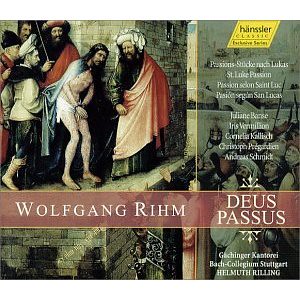
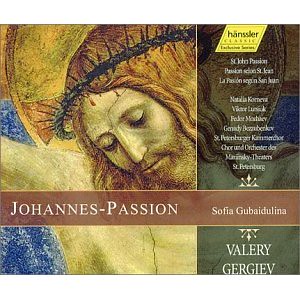
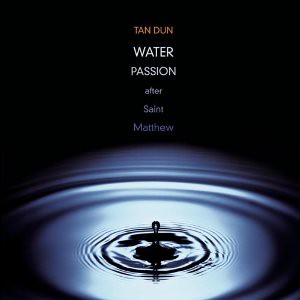
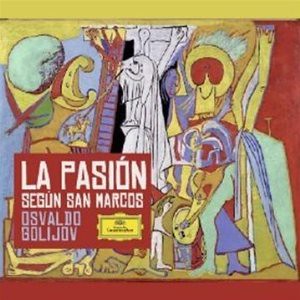
In 2000... the 250th anniversary of J.S. Bach's death, the International Bach Academy of Stuttgart commissioned new settings of the 4 passion narratives of the Gospels: Matthew, Mark, Luke, and John. These commissions went to four very different contemporary composers: Wolfgang Rihm, Sofia Gubaidulina, Tan Dun, and Osvaldo Golijov:
I have owned Tan Dun's Water Passion After St. Matthew for some 4 or so years now. It is a strange... yet somehow compelling work. The other three have been on my wish list for a good length of time now. Today my copy of Golijov's La Pasión según San Marcos arrived and I have been giving it a first listen. Where Tan Dun's effort was decidedly challenging... at times difficult... clearly within the Modernist tradition, Golijov's work is decidedly populist... employing the rhythms, instrumentation, joyful choruses, language (it is largely in Spanish... with some Latin and Aramaic passages) of Latin American Music.
The reviewer of The New Yorker exclaimed that Golijov's La Pasión según San Marcos "drops like a bomb on the belief that classical music is exclusively European art. It has a revolutionary air," while the Boston Globe critic declared the work to be "the first indisputably great composition of the 21st century." I agree on all accounts. It is along with Peter Lieberson's Neruda Songs and David Lang's Little Match Girl Passion one of the strongest and most moving works of classical music written since the turn of the millennium.
The piece is truly revolutionary... in the same manner in which Gershwin's Porgy and Bess was revolutionary in that like Gershwin's constuction of a serious opera based upon the jazz and other native American popular and classical music traditions, Golijov has the audacity to construct a work of "serious" music... a passion play in homage to that greatest of European masters: J.S. Bach... from the traditions of folk, pop, and classical music of Latin America.
Osvaldo Golijov was born and raised in Argentina of Jewish Romanian and Russian heritage. In the 1980s he moved to Israel where he absorbed the musical traditions of the Middle-East: ancient Hebrew, Arabic, and Christian. Over his career, his music has merged elements of this tradition with those of Latin-American and Spanish music, klezmer, Western classical, and pop. Golijov stages the entire drama of the Passion of Christ within a Latin-American setting that displays his affinity with the music of this aspect of his heritage far more than any other work that I have heard by the composer.
Golijov argues that Christ was a man of the people... a man of the streets... and should be presented in decidedly populist manner. Christ himself is often represented by the voice of the entire choir: as everyman. The composer employs a large choir that at times divides into two or even three choirs which echo or even argue with each other. The composer states that he thought of the distinct choirs as being based upon South American Easter processionals rooted in the Latin American synthesis of Catholicism and the Yoruba religion brought by African slaves. He intends something connoting the rituals and joyful processions coming from various villages as opposed to the Protestant tradition of somber meditation.
The initial effect of La Pasión según San Marcos is somewhat disconcerting... as if the take on the most sacred of narratives was almost blasphemous. The composer, after all, has the audacity to set this most sacred of narratives within a musical frame that at times suggests a rowdy South American night club with blaring horns and singers with sensuous smokey voices mouthing songs of seduction. But the music is also very effective.
There are sudden shifts in mood... going from the most uproarious and passionate, to passages of simplicity and quiet. In the scene of Gethsemane, the music suggests a delicate English choir with voices sailing high above. In the face of this, a mezzo sings the most haunting tune... suggestive of the Spanish lament or "deep song".
The most moving moment comes with the aria, Lúa Descolorida (Colorless Moon... the Aria of Peter's Tears). This aria sets a poem by Garcia-Lorca's beloved Rosalía de Castro written in Gallego (the language of the Galicia region in Spain) and defines despair in a way that is simultaneously tender and tragic. The soloist sings her haunting lament against the muted sounds of a string quartet. The aria was originally written for and performed by the singer Dawn Upshaw. Golijov states "the strongest inspiration for Lúa Descolorida was Dawn Upshaw's rainbow of a voice... I wanted to give her music so quietly radiant that it would bring an echo of the single tear that Schubert brings without warning..." It achieves this quite well... and in the context of the Passion... following Peter's 3rd denial of Christ... it powerfully conveys his emotions... his regret, pain, torment, and mourning. In a sense, it stands as the emotional climax of the entire work.
Where Lúa Descolorida is preceded by a moment of silence that makes it all the more powerful, it is followed by vicious voices... almost hissing and spitting... as they mock Christ. The Passion rapidly unfolds at this point. The journey to Golgotha and the crucifixion are accompanied by a raucous... at once mocking... yet joyful chorus that at once suggest Christ's tormentors... but also the joy of the believers who celebrate the Crucifixion as the penultimate event in the life of Christ... and ultimately humanity.
In the final moments the Crucifixion is portrayed... as it might be in a Latin-American passion play. The choir as the crowd shouts in derision: "Come down from the cross if you be the King of the Jews." And then: muerte... and Christ calls out, "Elohi, Elohi, Lama Shabachtani"... "My God, my God, why have you foresaken me?" In the final movement, Kaddish, a haunting Prayer for the Dead sung in Christ's own language of Aramaic as the women mourners repeat Christ's final words.
This particular recording comes complete with a DVD recording of a 2008 live performance of the work in Holland. I cannot recommend it highly enough.
http://www.youtube.com/watch?v=mvTiWPV2da0
http://www.youtube.com/watch?v=c5FgO...eature=related
http://www.youtube.com/watch?v=qceyTSpNxik
What lovely music and music discussion it seems I've been missing lately. Thanks for the madrigal, St. Luke's. I had never heard that one before. You made me break my budgetary ban on i-tunes and spend the 99 cents on that track so I can carry it around in my i-pod. Was good and resisted buying the whole 2 CD collection it's on. Are the rest of the selections as good? Should I put it on my list of possible things to buy when grant money from kind patron comes in?
The aria in question is undoubtedly the centerpiece of the entire cycle... but the 8th book of Monteverdi's madrigals as a whole is one of his supreme masterpieces... and the la Venexiana performances could not be better. Following the purchase of this and the 7th book... combined with the Vespers and L'Orfeo has me now thinking that Monteverdi may just be the most underrated of composers... ranking along side of Tchaikovsky, Debussy, Verdi, and few others among the greatest non-German composers.
Beware of the man with just one book. -Ovid
The man who doesn't read good books has no advantage over the man who can't read them.- Mark Twain
My Blog: Of Delicious Recoil
http://stlukesguild.tumblr.com/
[QUOTE=stlukesguild;926801.....Opera fanatics are far more obsessed than fanatics of almost any other field outside of sports and politics. Where a classical music buff may disagree as to which recording of Beethoven's piano sonatas is best they are not likely to refer to Gilels and Rubinstein as talentless hacks, "sluts" or "whores" if they happen to prefer Kempff. This, however, is quite common among opera fanatics. All one needs to do is read the comments on nearly any YouTube video of an opera performance... especially those involving contemporary female singers. While I surely have favorite singers... singers I prefer to others... I can't imagine the need to so viciously attack the efforts of any other singer... especially when... as you note... nearly any singer who attains a certain status... performing with leading orchestras and at major international venues most certainly has a degree of ability that is well beyond that of most.[/QUOTE]
This is keeping an old tradition alive, I think - it was not uncommon in the nineteenth century to have rival factions in Opera houses disrupting performances with cat-calls and raucous comments. I can't help feeling it is a custom that should be more honoured in the breach than in the observance, as someone once said,, especially in the twentyfirst century.
Hector Berlioz (1803-69)
'Shepherd's Farewell'
'L'Enfance du Christ'
(King's College
Cambridge
England)
http://www.youtube.com/watch?v=p0vO4LDImrc
Hector Berlioz (1803-69)
Duet
"Nuit paisible"
Opera
'Beatrice and Benedict' (1862)
http://www.youtube.com/watch#!v=JtZl...eature=related
///
Last edited by Musicology; 07-28-2010 at 09:15 AM.

To be fair, hanging, ducking witches, trial by ordeal, burning at the stake and Whig or Tory parliaments were traditional here, but fortunately, we've moved on a bit since then. Nor do we refer to people as a "bull's pizzle" any longer, as the Bard did, so hanging on to something objectionable just because it is "traditional" is less than desirable. By the way, where I live, up until fairly recently the outside toilet was traditional, but somehow, in the middle of the night when it was chucking it down with rain and blowing half a gale, we never really felt that connected to history.
Dafydd Manton, A Legend In His Own Lunchtime!!www.dafydd-manton.co.uk
My Work Has Been Spread Over Many Fields!
Don't tell me you have done away with the ty bach, Dafydd.
I get obsessed with "Gymnopedies" every now and then:
http://www.youtube.com/watch?v=q7DBo...eature=related
~
"It is not that I am mad; it is only that my head is different from yours.”
~
Hector Berlioz
Overture
'Le Corsaire' (1844)
http://www.youtube.com/watch?v=jCkfi3uR7yY

I'm falling back on an old favourite while I work:
http://www.youtube.com/watch?v=L5C99JyP2ns
Elgar's Cello Concerto - this is just the first movement, but everything else is on Youtube. This is probably the most famous recording - Jacqueline Du Pré on the Cello, with Barenboim conducting.
It's very unlike Elgar's usual jovial style, but that makes it all the more special. It is a profound piece of music, filled with deep emotion, and never fails to move me.
There is an anecdote that says of Elgar, during his final illness, that he remarked to a friend: "If ever after I'm dead you hear someone whistling this tune on the Malvern Hills, don't be alarmed. It's only me."
It is a sentiment I can understand.
"I should only believe in a God that would know how to dance. And when I saw my devil, I found him serious, thorough, profound, solemn: he was the spirit of gravity- through him all things fall. Not by wrath, but by laughter, do we slay. Come, let us slay the spirit of gravity!" - Nietzsche
Abbado's Carmen with Teresa Berganza (and Plácido Domingo).
http://www.amazon.com/Bizet-Carmen-G...1626345&sr=1-1
Can't get Carmen out of my mind since seeing Elina Garanca (with Alberto Alagana) in the MET's recent staging.
Elina Garanca is Carmen for me now--oh mamma!
http://en.wikipedia.org/wiki/Elina_Garanca
Take it away, little Kapellmeister ! Amazing bass line. Amazing parts. Amazing vocal line. You heard it first. And that is all.
J.S. Bach
Ebarme dich, mein Gott
Soloist - Maureen Forrester (contralto)
http://www.youtube.com/watch?v=X_tXq...eature=related
Last edited by Musicology; 08-15-2010 at 07:43 AM.
 Posting Permissions

 Reply With Quote