Buying through this banner helps support the forum!
Page 27 of 104 FirstFirst ... 1722232425262728293031323777 ... LastLast
Results 391 to 405 of 1549

Thread: Classical Listening

  1. #391
    Artist and Bibliophile stlukesguild's Avatar
    Join Date
    Jul 2006
    Location
    The USA... or thereabouts
    Posts
    6,083
    Blog Entries
    78
    Interestingly enough... the duel between the arch-Modernists and those who refused to abandon Romanticism. The Modernists too a progressive approach, abandoning tonality and harmony and pushing ever forward into increasingly challenging and difficult musical languages that often left even the educated audiences baffled. The Romantics continued to champion traditional tonality and harmony as essential... even natural to music. Many Modernists would accuse their Romantic rivals of being reactionaries... stuck in the past... and pandering to the broadest possible audience. In turn, they were accused of having abandoned music's ability to communicate with a public as a result of their esoteric efforts at experimentation for the sake of experimentation.

    By the late 20th century, the entire dispute had become something of a non-issue to subsequent generations of composers... many of whom saw either side as just one more possibility... and freely combined elements of tonality with the dissonance or atonality of Modernism. Another camp abandoned the dispute altogether... recognizing that the dispute which was essentially that of 19th century musical ideals vs those of the 20th century ignored the wealth of other musical possibilities... including non-Western musical forms... and "Early Music".

    Concurrent with the explorations of "Early Music" by composers such as Philip Glass, Steve Reich, Arvo Pärt, Henryk Górecki, Erkki-Sven Tüür, etc... the interest in the studies of Early Music increased and these would have a major impact upon the performance of music in the form of the Historically Informed Performance (HIP) movement. HIP recordings employed the proper period instruments and performing styles to the recording of early music, be it Bach, Handel, Mozart, Beethoven, or Gesualdo. Prior to this point, most recordings of earlier composers were performed upon modern instruments, using the large-scale Romantic-era orchestras, and modern performance techniques.

    Beyond the rethinking of the older masters such as Bach, Handel, Haydn, Mozart, and Beethoven, the HIP led to a greater awareness and exploration of other composers within the older musical styles. Where the larger classical music public were well aware of an entire range of masters from the Romantic era, the baroque was often limited to Bach, Handel, and Vivaldi... with perhaps a nod to Domenico Scarlatti. It was soon discovered that the Baroque was not so limited, but rather there were any number of other masterful composers such as Biber, Zelenka, Rameau, Lully, Corelli, and Scarlatti's father, Alessandro, also at work. Exploration expanded to Renaissance and Medieval music where an equally broad array of composers were unearthed and began to see the light of day through recordings: Gesualdo, Monteverdi, Josquin, Palestrina, Perotin, Leonin, Hildegard of Bingen, William Byrd, Thomas Tallis, John Dowland, and Nicolas Gombert... who I am currently listening to.

    Nicolas Gombert was born in Flanders c. 1495 and was employed in the entourage of the Emperor, Charles V. In this position he traveled widely around Europe spreading the innovations of Franco-Flemish music to the Iberian Peninsula. Gombert was perhaps the leading composer following Josquin and prior to Palestrina. His efforts centered upon the composition of vocal music... sacred works (masses, motets, a Magnificat, etc...) and secular (chanson/songs) where he developed polyphonic music... or music that employs multiple "voices"... singers singing different melodic lines at the same time (as many as 6, 8, 10, or 12 different voices with Gombert) which harmonically weave together into a single sound. Some of his compositions are for unusually large vocal ensembles for the time, and the secular works are often especially complex. Gombert is also known, like Gesualdo, for employing elements of dissonance for expressive purposes. While the music of composers such as Gombert immediately strikes the modern listener as perhaps soothing... hypnotic... clearly spiritual in content, it might serve well to note that in its day it was some of the most daring and cutting edge music... music that many of the more conservative church leaders found shocking... overly ornamental... even blasphemous!


    http://www.youtube.com/watch?v=v0yaz1_65v4

    http://www.youtube.com/watch?v=BuwKXSVlN-w

    http://www.youtube.com/watch?v=tWs6k...eature=related
    Beware of the man with just one book. -Ovid
    The man who doesn't read good books has no advantage over the man who can't read them.- Mark Twain
    My Blog: Of Delicious Recoil
    http://stlukesguild.tumblr.com/

  2. #392
    Banned
    Join Date
    Sep 2009
    Location
    London, England
    Posts
    1,258
    Here is the answer. We are free to forget the question.

    J.S. Bach
    Concerto for 2 Keyboards
    BWV 1061

    http://www.youtube.com/watch#!v=6vbb...eature=related
    http://www.youtube.com/watch#!v=CzTb...eature=related
    http://www.youtube.com/watch#!v=Cdbf...eature=related

    'The earth is the Lord's and the fullness thereof'

    J.S. Bach
    Concerto for 3 Keyboards
    Allegro
    BWV 1064/1

    http://www.youtube.com/watch#!v=SGNx...eature=related

  3. #393
    Artist and Bibliophile stlukesguild's Avatar
    Join Date
    Jul 2006
    Location
    The USA... or thereabouts
    Posts
    6,083
    Blog Entries
    78

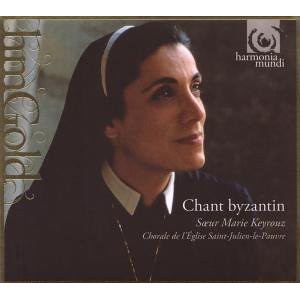
    More "Early Music": Soeur Marie Keyrouz and Byzantine Music


    According to Wikipedia: Byzantine music remains the oldest genre of extant music, of which the manner of performance and (with increasing accuracy from the 5th century onwards) the names of the composers, and sometimes the particulars of each musical work's circumstances, are known (although Robert/Musicology will probably be along to inform us that it was all the invention of the Jesuits, the Free Masons, Hollywood, and the Church of the Flying Spaghetti Monster). The Byzantine Church came into existence in a place in which Arabic, Aramaic, Hebrew, Greek, and Latin all rubbed shoulders. Some of this music dates back to as early as the 4th century. It was largely preserved both as it passed down from generation to generation orally, but also in a rough form of notation known as Ekphonetic notation, which involved symbols used as a mnemonic device to assist in their cantillation. The music was not set rigidly as in more modern Western music, but rather allowed for a deal of improvisation while adhering to notes within the given mode, metrical scheme, accents, and patterns.

    Today I'm listening to a second disc by Soeur Marie Keyrouz, who is virtually the unrivaled as a cantor of this ancient music. She was born in Deir el Ahmar in Lebanon and is a member of the Melkite through her religious congregation, she took her vows in the Melkite/Melchite or Byzantine Greek Catholic Church. She has a joint doctorate in musicology and anthropology from the Sorbonne. She has collected and performs a variety of so-called "Oriental" Christian chants, mostly preserved in Greek, Syrian, and Arabic manuscripts and through oral tradition. She is accompanied on this disc by the Chorale De L'église Saint-Julien-Le-Pauvre which provide the steady choral drone over which her voice soars. Not only is this music intensely spiritual... and hypnotic... but the disc is beautifully packaged in a booklet containing the complete texts in translation and a number of lovely reproduction of Byzantine art of the era. Soeur Marie Keyrouz has become something of a "cottage industry" with a high-tech web site of her own:

    http://www.keyrouz.com/

    http://www.youtube.com/watch?v=HAhvJ...eature=related

    http://www.youtube.com/watch?v=3ql5V_Osp2Y
    Beware of the man with just one book. -Ovid
    The man who doesn't read good books has no advantage over the man who can't read them.- Mark Twain
    My Blog: Of Delicious Recoil
    http://stlukesguild.tumblr.com/

  4. #394
    Vincit Qui Se Vincit Virgil's Avatar
    Join Date
    Nov 2005
    Location
    New York
    Posts
    20,354
    Blog Entries
    248
    My summer learning project is to learn and experience Beethoven's string quartets. Today I was listening to Opus 127.

    Here's that great first movement, Sonata form of course:

    http://www.youtube.com/watch?v=A5mQQnkKm1k
    LET THERE BE LIGHT

    "Love follows knowledge." – St. Catherine of Siena

    My literature blog: http://ashesfromburntroses.blogspot.com/

  5. #395
    Artist and Bibliophile stlukesguild's Avatar
    Join Date
    Jul 2006
    Location
    The USA... or thereabouts
    Posts
    6,083
    Blog Entries
    78
    My summer learning project is to learn and experience Beethoven's string quartets. Today I was listening to Opus 127.

    A formidable challenge, indeed! I've honestly never been a big fan of quartets... although I certainly have listened to Beethoven's, Schubert's, Shostakovitch's, Mozart's, Haydn's and a number of others with pleasure. I sometimes wonder if it is not due to my love of song that I am so enamored of nearly any form of vocal music... but find I'm less than enthralled with chamber music... to say nothing of a good deal of modern music?

    My own goal has been to broaden my grasp of Baroque and earlier music. At the same time... I've been getting back to my American roots in also touring through some of the pioneers of R & B, Blues, Rock, etc... such as Mahalia Jackson, John Lee Hooker, Muddy Waters, Little Richard, Son House, B.B. King, Little Jimmy Scott, Joe Williams, Etta James, etc...
    Beware of the man with just one book. -Ovid
    The man who doesn't read good books has no advantage over the man who can't read them.- Mark Twain
    My Blog: Of Delicious Recoil
    http://stlukesguild.tumblr.com/

  6. #396
    the beloved: Gladys's Avatar
    Join Date
    Oct 2007
    Location
    Australia
    Posts
    1,609
    Quote Originally Posted by Virgil View Post
    My summer learning project is to learn and experience Beethoven's string quartets.
    Discovering these in the 1970's, I much later experienced the same feelings - an appreciation of intense existential beauty and fragility - in novels of Dostoevsky, Henry James, James Joyce, Arundhati Roy, and others. Frail, fleeting visions of naked eternity, crystallised in the moment.
    "Love does not alter the beloved, it alters itself"

  7. #397
    Vincit Qui Se Vincit Virgil's Avatar
    Join Date
    Nov 2005
    Location
    New York
    Posts
    20,354
    Blog Entries
    248
    Quote Originally Posted by stlukesguild View Post
    My summer learning project is to learn and experience Beethoven's string quartets. Today I was listening to Opus 127.

    A formidable challenge, indeed! I've honestly never been a big fan of quartets... although I certainly have listened to Beethoven's, Schubert's, Shostakovitch's, Mozart's, Haydn's and a number of others with pleasure. I sometimes wonder if it is not due to my love of song that I am so enamored of nearly any form of vocal music... but find I'm less than enthralled with chamber music... to say nothing of a good deal of modern music?
    Chamber music doesn't have the power of orchestral music, but it has incredible subtlty. In some respect they have a higher level of artistry.

    My own goal has been to broaden my grasp of Baroque and earlier music. At the same time... I've been getting back to my American roots in also touring through some of the pioneers of R & B, Blues, Rock, etc... such as Mahalia Jackson, John Lee Hooker, Muddy Waters, Little Richard, Son House, B.B. King, Little Jimmy Scott, Joe Williams, Etta James, etc...
    Well, I'm a huge blues fan. Those are some great names there.

    Quote Originally Posted by Gladys View Post
    Discovering these in the 1970's, I much later experienced the same feelings - an appreciation of intense existential beauty and fragility - in novels of Dostoevsky, Henry James, James Joyce, Arundhati Roy, and others. Frail, fleeting visions of naked eternity, crystallised in the moment.
    Nicely said.
    Last edited by Virgil; 07-17-2010 at 09:28 PM.
    LET THERE BE LIGHT

    "Love follows knowledge." – St. Catherine of Siena

    My literature blog: http://ashesfromburntroses.blogspot.com/

  8. #398
    Artist and Bibliophile stlukesguild's Avatar
    Join Date
    Jul 2006
    Location
    The USA... or thereabouts
    Posts
    6,083
    Blog Entries
    78
    My own musical tastes are all over the place, and I will admit that some of what I love can be thought of as quite esoteric... especially to those just beginning to explore "classical music". With that in mind, I offer up the following:

    http://www.youtube.com/watch?v=3pVW4Z8qOUE


    If there is one piece of classical music composed by an American that I certain will last, it is surely Samuel Barber's Adagio for Strings. This piece of music must surely be one of the most absolutely heart-wrenching artistic experiences I have ever known. The Adagio began as the middle movement of Barber's string quartet, but the composer himself recognized the worth of the piece and scored it for full orchestra. He sent a copy of this score to the great conductor, Toscanini. Toscanini returned it without comment, which deeply annoyed and hurt Barber... until he was informed by the conductor that he had returned the work because he had already memorized it entire. Toscanini gave the first performance of the Adagio for Strings with the NBC Symphony Orchestra on November 5, 1938 in New York. This recording was selected in 2005 for permanent preservation in the National Recording Registry at the United States Library of Congress.

    The Adagio for Strings is such a moving and somber piece of music that it is no surprise that it was broadcast over the radio at the announcement of Franklin D. Roosevelt's death. It was also played at the funeral of Albert Einstein, the funeral of Princess Grace of Monaco, during the radio report of John F. Kennedy's assassination and again was performed in 2001 at Last Night of the Proms in the Royal Albert Hall to commemorate the victims of the September 11 attacks, replacing the traditional upbeat patriotic songs. It was also played during the opening ceremonies of the Vancouver 2010 Winter Olympics. On April 13, 2010 Adagio for Strings was performed at the special joint session of the Polish Parliament and Senate three days after the tragic plane crash. It has also been repeatedly used in television and film, including Oliver Stone's Platoon and David Lynch's The Elephant Man.

    Barber also composed a choral setting of the Adagio, Agnus Dei:

    http://www.youtube.com/watch?v=KkObnNQCMtM


    -Samuel Barber

    Here's one that Petrach's Love might appreciate:


    This particular madrigal by Moneteverdi absolutely blows my mind... with the high plaintive voice rising above the others in a sweetest/saddest of laments:

    http://www.youtube.com/watch?v=LxcMZl6YwNs

    Exquisite!!!
    Beware of the man with just one book. -Ovid
    The man who doesn't read good books has no advantage over the man who can't read them.- Mark Twain
    My Blog: Of Delicious Recoil
    http://stlukesguild.tumblr.com/

  9. #399
    Currently playing:


    I logged into Naxos and this Liztz recording of Beethoven's 9th symphony popped-up so I hit the "go" button! Seems very sharp and energetic (and fast), here is the second movement on youtube:

    http://www.youtube.com/watch?v=s1KmD...next=1&index=3

  10. #400
    Card-carrying Medievalist Lokasenna's Avatar
    Join Date
    Feb 2009
    Location
    In a lurid pink building...
    Posts
    2,769
    Blog Entries
    5
    Quote Originally Posted by Neely View Post
    Currently playing:


    I logged into Naxos and this Liztz recording of Beethoven's 9th symphony popped-up so I hit the "go" button! Seems very sharp and energetic (and fast), here is the second movement on youtube:

    http://www.youtube.com/watch?v=s1KmD...next=1&index=3
    Ooh, now that I like!
    "I should only believe in a God that would know how to dance. And when I saw my devil, I found him serious, thorough, profound, solemn: he was the spirit of gravity- through him all things fall. Not by wrath, but by laughter, do we slay. Come, let us slay the spirit of gravity!" - Nietzsche

  11. #401
    Artist and Bibliophile stlukesguild's Avatar
    Join Date
    Jul 2006
    Location
    The USA... or thereabouts
    Posts
    6,083
    Blog Entries
    78
    Naxos has some really great recordings. Might I suggest you look into the Kodaly Quartet recordings of Haydn's string quartets (they are among the best at any price). For something a bit more modern, check out any of Antoni Wit's recordings of Penderecki (Wit studied under Penderecki). Istvan Bogar's recording of Brahm's Hungarian Dances are also among the best. Naxos is also great for recording new composers that rarely ever get recorded by the major labels.
    Beware of the man with just one book. -Ovid
    The man who doesn't read good books has no advantage over the man who can't read them.- Mark Twain
    My Blog: Of Delicious Recoil
    http://stlukesguild.tumblr.com/

  12. #402
    Registered User Emil Miller's Avatar
    Join Date
    Jul 2008
    Location
    London, England
    Posts
    6,499
    Quote Originally Posted by Neely View Post
    Currently playing:


    I logged into Naxos and this Liztz recording of Beethoven's 9th symphony popped-up so I hit the "go" button! Seems very sharp and energetic (and fast), here is the second movement on youtube:

    http://www.youtube.com/watch?v=s1KmD...next=1&index=3
    This a great transcription of Beethoven's symphony by Franz Liszt, a man who was capable of transcribing virtually any orchestral piece for the piano. Beethoven was a much better composer than Liszt but Liszt is acknowledged to be a better pianist than Beethoven who was one of the 19th century's greatest pianists.
    "L'art de la statistique est de tirer des conclusions erronèes a partir de chiffres exacts." Napoléon Bonaparte.

    "Je crois que beaucoup de gens sont dans cet état d’esprit: au fond, ils ne sentent pas concernés par l’Histoire. Mais pourtant, de temps à autre, l’Histoire pose sa main sur eux." Michel Houellebecq.

  13. #403
    Quote Originally Posted by stlukesguild View Post
    Naxos has some really great recordings. Might I suggest you look into the Kodaly Quartet recordings of Haydn's string quartets (they are among the best at any price). For something a bit more modern, check out any of Antoni Wit's recordings of Penderecki (Wit studied under Penderecki). Istvan Bogar's recording of Brahm's Hungarian Dances are also among the best. Naxos is also great for recording new composers that rarely ever get recorded by the major labels.
    Great will do.

    I don't know what I'll do when I lose the Naxos connection next year - I might have to enrol on something just to keep it (and my student card) alive!

  14. #404
    Registered User Sebas. Melmoth's Avatar
    Join Date
    Apr 2010
    Location
    Hôtel d'Alsace, PARIS
    Posts
    374
    Been exploring Tristan und Islode.

    Wagner's concept of gesamtkunstwerk and music-drama is in fact a bit different from traditional grand-opera, and we have it on authority from G. B. Shaw ('The Perfect Wagnerite') that in Wagner's late work (i.e., after Lohengrin) the voice is treated as an equal instrument with all other orchestral instruments--hence Wagner's design of the stage and orchestra pit at Bayreuth: the orchestra is not only sunken, but there is a large overhanging shell which looks something like this:
    \~~~-G-----/
    which pushes the orchestra's sound waves on to the stage as the vocalists' sound waves are projected towards the audience, thusly achieving an equal acoustic intensity.

    Wagnerian vocalists are a separate category of opera singers due to the long rôles, stamina and physical requirements needed.

    But in any case it is often unseemly how some hyper-enthusiasts tend to treat vocalists as if they are thoroughbred racehorses, handicapping their performances at the track as it were.
    It's the wrong approach to art appreciation, which should be one of gratitude and humility.

    One would imagine that any vocalist invited to perform with great orchestras at major venues would be entirely qualified, and therefore any performance of a major Wagnerian work should be appreciated for its individuality all round, including the unique timbre and tessitura of the vocalists' instruments: meaning, each singer brings something special to the table.

    Of Tristan recordings, some have greatly favoured the Furtwängler--although it is virtually an 'antique' recording it's been remastered--featuring the famous Flagstad (although she couldn'd hit her high-Cs which were dubbed by Schwarzkopf):
    http://www.amazon.com/Wagner-Tristan...=cm_lmf_tit_28

    The 1966 Böhm set is justly admired:
    http://www.amazon.com/Tristan-Isolde...f=cm_lmf_tit_8
    (The previous year 1965 Böhm's complete Niblung's Ring cycle ditto:
    http://www.amazon.com/Wagner-Ring-Ni...=cm_lmf_tit_27 )

    Kleiber's white-hot realization is incredibly admirable:
    http://www.amazon.com/Wagner-Tristan...f=cm_lmf_tit_9

    Finally, the Karajan and Bernstein readings have their merits, but the three CD format of the Böhm and Kleiber have their attractions.
    http://www.amazon.com/Richard-Wagner...9810034&sr=1-1

    http://www.amazon.com/Tristan-Isolde...9810104&sr=1-1

    (Bernstein set is OOP and therefore $$$$, although Hildegard Behrens was definitely a great Wagnerian dramatic soprano...)


    Which one to get for a novice? Quick answer: Kleiber or Böhm.

  15. #405
    Card-carrying Medievalist Lokasenna's Avatar
    Join Date
    Feb 2009
    Location
    In a lurid pink building...
    Posts
    2,769
    Blog Entries
    5
    Tristan was recently discussed in the opera thread - the recent Barenboim production from La Scala is really quite an incredible production, if you're interested. Waltraud Meier is a stunning Isolde, but the entire cast is excellent.
    "I should only believe in a God that would know how to dance. And when I saw my devil, I found him serious, thorough, profound, solemn: he was the spirit of gravity- through him all things fall. Not by wrath, but by laughter, do we slay. Come, let us slay the spirit of gravity!" - Nietzsche

Similar Threads

  1. Listening While Reading
    By subterranean in forum General Chat
    Replies: 36
    Last Post: 02-06-2011, 04:00 PM
  2. Latin making a comeback?
    By quasimodo1 in forum General Literature
    Replies: 13
    Last Post: 12-17-2007, 05:21 PM
  3. Which One Do You Like Most Among Chinese Classical Poets
    By worldwalker in forum Poems, Poets, and Poetry
    Replies: 15
    Last Post: 09-21-2007, 01:39 PM
  4. Classical and Modern Tragedy
    By arabian night in forum General Literature
    Replies: 1
    Last Post: 10-02-2005, 12:52 PM
  5. Classical Music
    By IWilKikU in forum General Chat
    Replies: 12
    Last Post: 04-17-2004, 11:54 PM

Posting Permissions

  • You may not post new threads
  • You may not post replies
  • You may not post attachments
  • You may not edit your posts
  •