
Subscribe for ad free access & additional features for teachers. Authors: 267, Books: 3,607, Poems & Short Stories: 4,435, Forum Members: 71,154, Forum Posts: 1,238,602, Quizzes: 344
The Woman in White
A mystery novel of the 'sensation' genre, published in 1860.
The Woman in White is a mystery novel made up of eleven Parts. There are a number of narrators throughout the story, often one per Part. The main narrator is Walter Hartright, who relies on the others as "witnesses" to describe events that took place during his absence. Each narrator holds information regarding the central mystery. The story begins from Walter Hartright's perspective. He obtains a position as a drawing master at an estate in Cumberland. On his way there, he meets a woman dressed entirely in white. This strange woman asks him for directions and he assists her. Once they part ways, Walter overhears a policeman asking a passerby if he had seen a woman dressed all in white. This woman had escaped an insane asylum and needed to be escorted back. Walter wonders if he has assisted a dangerous woman as he journeys on to Cumberland. After his arrival, Walter meets his two pupils, half-sisters Marian and Laura, and the head of the estate, Sir Frederick Fairlie, who is Laura's uncle. Soon we see Walter and Laura falling in love. Unfortunately, she is engaged to another man, Sir Percival Glyde. At the same time, Laura receives an anonymous letter warning her that her betrothed is a horrible man and to stay away from him at all costs. After some investigation, Walter and Marian conclude that the warning letter came from the woman in white. Can the woman's word be trusted or is she insane? After more investigation, no evidence against Sir Percival Glyde's character can be found. Once Walter is sure of Laura's well-being, he decides to leave his position as drawing master earlier than planned, as to spare the girl unnecessary pain. Walter ends up leaving the continent to start fresh. Here, the other narrators take over for awhile.
Once Laura and Sir Percival are married, his true colors begin to show. Marian resides with the Glydes at Percival's estate, for Laura's sake. We are introduced to Percival's foreign friend, Count Fosco, and his wife, the Countess who also happens to be Laura's estranged aunt. Marian and Laura end up distrusting Percival, Fosco, and the Countess. The untrusting threesome seem to be scheming amongst themselves. Marian fears for her and Laura's futures. The woman in white reappears for a second warning, makes her presence known to the sisters, and alludes to Sir Percival's "secret". Marian does her best to get information out of the woman in white, all the while arousing suspicion from Percival and Fosco. It soon becomes apparent that Percival is using Laura for something, and Fosco is going to help him. He's also hiding a secret, one so important that he might be willing to send a woman to an insane asylum to keep her from revealing it. What is this secret and how far will Percival go to keep it hidden? What does he want from Laura and what will he do to get it? Can Marian protect her sister from Percival and Fosco?
I was very intrigued by the plot of this book, which kept me reading even though parts were a little dull. I had to know who the woman in white really was, and why she was in the insane asylum. The characters were well developed, especially the characters who were also narrators. There were multiple twists and turns, building and unfolding the mystery. Overall, an easy and enjoyable read. I suggest this book to anyone who likes a more drawn out story. It reminded me of reading The Count of Monte Crisco.--Submitted by CLM.
Fan of this book? Help us introduce it to others by writing a better introduction for it. It's quick and easy, click here.
Recent Forum Posts on The Woman in White
WIW - illegal wedding?
SPOLIERS: In the third Epoch 3, in the third chapter after Walter Hartwright resumes the narrative after Mrs Catherick's letter, Walter and the lovely but wet Laura get wed. I would have thought there was a legal impediment to the marriage in that, legally speaking, Laura Glyde (née Fairlie) was dead. Since the marriage banns could hardly be read out in Laura's parish in Limmeridge or her previous husband parish at Blackwater, Walter must have applied for a marriage licence. Since they were married in only ten days, that would confirm it. Legally speaking, is Walter married to Ann Catherick or was the wedding invalid and Walter's not married to anyone?
WIW - half way through
I am half way through the book and it has finally warmed up a bit. So much so, I read more than one chapter and it did not feel like homework. I was eager to find what happened next. This secret that Anne Catherick has on Sir Percival, it had better be good. Collins has been keeping me in suspense about it for the last five chapters. I am very concerned about one of the narrators. I had a feeling she was unwise writing so much down. This is exactly why when I kept a diary I wrote in code.
Womam in White - the marriage settlement
There appears to be a humungous plot error regarding The Woman in White. I had heard that there was one. I gather the plot pivots around a marriage settlement that Laura Fairlie's solicitor, Mr Gilmore, is unable to alter. Mr Gilmore wants the settlement to state that Laura will be able to leave a sum of £20,000 to her friends and relatives (such as Miss Halcombe, her half-sister) if she dies without children. This money is special because it is not specified as a life-interest, like the estate and another sum of £10,000. Sir Percival Glyde (through his solicitor) refuses the clause and insists that the £20,000 should come to him. Mr Gilmore tells Laura's guardian (uncle Frederick) that any respectable solicitor would want to draft the marriage settlement so that the wife would retain control of her money. However, this appears to be incorrect. According to the notes in the back of the book, until the Married Woman's Property Act of 1882, all of a woman's wealth and possessions became her husband's on marriage. Maybe it is not a major plot error, just some poetic licence. Sir Percival is obviously marrying Laura for her money. The chapters about the marriage settlement just make that clear. I am somewhat concerned for Laura's future. Btw, what an old queen Frederick Fairlie is! He sounds like a cross between acid-tongued art critic, Brian Sewell, and Charles Hawtry, the camp skinny one out of the Carry On films.
Mr Hartright's contract
I have recently started reading this. I am intrigued by Mr Hartright's contract: His contract was for four months certain. He was to teach two young ladies in painting and to repair and mount a collection of drawings. He was to be paid four guineas a week and be treated on the footing of a gentleman. Excellent references of character and abilities required. In reality he appears to have been employed as a companion for the two young ladies. The uncle is an invalid and everyone else is a servant. Limmeridge House appears to be rather isolated. The duties are hardly onerous. One of the young ladies likes painting and is already quite good at it. The other is not particularly interested in painting, but is happy to spend time with her sister. Four guineas a week is quite good pay on top of meals and a room. There's something fishy going on; I'd bet my mortgage on it.
A WIW Discussion?
Back in the day, I looked on Wilkie Collins as a bizarre Dickens hanger on. I have softened since, in part due to a teacher on a 19th century literature group who was an astute Collins advocate. I read WIW shortly after university, but must have not read it well, since I can't remember much of the novel but for a fleeting passage. I have started it again if any lit netters would like to discuss the book informally. Warning: I am dreadfully slow and have been fingering my edition since before the death of my desktop in June, and I am still in the first chapter, but I am going to read it and get it done before Christmas:eek2:. Logos, if you do chance upon this post, offhand, do you know if LN has his later novel with the legless poet? I am sympathetic to Wilkie's sympathetic treatment of the disabled in the Victorian era, but I can look it all up on the by and by, I am being lazy.
The Woman in White Chapter Summaries
Does anyone know where I can find them...I've searched far and wide The book is by Wilkie Collins (The Woman in White)
First Response
Walter Hartright's narrative Hippolyta: This is the silliest stuff that ever I heard. Theseus: The best in this kind are but shadows, and the worst are no worse, if imagination amend them. :lol: Like Theseus, I am having to do a certain amount of 'amendment' to get enjoyment out of this novel. I notice the OU in the UK are using this as an example of the 'sensational' in literature - and I do see their point - my overall impression is of a superficial emotional line, written 'loud'. There are a number of ‘stock’ characters designed to be instantly identifiable – the poor madwoman, driven crazy, most likely, by some wicked man – certainly persecuted by him. Jane Eyre’s attic dweller at least went mad because of a genetic defect. An impotent relation – uncle by preference - so self-absorbed as to become wraith-like, and possibly malevolent. Shady servant in the background too. The young hero, spurned in love for lack of good timing – if only he had come sooner. We just know he is good-looking – though not handsome. What I am not sure of is how ‘stock ’these characters were at the time of writing. Melodrama (theatrical) thrived on the stockiness of its characters – and there is a great appeal in this instantaneous understanding – depth of emotion comes from the accompanying music – but the character tells you which emotion it is. And there has to be a comic element – foreign or working class. We’ve already had the ‘silly little man’, and the stupid child – and the milkmaid. Was it Tennyson who said we all need some melodrama in our lives? As for its reputation as the first detective novel - well, the classification, 'Soap Opera' seems better fitting. But that is exactly what it was – originally published in parts, in need of a cliff hanger to drag the readership back. There is the potential for an interesting rural/urban clash too: It is a long time since I read it and am dying to know . . . :flare: Ahhhh, I’ve been trapped in the spiders web of a plot!
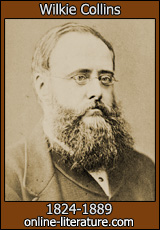
Here is where you find links to related content on this site or other sites, possibly including full books or essays about Wilkie Collins written by other authors featured on this site.
Sorry, no links available.
Part I
Part II
Part III
Part IV
Part V
Part VI
Part VII
Part VIII
Part IX
Part X
Part XI
Sorry, no summary available yet.
