 Subscribe for ad free access & additional features for teachers. Authors: 267, Books: 3,607, Poems & Short Stories: 4,435, Forum Members: 71,154, Forum Posts: 1,238,602, Quizzes: 344
VII: Freedom of the Press
THE PATENT MEDICINE CONSPIRACY AGAINST THE FREEDOM OF THE PRESS.
Reprinted from Collier's Weekly, Nov. 4, 1905.
"Here shall the Press the People's rights maintain.
Unawed by influence and unbribed by gain."
—Joseph Story: Motto of the Salem Register.
Would any person believe that there is any one subject upon which the newspapers of the United States, acting in concert, by prearrangement, in obedience to wires all drawn by one man, will deny full and free discussion? If such a thing is possible, it is a serious matter, for we rely upon the newspapers as at once the most forbidding preventive and the swiftest and surest corrective of evil. For the haunting possibility of newspaper exposure, men who know not at all the fear of God pause, hesitate, and turn back from contemplated rascality. For fear "it might get into the papers," more men are abstaining from crime and carouse to-night than for fear of arrest. But these are trite things—only, what if the newspapers fail us? Relying so wholly on the press to undo evil, how shall we deal with that evil with which the press itself has been seduced into captivity?
In the Lower House of the Massachusetts Legislature one day last March there was a debate which lasted one whole afternoon and engaged some twenty speakers, on a bill providing that every bottle of patent medicine sold in the state should bear a label stating the contents of the bottle. More was told concerning patent medicines that afternoon than often comes to light in a single day. The debate at times was dramatic—a member from Salem told of a young woman of his acquaintance now in an institution for inebriates as the end of an incident which began with patent medicine dosing for a harmless ill. There was humor, too, in the debate—Representative Walker held aloft a bottle of Peruna bought by him in a drug store that very day and passed it around for his fellow-members to taste and decide for themselves whether Dr. Harrington, the Secretary of the State Board of Health, was right when he told the Legislative Committee that it was merely a "cheap cocktail."
The Papers did not Print One Word.
In short, the debate was interesting and important—the two qualities which invariably ensure to any event big headlines in the daily newspapers. But that debate was not celebrated by big headlines, nor any headlines at all. Yet Boston is a city, and Massachusetts is a state, where the proceedings of the legislature figure very large in public interest, and where the newspapers respond to that interest by reporting the sessions with greater fullness and minuteness than in any other state. Had that debate been on prison reform, on Sabbath observance, the early closing saloon law, on any other subject, there would have been, in the next day's papers, overflowing accounts of verbatim report, more columns of editorial comment, and the picturesque features of it would have ensured the attention of the cartoonist.
Now why? Why was this one subject tabooed? Why were the daily accounts of legislative proceedings in the next day's papers abridged to a fraction of their usual ponderous length, and all reference to the afternoon debate on patent medicines omitted? Why was it in vain for the speakers in that patent-medicine debate to search for their speeches in the next day's newspapers? Why did the legislative reporters fail to find their work in print? Why were the staff cartoonists forbidden to exercise their talents on that most fallow and tempting opportunity—the members of the Great and General Court of Massachusetts gravely tippling Peruna and passing the bottle around to their encircled neighbors, that practical knowledge should be the basis of legislative action?
I take it if any man should assert that there is one subject on which the newspapers of the United States, acting in concert and as a unit, will deny full and free discussion, he would be smiled at as an intemperate fanatic. The thing is too incredible. He would be regarded as a man with a delusion. And yet I invite you to search the files of the daily newspapers of Massachusetts for March 16, 1905, for an account of the patent-medicine debate that occurred the afternoon of March 15 in the Massachusetts Legislature. In strict accuracy it must be said that there was one exception. Any one familiar with the newspapers of the United States will already have named it—the Springfield Republican. That paper, on two separate occasions, gave several columns to the record of the proceedings of the legislature on the patent-medicine bill. Why the otherwise universal silence?
The patent-medicine business in the United States is one of huge financial proportions. The census of 1900 placed the value of the annual product at $59,611,355. Allowing for the increase of half a decade of rapid growth, it must be to-day not less than seventy-five millions. That is the wholesale price. The retail price of all the patent medicines sold in the United States in one year may be very conservatively placed at one hundred million dollars. And of this one hundred millions which the people of the United States pay for patent medicines yearly, fully forty millions goes to the newspapers. Have patience! I have more to say than merely to point out the large revenue which newspapers receive from patent medicines, and let inference do the rest. Inference has no place in this story. There are facts a-plenty. But it is essential to point out the intimate financial relation between the newspapers and the patent medicines. I was told by the man who for many years handled the advertising of the Lydia E. Pinkham Company that their expenditure was $100,000 a month, $1,200,000 a year. Dr. Pierce and the Peruna Company both advertise more extensively than the Pinkham Company. Certainly there are at least five patent-medicine concerns in the United States who each pay out to the newspapers more than one million dollars a year. When the Dr. Greene Nervura Company of Boston went into bankruptcy, its debts to newspapers for advertising amounted to $535,000. To the Boston Herald alone it owed $5,000, and to so small a paper, comparatively, as the Atlanta Constitution it owed $1,500. One obscure quack doctor in New York, who did merely an office business, was raided by the authorities, and among the papers seized there were contracts showing that within a year he had paid to one paper for advertising $5,856.80; to another $20,000. Dr. Humphreys, one of the best known patent-medicine makers, has said to his fellow-members of the Patent Medicine Association: "The twenty thousand newspapers of the United States make more money from advertising the proprietary medicines than do the proprietors of the medicines themselves.... Of their receipts, one-third to one-half goes for advertising." More than six years ago, Cheney, the president of the National Association of Patent Medicine Men, estimated the yearly amount paid to the newspapers by the larger patent-medicine concerns at twenty million dollars—more than one thousand dollars to each daily, weekly and monthly periodical in the United States.
Silence is the Fixed Quantity.
Does this throw any light on the silence of the Massachusetts papers?
Naturally such large sums paid by the patent-medicine men to the newspapers suggest the thought of favor. But silence is too important a part of the patent-medicine man's business to be left to the capricious chance of favor. Silence is the most important thing in his business. The ingredients of his medicine—that is nothing. Does the price of goldenseal go up? Substitute whisky. Does the price of whisky go up? Buy the refuse wines of the California vineyards. Does the price of opium go too high, or the public fear of it make it an inexpedient thing to use? Take it out of the formula and substitute any worthless barnyard weed. But silence is the fixed quantity—silence as to the frauds he practices; silence as to the abominable stewings and brewings that enter into his nostrum; silence as to the deaths and sicknesses he causes; silence as to the drug fiends he makes, the inebriate asylums he fills. Silence he must have. So he makes silence a part of the contract.
Read the significant silence of the Massachusetts newspapers in the light of the following contracts for advertising. They are the regular printed form used by Hood, Ayer and Munyon in making their advertising contracts with thousands of newspapers throughout the United States.
On page 80 is shown the contract made by the J. C. Ayer Company, makers of Ayer's Sarsaparilla. At the top is the name of the firm, "The J. C. Ayer Company, Lowell,, Mass.," and the date. Then follows a blank for the number of dollars, and then the formal contract: "We hereby agree, for the sum of............ Dollars per year,........to insert in the............. published at............... the advertisement of the J. C. Ayer Company." Then follow the conditions as to space to be used each issue, the page the advertisement is to be on and the position it is to occupy. Then these two remarkable conditions of the contract: "First—It is agreed in case any law or laws are enacted, either state or national, harmful to the interests of the T. C. Ayer Company, that this contract may be canceled by them from date of such enactment, and the insertions made paid for pro-rata with the contract price."
This clause is remarkable enough. But of it more later. For the present examine the second clause: "Second—It is agreed that the J. C. Ayer Co. may cancel this contract, pro-rata, in case advertisements are published in this paper in which their products are offered, with a view to substitution or other harmful motive; also in case any matter otherwise detrimental to the J. C. Ayer Company's interest is permitted to appear in the reading columns or elsewhere in the paper."
This agreement is signed in duplicate, one by the J. C. Ayer Company and the other one by the newspaper.
All Muzzle-Clauses Alike.
That is the contract of silence. (Notice the next one, in identically the same language, bearing the name of the C. I. Hood Company, the other great manufacturer of sarsaparilla; and then the third—again in identically the same words—for Dr. Munyon.) That is the clause which with forty million dollars, muzzles the press of the country. I wonder if the Standard Oil Company could, for forty million dollars, bind the newspapers of the United States in a contract that "no matter detrimental to the Standard Oil Company's interests be permitted to appear in the reading columns or elsewhere in this paper."
Is it a mere coincidence that in each of these contracts the silence clause is framed in the same words? Is the inference fair that there is an agreement among the patent-medicine men and quack doctors each to impose this contract on all the newspapers with which it deals, one reaching the newspapers which the other does not, and all combined reaching all the papers in the United States, and effecting a universal agreement among newspapers to print nothing detrimental to patent medicines? You need not take it as an inference. I shall show it later as a fact.
"In the reading columns or elsewhere in this paper." The paper must not print itself, nor must it allow any outside party, who might wish to do so, to pay the regular advertising rates and print the truth about patent medicines in the advertising columns. More than a year ago, just after Mr. Bok had printed his first article exposing patent medicines, a business man in St. Louis, a man of great wealth, conceived that it would help his business greatly if he could have Mr. Bok's article printed as an advertisement in every newspaper in the United States. He gave the order to a firm of advertising agents and the firm began in Texas, intending to cover the country to Maine. But that advertisement never got beyond a few obscure country papers in Texas. The contract of silence was effective; and a few weeks later, at their annual meeting, the patent-medicine association "Resolved"—I quote the minutes—"That this Association commend the action of the great majority of the publishers of the United States who have consistently refused said false and malicious attacks in the shape of advertisements which in whole or in part libel proprietary medicines."
I have said that the identity of the language of the silence clause in several patent-medicine advertising contracts suggests mutual understanding among the nostrum makers, a preconceived plan; and I have several times mentioned the patent-medicine association. It seems incongruous, almost humorous, to speak of a national organization of quack doctors and patent-medicine makers; but there is one, brought together for mutual support, for co-operation, for—but just what this organization is for, I hope to show. No other organization ever demonstrated so clearly the truth that "in union there is strength." Its official name is an innocent-seeming one—"The Proprietary Association of America." There are annual meetings, annual reports, a constitution, by-laws. And I would call special attention to Article II of those by-laws.
"The objects of this association," says this article, "are: to protect the rights of its members to the respective trade-marks that they may own or control; to establish such mutual co-operation as may be required in the various branches of the trade; to reduce all burdens that may be oppressive; to facilitate and foster equitable principles in the purchase and sale of merchandise; to acquire and preserve for the use of its members such business information as may be of value to them; to adjust controversies and promote harmony among its members."
That is as innocuous a statement as ever was penned of the objects of any organization. It might serve for an organization of honest cobblers. Change a few words, without altering the spirit in the least, and a body of ministers might adopt it. In this laboriously complete statement of objects, there is no such word as "lobby" or "lobbying." Indeed, so harmless a word as "legislation" is absent—strenuously absent.
Where the Money Goes.
But I prefer to discover the true object of the organization of the "Proprietary Association of America" in another document than Article II of the by-laws. Consider the annual report of the treasurer, say for 1904. The total of money paid out during the year was $8,516.26. Of this, one thousand dollars was for the secretary's salary, leaving $7,516.26 to be accounted for. Then there is an item of postage, one of stationery, one of printing—the little routine expenses of every organization; and finally there is this remarkable item:
Legislative Committee, total expenses, $6,606.95.
Truly, the Proprietary Association of America seems to have several objects, as stated in its by-laws, which cost it very little, and one object—not stated in its by-laws at all—which costs it all its annual revenue aside from the routine expenses of stationery, postage and secretary. If just a few more words of comment may be permitted on this point, does it not seem odd that so large an item as $6,606.95, out of a total budget of only $8,516.26, should be put in as a lump sum, "Legislative Committee, total expenses"? And would not the annual report of the treasurer of the Proprietary Association of America be a more entertaining document if these "total expenses" of the Legislative Committee were carefully itemized?
Not that I mean to charge the direct corruption of legislatures. The Proprietary Association of America used to do that. They used to spend, according to the statement of the present president of the organization, Mr. F. J. Cheney, as much as seventy-five thousand dollars a year. But that was before Mr. Cheney himself discovered a better way. The fighting of public health legislation is the primary object and chief activity, the very raison d'etre, of the Proprietary Association. The motive back of bringing the quack doctors and patent-medicine manufacturers of the United States into a mutual organization was this: Here are some scores of men, each paying a large sum annually to the newspapers. The aggregate of these sums is forty million dollars. By organization, the full effect of this money can be got and used as a unit in preventing the passage of laws which would compel them to tell the contents of their nostrums, and in suppressing the newspaper publicity which would drive them into oblivion. So it was no mean intellect which devised the scheme whereby every newspaper in America is made an active lobbyist for the patent-medicine association. The man who did it is the present president of the organization, its executive head in the work of suppressing public knowledge, stifling public opinion and warding off public health legislation, the Mr. Cheney already mentioned. He makes a catarrh cure which, according to the Massachusetts State Board of Health, contains fourteen and three-fourths per cent, of alcohol. As to his scheme for making the newspapers of America not only maintain silence, but actually lobby in behalf of the patent medicines, I am glad that I am not under the necessity of describing it in my own words. It would be easy to err in the direction that makes for incredulity. Fortunately, I need take no responsibility. I have Mr. Cheney's own words, in which he explained his scheme to his fellow-members of the Proprietary Association of America. The quotation marks alone (and the comment within the parentheses) are mine. The remainder is the language of Mr. Cheney himself:
Mr. Cheney's Plan.
"We have had a good deal of difficulty in the last few years with the different legislatures of the different states.... I believe I have a plan whereby we will have no difficulty whatever with these people. I have used it in my business for two years and know it is a practical thing.... I, inside of the last two years, have made contracts with between fifteen and sixteen thousand newspapers, and never had but one man refuse to sign the contract, and my saying to him that I could not sign a contract without this clause in it he readily signed it. My point is merely to shift the responsibility. We to-day have the responsibility on our shoulders. As you all know, there is hardly a year but we have had a lobbyist in the different state legislatures—one year in New York, one year in New Jersey, and so on." (Read that frank confession twice—note the bland matter-of-factness of it.) "There has been a constant fear that something would come up, so I had this clause in my contract added. This is what I have in every contract I make: 'It is hereby agreed that should your state, or the United States Government, pass any law that would interfere with or restrict the sale of proprietary medicines, this contract shall become void.'... In the state of Illinois a few years ago they wanted to assess me three hundred dollars. I thought I had a better plan than this, so I wrote to about forty papers and merely said: 'Please look at your contract with me and take note that if this law passes you and I must stop doing business, and my contracts cease.'" The next week every one of them had an article, and Mr. Man had to go....
I read this to Dr. Pierce some days ago and he was very much taken up with it. I have carried this through and know it is a success. I know the papers will accept it. Here is a thing that costs us nothing. We are guaranteed against the $75,000 loss for nothing. It throws the responsibility on the newspapers.... I have my contracts printed and I have this printed in red type, right square across the contract, so there can be absolutely no mistake, and the newspaper man can not say to me, 'I did not see it.' He did see it and knows what he is doing. It seems to me it is a point worth every man's attention.... I think this is pretty near a sure thing.
THIS IS THE FORM OF CONTRACT—SEE (A) (B) (C)—THAT MUZZLES THE PRESS OF THE UNITED STATES.
The gist of the contract lies in the clause which is marked with brackets, to the effect that the agreement is voidable, In case any matter detrimental to the advertiser's interests "Is permitted to appear in the reading columns, or elsewhere, in this paper." This clause, in the same words, appears in all three of these patent-medicine advertising contracts. The documents reproduced here were gathered from three different newspapers in widely separated parts of the United States. The name of the paper in each case has been suppressed in order to shield the publisher from the displeasure of the patent-medicine combination. How much publishers are compelled to fear this displeasure is exemplified by the experience of the Cleveland Press, from whose columns $18,000 worth of advertising was withdrawn within forty-eight hours.
I should like to ask the newspaper owners and editors of America what they think of that scheme. I believe that the newspapers, when they signed each individual contract, were not aware that they were being dragooned into an elaborately thought-out scheme to make every newspaper in the United States, from the greatest metropolitan daily to the remotest country weekly, an active, energetic, self-interested lobbyist for the patent-medicine association. If the newspapers knew how they were being used as cat's-paws, I believe they would resent it. Certainly the patent-medicine association itself feared this, and has kept this plan of Mr. Cheney's a careful secret. In this same meeting of the Proprietary Association of America, just after Mr. Cheney had made the speech quoted above, and while it was being resolved that every other patent-medicine man should put the same clause in his contract, the venerable Dr. Humphreys, oldest and wisest of the guild, arose and said: "Will it not be now just as well to act on this, each and every one for himself, instead of putting this on record?... I think the idea is a good one, But really don't think it had better go in our proceedings." And another fellow nostrum-maker, seeing instantly the necessity of secrecy said: "I am heartily in accord with Dr. Humphreys. The suggestion is a good one, but when we come to put in our public proceedings, and state that we have adopted such a resolution, I want to say that the legislators are just as sharp as the newspaper men.... As a consequence, this will decrease the weight of the press comments. Some of the papers, also, who would not come in, would publish something about it in the way of getting square....."
This contract is the backbone of the scheme. The further details, the organization of the bureau to carry it into effect—that, too, has been kept carefully concealed from the generally unthinking newspapers, who are all unconsciously mere individual cogs in the patent-medicine lobbying machine. At one of the meetings of the association, Dr. R. V. Pierce of Buffalo arose and said (I quote him verbatim):... "I would move you that the report of the Committee on Legislation be made a special order to be taken up immediately... that it be considered in executive session, and that every person not a member of the organization be asked to retire, so that it may be read and considered in executive session. There are matters and suggestions in reference to our future action, and measures to be taken which are advised therein, that we would not wish to have published broadcast over the country for very good reasons."
Now what were the "matters and suggestions" which Dr. Pierce "would not wish to have published broadcast over the country for very good reasons?"
Can Mr. Cheney Reconcile These Statements?
Letter addressed to Mr. William Allen White, Editor of the Gazette, Emporia, Kan.
By Frank J. Cheney.
Dear Sir—
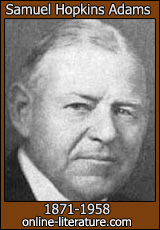
I have read with a great deal of interest, to-day, an article in Colliers illustrating therein the contract between your paper and ourselves, [see p. 18—Editor.] Mr. S. Hopkins Adams endeavored very hard (as I understand) to find me, but I am sorry to say that I was not at home. I really believe that I could have explained that clause of the contract to his entire satisfaction, and thereby saved him the humiliation of making an erratic statement.
This is the first intimation that I ever have had that that clause was put into the contract to control the Press in any way, or the editorial columns of the Press. I believe that if Mr. Adams was making contracts now, and making three-year contracts, the same as we are, taking into consideration the conditions of the different legislatures, he would be desirous of this same paragraph as a safety guard to protect himself, in case any State did pass a law prohibiting the sale of our goods.
His argument surely falls flat when he takes into consideration the conduct of the North Dakota Legislature, because every newspaper in that State that we advertise in hid contracts containing that clause. Why we should be compelled to pay for from one to two years' advertising or more, in a State where we could not sell our goods, is more than I can understand. As before stated, it is merely a precautionary paragraph to meet conditions such as now exist in North Dakota. We were compelled to withdraw from that State because we would not publish our formula, and, therefore, under this contract, we are not compelled to continue our advertising.
Extract from a speech delivered before the Proprietary Association of America.
By Frank J. Cheney.
"We have had a good deal of difficulty in the last few years with the different legislatures of the different states.... I believe I have a plan whereby we will have no difficulty whatever with these people. I have used it in my business for two years, and I know it is a practical thing.... I, inside of the last two years, have made contracts with between fifteen and sixteen thousand newspapers, and never had but one man refuse to sign the contract, and by saying to him that I could not sign a contract without this clause in it he readily signed it. My point is merely to shift the responsibility. We to-day have the responsibility of the whole matter upon our shoulders....
"There? has been constant fear that something would come up, so I had this clause in my contract added. This is what I have in every contract I make: 'It is hereby agreed that should your State, or the United States government, pass any law that would interfere with or restrict the sale of proprietary medicines, his contract shall become void.'... In the State of Illinois a few years ago they wanted to assess me three hundred dollars. I thought I had a better plan than this, so I wrote to about forty papers, and merely said: 'Please look at your contract with me and take note that if this law passes you and I must stop doing business, and my contracts cease.' The next week every one of them had an article.... I have carried this through and know it is a success. I know the papers will accept it. Here is a thing that costs us nothing. We are guaranteed against the $75,000 loss for nothing. It throws the responsibility on the newspapers.... I have my contracts printed and I have this printed in red type, right square across the contract, so there can be absolutely no mistake, and the newspaper man can not say to me, 'I did not see it.' He did see it and knows what he is doing. It seems to me it is a point worth every man's attention.... I think this is pretty near a sure thing."
To illustrate: There are 739 publications in your State—619 of these are dailies and weeklies. Out of this number we are advertising in over 500, at an annual expenditure of $8,000 per year (estimated). We make a three-year contract with all of them, and, therefore, our liabilities in your State are $24,000, providing, of course, all these contracts were made at the same date. Should these contracts all be made this fall and your State should pass a law this winter (three months later) prohibiting the sale of our goods, there would be virtually a loss to us of $24,000. Therefore, for a business precaution to guard against just such conditions, we add the red paragraph referred to in Collier's.
I make this statement to you, as I am credited with being the originator of the paragraph, and I believe that I am justified in adding this paragraph to our contract, not for the purpose of controlling the Press, but, as before stated, as a business precaution which any man should take who expects to pay his bills.
Will you kindly give me your version of the situation? Awaiting an early reply, I am,
Sincerely yours,
FRANK J. CHENEY.
Valuable Newspaper Aid.
Dr. Pierce's son, Dr. V. Mott Pierce, was chairman of the Committee on Legislation. He was the author of the "matters and suggestions" which must be considered in the dark. "Never before," said he, "in the history of the Proprietary Association were there so many bills in different state legislatures that were vital to our interests. This was due, we think, to an effort on the part of different state boards of health, who have of late years held national meetings, to make an organized effort to establish what are known as 'pure food laws.'" Then the younger Pierce stated explicitly the agency responsible for the defeat of this public health legislation: "We must not forget to place the honor where due for our uniform success in defeating class legislation directed against our legitimate pursuits. The American Newspaper Publishers' Association has rendered us valued aid through their secretary's office in New York and we can hardly overestimate the power brought to bear at Washington by individual newspapers."... (On another occasion, Dr. Pierce, speaking of two bills in the Illinois Legislature, said: "Two things operated to bring these bills to the danger line. In the first place, the Chicago papers were almost wholly without influence in the Legislature.... Had it not been for the active co-operation of the state outside of Chicago there is absolute certainty that the bill would have passed.... I think that a great many members do not appreciate the power that we can bring to bear on legislation through the press.") But this power, in young Dr. Pierce's opinion, must be organized and systematized. "If it is not presumptuous on the part of your chairman," he said modestly, "to outline a policy which experience seems to dictate for the future, it would be briefly as follows"—here the younger Pierce explains the "matters and suggestions" which must not be "published broadcast over the country." The first was "the organization of a Legislative Bureau, with its offices in New York or Chicago. Second, a secretary, to be appointed by the chairman of the Committee on Legislation, who will receive a stated salary, sufficiently large to be in keeping with such person's ability, and to compensate him for the giving of all his time to this work."
"The benefits of such a working bureau to the Proprietary Association," said Dr. Pierce, "can be foreseen: First, a systematic plan to acquire early knowledge of pending or threatened legislation could be taken up. In the past we have relied too much on newspaper managers to acquaint us of such bills coming up.... Another plan would be to have the regulation formula bill, for instance, introduced by some friendly legislator, and have it referred to his own committee, where he could hold it until all danger of such another bill being introduced were over, and the Legislature had adjourned."
Little wonder Dr. Pierce wanted a secret session to cover up the frank naïveté of his son, which he did not "wish to have published broadcast over the country, for very good reasons."
This letter was sent by the publishers of one of the leading newspapers of Wisconsin to Senator Noble of that state. It illustrates the method adopted by the patent-medicine makers to compel the newspapers In each state to do their lobbying for them. Senator Noble introduced a bill requiring patent-medicine manufacturers to state on their labels the percentage of various poisons which every bottle might contain. Senator Noble and a few others fought valiantly for their bill throughout the whole of the last session of the Wisconsin Legislature, but were defeated by the united action of the newspaper publishers, who, as this letter shows, exerted pressure of every kind, Including threats, to compel members of the Legislature to vote against the bill.
In discussing this plan for a legislative bureau, another member told what in his estimation was needed. "The trouble," said he—I quote from the minutes—"the trouble we will have in attempting to buy legislation—supposing we should attempt it—is that we will never know what we are buying until we get through. We may have paid the wrong man, and the bill is passed and we are out. It is not a safe proposition, if we consider it legitimate, which we do not."
True, it is not legitimate, but the main point is, it's not safe; that's the thing to be considered.
The patent-medicine man continued to elaborate on the plans proposed by Dr. Pierce: "It would not be a safe proposition at all. What this association should have... is a regularly established bureau.... We should have all possible information on tap, and we should have a list of the members of the legislature of every state. We should have a list of the most influential men that control them, or that can influence them.... For instance, if in the state of Ohio a bill comes up that is adverse to us, turn to the books, find out who are members of the legislature there, who are the publishers of the papers in the state, where they are located, which are the Republican and which the Democratic papers.... It will take money, but if the money is rightly spent, it will be the best investment ever made."
The Trust's Club for Legislators.
That is about as comprehensive, as frankly impudent a scheme of controlling legislation as it is possible to imagine. The plan was put in the form of a resolution, and the resolution was passed. And so the Proprietary Association of America maintains a lawyer in Chicago, and a permanent secretary, office and staff. In every state it maintains an agent whose business it is to watch during the session of the Legislature each day's batch of new bills, and whenever a bill affecting patent medicines shows its head to telegraph the bill, verbatim, to headquarters. There some scores of printed copies of the bill are made, and a copy is sent to every member of the association—to the Peruna people, to Dr. Pierce at Buffalo, to Kilmer at Birmingham, to Cheney at Toledo, to the Pinkham people at Lynn, and to all the others. Thereon each manufacturer looks up the list of papers in the threatened state with which he has the contracts described above. And to each newspaper he sends a peremptory telegram calling the publisher's attention to the obligations of his contract, and commanding him to go to work to defeat the anti-patent-medicine bill. In practice, this organization works with smooth perfection and well-oiled accuracy to defeat the public health legislation which is introduced by boards of health in over a score of states every year. To illustrate, let me describe as typical the history of the public health bills which were introduced and defeated in Massachusetts last year. I have already mentioned them as showing how the newspapers, obeying that part of their contract which requires them to print nothing harmful to patent medicines, refused to print any account of the exposures which were made by several members of the Legislature during the debate of the bill. I wish here to describe their obedience to that other clause of the contract, in living up to which they printed scores of bitterly partisan editorials against the public health bill, and against its authors personally; threatened with political death those members of the Legislature who were disposed to vote in favor of it, and even, in the persons of editors and owners, went up to the State House and lobbied personally against the bill. And since I have already told of Mr. Cheney's author-ship of the scheme, I will here reproduce, as typical of all the others (all the other large patent-medicine concerns sent similar letters and telegrams), the letter which Mr. Cheney himself on the 14th day of February sent to all the newspapers in Massachusetts with which he has lobbying contracts—practically every newspaper in the state:
"Toledo, Ohio, Feb. 14, 1905.
"Publishers
"——- Mass.
"Gentlemen:
"Should House bills Nos. 829, 30, 607, 724, or Senate bill No. 185 become laws, it will force us to discontinue advertising in your state. Your prompt attention regarding this bill we believe would be of mutual benefit.
"We would respectfully refer you to the contract which we have with you.
"Respectfully,
"Cheney Medicine Company."
Now here is the fruit which that letter bore: a strong editorial against the anti-patent-medicine bill, denouncing it and its author in the most vituperative language, a marked copy of which was sent to every member of the Massachusetts Legislature. But this was not all that this one zealous publisher did; he sent telegrams to a number of members, and a personal letter to the representative of his district calling on that member not only to vote, but to use his influence against the bill, on the pain of forfeiting the paper's favor.
Now this seems to me a shameful thing—that a Massachusetts newspaper, of apparent dignity and outward high standing, should jump to the cracking of the whip of a nostrum-maker in Ohio; that honest and well-meaning members of the Massachusetts Legislature, whom all the money of Rockefeller could not buy, who obey only the one thing which they look on as the expression of the public opinion of their constituents, the united voice of the press of their district—that these men should unknowingly cast their votes at the dictate of a nostrum-maker in Ohio, who, if he should deliver his command personally and directly, instead of through a newspaper supine enough to let him control it for a hundred dollars a year, would be scorned and flouted.
Any self-respecting newspaper must be humiliated by the attitude of the patent-medicine association. They don't ASK the newspapers to do it—they ORDER it done. Read again Mr. Cheney's account of his plan, note the half-contemptuous attitude toward the newspapers. And read again Mr. Cheney's curt letter to the Massachusetts papers; Observe the threat, just sufficiently veiled to make it more of a threat; and the formal order from a superior to a clerk: "We would respectfully refer you to the contract which we have with you."
And the threat is not an empty one. The newspaper which refuses to aid the patent-medicine people is marked. Some time ago Dr. V. Mott Pierce of Buffalo was chairman of what is called the "Committee on Legislation" of the Proprietary Association of America. He was giving his annual report to the association. "We are happy to say," said he, "that though over a dozen bills were before the different State Legislatures last winter and spring, yet we have succeeded in defeating all the bills which were prejudicial to proprietary interests without the use of money, and through the vigorous co-operation and aid of the publishers. January 23 your committee sent out letters to the principal publications in New York asking their aid against this measure. It is hardly necessary to state that the publishers of New York responded generously against these harmful measures. The only small exception was the Evening Star of Poughkeepsie, N. Y., the publisher of which, in a very discourteous letter, refused to assist us in any way."
Is it to be doubted that Dr. Pierce reported this exception to his fellow patent-medicine men, that they might make note of the offending paper, and bear it in mind when they made their contracts the following year? There are other cases which show what happens to the newspaper which offends the patent-medicine men. I am fortunate enough to be able to describe the following incident in the language of the man who wielded the club, as he told the story with much pride to his fellow patent-medicine men at their annual meeting:
"Mr. Chairman and Gentlemen of the Proprietary Association," said Mr. Cooper, "I desire to present to you a situation which I think it is incumbent on manufacturers generally to pay some attention to—namely, the publication of sensational drug news which appears from time to time in the leading papers of the country.... There are, no doubt, many of you in the room, at least a dozen, who are familiar with the sensational articles that appeared in the Cleveland Press. Gentlemen, this is a question that appeals to you as a matter of business.... The Cleveland Press indulged in a tirade against the so-called 'drug trust.'... (the 'drug trust' is the same organization of patent-medicine men—including Pierce, Pinkham, Peruna, Kilmer and all the well-known ones—which I have referred to as the patent-medicine association. Its official name is the Proprietary Association of America.) "I sent out the following letter to fifteen manufacturers" (of patent medicines):
"'Gentlemen—Inclosed we hand you a copy of matter which is appearing in the Cleveland papers. It is detrimental to the drug business to have this matter agitated in a sensational way.
In behalf of the trade we would ask you to use your influence with the papers in Cleveland to discontinue this unnecessary publicity, and if you feel you can do so, we would like to have you wire the business managers of the Cleveland papers to discontinue their sensational drug articles, as it is proving very injurious to your business. Respectfully, E. R. Cooper.'
"Because of that letter which we sent out, the Cleveland Press received inside of forty-eight hours telegrams from six manufacturers canceling thousands of dollars' worth of advertising and causing a consequent dearth of sensational matter along drug lines. It resulted in a loss to one paper alone of over eighteen thousand dollars in advertising. Gentlemen, when you touch a man's pocket, you touch him where he lives; that principle is true of the newspaper editor or the retail druggist, and goes through all business."
The Trust's Club for Newspapers.
That is the account of how the patent-medicine man used his club on the newspaper head, told in the patent-medicine man's own words, as he described it to his fellows. Is it pleasant reading for self-respecting newspaper men—the exultant air of those last sentences, and the worldly wisdom: "When you touch a man's pocket you touch him where he lives; that principle is true of the newspaper editor..."?
But the worst of this incident has not yet been told. There remains the account of how the offending newspaper, in the language of the bully, "ate dirt". The Cleveland Press is one of a syndicate of newspapers, all under Mr. McRae's ownership—but I will use Mr. Cooper's own words: "We not only reached the Cleveland Press by the movement taken up in that way, but went further, for the Cleveland Press is one of a syndicate of newspapers known as the Scripps-McRae League, from whom this explanation is self-explanatory:
"'Office Schipps-McRae Press Association.
"'Mr. E. R. Cooper, Cleveland, Ohio:
"'Mr. McRae arrived in New York the latter part of last week after a three months' trip to Egypt. I took up the matter of the recent cut-rate articles which appeared in the Cleveland Press with him, and to-day received the following telegram from him from Cincinnati: 'Scripps-McRae papers will contain no more such as Cleveland Press published concerning the medicine trust—M. A. McRae.'
"'I am sure that in the future nothing will appear in the Cleveland Press detrimental to your interests.
"'Yours truly,
"'F. J. Carlisle.'"
This incident was told, in the exact words above quoted, at the nineteenth annual meeting of the Proprietary Association of America.
I could, if space permitted, quote many other telegrams and letters from the Kilmer's Swamp Root makers, from the Piso's Cure people, from all the large patent-medicine manufacturers. The same thing that happened in Massachusetts happened last year in New Hampshire, in Wisconsin, in Utah, in more than fifteen states. In Wisconsin the response by the newspapers to the command of the patent-medicine people was even more humiliating than in Massachusetts. Not only did individual newspapers work against the formula bill; there is a "Wisconsin Press Association," which includes the owners and editors of most of the newspapers of the state. That association held a meeting and passed resolutions, "that we are opposed to said bill... providing that hereafter all patent medicine sold in this state shall have the formula thereof printed on their labels," and "Resolved, That the association appoint a committee of five publishers to oppose the passage of the measure." And in this same state the larger dailies in the cities took it on themselves to drum up the smaller country papers and get them to write editorials opposed to the formula bill. Nor was even this the measure of their activity in response to the command of the patent medicine association. I am able to give the letter which is here reproduced. It was sent by the publisher of one of the largest daily papers in Wisconsin to the state senator who introduced the bill. In one western state, a board of health officer made a number of analyses of patent medicines, and tried to have the analyses made public, that the people of his state might be warned. "Only one newspaper in the state," he says in a personal letter, "was willing to print results of these analyses, and this paper refused them after two publications in which a list of about ten was published.
In New Hampshire—but space forbids. Happily there Is a little silver in the situation. The legislature of North Dakota last year passed, and the governor signed a bill requiring that patent-medicine bottles shall have printed on their labels the percentage of alcohol or of morphin or various other poisons which the medicine contains. That was the first success in a fight which the public health authorities have waged in twenty states each year for twenty years. In North Dakota the patent-medicine people conducted the fight with their usual weapons, the ones described above. But the newspapers, be it said to their everlasting credit, refused to fall in line to the threats of the patent-medicine association. And I account for that fact in this way: North Dakota is wholly a "country" community.
It has no city of over 20,000, and but one over 5,000. The press of the state, therefore, consists of very small papers, weeklies, in which the ownership and active management all lie with one man. The editorial conscience and the business manager's enterprise lie under one hat. With them the patent-medicine scheme was not so successful as with the more elaborately organized newspapers of older and more populous states.
Just now is the North Dakota editor's time of trial. The law went into effect July 1. The patent-medicine association, at their annual meeting in May, voted to withdraw all their advertising from all the papers in that state. This loss of revenue, they argued self-righteously, would be a warning to the newspapers of other states. Likewise it would be a lesson to the newspapers of North Dakota. At the next session of the legislature they will seek to have the label bill repealed, and they count on the newspapers, chastened by a lean year, to help them. For the independence they have shown in the past, and for the courage they will be called on to show in the future, therefore, let the newspapers of North Dakota know that they have the respect and admiration of all decent people.
"What is to be done about it?" is the question that follows exposure of organized rascality. In few cases is the remedy so plain as here. For the past, the newspapers, in spite of these plain contracts of silence, must be acquitted of any very grave complicity. The very existence of the machine that uses and directs them has been a carefully guarded secret. For the future, be it understood that any newspaper which carries a patent-medicine advertisement knows what it is doing. The obligations of the contract are now public property. And one thing more, when next a member of a state legislature arises and states, as I have so often heard: "Gentlemen, this label bill seems right to me, but I can not support it; the united press of my district is opposed to it"—when that happens, let every one understand the wires that have moved "the united press of my district."
The Following are Extracts and Abstracts from Various Articles in the Ladies Home Journal?
A PECULIAR "ETC."
A great show of frankness was recently made by a certain "patent medicine." The makers advertised that they had concluded to take the public into their confidence, and that thereafter they would print a formula of the medicine on each bottle manufactured.
"There is nothing secretive about our medicine," was the cry. "We have nothing to hide. Here is the formula. Show it to your physician."
Then comes the formula: This herb and that herb, this ingredient and that ingredient, and the formula winds up, "etc." All good, old-fashioned, well recognized drugs were those which were mentioned—all except the "etc."
A certain Board of Pharmacy had never heard of a drug called "etc.," and so made up Its mind to find out.
And the "etc." was found to be 3.76 per cent of cocain!—just the simple, death-dealing cocain!—From The Ladies' Home Journal, February, 1906.
PATENT MEDICINE CONCERNS AND LETTER BROKERS.
One of the most disgusting and disgraceful features of the patent medicine business is the marketing of letters sent by patients to patent medicine firms. Correspondence is solicited by these firms under the seal of sacred confidence. When the concern is unable to do further business with a patient it disposes of the patient's correspondence to a letter-broker, who, in turn, disposes of it to other patent medicine concerns at the rate of half a cent, for each letter.
This Information was made public by Mark Sullivan in the Ladies' Home Journal for January, 1906.
An advertisement showing how the names to orders sent to "Patent Medicine" concerns are offered for sale or rent to be used by others.
Yet we are told how "Sacredly Confidential" these letters are regarded and held. (The advertisement is from the Mail Order Journal, April, 1905.)
Says Mr. Sullivan: "One of these brokers assured me he could give me 'choice lots' of 'medical female letters'... Let me now give you, from the printed lists of these 'letter brokers' some idea of the way in which these 'sacredly confidential' letters are hawked about the country. Here are a few samples, all that are really printable:
"'55,000 Female Complaint Letters' Is the sum total of one Item, and the list gives the names of the "medicine company" or the "medical institute" to whom they were addressed. Here is a barter, then, in 55,000 letters of a private nature, each one of which, the writer was told, and had a right to expect, would be regarded as sacredly confidential by the "doctor" or concern to whom she had been deluded into telling her private ailments. Yet here they are for half a cent each!
"Another batch of some 47,000 letters addressed to five 'doctors' and 'institutes' is emphasized because they were all written by women! A third batch is:
"'44,000 Bust Developer Letters'—letters which one man in a "patent medicine" concern told me were "the richest sort of reading you could get hold of."
"A still further lot offers: '40,000 Women's Regulator Letters'—letters which in their context any woman can naturally imagine would be of the most delicate nature. Still, the fact remains, here thy are for sale."
Is not this contemptible?
In the same article Mr. Sullivan exposes the inhuman greed of patent medicine concerns that turn into cold cash the letters of patients afflicted with the most vital diseases.
To quote Mr. Sullivan again: "All these are made the subject of public barter. Here are offered for sale, for example: 7,000 Paralysis Letters; 9,000 Narcotic Letters; 52,000 Consumption Letters; 3,000 Cancer Letters, and even 65,000 Deaf Letters. Of diseases of the most private nature one is offered here nearly one hundred thousand letters—letters the very classification of which makes a sensitive person shudder."
An Appeal To The American Woman.
"If the American woman would withhold her patronage from these secret nostrums the greater part of the industry would go to pieces. I do not ask any woman to take my word for this. Let me give her a personal statement direct from one of these manufacturers himself—a 'doctor' to whom thousands of women are writing to-day, and whose medicines they are buying by the hundreds of thousands of bottles each year. I quote his own statement, word for word:
"'Men are "on" to the game; we don't care a damn about them. It is the women we are after. We have buncoed them now for a good many years, and so long as they remain as "easy" as they have been, and we can make them believe that they are sick, we're all right. Give us the women every time. We can make them feel more female troubles In a year than they would really have if they lived to be a hundred.' ".—From "Why 'Patent Medicines' are Dangerous," Edward Bok, Ladies' Home Journal, March, 1905.
"REPEATERS."
It is the "repeat" orders that make the profit. Referring to a certain patent medicine that had gone to the wall a nostrum agent said that It failed because "it wasn't a good repeater." When these men doubt whether a new medicine will be a success they say: "I'm afraid it wouldn't be a 'repeater.'"
"Cure rheumatism" said a veteran patent medicine man considering the exploitation of a new remedy; "good Heavens, man, you don't want a remedy that cures 'em. Where would you get your 'repeats'? You want to get up a medicine that's full of dope, so the more they take of it the more they'll want."—From "The Inside Story of a Sham," Ladies' Home Journal, January, 1906.
PATENT MEDICINES AND TESTIMONIALS.
In the January, 1906, issue of the Ladies' Home Journal Mark Sullivan contributes an article on the business of securing from well-known people testimonials indorsing and praising nostrums. Mr. Sullivan learned that three men, rivals in trade, make a business of securing these indorsements. They are known as "testimonlal-brokers."
A representative of a patent medicine who was anxious to exploit his preparation through the press approached one of these brokers and made arrangements for the delivery of one hundred signed testimonials from members of congress, governors and men high in the Army and Navy. The following is the memorandum of the agreement as drawn up by the broker:
"Confirming my talk with Mr. ———, I will undertake to obtain testimonials from senators at $75 each, and from congressmen at $40, on a prearranged contract.... A contract for not less than $5,000 would meet my requirements In the testimonial line.... I can put your matter in good shape shortly after congress meets if we come to an agreement.... We can't get Roosevelt, but we can get men and women of national reputation, and we can get their statements in convincing form and language..."
It was for this reason that years ago Mrs. Pinkham, at Lynn, Mass., determined to step in and help her sex. Having had considerable experience in treating female ills with her Vegetable Compound, she encouraged the women of America to write to her for advice in regard to their complaints, and being a woman, it was easy for help ailing sisters to pour into her ears every detail of their suffering.
No physician in the world has had such a training, or has such an amount of information at hand to assist in the treatment of all kinds of female ills.
This, therefore, is the reason why Mrs. Pinkham, in her laboratory at Lynn, Mass., Is able to do more for the ailing women, of America than the family physician.' Any woman, therefore, is responsible for her own suffering who will not take the trouble to write to Mrs. Pinkham for advice.
The way in which the testimonial is actually obtained is thus described by the broker:
"The knowing how to approach each individual is my stock-in-trade. Only a man of wide acquaintance of men and things could carry it out. Often I employ women. Women know how to get around public men. For example, I know that Senator A has a poverty-stricken cousin, who works as a seamstress. I go to her and offer her twenty-five dollars to get the senator's signature to a testimonial. But most of it I do through newspaper correspondents here in Washington. Take the senator from some southern state. That senator is very dependent on the Washington correspondent of the leading newspaper in his state. By the dispatches which that correspondent sends back the senator's career is made or marred. So I go to that correspondent. I offer him $50 to get the senator's testimonial. The senator may squirm, but he'll sign all right. Then there are a number of easy-going congressmen who needn't be seen at all. I can sign their names to anything, and they'll stand for it. And there are always a lot of poverty-stricken, broken-down Army veterans hanging around Washington. For a few dollars they'll go to their old Army officers on a basis of old acquaintance sake and get testimonials."
It goes without saying that such testimonials are a fraud on the purchaser of the medicine thus exploited.
"Not one in a thousand of these letters ever reaches the eyes of the 'doctor' to whom they are addressed. There wouldn't be hours enough in the day to read them even if he had the desire. On the contrary, these letters from women of a private and delicate nature are opened and read by young men and girls; they go through not fewer than eight different hands before they reach a reply; each in turn reads them, and if there is anything 'spicy' you will see the heads of two or three girls get together and enjoy (!) the 'spice.' Very often these 'spicy bits' are taken home and shown to the friends and families of these girls and men! Time and again have I seen this done; time and again have I been handed over a letter by one of the young fellows with the remark: 'Read this, isn't that rich?' only to read of the recital of some trouble into which a young girl has fallen, or some mother's sacred story of her daughter's all!
"Then, to cap the climax of iniquity, with some of these houses these names and addresses are sold at two, three or five cents a name to firms in other lines of business for the purpose of sending circulars. As a fact, often the trouble is not taken to copy off the names and addresses, but the letters themselves, with all their private contents, are sold!
"This is the true story of the 'sacredly confidential' way in which these private letters from women are treated!"—Statement of a man who spent two years in the employ of a large patent medicine concern, as told in "How the Private Confidences of Women Are Laughed At." Edward Bok, Ladies' Home Journal, November, 1904.
THE END.
| Art of Worldly Wisdom Daily In the 1600s, Balthasar Gracian, a jesuit priest wrote 300 aphorisms on living life called "The Art of Worldly Wisdom." Join our newsletter below and read them all, one at a time. |
Sonnet-a-Day Newsletter Shakespeare wrote over 150 sonnets! Join our Sonnet-A-Day Newsletter and read them all, one at a time. |
