
Subscribe for ad free access & additional features for teachers. Authors: 267, Books: 3,607, Poems & Short Stories: 4,435, Forum Members: 71,154, Forum Posts: 1,238,602, Quizzes: 344
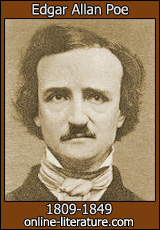
Edgar Allan Poe
Edgar Allan Poe (1809-1849), American poet, critic, short story writer, and author of such macabre works as “The Fall of the House of Usher” (1840);
I looked upon the scene before me - upon the mere house, and the simple landscape features of the domain - upon the bleak walls - upon the vacant eye-like windows - upon a few rank sedges - and upon a few white trunks of decayed trees - with an utter depression of soul which I can compare to no earthly sensation more properly than to the after-dream of the reveller upon opium - the bitter lapse into everyday life - the hideous dropping off of the veil. There was an iciness, a sinking, a sickening of the heart - an unredeemed dreariness of thought which no goading of the imagination could torture into aught of the sublime. What was it - I paused to think - what was it that so unnerved me in the contemplation of the House of Usher?
Contributing greatly to the genres of horror and science fiction, Poe is now considered the father of the modern detective story and highly lauded as a poet. Walt Whitman, in his essay titled “Edgar Poe’s Significance” wrote;
Poe’s verses illustrate an intense faculty for technical and abstract beauty, with the rhyming art to excess, an incorrigible propensity toward nocturnal themes, a demoniac undertone behind every page. … There is an indescribable magnetism about the poet’s life and reminiscences, as well as the poems.
Poe’s psychologically thrilling tales examining the depths of the human psyche earned him much fame during his lifetime and after his death. His own life was marred by tragedy at an early age (his parents died before he was three years old) and in his oft-quoted works we can see his darkly passionate sensibilities—a tormented and sometimes neurotic obsession with death and violence and overall appreciation for the beautiful yet tragic mysteries of life. They who dream by day are cognizant of many things which escape those who dream only by night.—“Elonora”. Poe’s literary criticisms of poetry and the art of short story writing include “The Poetic Principal” and “The Philosophy of Composition”. There have been numerous collections of his works published and many of them have been inspiration for popular television and film adaptations including “The Tell-Tale Heart”, “The Black Cat”, and “The Raven”. He has been the subject of numerous biographers and has significantly influenced many other authors even into the 21st Century.
Edgar Poe was born on 19 January 1809 in Boston, Massachusetts, the son of actors Elizabeth Arnold Hopkins (1787-1811) and David Poe (1784-1810). He had a brother named William Henry (1807-1831) and sister Rosalie (1811-1874). After the death of his parents Edgar was taken in by Frances (d.1829) and John Allan (d.1834), a wealthy merchant in Richmond, Virginia.
Young Edgar traveled with the Allans to England in 1815 and attended school in Chelsea. In 1820 he was back in Richmond where he attended the University of Virginia and studied Latin and poetry and also loved to swim and act. While in school he became estranged from his foster father after accumulating gambling debts. Unable to pay them or support himself, Poe left school and enlisted in the United States Army where he served for two years. He had been writing poetry for some time and in 1827 “Dreams”—Oh! that my young life were a lasting dream! first appeared in the Baltimore North American, the same year his first book Tamerlane and Other Poems was published, at his own expense.
When Poe’s foster mother died in 1829 her deathbed wish was honoured by Edgar and stepfather John reconciling, though it was brief. Poe enlisted in the West Point Military Academy but was dismissed a year later. In 1829 his second book Al Aaraaf, Tamerlane and Minor Poems was published. The same year Poems (1831) was published Poe moved to Baltimore to live with his aunt Maria Clemm, mother of Virginia Eliza Clemm (1822-1847) who would become his wife at the age of thirteen. His brother Henry was also living in the Clemm household but he died of tuberculosis soon after Edgar moved in. In 1833, the Baltimore Saturday Visiter published some of his poems and he won a contest in it for his story “MS found in a Bottle”. In 1835 he became editor and contributor of the Southern Literary Messenger. Though not without his detractors and troubles with employers, it was the start of his career as respected critic and essayist. Other publications which he contributed to were Burton’s Gentleman’s Magazine (1839–1840), Graham’s Magazine (1841–1842), Evening Mirror, and Godey’s Lady’s Book.
After Virginia and Edgar married in Richmond in 1836 they moved to New York City. Poe’s only completed novel The Narrative of Arthur Gordon Pym was published in 1838. The story starts as an adventure for a young Nantucket stowaway on a whaling ship but soon turns into a chilling tale of mutiny, murder, and cannibalism.
It is with extreme reluctance that I dwell upon the appalling scene which ensued; a scene which, with its minutest details, no after events have been able to efface in the slightest degree from my memory, and whose stern recollection will embitter every future moment of my existence.—Ch. 12
Poe’s contributions to magazines were published as a collection in Tales of the Grotesque and Arabesque (1840) which included “The Duc de L'Omelette”, “Bon-Bon” and “King Pest”. What some consider to be the first detective story, “The Murders in the Rue Morgue” was published in 1841;
Now, brought to this conclusion in so unequivocal a manner as we are, it is not our part, as reasoners, to reject it on account of apparent impossibilities. It is only left for us to prove that these apparent ‘impossibilities’ are, in reality, not such.
Poe’s collection of poetry The Raven and Other Poems (1845) which gained him attention at home and abroad includes the wildly successful “The Raven” and “Eulalie” and “To Helen”;
Lo, in yon brilliant window-niche
How statue-like I see thee stand,
The agate lamp within thy hand,
Ah! Psyche, from the regions which
Are Holy Land!
Poe continued to write poetry, critical essays and short stories including “Ulalume”, “Eureka” and “The Cask of Amontillado” (1846);
It must be understood, that neither by word nor deed had I given Fortunato cause to doubt my good will. I continued, as was my wont, to smile in his face, and he did not perceive that my smile now was at the thought of his immolation.
Now living in their last place of residence, a cottage in the Fordham section of the Bronx in New York City, Virginia died in 1847. Poe turned to alcohol more frequently and was purportedly displaying increasingly erratic behavior. A year later he became engaged to his teenage sweetheart from Richmond, Elmira Royster. In 1849 he embarked on a tour of poetry readings and lecturing, hoping to raise funds so he could start his magazine The Stylus.
There are conflicting accounts surrounding the last days of Edgar Allan Poe and the cause of his death. Some say he died from alcoholism, some claim he was murdered, and various diseases have also been attributed. Most say he was found unconscious in the street and admitted to the Washington College Hospital in Baltimore, Maryland. He died soon after, on 7 October 1849, and was buried unceremoniously in an unmarked grave in the Old Westminster Burying Ground of Baltimore. On this original site now stands a stone with a carving of a raven and the inscription;
Quoth the Raven, Nevermore
Original Burial Place of
Edgar Allan Poe
From
October 9, 1849
Until
November 17, 1875
Mrs. Marian Clemm, His Mother-In-Law
Lies Upon His Right And Virginia Poe
His Wife, Upon His Left. Under The
Monument Erected To Him In This
Cemetery
In a dedication ceremony in 1875, Poe’s remains were reinterred with Maria Clemm’s in the Poe Memorial Grave which stands in the cemetery’s corner at Fayette and Greene Streets. A bas-relief bust of Poe adorns the marble and granite monument which is simply inscribed with the birth and death dates of Poe (although his birthdate is wrong), Maria, and Virginia who, in 1885, was reinterred with her husband and mother. Letters from Henry Wadsworth Longfellow and Lord Alfred Tennyson were read, and Walt Whitman attended. The mysterious Poe Toaster visits Poe’s grave on his birthdays and leaves a partially filled bottle of cognac and three roses.
All that we see or seem
Is but a dream within a dream.—A Dream within a Dream
Biography written by C.D. Merriman for Jalic Inc. Copyright Jalic Inc. 2006. All Rights Reserved.
The above biography is copyrighted. Do not republish it without permission.
Forum Discussions on Edgar Allan PoeRecent Forum Posts on Edgar Allan Poe
- Quiz: Edgar Allan Poe 10 Questions
- Quiz: Edgar Allen Poe: Life and Works
- Quiz: Edgar Allan Poe's short story The Gold Bug
- Quiz for Edgar Allan Poe's short story The Assignation
- Quiz for Edgar Allan Poe's short story Berenice
- Quiz for Edgar Allan Poe's short story The Black Cat
- Quiz for Edgar Allan Poe's short story The Cask of Amontillado
- Quiz for Edgar Allan Poe's short story A Descent into the Maelstrom
- Quiz for Edgar Allan Poe's short story The Devil in the Belfry
- Quiz for Edgar Allan Poe's short story The Domain of Arnheim
- Quiz for Edgar Allan Poe's short story Eleanora
- Quiz for Edgar Allan's Poe's The Facts in the Case of M. Valdemar
- Quiz for Edgar Allan Poe's The Fall of the House of Usher
- Quiz for Edgar Allan Poe's The Imp of the Perverse
- Quiz for Edgar Allan Poe's The Island of the Fay
- Quiz: Edgar Allan Poe's Landor's Cottage
- Edgar Allan Poe's The Masque of the Red Death
- Edgar Allan Poe's Mesmeric Revelation
- Edgar Allan Poe's The Murders in the Rue Morgue
- Edgar Allan Poe's The Oblong Box
- Edgar Allan Poe's The Pit and the Pendulum
- Edgar Allan Poe's The Premature Burial
- Edgar Allan Poe's The Purloined Letter
- Edgar Allan Poe's Silence--A Fable
- Edgar Allan Poe's The Tell-Tale Heart
- Edgar Allan Poe's The 1002 Tale of Scheherazade
- Edgar Allan Poe's Ligeia
- Edgar Allan Poe's William Wilson
- Edgar Allan Poe's Von Kempelen and His Discovery
- Edgar Allan Poe's Morella
- Quiz for Edgar Allan Poe's The Spectacles
- Quiz for Edgar Allan Poe's A Tale of Ragged Mountains
- Quiz for Edgar Allan Poe's King Pest
- Quiz for Edgar Allan Poe's Three Sundays in a Week
- Quiz for Edgar Allan Poe's The Angel of the Odd
- Quiz for Edgar Allan Poe's Lionizing
- Quiz for Edgar Allan Poe's X-ing a Paragrab
- Quiz for Edgar Allan Poe's Metzengerstein
- Quiz for Edgar Allan Poe's The System of Dr. Tarr and Professor Feather
- Quiz for Edgar Allan Poe's A Predicament
- Quiz for Edgar Allan Poe's How to Write a Blackwood Article
- Quiz for Edgar Allan Poe's Diddling
- Quiz for Edgar Allan Poe's Mellonta Tauta
- Quiz for Edgar Allan Poe's The Duc De L'Omelette
- Quiz for Edgar Allan Poe's Loss of Breath
- Quiz for Edgar Allan Poe's The Business Man
- Quiz for Edgar Allan Poe's Maelzel's Chess Player
- Quiz for Edgar Allan Poe's The Power of Words
- Quiz for Edgar Allan Poe's The Colloquy of Monos and Una
- Quiz for Edgar Allan Poe's The Conversation of Eiros and Charmion
- Quiz for Edgar Allan Poe's A Shadow--A Parable
- Quiz for Edgar Allan Poe's A Tale of Jerusalem
- Quiz for Edgar Allan Poe's The Sphinx
- Quiz for Edgar Allan Poe's Hop Frog
- Quiz for Edgar Allan Poe's The Man of the Crowd
- Quiz for Edgar Allan Poe's Never Bet the Devil Your Head
- Quiz: Edgar Allan Poe's Thou Art the Man
- Quiz: Poe's 'Why the Little Frenchman Wears His Hand in a Sling'
- Quiz for Edgar Allan Poe's Bon-Bon
- Quiz for Edgar Allan Poe's Some Words with a Mummy
Please submit a quiz here.
Here is where you find links to related content on this site or other sites, possibly including full books or essays about Edgar Allan Poe written by other authors featured on this site.

Thesis statement for Alan Edgar Poe and Race
Hello, Could somebody give me a good thesis statement on Alan Edgar Poe and race? I'm not much into this topic and I need to give it to my teacher. I will be very grateful for any help. Cheers...
Posted By seminarPOE in Poe, Edgar Allan || 6 Replies
Poems inspired of 'The House Of Usher'.
The Grand Father Clock. Howling through the midnight hour as clock strike past hour. As the night before, the door flew open with shining crystal light with whisper noise. Which is so soft that only trees outside can heard it call. Whistling crest the air carrying it beyond the floor boards. The humming is get loud as the faint sound of the ticking of hand on the Grandfather clock. Subtle rattles of the pipes thought house is shaking it. Suddenly the house collapse but the Grandfather clock is still stand. Stand its ground thought the test of time. My Son. While I sitting here waiting for life end. With ‘The Fall of the House of Usher’ just out gasp. My hand is weake...
Posted By zoolane in Poe, Edgar Allan || 2 Replies
Poe's influence on Gothic Fiction?
Hello there, anybody still active in here? I'm from Germany and kind of a Fan of Edgar Allan Poe. ('The Raven' just fascinates me as well as 'Usher' and the 'Tell-Tale Heart') Now that I've read some works of Poe and also spend some time in this Network, I have a question: What was Poe's influence on Gothic Fiction? He is seen as the Father of modern horror stories and maybe a role model for e.g. Stephen King. But what was the difference between Poe's style and the style of the authors before him (like Mary Shelly)? What made him so important for this genre? I'm curious about you're answers......
Posted By Aquilinus in Poe, Edgar Allan || 1 Reply
The Fall of the House of Usher and the Legend of Fafnir
In The Fall of the House of Usher the narrator reads from "The Mad Trist," in which a hero named Ethelred kills a dragon and takes the treasure that was guarded by the dragon. This reminded me of the story of Fafnir from Norse Mythology. When he was originally a dwarf, the gods accidentally killed his brother, and the gods paid his family a ransom of gold treasure. Fafnir then killed his father and kept the gold for himself, and eventually transformed himself into a dragon and poisoned the land around him to keep people away from his gold. Fafnir's last remaining brother later sent a mortal, Sigurd, to kill Fafnir and take the gold. There are several connections between the Poe story ...
Posted By Hal K in Poe, Edgar Allan || 0 Replies
Is the Man of the Crowd a hero?
The narrator begins and ends by referencing a German phrase meaning "it does not permit itself to be read." And so he gives up after following the old man around the city all night. So what is Poe/the narrator saying about the old man? Is he a hero? A villain? Is mankind at its greatest when wandering thus? Thoughts?...
Posted By RJbibliophil in Poe, Edgar Allan || 1 Reply
For Mr. Budge
Our favorite Poe Story is Ligeia due to its themes and the multiple ways the story can be viewed, such as taking the idea that the second wife, Rowena, did not exist....
Posted By bibliobibuli in Poe, Edgar Allan || 0 Replies
The Tell-Tale Heart
I am trying to find a copy of a dramatised version of this short story written, I believe, by Anthony Holland and published in the early 50's. Can anyone help with a clue about this seemingly 'lost' one-act play? Ronald Cattell...
Posted By Ronald Cattell in Poe, Edgar Allan || 0 Replies
The work of E.A. POE put in music by a french rock band
Hi there, (sorry if I double-post with the "Poetry" part of the forum...) You can download for free here http://akin69.bandcamp.com/album/verse the album "Verse" by the french rock/metal band AKIN. All the songs are made out of Poe's work (Annabel lee, Lenore, A dream within a dream, The city in the sea, Evening star, Dreamland...). Hope you'll like it !...
Posted By jakin in Poe, Edgar Allan || 0 Replies
Docu-drama: Edgar Allan Poe: Love, Death and Women
This may or may not run outside the UK: http://www.bbc.co.uk/programmes/b00vfhhp Rather sad that people around him died of TB and this was at a time when it was unusual to make money from writing....
Posted By Karl Rommel in Poe, Edgar Allan || 0 Replies
Rue Morgue, Dupin can't deduce?
So my teacher asked us what can't Dupin deduce about the murder, then later he related it to Poe's other work, "Man of the Crowd," saying that if one cannot read or categorize a person, then that person is a criminal, and is that a fair assumption. However, my thoughts were, well first that I could not figure out what Dupin could not deduce ( it may be the motive, but personally that answer seems childlike). Second that when Poe explains that man the narrator could not categorize in the "Man of the Crowd" as a genius of a deep crime that the crime was that of not fitting into the anonymous society, and not a criminal. I can see that the man is a criminal, or assumed to be, because of the dia...
Posted By pudgeg in Poe, Edgar Allan || 0 Replies
Loss of Breath--Your Opinions Are Appreciated...
I'm not sure why Edgar Allan Poe decided to extend this story. It was first published as 'A Decided Loss.' Then, Poe added to it, republished it, and retitled it, 'Loss of Breath'. Now, maybe there's something I'm not getting here, but doesn't the last paragraph of 'Loss of Breath' kind of seem.... for lack of a better phrase, 'biblically un-poe-ish'? I get that there is no breath to utter, 'Amen,' in this story, but what is with the last part? Is he saying that philosophers should find God before they die? These seems odd for Poe... Is it sarcasm, or was he printing it in a religious periodical? As a matter of opinion, I don't like the part where he wakes up in the tomb and has the...
Posted By loulou164 in Poe, Edgar Allan || 0 Replies
Psychoanalysis of Poes Poems?
Right is there any chance that any of you lovely people could help me on this? I have to Psychoanalyse some of Poes poems and write an essay where I compare two other pieces of gothic literature for my Coursework. If anybody could possibly point me in the right direction of where I may acquire information for me to build on my essay please feel free to PM me. Thank you :wave:...
Posted By rlw92 in Poe, Edgar Allan || 3 Replies
Post a New Comment/Question on Poe