 Subscribe for ad free access & additional features for teachers. Authors: 267, Books: 3,607, Poems & Short Stories: 4,435, Forum Members: 71,154, Forum Posts: 1,238,602, Quizzes: 344
Chapter 5
V A PROFITABLE JOB
After finishing her work at Colonel Preston's Mrs. Burke went home. She did not see Mrs. Preston again, for the latter sent her the money for her services by Ellen. "Mrs. Preston says you're not to come next week," said Ellen.Andy to ask:
"What's the matter, mother? Has anything happened?" "I've got through working for Mrs. Preston, Andy." "Got through? For to-day, you mean?" "No; I'm not going to work there again." "Why not?" "She complained of you, Andy." "What did she say, mother?" asked our hero, listening with attention. "She said you ought not to have struck Godfrey." "Did you tell her he struck me first?" "Yes, I did." "And what did she say, thin?" "She said that you ought not to have struck him back." "And what did you say, mother?" "I said my Andy wasn't the boy to stand still and let anybody beat him." "Good for you, mother! Bully for you! That's where you hit the nail on the head. And what did the ould lady say then?" "She told me I needn't come there again to work." "I'm glad you're not goin', mother. I don't want you to work for the likes of her. Let her do her own ironin', the ould spalpeen!" In general, Andy's speech was tolerably clear of the brogue, but whenever he became a little excited, as at present, it was more marked. He was more angry at the slight to his mother than he would have been at anything, however contemptuous, said to himself. He had that chivalrous feeling of respect for his mother which every boy of his age ought to have, more especially if that mother is a widow. "But, Andy, I'm very sorry for the money I'll lose." "How much is it, mother?" "Seventy-five cents." "I'll make it up, mother." "I know you will if you can, Andy; but work is hard to get, and the pay is small." "You might go back and tell Mrs. Preston that I'm a dirty spalpeen, and maybe she'd take you back, mother." "I wouldn't slander my own boy like that if she'd take me back twenty times." "That's the way to talk, mother," said Andy, well pleased. "Don't you be afeared�we'll get along somehow. More by token, here's three dollars I brought home with me yisterday." Andy pulled out from his pocket six silver half-dollars, and offered them to his mother. "Where did you get them, Andy?" she asked, in surprise. "Where did I get them? One way and another, by overwork. We won't starve while them last, will we?" Andy's cheerful tone had its effect upon his mother. "Perhaps you're right, Andy," she said, smiling. "At any rate we won't cry till it's time." "To-morrow I'll go out and see if I can find work." "Suppose you don't find it, Andy?" suggested his sister. "Then I'll take in washing," said Andy, laughing. "It's an iligant washer I'd make, wouldn't I now?" "Nobody'd hire you more than once, Andy." By and by they had supper. If they had been alone they would have got along on bread and tea; but "Andy needs meat, for he's a growing boy," said his mother. And so Mary was dispatched to the butcher's for a pound and a half of beefsteak, which made the meal considerably more attractive. Mrs. Burke felt that it was extravagant, particularly just as her income was diminished, but she couldn't bear to stint Andy. At first she was not going to eat, herself, meaning to save a part for Andy's breakfast; but our hero found her out, and declared he wouldn't eat a bit if his mother did not eat, too. So she was forced to take her share, and it did her good, for no one can keep up a decent share of strength on bread and tea alone. The next morning Andy went out in search of work. He had no very definite idea where to go, or to whom to apply, but he concluded to put in an application anywhere he could. He paused in front of the house of Deacon Jones, a hard-fisted old farmer, whose reputation for parsimony was well known throughout the village, but of this Andy, being a newcomer, was ignorant. "Wouldn't you like to hire a good strong boy?" he asked, entering the yard. The deacon looked up. "Ever worked on a farm?" "Yes." "Can you milk?" "Yes." "Where did you work?" "In Carver." "What's your name?" "Andy Burke." "Where do you live?" "With my mother, Mrs. Burke, a little way down the road." "I know�the Widder Burke." "Have you got any work for me?" "Wait a minute, I'll see." The deacon brought out an old scythe from the barn, and felt of the edge. There was not much danger in so doing, for it was as dull as a hoe. "This scythe needs sharpening," he said. "Come and turn the grindstone." "Well, here's a job, anyhow," thought Andy. "Wonder what he'll give me." He sat down and began to turn the grindstone. The deacon bore on heavily, and this made it hard turning. His arms ached, and the perspiration stood on his brow. It was certainly pretty hard work, but then he must be prepared for that, and after all he was earning money for his mother. Still the time did seem long. The scythe was so intolerably dull that it took a long time to make any impression upon it. "Kinder hard turnin', ain't it?" said the deacon. "Yes," said Andy. "This scythe ain't been sharpened for ever so long. It's as dull as a hoe." However, time and patience work wonders, and at length the deacon, after a careful inspection of the blade of the scythe, released Andy from his toil of an hour and a half, with the remark: "I reckon that'll do." He put the scythe in its place and came out. Andy lingered respectfully for the remuneration of his labor. "He ought to give me a quarter," he thought. But the deacon showed no disposition to pay him, and Andy became impatient. "I guess I'll be goin'," he said. "All right. I ain't got anything more for you to do," said the deacon. "I'll take my pay now," said Andy, desperately. "Pay? What for?" inquired the deacon, innocently. "For turning the grindstone." "You don't mean ter say you expect anything for that?" said the deacon in a tone of surprise. "Yes I do," said Andy. "I can't work an hour and a half for nothing." "I didn't expect to pay for such a trifle," said the old man, fumbling in his pocket. Finally he brought out two cents, one of the kind popularly known as bung-towns, which are not generally recognized as true currency. "There," said he in an injured tone. "I'll pay you, though I didn't think you'd charge anything for any little help like that." Andy looked at the proffered compensation with mingled astonishment and disgust. "Never mind," he said. "You can keep it. You need it more'n I do, I'm thinkin'!" "Don't you want it?" asked the deacon, surprised. "No, I don't. I'm a poor boy, but I don't work an hour and a half for two cents, one of 'em bad. I'd rather take no pay at all." "That's a cur'us boy," said the deacon, slowly sliding the pennies back into his pocket. "I calc'late he expected more just for a little job like that. Does he think I'm made of money?" As Andy went out of the yard, the idea dawned upon the deacon that he had saved two cents, and his face was luminous with satisfaction.
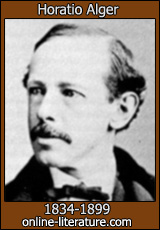
Sorry, no summary available yet.
| Art of Worldly Wisdom Daily In the 1600s, Balthasar Gracian, a jesuit priest wrote 300 aphorisms on living life called "The Art of Worldly Wisdom." Join our newsletter below and read them all, one at a time. |
Sonnet-a-Day Newsletter Shakespeare wrote over 150 sonnets! Join our Sonnet-A-Day Newsletter and read them all, one at a time. |
