
Subscribe for ad free access & additional features for teachers. Authors: 267, Books: 3,607, Poems & Short Stories: 4,435, Forum Members: 71,154, Forum Posts: 1,238,602, Quizzes: 344
Gertrude Franklin Horn Atherton
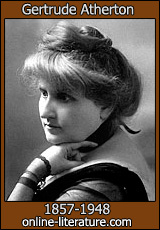
Gertrude Franklin Atherton (1857-1948), American biographer, historian, and author of the controversial best-seller Black Oxen (1923);
"These glands in my case had undergone a natural process of exhaustion. In women the slower functioning of the endocrines is coincident with the climacteric, as they have been dependent for stimulation upon certain ovarian cells. The idea involved is that the stimulation of these exhausted cells would cause the other glands to function once more at full strength and a certain rejuvenation ensue as a matter of course; unless, of course, they had withered beyond the power of science. I was a promising subject, for examination proved that my organs were healthy, my arteries soft; and I was not yet sixty. Only experimentation could reveal whether or not there was still any life left in the cells, although I responded favorably to the preliminary tests. The upshot was that I consented to the treatment——"--Ch. 26
Written when Atherton was 65 years old, the novel's mixture of science and romance was controversial but extremely popular upon publication. A story of infatuation and obsession with beauty, it is based on Atherton's personal experience with the Steinach Treatment, x-rays used to regenerate the reproductive organs. Like so many in their search for the Fountain of Youth, (William Butler Yeats also had this treatment) she wanted rejuvenation, a fresh energy to begin a new novel. The title for the novel was inspired by a line from William Butler Yeats' play The Countess Cathleen;
OONA: Tell them who walk upon the floor of peace,
That I would die and go to her I love,
The years like great black oxen tread the world,
And God the herdsman goads them on behind,
And I am broken by their passing feet.--Scene 5
Black Oxen was adapted to the screen in 1923 as a silent black and white film starring "It Girl" Clara Bow (1905-1965), who also starred in a few adaptations of Elinor Glyn's novels. Atherton also wrote under the pen names "Asmodeus" and "Frank Lin". She wrote many novels, short stories, essays, and articles for magazines and newspapers on such contemporary issues as feminism, politics and war. She is oft said to have been difficult and strong-willed herself, writing before her time, but her scope and range of vision in her stories of remarkable and independent woman entering the 20th century are well-respected and still in print.
Gertrude Franklin Horn was born 30 October, 1857, in San Francisco, California, U.S.A. Her father was Thomas L. Horn, a businessman, and her mother Gertrude Franklin was a relative of Benjamin Franklin. At the age of two young Gertrude went to live with her maternal grandfather when her parents separated and her mother remarried. She attended St. Mary's Hall high school in Benecia, California, then went on to the Sayre Institute in Lexington, Kentucky for a time but contracted tuberculosis and couldn't remain. She was an avid reader and early on started to craft short stories.
In 1876, at the age of nineteen, Gertrude eloped with George H. Bowen Atherton, a former suitor of her mother's and the son of Faxon Atherton, a wealthy merchant and namesake of the town of Atherton in California. They would have a daughter, Muriel. Their son George died at the age of six. George Sr., a somewhat lacklustre and impassive man, and Gertrude lived with his mother Dominga de Goñi Atherton at her vast estate called Valparaiso Park in San Francisco, which is said to now be haunted by their ghosts. It is claimed that because of both women's domineering ways, George decided to venture to Chile in 1887 to prove his mettle, but died of kidney failure on the way. Now free to pursue her life as an author, Gertrude moved to New York, though travelled extensively in France, Germany and England.
Defying conventions in 1882 Atherton had published anonymously the scandalous The Randolph’s of the Redwoods, said to be based on a local families troubles. It was first serialised in the San Francisco Argonaut (later published as A Daughter of the Vine in 1899). Her family, including her husband and mother-in-law, were not impressed with her pursuing a career in writing, and her female characters exuding independence and sexuality caused them embarrassment. What Dreams May Come (1888) was published under the pseudonym Frank Lin. Hermia Suydam (1889) was another of Atherton's controversial works, deemed immoral by London critics. Whilst in California, she finished Los Cerritos (1890). The Doomswoman (1893) and Before the Gringo Came (1894) followed.
Atherton moved to England in 1895 and wrote Patience Sparhawk and Her Times (1897) and American Wives and English Husbands (1898). Senator North (1900) is based on the life of Eugene Hall of Maine. The Conqueror (1902), about Alexander Hamilton, while presented as fiction, fulfills Atherton's painstaking attention to detail from documented and published facts about the man and his life and was widely acclaimed. She also wrote a gothic-supernatural work The Bell in the Fog (1905) and her biographical story of Nicolai Petrovich de Rezánov and Dona Concha was published in 1906. The Gorgeous Isle (1908) explores the West Indian romance of a poet based on Swinburne. Julia France and Her Times (1912) is about the women's suffrage movement in England. During World War I, 1914 Atherton's service in hospitals earned her the Legion d'Honneur. Her essays on women's role in the war effort, The Living Present were published in 1917.
Having lived in Germany for a number of years and becoming acquainted with the culture and status of women in society, her The White Morning (1918) is an apt prediction that the women of Germany, having suffered too many losses of fathers, husbands and sons to war and "driven to desperation by suffering and privation, and disillusion, would arise suddenly and overturn the dynasty.""They will do nothing futile, nothing without the most secret and methodical preparation of which even the German mind is capable. It will be like turning over in bed in camp: they will all turn over together. They are damnably efficient." .. "No one knows what the future holds, or what unexpected event will suddenly end the war; but I should not have written The White Morning if I had not been firmly convinced that a Gisela might arise at any moment and deliver the world."
After her Steinach treatment, when Atherton found "renewed mental vitality and neural energy", she wrote in her autobiography Adventures of a Novelist (1932) to have written Black Oxen in record time. She created another heavily researched series of historical books, one about the philosopher Aspasia The Immortal Marriage (1927); Alcibiades in The Jealous Gods (1928), and a story of Dido in Dido, Queen of Hearts (1929).
In 1932 Atherton had moved back to San Francisco and become known as one of California's most distinguished women. She earned several honorary degrees in her lifetime. Her works are now appreciated for their romantic-realism, exploring themes of nature versus nurture, characters often changing their environments on their pursuit of happiness and success. The House of Lee (1940) and The Horn of Life (1942) were followed by My San Francisco (1946).
Gertrude Franklin Atherton died 14 June 1948 in San Francisco and her ashes are interred in a niche at the Cypress Lawn Memorial Park columbarium in Colma, San Mateo County, California. California's Daughter: Gertrude Atherton and Her Times by Emily Wortis Leider was published in 1993.
Biography written by C.D. Merriman for Jalic Inc. Copyright Jalic Inc 2005. All Rights Reserved.
The above biography is copyrighted. Do not republish it without permission.
Forum Discussions on Gertrude Franklin Horn AthertonRecent Forum Posts on Gertrude Franklin Horn Atherton
Please submit a quiz here.
Here is where you find links to related content on this site or other sites, possibly including full books or essays about Gertrude Franklin Horn Atherton written by other authors featured on this site.
Sorry, no links available.

No active discussions on Atherton found. Why not post a question or comment yourself? Just click the link below.
Post a New Comment/Question on Atherton