Page 11 of 22 FirstFirst ... 67891011121314151621 ... LastLast
Results 151 to 165 of 324

Thread: Poetry Reading Group Redux- Nominations

  1. #151
    Artist and Bibliophile stlukesguild's Avatar
    Join Date
    Jul 2006
    Location
    The USA... or thereabouts
    Posts
    6,083
    Blog Entries
    78
    Virgil, the Grennan translation is a dual language translation. From what I have read it seems to have received the highest accolades as a translation into English poetry... in other words it is not merely an accurate literal translation but one that retains some semblance of the poetry. It is not highly annotated... but I'm not certain I need or want this. I already have the Casale translation in his volume, A Leopardi Reader which includes a good deal of notation, critical commentary, and a good deal of quotes from other writings of Leopardi that the editor/translator felt help to illuminate the poems.
    Beware of the man with just one book. -Ovid
    The man who doesn't read good books has no advantage over the man who can't read them.- Mark Twain
    My Blog: Of Delicious Recoil
    http://stlukesguild.tumblr.com/

  2. #152
    Vincit Qui Se Vincit Virgil's Avatar
    Join Date
    Nov 2005
    Location
    New York
    Posts
    20,354
    Blog Entries
    248
    Quote Originally Posted by stlukesguild View Post
    Virgil, the Grennan translation is a dual language translation. From what I have read it seems to have received the highest accolades as a translation into English poetry... in other words it is not merely an accurate literal translation but one that retains some semblance of the poetry. It is not highly annotated... but I'm not certain I need or want this. I already have the Casale translation in his volume, A Leopardi Reader which includes a good deal of notation, critical commentary, and a good deal of quotes from other writings of Leopardi that the editor/translator felt help to illuminate the poems.
    Fabulous. I'll go order it. Muchos gracias.
    LET THERE BE LIGHT

    "Love follows knowledge." – St. Catherine of Siena

    My literature blog: http://ashesfromburntroses.blogspot.com/

  3. #153
    Dance Magic Dance OrphanPip's Avatar
    Join Date
    Oct 2009
    Location
    Kuala Lumpur but from Canada
    Posts
    4,163
    Blog Entries
    25
    I got mine today, the orange one with no table of contents.

    Looks good, but I haven't had a chance to read any of the poems yet.
    "If the national mental illness of the United States is megalomania, that of Canada is paranoid schizophrenia."
    - Margaret Atwood

  4. #154
    Skol'er of Thinkery The Comedian's Avatar
    Join Date
    Jul 2008
    Location
    where the cold wind blows
    Posts
    3,919
    Blog Entries
    81
    My copy arrived today. I'm ready to roll.
    “Oh crap”
    -- Hellboy

  5. #155
    Bibliophile JBI's Avatar
    Join Date
    Feb 2007
    Location
    Toronto
    Posts
    6,360
    Quote Originally Posted by quasimodo1 View Post
    Leopardi describes his method of poetic composition: "I compose only when under an inspiration, yielding to which, in two minutes, I have designed and organised the poem. This done, I wait for a recurrence of such inspiration, which seldom happens until several weeks have elapsed. Then I set to work at composition, but so slowly that I cannot complete a poem, however short, in less than two or three weeks. Such is my method; without inspiration it were easier to draw water from a stone than a single verse from my brain."
    Can we take it then, that whenever backpain was at its worst, or he was feeling horny/lonely he got the so called "inspiration", and wrote? Given the subjects, it seems that the inspiration found is generally a connection between history or abstract ideas and his own deformity and perceived failures.

  6. #156
    Of Subatomic Importance Quark's Avatar
    Join Date
    May 2006
    Posts
    1,368
    For those of you with dual language versions (and know how to use them), I have a couple of questions about the mood and emotion of "The Infinite." Reading in different books, I've seen the poem treated in a few different ways and I'm curious to know which is closer to the original. Some translations give the last half of the poem a happier ending than others. Take the Kate Flores translation:

    And listening to the wind
    Rustling in this greenery, to
    That infinite silence I compare
    This voice: and I ponder the eternal,
    And the dead seasons, and the present
    And living, and its sound. Thus in this immensity
    My meditations drown:
    And it is sweet to lose myself in this sea.

    In this version, the poem winds up its platonic message with the warm, reassuring last line "And it is sweet to lose myself in this sea." Most translations, though, insert a little trouble or sadness into the poem:

    And as I listen to the wind, that through
    These trees is murmuring, its plaintive voice
    I with that infinite compare;
    And things eternal I recall, and all
    the seasons dead, and this, that round me lives,
    and utters its complaint. Thus wandering,
    My thought in this immensity is drowned;
    And sweet to me is shipwreck on this sea.

    This version makes nature dolorous. And it turns the quiet absorption at the end of the Flores translation into a "shipwreck." Are these details in the Italian? JBI's characterization of the poet as a chronic complainer make me believe the latter translation is more accurate, but I was hoping someone might know for sure.
    "Par instants je suis le Pauvre Navire
    [...] Par instants je meurs la mort du Pecheur
    [...] O mais! par instants"

    --"Birds in the Night" by Paul Verlaine (1844-1896). Join the discussion here: http://www.online-literature.com/for...5&goto=newpost

  7. #157
    Vincit Qui Se Vincit Virgil's Avatar
    Join Date
    Nov 2005
    Location
    New York
    Posts
    20,354
    Blog Entries
    248
    I was about to suggest someone start off with a poem. Quark has apparent leadership qualities. Why don't you start with that poem? I can't contribute yet, since i don't have my copy, but I think most people do and there's no point in waiting.
    LET THERE BE LIGHT

    "Love follows knowledge." – St. Catherine of Siena

    My literature blog: http://ashesfromburntroses.blogspot.com/

  8. #158
    Bibliophile JBI's Avatar
    Join Date
    Feb 2007
    Location
    Toronto
    Posts
    6,360
    Shipwreck is clearly in the original, though in is the better choice of preposition. Shipwreck though is, by my reading, not a negative but a positive, in contrast to the world outside of the infinite. The poem is certainly contrasting the emptiness of the infinite with the pains of life - that is the central idea I think, as to how depressing it is, well that is up to the reader.

  9. #159
    Of Subatomic Importance Quark's Avatar
    Join Date
    May 2006
    Posts
    1,368
    Quote Originally Posted by JBI View Post
    Shipwreck is clearly in the original, though in is the better choice of preposition.
    Yeah, I'm seeing a lot of "shipwreck" in the translations I'm looking at now. It must just be a quirk of Flores to leave it out. What do you make of the "plaintive" and "complaint" of the second translation? Are those in there, too?

    Quote Originally Posted by JBI View Post
    Shipwreck though is, by my reading, not a negative but a positive, in contrast to the world outside of the infinite.
    I agree that the last line is still positive, but to say "shipwreck" rather than "lose myself" changes things a little. "Shipwrecks" generally are "negative" since they remind us of danger, mortality, and being lost. I think Leopardi is acknowledging these meanings, and acknowledging that there is a danger to the self involved in drowning one's thought in "immensity." No doubt, Leopardi still believes it's worth it to do so, but there's a slight reservation in that word.

    Quote Originally Posted by JBI View Post
    The poem is certainly contrasting the emptiness of the infinite with the pains of life
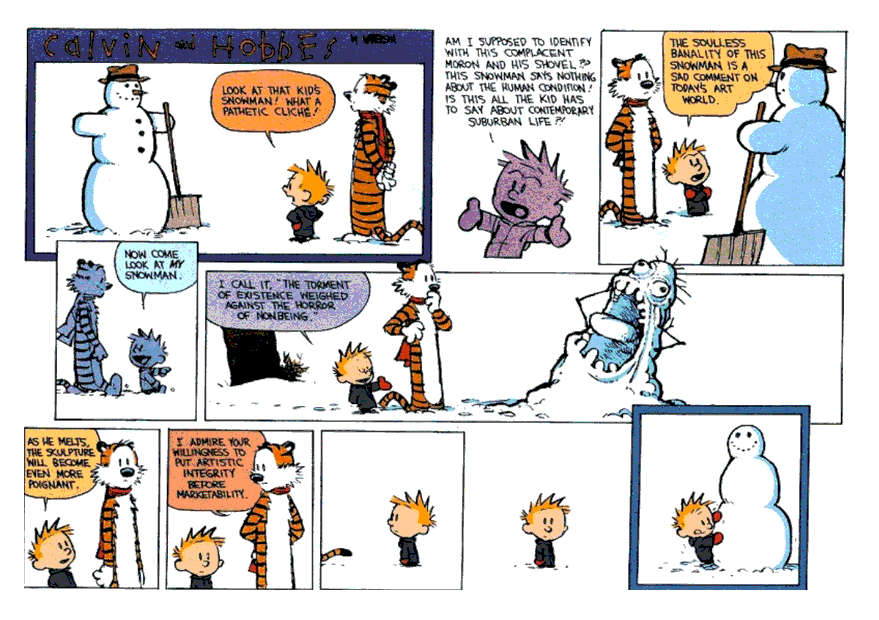
    For some reasons this reminded me of one of my favorite Calvin and Hobbes strips--the one where Calvin unveils his new sculpture "The Torment of Existence Weighed Against the Horror of Nonbeing:"


    While Leopardi is probably being just as intellectually pompous as Calvin, I don't think he's nearly so dramatic. Calvin's focusing on the dilemma, whereas Leopardi is more concerned with how the infinite and finite, immortal and mortal interact in the mind. It's a creative back-and-forth between these concepts that Leopardi seems to be after. To be shipwrecked here is to be absorbed in this interaction.

    Quote Originally Posted by JBI View Post
    as to how depressing it is, well that is up to the reader.
    Clearly.
    "Par instants je suis le Pauvre Navire
    [...] Par instants je meurs la mort du Pecheur
    [...] O mais! par instants"

    --"Birds in the Night" by Paul Verlaine (1844-1896). Join the discussion here: http://www.online-literature.com/for...5&goto=newpost

  10. #160
    The Infinite (trans Nichols)

    To me this lonely hill was always precious,
    And this hedgerow also, where so wide a stretch
    Of the extreme horizon’s out of sight.
    But sitting here and gazing, I find that endless
    Spaces beyond that hedge, and more-than-human
    Silences, and the deepest peace and quite
    Are fashioned in my thought; so much that almost
    My heart fills up with fear. And as I hear
    The wind rustle among the leaves, I set
    That infinite silence up against this voice,
    Comparing them; and I recall the eternal,
    And the dead seasons, and the present one
    Alive, and all the sound of it. And so
    In this immensity my thought is drowned:
    And I delight in sinking in this sea.

    I must admit that when I first read this poem, the first part of it immediately reminded me of something not altogether out of Wordsworth, the way the narrator takes comfort (in some way) in re-visiting nature. This is perhaps also the case because he takes pains to name the particular elements of nature in exact detail reaffirming that it is the exact place he has been before “this lonely hill” “this hedgerow” “that hedge” similar to that of say “Tintern Abbey” where Wordsworth does the same with “these waters” “these steep and lofty cliffs” “this dark sycamore” etc, etc. The difference being of course that one takes comfort in nature in itself, even delights in nature, whereby one uses nature simply because it presents the infinite which blocks out darker internal voices and woes. If “The Infinite” can be seen as light in any way, then surely the whole thing is tinged in despair because we know that such temporary reliefs are just that? Because of this for me, the whole piece is still ultimately clouded in sadness because nature or the infinity the narrator gets from nature, only offers a short respite from darker thoughts from which the narrator/Leopardi figure is obviously suffering.
    Last edited by LitNetIsGreat; 03-12-2010 at 01:52 PM.

  11. #161
    TobeFrank Paulclem's Avatar
    Join Date
    Jul 2009
    Location
    Coventry, West Midlands
    Posts
    6,363
    Blog Entries
    36
    Quote Originally Posted by Neely View Post
    The Infinite (trans Nichols)

    To me this lonely hill was always precious,
    And this hedgerow also, where so wide a stretch
    Of the extreme horizon’s out of sight.
    But sitting here and gazing, I find that endless
    Spaces beyond that hedge, and more-than-human
    Silences, and the deepest peace and quite
    Are fashioned in my thought; so much that almost
    My heart fills up with fear. And as I hear
    The wind rustle among the leaves, I set
    That infinite silence up against this voice,
    Comparing them; and I recall the eternal,
    And the dead seasons, and the present one
    Alive, and all the sound of it. And so
    In this immensity my thought is drowned:
    And I delight in sinking in this sea.

    I must admit that when I first read this poem, the first part of it immediately reminded me of something not altogether out of Wordsworth, the way the narrator takes comfort (in some way) in re-visiting nature. This is perhaps also the case because he takes pains to name the particular elements of nature in exact detail reaffirming that it is the exact place he has been before “this lonely hill” “this hedgerow” “that hedge” similar to that of say “Tintern Abbey” where Wordsworth does the same with “these waters” “these steep and lofty cliffs” “this dark sycamore” etc, etc. The difference being of course that one takes comfort in nature in itself, even delights in nature, whereby one uses nature simply because it presents the infinite which blocks out darker internal voices and woes. If “The Infinite” can be seen as light in any way, then surely the whole thing is tinged in despair because we know that such temporary reliefs are just that? Because of this for me, the whole piece is still ultimately clouded in sadness because nature or the infinity the narrator gets from nature, only offers a short respite from darker thoughts from which the narrator/Leopardi figure is obviously suffering.
    It reminded me of the Romantics too - its vision of time which I've picked up before in Shelley.

    I thought it was perhaps less despairing, more accepting - after all it is a return to the eternal - a vision of divinity, although the fear is acknowledged.

  12. #162
    This celestial seascape! Lynne50's Avatar
    Join Date
    Mar 2009
    Location
    Southern New Jersey near Philadelphia
    Posts
    337
    Just received my copy with Eamon Grennan's translation. Some of the poems I read, (late last night) were very enjoyable to read out loud. I loved Leopardi's imagery of nature, but then the poems all seemed to turn dark and sad. What started out as a celebration of nature, then turned depressive. I wonder if anyone else felt that. I need help with interpretations,that's why I wanted to participate in these discussions, so if I'm totally offbase, please let me know.

    Neely, My Eamon Grennan translation starts like this.

    Infinitive

    I've always loved this lonesome hill...

    I have to admit that I like this translation better than the one you cited, but you can only go by the edition you have.

    Happy Reading! Everybody
    "What is this life if, full of care, we have no time to stand and stare." W.H. Davies

  13. #163
    Hi, yes you can only go by the translations you have got, but then again if other translations (and the original of course) bring other thoughts to the table then I am more than happy with that - even if I have to change my thinking slightly because of it, it's not a problem, it's all good fun.

    I loved Leopardi's imagery of nature, but then the poems all seemed to turn dark and sad. What started out as a celebration of nature, then turned depressive.
    Yes I wouldn't disagree with you at all, it's just that I took the celebration of nature not to be celebrating nature for its own sake, as it were, as say Wordsworth clearly does, but in celebrating nature only because it helps to block out his inner thoughts and feelings (which are certainly dark and depressive). In other words my reading is that "I've always loved this lonesome hill" not because he particularly loves the hill, but because the views present the infinite which helps to block out his depressive thoughts. Maybe I am a little clouded in my judgment to the extent of his negative feelings (as Paulclem says he found it less despairing than me) because of reading some of his personal musing in such works as his Zibaldone, which seems to be a sort of diary:

    Nowadays I no longer envy the foolish or the wise, the great or the small, the weak or the powerful. I envy the dead, and only with them would I change places. Every pleasing fancy, every thought of the future which I happen to have in my solitude, and with which I pass the time, is concerned with death, and cannot go beyond it. Nor is the desire troubled any more, as it used to be, by the memory of the dream of my youth, and the thought of having lived in vain. If I obtain death, I shall die as peaceful and contented, as if I had never hoped for or desired anything else in the world. This is the only blessing which can reconcile me with destiny. If I were offered on the one hand the fortune and fame of Caesar or of Alexander, free from any blemish, and on the other hand to die today, and if I had to choose, I would say, die today, and I would not need any time to make up my mind.

    Death is not an ill: because it frees man from all ills, and together with the good things it takes away the desire for them. Old age is the greatest of all ills; because it deprives man of all pleasures, leaving him only the appetite for them; and it brings with itself all suffering. Nevertheless men fear death, and desire old age.

    Not individuals only, but the human race was and always will be inevitably unhappy. Not the human race only, but all the animals. Not the animals only, but all other beings in their own way. Not just the individuals, but the species, the races, the kingdoms, the spheres, the systems, the universes.

    So with this in mind to some degree, when I am reading like in the poem above of the narrator's thoughts, I am thinking in terms of things like these. This is why I ultimately see the poem as dark because nature or the infinite can only provide a temporary break from such thoughts. Likewise though, this is just an initial thought and one from which I am not totally unmovable, though often I that that initial thoughts and gut reactions should always be harboured to some extent.

    Happy reading!!

  14. #164
    TobeFrank Paulclem's Avatar
    Join Date
    Jul 2009
    Location
    Coventry, West Midlands
    Posts
    6,363
    Blog Entries
    36
    Having read some of his other shorter poems from the anthology now, I can see that he is a pretty depressed individual. It was his later poems that were more depressing. Perhaps he'd had enough by then. I've got more to read though. Infinity seems light compared to the ones about death.

  15. #165
    Vincit Qui Se Vincit Virgil's Avatar
    Join Date
    Nov 2005
    Location
    New York
    Posts
    20,354
    Blog Entries
    248
    Hey mine just came in the mail too, just moments ago!!

    Quote Originally Posted by Lynne50 View Post
    Just received my copy with Eamon Grennan's translation. Some of the poems I read, (late last night) were very enjoyable to read out loud. I loved Leopardi's imagery of nature, but then the poems all seemed to turn dark and sad. What started out as a celebration of nature, then turned depressive. I wonder if anyone else felt that. I need help with interpretations,that's why I wanted to participate in these discussions, so if I'm totally offbase, please let me know.

    Neely, My Eamon Grennan translation starts like this.

    Infinitive

    I've always loved this lonesome hill...

    I have to admit that I like this translation better than the one you cited, but you can only go by the edition you have.

    Happy Reading! Everybody
    I have to agree, the Grennan translation comes across more poetic, and though my Italian is not the best, it rings pretty accurately in terms of meaning. It's a short poem. Let me copy the Grennan translation:

    Infinitive
    (trans Grennan)

    I've always loved this lonesome hill
    And this hedge that hides
    The entire horizon, almost, from sight.
    But sitting here in daydream, I picture
    The boundless spaces away out there, silences,
    Deeper than human silence, an unfathomable hush
    In which my heart is hardly a beat
    From fear. And hearing the wind
    Rush rustling through these bushes,
    I pit its speech against infinite silence--
    And a notion of eternity floats to my mind,
    And the dead seasons, and the season
    Beating here and now, and the sound of it. So,
    In this immensity my thoughts all drown;
    And it's easeful to be wrecked in seas like these.

    I know some people have said how this reminds them of the Romantics, but I'm not sure i see the same thing. This is the only one I've read so far, so I can't speak from an intertextual perspective, I can only address from this short poem. The Romantics for the most part see a spirituality in nature, a mystery tending toward the numinous. Here I get the feeling that there is no mystery, no spirituality, no anything but death in nature. I can't say that this is a statement of atheism (though it could be); I'm saying that nature does not seem to contain substenance. Tintern Abbey nourished Wordsworth; there's no noursihment here.

    What I find incredibly interesting, though I don't have a reason for why, but the title of the poem is not "Infinity" but "Infinitive." I had to check the Italian to make sure that was correct. The title isn't talking about eternity, which is the subject of the poem, but a grammatical part of speech. And yet "infinitve" has as a root part of the word that wouold suggest infinity, and so there's a sort of pun there. I'm not sure what to make of it.

    Lynne, if you're looking to improve your reading of poetry, here's a few things you might want to do. After absorbing the poem, break up the poem into natural segments, and by natural segments i mean kernals of thought. Here's how I would segment the poem:
    Part 1:
    I've always loved this lonesome hill
    And this hedge that hides
    The entire horizon, almost, from sight.

    Part 2:
    But sitting here in daydream, I picture
    The boundless spaces away out there, silences,
    Deeper than human silence, an unfathomable hush
    In which my heart is hardly a beat
    From fear. And hearing the wind
    Rush rustling through these bushes,
    I pit its speech against infinite silence--

    Part 3
    And a notion of eternity floats to my mind,
    And the dead seasons, and the season
    Beating here and now, and the sound of it. So,
    In this immensity my thoughts all drown;

    Part 4
    And it's easeful to be wrecked in seas like these.

    The next thing is to identify the kernal of though in each part.
    Part 1: A description of a place, and how it gives him pleasure.
    Part 2: "But" signifies contrast, and so the daydream exercise is in contrast to the pleasurable little hill. So what's the contrast? Pleasure versus fear, finite spot and moment versus boundless space.
    Part 3: The boundless space is developed to an abstract thought, "eternity" and his relationship with it - death, overwhelming powerlessness to it.
    Part 4: Closure, the death and powerlessness actually alleviates the fear.

    Of course there's more to it than just the development. Now you can start looking at the various phrasings, images, and poetic devices and see what those suggest. I'm sure there will be more to discuss. I'll let others jump in here.
    LET THERE BE LIGHT

    "Love follows knowledge." – St. Catherine of Siena

    My literature blog: http://ashesfromburntroses.blogspot.com/

Similar Threads

  1. Light in August - reading group
    By Zee. in forum General Literature
    Replies: 96
    Last Post: 04-15-2012, 09:59 AM
  2. I need to know!
    By kels21 in forum Who Said That?
    Replies: 14
    Last Post: 11-06-2006, 06:46 PM
  3. Great Reading Group book
    By Debra in forum The Tenant of Wildfell Hall
    Replies: 1
    Last Post: 06-14-2006, 07:09 PM
  4. Valentine's Day Reading Nominations
    By Scheherazade in forum Forum Book Club
    Replies: 25
    Last Post: 01-25-2006, 01:14 PM
  5. Halloween Reading Nominations
    By Scheherazade in forum Forum Book Club
    Replies: 14
    Last Post: 09-28-2005, 07:35 AM

Posting Permissions

  • You may not post new threads
  • You may not post replies
  • You may not post attachments
  • You may not edit your posts
  •