Buying through this banner helps support the forum!
Page 11 of 19 FirstFirst ... 678910111213141516 ... LastLast
Results 151 to 165 of 278

Thread: Your favourite artist and Painting

  1. #151
    Artist and Bibliophile stlukesguild's Avatar
    Join Date
    Jul 2006
    Location
    The USA... or thereabouts
    Posts
    6,083
    Blog Entries
    78
    One of the most spectacular manuscripts to have been produced at Tabriz was an unfinished Shanameh (1515-1522) of which only a single image remains: Rustam Sleeping while Rakhsh Fights the Lion,attributed to the painter Sultan Muhammad:


    The scale and quality of this painting,, are enough to substantiate its claim to having been one of the greatest masterworks of Turkoman style at Tabriz. Sultan Muhammad, the leading painter of the Turkoman style, is credited with several other exceptional works, perhaps most brilliant being the luminous image of the Miraj or the heavenly ascension of the prophet Muhammad, painted for an illuminated text of Nezami’s Khamseh (c. 1540):


    The painting school of Herat was established in the early 15th century drawing upon many of the best artists from Shiraz and Tabriz. The artists of Herat were especially accomplished at painting people staged within complex settings beautifully composed. The greatest of the artists at Herat was Kamal ud-Din Behzad Herawi or Bihzad (c. 1460–1535), generally acknowledged as the greatest of all Persian painters. Bihzad had a special talent for not only portraying people but also in conveying a clarity of action or narrative, and staging this within a sophisticated space that drew great attention to the surroundings of everyday urban life. In this scene of a beheading (below) Bihzad's use of color and positioning of the figures leads the eye to the central drama... and then around the picture where we find a great variety of personalities and their differing... even conflicting responses to the event unfolding before us:


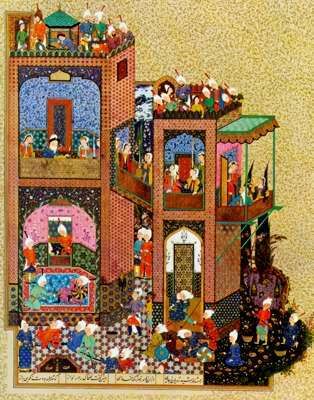
    In this scene Bihzad explores the everyday actions of urban life in a major Persian metropolis:


    The eye is led around through scenes of beggars, barbers, bathers, and carpet sellers. Bihzad adds the sophisticated element of the architectural detailing breaking out of the rectangular picture plane.

    One of the best examples of Bihzad’s work from Herat is to be found in his painting of Joseph and Zulaykha (the Hebrew Joseph and Potipher’s wife):


    In this painting the virtuous Joseph flees the amorous advances of Zulaykha running through a labyrinthine space in which the viewer is given a simultaneous interior and exterior view. Bricks, patterned tiles, Persian rugs, and steep stairwells are at once dazzling and disorienting… perhaps conveying Joseph’s own feelings as he seeks to escape from Zulaykha. The artist allows towers and balconies to again break out of the rectangular space while also weaving the text throughout the image in the most sophisticated manner.

    Under the Safavid rulers, and the examples of Sultan Muhammad and Bihzad, there is a brilliant synthesis of the various Persian miniature styles that would result in what is arguably THE masterwork of Persian painting, the so-called Shahnameh of Tabriz (or the "Houghton Shahnameh"). Entire workshops of calligraphers, painters, gilders, leather workers, book binders, etc... were employed under the oversight of masters, including Sultan Muhammad and Bihzad. The format for each individual illustration was conceived of independently and involved the input of many different hands… some with quite dissimilar methods of working, and so for a book to maintain any sense of continuity and coherence demanded clear thinking, planning, and foresight on the part of the masters. This must have been especially challenging considering the fact the text and paintings could not always be completed in sequence. In order to maintain a degree of continuity of style, the artists in the workshops employed scrapbook collections or anthologies of calligraphy styles...


    ...painting styles for rendering various flora, fauna, or figures...


    ...as models in creating a work as complex as an illuminated manuscript. Something similar to these examples of calligraphy and imagery collaged into compositions may have even served as a mock-up or proto-codex in preparation for the final book. The stringent demands placed upon the workshop artists for major illuminated manuscripts can be clearly witnessed by the quality of the works rejected, as in this unfinished folio page:


    The Shahnameh of Tabriz is the most brilliant realization of the Persian book arts. No other book comes near to its level of polish, refinement and decorativeness. The work is the most stunning merger of painting, design, and calligraphy in the service of the singular masterwork of Persian poetry. Any number of the individual folio miniatures certainly rank among the finest examples of Persian painting… of painting in general. Among the most splendid miniatures one might wish to look particularly to The Court of Gayumars:


    This painting is the culmination of the Turkoman style, and echoes many of the most striking elements of Rustam Sleeping while Rakhsh Fights the Lion. Both works show the influence, if not the hand of the painter, Sultan Muhhamad. The Court of Gayumars is considered by many to be the greatest of Persian manuscript paintings. The painting represents Gayumars, the first king of Persia, who ruled from the mountaintops and in whose presence the wild beasts became meek as lambs. Gayumars is seen sitting atop his mountain before a backdrop of flowering trees silhouetted against a gilded sky. He looks down mournfully at his son, Siyamak, who will be killed in battle with the Black Div. Beneath him his courtiers stand organized in a circular manner around a center of leafy, luxuriant vegetation. The court is bracketed by further exuberant flora and vividly colored rocks which burst forth from the limits of the rectangular frame.

    continued...
    Last edited by stlukesguild; 07-08-2008 at 04:00 PM.
    Beware of the man with just one book. -Ovid
    The man who doesn't read good books has no advantage over the man who can't read them.- Mark Twain
    My Blog: Of Delicious Recoil
    http://stlukesguild.tumblr.com/

  2. #152
    Artist and Bibliophile stlukesguild's Avatar
    Join Date
    Jul 2006
    Location
    The USA... or thereabouts
    Posts
    6,083
    Blog Entries
    78
    The contributions to the Shahnameh of the painter, Sultan Muhammad are further seen in several other equally magnificent paintings beyond the possible attribution of the aforementioned tour de force (The Court of Gayumars). Among these is the splendid painting of Hushang Discovering Fire:


    Like The Court of Gayumars this painting is unmatched in its vigorous portrayal of sensuous flora and fauna. The work also exploits a similar circular/organic organization of the figures beneath the central figure of Hushang. An equally marvelous painting (also possibly by Sultan Muhammad) that repeats the sumptuous and organic Turkoman style is the painting Rustam, aided by his Horse, Rakhsh, Slays a Dragon:


    Here we find a Chinese-inspired dragon writhes in a serpentine knot as he wrestles with Rustam’s trusty steed, while the great warrior strikes the death blow with his sword. This arabesque of action takes place in a brilliantly colored and opulent landscape where the very fauna and the swirling clouds repeat the twisting and snaking motion of the central drama. The color alone would certainly inspire jealousy in an artist such as Matisse, Bonnard, or Gauguin.

    In contrast to these, paintings such as The Nightmare of Zahhak...


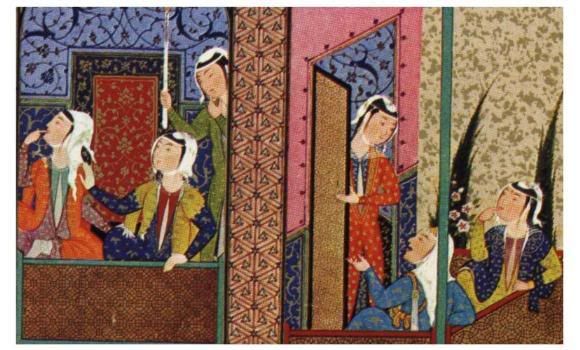
    ...clearly reverberate with the influence of Bihzad and the painting school of Herat. The viewer is presented with a geometrically constructed depiction of Zahhak’s palace that is at once an interior and exterior view. There is the most exquisite attention given to details of the setting and the decorative architectural patterns. The most refined element, however, is the artist’s mastery with the human figure. The scene illustrated in the narrative is of that moment at which Zahhak, the evil “snake king” awakes screaming from a dream in which he envisions his own death at the hands of a great hero wielding an ox-headed mace. Rather than focus upon Zahhak, the artist (quite possibly Bihzad himself) gives all his attention to the reaction of Zahhak’s court. Courtiers in the magnificent royal palace look up in surprise; Guardsmen in the towers glance over the balconies in an effort to discern just what the commotion is all about, while the women of the harem hold their fingers to their lips in a gesture of surprise or whisper to each other as they pass on the stairwells:


    Many of the finest paintings of the Shahnameh and later Persian manuscripts of the "classical" period combine elements of both the lush Turkoman manner of Tabriz and the more cultured and urbane style of Bihzadian Herat. The dynamic, fervid, and “Dionysian” approach of Sultan Muhammad, the leading painter of the Turkoman school, was influenced by the balanced, harmonious, and humane school of Herat under the elder Bihzad. In the painting of Zahhak Receiving the Daughters of Jamshid whose Throne he has Usurped, (attributed to Sultan Muhammad):


    ... there is a marvelous merger of the two modes of working. Zahhak, the “snake king” is seen enthroned in the most ornate and luxurious of palaces and surrounded by courtiers and servants. The almost gothic/baroque sensory overload or horror vacuii of the fabulous patterned architectural setting continues into the surrounding landscape where twisting trees bloom and clouds spiral and dance against a gilded sky. The gold itself carries over back into the architecture so that the sophisticated, urbane setting and organic natural surrounding almost become one.

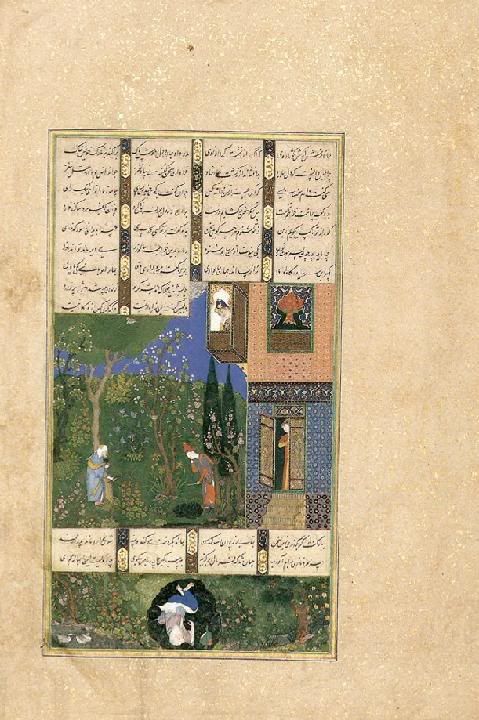
    In the Folio representing The Murder of King Mirdas:


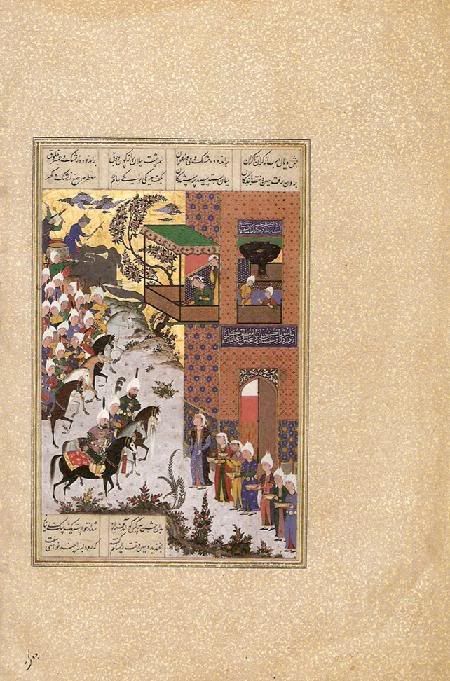
    ...one may discover another marvelous example of the merger of styles. The painting presents the brutal patricide of Mirdas which occurs in a lush garden orchard. Mirdas lies with his back broken in a pit dug by his son, Zahhak while unseen observers peer out from doors and balconies of the palace, suggesting the evil deed did not go unnoticed. Spectators, often women, concealed behind doors and balconies, or peering from behind veils and curtains are suggestive of a sophisticated view of the intrigues of the court and were quite expressive of the influence of Bihzad and the urbane style of Herat. A similar balance of the organic and the geometric… the landscape wilderness and the sophistication of civilization can be found in the painting of Sam and Zal are Welcomed into Kabul, Where the Latter is to be Betrothed to Rudabe, a Decendant of Zahhak.(Now there's a title!):


    In this painting the mounted warriors under Sam and Zal move diagonally across the desert landscape. This diagonal is picked up and reiterated by the rigidly ordered line of figures welcoming them into the city. This rigidity itself restates the strict geometry of the fortified architectural setting. Perhaps the most remarkable detail is to be found in the balcony which juts out from the severe structure of the architecture in profile against the most gestural and organic element of the entire painting, the twisting tree silhouetted against the gilded sky which swirls in an arabesque that immediately draws ones eye to the very place where Zal’s wife-to-be observes the hero’s entrance unnoticed.

    The Shahnameh of Tabriz remained intact and in near-perfect condition well into the 20th century. The calligraphy remained crisp, the paper flawless and the brilliant colors remained virtually unchanged, due in part, no doubt, to the fact that the book had seldom been opened for reading thanks to a lack of understanding of the Persian language (Farsi) and only upon rare occasions for the display of the paintings to honored visitors. In 1959 the Baron Edmond de Rothschild, sold the intact book to the American collector, Arthur Houghton. Rothschild, who had taken special care to ensure that the miniatures were always well-protected had initially turned to the Metropolitan Museum of Art with the belief that a work of such importance deserved to be housed in an appropriate institution. The Met, however, on the recommendation of the board of trustees (headed by Houghton!) passed on the prospect, at which time Houghton snatched it up it for himself.

    Initially Houghton placed the book at Harvard with the understanding that an elegant and scholarly facsimile would be published by the university’s academic press. It was thought that Houghton might eventually donate the work to his alma mater. Harvard’s Fogg Museum contained a renowned collection of Islamic art, an ideal setting for the work. In 1972, however, Houghton became “piqued” with the university’s delay in the production of the book and he pulled the Shahnameh and brought it to New York. At that time, after remaining intact for over 400 years, Houghton inexplicably tore 78 of the finest paintings from the book and presented them as a gift to the Metropolitan Museum of Art. Thomas Hoving, then director of the Met states, “I was flatly opposed to the breaking up of the book in any fashion. I confronted Arthur physically, personally on the matter, but he was determined to do this, and he was the chairman of our board of trustees, after all.” On the other hand, Hoving also admitted that Houghton’s gift “was like getting a whole bunch of Michelangelo paintings from out of the blue.”

    As the museum held non-profit status Houghton sought to claim a sizeable tax reduction. Unfortunately the bequest came at a point at which the government was becoming increasingly suspicious of deductions claimed for the donation of art. A gift this size was enough to trigger an audit by the IRS, who disallowed Houghton’s claim. Houghton became terrified that the government would eventually begin to investigate all of his business dealings… especially his various charitable foundations which had acted as fronts for the CIA during the Cold War.

    Houghton’s fears (“unbelievably paranoid” according to Hoving) led him to the irrational decision to dispose of the remains of the Shahnameh. He initially offered it to the Shah of Iran, but the $20 million asking price was rejected. At this point he began to consign a few pieces at a time (prudently to avoid “flooding the market” and hurting his price) to Christie’s of London for public auction. The Ł785,000 realized by the sale of thefirst seven folio pages should certainly have proved to the IRS that Houghton’s claim as to the monetary value of his donation to the Met was in no way inflated. Over the next decade or so Houghton continued to remove further folios from the Shahnameh and consign them to the auction block. This wholesale pillage of one of the greatest masterpieces of world art only came to a halt when Houghton died in 1990. By that time only 120 of the plates remained. All that exists today to suggest the coherent magnificence of the book as it originally existed is the scholarly limited edition facsimile eventually published by Harvard.

    In spite of the irreparable vandalism that the Shahnameh had suffered, the Iranians were still more than eager to get what remained of their cultural patrimony. The estimated $20-million price tag, however, was impossible to justify for a mere work of art, especially following the prolonged and devastating war with Iraq. Eventually an ingenious barter was worked out between Houghton’s estate and the Iranian government. The Iranians had been attempting to get rid of certain “decadent” paintings that were “unsuitable” for public exhibition under the Islamic rule. Among these was the painting, Woman III, by the Abstract Expressionist, Willem de Kooning, to which a like value of $20 million had been arbitrarily assigned. The trade took place under clandestine conditions upon the neutral turf of the Vienna airport. The remains of the Shahnameh were returned to in Iran in triumph and proudly put upon public display in Tehran, in the Museum of Contemporary Art which had sacrificed the de Kooning. The de Kooning, on the other hand, was privately sold for an undisclosed sum to the media executive, David Geffen, and immediately disappeared from public view. The great British art critic, David Sylvester, a champion of Modernism, was quoted as saying that “the Shahnameh was worth at least 20 paintings by de Kooning, and that the Houghton Foundation had been the loser in exchanging the work for one painting by de Kooning, and that the Iranian government had actually recovered the Shahnameh gratis.” One cannot easily question Sylvester’s claim, considering the fact that in 2006 just a single folio painting of the Shahnameh was auctioned off for $1.7 million, making it the 7th most-expensive book or part of a book sold that year… in spite of it being but a single page.

    The parts of the Shahnameh can be found in collections around the world, including not only the Metropolitan Museum of Art, but also The State Hermitage Museum in Russia and the Museum of Contemporary Art, Tehran. The book was a entire art gallery between two covers and almost every individual painting is worthy of careful examination. It was one of the most magical works of art ever created; a virtual visual fairy-tale. Looking at the paintings one can easily see why artists as diverse as Ingres, Delacroix, Gauguin, Matisse, Klee, Beckmann, Kandinsky, etc… were greatly impressed with and inspired by Persian painting. At the same time one would hope that the tragic events surrounding the Shahnameh rooted in greed and a disregard for the cultural achievements outside one’s own culture would have taught us a lesson not soon forgotten. Unfortunately the looting of the Baghdad Museum following the invasion of Iraq suggests that we may still have far to go.

    Bibliographic sources:

    Basbanes, Nicholas A., A Splendor of Letters; The Permanence of Books in an Impermanent World, HarperCollins Publishers, NY 2003, ISBN:0-06-008287-9

    Blair, Sheila S. and Bloom, Jonathan M., The Art and Architecture of Islam, 1250-1800,
    Yale University Press, NY 1994, ISBN: 0-300-05888-8

    Danby, Miles, Moorish Style, Phaidon Press, London 1995, ISBN: 0-7148-3861-6

    Davis, Dick (translation and Introduction) Abolqasem Ferdowsi’s Shahnameh, The Persian Book of Kings, Penguin Books, NY 2006, ISBN: 978-0-14-310493-3

    Ferrier, R.W. ed., The Arts of Persia, Yale University Press, NY 1989, ISBN-10: 0300039875

    Piortrovski, M.B. and Rogers, J.M. editors, Heaven on Earth: Art from Islamic Lands, Prestel Verlag, Munich, Berlin, London, NY 2004, ISBN:3-7913-3055-1
    Last edited by stlukesguild; 07-07-2008 at 10:56 PM.
    Beware of the man with just one book. -Ovid
    The man who doesn't read good books has no advantage over the man who can't read them.- Mark Twain
    My Blog: Of Delicious Recoil
    http://stlukesguild.tumblr.com/

  3. #153
    Tu le connais, lecteur... Kafka's Crow's Avatar
    Join Date
    Jan 2008
    Location
    ...the timekept City
    Posts
    847
    Blog Entries
    2
    That's what I was expecting Stlukesguild, bravo! Excellent post. Very, very enlightening. I have been indirectly and discreetly egging you on to write something like this because I knew since the day one that you had it all inside your head. Excellent, chapeau bas! The last lines are very, very touching. Some day we will discuss another similar topic very close to my heart: Moors in Spain. That was another great chapter in the history of human artistic achievement. All the propaganda around us tells that we are out to civilize the world whereas the truth lies in the fact that we can still learn a thing or two from those 'stone-age fanatics'. Yet another interesting thing: art saves the truth. Whatever we are led to believe is negated in the above paintings. Beauty is truth, indeed, and truth beauty. Beauty saves!
    "The farther he goes the more good it does me. I don’t want philosophies, tracts, dogmas, creeds, ways out, truths, answers, nothing from the bargain basement. He is the most courageous, remorseless writer going and the more he grinds my nose in the sh1t the more I am grateful to him..."
    -- Harold Pinter on Samuel Beckett

  4. #154
    Artist and Bibliophile stlukesguild's Avatar
    Join Date
    Jul 2006
    Location
    The USA... or thereabouts
    Posts
    6,083
    Blog Entries
    78
    Kafka... Thanks. Of course I had the advantage of being able to use a somewhat edited version of the essay I had written for a class on Non-Western Art I took this Spring as part of the requirements for renewing my teaching license. The art of Arab-Andalusia or Moorish Spain, you say? Truly a fascinating period. I'm actually reading a good amount of poetry from that time, and I do very much admire the architecture and the Romanesque book illuminations. Perhaps not so far down the road.
    Beware of the man with just one book. -Ovid
    The man who doesn't read good books has no advantage over the man who can't read them.- Mark Twain
    My Blog: Of Delicious Recoil
    http://stlukesguild.tumblr.com/

  5. #155
    Bibliomaniac Guinivere's Avatar
    Join Date
    Jul 2008
    Location
    In Gabriel Oak's arms.
    Posts
    241
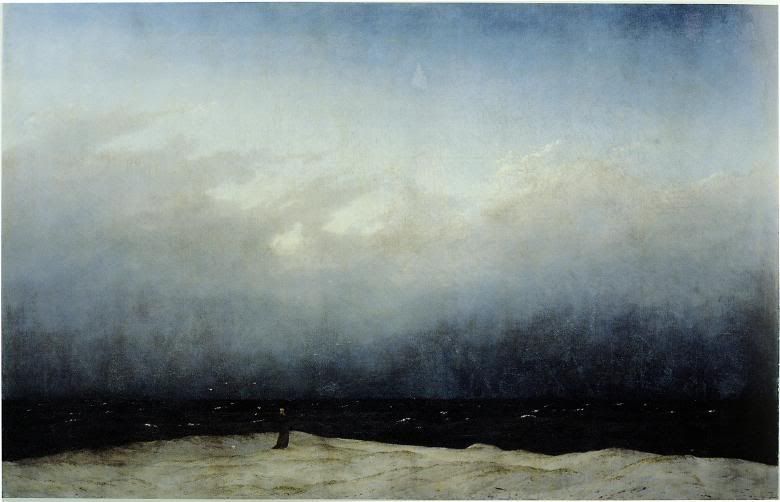
    My favourite artist would be Caspar David Friedrich.

    http://www.onlinekunst.de/wetter/sch..._Friedrich.jpg
    http://www.nga.gov/exhibitions/2001/spirit/large/02.jpg
    http://www.kunstkopie.de/kunst/caspa..._meer_2584.jpg

    These are three of his pictures. I like the monk by the sea best. That's the third one.
    My lifelong love affair with books and reading continues unaffected by automation, computers, and all other forms of the twentieth-century gadgetry.

    People say that life is the thing, but I prefer reading.
    Logan Pearsall Smith, 1931

  6. #156
    Artist and Bibliophile stlukesguild's Avatar
    Join Date
    Jul 2006
    Location
    The USA... or thereabouts
    Posts
    6,083
    Blog Entries
    78
    Caspar David Friederich. Yes! The great German Romantic landscape painter. Personally, I prefer Turner... but Friederich is certainly no slouch. If anything he is underrated... largely because most of his paintings are still in Germany limiting their exposure to French, Spanish, British, American (etc...) artists. Both he and Turner capture that Romantic feeling of the "sublime" in nature. Turner more often achieves this with the turbulent even violent: storms, avalanches, fires, the churning sea, the blinding light of the sun... although there are a good many examples where he unveils the sublime in the more subdued... "elegiac" side of nature. Friederich's work is continually elegiac: the light of day or the moon seems to be just rising... or more often waning. His light bathes everything in a feeling of melancholy... which is further heightened quite often by his choice of imagery: lone figures standing before the vast expanse of the sea... before the void?.. ruins of Gothic cathedrals or Greek Temples, etc...


    Monk before the Sea may just be my favorite as well. It his paintings one can surely see links with a painter such as Mark Rothko.
    Beware of the man with just one book. -Ovid
    The man who doesn't read good books has no advantage over the man who can't read them.- Mark Twain
    My Blog: Of Delicious Recoil
    http://stlukesguild.tumblr.com/

  7. #157
    Tu le connais, lecteur... Kafka's Crow's Avatar
    Join Date
    Jan 2008
    Location
    ...the timekept City
    Posts
    847
    Blog Entries
    2
    I remember carrying a print of The Wanderer above a Sea of Clouds in my college folder as a spotty 16 year old teenager (back in 1985). This was my favorite painting then. Later on I fell in love with Ginevra Benci and that love is still going on after 14 years of obsession with one painting:

    "The farther he goes the more good it does me. I don’t want philosophies, tracts, dogmas, creeds, ways out, truths, answers, nothing from the bargain basement. He is the most courageous, remorseless writer going and the more he grinds my nose in the sh1t the more I am grateful to him..."
    -- Harold Pinter on Samuel Beckett

  8. #158
    Artist and Bibliophile stlukesguild's Avatar
    Join Date
    Jul 2006
    Location
    The USA... or thereabouts
    Posts
    6,083
    Blog Entries
    78
    That is an exquisite painting. The only Leonardo painting in the entire Western Hemisphere. I certainly make a point of seeing it on every visit to the National Gallery in Washington. I don't think its much bigger than the reproduction you've posted. Leonardo certainly does capture a sphinx-like unearthliness in this and a few other paintings... an element that Rossetti was able to put so well into words when responding to Leonardo's equally mysterious Virgin of the Rocks:


    For Our Lady of the Rocks by Leonardo Da Vinci
    by Dante Gabriel Rossetti

    Mother, is this the darkness of the end,
    The Shadow of Death? and is that outer sea
    Infinite imminent Eternity?
    And does the death-pang by man's seed sustained
    In Time's each instant cause thy face to bend
    Its silent prayer upon the Son, while He
    Blesses the dead with His hand silently
    To His long day which hours no more offend?

    Mother of grace, the pass is difficult,
    Keen are these rocks, and the bewildered souls
    Throng it like echoes, blindly shuddering through.
    Thy name, O Lord, each spirit's voice extols,
    Whose peace abides in the dark avenue
    Amid the bitterness of things occult.
    Beware of the man with just one book. -Ovid
    The man who doesn't read good books has no advantage over the man who can't read them.- Mark Twain
    My Blog: Of Delicious Recoil
    http://stlukesguild.tumblr.com/

  9. #159
    Of Subatomic Importance Quark's Avatar
    Join Date
    May 2006
    Posts
    1,368
    Quote Originally Posted by stlukesguild View Post


    Monk before the Sea may just be my favorite as well. It his paintings one can surely see links with a painter such as Mark Rothko.
    I used this painting a while back in the Chekhov discussion. About two weeks into a conversation on a short story called "The Black Monk" I remembered that a German had painted a masterpiece that would go perfectly with the story. I'll have to dig up what I wrote about it. Wait, here it is:

    Quote Originally Posted by Quark View Post
    In my pursuit of Russian art for the story introductions, I must have overlooked this painting because it was German. It works well with this story, though, and I probably should have used it earlier. It portrays three elements of Kovrin's Black Monk in beautiful color. The foreground with monk shows the barren isolation of the monk and corresponds to Kovrin's own condition toward the end--after he's alienated everyone. The horizon of the painting is all turmoil. The sea and sky dissolve into each other in this mess of blue, like Kovrin's confused, ambiguous state. The sky is peaceful, though. Kovrin has hope for a celestial peace in the Black Monk, too. The painting lumps these three moods of the story together, so I thought I should bring it up.
    and Janine added:

    Quote Originally Posted by Janine View Post
    I love the painting, Quark! Thanks so much for finding it and posting it. You know how I like having illustrations within the text - it livens things up. That painting is very moody and imparts the feelings in this story of his final isolation with the Black Monk.
    It's an excellent painting. Thanks for bringing these up. I'll try to come up with an image myself to add to the conversation.
    "Par instants je suis le Pauvre Navire
    [...] Par instants je meurs la mort du Pecheur
    [...] O mais! par instants"

    --"Birds in the Night" by Paul Verlaine (1844-1896). Join the discussion here: http://www.online-literature.com/for...5&goto=newpost

  10. #160
    Registered User
    Join Date
    May 2008
    Location
    Surrey, UK
    Posts
    146
    I like very much impressionists like Auguste Renoir,Claude Monet,Edgar Degas.

    My favourite Renoir's painting:

    http://www.poster.net/renoir-auguste...rs-9701659.jpg

    Some works of Monet:

    http://en.wikipedia.org/wiki/Image:Claude_Monet_040.jpg

    http://en.wikipedia.org/wiki/Image:C...ing_Willow.JPG

    And Degas' painting:

    http://upload.wikimedia.org/wikipedi..._Degas_009.jpg


    And one of my favourite artists is also Vermeer:

    http://upload.wikimedia.org/wikipedi...ing_(1665).jpg

  11. #161
    Banned
    Join Date
    Nov 2005
    Posts
    1,590
    Blog Entries
    157
    My favorite art actually isn't paintings. I much prefer black and white photography. My current favorite paintings are those of Christian Riese Lassen. You can find some of his work here. Sorry everything is under copywrite, so you will have to follow the link http://www.lassenart.com/flash.html

    My favorite is called Amber Dawn, and I would love to own it. I doubt I would have much luck talking my husband into spending the money Oh well, one can wish.

  12. #162
    Kafkaesque johann cruyff's Avatar
    Join Date
    Jan 2008
    Location
    Bosnia & Herzegovina
    Posts
    405
    I don't know if he's already been mentioned (sorry,didn't exactly read/see the entire thread),but I always thought the paintings of Nikolai Ge were interesting. I'm by no means an expert,and I'm usually not a big fan of religious motifs,but his style always struck me as interesting.

    Also,Luis Egidio Meléndez! Again,I'm not an expert,but his paintings are the best still-life paintings I've ever seen.

    But,you know,this really isn't a fair question,about my favourite artist and painting... Because,now when I start thinking about it,there are at least 50 names that spring to mind. So,instead of picking one,here are a few of my favourites: Dante Gabriel Rossetti,Delacroix,Caspar David Friedrich,Renoir,Manet,Van Gogh,Cezanne,de Chirico,Ernst,maybe even Kandinsky...Magritte,Eugeniusz Zak,Chagall...Definitely Louis le Brocquy!

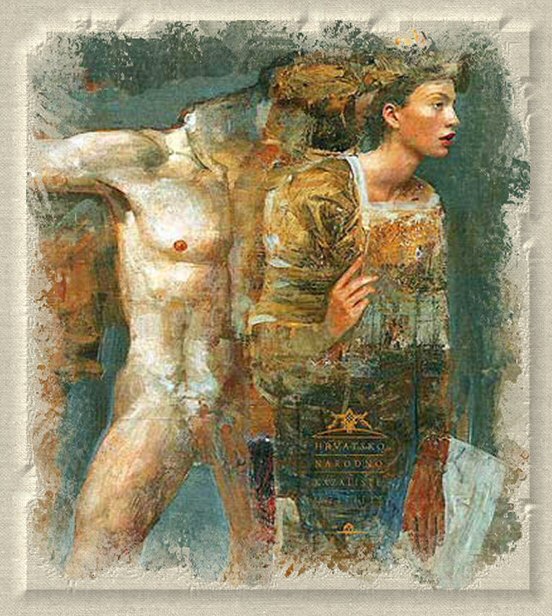
    And,I have to mention Mersad Berber,perhaps the greatest Bosnian painter of all time. You may not have heard about him,which is a shame,but perfectly understandable - however,he truly is a great artist. Here are a few of his paintings(I've had the pleasure of seeing some of these in person):


    Noću, u intimnom, poluglasnom razgovoru sa samim sobom, nikako ne mogu zapravo logički opravdati zašto se u posljednje vrijeme toliko uzrujavam zbog ljudske gluposti.

    Miroslav Krleža

  13. #163
    Artist and Bibliophile stlukesguild's Avatar
    Join Date
    Jul 2006
    Location
    The USA... or thereabouts
    Posts
    6,083
    Blog Entries
    78
    Actually, I am familiar with Mersad Berber. I have mixed feelings about his work. In many ways he strikes me as a hopeless anachronism... his work is clearly derivative... too much so at times... of 19th century academic tradition... I especially see echoes of Klimt... and he rarely breaks away from the same 'classical" themes and motifs (all so painfully beautiful) of the era. His paint handling... his pseudo-weathered and beaten surfaces and his "Neo-Classicism" recall ancient Egytian encaustic tomb paintings... and abstraction. But then again I quite like some of his paintings:


    Beware of the man with just one book. -Ovid
    The man who doesn't read good books has no advantage over the man who can't read them.- Mark Twain
    My Blog: Of Delicious Recoil
    http://stlukesguild.tumblr.com/

  14. #164
    Kafkaesque johann cruyff's Avatar
    Join Date
    Jan 2008
    Location
    Bosnia & Herzegovina
    Posts
    405
    Quote Originally Posted by stlukesguild View Post
    Actually, I am familiar with Mersad Berber. I have mixed feelings about his work. In many ways he strikes me as a hopeless anachronism... his work is clearly derivative... too much so at times... of 19th century academic tradition... I especially see echoes of Klimt... and he rarely breaks away from the same 'classical" themes and motifs (all so painfully beautiful) of the era. His paint handling... his pseudo-weathered and beaten surfaces and his "Neo-Classicism" recall ancient Egytian encaustic tomb paintings... and abstraction. But then again I quite like some of his paintings:
    I agree,it does sometimes seem that he was just...born at the wrong time. Also,his two main motifs,the horse's head and the face of a girl(woman) are recognizable in pretty much all of his paintings,yes,but I think that is a bigger pro than con(after all,Picasso was quite fond of recurring motifs as well),at least you instantly know whose painting it is when you see it
    Noću, u intimnom, poluglasnom razgovoru sa samim sobom, nikako ne mogu zapravo logički opravdati zašto se u posljednje vrijeme toliko uzrujavam zbog ljudske gluposti.

    Miroslav Krleža

  15. #165
    Artist and Bibliophile stlukesguild's Avatar
    Join Date
    Jul 2006
    Location
    The USA... or thereabouts
    Posts
    6,083
    Blog Entries
    78
    Outsider Art- Part 1

    Outsider art is one of the most fascinating fields in the whole of art production... and in a way it is seemingly unique to the visual arts... or rather I should say its appreciation... perhaps due to the quality of the work... seems to be unique (although one might note Nerval and John Clare). By "outsider art" I am referring to that art which was produced outside of the context of any larger culture and their artistic traditions. By this definition the art of the Amish or the Shakers may have been created outside of the tradition of the dominant American culture and it's artistic traditions... but it was most certainly not outside of the Amish or Shaker traditions in which it was developed. Rather, when speaking of an "outsider artist" I am speaking of that lone individual... often having little or no formal artistic training... who has created a body of work of unique vision... having little or no connection with the culture(s) in which they live... often having little concern for displaying this work to the larger society... and almost certainly not in any professional context. The unique vision of this art has led to it's being also defined as "visionary art", and the "visionaries" of which I speak are more likely than not isolated individuals... eccentrics... and even the mentally disturbed.

    In some ways, William Blake falls into this category. If it were not for his traditional training in the field of print-making, as well as his central stature as both poet and visual artist, he would almost certainly qualify as an "outsider artist". Eccentric? Unquestionably. Unique vision? Certainly his efforts as a poet and an artist fall outside even the most daring innovations of European Romanticism. One also must look at the manner in which the artist/poet continues to turn out a voluminous body of art and writings... in spite of having virtually no audience within the larger culture of the time. Perhaps most intriguing, in Blake's case, is the fact that his visual art most definitely exhibits several characteristics that are quite common of "outsider art" (and in spite of their not being part of any formal "group" there are surprisingly certain common elements in the art of many "outsider artist"... perhaps not unlike the common elements found in the art of children). The most obvious of these elements is the obsessiveness... a horror vacui:


    -Last Judgment


    -Last Judgment


    ... in which every single little area of the painting surface must be filled with detail... and the entire whole swirls and writhes in visionary ecstasy.

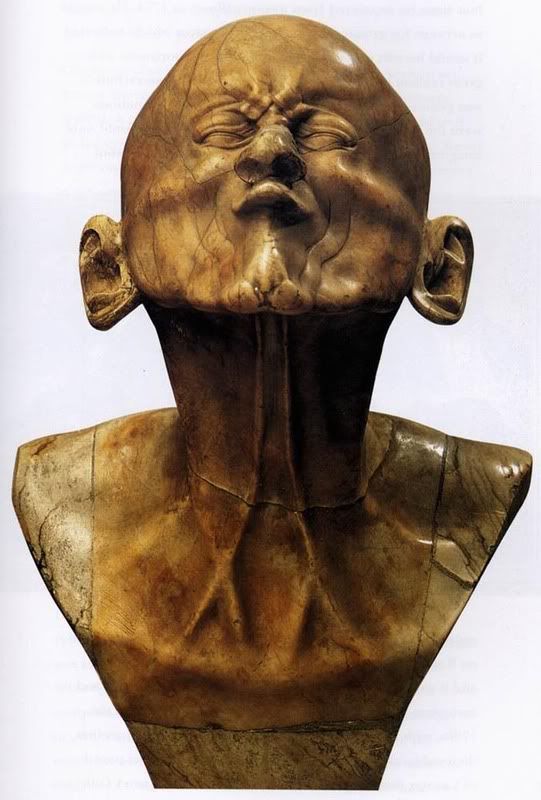
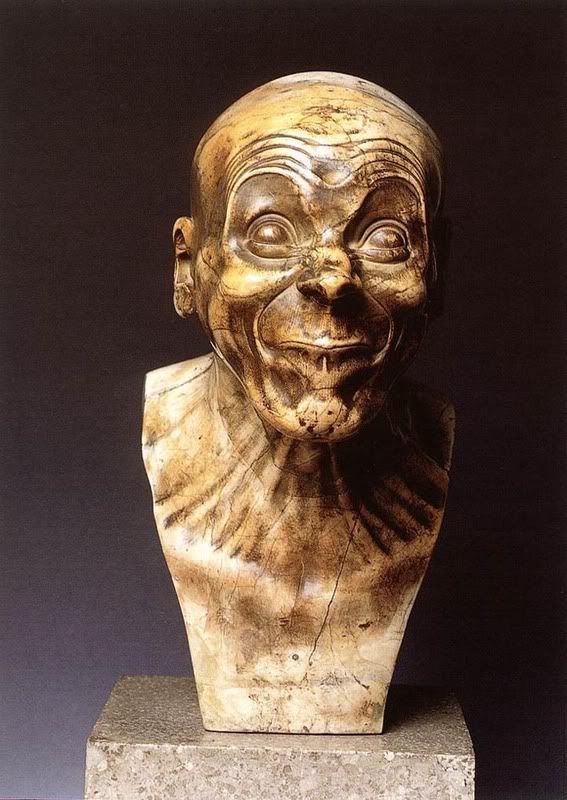
    One of the earliest of the outsider artists was the sculptor, Franz Xavier Messerschmidt (1736-1783). Messerschmidt had been trained as a sculptor by his uncles and attained the position of assistant professor of sculpture at the Imperial Academy of Vienna with the understanding that he would be promoted to the position of the chair or sculpture upon the vacancy of that position. When the incumbent chairman died, however, he was passed over... due to a "confusion of the head". Messerschmidt abandoned his post and began wandering throughout Germany, eventually settling in Pressburg. He continued to take on commissions... which he would never undertake to do. However, he had not abandoned his art altogether. Rather, Messerschmidt spent his time working on a large body of very strange self-portraits. Although, as he stated, he lived chastely, he was continually visited by ghosts who caused him pains in his legs and abdomen. Through his study of the Egyptian, Hermes Trismegistos, he developed a bizarre theory of the relationship between the parts of the body and facial proportions. By striking bizarre facial attitudes: grimaces, scowls, grins, etc... he thought to confront and counteract his bodily pains. In spite of the "eccentricity" of his theories, the resulting works are among the most fascinating sculptural works of the era.

    [IMG]http://i90.photobucket.com/albums/k255/Stlukesguild/MESSERSCHMIDT_Franz_Xaver_Character.jpg[/IMG
    -Hanged


    -Beaked


    -Beaked (side view)


    -Lecher

    In another vein altogether, we find the outsider work of the painter Edward Hicks (1780-1849). At the age of thirteen he apprenticed as a coach-maker where he was to remain employed for 7 years. His living situation inspired him to desire a much better way of life. He wanted a simple, well respected life employed in such as way as to earn his own keep (something akin to Thoreau?) He spent three years contemplating what his life should mean and developed a deep and abiding passion for art and religion. Hick took on the role of a minister within the Quaker church, and he was a fervent preacher. His wages in this role, however, were strained as his family began to grow following his marriage to Sarah Worstall. He decided to take on a secondary profession, as it were, painting household objects, tavern signs, etc... He was actually quite successful in his role as a painter, but this began to conflict with the some of his congregation's beliefs as to the proper "simple life" without adornments. Hicks abandoned painting and the ministry and took up farming... at which he was a complete failure. He was eventually persuaded to return to painting... without the added role of minister. His paintings essentially became a visual means of sharing his spiritual beliefs. Hicks was completely self-taught as a painter. His paintings have a magical child-like/fantasy quality to them. Hicks was known for paintings illustrating historical narratives of the period as well as Biblical narratives. Perhaps the most successful of the latter was his painting of Noah's Ark. Hie most famous... and popular painting... an image he would paint again and again... was the Peaceable Kingdom. In Hicks' Peaceable Kingdom... not only would the lion lay down with the lamb... but also the cheetah, jaguar, bald eagle, the cow, the bear, the goat, the child, the wolf... the native American Indians and the colonists... all would live together in peace and harmony in this new America.


    -Noah's Ark


    -Peaceable Kingdom


    -Peaceable Kingdom

    continued...
    Last edited by stlukesguild; 07-19-2008 at 12:10 PM.
    Beware of the man with just one book. -Ovid
    The man who doesn't read good books has no advantage over the man who can't read them.- Mark Twain
    My Blog: Of Delicious Recoil
    http://stlukesguild.tumblr.com/

Page 11 of 19 FirstFirst ... 678910111213141516 ... LastLast

Similar Threads

  1. Do you know the artist? please help!
    By imthefoolonthehill in forum Who Said That?
    Replies: 2
    Last Post: 08-03-2005, 12:34 PM

Posting Permissions

  • You may not post new threads
  • You may not post replies
  • You may not post attachments
  • You may not edit your posts
  •