Page 2 of 3 FirstFirst 123 LastLast
Results 16 to 30 of 34

Thread: Poetry Redux

  1. #16
    Artist and Bibliophile stlukesguild's Avatar
    Join Date
    Jul 2006
    Location
    The USA... or thereabouts
    Posts
    6,083
    Blog Entries
    78
    continued...

    Beyond Blake's lyrical poetry we find some of his greatest, yet most misunderstood and underrated work. His prose piece, The Marriage of Heaven and Hell


    ...may just be Blake's masterpiece. This brief book is composed of a series of meditations or "fancies" as Blake titles them, in which he puts forth many of his ideas about good and evil, free will, creation and even of literature:

    Note: The reason Milton wrote in fetters when he wrote of Angels & God, and at liberty when of Devils & Hell, is because he was a true poet and of the Devil's party without knowing it.

    Perhaps the most known passages of this work come from the series of aphorisms entitled, Proverbs of Hell:

    A fool sees not the same tree a wise man sees.

    A dead body revenges not injuries.

    The nakedness of woman is the work of God.

    What is now proved was once only imagin'd.

    The eagle never lost so much time as when he submitted to learn of the crow.

    Expect poison from standing water.

    You never know what is enough unless you know what is more than enough.

    Listen to the fool's reproach! It is a kingly title!


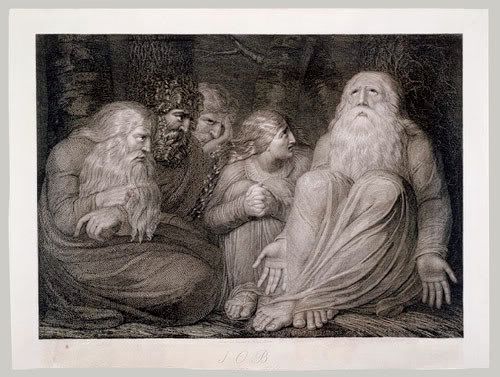
    Job, his Wife and his Accusers

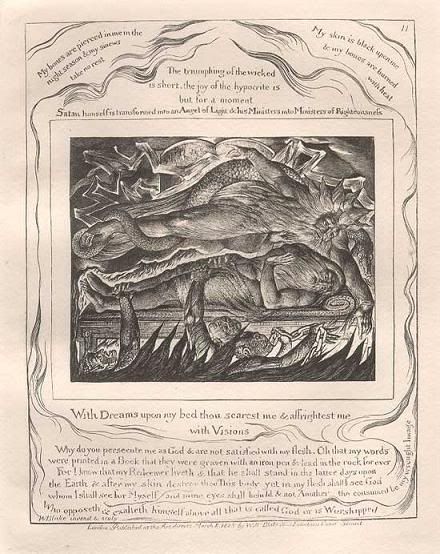
    Perhaps the most unique... and challenging work by Blake is his Job. This work is built of a title page and 21 engraved illustrations. At first glimpse one might assume that Blake has merely illustrated the Biblical text of Job... but as is usual with Blake, nothing is as simple as it first appears. The usual orthodox interpretation of Job is that he represents an admirable figure of faith and patience... a good man who is tested by God by having all of his worldly belongings stripped from him, his family killed, and his own body stricken with painful disease... and yet he does not lose his faith in God. Blake's Job is something of a critique of this interpretation. Utilizing images as well as inscribed quotes from the Book of Job and other Biblical texts, Blake presents the idea that Job does not begin as a man deeply faithful to God... but rather as a figure who is faithful only in appearance. He may do the right things... but for the wrong reasons. Blake suggests that the various trials that Job undergoes amount to a spiritual journey... from a false believer to a truly spiritual man. In what in perhaps the most powerful image, Illustration XI:


    Blake presents a Job condemned to the fires of Hell. Devils reach out from the hell fires below in an attempt to drag him down. Still his hands are clutched in prayer as he looks up to the Hebrew God, Jehovah, hovering over him. Jehovah points to the tablets of the law which condemn Job while the lightning bolt of damnation leap around him. And yet... as Job glances down at Jehovah's cloven foot and at the serpent of materialism with which he is intertwined... he realizes that this immovable God of the law is one and the same with Satan. The inscription "I know that my redeemer liveth" suggests that Job has begun to imagine that there is a better God.

    Blake's epic poems, especially Milton and Jerusalem are undoubtedly his most challenging works. The staggering achievement of these works is that Blake has essentially created his own cosmology and mythology... an achievement not unlike that of Muhammad, Dante, or Homer. He essentially attempts to live up to his own declaration:

    "I must Create a System, or be enslav'd by another Man's
    I will not Reason & Compare; my business is to Create!


    In Milton, Blake presents a fantastic narrative in which Milton is driven out of Heaven for his false representation of God as an external authoritarian being. To Blake there was no God outside of the God that resides within the human breast. Milton enters into Blake himself and begins a spiritual journey of remaking himself. Milton contains some of Blake's most fabulous and memorable poetry:

    And did those feet in ancient time
    walk upon England’s mountains green?
    And was the holy Lamb of God
    on England’s pleasant pastures seen?
    And did the countenance divine
    shine forth upon our clouded hills?
    And was Jerusalem builded here
    among these dark Satanic Mills?

    Bring me my bow of burning gold!
    Bring me my arrows of desire!
    Bring me my spear! O clouds, unfold!
    Bring me my chariot of fire!
    I will not cease from mental fight,
    nor shall my sword sleep in my hand,
    till we have built Jerusalem
    In England’s green and pleasant Land.


    (The oft-quoted phrase from this introduction to Milton, "dark and Satanic Mills" is among the first criticisms directed at the dehumanizing and polluting elements of industrialization and clearly made Blake a hero with the socially like-minded Pre-Raphaelites.)

    If you account it Wisdom when you are angry to be silent, and
    Not to shew it: I do not account that Wisdom but Folly.
    Every Mans Wisdom is peculiar to his own Individuality
    O Satan my youngest born, art thou not Prince of the Starry Hosts
    And of the Wheels of Heaven, to turn the Mills day & night?...

    And this is the manner of the Daughters of Albion in their beauty
    Every one is threefold in Head & Heart & Reins, & every one
    Has three Gates into the Three Heavens of Beulah which shine
    Translucent in their Foreheads & their Bosoms & their Loins
    Surrounded with fires unapproachable: but whom they please
    They take up into their Heavens in intoxicating delight...

    Ah weak & wide astray! Ah shut in narrow doleful form
    Creeping in reptile flesh upon the bosom of the ground
    The Eye of Man a little narrow orb closed up & dark
    Scarcely beholding the great light conversing with the Void
    The Ear, a little shell in small volutions shutting out
    All melodies & comprehending only Discord and Harmony
    The Tongue a little moisture fills, a little food it cloys
    A little sound it utters & its cries are faintly heard
    Then brings forth Moral Virtue the cruel Virgin Babylon

    Can such an Eye judge of the stars? & looking thro' its tubes
    Measure the sunny rays that point their spears on Udanadan
    Can such an Ear fill'd with the vapours of the yawning pit.
    Judge of the pure melodious harp struck by a hand divine?
    Can such closed Nostrils feel a joy? or tell of autumn fruits
    When grapes & figs burst their covering to the joyful air
    Can such a Tongue boast of the living waters? or take in
    Ought but the Vegetable Ratio & loathe the faint delight
    Can such gross Lips perceive? alas! folded within themselves
    They touch not ought but pallid turn & tremble at every wind...

    But in the wine presses the human grapes sing not nor dance:
    They howl & writhe in shoals of torment, in fierce flames consuming,
    In chains of iron & in dungeons circled with ceaseless fires,
    In pits & dens & shades of death, in shapes of torment & woe –
    The plates & screws & racks & saws & cords & fires & cisterns,
    The cruel joys of Luvah's daughters, lacerating with knives
    And whips their victims, & the deadly sport of Luvah's sons...


    The epic poem, Jerusalem is Blake's longest and most ambitious work. The narrative, which is confusing and does not seem to follow a linear manner, centers upon the fall of Albion, a personification of Man... Britain... or Western Culture. The work is cloaked in a dense symbolism where characters are all inventions of Blake's own personal mythology and where any single character can represent multiple persons, concepts, or even cities. In spite of this hermetic aspect the poem, like Milton, contains many brilliant passages:

    Awake! awake O sleeper of the land of shadows, wake! expand!
    I am in you and you in me, mutual in love divine:
    Fibres of love from man to man thro' Albion's pleasant land.
    In all the dark Atlantic vale down from the hills of Surrey
    A black water accumulates, return Albion! return!
    Thy brethren call thee, and thy fathers, and thy sons,
    Thy nurses and thy mothers, thy sisters and thy daughters
    Weep at thy souls disease, and the Divine Vision is darken'd:
    Thy Emanation that was wont to play before thy face,
    Beaming forth with her daughters into the Divine bosom
    Where hast thou hidden thy Emanation lovely Jerusalem
    From the vision and fruition of the Holy-one?
    I am not a God afar off, I am a brother and friend;
    Within your bosoms I reside, and you reside in me:
    Lo! we are One; forgiving all Evil; Not seeking recompense!
    Ye are my members O ye sleepers of Beulah, land of shades!...

    Trembling I sit day and night, my friends are astonish'd at me.
    Yet they forgive my wanderings, I rest not from my great task!
    To open the Eternal Worlds, to open the immortal Eyes
    Of Man inwards into the Worlds of Thought: into Eternity
    Ever expanding in the Bosom of God, the Human Imagination
    O Saviour pour upon me thy Spirit of meekness & love:
    Annihilate the Selfhood in me, be thou all my life!
    Guide thou my hand which trembles exceedingly upon the rock of ages...

    Los answer'd: Altho' I know not this, I know far worse than this:
    I know that Albion hath divided me, and that thou, O my Spectre,
    Hast just cause to be irritated; but look steadfastly upon me;
    Comfort thyself in my strength; the time will arrive
    When all Albion's injuries shall cease, and when we shall
    Embrace him, tenfold bright, rising from his tomb in immortality.
    They have divided themselves by Wrath, they must be united by
    Pity; let us therefore take example & warning, O my Spectre.
    O that I could abstain from wrath! O that the Lamb
    Of God would look upon me and pity me in my fury!
    In anguish of regeneration, in terrors of self annihilation,
    Pity must join together those whom wrath has torn asunder...

    Inspiration deny'd; Genius forbidden by laws of punishment:
    I saw terrified; I took the sighs & tears, & bitter groans:
    I lifted them into my Furnaces; to form the spiritual sword.
    That lays open the hidden heart: I drew forth the pang
    Of sorrow red hot: I work'd it on my resolute anvil:
    I heated it in the flames of Hand, & Hyle, & Coban
    Nine times; Gwendolen & Cambel & Gwineverra
    Are melted into the gold, the silver, the liquid ruby,
    The crysolite, the topaz, the jacinth, & every precious stone.
    Loud roar my Furnaces and loud my hammer is heard:
    I labour day and night, I behold the soft affections
    Condense beneath my hammer into forms of cruelty
    But still I labour in hope, tho' still my tears flow down.
    That he who will not defend Truth, may be compell'd to defend
    A Lie:...

    We are told to abstain from fleshly desires that we may lose no
    time from the Work of the Lord. Every moment lost, is a moment
    that cannot be redeemed every pleasure that intermingles with the
    duty of our station is a folly unredeemable & is planted like the
    seed of a wild flower among our wheat. All the tortures of
    repentance. are tortures of self-reproach on account of our
    leaving the Divine Harvest to the Enemy, the struggles of
    intanglement with incoherent roots. I know of no other
    Christianity and of no other Gospel than the liberty both of body
    & mind to exercise the Divine Arts of Imagination.
    Imagination the real & eternal World of which this Vegetable
    Universe is but a faint shadow & in which we shall live in our
    Eternal or Imaginative Bodies, when these Vegetable Mortal Bodies
    are no more...

    England! awake! awake! awake!
    Jerusalem thy Sister calls!
    Why wilt thou sleep the sleep of death?
    And close her from thy ancient walls.

    Thy hills & valleys felt her feet,
    Gently upon their bosoms move:
    Thy gates beheld sweet Zions ways;
    Then was a time of joy and love.

    And now the time returns again:
    Our souls exult & London's towers,
    Receive the Lamb of God to dwell
    In England's green & pleasant bowers.


    Blake never attained the recognition he deserved during his lifetime and he forever lived in near poverty. A prophet by calling and an engraver by trade he struggled to eek out a living in a highly competitive field working in what appeared to many to be a hopelessly outmoded manner... yet in many ways Blake was as innovative as a visual artist as he was as a poet. At a time when oil painting dominated the visual arts (and had dominated for centuries) Blake had the audacity to reject such in favor of print, watercolor and his ideal of the "illuminated books". While Western art reveled in the abilities of the artist to mimic the appearance of physical reality, Blake rejected such a goal as worthy of the artist, declaring "One power alone makes a poet, Imagination. The Divine Vision." As such it should come as little surprise that few took Blake's art seriously until the advent of Modernism when invention and imagination would triumph over the imitation of nature.

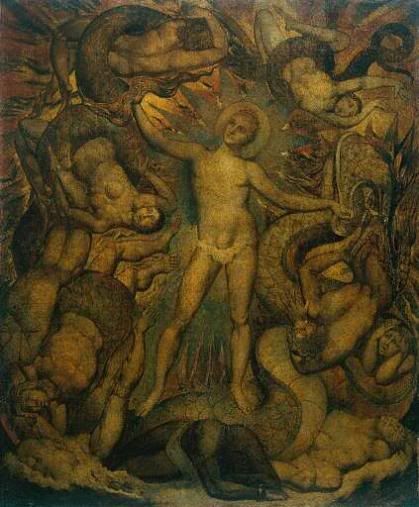
    Beyond the books that Blake completed in an engraved manner he also produced numerous watercolor "illustrations" for other texts: the Bible:


    The Parable of the Wise and Foolish Virgins


    The Last Judgment

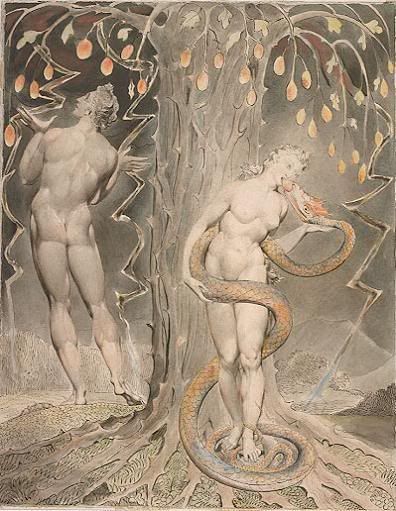
    Milton's Paradise Lost:


    The Temptation and Fall

    Dante's Divine Comedy:


    The Blasphemer


    Antaeus Setting Down Dante and Virgil

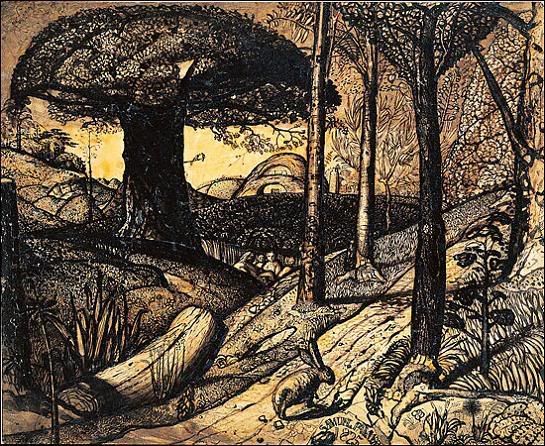
    ...chief among them. These may have been intended as studies for color engraved versions of these books. One might even suggest that Blake may have intended something along the line of what he had achieved with his Job: a merger of text and image that is a completely new invention. Blake's art would have a direct influence upon the work of a group of followers known as "the ancients" that included Samuel Palmer...


    Samuel Palmer-Early Morning-engraving

    and Edward Calvert...


    Edward Calvert-The Bride-engraving

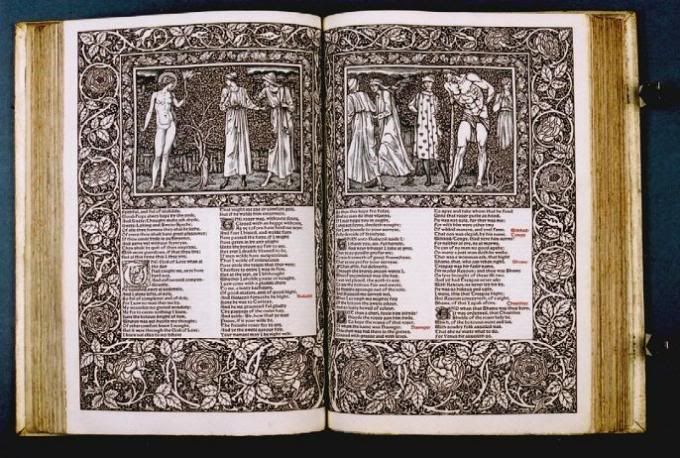
    His work would be a model for the design of children's books by the end of the 19th century as well as a major source of inspiration for the development of the so-called "book arts" as found in the works of Eric Gill...


    Eric Gill-The Bible

    and most importantly William Morris:


    William Morris/Edward Burns Jones-"Kelmscott Chaucer"

    In spite of this, Blake's art did not attain a level of recognition equal to that afforded to his poetry until after mid-century with the increased access to color reproduction allowing for his work to be experienced as close as possible to the manner in which he had intended. Since that time Blake's work has grown greatly in popularity with artists and art lovers (as with lovers of literature)... and especially with those who follow the "book arts". A recent collection of 19 watercolors were broken up by the owners and 12 sold for more than $7 million US. In spite of the incredibly high price for works on paper, the sale was actually far below what was expected. (A good many buyers opted out of the auction due to anger over the fact that the collection had been quickly broken up by speculators out to make a quick dollar rather than allowing the Tate or another museum time to raise the funds needed to purchase the work as a whole) The recent exhibition of Blake's work at the Metropolitan Museum of Art drew crowds in numbers usually reserved for the finest painters in oils... not for an artist working in print and watercolor and often regulated to the category of "outsider artist". It is clear that Blake's achievements as a visual artist have attained a status that equals his achievements as a poet.
    Last edited by stlukesguild; 12-05-2007 at 02:27 AM.
    Beware of the man with just one book. -Ovid
    The man who doesn't read good books has no advantage over the man who can't read them.- Mark Twain
    My Blog: Of Delicious Recoil
    http://stlukesguild.tumblr.com/

  2. #17
    in angulo cum libro Petrarch's Love's Avatar
    Join Date
    Dec 2005
    Location
    California
    Posts
    2,333
    Blog Entries
    24
    What a fascinating little thread this is. I've enjoyed reading both Quasi and St. Luke's entries. Incidently, SLG, you've helped me feel friendly toward Herrick again. My reading for my recent exam included all the Noble Numbers and none of the secular works and I'm here to say that for a bachelor clergyman Herrick's love poetry is almost unbelievably superior to his religious verse. I had always enjoyed Herrick because of examples like those you note above, but I'm afraid I couldn't find much to praise in his religious verse.

    Also, thanks for the detailed Blake post. He's a poet/artist I've always wanted to look into more closely (especially because of his close dialogue with Milton, Dante etc.), and your post added a little more to what little I already knew about him. Very nicely and informatively written.

    Great reading fellas. Keep it up!

    "In rime sparse il suono/ di quei sospiri ond' io nudriva 'l core/ in sul mio primo giovenile errore"~ Francesco Petrarca
    "Follies and nonsense, whims and inconsistencies do divert me, I own, and I laugh at them whenever I can."~ Jane Austen

  3. #18
    Ruadh gu brath ampoule's Avatar
    Join Date
    Jun 2007
    Location
    From the mountains to the prairies to the oceans white with foam
    Posts
    2,744
    Blog Entries
    67
    What wonderful reading this has been. Thank you both so much.


    Concerning poet John Berryman's mama who taught him...

    Quote Originally Posted by quasimodo1 View Post
    "Ever to confess you're bored
    means you have no/Inner Resources."
    ...now I know where the saying, "Only boring people are bored", comes from.


    And stlukesguild, my heart skipped a beat when I saw The Lamb. I sang that as a solo in junior high school. I knew Blake was the author of the lovely words but I do not know who wrote the music. Still, I remember each note and its sweetness. Maybe a little research is in order.

    Thank you again. For once I'm thankful I couldn't sleep.

    (My message seems so simple in comparison to the information in this thread but I was unable to send quasimodo a pm )
    I'm in love with The Vinegar Man and Mr. Tanner, but be careful, it could just as easily be you.

    "If you're going to write you better have somewhere to come from." Flannery O'Connor

  4. #19
    Registered User quasimodo1's Avatar
    Join Date
    Feb 2007
    Location
    Bensalem, PA 19020
    Posts
    3,267

    Walt Whitman, prose preface to Leaves of Grass

    "This is what you shall do: Love the earth and sun

    and the animals, despise riches, give alms to every

    one that asks, stand up for the stupid and crazy,

    devote your income and labor to others, hate

    tyrants, argue not concerning God, have patience

    and indulgence toward the people, take off your

    hat to nothing known or unknown or to any man or

    number of men, go freely with powerful

    uneducated persons and with the young and with

    the mothers of families, read these leaves in the

    open air every season of every year of your life,

    re-examine all you have been told at school or

    church or in any book, dismiss whatever insults your

    own soul, and your very flesh shall be a great poet

    and have the richest fluency not only in its words

    but in the silent lines of its lips and face and

    between the lashes of your eyes and in every

    motion of joint of your body." {part one, poetry redux: Walt Whitman}

  5. #20
    Registered User quasimodo1's Avatar
    Join Date
    Feb 2007
    Location
    Bensalem, PA 19020
    Posts
    3,267
    Compliments to Stlukesguild for a comprehensive and magnificent posting. quasi

  6. #21
    Inexplicably Undiscovered
    Join Date
    Jun 2007
    Location
    next door to the lady in the vinegar bottle
    Posts
    5,089
    Blog Entries
    72
    St Luke's Guild: Where do you find all of these paintings?

    Quasimodo: Yours are among the very BEST postings on the entire forum! How generous it is of you to share with us your extensive research, your own critical expertise, and
    your heartfelt appreciation for these poetic masters. Now, I would like to ask your "take" on James Merrill. I think his poem "The Black Swan" is one of the lyrical gems of the past century. I like Merrill's work as a whole, but some of the later books (based on messages via a ouija
    board) stretch the reader's credibility, though they are indeed interesting and aesthetically pleasing.

  7. #22
    Registered User quasimodo1's Avatar
    Join Date
    Feb 2007
    Location
    Bensalem, PA 19020
    Posts
    3,267
    To AuntShecky: Thank you for your kind remarks although some of the moderators might take exception to what you say; it seems I give some of them fits, especially Logos, relative to copyright issues and admitedly I have gone beyond some bounds there. My take on Merrill is that I like his work but it's been awhile since I examined his work in depth. Right now, Whitman has my attention relative to some criticism that will be done on the "Redux" thread. There is one sub-site worth mentioning to give you one analyst's view...http://www.english.uiuc.edu/maps/poe...rrill/puns.htm and his correspondence is on that site as well. For me, the letters of an author are most revealing, much more so than critics and essayists. I'll try to do James Merrill next but it won't be right away. Sincerely, quasimodo1

  8. #23
    Registered User quasimodo1's Avatar
    Join Date
    Feb 2007
    Location
    Bensalem, PA 19020
    Posts
    3,267

    Walt Whitman, "Song of Myself" (1855 edition)

    Walt Whitman's "Song of Myself" (1855 edition) "I celebrate myself, And what I assume you

    shall assume, For every atom belonging to me as good belongs to you." What poet today

    would have the gall, the confidence, even the effrontery to title a poem this way?

    Whitman's rhetorical questions are not easily or honestly answered..."Have you reckoned a

    thousand acres much? Have you reckoned the earth much? Have you practiced so long to

    learn to read? Have you felt so proud to get at the meaninng of poems?" Well you better

    practice a little to get at the meaning of "Song of Myself". Still in the early lines he gives

    great clues..."Sure as the most certain sure....plumb in the uprights, well entretied, braced in

    the beams, Stout as a horse, affectionate, haughty, electrical, I and this mystery here we

    stand." As Whitman says earlier, the mystery is "Always the procreant urge of the world."

    This poem is more about the joi de vivre than himself. "Backward I see in my own

    days where I sweated through fog with linguists and contenders, I have no mockings or

    arguments....I witness and wait." This poet wants some special abilities to enhance his song.

    "I wish I could translate the hints about the dead young men and women, And the hints

    about old men and mothers, and the offspring taken soon out of their laps." From Part X,

    Whitman acquits himself of worries and work ethics and experiences the world in his (and

    our) inimitable way..."Alone far in the wilds and mountains I hunt, Wandering amazed at my

    own lightness and glee..." He has allready declared that it is lucky to have been born, and if

    so, it is just as lucky to die. The man has freed himself from one huge prejudice. Life also is

    an outdoor activity, as if indoors constitutes man's normal, everyday state. Evolution came

    along with "indoors" very late in the game; a game with no goal except your duty to take joy

    in it. "I am enamoured of growing outdoors, Of men that live among cattle or taste of

    the ocean or woods, Of the builders and steerers of ships, of the wielders of axes and

    mauls, of the drivers of horses, I can eat and sleep with them week in and week out."

    Part XVI begins with his variation on the theme of all-connectedness, of I am what you are, of

    life being joyful by the quality of non-uniqueness; if I have seen it, done it, been there,

    gone away...everyone else has too, in their ironically unique self. "I am of old and young, of

    the foolish as much as the wise, Regardless of others, ever regardful of others, Maternal as

    well as paternal, a child as well as a man, Stuffed with the stuff that is coarse, and stuffed

    with the stuff that is fine..." And I think here is the true center of this poem..."AND I KNOW

    I AM DEATHLESS, I KNOW THIS ORBIT OF MINE CANNOT BE SWEPT BY A CARPENTER'S

    COMPASS, I KNOW I SHALL NOT PASS LIKE A CHILD'S CARLACUE CUT WITH A BURNT STICK

    AT NIGHT. I KNOW I AM AUGUST, I DO NOT TROUBLE MY SPIRIT TO VINDICATE ITSELF

    OR BE UNDERSTOOD, I SEE THAT THE ELEMENTARY LAWS NEVER APOLOGIZE, I RECKON I

    BEHAVE NO PRODUCER THAN THE LEVEL I PLANT MY HOUSE BY AFTER ALL."

    Refering again to the basic evolutionary process of life, in Part XXX, Whitman correctly

    pontificates..."All truths wait in all things, They neither hasten their own delivery nor resist it,

    They do not need the obstetric forceps of the surgeon, The insignificant is as big to me as

    any, What is less or more than a touch? ......Only what proves itself to every man and

    woman is so, Only what nobody denies is so." Irony thus is not a quirky thing or an unusual

    event; it is a natural law. "I believe a leaf of grass is no less than the journeywork of the

    stars..." Lastly from Part LII, "I bequeth myself to the dirt to grow from the grass I love, If

    you want me again look for me under your bootsoles." {Re: "Song of Myself" by Walt

    Whitman, 1819-1892} quasimodo1
    Last edited by quasimodo1; 12-16-2007 at 06:46 PM.

  9. #24
    Registered User quasimodo1's Avatar
    Join Date
    Feb 2007
    Location
    Bensalem, PA 19020
    Posts
    3,267

    James Merrill (part 1)

    Poetry Redux--James Merrill. Helen

    Vendler said in an essay about James Merrill..."The

    time eventually comes, in a good poet's career,

    when readers actively long for his books: To know

    that some one out there is writing down your

    century, your generation, your language, your

    life--under whatever terms of difference makes you

    wish for news of yourself!" This incomplete

    assessment of Merrill's sensibility occurs because of

    James Merrill's family's wealth, being at the gamut

    of society; his father's family founded Merrill-Lynch

    Investments Inc. Fortunately Merrill's assets

    included great poetic talent. He travelled

    extensively and experienced his generation's

    version of the "grand tour", visiting classical

    locations, all the climes and nature, taking his

    options and liesure in order to enable his literary

    growth and concentrate on writing, always taking

    his poetry to the next level. Bread was not a

    necessity but another source of metaphor; his

    readers by extension visit the Parthenon and the

    Acropolis and other inspiring locations.

    His very first poems indicated an early mastery of

    lyrical ways and means. Avoiding the "starving

    artist in his garrett" phase only aided a jump-start

    carreer. Merrill describes the family house in an

    early poem as a dwelling "whose west wall takes the

    sunset like a blow" where "courtesies melt into blue

    air. Lights for the future sleuth of the oblique." In

    Merrill's rhetorical parlance, "Glory's grasp of

    lightening rod labor, cost, frostbite, bedazzlement.

    Down to the last friend's guitar and stories." In

    Istanbul, his autobiographical persona wakes one

    morning to find the right side of his face paralyzed.

    He views this as a chance and a new proclivity to

    change so that his "lean illuminations decompose".

    At this time he is leaning over the brink of creating

    his three related narrative poems into one

    published volume: "The Changing Light at

    Sandover"; a collection that in 1976 have no

    previous equal in demonic force. The third of these

    long poems, "Scripts for The Pageant" (1980) is

    described by Charles Berger at its completion..."This

    is poetry that may well be the most astonishing

    poem ever written by an American" (perhaps a

    slight hyperbole there). Merrill admits that this

    three work volume was composed using a "ouiji

    board" as a coda and "...Sandover" owes its origen

    to many nights that Merrill and his companion,

    David Jackson, spent using this parlor game

    technique as a way of generating material, among

    the other worldly voices in the poem are those of

    Auden and Gertrude Stein. This experiment,

    though never repeated, left Merrill inspired,

    disillusioned and yet determined to move forward

    with more elegant and concrete forms. (That is a

    wild beginning for a poet who would come to

    dedicate one of his later greater works to Richard

    Howard.) Returning to a younger James Merrill,

    educated at Amherst College, he wrote an honors

    thesis on Marcel Proust (a fitting artistic

    counterpart?), all the while dividing his living

    arrangements between Athens, Stonington, CT and

    New York City. These earlier days he began

    displaying his absolute skill with the diabolical pun,

    lyrical intensity and narrative and formal poetic

    styles. In 1959 he wrote "A Dedication" and in 1966

    he created "Charles on Fire", the latter is his

    concept of an American "buldungsroman"

    ..."Without your intellectual and spiritual values,

    man, you are sunk". Also in 1966, "Days of 1964"

    was published; a strange, partially autobiographical

    long poem describing his life in embassies, the

    town of Palmyra, reports of time spent with an

    ailing, aging woman and her daughter

    (relationship?), material about the daughter's

    wastrel son and conversations with the mother who

    in this poem refers to James Merrill as her real son.

    From "Days of 1964" ..."I paid her generously, I dare

    say. Love makes one generous. Look at us; we'd

    known each other so briefly that instead of

    sleeping, we lay whole nights, open, in the

    lamplight, and gazed, or traded stories" ....in the

    woods one day, the poem continues..."Eat me, Pay

    me--The erotic mask, worn the world over by

    illusion, to weddings of itself and simple need.

    ...Where I hid my face, your touch, quick, merciful,

    blindfolded me. A God breathed from my lips, If

    that was illusion, I wanted it to last long; To dwell,

    for its daily pittance, with us there." In

    1972, he wrote the poem "Days of 1935", a very

    long narrative poem with more than one mention

    of the tragic Lindbergh kidnapping; a piece that

    lingers over the vagaries of that particular year.

    Later in 1972, Merrill radically changes his style

    again in the enigmatic poem, "Syrinx". The allusion

    in the title refers to a nymph in classical Greek

    mythology, a follower of Artemis, known for her

    chastity. Pursued by the amorous god Pan, she

    runs to the river's edge and requests help from the

    river nymphs. They help her (Greek mythology can

    get really bizarre) by changing the nymph Syrinx

    into hollow water reeds that make a haunted,

    soulfull sound when the god Pan's breath blows

    over them. (Pan is said to have cut the reeds to

    create the first set of pan pipes as in the pan flute).

    [Ref: Ovid, Metamorphoses 1.689ff] From the

    poem "Syrinx"..."I tremble, still, A thinking reed.

    Who puts his mouth to me, Draws out the scale of

    love and dread--O Ramify, sole antidote? Foxglove

    each year, cloud, hornet, fatal growths, Proliferating

    by metastisis, Rooted their total in the gliding

    streams. Some formula not relevant anymore,

    though flower children might express it yet. ...Or

    stop the four winds, racing overhead, Naught

    Waste Eased Sought" {This critique and

    description of James Merrill will continue. Three of

    Merrill's best are still to be examined: "Lost in

    Translation" "Poems for the Clothesline" and

    probably his most famous poem, "The Black Swan" :
    quasimodo1}

  10. #25
    Artist and Bibliophile stlukesguild's Avatar
    Join Date
    Jul 2006
    Location
    The USA... or thereabouts
    Posts
    6,083
    Blog Entries
    78
    For Blake images check out the William Blake Archive:

    http://www.blakearchive.org/blake/
    Beware of the man with just one book. -Ovid
    The man who doesn't read good books has no advantage over the man who can't read them.- Mark Twain
    My Blog: Of Delicious Recoil
    http://stlukesguild.tumblr.com/

  11. #26
    Inexplicably Undiscovered
    Join Date
    Jun 2007
    Location
    next door to the lady in the vinegar bottle
    Posts
    5,089
    Blog Entries
    72
    These postings-- re: Blake, Whitman, and Merrill in particular -- are monumental! I am awestruck and humbled by the minds of these posters!

  12. #27
    yes, that's me, your friendly Moderator 💚 Logos's Avatar
    Join Date
    Feb 2004
    Posts
    6,510
    Blog Entries
    19
    Quote Originally Posted by quasimodo1 View Post
    To AuntShecky: Thank you for your kind remarks although some of the moderators might take exception to what you say; it seems I give some of them fits, especially Logos, relative to copyright issues and admitedly I have gone beyond some bounds there.
    Uh, no, 'fits' is not quite the right word I've merely tried to explain copyright issues and it is my job to see that people here comply.
    Forum » Rules » FAQ » Tags » Blogs » Groups » Quizzes » e-Texts »
    .
    📚 📚 📒 📓 📙 📘 📖 ✍🏻 📔 📒 📗 📒 📕 📚 📚 📚 📚 📚 📚 📚
    .

  13. #28
    in angulo cum libro Petrarch's Love's Avatar
    Join Date
    Dec 2005
    Location
    California
    Posts
    2,333
    Blog Entries
    24
    Thanks for some more excellent posts on Whitman and Merrill, Quasi. This continues to be a fascinating thread.

    "In rime sparse il suono/ di quei sospiri ond' io nudriva 'l core/ in sul mio primo giovenile errore"~ Francesco Petrarca
    "Follies and nonsense, whims and inconsistencies do divert me, I own, and I laugh at them whenever I can."~ Jane Austen

  14. #29
    Registered User quasimodo1's Avatar
    Join Date
    Feb 2007
    Location
    Bensalem, PA 19020
    Posts
    3,267

    Louis Zukofsky

    Louis Zukofsky is from the second wave of

    American modernists, standing on the shoulders of

    Ezra Pound, T.S.Eliot, Wallace Stevens, Joyce and

    William Carlos Williams. Being both poet and critic,

    he stands out mostly because of his 800 page

    radical biographical poem called simply "A". He

    said once about his work "I try to be as simple as

    possible", yet in fact the sound leads to the sense

    more than the opposite way, the standard way. It is

    typical of his life that he achieved his MA, yet never

    recieved his BA and this at twenty years old. He

    worked for the WPA doing research from 1934 to

    1942 creating a history of American handicrafts.

    Some of his critics have called him the most

    influential poet you never heard of. New York City

    was his home and his resource. He died at Port

    Jefferson, Long Island in 1978.

    http://www.ofscollege.edu.sg/z-site/ An excerpt...

    from "A" "Facing south, I looked
    At the ferry at South Ferry
    At night, the ruins of Castle Garden
    Where Jenny Lind sang
    Before my time — with the diamonds
    Of the songs of the nightingale —
    Long after the Castle became the Aquarium:
    Swung back by my young pulse,
    Recalled a seal in teal blue,
    A compass in binnacle —
    Asleep or sleepless .................................................. ..................

    "Often in reading one of his poems, you can sense

    multiple patterns at play; indeed, reading Zukofsky

    induces this sensation. But these poems are not

    multi-dimensional crossword puzzles: no solution is

    required, or, for that matter, even desired. The

    experience made possible through the crafting of

    the poems is 'when the meanings are' (as Emily

    Dickinson puts it): the meaning is not behind the

    words but in the words as they unfold, and refold,

    in the ear."

    ...............http://jacketmagazine.com/30/z-bernstein.html

    .................................................. .............................................

    The melody! the rest is accessory: …
    My one voice. My other: is
    An objective – rays of the object brought to a focus,
    An objective – nature as creator – desire for what is

    objectively perfect
    Inextricably the direction of historic and

    contemporary particulars

    — from “A”-6


    Louis Zukofsky (1904-78), The new biography

    review can be found at this link...

    http://www.nytimes.com/2008/01/20/bo...tml?ref=books#

    ...Zukofsky........"you

    cannot talk about Zukofsky the man without talking

    about the poem that collected, to an extent few

    writers have ever attempted, the history of one

    person’s perception of experience, from Bach to

    Watts, from Spinoza to Kennedy."

    .......................................quote from biography by Marc

    Scroggins
    Last edited by quasimodo1; 01-19-2008 at 08:22 PM.

  15. #30
    Registered User quasimodo1's Avatar
    Join Date
    Feb 2007
    Location
    Bensalem, PA 19020
    Posts
    3,267

    Charles Simic

    Charles Simic gives insight into his own work; "Awe is my religion, and mystery its church." Born 1938, he wrote in his memoirs (A Fly In The Soup), "My family like so many others, got to see the world for free, thanks to Hitler's wars and Stalin's takeover of east Europe." In 1954 Charles, his brother and his mother moved from the Yugoslavia and postwar/coldwar Belgrade to Manhatten and the US of Dodger baseball, burger and fries, chicken in every pot and the jazz clubs of the city. He characterizes and contours his life "in the mid 1970's at a nearby fair in Deerfield, New Hampshire. "What a life, I thought at the time. It's not enough to have six legs, they want you to do tricks, too. Then it occured to me. That's what a poet is; a six legged dog." In the 1967 poem called "MY SHOES" he writes autobiographically " Shoes, secret face of my inner life:/ Two gaping toothless mouths/ .........My brother and sister who died at birth/ continuing their existance in you,/ Guiding my life/ Toward their incomprehensible innocence." Simic imparts secretive and subtle joy together with darker sentiments; e.g. the four line poem, "WATERMELONS". (1974) "Green Buddhas/ on this fruit stand/ we eat the smile/ and spit out the teeth." In the poem "MY BELOVED (after D.Khrams)" (1981) with signature similes and metaphors, he writes: "In the fine print of her face/ Her eyes are like two loopholes/ .........When she crosses them (her legs) on the sofa/ It's like a jailer unwrapping a parcel/ And in that parcel is a christmas cake/ and in that cake a secret little file/ That gasps her name as it files my chains." (1981) By 1990 Simic has refined his style to bright, laconic verse, the peeks and valleys of emotion and controlled ironies...e.g. "ST THOMAS AQUINAS" (1990) (the patron of all universities and students) "I was on a park bench asleep./ It was like the art of ancient Egypt/ I didn't wish to bestir myself./ I made my long shadow take the evening train/ 'We give death to a child when we give it a doll'/ Said the woman who had read Djuna Barnes"./ reference: (Djuna Barnes, June 12, 1892 – June 18, 1982, was an American writer who played an important part in the development of 20th century English language), and further into the same poem....."I had the travels of Herman Melville to serve me as a pillow./ I was a ghost ship with its sails fully raised./ I could see no land anywhere./ The sea and its monsters could not cool me." Simic the cynic harmonizes with the Simic of joie de vivre; he counterpoints dark description with light and trivial experiences. From "THE DEVILS" (1990) ....."You were a victim of semiromantic anarchism/ in its most irrational form/ I was ill at ease in an ambiguous world/ deserted by providence"........"He's got dark ages on his brain, you said./ Who does, I asked and got no reply./ The world was quiet/ except when one of us took a sip of gin." Charles Simic was chosen Poet Laureate over 14 other poets by James H. Billington who describes his work "of rather stunning and of original quality." In "A BOOK FULL OF PICTURES" ....."The pages I turned sounded like wings./ 'the soul is a bird', he once said./ In my book full of pictures/ A battle raged: lances and swords/ made a kind of wintry forest/ With my heart spiked and bleeding in its branches.." Billington also said of Simic..."he's very hard to describe, and that's a great tribute to him. His poems have a sequence that you encounter only in dreams." When interviewed about what and who influenced him...Simic responded "I adored different kinds of poets" and goes on to mention the ancient Chinese poets, Roman poets (Virgil), French symbolists and American modernists. "I was so promiscuous. I'd be lying if I pretended that. I had just one great love." In 1996 Simic wrote "CAMEO APPEARANCE" where he refers to the wartime Europe of his youth...."I had a small, non speaking part/ in a bloody epic./ I was one of the/ Bombed and fleeing humanity./ In the distance our great leader/ Crowed like a rooster from a balcony/ or was it a great actor/ Impersonating our great leader?" In a collection of poems entitled "JACKSTAWS" he is obsessed by mortality. The epigraph for "Jackstraws" by Adam Zagajewski..."This moment- what is it?- just a mosquitto, a fly, a spec, a scrap of breath." Simic's primary concern in this collection is locating and capturing the ever-vanishing scraps of breath that make a life. If most poets in their later years become dull an staid, Simic in "THE GANG OF MIRRORS" will not go quietly into his night. From "Jackstaws" ........"And the one that's got it in for you,/ That keeps taunting you/ In an old man's morning wheeze/ Every time you so much as glance at it,/ Or blurt something in your defense,/ Screaming, raising your chin high,/ While it spits and chokes in reply." The Paris Review has in archive this great interview with Simic...http://www.theparisreview.com/media/5507_simic.pdf The Boston Review has an essay on Jackstraws ...http://bostonreview.net/BR24.3/henry.html Also the NYTimes has an article on Simic as new Poet Laureate http://www.nytimes.com/2007/08/02/bo...1&oref=slogin# quasimodo1
    Last edited by quasimodo1; 02-02-2008 at 09:16 AM.

Page 2 of 3 FirstFirst 123 LastLast

Similar Threads

  1. what is poetry?
    By blazeofglory in forum Poems, Poets, and Poetry
    Replies: 20
    Last Post: 09-22-2007, 09:27 PM
  2. Henry James and Poetry: A Personal Touch
    By Ron Price in forum James, Henry
    Replies: 1
    Last Post: 08-23-2007, 11:56 PM
  3. I need to know!
    By kels21 in forum Who Said That?
    Replies: 14
    Last Post: 11-06-2006, 06:46 PM
  4. The "State" of American Poetry Today
    By jon1jt in forum Poems, Poets, and Poetry
    Replies: 0
    Last Post: 09-16-2006, 04:41 PM
  5. National Poetry Month
    By Basil in forum Poems, Poets, and Poetry
    Replies: 0
    Last Post: 04-29-2005, 03:09 PM

Posting Permissions

  • You may not post new threads
  • You may not post replies
  • You may not post attachments
  • You may not edit your posts
  •