Buying through this banner helps support the forum!
Page 8 of 24 FirstFirst ... 34567891011121318 ... LastLast
Results 106 to 120 of 359

Thread: The Visual Arts: Exploring the History of "Fine Art" and Beyond

  1. #106
    Artist and Bibliophile stlukesguild's Avatar
    Join Date
    Jul 2006
    Location
    The USA... or thereabouts
    Posts
    6,083
    Blog Entries
    78
    I don’t have any idea why you said that Pre-Raphaelites were quite reactionary. If we look at themes, we may see themes from Greek/Roman mythology . Evelyn de Morgan was involved in occult and her art is quite intriguing.

    The dominant strains in art as from the late 1700s through the early/mid-1800s were Neo-Classicism and Romanticism. Neo-Classicism was rooted in the philosophy of the Enlightenment and stressed reason and logic over all. In visual terms this meant an art rooted in the paintings of the Renaissance and the art of Classical Greece and Rome stressing clarity of form, line, and rational composition based in mathematics. The subject matter tended to be that which glorified nobility of character, heroic deeds, military and political achievements, etc... The best example of the Neo-Classical painter was Jacques Louis David:


    Romanticism stressed "realism" over "the ideal"; the "exotic" worlds of the Middle-Ages, Persia and the Middle-East, and the wild, unspoiled landscapes of America over Greece and Rome and the Florentine Renaissance; emotion and unbridled passion over logic and reason; atmosphere and color over line and form; and the overwhelming power of nature as opposed to the achievements of man. Among the leading Romantics, we should include:

    Goya:


    Caspar David Friedrich:


    J.M.W. Turner:


    As the century progressed, the boundaries between Romanticism and Neo-Classicism became increasingly blurred. The most important artist to truly straddle the line was undoubtedly Ingres. Ingres merged the linear clarity and immaculate, polished form of Neo-Classicism with the exoticism and eroticism and rich color of Romanticism:


    As with every artistic style, Romanticism and Neo-Classicism became academic and mannered. The "masters" of the French and British academies were masterful technicians... but their paintings lacked the originality, the energy, and the passion of the original Neo-Classicists and Romantics.

    The cutting edge in art shifted toward "Realism". The leading "Realists" included:

    Gustave Courbet:


    Millet:


    Early Degas:


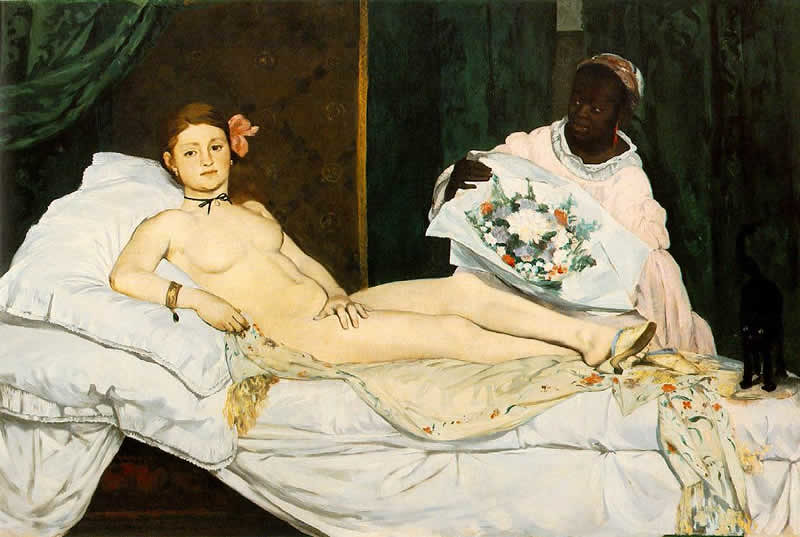
    Early Manet:


    Daumier:


    Winslow Homer:


    and George Bellows:


    The aim of all these artists was to capture the honest truth with regard to the world that they loved in... whether the urban landscapes of Paris or New York... or the rural life... as they were seen by the artists.

    Impressionism, by far the most important and influential movement of the latter 19th century continued in this direction... focusing upon the artist's visual perception of the play of light and color upon the landscapes... or upon the urban scenes of Degas and Manet.

    The "reactionary" nature of the Pre-Raphaelites has to do with the fact that for all the revolutionary political fervor, as painters they were quite conservative.


    Their paintings were clearly rooted in the Romanticism of William Blake, Medievalism, and the techniques and appropriate subject matter of painting as then taught in academia.

    The question of whether an artist is reactionary or revolutionary, of course, is not an immediate measure of artistic merit. William Blake was both reactionary and revolutionary and has had far more impact upon artists into the 20th century than he did upon his immediate peers or successors. Giorgio Morandis simple gray and earth-toned paintings of still-life objects seemed completely out of tune with the work of his era... especially the grand-scaled, heroic, and explosive works of Abstract Expressionism. Today, however, he is one of the most admired painters of the Post-War era... a true "painter's painter."
    Beware of the man with just one book. -Ovid
    The man who doesn't read good books has no advantage over the man who can't read them.- Mark Twain
    My Blog: Of Delicious Recoil
    http://stlukesguild.tumblr.com/

  2. #107
    Quote Originally Posted by stlukesguild View Post
    [. Giorgio Morandis simple gray and earth-toned paintings of still-life objects seemed completely out of tune with the work of his era... especially the grand-scaled, heroic, and explosive works of Abstract Expressionism. Today, however, he is one of the most admired painters of the Post-War era... a true "painter's painter."


    Among the artists wanting to capture the honest truth of their world one must pre-eminently include Van Gogh, and his "social realist" period culminated in The Potato Eaters. But then he transcended realism with the discovery of color, and its expressive possibilities.

  3. #108
    Banned
    Join Date
    Jun 2011
    Location
    Where the rain doesn't stop.....
    Posts
    763
    Blog Entries
    1
    Originally posted by stlukesguild
    Their paintings were clearly rooted in the Romanticism of William Blake, Medievalism, and the techniques and appropriate subject matter of painting as then taught in academia.

    The question of whether an artist is reactionary or revolutionary, of course, is not an immediate measure of artistic merit. William Blake was both reactionary and revolutionary and has had far more impact upon artists into the 20th century than he did upon his immediate peers or successors. Giorgio Morandis simple gray and earth-toned paintings of still-life objects seemed completely out of tune with the work of his era... especially the grand-scaled, heroic, and explosive works of Abstract Expressionism. Today, however, he is one of the most admired painters of the Post-War era... a true "painter's painter."
    Well, we may create many theories. I am very far from that but I prefer to look at paintings and the themes. For example, I have found the same themes in painters involved in occult. Second, Greek/Roman mythology themes were painted through centuries. Today, we find strange fascination with demons. Well, not only in paintings but in music.

    As a one of example is Qlimax That gathers 30.000 young people indoctrinated into demons and dark side.

    http://www.youtube.com/watch?v=ArVnBOqSD3Q


    We even have Adamu: Luciferian Tantra and Sex Magick written by Micheal Ford.

    http://www.amazon.com/Adamu-Luciferi.../dp/1411690656


    But dark angels that I posted on my previous post is quite intriguing. With dark angel goes angel of death.

    The Book of Abramelin tells the story of an Egyptian mage named Abramelin, or Abra-Melin, who taught a system of magic to Abraham of Worms, a German Jew presumed to have lived from c.1362–c.1458. The system of magic from this book regained popularity in the 19th and 20th centuries due to the efforts of Mathers'' translation, The Book of the Sacred Magic of Abramelin the Mage, its import within the Hermetic Order of the Golden Down, and later within the mystical system of Thelema (created in 1904 by Aleister Crowley).
    http://en.wikipedia.org/wiki/Four_Crown_Princes_of_Hell
    In the literature,kabbalistic symbol of Leviathan Samael (the angel of death, prosecutor, seducer, the spirit of destruction), who would be killed in the future.

    Knowledge of this angel is derived from Talmudic, Kabbalistic and Gnostic literature.

  4. #109
    Apparently for ftil, everything to do with the visual arts (and probably all other arts as well) has to do with the occult. This a terribly limited and tedious way of "understanding" art.

  5. #110
    Banned
    Join Date
    Jun 2011
    Location
    Where the rain doesn't stop.....
    Posts
    763
    Blog Entries
    1
    I thought about different theories that try to explain art. Interestingly enough, when I look at paintings and the interpretation there is such a contradiction as words don't match with the paintings. Well, I strongly believe that art is not a left brain activity..... Renaissance magicians agree, particularly Bruno and Ficino that art can't be understood by rational mind.

    A short review of prof. Ioan P. Culiano’s, Eros and Magic in the Renaissance may explain it.

    Ficino, the most prominent of the Renaissance magicians, employed a
    curious synthesis of astrology, divination and Kabbalah in his work-keeping
    allegiance with the humanist ethos of his day. According to Culiano, Marcilio
    also seemed to be a precursor of modern day psychologists, being fully aware of
    such things as Freudian projection, the Jungian concept of anima/animus
    (female and male counterparts in our psyches) and more importantly how images
    impress upon the unconscious mind, thus altering the behavior of the
    individual, often times against their will. When images enter through the eye
    and into the soul of a person, according to Ficino, they ‘are changed into
    phantasms’ , an interesting concept indeed and one quite antithetical to
    current day analytical psychology which tends to regard images as being
    lifeless. The Renaissance mages regarded these phantasms not metaphorically
    but quite literally as having an existence of their own. These phantasms were not
    merely the fanciful product of poets’s imaginations whatsoever and the magicians
    were well aware of their potential for harm if not controlled.

    Marcilio even went on to develop a ‘phantasmic language’ which could be
    employed through various conjuring procedure, a language that most certainly
    held the interest of the Medici who saw the potential for manipulating the
    masses, enabling them to cause large scale possession in order to transfix
    and sedate the public at large.

    Could the artists of the Renaissance, such as those employed to
    illustrate Francesco Colonna’s cryptic work, have been employed by their
    wealthy patrons with this specific purpose in mind, i.e. to conjure phantasms
    to be then delivered into the souls of individuals , primarily through the
    means of beautiful and seductive images in order to create a kind of delirium
    and disorientation?


    Bruno also delved into the realms of mass manipulation through magic. In his work De Vinculus in Genere
    (Of Bonds in General) he daringly posits the idea that the
    ‘magician-psychologist’ him/herself can directly persuade the masses without
    any divine intervention whatsoever, again maintaining a humanist stance like
    Ficino. Central to the effectiveness of such workings is to gather as much
    personal information about the target individual or groups as possible, for it
    is the most effective way to create a link with them to cast spells.

    http://www.facebook.com/topic.php?ui...479&topic=6100

    Ficino in his Book of Life explained three monsters to our intellect. Food, sleep, and sex but he called sex the first monster. It is common knowledge what alcohol or lack of seep do to our mind but I have never thought about sex. A very clever way to keep people dumb.


    The first monster is sexual intercourse, especially if it proceeds even a little beyond one's strength; for indeed it suddenly drains the spirits, especially the more subtle ones, it weakens the brain, and it ruins the stomach and the heart no evil can be worse for one's intelligence. For why did Hippocrates judge sexual intercourse to be like epilepsy, if not because it strikes the mind, which is sacred;' and it is so harmful that Avicenna has said in his book De animali-bus: "If any sperm should flow away through intercourse beyond that which nature tolerates, it is more harmful than if forty times as much blood should pour forth."~o it was with good reason that the ancients held the Muses and Minerva to be virgins. That Platonic saying has relevance here: When Venus threatened the Muses that, unless they celebrated the rites of love, she would send her son armed against them, "the Muses answered,
    'Venus, threaten Mars with such things, your Cupid does not fly among us.'
    "
    Finally, nature has placed no sense farther from intelligence than touch.

  6. #111
    Registered User
    Join Date
    Feb 2007
    Location
    Belo Horizonte- Brasil
    Posts
    3,309
    Quote Originally Posted by Cioran View Post
    What today is called post-modernist art is clearly quite different from modernism, contains a good deal of figuratism as well as an air of irony, detachment, self-referential parody and other characteristics not found in modernism. My point, however, is to contest the notion that these kind of changes somehow devalue modernism.

    A Mondrian that seems to fit the season:

    I do not think Mortal is saying post-modernism - purely an chronological accident - will devalue modernism. I think he is saying all XX century art will be devalued and then "selected" by an aesthetic shift. Which is pretty much natural.

  7. #112
    Artist and Bibliophile stlukesguild's Avatar
    Join Date
    Jul 2006
    Location
    The USA... or thereabouts
    Posts
    6,083
    Blog Entries
    78
    Apparently for ftil, everything to do with the visual arts (and probably all other arts as well) has to do with the occult. This a terribly limited and tedious way of "understanding" art.

    It also ignores the fact that a deep interest in the occult is a rarity among major artists. Most of the figures that ftil has put forth, including:

    Carlos Schwabe:


    Anna Razumovskaya:


    Wojtek Siudmak:


    Andrew Atroschenko:


    Michael Hussar:


    H.R. Giger:


    Vladimir Kush:


    Jean-Baptiste Valadie:


    Ferdinand Knopff:


    Bradley Platz:


    Emile Fabry:


    Alexandre Seon:


    Elihu Vedder:


    Jean Deville:


    ... are very minor figures within the tradition of Western Art History. You cannot engage in a dialog in which you make sweeping statements about the proliferation of the imagery drawn from the occult, Masons, Gnosticism, the Templars, the Illuminati, or what have you and then attempt to illustrate of prove your point by employing nothing other that obscure and minor figures. I have some 120,000+ files or images of paintings saved to my hard-drive... and yet with the exception of Deville, Schwabe, and Knopff, I had to go on line for images of all the painters you have listed. You could "prove" nearly any far-out theory by employing a similar methodology. I could "prove" that Western Art was dominated by homo-eroticism simply by entering "homo-erotic art" into a Google image search. And hell, my theory would hold up better than your notion of the predominance of the occult on art (and the use of art in the manipulation of the masses). I'd at least have Michelangelo, Leonardo, Caravaggio, and Francis Bacon... some major painters... to reinforce my point. Most of the artists you have cited (above) are minor figures having had little or no impact upon the tradition of art... or illustrators/low-brow painters. Admittedly, I have stated that I am intrigued with the so-called "low-brow artists"... but largely because they offer a challenge to the increasingly pretentious, esoteric, and inaccessible art championed by certain circles of the "art world." Most "Low Brow Artists" (like artists in any other realm) are mediocre at best. A good many, like Michael Hussar and H.R. Giger are little more than kitsch illustrators for an audience with a passion for the darker side of the Sci-Fi/Fantasy genre.

    I prefer to look at paintings and the themes.

    That is fine for you. A good many look at art first and foremost for the subject matter. When asked what sort of art they like, they might respond "landscapes" or "religious paintings" or "mythological paintings". You, however, are making assumptions about artists and their intentions and it may serve you well to come to some understanding of how artists look at art. While the formal university art degree demands that the art student be somewhat well-read as well as knowledgeable of art and art history, this was not always so. The Renaissance ideal of the artist who is also well-read, knowledgeable of literature, poetry, history, mathematics, science, philosophy, theology, religion, etc... is quite rare. Even in the instance when an artist fits this Renaissance ideal, in most instances the artist is first and foremost a visual being. Artists are looking... at the visual world around them and at the tradition of Art History in which they labor. Most artists I know are not researching esoteric religions, Gnosticism and the occult. I doubt that Michael Hussar was researching anything more than the images on heavy metal record albums and science fiction and horror books and films.
    Beware of the man with just one book. -Ovid
    The man who doesn't read good books has no advantage over the man who can't read them.- Mark Twain
    My Blog: Of Delicious Recoil
    http://stlukesguild.tumblr.com/

  8. #113
    Artist and Bibliophile stlukesguild's Avatar
    Join Date
    Jul 2006
    Location
    The USA... or thereabouts
    Posts
    6,083
    Blog Entries
    78
    I do not think Mortal is saying post-modernism - purely an chronological accident - will devalue modernism. I think he is saying all XX century art will be devalued and then "selected" by an aesthetic shift. Which is pretty much natural.

    But I think that Mortal does assume that the vast majority of the most admired masters of Modernism and Post-Modernism are little more than a case of the Emperor's New Clothes. The majority of all art is mediocre and undoubtedly time will begin to sort things out... and perhaps in ways that we, living now, would not have imagined. Abstract Expressionism, which was virtually unassailable 20 or 30 years ago has now undergone a degree of re-evaluation. Most critics will now admit that a lot of the glowing praise that surrounded the movement was overblown hyperbole. I doubt few today would suggest that Pollock or Rothko or Motherwell were equals to... let alone greater than Picasso or Matisse. At the same time, we now recognize that there were other artists at that time including Morandi, Giacometti, Francis Bacon, Dubuffet, and Andrew Wyeth that were producing a stunning body of work that was sadly ignored then. Hell, who in the 1930s or 1940s could have even imagined that Duchamp would be seriously placed alongside Picasso and Matisse by the late 20th century? But the rise of Conceptual Art led to a need for a founding father... and Duchamp was the clear choice.

    Having said this... it's easy to make a vague statement like "the pendulum in is motion and change is afoot." Art will always involve change and evolution... but how do you assume which direction this change will take us? Those who predicted a return to figurative art at the height of Abstract Expressionism were quite right... but I doubt that they imagined that this return to figurative art would look like Pop Art. Right now there are many pushing for what is being loosely called the "New Old-Masterism". A great many private ateliers are springing up where students can develop the traditional skills of drawing and painting. I suspect much of this is in response to the obscene costs of a university art degree that often ends in the students having learned let alone mastered almost no marketable skills let alone the ability to draw or paint (or sculpt, etc...) as they desire. But will this lead to a new "realism" akin to that of the 19th century French and British academies? Undoubtedly some will take this route... but others will recognize that we don't live in the 19th century... that the visual world around us is market by different light sources, different colors, different fashions, different objects, etc...
    Beware of the man with just one book. -Ovid
    The man who doesn't read good books has no advantage over the man who can't read them.- Mark Twain
    My Blog: Of Delicious Recoil
    http://stlukesguild.tumblr.com/

  9. #114
    Registered User
    Join Date
    Feb 2007
    Location
    Belo Horizonte- Brasil
    Posts
    3,309
    Well, a pendullum can only go back and forth. I guess Mortal feels or wants a return of classicism or at least more traditional style. I do not know, but then, it makes sense if we consider Mortal preferences.

    Yes, as you saw by my examples - comic books and video games (I should have added movies too) - i do think a tendecy for classical style is reflected on market. The question "this is art" or "what is art" seems exausted, probally as much the romantics felt the enlightment model was exausted.

    Since i consider modernism and even know, a romantic decline, yet, romanticism, i guess we are closing a cicle towards classicism again. Usually classical artist organize multiple cultures in one, the fragmentaded, multi-cultural society of today seems to be needing this kind of solution.

    But of course, it Mortal guess is a good as any. You know, in 100 years, they may say you two are from the same movement, like Voltaire and Rousseau.

  10. #115
    Banned
    Join Date
    Jun 2011
    Location
    Where the rain doesn't stop.....
    Posts
    763
    Blog Entries
    1
    Originally posted by stlukesguild

    It also ignores the fact that a deep interest in the occult is a rarity among major artists. Most of the figures that ftil has put forth, including:
    LOL! Nice try to misinterpret my posts. I guess you are out of ammunition.

    I think that I have already posted Carlos Schwabe and Belgian occult symbolism video here.
    For your convincence.

    Carlos Schwabe - Occultist Symbolism II

    https://www.youtube.com/watch?v=F_X4dCtMuFY


    Jean Deville - Belgian Occultist Symbolism I

    http://www.youtube.com/watch?v=54IeQWD7QHI


    Emile Fabry - Belgian Occultist Symbolism IV and last.

    http://www.youtube.com/watch?v=cNnN2PtW1bg

    Jean Delville (19 January 1867, Leuven – 1953) was a Belgian symbolist painter, writer, and occultist. In 1896, he founded the Salon d’Art Idealiste, which is considered the Belgian equivalent to the Parisian Rose & Cross Salon and the Pre-Raphaelite movement in London.

    Delville became committed to spiritual and esoteric subjects during his early twenties. In 1887 or 1888 he spent a period in Paris, where he met Sâr Joséphin Péladan, an eccentric mystic and occultist, who defined himself as a modern Rosicrucian, descended from the Persian Magi.
    http://en.wikipedia.org/wiki/Jean_Delville

    Alexandre Seon, Elihu Vedder and Fernand Khnopff were members of Rose &Cross Salon.

    Fernand Khnopff - Belgian Occultist Symbolism III

    http://www.youtube.com/watch?v=b81TYTQva0g

    But you have forgotten about a few painters I have posted.


    You, however, are making assumptions about artists and their intentions and it may serve you well to come to some understanding of how artists look at art.
    Shaw me where I make assumptions about artists and their intentions! How many times I need to repeat that I don’t make assumptions. I also never make interpretations. Please don’t confuse me with your own posts…full of interpretations.

    I doubt that Michael Hussar was researching anything more than the images on heavy metal record albums and science fiction and horror books and films.
    LOL! His art is full of occult symbolism.......he put unintentionally.

  11. #116
    Artist and Bibliophile stlukesguild's Avatar
    Join Date
    Jul 2006
    Location
    The USA... or thereabouts
    Posts
    6,083
    Blog Entries
    78
    But of course, it Mortal guess is a good as any. You know, in 100 years, they may say you two are from the same movement, like Voltaire and Rousseau.

    I get to be Rousseau!
    Beware of the man with just one book. -Ovid
    The man who doesn't read good books has no advantage over the man who can't read them.- Mark Twain
    My Blog: Of Delicious Recoil
    http://stlukesguild.tumblr.com/

  12. #117
    Artist and Bibliophile stlukesguild's Avatar
    Join Date
    Jul 2006
    Location
    The USA... or thereabouts
    Posts
    6,083
    Blog Entries
    78
    LOL! Nice try to misinterpret my posts. I guess you are out of ammunition.

    My point was that you are using certain artists to illustrate your ideas about the proliferation of the occult in modern art... but the artists you have cited are all minor figures at best. Pull out the standard texts on the history of Western Art and you are not going to find any of the artists you have listed. Simply posting more images of Deville, Schwabe, and Fabry is not going to change that fact.
    Beware of the man with just one book. -Ovid
    The man who doesn't read good books has no advantage over the man who can't read them.- Mark Twain
    My Blog: Of Delicious Recoil
    http://stlukesguild.tumblr.com/

  13. #118
    My own view is that painterly art is increasingly going to be informed by, and to some extent merge with, technology. Already for years one has been able to use applications like Photshop to create stunning art (and also mediocre art). I can foresee (as mentioned earlier) video merging with paint. I can see immersive 3D virtual reality environments -- some of them creating aritifical worlds, others, perhaps, making 3D recreations (perhaps even with sound, movement and other interaction) of the great works of the past, like the Sistine Chapel.

    There is also the rise of 3D printing. Amazingly enough, in the sad era of Newtown and the deranged NRA, it is now possible to use a 3D printer to print a gun that fires real bullets. Happily, I can foresee other, more benign uses of this technology, such as the merger of painting with sculpture, and the merger of both of them with virtual reality.

    As time goes be, easel painting may come to be seen as entirely passe, an old "luddite" art form that has outlived its usefulness. Should that happen, it may inspire a backlash among the Luddite Easel Painters Alliance, who not only will insist on preserving the obsolete art form, but perhaps taking it back to its pre-photographic roots -- to a more realistic, classicist conception, and leaving the razzmatazz to the techno-artists. So ironically painting may come full circle but for unexcpected reasons.

    All of the above are speculations, of course, but they do not seem too implausible.

  14. #119
    Quote Originally Posted by ftil View Post
    LOL! His art is full of occult symbolism.......he put unintentionally.
    There you go. Fitl's next tactic will be to claim that occultism informs ALL art, whether the artist knows it or not. It may be unintentional, but it's there!

    Ftil evidently believes occultism is the key to reality. How boring.

  15. #120
    Banned
    Join Date
    Jun 2011
    Location
    Where the rain doesn't stop.....
    Posts
    763
    Blog Entries
    1
    Quote Originally Posted by stlukesguild View Post
    LOL! Nice try to misinterpret my posts. I guess you are out of ammunition.

    My point was that you are using certain artists to illustrate your ideas about the proliferation of the occult in modern art... but the artists you have cited are all minor figures at best. Pull out the standard texts on the history of Western Art and you are not going to find any of the artists you have listed. Simply posting more images of Deville, Schwabe, and Fabry is not going to change that fact.

    You have absolutely no idea why I posted occult painters. It is not good to try to sit in somebody’s head.


    I remember that you didn’t like Andrew Atroschenko but what about this painting.

    Robert Coombs, Almost Sundown.
    Attached Images Attached Images

Page 8 of 24 FirstFirst ... 34567891011121318 ... LastLast

Similar Threads

  1. Replies: 10
    Last Post: 12-13-2010, 06:11 PM
  2. Replies: 0
    Last Post: 01-11-2010, 06:59 PM
  3. "I wanted to be fine and strong and quit the law"
    By pantherhare in forum Who Said That?
    Replies: 0
    Last Post: 04-08-2009, 05:43 PM
  4. Bertrand Russell's "History of Western Philosophy"
    By vincanity1 in forum General Literature
    Replies: 6
    Last Post: 08-31-2007, 10:58 AM
  5. "The History of Tom Jones: A Foundling" by Henry Fielding
    By lrd2004 in forum Book & Author Requests
    Replies: 0
    Last Post: 02-13-2004, 03:12 AM

Posting Permissions

  • You may not post new threads
  • You may not post replies
  • You may not post attachments
  • You may not edit your posts
  •