Buying through this banner helps support the forum!
-

Originally Posted by
Paulclem

St Lukes - your contributions to threads with your breadth and knowledge of art are admired from the many posts I've seen complimenting you. I just thought I'd add this after reading how someone has tried to set you up.
Keep up the good work.
LOL! That’s a direct communication. I didn’t try to set stlukesguild up. I have noticed that you have a problem when I honestly express my thoughts and concerns.......Nothing has changed since we have had a conversation about Buddhism where you couldn’t digest that I had a very different opinion. 
Don’t forget change is inevitable….misery optional.
I have a gift for you.....a different painter but the same theme.
An allegory of Truth and Time (1584-5), Royal Collection, London, Annibale Carracci.
http://en.wikipedia.org/wiki/File:CA...e_(1584-5).JPG
-
Artist and Bibliophile
Well, if you can’t see how sick is that….I can’t help you. Second, don’t project your issues upon other artists. Not ever artist was obsessed with sex. It is a big difference between sick minds of the artists I posted and a mind who appreciates beauty and love.
I think perhaps you need to learn a bit about art history before you start making such statements. Caravaggio, the father of the Baroque in painting... surely recognized as one of the greatest artists in history...

... began his career by pandering homoerotic images of prepubescent boys to high-ranking clergy with a taste for such.
Gauguin... one of the seminal figures in the transition from 19th century art (and the whole of the Post-Renaissance focus upon the illusion of reality) to Modernism died of syphilis as a result of any number of sexual trysts with prepubescent girls in Tahiti.
Do I need to bring up Picasso, Matisse, Renoir, Rodin, Klimt, Schiele, etc...
Artists are no less "obsessed" with sex than anybody else. In some cases this obsessing may verge upon the pathological... but I don't think I'd want you in charge of deciding which sexual passions are acceptable and which are "sick".
Until the period of Romanticism, most art was created on commission and thus if a painter employed an erotic theme it was in response to the demands of the patron. Michelangelo's erotic passions famously drew a good deal of criticism when included in the Sistine frescoes. It was not until the late 19th century that art allowing an open exploration of sexuality (and I'm excluding non-Western and pre-Medieval art here) was allowed.
Goya's famous Naked Maja is perhaps the first image that displays the existence of pubic hair... and was commissioned for one of the most powerful figures in Spain at the time. Even so, Goya was summoned and interrogated by the Inquisition.
Beardsley's prints were repeatedly ran afoul of the censors. Klimt's nudes... painted in the 20th century... earned him criticism from the officials of the academic art establishment of Vienna, while Schiele's cost him a stay in prison.
Bayros and Rops are both minor figures in the history of art... and along with Beardsley they tapped into a demand for titillation and eotica not far removed from today's pornography... albeit with a greater degree of aesthetic sophistication. I'm not willing to jump to conclusions about their "sick" sexual obsessions based upon their art work for the simple reason that I don't see art in a Freudian manner as an autobiography in which we may analyse the personality of the artist. Schiele painted some of the most graphic and some of the most disturbing nudes... and yet from all I have read of him, he was rather conservative in his personal life... happily married and little by way of any suggestion of affairs or illicit sexual conduct.
Last edited by stlukesguild; 07-19-2012 at 10:19 AM.
Beware of the man with just one book. -Ovid
The man who doesn't read good books has no advantage over the man who can't read them.- Mark Twain
My Blog: Of Delicious Recoil
http://stlukesguild.tumblr.com/

-
Awwwwwww snap, school's in session!
Originally Posted by
Paulclem
St Lukes - your contributions to threads with your breadth and knowledge of art are admired from the many posts I've seen complimenting you. I just thought I'd add this after reading how someone has tried to set you up.
Keep up the good work.
Ditto.
I also like ftil's technique of throwing in an emoticon after every jab. Every insult comes with plausible deniability. "Insult? That wasn't an insult! Look at the emoticon, I was just joking!"
-
Originally posted by
Mutatis-Mutandis
Ditto.
I also like ftil's technique of throwing in an emoticon after every jab. Every insult comes with plausible deniability. "Insult? That wasn't an insult! Look at the emoticon, I was just joking!"
You are making assumption like Paulclem. It sounds that it is also your modus operandi.  Don’t waste your and my time. I have been on a few forum where I have learned all methods to stop, silence, or distract members. Very primitive methods indeed. Interstingly enough, they were masons or occultists…very clever indeed but being clever doesn’t mean being smart. It didn’t take that long to see their games.
BTW, you may not like using emoticons. You may have suppressed your feelings so that there is no need to use emoticons.
Enjoy LItNet forum and find likeminded people.
Originally posted by
stlukesguild
I think perhaps you need to learn a bit about art history before you start making such statements. Caravaggio, the father of the Baroque in painting... surely recognized as one of the greatest artists in history...
No, I studied about artists enough and it is not of my interest what "authority" says. In fact, I was laughing sometimes when I read their interpretation, therefore, I never read about the artist before I can see his or her art as I don’t want to be influenced by “educated” interpretations. Only the artist or the sponsor can talk about the art, everything else is a pure speculation.
Yes, Carravagio was one of the greatest painters and he was suffering from mental illness but it is not that kind of illness I was talking about. Don’t even try to compare Franz von Bayros, Félicien Rops, Shiele, or Klimt with Carravagio, Michelangelo, or Renoir to name a few.
Artists are no less "obsessed" with sex than anybody else. In some cases this obsessing may verge upon the pathological... but I don't think I'd want you in charge of deciding which sexual passions are acceptable and which are "sick".
I think that maybe you should learn bit about psychology to understand what obsession and psychological health means. As I said not every artists was obsessed with sex. Please don’t repeat like a broken records your arguments. Think harder or give up.
talbeit with a greater degree of aesthetic sophistication
.
LOL! We definitely have a different sense of beauty. Their art is nothing else but ugly and reflect their sick mind.
-
Pièce de Résistance
W a r n i n g
Please do not discuss each other but the topic at hand.
Off topic posts will be deleted without further notice.

~
"It is not that I am mad; it is only that my head is different from yours.”
~
-
Artist and Bibliophile
...it is not of my interest what "authority" says.
In other words, you are not interested in what others who know more about a given topic have to say.
I was laughing sometimes when I read their interpretation...
Because, of course, your own interpretation... which ignores any inconvenient facts that may be brought to the topic by someone a bit more versed than yourself is irrelevant... are naturally far better.
I don’t want to be influenced by “educated” interpretations.
That's clear enough.
Only the artist or the sponsor can talk about the art...
So why are you talking? Hmmm... in fact of the two of us here which one is actually a working and exhibiting artist?
The reality is that art is open to interpretation by anyone... however, having some knowledge of the history of the artist, the period and tradition in which he or she worked, etc... is useful in developing a more accurate interpretation.
Don’t even try to compare Franz von Bayros, Félicien Rops, Shiele, or Klimt with Carravagio, Michelangelo, or Renoir to name a few.
All artists are open to comparison. I find it telling, by the way, that you would throw a pair a major Modernist painters such as Klimt and Schiele in with Rops and Bayros.
Gustav Klimt was the leading figure in the visual arts in Vienna at the turn of the 19th century. After having visited Ravenna and viewed the mosiacs there with their use of decorative pattern and gold, Klimt began to employ similar elements in his painting. His portraits were in high demand by the wealthy elite of Vienna...

... while the most famous of Klimt's paintings, The Kiss, is the single most reproduced work of art... beyond even the Mona Lisa...

These two facts alone would seem to indicate that Klimt was a little more than some minor deviant as you would have us believe. Regardless of your personal preferences and beliefs... unhampered as they are by the facts... Klimt is one of the most respected and influential artists of the 20th century.
He may have shocked the conservative establishment of Vienna with his more sexually daring works... such as Hope... one of the first paintings to portray a pregnant nude... But of course this painting, like most of Klimt's nudes, offered something far more than mere titillation. In this case, he sought to convey the hope of birth and new life brought into a world filled with evil and death... seen lurking in the background...

Even so... Klimt was admittedly a sensualist who had multiple affairs with his models. He absolutely worshipped women and his primary theme as an artist was his awe before the power of women's sexuality...

Beyond this, Klimt was the most important decorative painter of the era... and a major landscape artist...


Klimt brought to Impressionism a sort of elegant decorative design and daring composition.
Egon Schiele, the younger peer and pupil of Klimt in many ways, brought to his art a wiry mastery of line, an angst, and a sort of simultaneous attraction and repulsion from or horror of the flesh, that echoed German Gothic art, and pointed the way toward German Expressionism.
Klimt is acknowledged by artists and art lovers as a master draftsman...

Like the sculptor Rodin, and Klimt before him, Schiele was able to capture the unexpected poses... often seething with an unbridled sexuality... by allowing his models to simply move about the studio according to their own whims.


In spite of the artist/model relationship that many artists over the years have taken advantage of, Schiele, from all reports, maintained a strictly professional relationship with his models. Quite often, while working, he was accompanied by his long-term lover, Wally... and later his wife, Edith.

He was actually with his wife when the incident occurred that led to his arrest for "indecency". Schiele and his wife wished for a break from the confines of the city, and so they left Vienna for a stay in a small rural town, accompanied by one of their models. The residents of this town, having less liberal concepts with regard to nudity reported the goings-on in Schiele's studio to the authorities and the police raided the studio, arrested Schiele and seized a good number of drawings. He spent nearly a month in jail awaiting trial for indecency. The most serious charges were dismissed as it became clear that there was no suggestion of Schiele having sex with his model, but he was fined for contributing to the deliquency of a minor for having erotic drawing on display where a minor might have seen them. Just to drive the point hoome, the judge burned one of the drawings in the courtroom. An act that some of today's more prudish critics would undoubtedly agree with.
Schiele's career ended tragically... just as he was beginning to develop a real ability for painting (He had long been a talented draftsman... but struggled as a painter). He, his wife, and their infant son all succumbed to the Spanish Influenza epidemic of the period following WWI.

Both Klimt and Schiele are major figures in the history of 20th century painting. While neither may be as much of a towering figure as Caravaggio or Michelangelo (and few artists are of such distinction), neither are they minor figures and sexual deviants best forgotten... as some would have us think.
Beware of the man with just one book. -Ovid
The man who doesn't read good books has no advantage over the man who can't read them.- Mark Twain
My Blog: Of Delicious Recoil
http://stlukesguild.tumblr.com/
-
In other words, you are not interested in what others who know more about a given topic have to say.
Because, of course, your own interpretation... which ignores any inconvenient facts that may be brought to the topic by someone a bit more versed than yourself is irrelevant... are naturally far better.
LOL! You haven't learned yet that I am not a blind follower but I think independently. How many times I have to repeat it?
I choose from whom I want to learn and what I want to learn. If I read someone’s’ brain farts who tries so hard to interpret the painting…...I laugh out loud. Second, I am interested in learning about certain techniques and I love to learn about new artists. I need a name of the painter and a few words about the artist. I would never give up a pleasure to study on my own and if I have a question, I always ask. But since I am not an artist, it is not my priority to learn about techniques. I am more interested how images affect our mind. After all, Bruno’s The De vinculis in Genere is considered a cornerstone of modern political thought – on the par with Machiavelli’s Prince. In fact, many Anglo Saxon and Middle European historians and intellectuals consider De vinculis in genere modernity’s most intelligent and insightful political work.
Second, Carl Jung, godfather of art therapy, utilized art making process in therapy. He was Gnostic and his knowledge has come from the occult. Goethe, a mason, considered his Theory of Color more profound than his poetry. Rudolf Steiner, esotericist and founder of Anthroposophy, was very interested in his theory.
I definitely share masons or occults passion for art but my reason are very different than that of masons and occultist.
I don’t even want to talk about Klimt. Egon Schiele has a few interesting paintings but many of his paintings are disgusting.
BTW, a few months ago you wrote:
You still haven't learned your lesson from Oscar Wilde:
The highest as the lowest form of criticism is a mode of autobiography. Those who find ugly meanings in beautiful things are corrupt without being charming. This is a fault.
Those who find beautiful meanings in beautiful things are the cultivated. For these there is hope. They are the elect to whom beautiful things mean only beauty.
There is no such thing as a moral or an immoral book. Books are well written, or badly written. That is all.
I don’t know if you remember what I said. I was laughing that I was choosing from whom I wanted to learn and I preferred to quote Bruno who understood art the same way as I do. I didn’t agree with Wilde but I didn’t explore it deeper. But thanks to you I connected Wilde, another mason, with the Félicien Rops, Franz von Bayros, or Franz von Stuck and aestheticism related to other movements such as symbolism or decadence. I understand his words. After all, he has to find justification for his perversions.
-
Still, isn't a little close minded to not open oneself up to interpretations and art that one may not agree with or like? How can someone discover something new if not by steeping out of their comfort zone? I like plenty of art now that I never had an interest in before. If I never let myself explore other works I wasn't initially interested in, I'd still just be a Dali and Escher fan (not that I am not now).
I like to try to understand as much about any subject as I can, including what I don't like. I've learned that my opinion does not necessarily translate to an evaluation of a piece of art's worth. I don't really like the above pieces by Klimt posted above, but I get what their impact was (at least a little). Maybe someday I will like them, I don't know. I'll leave myself open, though.
-
Originally Posted by
Mutatis-Mutandis
Still, isn't a little close minded to not open oneself up to interpretations and art that one may not agree with or like? How can someone discover something new if not by steeping out of their comfort zone? I like plenty of art now that I never had an interest in before. If I never let myself explore other works I wasn't initially interested in, I'd still just be a Dali and Escher fan (not that I am not now).
I like to try to understand as much about any subject as I can, including what I don't like. I've learned that my opinion does not necessarily translate to an evaluation of a piece of art's worth. I don't really like the above pieces by Klimt posted above, but I get what their impact was (at least a little). Maybe someday I will like them, I don't know. I'll leave myself open, though.
Absolutely not! I wrote earlier that I had my own approach to art. Nobody was teaching me that but it was a result of my understanding of psychology and healing. I was surprised when I read Bruno’s work, a renaissance occultist and magician, who understood the art as I do. So, saying that it may be a little close minded is very wrong. We have to get back the control over our minds and not to blindly listen to “authority”.
I wrote earlier that I was laughing sometimes while I was reading someone’s brain farts. I read carefully, thought about it, and laughed. Only children or immature adults can't think critically. But a psychologically healthy adult moves into Critic stage of development at the age of 20. Many peole are locked in earlier stages of development and never reach this stage or Integrated Faith.
Don’t make assumptions that I don’t use my brain. I use it and I love using it. I am not afraid to question pseudo scholars or authority. People are close mined who blindly listen without questioning and researching the subject. Or using the human development terminology, they are at Literalist or Loyalist stage.
My point is that we have mind and we got it for a reason. People need to think independently and sharpen their critical thinking. Unfortunately, school doesn’t teach to think independently and critically.
I guess we can go back to art. Hopefully, St. Luke will bring new artists I don't know and I will enjoy looking at their art. But it was good to learn about Félicien Rops or Franz von Bayros to see how sick some artist can be. 
-
07-19-2012, 11:36 PM
#100
Well, I didn't really say any of that, but okay.
-
07-19-2012, 11:43 PM
#101
Originally Posted by
Darcy88
After seeing these pictures, I looked into El Greco a little more, as I only knew of him by name. I love his bold use of colors, and while his style is simplistic, it manages to convey more emotion than many realistic pieces. After seeing his work, I was quite surprised to see he was a late 16th-early 17th century painter, since it looks more like something out of expressionism.
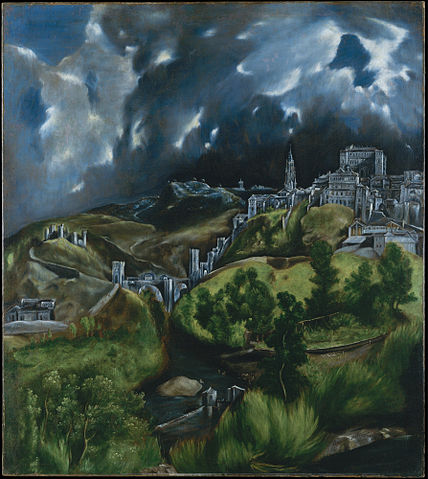
From what I've read, he only did two landscapes, or at least only two still exist. One of them, The View of Teledo, is one of my favorite landscape paintings of all time.
-
07-20-2012, 12:38 AM
#102
Artist and Bibliophile
LOL! You haven't learned yet that I am not a blind follower but I think independently. How many times I have to repeat it?
In other words... you think independent of the facts... or the facts that might contradict your own personal interpretations. Sounds like an approach taken by many with regards to politics.
By the way... I must agree with the comments per your use of emoticons. Such an excessive use comes off like a drum roll after a bad joke.
I am more interested how images affect our mind.
The problem is that there is no "our". Clearly you respond to art in a vastly different way than many others.
After all, Bruno’s The De vinculis in Genere is considered a cornerstone of modern political thought – on the par with Machiavelli’s Prince. In fact, many Anglo Saxon and Middle European historians and intellectuals consider De vinculis in genere modernity’s most intelligent and insightful political work.
Now that was certainly a major and wholly irrelevant digression. I almost found myself thinking (ala Monty Python) "And now for something completely different."
Carl Jung, godfather of art therapy, utilized art making process in therapy.
Who cares? Jung was probably a bigger idiot than Freud, and art therapy has nothing to do with art as created by professional artists.
Goethe, a mason, considered his Theory of Color more profound than his poetry.
Is there any point to these digressions? By the way... if Goethe did indeed believe this, he was wrong. Any artist will tell you that you'll learn far more about color theory by studying the a few paintings by Veronese, Rubens, Ingres, Monet, and Bonnard than from all the collected written theories by Goethe, Albers, and even Matisse.
(Matisse famously went on for pages in discussing his theory of color when asked. He was then told Picasso's answer to the same question about his color theory: "If I don't have red, I use blue." Matisse responded, "I wish I'd said that.")
I don’t even want to talk about Klimt. Egon Schiele has a few interesting paintings but many of his paintings are disgusting.
You forgot the key sentence in Wilde's preface to Doran Gray:
"It is the spectator, and not life, that art really mirrors."
Your disdain and disgust say far more about you than they do about the art work of the artists in question.
I wrote earlier that I was laughing sometimes while I was reading someone’s brain farts. I read carefully, thought about it, and laughed. Only children or immature adults can't think critically. But a psychologically healthy adult moves into Critic stage of development at the age of 20. Many peole are locked in earlier stages of development and never reach this stage or Integrated Faith.
Now there's surely a subtle way to dismiss everything that you personally disagree with... you simply portray such as the product of immature or diseased thinking as opposed to your own advanced development and psychological good health.
Beware of the man with just one book. -Ovid
The man who doesn't read good books has no advantage over the man who can't read them.- Mark Twain
My Blog: Of Delicious Recoil
http://stlukesguild.tumblr.com/
-
07-20-2012, 12:54 AM
#103
Artist and Bibliophile
I looked into El Greco a little more, as I only knew of him by name. I love his bold use of colors, and while his style is simplistic, it manages to convey more emotion than many realistic pieces. After seeing his work, I was quite surprised to see he was a late 16th-early 17th century painter, since it looks more like something out of expressionism.
Back in art school I became quite enamored of El Greco... in part because of his use of tall, narrow formats that I was intrigued with myself:

I was also fascinated with his bold, gestural brushwork... which indeed appears Modernist and Expressionistic. I agree that his use of color appears quite bold... but in actuality he was not much of a colorist. Indeed, he could have said as well as Picasso, "If I don't have red, I use blue." This may owe much to the fact that he studied under Tintoretto... who in spite of his name (his nick-name meant "little dyer" or "little colorist") was perhaps the single Venetian master who was not much attuned with color, and more concerned with the drama of light and dark):

Seeing his works in person as part of a major retrospective a few years back reinforced my recognition of how poor a colorist he was. The worst paintings almost come off like black velvet painting. Nevertheless... the strongest works... such as the View of Toledo... certainly do have a real power... and an almost unearthly, electric energy than one might term "visionary".
Still... I'd take Veronese in a pinch:

By the way... for the experience of Baroque art that seems as if out of its time... give a listen to this... wait until the second movement...
http://www.youtube.com/watch?v=Z9DJpaxT7wg
Last edited by stlukesguild; 07-20-2012 at 12:57 AM.
Beware of the man with just one book. -Ovid
The man who doesn't read good books has no advantage over the man who can't read them.- Mark Twain
My Blog: Of Delicious Recoil
http://stlukesguild.tumblr.com/
-
07-20-2012, 01:13 AM
#104
I'm a big fan of Veronese, and the Wedding at Cana is one of my favorite paintings--I've found I'm a fan of clutter, for lack of a better word. I love works with a lot going on, be it lots of people, objects, colors, etc. Anyways, I saw Wedding at Cana at the Louvre, and was blown away by its immensity. I loved the contrast of it with the Mona Lisa, which is displayed on the opposite wall of the big room (I know you've been there, of course, but maybe the set up has changed). I can't say the same for The Mona Lisa, which was quite underwhelming (a reaction I think most have when finally seeing the actual painting), though it was neat to see what is probably the most famous painting ever.
And I'll listen to that, but when I'm not fighting to stay awake (as my rambling paragraph shows).
-
07-20-2012, 01:50 AM
#105
In other words... you think independent of the facts... or the facts that might contradict your own personal interpretations. Sounds like an approach taken by many with regards to politics.
I don’t have any idea where your interpretation of my words comes from. Hey, why don’t you read carefully my post ….
By the way... I must agree with the comments per your use of emoticons. Such an excessive use comes off like a drum roll after a bad joke.
Thanks for good laugher. No feelings that need to be expressed???? Not healthy for physical and emotional well being.
The problem is that there is no "our". Clearly you respond to art in a vastly different way than many others.
Why don’t you read Giordano Bruno. The first to recognize the importance of Bruno’s text were the Rosicrucians, as indicated in the texts of P. Arnold and F. A. Yates on the movement’s history. He was very perceptitive into human nature and he made his observations from a different angle that modern psychology. I my reiterate that De Vinculis in Genere, is considered a cornerstone of modern political thought – on the par with Machiavelli’s Prince. In fact, many Anglo Saxon and Middle European historians and intellectuals consider De vinculis in genere modernity’s most intelligent and insightful political work.
You will understand why I said ‘our” 
Who cares? Jung was probably a bigger idiot than Freud, and art therapy has nothing to do with art as created by professional artists.
Hey, you have missed my point again. Jung was Gnostic and he got his knowledge from the occult. Rossicrucians, masons, or Steiner and Antroposophy were very interested in occult work of Giordano Bruno and art. Connect the dots.
You know very well that there are a number of painters who were/ are masons or occultists. I have posted a few of them on Mythology and Religion in Art thread but there are much more than that...... Try to think outside of the box. Everything is connected when we start paying attention. Fragmentation is not a good sign.
Your disdain and disgust say far more about you than they do about the art work of the artists in question.
True. You maybe exited to watch Franz von Bayros’ version of masturbation, lesbian sex or his painting of a dog and a naked women. It is similar to India temple’s sculpture and sex with animals. I remember your excitement about sexual freedom in India.  But I have a very different idea about beauty and love. I can’t be more clear than that.
Now there's surely a subtle way to dismiss everything that you personally disagree with... you simply portray such as the product of immature or diseased thinking as opposed to your own advanced development and psychological good health.
Hehehe……you mean that I don’t agree with you. You are right. I don’t but I don’t stop learning about art. I love art very much. BTW, I know several painters, very talented, and we don’t have any problem to understand each other. A few of them share my passion for psychology and think outside of the box. Like attracts alike. 
So, why we go back to art. I have been looking at Jean Delville, (1867 – 1953), Belgian Occultist Symbolism and his painting School of Plato. Very intriguing indeed. All men have feminine feature except Plato. It is similar to Apollo, Dionysus, or Siva or Michelangelo's Ignudi at Sistine Chapel. We hear a lot about transgender. Well, collages even have course about that subject.
He must have been a prophet like Michelangelo, for example.......
School of Plato
http://jeandelville.org/Paintings/Sc...lato/index.htm
More of his paintings.
http://jeandelville.org/Paintings/index.htm
Similar Threads
-
By The Atheist in forum General Chat
Replies: 7032
Last Post: 03-10-2018, 02:20 PM
-
By burmesedays in forum Author List:
Replies: 4
Last Post: 11-16-2014, 11:54 PM
-
By The Atheist in forum Shakespeare, William
Replies: 115
Last Post: 03-02-2014, 04:00 PM
-
By The Comedian in forum General Literature
Replies: 2
Last Post: 04-05-2009, 06:19 PM
-
By IWilKikU in forum General Chat
Replies: 2
Last Post: 02-26-2004, 02:05 PM
Tags for this Thread
 Posting Permissions
- You may not post new threads
- You may not post replies
- You may not post attachments
- You may not edit your posts
-
Forum Rules



