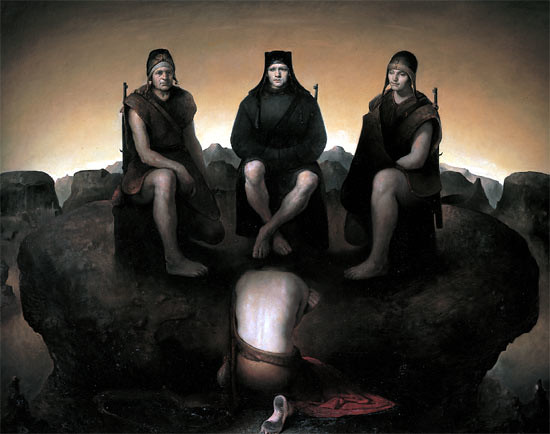
I'd seen that painting of Nerdrum's several times before, but I'd never noticed that the legs were wrong.

I'd seen that painting of Nerdrum's several times before, but I'd never noticed that the legs were wrong.
"So-Crates: The only true wisdom consists in knowing that you know nothing." "That's us, dude!"- Bill and Ted
"This ain't over."- Charles Bronson
Feed the Hungry!

Using the art to explain it was the best tool that was used to explain it to me.
The term "Post-Modernism" was first employed (I believe) in the visual arts... specifically in response to architecture.
I can definitely see how the paintings that you presented would be considered Postmodern (and I really don't like any of them. I think Postmodernism and I arent going to get along but I still want to stick with it so I at least can understand it), but Odd Nerdrum- Seed Protectors spoke to me on a much deeper level than the other paintings. Would you say it is postmodern because of the fact that the artist used different techniques instead of focusing on one classical technique?
If we look at Western art from the 14th century through the late 19th century we find a period of incredible continuity:
Raphael- Portrait of Baldasare Castiglione (Italian Renaissance/early 15th c.)
Peter Paul Rubens- Portrait of Susanna Fourment (Belgian/Catholic/early 17th c.)
Rembrandt- Self Portrait (Dutch/Protestant/1659)
Jean-Baptiste-Siméon Chardin- Self Portrit (French/late 18th century)
Jean Auguste Dominique Ingres-Portrait of Princesse Albert de Broglie (French/mid-19th century)
John Singer Sargent- Portrait of Miss Helen Duinham (American/late 19th c.)
While someone well-versed in art history will be able to discern just when each of the above paintings was produced by various stylistic clues, the reality is that across this entire 500+ year span the stylistic similarities from one major artist to the next remain far greater than the differences. The reason behind this is that for the whole of this period, artist embraced the notion that the highest goal of art was to present a "window upon nature... or visible reality". This resulted in the strengths (as well as the limitations) of Western art. The most important innovations were almost all employed as a means of creating a greater illusion of real, solid form: linear and atmospheric perspective, anatomy, physiology, the development of oil paint, chiaroscuro, overlapping, foreshortening, the use of mirrors and optical lenses... and ultimately: photography. Photography represented the ultimate means of capturing visual reality and as such it also represented the beginning of Modernism and the end of the Western tradition that had begun in the Renaissance.
By way of comparison with the 500+ year span represented by the paintings above, we might take a look at the radical evolution of painting over little more than half a century following the onslaught of Modernism:
Degas- Bather (French/late 1900s)
Bonnard- Bather (French/1907)
Andre Derrain- London (French/early 1900s)
Matisse- Music (French/1910)
Picasso- Girl at the Mirror (Spanish/1932)
Piet Mondrian- Trafalgar Square (Dutch/1943)
Arshile Gorky- The Liver is the Cocks Comb (Armenian-American/1944)
Robert Motherwell- Elegy to the Spanish Republic LXX (American/1961)
The evolution of one artist to the next nearly surpasses the whole of that of the period from the Renaissance through the late 19th century. This is owed to the fact that the central goal of Modernism became to "Make it New" in Ezra Pound's words. The value of Modernism is that it opened up an infinite variety of possibilities to the artist. Perhaps even more importantly, it resulted in a rediscovery and increased appreciation of art work from outside the Western Post-Renaissance tradition. Prior to Modernism, art such as this:
or this:
or this:
or this:
or this:
or this:
... would not have been appreciated or even taken seriously as art. If anything, such works were acknowledged as little more than historical, ethnic, and anthropological "curiosities". Modernism opened up the West to the achievements of other cultures.
continued....
Beware of the man with just one book. -Ovid
The man who doesn't read good books has no advantage over the man who can't read them.- Mark Twain
My Blog: Of Delicious Recoil
http://stlukesguild.tumblr.com/
The main problem with Modernism was brought about by its very fixation with the new. While Modernism opened up art to a myriad of new possibilities, the demand for continual novelty meant that such possibilities needed to be abandoned as outdated as soon as they became accepted. The constant drive for the cutting-edge and the latest style also resulted in reducing art to something akin to the fashion industry and the latest fashions or the marketplace and the marketing of the latest, state of the art model to replace the old worn out/out of fashion one. And ultimately... it resulted in artists finding themselves painted into a corner with very few real possibilities of creating something new.
Post-Modernists recognized the predicament that art had come to, and began to question the overriding obsession with innovation for the sake of innovation... or mere novelty. Odd Nerdrum attended art school during the peak of Modernist theory. His work was openly attacked by professors and his peers alike. Nerdrum, however, was not unaware of Modernism (nor even unappreciative of some Modernist painters) however he felt the need to reject their obsession with formal novelty for the simple reason that he sought to create an art that was broadly accessible. As such, he returned to the techniques of "realism" of the Old Masters which he compared to a lingua franca or universal language. Beyond rejecting the central tenet of Modernism, Nerdrum clearly employs a number of key elements recognizable as "Post-Modernist". As Orphan Pip spoke of "metanarratives" and "metafictions" Nerdrum encloses his narratives within a second illusion... painting in such a manner that his paintings appear ancient and weathered... blurring the old and the new. He also makes free use of themes taken form "high" and "low" sources drawing upon science fiction, fantasy, illustration, film, pornography, etc...
-Barter
-Early Morning
-Dying Couple
-Prophet
- Water Hole
It might be noted that the very imagery... suggesting a post-apocalyptic world ala Mad Max in which humanity struggles to survive and engages in certain crude archaic rituals wholly rejects the faith that Modernism placed in the future: "Better living through technology... chemistry... etc..."
Beware of the man with just one book. -Ovid
The man who doesn't read good books has no advantage over the man who can't read them.- Mark Twain
My Blog: Of Delicious Recoil
http://stlukesguild.tumblr.com/

I don't always read everything stlukes writes about art, but I sure like looking at his posts!
Exit, pursued by a bear.

Really great point. As I was reading this, I thought of how Benjamin Franklin wrote in his autobiography that in order to get better at things, one should imitate something that they like. The more they imitate it, the better they become at it. Soon, they are better than the original which makes them "unique" and seperate from the original. I don't know that I agree with him entirely but his thoughts on developing originality by the imitation of classics instead of outdating them and trying to find uniquness in something else entirely seems more progressive than this modernist thought.Originally Posted by stlukesguild

Could this be related to the skepticism of metanarratives and the idea of a universal truth? The fact that the Old Masters only supported a particular style, which they believed was "a universal language?"The constant drive for the cutting-edge and the latest style also resulted in reducing art to something akin to the fashion industry and the latest fashions or the marketplace and the marketing of the latest, state of the art model to replace the old worn out/out of fashion one. And ultimately... it resulted in artists finding themselves painted into a corner with very few real possibilities of creating something new.
-Modernists recognized the predicament that art had come to, and began to question the overriding obsession with innovation for the sake of innovation... or mere novelty. Odd Nerdrum attended art school during the peak of Modernist theory. His work was openly attacked by professors and his peers alike. Nerdrum, however, was not unaware of Modernism (nor even unappreciative of some Modernist painters) however he felt the need to reject their obsession with formal novelty for the simple reason that he sought to create an art that was broadly accessible. As such, he returned to the techniques of "realism" of the Old Masters which he compared to a lingua franca or universal language. Beyond rejecting the central tenet of Modernism, Nerdrum clearly employs a number of key elements recognizable as "Post-Modernist". As Orphan Pip spoke of "metanarratives" and "metafictions" Nerdrum encloses his narratives within a second illusion... painting in such a manner that his paintings appear ancient and weathered... blurring the old and the new. He also makes free use of themes taken form "high" and "low" sources drawing upon science fiction, fantasy, illustration, film, pornography, etc...
I'm also wondering how Postmodern theory is tied into race. The class that I am currently taking is called Black Literary Postmodernism and there are a lot of arguments made by Postmodern theorists that PoMo leaves out entire classes and races of people. Most of the readings that I have to do are primarily centered about American minorities (predominantly African Americans) feeling like they need to represent the marginalized in order to be given any credibility by the middle/upperclass whites and even lower class blacks. An example would be how a black author would need to write about black poverty becuase that is what society expects black authors to write about. If she wanted to write about something different, it would be unaccepted by both communties: the white community because it is not expected that a topic other than nihilism or black poverty would be written by a black author, and also the black community becuase they would feel seperated from the author because of a difference in class. Do you think this fits in with Postmodernist theory? I am having a hard time grasping it.
Last edited by PMLondonderry; 02-09-2012 at 10:17 AM.
"If I knew for a certainty that a man was coming to my house with the conscious design of doing me good, I should run for my life." -Thoreau
Ní mar a dtarraingím mo chuid anála ach mar a dtugaim mo ghrá a bhfuil mé i mo chónaí
(Not where I breathe but where I love, I live)

before i make a comment on the topic and forget - this post amazed me. Beautiful examples!
Lyotard's definition of postmodernity as "incredulity towards meta-narratives" is a widely accepted definition of the term.
I will attempt to explain to the best of my understanding.
Throughout history, reality as experienced has been veiled by meta-narratives as a way of organizing, understanding and institutionalizing our perception of it. Simply put (and this is a stretch), meta-narratives can be understood as ideologies. These ideologies are vying for dominance as the definite, all-encompassing, all-engrossing abstract (or distillation) of the natural world. Religion would be an example of such.
Postmodern theory efficiently substitutes "ideology" for "narrative" to assert the fallaciousness of these constructions. As such, the "meta" property of these ideologies are rejected due to the subjectivity of their constructions and usurped from their proverbial throne. The postmodern stance would then be one of incredulity towards the meta-narratives claim of absolute truth. In a way, all subjective truths are valid.
Thus, the claim spawned by the age of reason that humanity is always progressing is rejected (here it is perhaps goes awry from modernity). This is why, perhaps, postmodern art borrows so heavily from divergent eras and artists in order to create a pastiche - this hybrid can potentially yield something new.
This view was grounded by the advent of structuralism (Levi-Strauss) - where all can be reduced to binary oppositions - and psychoanalysis - where the human psyche is fragmented and layered (conscious, sub/un-conscious), and developments in other disciplines (such as semiotics - DeSaussure, Roland Barthes). Reality, as perceived by the subject, is filtered through a complex sign system independent to the individual as acquired in his experience with society, and thus, partially (!) overlapping with other individuals.
In this multi-layered and fragmented reality, man is an interpreter of symbols.
Our current society is often criticized by contemporary pm thinkers as a symbol whose referent is another symbol - thus, the essence so to speak is gone (see Baudrillard's Simulacrum theory). This blurs the boundaries between reality and fiction (Vonnegut - period).A prime example of such in art would be Tarantino's "Inglorious Basterds". It invokes a historical time period, manipulates it as it pleases, and creates a pastiche fusing other movies. But then again, pm critics often discredit the validity of history.
Alright, I can't go on anymore. Hope this was helpful.
Last edited by the facade; 02-09-2012 at 04:34 PM.
A good analysis. Modernism ended with structuralism. Very good points throughout. People are symbolic. Can't go beyond that except in science and not even there very far. Semiology is over because in depth, icon, symbol and sign are the same depending on what tickles the interpreter.
I think postmodernist literature ask encompasses the experimental genres. As the term postmodern can be quite vague, works attempting to defy categorization may inevitably be categorized as not only experimental but also postmodern.
Consider projects like TheNewerYork:
http://www.kickstarter.com/projects/...we-m-w-yor-had
they attempt to find beauty or merit in all types of text that don't receive conventional literature status.
I agree with you. But the categorizations will not be cultural. That's a giant leap ahead.
The best and most accurate manner of describing what post-modernism is for academians of critical thought, is this symbol:


This might help:
http://owl.english.purdue.edu/owl/resource/722/08/

I have my doubts as to whether PoMo is really a meaningful term as it applies to literature and I have yet to hear any set of characteristics or features that applies across the board to works routinely dumped into this promiscuous grab bag of a category.
Thanks to Luke for the images! A number of intriguing leads to follow up there . . .

You actually took words right out of my mouth!
I sang of leaves, of leaves of gold, and leaves of gold there grew.
Much of what we are reading says the story is set in a specific time period, but deals with modern issues. For example The Pagoda by Patricia Powell is a story set in 1850 Jamaica and deals with Transgender issues, Oxherding Tale is a neo-slave narrative that deals with feminism, Black Nationalism, and many other issues that havent actually been put into academic study until much later. The language used in the book also feels as though it doesn't belong. Modern slang is used and the particular dialect used during the 1850s is ignored entirely. There were many times while reading these stories that I had to stop picturing my characters in jeans and t-shirts and try to remember that they were living in 1850 Jamaica and Antebellum South.
"If I knew for a certainty that a man was coming to my house with the conscious design of doing me good, I should run for my life." -Thoreau
Ní mar a dtarraingím mo chuid anála ach mar a dtugaim mo ghrá a bhfuil mé i mo chónaí
(Not where I breathe but where I love, I live)
 Posting Permissions

 Reply With Quote