Buying through this banner helps support the forum!
Page 8 of 12 FirstFirst ... 3456789101112 LastLast
Results 106 to 120 of 172

Thread: mythology and religion in art

  1. #106
    Artist and Bibliophile stlukesguild's Avatar
    Join Date
    Jul 2006
    Location
    The USA... or thereabouts
    Posts
    6,083
    Blog Entries
    78
    Dragons vary across art history... and certainly they vary between cultures. Japanese and Chinese dragons tend to appear far more formidable. They tend to be snake-like with long, twisting bodies and small arms and legs, and they can be found in the clouds, in the mountains, in the ocean, etc...


    The European dragon tends to be smaller. It should be remembered that the European artists concept of animals did not include lions or elephants. Perhaps the largest beast of prey they would have been familiar with would have been the Wolf and the Bear... and even then, the larger bear, such as the Grizzly and the Brown Bear would not have been known to most of Europe. Many of the image prior to the late Renaissance or even the Baroque (1600s) suggest little knowledge even of a creature such as the lion:


    It should also be recognized that the dragon, in many cases, simply represented Satan. St. George's defeat of the dragon was interpreted as St. George/Christianity defeating Satan and paganism. It has even been interpreted as the British defeat of the pagan Irish/Celts. The dragon, after all, was quite a common creature in pre-Christian literature and remained a common motif in Celtic/Anglo/Scandinavian art... his snake-like body often hidden... woven through the ornate twisting, decorative details of illuminated manuscripts...


    even abstracted into pure interwoven knots:


    and also found in architectural details:


    As the dragon represented Satan, scale was irrelevant to the danger of this beast:


    He might certainly take a larger size if he so wished... as he does in a number of images of the dragon as the Anti-Christ... or the Beast (Θηρίον) from the Book of Revelations:


    William Blake makes the link between the dragon/the beast/Satan more obvious:


    A good many medieval paintings and sculpture present a sizable image of the dragon/Satan devouring an entire slew of sinners:


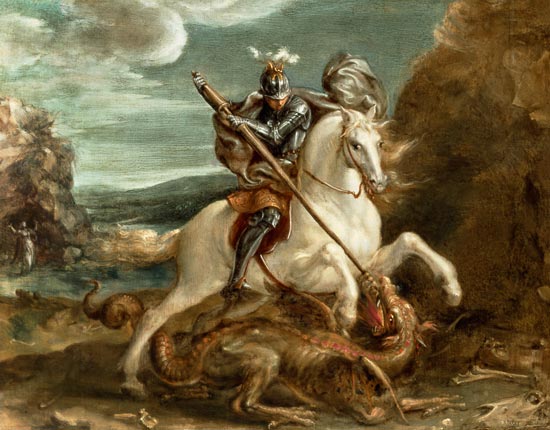
    I'm especially fond of these medieval representations of the Dragon... but perhaps my favorite painting of a dragon has to be that by the Italian Mannerist, Giovanni Antonio Bazzi, known as Il Sodoma:


    Il Sodoma's St. George and the Dragon is an absurdly and deliciously over-the-top representation of the St. George narrative worthy of a ridiculously funny comic opera. St. George charges the pathetically puny dragon that is as twisted upon itself as any Celtic knot with his candy-cane lance that's hardly big enough for the dragon to use as a toothpick to clean his teeth of the remains of his horrific dinner (the remains of which... heads and arms... lie strewn around). George's buck-toothed steed appears far more dangerous than the dragon or George's lance. Standing to the side of the action, the poor "damsel in distress" warbles deliciously as any good comic operatic diva should. The painting is pure, unadulterated camp. Every time I see it I cannot help but think of the scene of the killer rabbit from Montey Python's Holy Grail.

    Il Sodoma was a master of camp. Reputedly so open with regard to his homosexual behavior that it earned him his pseudonym, the artist is also well-known for his equally campy St. Sebastian which essentially established the motif as a Sado-Masochistic, Homo-erotic icon:


    Sebastian's tear-filled big eyes looking to the heavens above is worthy of a slew of Victorian paintings of tearful pre-pubescent female saints and Madonnas.
    Beware of the man with just one book. -Ovid
    The man who doesn't read good books has no advantage over the man who can't read them.- Mark Twain
    My Blog: Of Delicious Recoil
    http://stlukesguild.tumblr.com/

  2. #107
    Banned
    Join Date
    Jun 2011
    Location
    Where the rain doesn't stop.....
    Posts
    763
    Blog Entries
    1

    Dionysus, Sabazios, and Cybele

    Quote Originally Posted by ftil View Post
    DIONYSUS IDENTIFIED WITH FOREIGN GODS

    Dionysus was identified with the Thraco-Phrygian god Sabazios, Egyptian Osiris, Phoenician Tammuz and the Roman god Liber, amongst others.


    Sabazios is the nomadic horseman and sky father god of the Phrygians and Thracians. In Indo-European languages, such as Phrygian, the -zios element in his name derives from dyeus, the common precursor of Latin deus ('god') and Greek Zeus. Though the Greeks interpreted Phrygian Sabazios with both Zeus and Dionysus, representations of him, even into Roman times, show him always on horseback, as a nomadic horseman god, wielding his characteristic staff of power.
    http://en.wikipedia.org/wiki/Sabazios

    SABAZIOS (THRACO-PHRYGIAN GOD)

    Herodotus, Histories 5. 7 (trans. Godley) (Greek historian C5th B.C.) :
    "They [the Thrakians] worship no gods but Ares, Dionysus [Sabazios], and Artemis [Bendis]. Their princes, however, unlike the rest of their countrymen, worship Hermes [Zalmoxis] above all gods and swear only by him, claiming him for their ancestor."

    Cicero, De Natura Deorum 3. 21- 23 (trans. Rackham) (Roman rhetorician C1st B.C.) :
    "The [god identified with Dionysus] father of the third [Phrygian Sabazios] is Cabirus; it is stated that he was king over Asia, and the Sabazia were instituted in his honor. The fourth [the Thraco-Orphic god Sabazios] is the son of Jupiter [Thrakian sky-god] and Luna [Bendis]; the Orphic rites are believed to be celebrated in his honor."
    http://www.theoi.com/Olympios/Dionysos.html

    Thracian/Phrygian Sabazios

    It seems likely that the migrating Phrygians brought Sabazios with them when they settled in Anatolia (ca. 1200 BC?) and that the god's origins are to be looked for in Macedonia and western Thrace. The Macedonians were noted horseman, horse-breeders and horse-worshippers into the time of Philip II.

    Transformation to Sabazios

    The naturally syncretic approach of Greek religion blurred distinctions. Later Greek writers, like Strabo, 1st century AD, linked Sabazios with Zagreos, among Phrygian ministers and attendants of the sacred rites of Rhea and Dionysus. (Strabo, 10.3.15). Strabo's Sicilian contemporary, Diodorus Siculus, conflates Sabazios with the secret 'second' Dionysus, born of Zeus and Persephone (Diodorus Siculus, 4.4.1). The Clement of Alexandria had been informed that the secret mysteries of Sabazios, as practiced among the Romans, involved a serpent, a chthonic creature unconnected with the mounted skygod of Phrygia: "‘God in the bosom’ is a countersign of the mysteries of Sabazios to the adepts, " Clement reports (Protrepticus, 1, 2, 16). "This is a snake, passed through the bosom of the initiates”.

    Much later, the Greek encyclopedia, Sudas (10th century?), flatly states "Sabazios... is the same as Dionysus. He acquired this form of address from the rite pertaining to him; for the barbarians call the bacchic cry 'sabazein'. Hence some of the Greeks too follow suit and call the cry 'sabasmos'; thereby Dionysus [becomes] Sabazios. They also used to call 'saboi' those places that had been dedicated to him and his Bacchantes
    http://www.mlahanas.de/Greeks/Mythology/Sabazios.html


    Sabazios

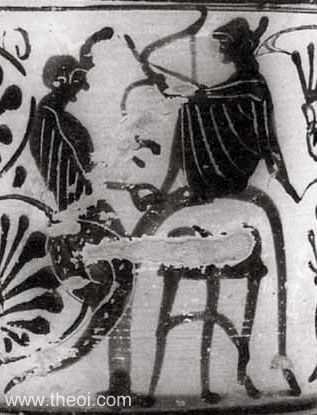
    The god was represented on a horseback battling the chthonic serpent or he was often sitting on a throne holding his staff of power.
    His appearance was a majestic one, another time a soft and an effeminate one because a part of his myth and cult was his self-castration, including the god´s annual death and revival. Sabazios was often surrounded by the goddess Cybele or (especially in Greek iconography) by Demeter and Persephone. His cult (similarly, like the one of Cybele or Dionysus) was also accompanied by some musicians and ecstatic dancers who were keeping the small snakes with heads raised up. Sometimes we can even observe a snake twisting near the god´s throne. The chthonic animals (including a horned snake, a frog, a tortoise, a lizard), as well as the triple Hecate, the bust of Mercury and the caduceus, the symbols of the sun and the moon, the zodiac symbols, and even a head of a ram on an altar, as a pine cone and some Greek inscriptions, appeared around the god on some representations. These attributes often decorated the reliefs and small votive hands which are associated with the cult of Sabazios in the Roman sites.
    http://www.anistor.gr/english/enback...nistoriton.pdf


    Bronze hand used in the worship of Sabazios (British Museum). Roman 1st-2nd century CE. Hands decorated with religious symbols were designed to stand in sanctuaries or, like this one, were attached to poles for processional use.


    Early conflict between Sabazios and his followers and the indigenous Mother Goddess of Phrygia (Cybele) is reflected in Homer's brief reference to the youthful feats of Priam, who aided the Phrygians in their battles with Amazons.
    http://www.mlahanas.de/Greeks/Mythology/Sabazios.html


    Thracian horseman is the conventional term for a recurring motif from the iconography of Paleo-Balkanic mythology during the Roman era.
    The tradition is attested from Thrace to Moesia and Scythia Minor, also known as the "Thracian Heros", at Odessos (Varna) attested by a Thracian name as Heros Karabazmos, a god of the underworld usually depicted on funeral statues as a horseman slaying a beast with a spear.

    Sabazios, the Thracian reflex of Indo-European Dyeus, identified with Heros Karabazmos, the "Thracian horseman". He gained a widespread importance especially after the Roman conquest. After Christianity was adopted, the symbolism of Heros continued as representations of Saint George slaying the dragon (compare Uastyrdzhi/Tetri Giorgi in the Caucasus).

    http://www.answers.com/topic/thracian-horseman

    Heros /hero/ – a Thracian god of hunting, fertility, life and death, all-knowing and all-hearing god – all-god.
    The cult of the Thracian horseman was widely spread during the Roman Age, which indicates a renaissance of the Thracian religion at that time – something unknown for the other peoples under Roman domination. Its figure is well known thanks to the numerous historical records from the Roman Age, 1st-4th century AD – young horseman with a spear and shield or with killed game in his hands, followed by a servant, dog and a lion. As an all-knowing and all-hearing god he was portrayed with two or three faces. Due to the mixture of various religions the Thracian horseman was often depicted as a Greek god – Apollo, Asclepius, Zeus, Dionysus, etc., and as the Old Iranian god Mithra, as well as with some of their attributes – lyre (Apollo), single snake staff (Asclepius), impressive beard (Zeus), Phrygian cap (conical cap with its top pulled forward – Mithra), etc. The image of the Thracian horseman served as a base for Christian Saint George.
    http://ancient-treasure.info/ancient...-horseman.html


    "Thracian horseman" relief with Latin inscription at Philippi.
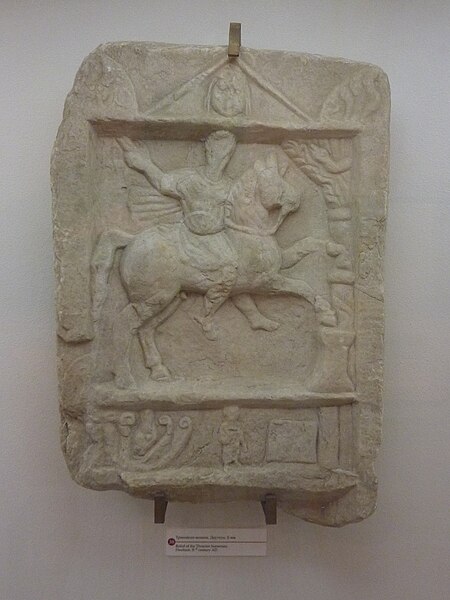


    A "Thracian rider" relied from the collection of the Burgas Archaeological Museum. 2nd century AD


    Romanian National History Museum Thracian horseman


    Thracian horseman in National Historical Museum Bulgaria


    Raffaello Sanzio, Saint George and the Dragon


    Saint George, Gustave Moreau.


    Vitale da Bologna, St. George 's Battle with the Dragon


    Paolo Uccello


    Paolo Uccello


    Hans von Aachen "St. George slaying the dragon"
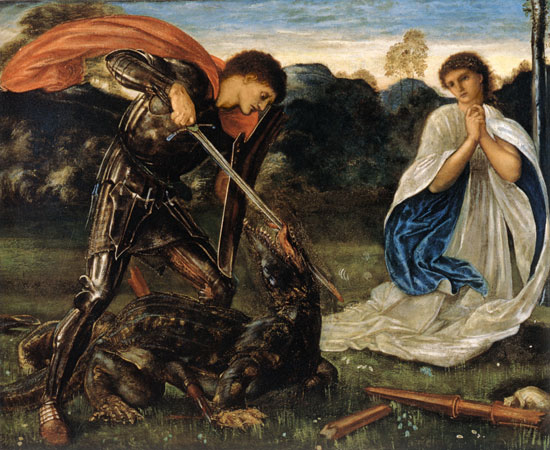


    St. George and the Dragon, Edward Burne-Jones


    Saint George and the Dragon at Casa Amatller


    St. George in the New Church St. Margaret, Munich-Sendling, early 16th century.


    Liberty Monument (St George slaying the dragon) in Tbilisi



    Let’s go back to Dionysus, Sabazios and his mother Cybele. There is much more about Dionysus.

    From post # 101
    TAUGHT THE ORGIES BY RHEA-KYBELE IN PHRYGIA

    Pseudo-Apollodorus, Bibliotheca 3. 33 :
    "He [the young god Dionysus] went to Cybela in Phrygia. There he was purified by Rhea (Cybela) and taught the mystic rites of initiation, after which he received from her his gear and set out eagerly through Thrake [where he introduced the orgiastic cult]."
    http://www.theoi.com/Olympios/Dionysos.html


    The Phrygian goddess Cybele was the mother of Sabazios (the Phrygian equivalent of Dionysus). The Greeks adapted this tradition by describing Mother Rhea as the nurse and mentor of Dionysus. The Orgia (Orgiastic Cult) of Dionysus-Sabazios was derived from that of the Phrygian Meter Theon.
    CYBELE was the great Phrygian mother of the gods, a goddess of fertility, motherhood and the mountain wilds. Her orgiastic cult dominated the central and north-western districts of Asia Minor, and was introduced into Greece via the island of Samothrake and the Boiotian town of Thebes.
    Cybele was closely associated with a number of Greek goddesses, firstly Rhea, the Greek mother of the gods (Meter Theon), but sometimes also Demeter (especially in the Samothrakian cult), Aphrodite (on Mt Ida) and Artemis (in Karia).
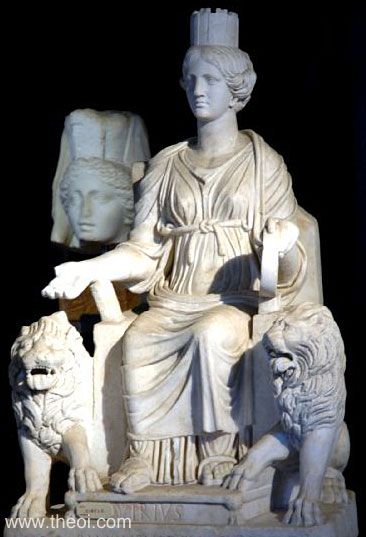
    Cybele was portrayed in classical sculpture as a matronly woman with a turret-crown, enthroned and flanked by lions.
    The Orgia (Orgiastic festivals) of the Meter Theon were introduced into Greece from Phrygia via the island of Samothrake. They were closely related to those of Dionysus, whose Phrygian form, Sabazios, was named as a son of the goddess.
    http://www.theoi.com/Cult/KybeleCult.html


    RHEA-CYBELE


    SUMMARY

    Rhea-Kybele, the mother of the gods, with turret crown, enthroned and flanked by lions.


    RHEA-CYBELE

    Museum Collection: The J. Paul Getty Museum, Malibu, California, USA
    Date: ca 50 AD
    Period: Imperial Roman

    SUMMARY

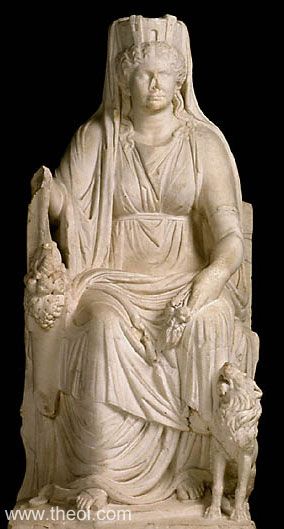
    Rhea-Kybele, the mother of the gods, with turret crown, enthroned, holding a bouquet of wheat and poppy heads and flanked by a fruit-brimming cornucopia (horn of plenty), rudder and small lion. (NB Most of these attributes are similar to those of Demeter and Tykhe).


    The Thracians conceived the chief divinity of the Samothracian and Lemnian mysteries as Rhea-Hecate, while some of them who had settled in Asia Minor, became there acquainted with still stranger beings, and one especially who was worshipped with wild and enthusiastic solemnities, was found to resemble Rhea. In like manner the Greeks who afterwards settled in Asia identified the Asiatic goddess with Rhea, with whose worship they had long been familiar (Strab. x. p. 471; Hom. Hymn. 13, 31). In Phrygia, where Rhea became identified with Cybele, she is said to have purified Dionysus, and to have taught him the mysteries (Apollod. iii. 5. § 1), and thus a Dionysian element became amalgamated with the worship of Rhea. Demeter, moreover, the daughter of Rhea, is sometimes mentioned with all the attributes belonging to Rhea. (Eurip. Helen. 1304.) The confusion then became so great that the worship of the Cretan Rhea was confounded with that of the Phrygian mother of the gods, and that the orgies of Dionysus became interwoven with those of Cybele. Strangers from Asia, who must be looked upon as jugglers, introduced a variety of novel rites, which were fondly received, especially by the populace (Strab. 1. c.; Athen. xii. p. 553 ; Demosth. de Coron. p. 313). Both the name and the connection of Rhea with Demeter suggest that she was in early times revered as goddess of the earth . . .
    http://www.theoi.com/Phrygios/Kybele.html


    The Phrygian Orgia were overseen by eunuch priests called Gallai, who led devotees in nocturnal mountain rites involving much drinking, and frantic dancing accompanied by the music of rattles, kettledrums, flutes and castanets and the ritual cry 'evoe saboe,' 'hyes attes, attes hyes'. Young men armed with shield and sword also performed the high-footed, shield-clashing Korybantic dance (which Greek legend described as the dance of the Kourete-protectors of the infant Zeus). The rites also involved ritual mutilation, ranging from flagellation to the act of self-castration performed by the Gallai priests.

    Greek Lyric V Anonymous, Fragments 1030 (from Hephaestion, Handbook on Metres) (trans. Campbell) (Greek lyric B.C.) :
    "Gallai [eunuch priests] of the Meter Oreias (Mountain Mother), thyrsus-loving, racing, by whom instruments and bronze cymbals are clashed."

    "Socrates: The Korybantian revellers [of the Meter Theon] when they dance are not in their right mind ... by divine inspiration and by possession; just as the Korybantian revellers too have a quick perception of that strain only which is appropriated to the god by whom they are possessed, and have plenty of dances and words for that, but take no heed of any other." - Plato, Ion

    Apollonius Rhodius, Argonautica 1. 1076 ff (trans. Rieu) (Greek epic C3rd B.C.) :
    "[The Argonauts celebrate the orgies of the Meter Theon on Mt Didymnos near Kyzikos in Mysia :] Standing in the woods, there was an ancient vine with a massive trunk withered to the roots. They cut this down to make a sacred image of the Mountain Goddess; and when Argos had skillfully shaped it, they set it up on a rocky eminence under the shelter some tall oaks, the highest trees that grow, and made an altar of small stones near by. Then, crowned with oak-leaved, they began the sacrificial rites, invoking the Meter Dindymene (Mother of Mt Dindymos), most worshipful, who dwells in Phrygia; and with her, Titias and Kyllenos. For these two are singled out as dispensers of doom and assessors to the Meter Idaia (Mother of Mt Ida) . . .
    Jason, pouring libations on the blazing sacrifice, earnestly besought the goddess to send the stormy winds elsewhere. At the same time, by command of Orpheus, the younger men in full armor moved round in a high-stepping dance, beating their shields with their swords to drown the ill-omened cries that came up from the city, where the people were still waiting for their king [i.e. Kyzikos, king of the Doliones, who was accidentally killed by the Argonauts]. This is why the Phrygians to this day propitiate Rhea with the tambourine and drum. The goddess they invoked observed the flawless sacrifice with pleasure."


    Ovid, Fasti 4. 181 ff (trans.Boyle) (Roman poetry C1st B.C. to C1st A.D.) :
    "[The festival of the Meter Theon in Rome :] April 4 Megalensia Ludi Comitailis . . . Then the Berecyntian flute’s curved horn will blow and the Idaean Mother’s [Rhea’s] feast begin. The eunuchs will parade and pound the hollow drums, and their clashing bronze cymbals will ring. She will ride on the soft necks of her acolytes, howled along the city’s major streets . . . the Great Goddess loves incessant din . . . Her acolytes howl and the maddening flute blows, and dainty hands pound the cowhide drums . . .
    `But why do we call the self-castrated Galli, when the Gallic land is far from Phrygia?'`Between,' she says, `green Cybele and high Celaenae [in Phrygia] runs a stream of bad water named Gallus. Its taste causes madness. Keep away, if you want a healthy mind. Its taste causes madness.' `Aren't they ashamed,' I said, `to place a herb salad before the Mistress? Or is there some cause?' `The ancients are said to have dieted on pure milk and on herbs produced by the earth itself, White cheeses,' she says, `are mingled with pounded herbs, so the primal goddess sees primal food.'"

    SACRED PLANTS

    Ovid, Metamorphoses 10. 103 ff (trans. Melville) (Roman epic C1st B.C. to C1st A.D.) :
    "Pines, high-girdled, in a leafy crest, the favorite of the Gods’ Great Mother (Grata Deum Matri), since in this tree Attis Cybeleius doffed his human shape and stiffened in its trunk."

    SACRED BIRDS & ANIMALS
    I) HAWK Sacred Bird
    Aelian, On Animals 12. 4 (trans. Schofield) (Greek natural history C2nd to 3rd A.D.) :
    "There are in fact several species of Hawks . . . They are allotted separately to many gods. The partridge-catcher . . . is the servant of Apollon . . . [and] to the Meter Theon (Mother of the Gods) they assign the mermnus, and to one god one bird, to another another."

    II) LION Sacred Animal

    Pausanias, Description of Greece 8. 44. 5 (trans. Jones) (Greek travelogue C2nd A.D.) :
    "Near the source of the Alpheios [in Arkadia] is a temple of the Meter Theon (Mother of the Gods) without a roof, and two lions made of stone."

    RHEA COMPANIONS: PAN
    The mountain-dwelling, goat-footed god of the herds was a companion of Rhea in Arkadian myth.

    Pindar,Maiden Songs Fragment 95 (trans. Sandys) (Greek lyric C5th B.C.) :
    "O Pan, that rulest over Arkadia, and art the warder of holy shrines . . . thou companion of the Megale Mater (Great Mother)."
    http://www.theoi.com/Cult/KybeleCult.html

  3. #108
    Bibliophile JBI's Avatar
    Join Date
    Feb 2007
    Location
    Toronto
    Posts
    6,360
    The idea of an Eastern dragon is a misconception - the mythological dragon of the West and the mythological dragon of the east have little in common other than the fact that they have scales (usually). It's a useful name as translation, but doesn't actually define the beast.

  4. #109
    Banned
    Join Date
    Jun 2011
    Location
    Where the rain doesn't stop.....
    Posts
    763
    Blog Entries
    1
    Quote Originally Posted by JBI View Post
    The idea of an Eastern dragon is a misconception - the mythological dragon of the West and the mythological dragon of the east have little in common other than the fact that they have scales (usually). It's a useful name as translation, but doesn't actually define the beast.
    Thank you for your feedback. But let me finish with Dionysus. I will look at dragons later as it seems an interesting subject.

  5. #110
    Bibliophile JBI's Avatar
    Join Date
    Feb 2007
    Location
    Toronto
    Posts
    6,360
    Quote Originally Posted by ftil View Post
    Thank you for your feedback. But let me finish with Dionysus. I will look at dragons later as it seems an interesting subject.
    It was intended as a reply to St. Lukes, who mentions how dragons vary between countries; my point was to illustrate how often what we call variance is a case of two completely different entities with similar physical appearance.

  6. #111
    Banned
    Join Date
    Jun 2011
    Location
    Where the rain doesn't stop.....
    Posts
    763
    Blog Entries
    1
    Quote Originally Posted by JBI View Post
    It was intended as a reply to St. Lukes, who mentions how dragons vary between countries; my point was to illustrate how often what we call variance is a case of two completely different entities with similar physical appearance.
    I understand that you replied to St. Lukes post. I ask you let me finish because I like continuity of the thread. I understand that a few members are fascinated with dragons. I would rather focus on Goddess and Gods. But I will look at dragons later.

  7. #112
    Artist and Bibliophile stlukesguild's Avatar
    Join Date
    Jul 2006
    Location
    The USA... or thereabouts
    Posts
    6,083
    Blog Entries
    78
    Be wary, JBI... ftil has something of a pathological need to control the development of any conversation. You will notice she quoted her own thread... complete with a couple dozen images... immediately following my posting... just in case someone missed it the first time and might actually end up responding to my posting, which was woefully "off topic".

    Perhaps I should do the same thing and quote my entire post so that I might post it again.
    Beware of the man with just one book. -Ovid
    The man who doesn't read good books has no advantage over the man who can't read them.- Mark Twain
    My Blog: Of Delicious Recoil
    http://stlukesguild.tumblr.com/

  8. #113
    Banned
    Join Date
    Jun 2011
    Location
    Where the rain doesn't stop.....
    Posts
    763
    Blog Entries
    1
    Quote Originally Posted by stlukesguild View Post
    Be wary, JBI... ftil has something of a pathological need to control the development of any conversation. You will notice she quoted her own thread... complete with a couple dozen images... immediately following my posting... just in case someone missed it the first time and might actually end up responding to my posting, which was woefully "off topic".

    Perhaps I should do the same thing and quote my entire post so that I might post it again.
    Thank you for your honesty. But you are making assumptions again and you are wrong. We had recently discussion about it and I am tired of repeating myself.

    You got it right that I quoted my post. I did on purpose to continue about Sabazios and Cybele. There are so many gods and it makes easer to do this way. Secondly, I wrote several times that you and I have a very different approach to art. I don’t like influence people what I think, therefore I have opened my tread. I explained in detail my position here and on your art tread. Why don’t we respect difference?

    You have your Ovid and Metamorphosis tread. Sadly, it is dead for a longer while. You may enjoy posting your way and I may continue my way that is very different than yours. As adults, we should respect others needs, shouldn’t we?

    Finally, I am not very fond of dragons and it is nothing wrong about that. I have already posted about Chimers, Griffin, and Harpies to name a few and I want to keep some balance.

    So, who is controlling?

  9. #114
    Banned
    Join Date
    Jun 2011
    Location
    Where the rain doesn't stop.....
    Posts
    763
    Blog Entries
    1

    St. George

    The iconic image of St. George on horseback trampling the serpent-dragon beneath him is considered to be similar to these pre-Christian representations of Sabazios, the mounted god of Phrygia and Thrace.
    http://en.wikipedia.org/wiki/Saint_G...and_the_Dragon
    Sabazios, the Thracian reflex of Indo-European Dyeus, identified with Heros Karabazmos, the "Thracian horseman". He gained a widespread importance especially after the Roman conquest. After Christianity was adopted, the symbolism of Heros continued as representations of Saint George slaying the dragon (compare Uastyrdzhi/Tetri Giorgi in the Caucasus).

    http://www.answers.com/topic/thracian-horseman

    Let’s look at St. George again since he got lots of attention in art.


    Saint George (ca. 275/281 – 23 April 303) was, according to tradition, a Roman soldier from Syria Palaestina and a priest in the Guard of Diocletian, who is venerated as a Christian martyr.

    The episode of Saint George and the Dragon appended to the hagiography of Saint George was Eastern in origin, brought back with the Crusaders and retold with the courtly appurtenances belonging to the genre of Romance. The earliest known depictions of the motif are from tenth- or eleventh-century Cappadocia and eleventh-century Georgia; previously, in the iconography of Eastern Orthodoxy, George had been depicted as a soldier since at least the seventh century. The earliest known surviving narrative of the dragon episode is an eleventh-century Georgian text.
    http://en.wikipedia.org/wiki/Saint_George


    According to the Golden Legend the narrative episode of Saint George and the Dragon took place in a place he called "Silene," in Libya; the Golden Legend is the first to place this legend in Libya as a sufficiently exotic locale, where a dragon might be imagined. In the tenth-century Georgian narrative, the place is the fictional city of Lasia, and it is the godless Emperor who is Selinus.
    The town had a pond, as large as a lake, where aplague-bearing dragon dwelled that envenomed all the countryside. To appease the dragon, the people of Silene used to feed it two sheep every day, and when the sheep failed, they fed it their children, chosen by lottery. It happened that the lot fell on the king's daughter, who is in some versions of the story called Sabra. The king, distraught with grief, told the people they could have all his gold and silver and half of his kingdom if his daughter were spared; the people refused. The daughter was sent out to the lake, decked out as a bride, to be fed to the dragon.
    Saint George by chance rode past the lake. The princess, trembling, sought to send him away, but George vowed to remain. The dragon reared out of the lake while they were conversing. Saint George fortified himself with the Sign of the Cross, charged it on horseback with his lance and gave it a grievous
    wound. Then he called to the princess to throw him her girdle, and he put it around the dragon's neck. When she did so, the dragon followed the girl like a meek beast on a leash.
    She and Saint George led the dragon back to the city of Silene, where it terrified the people at its approach. But Saint George called out to them, saying that if they consented to become Christians and be baptized, he would slay the dragon before them. The king and the people of Silene converted to Christianity, George slew the dragon, and the body was carted out of the city on four ox-carts. "Fifteen thousand men baptized, without women and children." On the site where the dragon died, the king built a church to the Blessed Virgin Mary and Saint George, and from its altar a spring arose whose waters cured all disease.
    http://en.wikipedia.org/wiki/Saint_G...and_the_Dragon

    Other researchers have proposed a different interpretation of St George and the Dragon origin.


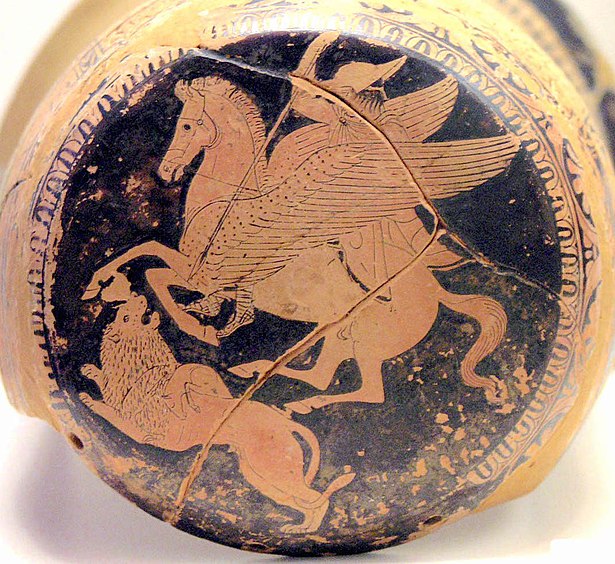
    According to Christopher Booker it is more likely, however, that the "George and the Dragon" story is a medieval adaptation of the ancient Greek myth of Perseus and Andromeda—evidence for which can be seen in the similarity of events and locale in both stories. In this connection, the Perseus and Andromeda myth was known throughout the Middle Ages from the influence of Ovid. In imagery, other Greek myths also played a role. "Medieval artists used the Greco-Roman image of Bellerophon and the Chimaera as the template for representations of Saint George and the Dragon."
    http://en.wikipedia.org/wiki/Saint_G...and_the_Dragon


    Edward Burne-Jones, Perseus Cycle 7: The Doom Fulfilled


    Titian, Perseus and Andromeda


    Paul Véronese, Perseus and Andromeda


    Bellerophon on Pegasus spears the Chimera, on an Attic red-figure epinetron, 425–420 BC


    These myths in turn may derive from an earlier Hittite myth concerning the battle between the Storm God Tarhun and the dragon Illuyankas. Such stories also have counterparts in other Indo-European mythologies: the slaying of the serpent Vritra by Indra in Vedic religion, the battle between Thor and Jörmungandr in the Norse story of Ragnarok, the Greek account of the defeat of the Titan Typhon by Zeus.
    http://en.wikipedia.org/wiki/Saint_G...and_the_Dragon


    Zeus and Typhon


    Parallels also exist outside of Indo-European mythology, for example the Babylonian myths of Marduk slaying the dragon Tiamat. The book of Job 41:21 speaks of a creature whose "breath kindleth coals, and a flame goeth out of his mouth."
    http://en.wikipedia.org/wiki/Saint_G...and_the_Dragon


    Marduk and the Dragon
    Marduk, chief god of Babylon, with his thunderbolts destroys Tiamat the dragon of primeval chaos.

  10. #115
    Banned
    Join Date
    Jun 2011
    Location
    Where the rain doesn't stop.....
    Posts
    763
    Blog Entries
    1
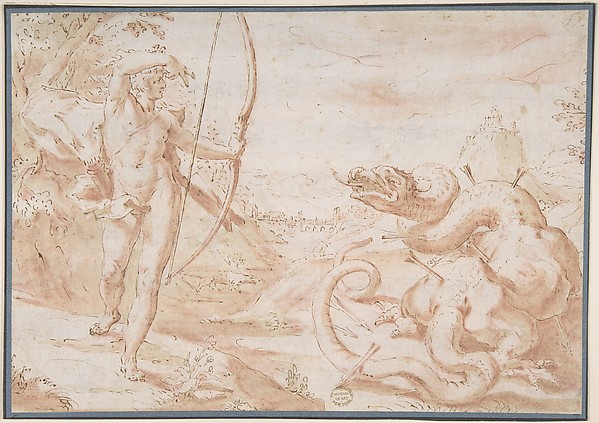
    Before I learned about Sabazios, I associated St. George and the Dragon with Apollo slaying the Python.

    PYTHON was a monstrous serpent which Gaia (Mother Earth) appointed to guard the oracle at Delphi. The beast was sometimes said to have been born from the rotting slime left behind after the great Deluge. When Apollo laid claim to the shrine, he slew the dragon with his arrows. The oracle and festival of the god were then named Pytho and Pythian from the rotting (pythô) corpse of the beast.

    Seneca, Hercules Furens 453 ff (trans. Miller) (Roman tragedy C1st A.D.) :
    "Did Phoebus [Apollo] encounter savage monsters or wild beasts? A draco (dragon) was the first to stain Phoebus’ shafts."

    Pseudo-Apollodorus, Bibliotheca 1. 22 (trans. Aldrich) (Greek mythographer C2nd A.D.) :
    "[Apollo] made his way to Delphi, where Themis gave the oracles at that time. When the serpent Python, which guarded the oracle, moved to prevent Apollo from approaching the oracular opening, he slew it and thus took command of the oracle."
    http://www.theoi.com/Ther/DrakainaPython.html


    APOLLO & PYTHON

    Museum Collection: Musée du Louvre, Paris, France
    Date: ca 470 BC
    Period: Archaic

    SUMMARY

    Apollon, seated on the omphalos stone of Delphoi, and beside the Delphic tripod, shoots arrows at the monster Python, the old guardian of the shrine. The beast is depicted with a woman's head and breast, matching the peot Hesiod's description of Ekhidna.


    Other closely related she-dragons included the Argive Ekhidna and Poine, the Tartarean Campe, and the Phokian Sybaris or Lamia.
    EKHIDNA (or Echidna) was a monstrous she-dragon (drakaina) with the head and breast of a woman. She probably represented or presided over the corruptions of the earth : rot, slime, fetid waters, illness and disease.
    She was often equated with Python (the rotting one), a dragon born of the fetid slime left behind by the great Deluge.
    http://www.theoi.com/Ther/DrakainaEkhidna1.html


    Apollo Slays Python, Eugene Delacroix


    Apollo Slaying the Python


    Let's go back to Dionysus.

    Dionysus was identified with Tammuz.

    Herodotus, Histories 2. 49 (trans. Godley) (Greek historian C5th B.C.) :
    "Melampos [a mythical seer] was the one who taught the Greeks the name of Dionysus and the way of sacrificing to him . . . I [Herodotus] believe that Melampos learned the worship of Dionysus chiefly from Kadmos of Tyre [the mythical Phoenician grandfather of Dionysus] and those who came with Kadmos from Phoinikia to the land now called Boiotia."
    http://www.theoi.com/Olympios/Dionysos.html

    Tammuz, Akkadian Dumuzi, in Mesopotamian religion, god of fertility embodying the powers for new life in nature in the spring. The earliest known mention of Tammuz is in texts dating to the early part of the Early Dynastic III period (c. 2600–c. 2334 BC), but his cult probably was much older.
    http://www.britannica.com/EBchecked/topic/582039/Tammuz


    Tammuz

    In Babylonia, the month Tammuz was established in honor of the eponymous god Tammuz, who originated as a Sumerian shepherd-god, Dumuzid or Dumuzi, the consort of Inanna and, in his Akkadian form, the parallel consort of Ishtar. The Levantine Adonis ("lord"), who was drawn into the Greek pantheon, was considered by Joseph Campbell among others to be another counterpart of Tammuz, son and consort.
    http://en.wikipedia.org/wiki/Tammuz_(deity)


    Famous relief from the Old Babylonian period (now in the British museum) called the "Burney relief" or "Queen of the Night relief". The depicted figure could be an aspect of the goddess Ishtar, Mesopotamian goddess of sexual love and war. However, her bird-feet and accompanying owls have suggested to some a connection with Lilitu (called Lilith in the Bible), though seemingly not the usual demonic Lilitu.


    When the cult of Tammuz spread to Assyria in the 2nd and 1st millennia BC, the character of the god seems to have changed from that of a pastoral to that of an agricultural deity. The texts suggest that, in Assyria (and later among the Sabaeans), Tammuz was basically viewed as the power in the grain, dying when the grain was milled.
    The cult of Tammuz centred around two yearly festivals, one celebrating his marriage to the goddess Inanna, the other lamenting his death at the hands of demons from the netherworld.
    During the 3rd Dynasty of Ur (c. 2112–c. 2004 BC) in the city of Umma (modern Tell Jokha), the marriage of the god was dramatically celebrated in February–March, Umma’s Month of the Festival of Tammuz.
    The celebrations in March–April that marked the death of the god also seem to have been dramatically performed. Many of the laments for the occasion have as a setting a procession out into the desert to the fold of the slain god. In Assyria, however, in the 7th century BC, the ritual took place in June–July
    Eventually a variety of originally independent fertility gods seem to have become identified with Tammuz. Tammuz of the cattle herders, whose main distinction from Tammuz the Shepherd was that his mother was the goddess Ninsun, Lady Wild Cow, and that he himself was imagined as a cattle herder, may have been an original aspect of the god.
    http://www.britannica.com/EBchecked/topic/582039/Tammuz
    After the Old Babylonian period, Dumuzi appears only rarely in Mesopotamian.
    Thorkild Jacobsen, in The Treasures of Darkness (Yale University Press, 1976, New Haven and London) says that "the cult of Dumuzi the Shepherd (Uruk, fourth millennium BC) "comprises both happy celebration of the marriage of the god with Inanna (who, originally, it seems, was the goddess of the communal storehouse) and bitter laments when he dies as the dry heat of summer yellows the pastures and lambing, calving, and milking come to an end. Thus, "as the farmer, he helps to make the fields fertile, as the shepherd, he helps to make the sheepfolds multiply, under his reign there is vegetation, under his reign, there is rich grain" (from - "The Courtship of Inanna and Dumuzi")
    http://www.gatewaystobabylon.com/god...lordumuzi.html


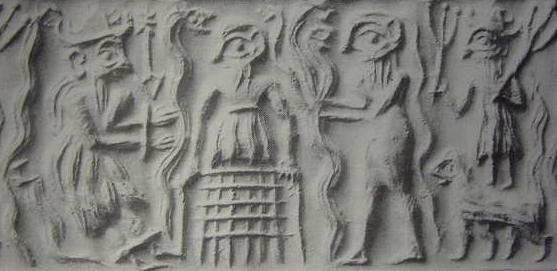
    Dumuzi, left, bound in hands and feet, before a god(dess) flanked by snakes. A storm god (right) stands atop a dragon


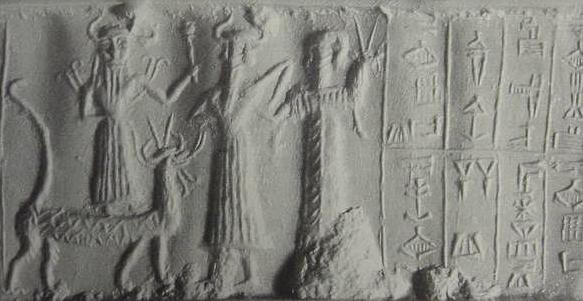
    The Mushhushshu two-horned serpent-dragon beast which supports on its back a bearded god (not identified by McCall) with mace in hand and wearing a horned crown. The Mushhushshu was associated with several different gods over a long period of time, Ninazu ("Lord Healer'), father of Ningishzida, who was also identified with the beast, possibly Dumuzi, to the degree Langdon has noted that Ningshzida is an aspect of Dumuzi, later Marduk and even Asshur were also identified with the serpent-dragon. The beast's tail appears similar to the quadruped in the Dumuzi seal above. Another horned god presents a human petitioner carrying an offering, perhaps a goat ? (cf. p. 53. H. McCall. Mesopotamian Myths. 1990, 1993)
    Last edited by ftil; 10-29-2011 at 05:05 PM.

  11. #116
    Banned
    Join Date
    Jun 2011
    Location
    Where the rain doesn't stop.....
    Posts
    763
    Blog Entries
    1

    Dionysus, Osiris

    Let's look at Ningishzida again.

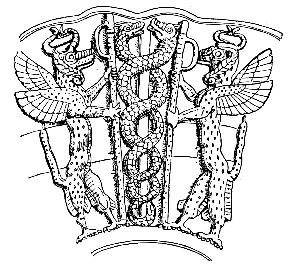
    Ningishzida is a Mesopotamian deity of the underworld. His name in Sumerian is translated as "lord of the good tree" by Thorkild Jacobsen.
    In Sumerian mythology, he appears in Adapa's myth as one of the two guardians of Anu's celestial palace, alongside Dumuzi. He was sometimes depicted as a serpent with a human head.
    http://en.wikipedia.org/wiki/Ningishzida


    The "libation vase of Gudea", dedicated to Ningishzida (21st century BC short chronology). The caduceus is interpreted as depicting the god himself.


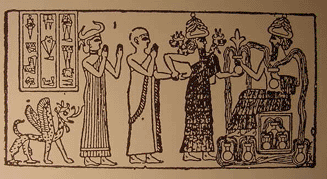
    Ningishzida with serpent dragon heads on his shoulder presenting King Gudaea of Samaria. Note dragon later known as the god Marduk on the left.


    I have also found the caduceus at Naga stone worship at Hampi.


    Let's go back to Dionysus.

    Dionysus was identified with Egyptian god Osiris.

    Herodotus, Histories 2. 42 (trans. Godley) (Greek historian C5th B.C.) :
    "No gods are worshipped by all Egyptians in common except Isis and Osiris, who they say is Dionysus; these are worshipped by all alike."

    Herodotus, Histories 2. 144 :
    "Before men, they said, the rulers of Egypt were gods . . . the last of them to rule the country was Osiris' son Horus, whom the Greeks call Apollo; he deposed Typhon [Set], and was the last divine king of Egypt. Osiris is, in the Greek language, Dionysus."

    Herodotus, Histories 2. 156 :
    "Apollo [Horus] and Artemis [Bastet] were (they say) children of Dionysus [Osiris] and Isis, and Leto [Buto]was made their nurse and preserver; in Egyptian, Apollo is Horus, Demeter Isis, Artemis Bubastis."

    Herodotus, Histories 2. 123 :
    "The Egyptians say that Demeter [Isis] and Dionysus [Osiris] are the rulers of the lower world. The Egyptians were the first who maintained the following doctrine, too, that the human soul is immortal, and at the death of the body enters into some other living thing . . . There are Greeks who have used this doctrine [the Orphics]."

    Herodotus, Histories 2. 145 :
    "In Egypt . . . Dionysus [Osiris] belongs to the third generation of gods, which came after the twelve. How many years there were between . . . Dionysus [Osiris] and Amasis [the last true Egyptian pharaoh] are the fewest, and they are reckoned by the Egyptians at fifteen thousand. The Egyptians claim to be sure of all this, since they have reckoned the years and chronicled them in writing."

    Pausanias, Description of Greece 10. 29. 4 (trans. Jones) (Greek travelogue C2nd A.D.) :
    "Both the Greeks and the Egyptians have many legends about Dionysus [i.e. Osiris for the Egyptians]."

    Cicero, De Natura Deorum 3. 21- 23 (trans. Rackham) (Roman rhetorician C1st B.C.) :
    "The second [god identified with Dionysus] of the Nile - he [the Egyptian Osiris] is the fabled slayer of Nysa."

    http://www.theoi.com/Olympios/Dionysos.html


    Osiris - ( Egyptian. Isir or Iszir ) in Egyptian mythology, the god of death and reborn life , the Great Judge of the dead. Son of the goddess Nut and the god Geb , brother Seth , Isis and Nephthys . He was married to Isis , was the ruler of the earth, the underworld and the dead ( Fields Jar ). He had two sons: Anubis of Nephthys and Horus with Isis.
    http://pl.wikipedia.org/wiki/Ozyrys


    Facsimile of a vignette from the Book of the Dead of Ani. The deceased Ani kneels before Osiris, judge of the dead. Behind Osiris stand his sisters Isis and Nephthys, and in front of him is a lotus on which stand the four sons of Horus.
    Data
    Original artwork created c. 1300 BC


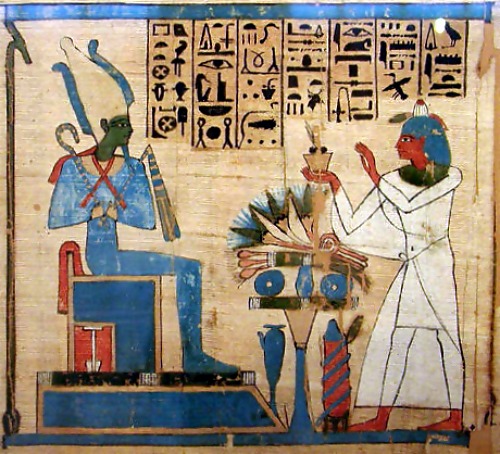
    Lady Meresimen, Singer of God Amon, giving presents to Osiris and the "Four Sons of Horus", Louvre Museum


    The god Osiris receiving offerings.


    Book of the Dead papyrus of Pinedjem II, 21st dynasty, circa 990-969 BC. Originally from the Deir el-Bahri royal cache. This scene depicts Pinedjem II in his role of High Priest making an offering to the god Osiris.


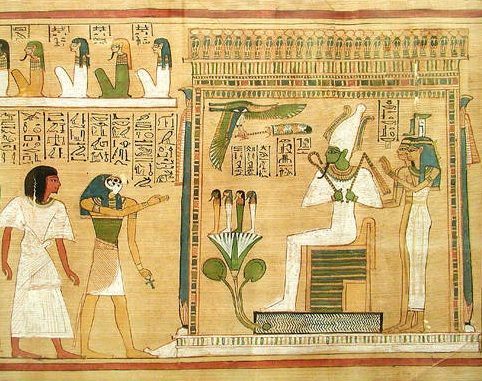
    A triumphant Hunefer, having passed the weighing of the heart, is presented by falcon-headed Horus to the shrine of the green-skinned Osiris, god of the underworld and the dead, accompanied by Isis and Nephthys.


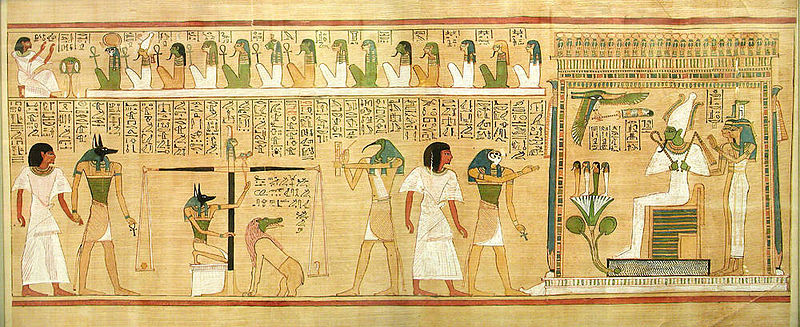
    Weighing of the heart scene, with en:Ammit sitting, from the book of the dead of Hunefer. From the source: "The judgement, from the papyrus of the scribe Hunefer. 19th Dynasty. Hunefer is conducted to the balance by jackal-headed Anubis. The monster Ammut crouches beneath the balance so as to swallow the heart should a life of wickedness be indicated. EA9901." Anubis conducts the weighing on the scale of Maat, against the feather of truth. The ibis-headed Thoth, scribe of the gods, records the result. If his heart is lighter than the feather, Hunefer is allowed to pass into the afterlife. If not, he is eaten by the waiting chimeric devouring creature Ammit, which is composed of the deadly crocodile, lion, and hippopotamus. In the next panel, showing the scene after the weighing, a triumphant Hunefer, having passed the test, is presented by falcon-headed Horus to the shrine of the green-skinned Osiris, god of the underworld and the dead, accompanied by Isis and Nephthys. The 14 gods of Egypt are shown seated above, in the order of judges.


    Part of the Book of the Dead of the scribe Nebqed, under the reign of Amenophis III (1391-1353 BC), 18th dynasty. Followed by his mother Amenemheb and his wife Meryt, Nebqed meets the Egyptian god of the dead, Osiris.


    A view of the well preserved and beautifully painted Tomb TT3 from Deir el-Medina on the West Bank of Luxor. This scene depicts the god Osiris with the Mountains of the West behind him. It belonged to Pashedu who served as an Ancient Egyptian artist and foreman at Deir el-Medina under pharaoh Seti I.


    Osiris, Anubis, Horus, Osiris Pharaoh XVIII dynasties and Isis.


    Valley of the Kings, Luxor, Egypt


    Osiris, Isis, and Horus


    Osiris, Louvre Museum

  12. #117
    Banned
    Join Date
    Jun 2011
    Location
    Where the rain doesn't stop.....
    Posts
    763
    Blog Entries
    1

    Dionysian Mysteries

    Dionysus identified with UNKNOWN (INDIAN GOD)

    Philostratus, Life of Apollonius of Tyana 2. 2 (trans. Conybeare) (Greek biography C1st to 2nd A.D.) :

    "Dionysus is called Nysios (Nysian) by the Indians and by all the Oriental races from Nysa in India."

    Philostratus, Life of Apollonius of Tyana 2. 6 - 10 :
    "They [The legendary prophet Apollonios of Tyana C1st A.D. and his companions] were now in land subject to the king [of India], in which the mountain of Nysa rises covered to its very top with plantations, like the mountain of Tmolos in Lydia; and you can ascend it, because paths have been made by the cultivators. They say then that when they had ascended it, they found the shrine of Dionysus, which it is said Dionysus founded in honor of himself, planting round it a circle of laurel trees which encloses just as much ground as suffices to contain a moderate sized temple.

    Ovid, Metamorphoses 4. 605 ff (trans. Melville) (Roman epic C1st B.C. to C1st A.D.) :
    "[Dionysus], conqueror of India, worshipped in the new-built shrines of Greece . . . was placed among the gods of heaven."

    http://www.theoi.com/Olympios/Dionysos.html


    I will have to do more study to find connection of Dionysus with Hindu gods.

    Alain Danielou draws attention to the close similarities between the two deities and concludes that the 'Indian Bacchus' of the Greeks was none other than Skanda. Cultural anthropologist Agehananda Bharati earlier made the specific observation that Kataragama Skanda is a "Dionysian god"
    http://xlweb.com/heritage/skanda/dionysus.htm

    John Lash postules Hindu-Maya-Egyptian correlation and Krishna and Osiris correlation as well as Krisha and Dionysus correlation. I have to look at Joseph Campbell's writtings as I have found his interpretations too farfetched.


    Let’s look at Dionysian Mysteries


    The Dionysian Mysteries largely remain just that, a mystery. The secrecy surrounding them has been even more successful than that around the Rites of Eleusis.

    The place of origin of the Hellenic Dionysian Mysteries is unknown. The first large scale cult worship of Dionysus in Greece seems to have begun in Thebes in around 1500 BC, around a thousand years before the development of the Athenian Mysteries.

    The Dionysian Mysteries are believed to have consisted of two sets of rites, the outer public rites, or Dionysia, and the secret rites of initiation, presumably into the Inner Mysteries, that occurred during these Dionysia.

    The basic principle beneath the original initiations, other than the seasonal death-rebirth theme supposedly common to all vegetation cults (such as the Osirian, which closely parallels the Dionysian), was one of spirit possession and atavism. This in turn was closely associated with the effects of the wine. The spirit possession involved the invocation of spirits by means of the bull roarer, followed by communal dancing to drum and pipe, with characteristic movements (such as the backward head flick) found in all trance inducing cults (represented most famously today by African Voodoo and its relatives). As in Vodoun rites, certain drum rhythms were associated with the trance state, and these rhythms are allegedly found preserved in Greek prose, particularly the Bacchae of Euripides One classical source describes what had become of these ancient rites in the Greek countryside, where they were held high in the mountains to which ritual processions were made on certain feast days:

    Following the torches as they dipped and swayed in the darkness, they climbed mountain paths with head thrown back and eyes glazed, dancing to the beat of the drum which stirred their blood…. In the state of ekstasis or enqousiasmos, they abandoned themselves, dancing wildly…. and calling 'Euoi!' At that moment of intense rapture they became identified with the god himself…. They became filled with his spirit and acquired divine powers". Peter Hoyle, Delphi (London: 1967), p. 76.

    Unlike many trance cults however, the Dionysian rites were primarily atavistic, that is the participant was possessed by animal spirits and bestial entities, rather than intelligible divinities, and may even "transform into animals". A practise preserved by the rite of the "goat and panther men" of the "heretical" Aissaoua Sufi cult of North Africa, and remembered in the satyrs and sileni of the Dionysian procession, and perhaps even the "bull man", or Minotaur, of the chthonic Minoan labyrinth. But the most desired possession was that by Dionysos himself, or his consort Ariadne.

    Dionysos was most probably regarded as the patron of all consciousness altering substances in Roman times, and potion making paraphenalia have been found in the ruins of Bacchic temples. "magic potion" associated with the Dionysos rites, said to include poison ivy, and by the known use of datura, henbane and belladona by shamans in this region, as well as the alleged use of "kykeon" (probably ergot ale), and possibly fly agaric mushrooms, within the Greek Eleusinian Mysteries.
    http://www.mlahanas.de/Greeks/LX/Dio...Mysteries.html

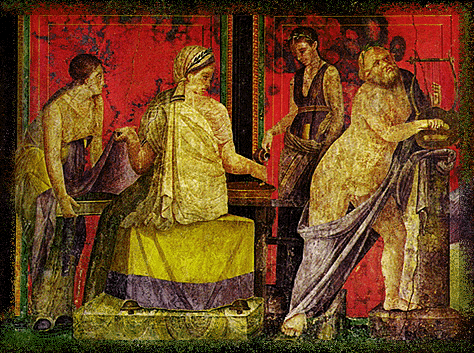
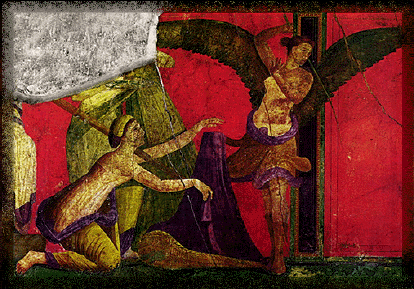
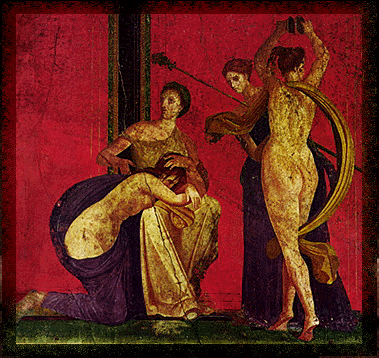
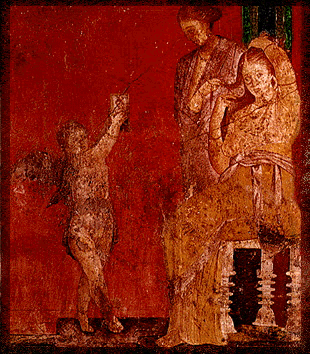
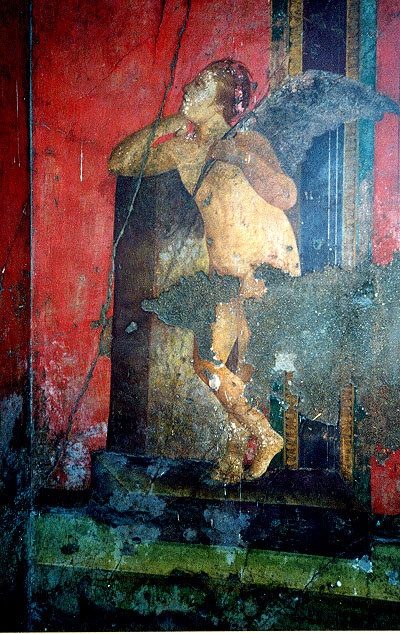
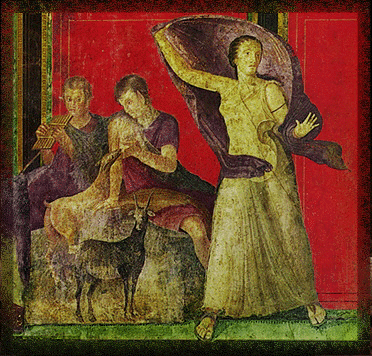
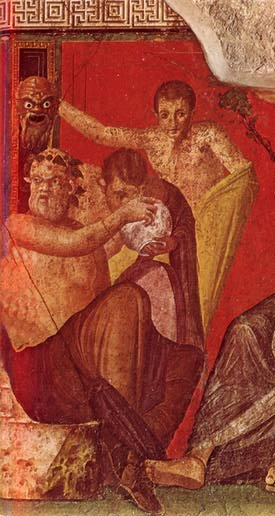
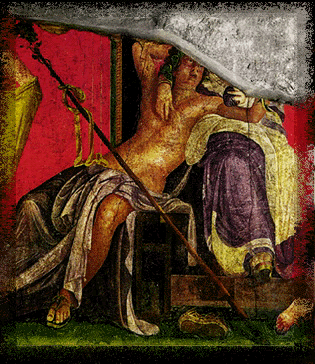
    Fortunately we do have more insight into mystery rites through the preserved murals on the Bacchic ‘Villa of the Mysteries’ in Pompeii.

    Here a series of murals painted on the walls of an initiation chamber have been almost perfectly preserved, though there remains controversy as to whether the entire process is shown.


    http://www.art-and-archaeology.com/t...mysteries.html

    Scene 1

    The action of the rite begins with the initiate or bride crossing the threshold as the preparations for the rites to begin. Her wrist is cocked against her hip. Is she removing her scarf? Is she listening to the boy read from the scroll? Is she pregnant?
    The nudity of the boy may signify that he is divine. Is he reading rules of the rite? He wears actor's boots, perhaps indicating the dramatic aspect of the rites. The officiating priestess (behind the boy) holds another scroll in her left hand and a stylus in her right hand. Is she prepared to add the initiate's name to a list of successful initiates?


    The initiate, now more lightly clad, carries an offering tray of sacramental cake. She wears a myrtle wreath. In her right hand she holds a laurel sprig.


    Scene 2

    A priestess (center), wearing a head covering and a wreath of myrtle removes a covering from a ceremonial basket held by a female attendant. Speculations about the contents of the basket include: more laurel, a snake, or flower petals. A second female attendant wearing a wreath, pours purifying water into a basin in which the priestess is about to dip a sprig of laurel.
    Mythological characters and music are introduced into the narrative. An aging Silenus plays a ten-string lyre resting on a column.

    The second mural depicts another ‘priestess’ and her assistants preparing the Liknon basket, at her feet are mysterious mushroom shaped objects, which some find suggestive.
    http://www.mlahanas.de/Greeks/LX/Dio...Mysteries.html


    Scene 3


    A young male satyr plays pan pipes, while a nymph suckles a goat. The initiate is being made aware of her close connection with nature. This move from human to nature represents a shift away from the conscious human world to our preconscious animal state. In many rituals, this regression, assisted by music, is requisite to achieving a psychological state necessary for rebirth and regeneration.
    The startled initiate has a glimpse of what awaits her in the inner sanctuary where the katabasis will take place. This is her last chance to save herself by running away. Perhaps some initiates did just that. The next scene provides hints about what both frightens and awaits the initiate.

    Some scholars think a katabasis occurs now, others disagree.
    http://www.mlahanas.de/Greeks/LX/Dio...Mysteries.html


    Scene 4


    The Silenus looks disapprovingly at the startled initiate as he holds up an empty silver bowl. A young satyr gazes into the bowl, as if mesmerized. Another young satyr holds a theatrical mask (resembling the Silenus) aloft and looks off to his left. Some speculate that the mask rather than the satyr's face is reflected in the silver bowl. So, looking into the vessel is an act of divination: the young satyr sees himself in the future, a dead satyr. The young satyr and the young initiate are coming to terms with their own deaths. In this case the death of childhood and innocence. The bowl may have held Kykeon, the intoxicating drink of participants in Orphic-Dionysian mysteries, intended for the frightened initiate.


    Scene 5

    This scene is at the center of both the room and the ritual. Dionysus sprawls in the arms of his mother Semele. Dionysus wears a wreath of ivy, his thyrsus tied with a yellow ribbon lies across his body, and one sandal is off his foot. Even though the fresco is badly damaged, we can see that Semele sits on a throne with Dionysus leaning on her. Semele, the queen, the great mother is supreme.


    Scene 6

    The next mural sees the initiate returning, perhaps from a successful ordeal, she now carries a staff and wears a cap. She kneels before the priestess and then appears to be whipped by a winged female figure. Flagellation being one of the many trance inducing techniques used in the Bacchic rites. Next to her is a dancing figure, a Maenad or Thyiade.
    http://www.mlahanas.de/Greeks/LX/Dio...Mysteries.html
    The initiate, carrying a staff and wearing a cap, returns from the night journey. What has happened is a mystery to us. But in similar rituals the confused, and sometimes drugged initiate emerges like an infant at birth, from a dark place to a lighted place. She reaches for a covered object sitting in a winnowing basket, the liknon. The covered object is taken by many to be a phallus, or a herm.


    To the right is a winged divinity, perhaps Aidos. Her raised hand is rejecting or warding off something. She is looking to the left and is prepared to strike with a whip.

    Standing behind the initiate are two figures of women, unfortunately badly damaged. One woman (far left) holds a plate with what appear to be pine needles above the initiate's head. The apprehensive second figure is drawing back.


    Scene 7

    The two themes of this scene are torture and transfiguration, the evocative climax of the rite. Notice the complete abandonment to agony on the face of the initiate and the lash across her back. She is consoled by a woman identified as a nurse. To the right a nude women clashes celebratory cymbals and another woman is about to give to the initiate a thyrsus, symbolizing the successful completion of the rite.


    Scene 8

    This scene represents an event after the completion of the ritual drama. The transformed initiate or bride prepares, with the help of an attendant, for marriage. A young Eros figure holds a mirror which reflects the image of the bride. Both the bride and her reflected image stare out inquiringly at us, the observers.


    Scene 9

    The figure above has been identified as: the mother of the bride, the mistress of the villa, or the bride herself. Notice that she does wear a ring on her finger. If she is the same female who began the dramatic ritual as a headstrong girl, she has certainly matured psychologically.


    Scene 10

    Eros, a son of Chronos or Saturn, god of Love, is the final figure in the narrative.


    The evolution of the Dionysian Cult continued in the Roman Empire, where the Bacchic Mysteries, as they were known here after their arrival in 200 BC, were banned for a time in Rome and forced underground, following rumours of their "corrupt" and "subversive" behavior. They were revived under Julius Caesar around 50 BC, and remained in existence, along with the Bacchanalian street procession, at least until the time of Augustine (A.D. 354-430))
    http://www.mlahanas.de/Greeks/LX/Dio...Mysteries.html

    We may, however, remark at once, that all traditions which have reference to a mystic worship of Dionysus, are of a comparatively late origin. The orgiastic worship of Dionysus seems to have been first established in Thrace, and to have thence spread southward to mounts Helicon and Parnassus, to Thebes, Naxos, and throughout Greece, Sicily, and Italy, though some writers derived it from Egypt. (Paus. i. 2. § 4; Diod. i. 97.)
    http://www.theoi.com/Olympios/Dionysos.html

  13. #118
    Banned
    Join Date
    Jun 2011
    Location
    Where the rain doesn't stop.....
    Posts
    763
    Blog Entries
    1

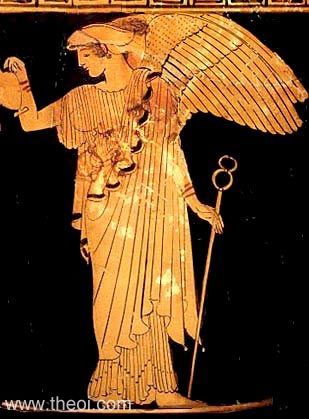
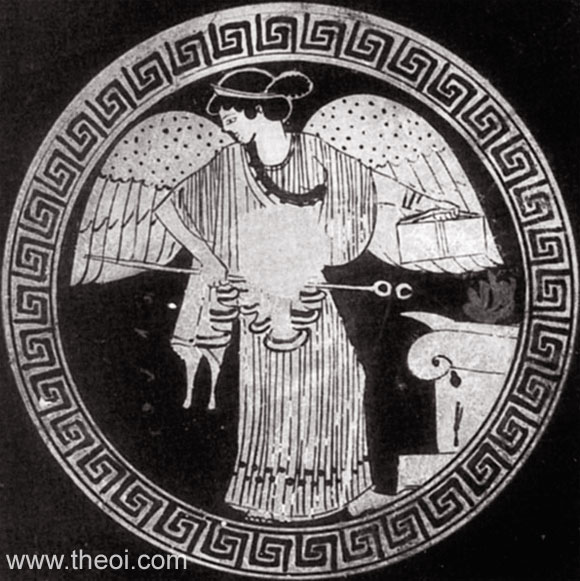
    Goddess Iris

    Dionysus got lot's of attention. Time to change a subject.


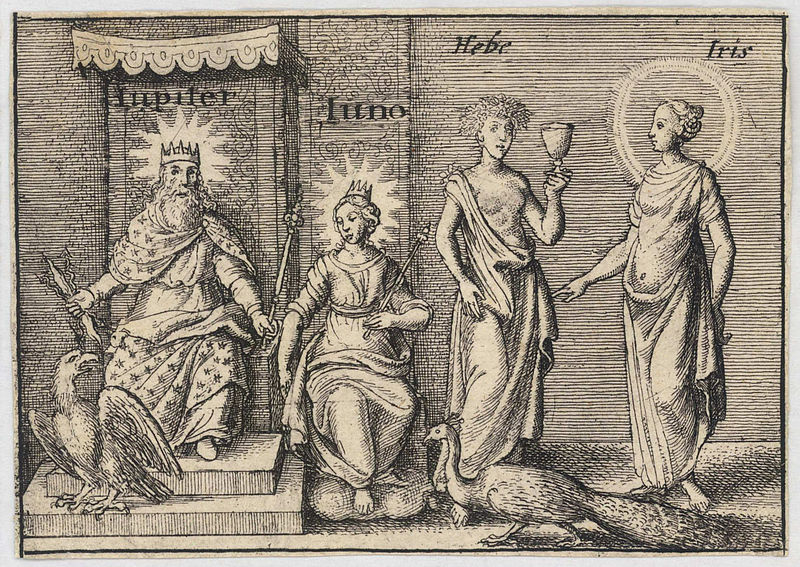
    IRIS was the goddess of the rainbow, the messenger of the Olympian gods. She was often represented as the handmaiden and personal messenger of Hera. Iris was a goddess of sea and sky--her father Thaumas "the wondrous" was a marine-god, and her mother Elektra "the amber" a cloud-nymph.

    In the Homeric poems she appears as the minister of the Olympian gods, who carries messages from Ida to Olympus, from gods to gods, and from gods to men. (Il. xv. 144, xxiv. 78, 95, ii. 787, xviii. 168,Hymn. in Apoll. Del. 102, &c.)
    ]http://www.theoi.com/Pontios/Iris.html]


    IRIS

    Museum Collection: Museum of Art, Rhode Island School of Design, New York City, USA

    Date: ca 480 BC
    Period: Late Archaic

    SUMMARY

    Detail of Iris from a painting depicting her in the attendance of Hera. Iris appears as a winged goddess, whose hair is wrapped in a sakkos scarf. She holds an oinochoe jug and kerykeion (herald's wand) in her hands.


    IRIS AT ALTAR

    Museum Collection: (last known) Sotheby's, London, UK

    SUMMARY

    Iris, the winged messenger of the gods, stands at an altar holding her kerykeion or herald's wand.


    Some poets describe Iris actually as the rainbow itself, but Servius (ad Aen v. 610) states that the rainbow is only the road on which Iris travels, and which therefore appears whenever the goddess wants it, and vanishes when it is no longer needed:

    Hesiod, Theogony 265 ff (trans. Evelyn-White) (Greek epic C8th or C7th B.C.) :
    "Now Thaumas married a daughter of deep-running Oceanus, Electra, and she bore him swift-footed Iris, the rainbow."
    http://www.theoi.com/Pontios/Iris.html
    Pseudo-Apollodorus, Bibliotheca 1. 10 (trans. Aldrich) (Greek mythographer C2nd A.D.) :
    "Thaumas and Elektra (Electra) had [children] Iris and the Harpyiai (Harpies) named Aello and Okypete."

    http://www.theoi.com/Pontios/Iris.html


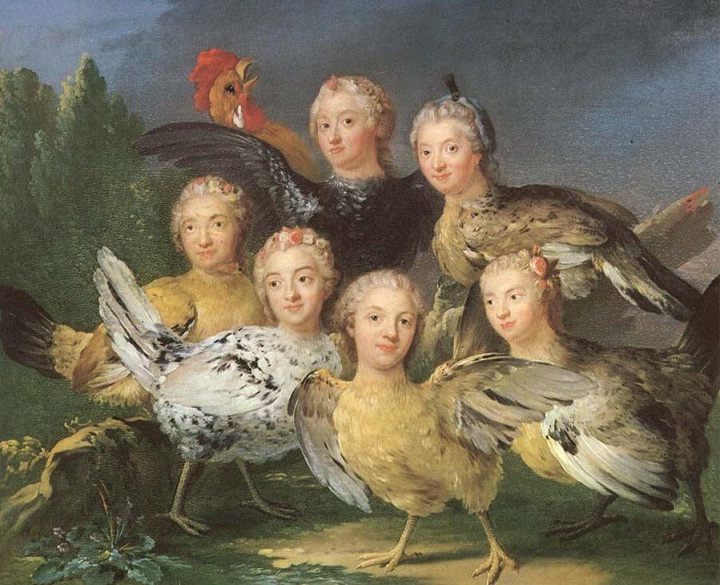
    Johan Pasch


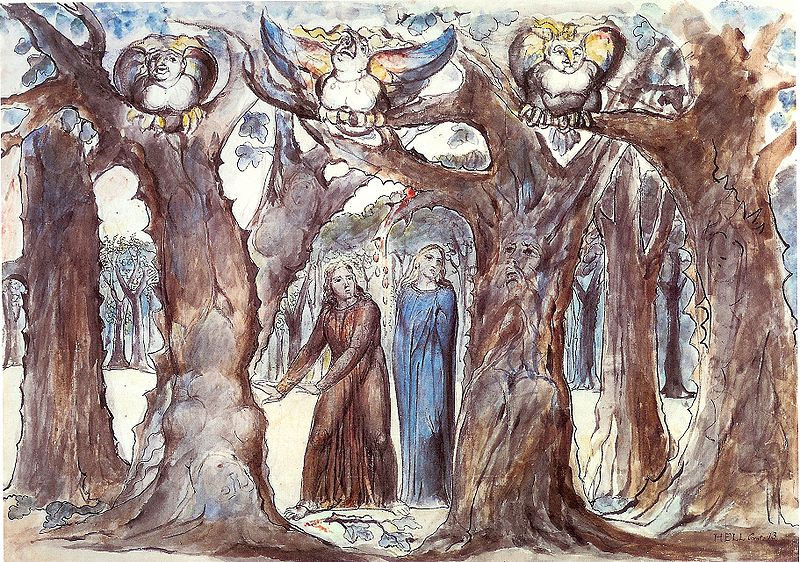
    William Blake, Hell_XIII


    With regard to her functions, which we have above briefly described, we may further observe, that the Odyssey never mentions Iris, but only Hermes as the messenger of the gods: in the Iliad, on the other hand, she appears most frequently, and on the most different occasions. She is principally engaged in the service of Zeus, but also in that of Hera, and even serves Achilles in calling the winds to his assistance. (Il. xxiii. 199.)


    Statius, Silvae 3. 3. 80 ff (trans. Mozley) (Roman poetry C1st A.D.) :
    "The winged Arcadian [Hermes] is the messenger of supreme Jove [Zeus]; Juno [Hera] hath power over the rain-bringing Thaumantian [Iris the rainbow].


    Plato, Cratylus 400d & 408c ff (trans. Lamb) (Greek philosopher C4th B.C.) :
    "[Plato invents philosophical etymologies to explain the names of the gods:]
    Sokrates: Let us inquire what thought men had in giving them [the gods] their names . . . The first men who gave names [to the gods] were no ordinary persons, but high thinkers and great talkers . . . Iris [like Hermes] also seems to have got her name fromeirein, because she is a messenger."


    http://www.theoi.com/Pontios/Iris.html


    IRIS & THE INFANT HERMES

    Museum Collection: Antiken-sammlungen, Munich, Germany
    Date: ca 500 - 450 BC
    Period: Classical

    SUMMARY

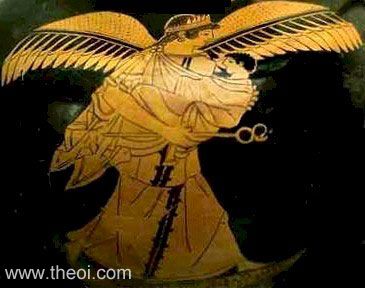
    The winged goddess Iris, messenger of the gods, nurses the infant Hermes on her breast. She is depicted with a tiara-crown and a kerykeion (herald's wand) in her hand.


    Spranger, Bartholomäus, Hermes and Athena


    Punishment of Ixion: in the center Mercury holding the caduceus, on the right the throning Juno, behind her Iris. On the left Vulcanus with Ixion already tied to the wheel. At Mercuries feet sitting Nephele. Roman fresco from the eastern wall of the triclinium in the Casa dei Vettii (VI 15,1) in Pompeii.


    Wenzel Hollar


    Venus, supported by Iris, complaining to Mars, exhibited in 1820 at the RA "to acclaim" (in the Ceiling of the Ante Library Chatsworth House) – Winner of the Royal Academy Painting of the Year in 1823


    Iris and Jupiter, Michel Corneille the Younger, Palace of Versailles, Versailles


    Morpheus and Iris, Baron Pierre-Narcisse Guérin


    Nonnus, Dionysiaca 31. 103 ff (trans. Rouse) (Greek epic C5th A.D.) :
    "Hera made her way brooding to the waters of Khremetes [Chremetes, a river of North Africa] in the west . . . and she sought out the wife of jealous Zephyros (West-Wind), Iris (Rainbow), the messenger of Zeus when he is in a hurry--for she wished to send her swift as the wind from heaven with a message for shadowy Hypnos (Sleep). She called Iris then, and coaxed her with friendly words: ‘Iris, goldenwing bride of plantnourishing Zephyros, happy mother of Eros (Love) [i.e. Pothos]! Hasten with stormshod foot to the home of gloomy Hypnos in the west. Seek also about seagirt Lemnos, and if you find him tell him to charm the eyes of Zeus uncharmable for one day, that I may help the Indians. But change your shape, take the ugly form of Hypnos' mother the blackgirdled goddess Nyx (Night); take a false name and become darkness . . . Promise him Pasithea for his bride, and let him do my need from desire of her beauty. I need not tell you that one lovesick will do anything for hope.’
    At these words, Iris goldenwing flew away peering through the air . . . seeking the wandering track of vagrant Hypnos (Sleep). She found him on the slopes of nuptial Orkhomenos . . . Then Iris changed her shape, and all unseen she put on the look of dark Nyx unrecognisable. She came near to Hypnos, weaving guile; and in his mother’s guise uttered her deceitful speech in cajoling whispers . . . Iris begged him to fasten Kronion with slumber for the course of one day only . . . Then goddess Iris returned flying at speed and hastened to deliver her welcome message to her queen."
    http://www.theoi.com/Pontios/Iris.html


    Iris visits the Sleep. Engraving by Virgil Solis for Ovid's Metamorphoses Book XI,


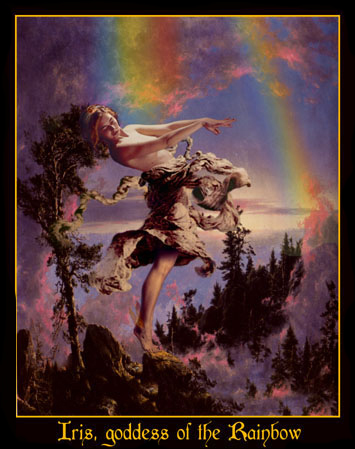
    Iris, goddess of the Rainbow, Howard D. Johnson


    In the earlier poets, and even in Theocritus (xvii. 134) and Virgil (Aen. v. 610) Iris appears as a virgin goddess; but according to later writers, she was married to Zephyrus, and became by him the mother of Eros. (Eustath. ad Hom. pp. 391, 555; Plut. Amat. 20.)

    Nonnus, Dionysiaca 31. 103 ff (trans. Rouse) (Greek epic C5th A.D.) :
    "The wife of Zephyros (West-Wind), Iris (Rainbow), the messenger of Zeus . . . Iris, goldenwing bride of plantnourishing Zephyros, happy mother of Eros (Love) [i.e. the eros Pothos]."

    http://www.theoi.com/Pontios/Iris.html

  14. #119
    Banned
    Join Date
    Jun 2011
    Location
    Where the rain doesn't stop.....
    Posts
    763
    Blog Entries
    1
    Let's look at rainbow symbolism.


    The rainbow, a natural phenomenon noted for its beauty and inexplicability, has been a favorite component of mythology throughout history.
    Whether as bridge, messenger, archer’s bow, or serpent, the rainbow has been pressed into symbolic service for millennia.
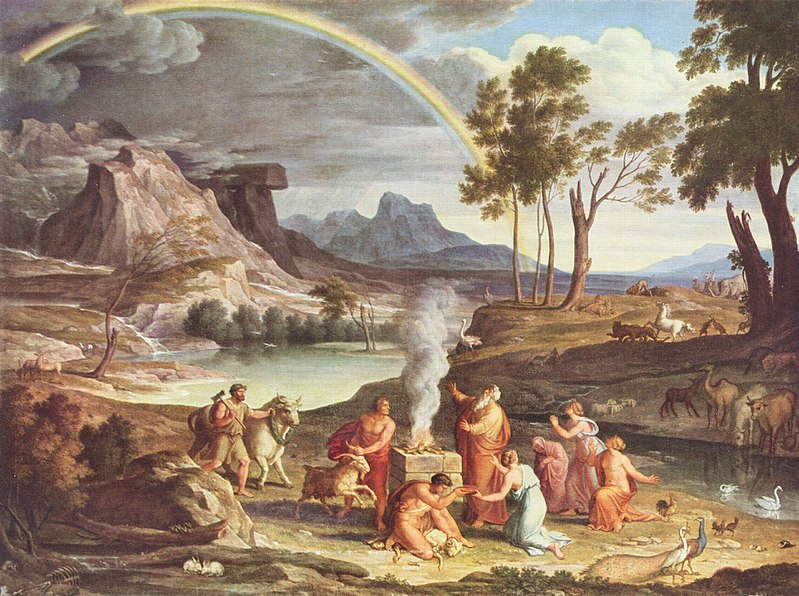
    In Judeo-Christian traditions signs it as a covenant with God not to destroy the world by means of floodwater.
    http://en.wikipedia.org/wiki/Rainbows_in_mythology


    Noah's Thanks offering by Joseph Anton Koch. Noah builds an altar to the Lord after being delivered from the Flood; God sends the rainbow as a sign of his covenant (Genesis 8-9).


    In Norse mythology, Bifröst or Bilröst is a burning rainbow bridge that reaches between Midgard (the world) and Asgard, the realm of the gods. The bridge is attested as Bilröst in the Poetic Edda; compiled in the 13th century from earlier traditional sources, and as Bifröst in the Prose Edda; written in the 13th century by Snorri Sturluson, and in the poetry of skalds. Both the Poetic Edda and the Prose Edda alternately refer to the bridge as Asbrú (Old Norse "Æsir's bridge").

    John Lindow points to a parallel between Bifröst, which he notes is "a bridge between earth and heaven, or earth and the world of the gods", and the bridge Gjallarbrú, "a bridge between earth and the underworld, or earth and the world of the dead." Several scholars have proposed that Bifröst may represent the Milky Way.
    http://en.wikipedia.org/wiki/Bifrost


    The god Heimdallr stands before the rainbow bridge while blowing a horn by Emil Doepler.


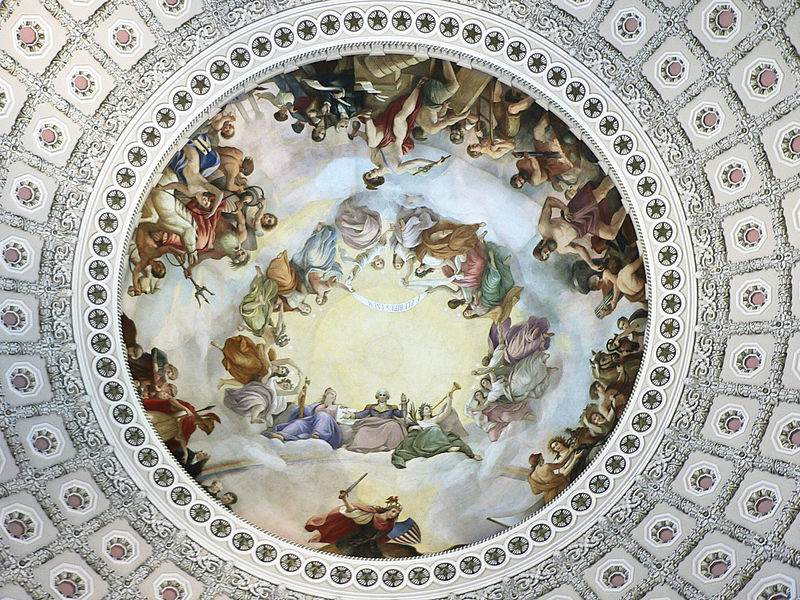
    In 1866, Constantino Brumidi's oil on canvas Apotheosis of George Washington "America’s founding father wears a [calm] expression… as he is propelled heavenward on a rainbow... Surrounded by thirteen maidens, Washington serenely supervises an armed Lady Liberty beneath him as she tramples out the powers of kings and tyrants." The Victorians of Brumidi’s age were merely "inheritors of a long tradition of exploiting the rainbow’s powerful visual symbolism," perpetuated by thousands of years of human communication.
    http://en.wikipedia.org/wiki/Rainbows_in_mythology


    Constantino Brumidi, Apotheosis of Washington


    Details of Apotheosis of Washington


    "Agriculture": Ceres, the goddess of agriculture, is shown with a wreath of wheat and a cornucopia, seated on a McCormick reaper. Young America in a liberty cap holds the reins of the horses, while Flora gathers flowers in the foreground.


    "Commerce": Mercury, god of commerce, with his winged cap and sandals and caduceus, hands a bag of gold to en:Robert Morris, financier of the Revolutionary War. On the left, men move a box on a dolly; on the right, the anchor and sailors lead into the next scene, "Marine."


    "Marine": Neptune, god of the sea, holding his trident and crowned with seaweed, rides in a shell chariot drawn by sea horses. Venus, goddess of love born from the sea, helps lay the transatlantic cable. In the background is a form of iron-clad ship with smokestacks.


    "Mechanics": Vulcan, god of the forge, stands at his anvil with his foot on a cannon, near a pile of cannon balls and with a steam engine in the background. The man at the forge is thought to represent Charles Thomas, who was in charge of the ironwork of the Capitol dome.


    "Science": Minerva, goddess of wisdom and the arts of civilization, with helmet and spear, points to an electric generator creating power stored in batteries, next to a printing press, while inventors Benjamin Franklin, Samuel F. B. Morse, and Robert Fulton watch. At the left, a teacher demonstrates the use of dividers.


    "War": Armored Freedom, sword raised and cape flying, with a helmet and shield reminiscent of those on the Statue of Freedom, tramples Tyranny and Kingly Power; she is assisted by a fierce eagle carrying arrows and a thunderbolt.


    Sumerian mythology
    The Epic of Gilgamesh, who was an ancient Sumerian king (ca.3000 BC), is our first detailed written evidence of human civilization. In a Victorian translation of a Gilgamesh variant, Leonidas Le Cenci Hamilton's Epic of Ishtar and Izdubar, King Izdubar sees "a mass of colors like the rainbow’s hues" that are "linked to divine sanction for war." Later in the epic, Izdubar sees the "glistening colors of the rainbow rise" in the fountain of life next to Elam’s Tree of Immortality.
    http://en.wikipedia.org/wiki/Rainbows_in_mythology


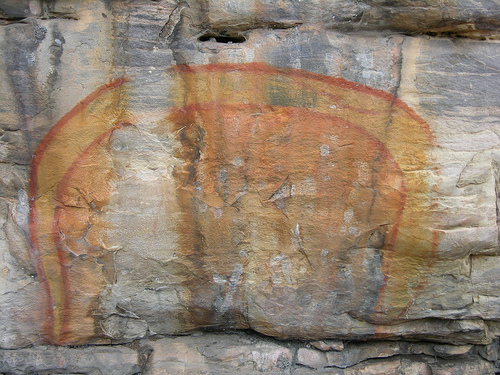
    In Australian Aboriginal mythology, the rainbow snake is the Creator (Kurreah, Andrenjinyi, Yingarna, Ngalyod and others) in the Dreaming, which is the infinite period of time that "began with the world's creation and that has no end. People, animals, and Eternal Beings like the Rainbow Serpent are all part of the Dreaming, and everyday life is affected by the Dreaming's immortals," in almost every Australian Aborigine tribe. In these tribes, of which there are over 50, actual rainbows are gigantic, often malevolent, serpents who inhabit the sky or ground. This snake has different names in different tribes, and has both different and similar traits from tribe to tribe.
    http://en.wikipedia.org/wiki/Rainbows_in_mythology


    Australian Aboriginal rock painting of "The Rainbow Serpent".


    And we have The Wizard of Oz.


  15. #120
    Registered User Des Essientes's Avatar
    Join Date
    Jul 2011
    Location
    Milky Way
    Posts
    119
    It should be remembered that the European artists concept of animals did not include lions or elephants. Perhaps the largest beast of prey they would have been familiar with would have been the Wolf and the Bear... and even then, the larger bear, such as the Grizzly and the Brown Bear would not have been known to most of Europe. Many of the image prior to the late Renaissance or even the Baroque (1600s) suggest little knowledge even of a creature such as the lion:

    [/QUOTE]
    Lions had been indigenous to Europe as is well demonstrated by the verses of the Iliad in which Homer frequently compares the heros to lions, and these beasts had not been forgotten by Europeans, hence the title of the crusader king Richard "the Lion Hearted", and even if the lion were somewhat forgotten in Europe, just as in the case of the dragon, whose form is gotten from enlarging that of a lizard, the lion, save for the mane, can be extrapolated from the smaller cats that are indigenous to Europe. Lions had never been found, or were made extinct long ago, in South-East Asia but that area having been in good part converted to Buddhism, an originally Indian religion which made much use of the lion in its literature, Buddhist monks bred the Pekinese dog to have a mane and feline features thus approximating the appearance of the lion.

Page 8 of 12 FirstFirst ... 3456789101112 LastLast

Similar Threads

  1. Banned books
    By Lara in forum General Literature
    Replies: 250
    Last Post: 12-12-2015, 04:16 PM
  2. Why I believe in God?
    By laidbackperson in forum Religious Texts
    Replies: 938
    Last Post: 11-27-2011, 05:49 PM
  3. The Man with the Blue Guitar
    By Virgil in forum Poems, Poets, and Poetry
    Replies: 50
    Last Post: 07-09-2009, 11:36 PM
  4. The novel
    By Newcomer in forum Jane Eyre
    Replies: 23
    Last Post: 03-06-2009, 09:29 AM
  5. Why do you conceive the Bible is difficult?
    By Deng Xiang in forum Religious Texts
    Replies: 65
    Last Post: 09-12-2008, 09:01 PM

Posting Permissions

  • You may not post new threads
  • You may not post replies
  • You may not post attachments
  • You may not edit your posts
  •