While, I would agree poetry is older than the novel, the tradition of the novel is older than you're giving credit. The novel it turns out is really not that novel. The Ancient Greeks and Romans had novels.Originally Posted by stlukesguild


While, I would agree poetry is older than the novel, the tradition of the novel is older than you're giving credit. The novel it turns out is really not that novel. The Ancient Greeks and Romans had novels.
Last edited by Drkshadow03; 09-25-2011 at 11:07 AM.
"You understand well enough what slavery is, but freedom you have never experienced, so you do not know if it tastes sweet or bitter. If you ever did come to experience it, you would advise us to fight for it not with spears only, but with axes too." - Herodotus
https://consolationofreading.wordpress.com/ - my book blog!
Feed the Hungry!
so either you equate your opinion with reality, or else you claim that there is some objective, absolute yardstick of which I'm unaware.
I questioned the truth of the statement, "poetic prose supported by strong plot and believable characters are what make the best of literature..." which Raven Falcon admitted was but a personal opinion. I am not challenging anyone's personal opinion with regard to what he or she likes. I tend to prefer poetry over novels. I am simply questioning the idea that what one individual prefers in terms of artistic intention is not necessarily what "makes the best literature."
It would seem that looking across the spectrum of literary history one discovers that the best literature is not necessarily limited to that written in "poetic prose" with a strong plot and character development... or any single genre or form. The best literature exists in a multitude of styles/forms/genre and explores a vast wealth of artistic intentions. The form/structure/emphasis of the traditional novel may be prevalent today, but in no way does it account for the lion's share of the greatest literature across the whole of history. Even among modern and contemporary writers we find any number who would in no way emphasize "poetic prose supported by strong plot and believable characters..."
Again, if Raven Falcon prefers a given genre and approach to literature, I have no qualms with this... because I recognize this is true of all of us... even those among us who have read a vast array of literature. We still have personal biases and preferences.
While, I would agree poetry is older than the novel, the tradition of the novel is older than you're giving credit. The novel it turns out is really not that novel. The Ancient Greeks and Romans had novels.
Well, of course we can always debate what counts as a true "novel". Prose narrative is not the sole definition. Stories and historical/fictive narratives and romances long predate the novel, and you undoubtedly know that the very term, "novel" is but a shortening of novella romance.
Richard Elliott Friedman, a Biblical scholar, has expanded upon the so-called Documentary Hypothesis which ascribes various different writers to different parts of the Hebrew Bible. Many scholars, even Harold Bloom in his Book of J, have recognized certain similarities between the so-called J-writer, responsible for much of the central narratives of Genesis and Exodus, and the S-writer or Court Historian who composed much of the Saul/David/Solomon. Bloom went so far to suggest that the two writers ... possibly women... may have known each other at the court. Friedman pushes the hypothesis further with an analysis of the choice of vocabulary and other textual clues to suggest the J-writer and S-writer are one and the same. Removing their contributions from the surrounding interpolations of later authors, Friedman suggests that what we discover is essentially the first novel in which the narratives of the creation, the fall, the first murder, the flood, the Exodus, etc... act as precursors to the great rulers of Israel and their tragic failings:
http://www.amazon.com/Hidden-Bible-R...6963394&sr=1-1
The Wikipedia entry on the novel (surely a source that cannot be questioned) suggested another aspect required of the true Novel or "novella romance" and that was the existence and transference of the text through the means of mechanical reproduction (printing). certainly the printing press had an immense impact upon reading and the accessibility of books and broadening of the literate audience... which in a like manner, undoubtedly had a major impact upon the development of certain popular forms of literature, such as the novel.
As for those Terracotta Warriors, meh, kind of boring to be honest, it's like a big factory with a bunch of boring statues. In the Chinese tradition, what does it for me are Buddhist sculpture - the Terracotta warriors are interesting since they are numerous, and since nobody is particularly sure how they were created, but in the end look even more ridiculous with their paint on them.
I'll take the buried army of Qin Shi Huang over most of the Chinese Buddhas. I agree that the number of figures is essential to their merit. Of course I'm not big on most Chinese art, far preferring that of Indian and Japan among the achievements of Eastern art. The separate surely lack the individuality of the sculptural figures of Chartres... let alone Michelangelo, Bernini, and Rodin. They are mass-produced in many ways... and yet there are individual elements with regard to the ethnicity of various warriors, clothing etc...
Or perhaps a far different kind of artwork - that of accidental agriculture...
You are surely pushing the definition of "ART" here. We can find any number of visually arresting landscapes of human constructs:
And what of these lovely abstractions seen from above?
Deadly beauty. Both are toxic waste sites... the second from Canada.
Beware of the man with just one book. -Ovid
The man who doesn't read good books has no advantage over the man who can't read them.- Mark Twain
My Blog: Of Delicious Recoil
http://stlukesguild.tumblr.com/

John Ajvide Lindqvist. <3
Check these out:
The 500 Arhats of Qiongzhu Temple
These were mass produced by a team of artists just like the Terracotta Warriors but but they retain their individuality.
Or this lovely statue of the goddess Guan Yin
I'm pretty sure these statues come from the caves of Dunhuang
Here's another arhat from the Lingansi Thousand Buddha Hall
And a couple more to round things out

"So-Crates: The only true wisdom consists in knowing that you know nothing." "That's us, dude!"- Bill and Ted
"This ain't over."- Charles Bronson
Feed the Hungry!
What do those pictures above (and on the previous page) have to do with poetic beauty?
How would you describe those pictures or sceneries in prose form?
Prose form not in the vein of Wikipedia description, but in the way which authors describe the settings in their novels.
I thank you all.
Last edited by Raven Falcon.; 09-25-2011 at 04:53 PM.
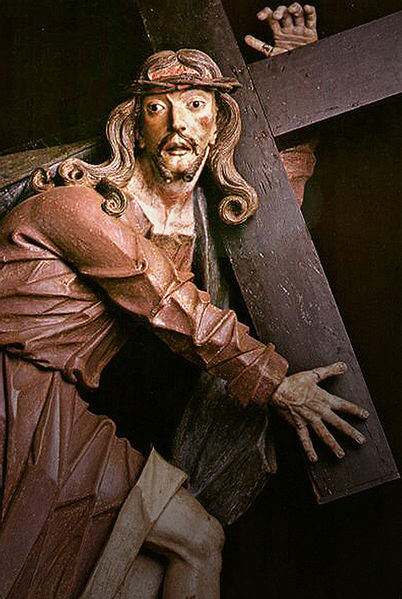
I have mixed feelings about these Qiongzhu figures:
Completed in the 20th century, there is something mannered... almost comic about these figures. I am reminded of the works of Gerard Mas... his ironic parodies of Renaissance sculpture:
Or Ron Mueck's figures rooted in the techniques of the Hollywood special effects artist:
Or even more so... the work of Tom Keubler who exhibits a similar individuality...
For all the individuality... and all the undeniable mastery of craft... there is something unsettling... unnerving... and embarrassingly comic... for better or worse... to all these works.
The Guan Yin, on the other hand, is quite exquisite... although it clearly owes much to the sensual forms of Indian sculpture.

Beware of the man with just one book. -Ovid
The man who doesn't read good books has no advantage over the man who can't read them.- Mark Twain
My Blog: Of Delicious Recoil
http://stlukesguild.tumblr.com/

D.H. Lawrence and Virginia Woolf.
Full many a gem of purest ray serene
The dark unfathom'd caves of ocean bear:
Full many a flower is born to blush unseen,
And waste its sweetness on the desert air.
From Elegy Written in a Country Churchyard ~ Thomas Gray
Mortal's image make me think more of Brazilian Baroque, also much maneirism, but the african influence brings some comic sense where is none, due the allegorism...
Raven, some authors are quite good to describe scenaries. Chesterton was one. But this does not imply giving that same feeling.
Thread derailed, LOL.
But these works of art are pretty cool. Keep em coming please!
The lighting in the room that the Qiongzhu statues are kept is terrible - they are pretty much in an abandoned storeroom, no lighting or pictures.
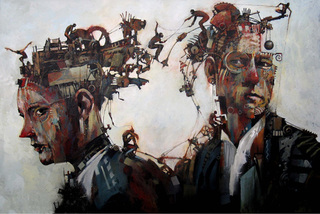
This is exactly why I love these pieces (sans "embarrassing" adjective, though). I love sculpture/visual art that evokes unsettling feelings, or exhibits a sense of morbidity. I'd be quite surprised if these artists (the modern/contemporary ones) aren't going for that feel.
One of my favorite artists, Bruce Holwerda, is excellent at doing this:

I have to second Darkshadow's contention that the Ancient Romans and Greeks had novels. I know what a novel looks like and those are novels. They aren't primitive proto-genre type things. They had centuries of tradition, fully formed masterpieces. If Satyricon or The Golden *** were published for the first time in our day they could be massively successful.
"So-Crates: The only true wisdom consists in knowing that you know nothing." "That's us, dude!"- Bill and Ted
"This ain't over."- Charles Bronson
Feed the Hungry!
I think that there's an objective element to this kind of discussion. In other words, we would probably all agree, roughly, who the contenders might be - based on common and shared criteria concerning what constitutes the good stuff.
When it comes down to the final choice, though, things get much more subjective. Each of us is still judging against criteria, but at that level of appreciation the criteria are specific to each of us - they have more to do with our individual expectations of art than with any distributed consensus.
So, if, at that second level, one were to select Davy L as the creator of the most poetically beautiful English prose, it would be difficult to construct an argument to the contrary.
Except, for me, he wouldn't even make the first cut.
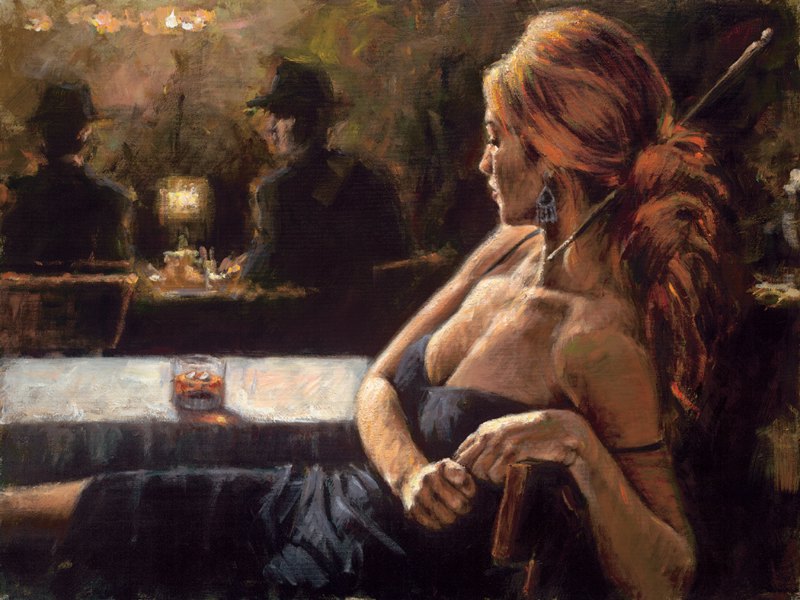
I hope not! There are many painters who prefer the opposite feelings.Mutatis-Mutandi wrote:
This is exactly why I love these pieces (sans "embarrassing" adjective, though). I love sculpture/visual art that evokes unsettling feelings, or exhibits a sense of morbidity. I'd be quite surprised if these artists (the modern/contemporary ones) aren't going for that feel.
William Whitaker
Taras Loboda
Michael and Inessa Garmash
Fabian Perez
Anna Razumovskaya
Richard Young
Juan Medina
Willem Haenraets
Aldo Luongo

Lucretius doesn't desrerve to be in the same sentence as the other three *true* giants. I read a prose translation, so I can't comment much on its poetic merits, but 'content' has to count for something - certainly Plato Montaigne and Shakespeare could live on content alone.
The main content of De rerum natura is (truly awful!) Roman physics. The interesting ethical ideas only occupy a few pages and are stolen from Epicurus - who does deserve to live with the greats...
I forced myself to read all of De Rerum natura last year, because of my interest in Epicuruis, and my professional background in physics - it was certainly my most disappointing literary experience last year...
 Posting Permissions

 Reply With Quote