Page 1 of 9 123456 ... LastLast
Results 1 to 15 of 124

Thread: Was Jane Austen (1775-1817) Black?

  1. #1
    Banned
    Join Date
    May 2010
    Location
    The Netherlands
    Posts
    54

    Was Jane Austen (1775-1817) Black?


    Cassandra Austen or Jane Austen?


    WAS JANE AUSTEN (1775-1817) BLACK?


    "In person she was very attractive; her figure was rather tall and slender, her step light and firm, and her whole appearance expressive of health and animation. In complexion she was a clear brunette with a rich colour; she had full round cheeks, with mouth and nose small and wellformed bright hazel eyes, and brown hair forming natural curls close round her face."

    James-Edward Austen,
    Jane's nephew

    ~

    "... certainly pretty-bright & a good deal of colour in her face – like a doll – no that would not give at all the idea for she had so much expression – she was like a child – quite a child very lively and full of humour."

    Mr Fowle,
    family friend

    ~

    "... her's was the first face I can remember thinking pretty ... Her hair, a darkish brown, curled naturally – it was in short curls round her face...Her face was rather round than long – she had a bright but not a pink colour – a clear brown complexion and very good hazel eyes. Her hair, a darkish brown, curled naturally, it was in short curls around her face. She always wore a cap ... before she left Steventon she was established as a very pretty girl, in the opinion of most of her neighbours."

    Caroline Austen,
    Jane's niece

    ~

    "Her hair was dark brown and curled naturally, her large dark eyes were widely opened and expressive. She had clear brown skin and blushed so brightly and so readily."

    An early description of young Jane at Steventon by Sir Egerton Brydges

    ~

    "She was tall and slender; her face was rounded with a clear brunette complexion and bright hazel eyes. Her curly brown hair
    escaped all round her forehead, but from the time of her coming to live at Chawton she always wore a cap, except when her nieces had her in London and forbade it."

    Edward Austen Leigh of Jane's appearence in the years just after the family left Southampton

    ~

    " Her stature rather exceeded the middle height; her carriage and deportment were quiet but graceful; her complexion of the finest texture, it might with truth be said that her eloquent blood spoke through her modest
    cheek."


    " Her pure and eloquent blood spake in her cheeks and so distinctly wrought that you had almost said her body thought."

    Henry Austen said of his sister

    ~

    SOURCE: http://www.jasa.net.au/images/austen.htm

  2. #2
    Registered User Emil Miller's Avatar
    Join Date
    Jul 2008
    Location
    London, England
    Posts
    6,499
    [QUOTE=Egmond Codfried;928423[/QUOTE]


    WAS JANE AUSTEN (1775-1817) BLACK?

    You have asked the same question before and the answer is NO.

    Are you sure that you don't work for the BBC?
    "L'art de la statistique est de tirer des conclusions erronèes a partir de chiffres exacts." Napoléon Bonaparte.

    "Je crois que beaucoup de gens sont dans cet état d’esprit: au fond, ils ne sentent pas concernés par l’Histoire. Mais pourtant, de temps à autre, l’Histoire pose sa main sur eux." Michel Houellebecq.

  3. #3
    dafydd dafydd manton's Avatar
    Join Date
    Jan 2009
    Location
    Sheffield, South Yorks, England. Tha knows.
    Posts
    4,831
    Blog Entries
    7
    The gentleman in question has also attempted to prove that Pushkin, Martha the sister of Lazarus, Queen Sophie Charlotte, George Washington, Hamlet (!), Beethoven, Anne Boleyn and the entire nation of Iceland are or were black. A look through other internet websites and forums is illuminating. I'm not particularly sure that I appreciate the phrases "strangely irrational" and "for lack of useful activities".
    Last edited by dafydd manton; 07-26-2010 at 09:28 AM.
    Dafydd Manton, A Legend In His Own Lunchtime!! www.dafydd-manton.co.uk

    My Work Has Been Spread Over Many Fields!

  4. #4
    Banned
    Join Date
    May 2010
    Location
    The Netherlands
    Posts
    54
    Some quotes from Jane Austen’s novels, which show that Austen wrote about people who were ‘sallow, brown, very brown and black’. And they intermarried too.

    citaat:
    '[henry crawford], was not handsome; no, when they first saw him, he was: ‘ absolutely plain, black and plain;’ but still he was the gentleman, -northanger abbey

    citaat:
    Oh! They give themselves such airs. They are the most conceited creatures in the world, and think themselves of so much importance! By the by, though i have thought of it a hundred times, i have always forgot to ask you what is your favourite complexion in a man. Do you like them best dark or fair?"

    "i hardly know. I never much thought about it. Something between both, i think. Brown--not fair, and--and not very dark."

    "very well, catherine. That is exactly he. I have not forgot your description of mr. Tilney--'a brown skin, with dark eyes, and rather dark hair.' well, my taste is different. I prefer light eyes, and as to complexion--do you know--i like a sallow better than any other. You must not betray me, if you should ever meet with one of your acquaintance answering that description." -northanger abbey

    citaat:
    Emma watson was not more than of the middle height, well made and plump, with an air of healthy vigour. Her skin was very brown, but clear, smooth, and glowing, which, with a lively eye, a sweet smile, and an open countenance, gave beauty to attract, and expression to make that beauty improve on acquaintance. […]the next morning brought a great many visitors. It was the way of the place always to call on mrs. Edwards the morning after a ball, and this neighbourly inclination was increased in the present instance by a general spirit of curiosity on emma`s account, as everybody wanted to look again at the girl who had been admired the night before by lord osborne. Many were the eyes, and various the degrees of approbation with which she was examined. Some saw no fault, and some no beauty. With some her brown skin was the annihilation of every grace, and others could never be persuaded that she was half so handsome as elizabeth watson had been ten years ago. -the watsons

    citaat:
    Miss dashwood had a delicate complexion, regular features, and a remarkably pretty figure. Marianne was still handsomer. Her form, though not so correct as her sister's, in having the advantage of height, was more striking; and her face was so lovely, that when, in the common cant of praise, she was called a beautiful girl, truth was less violently outraged than usually happens. Her skin was very brown, but, from its transparency, her complexion was uncommonly brilliant; her features were all good; her smile was sweet and attractive; and in her eyes, which were very dark, there was a life, a spirit, an eagerness, which could hardily be seen without delight. From willoughby their expression was at first held back, by the embarrassment which the remembrance of his assistance created. But when this passed away, when her spirits became collected, when she saw that to the perfect good breeding of the gentleman, he united frankness and vivacity, and above all, when she heard him declare, that of music and dancing he was passionately fond, she gave him such a look of approbation, as secured the largest share of his discourse to herself for the rest of his stay.-sense and sensibility


    citaat:
    "did you ever see such a skin? -- such smoothness! Such delicacy! -- and yet without being actually fair. --one cannot call her fair. It is a most uncommon complexion, with her dark eye-lashes and hair -- a most distinguishing complexion! So peculiarly the lady in it. --just colour enough for beauty."

    "i have always admired her complexion," replied emma, archly; "but do not i remember the time when you found fault with her for being so pale? --when we first began to talk of her. --have you quite forgotten?"-emma

    citaat:
    “how very ill eliza bennet looks this morning, mr darcy," [caroline bingley] cried; "i never in my life saw any one so much altered as she is since the winter. She is grown so brown and coarse! Louisa and i were agreeing that we should not have known her again.”

    however little mr darcy might have liked such an address, he contented himself with coolly replying that he perceived no other alteration than her being rather tanned -- no miraculous consequence of traveling in the summer.

    "for my own part," she rejoined, "i must confess that i never could see any beauty in her. Her face is too thin; her complexion has no brilliancy; and her features are not at all handsome. Her nose wants character; there is nothing marked in its lines. Her teeth are tolerable, but not out of the common way; and as for her eyes, which have sometimes been called so fine, i never could perceive any thing extraordinary in them.”-pride and prejudice

    http://www.jasa.net.au/jabooks2.htm#maid

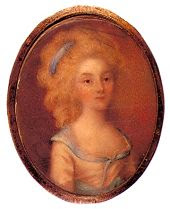
    Some discussion of the Rice portrait: a fake portrait.


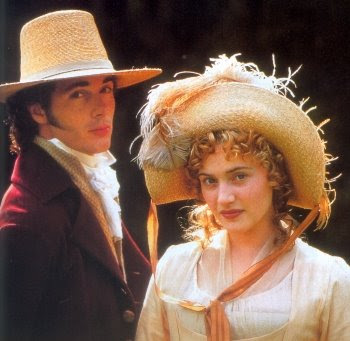
    Kate Winslet in the role of Marianne Dashwood in Sense and Sensibility.

    Miss Dashwood had a delicate complexion, regular features, and a remarkably pretty figure. Marianne was still handsomer. Her form, though not so correct as her sister's, in having the advantage of height, was more striking; and her face was so lovely, that when, in the common cant of praise, she was called a beautiful girl, truth was less violently outraged than usually happens. Her skin was very brown, but, from its transparency, her complexion was uncommonly brilliant; her features were all good; her smile was sweet and attractive; and in her eyes, which were very dark, there was a life, a spirit, an eagerness, which could hardily be seen without delight. From willoughby their expression was at first held back, by the embarrassment which the remembrance of his assistance created. But when this passed away, when her spirits became collected, when she saw that to the perfect good breeding of the gentleman, he united frankness and vivacity, and above all, when she heard him declare, that of music and dancing he was passionately fond, she gave him such a look of approbation, as secured the largest share of his discourse to herself for the rest of his stay.-sense and sensibility
    Now does this description represent a white, blond women like Kate Winslet?


    Actor Dominic Rowan in the role van Mr. Elton described by Jane Austen as: "Mr. Elton, spruce, black and smiling.'


    Emma by Jane Austen
    Ch. 13


    They arrived, the carriage turned, the step was let down, and Mr. Elton, spruce, black, and smiling, was with them instantly. Emma thought with pleasure of some change of subject. Mr. Elton was all obligation and cheerfulness; he was so very cheerful in his civilities indeed, that she began to think he must have received a different account of Harriet from what had reached her. She had sent while dressing, and the answer had been, "Much the same-- not better."

    Can Mr. Rowan be described as 'black'?

  5. #5
    Pièce de Résistance Scheherazade's Avatar
    Join Date
    Sep 2004
    Location
    Tweet @ScherLitNet
    Posts
    23,903
    W a r n i n g

    Please discuss the topic, not each other,

    and

    respect everyone's right to share their views on the topic.


    Off-topic posts or those contain personal/inflammatory comments will be removed as well as earning the posters infraction points.
    ~
    "It is not that I am mad; it is only that my head is different from yours.”
    ~


  6. #6
    Banned
    Join Date
    May 2010
    Location
    The Netherlands
    Posts
    54


    [Cassandra Austen (1773-1845), or Jane Austen (1775-1817)


    WAS JANE AUSTEN (1775-1817) BLACK?

    By Egmond Codfried


    The chief glory of nations is derived from their writers wrote Dr. Samuel Johnson (1708-1784). And many around the world deeply enjoy Jane Austen’s books and letters, of which the interpretation is constantly fine-tuned and made into movies and TV series. They study human behaviour and are satirical of human failings. Her style was based on Dr. Samuel Johnson’s: ‘cool, well-ordered, witty and incisive observations of life.’ But because Austen’s live straddled the decisive period around the French Revolution (1789-1795), her life, her books and surviving letters can also be mined for her ideas about the radical changing times. Although she wrote novels in the Romantic fashion: ‘The passion of Romantism did not inspire her.’ So I, because of my research interests, look for Austen’s ideas about the changing views on the emergence and the controversial role of Race. In this light, the fact that there is no credible portrait of Britain’s finest nineteen-century female writer should be considered as highly problematic. Jane Austen, properly read, might grow into our greatest activist in proclaiming the glory of Blacks.


    [Scene by William Hogarth]

    Austen is very insistent about the brown and very brown complexion and the special beauty of her heroines. There can be no doubt that she is writing about brown, very brown and black skinned persons belonging to the gentry and aristocracy. Henry Crawford in Mansfield Park (1814) is ‘absolutely plain, black and plain.’ His description can be compared to the Moor, always a Classical African, in many eighteen-century scenes by painter Wiiliam Hogarth (1697-1764), which show a Moor in the middle of a noble assembly. The Moor, often disguised as a servant, is one symbol of blue blood, and informs us about the true looks and high birth of the company. In Northanger Abbey (1818) two women talk about there favourite complexion in a man: ‘dark or fair.’ This is answered as: ‘I hardly know. I never much thought about it. Something between both, I think. Brown—not fair, and not very dark.’ The other woman prefers light eyes and likes ‘a sallow better then any other.’ Marianna Dashwood from Sense and Sensibility (1811) is Austen’s heroine who is ‘so lovely,’ ‘uncommonly brilliant’ and a delightful beauty: ‘that when, in the common cant of praise, she was called a beautiful girl, truth was less violently outraged then usually happens.’ But only after all this staggering praise we are told that: ‘Her skin was very brown.’ The most famous of Austen’s heroines, Eliza Bennet from Pride and Prejudice (1813) is described deprecatingly by her rival in love, Miss Caroline Bingley, as: ‘grown brown and coarse’ and ‘her complexion has no brilliancy.’ However, Mr. Darcy, their love interest; does not find any fault in any of that but perceives her as ‘rather tanned’ because of her ‘travelling in summer.’ From The Watsons, we learn about its heroine Emma Watson: ‘Her skin was very brown, but clear, smooth, and glowing.’

    Austen is clearly not talking about whites who happen to be more or less tanned. In a letter to her sister Cassandra Austen she mentions a Mrs. Blount with: ‘Her Pink husband & Fat neck’ (20-21 November 1800). White skin is referred to as ‘Pink.’ She rather discusses the many shades we see among Blacks, in a way that Blacks today have abandoned. We consider this talk today as colorism, the dangerous antagonism between ‘good’ and ‘bad complexion.’ So naturally Emma Watson’s beauty does not ‘improve on acquaintance’ with everybody. Austen states: ‘Some saw no fault, and some no beauty.’ And: ‘With some her brown skin was the annihilation of every grace.’ But Miss Austen is clearly not fooling around when she discusses complexion. In Persuasion (1818) she never mentions brown or black complexion, but subtle yet with devastating force mentions ‘Gowland’ twice. She refers to real life Gowland’s Lotion, a skin-bleaching potion introduced in 1760. So it had grown into quite an institution in her lifetime. Although advertised as a panacea for many beauty problems, the real purpose was to bleach a black or brown skin by peeling with lead white, a corrosive ingredient. Lead white was also used during the Renaissance by Elizabeth I and Catherine de Medici, Queen of France, as a whitening make-up and bleaching agent named Venetian Ceruse or Spirits of Saturn. By the addition of mercury derivates, another corrosive substance, to Gowland’s, it also functions as our Botox today, as it paralyses the facial muscles and causes a youthful radiance, but an immobile facial expression. Both substances are poisonous and their constant and excessive use attracted censure by scientists. Austen ascribes the use of Gowland to Sir Walter Elliot, the father of the heroine Anne Elliot. Her personage had ‘an elegance of mind and sweetness of character.’ She had taken after her mother who was: ‘ an excellent woman, sensible and amiable.’ Austen introduced Sir Elliot as: ‘Handsome with the blessing of beauty,’ through Anne’s eyes, and as a ‘failing’ and ‘conceited, silly father.’ So we may assume Austen decidedly rejects the skin-bleaching practises by the black and brown Europeans in her books.


    [Eliza de Feuillide (1761-1813), Jane Austen's first cousin]

    The brown beauty of Emma and Eliza and the very brown beauty of Marianne and Emma Watson are reflected in the six detailed descriptions of Jane Austen by her family and friends. Even towards the controversial nature of the views of black and brown looks that we can derive from her books. Austen is described as: ‘in complexion she was a clear brunette with a rich colour’ (1864) and: ‘- she had a bright but not a pink colour – a clear brown complexion’ and: ‘she had clear brown skin.’ But the language also becomes cryptic: ‘Her pure and eloquent blood spoke in her cheeks,’ and needs deciphering. Her niece Eliza de Feuillide (1761-1813) married a French aristocrat, who was guillotined during the French revolution (1789-1795), describes her own looks as: ‘add to all this a very share of Tan with which I have contrived to heighten the native brown of my Complexion, during a two years residence in the country.’ One takes notice of the self-deprecating tone of voice, which is also encountered in the works by contemporary Isabelle de Charrière (1740-1805). She described herself as: ‘She does not have the white hands, she knows this and even jokes about it, but its not a laughing matter.’(1764) And in Lettres écrites de Lausanne (1785) her heroine Cécile is described by her doting mother as: ‘she would have been beautiful if her throat was whither.’ Jane Austen died young from a still unidentified disease and she wrote in a final letter: ‘I’m recovering my Looks a little, which have been bad enough, black and white & every wrong colour.’(1817)


    [Maria Jacoba van Goor (1687-1737), Isabelle de Charriere's grandmother]

    The prevailing emphasise on brown and very brown skin in both her works and the way she herself was described, forces us to consider Jane Austen’s personal identity as Black. And there we are double crossed by the absence of an authenticated portrait which shows her own rich brown complexion and prettiness. In my ongoing research, my Blue Blood is Black Blood (1500-1789) Theory (2005), I have already encountered some so-called ‘missing’ portraits, which however do exist, or existing portraits which are not put on display in a museum because of African looks, or those portraits which show the same person who is described as ‘noir et basané’ (black brown) and ‘chimney sweeper’ as a blue eyed, white man. This scandalous falsehood we also encounter in the present day depictions of Austen’s personages by white actors and actresses. Marianne Dashwood, who was ‘very brown,’ is played by the lovely Miss Kate Winslet, who is blond and white. Miss Jennifer Ehle is white and has ethnic looks, derived from her Rumanian grandmother, but does not look ‘brown’ nor ‘’rather tanned’ as Austen describes Eliza Bennet.

    Apparently, I’m not the only one who has discovered Jane Austen’s blackness. Yet where I welcome this as a valuable addition to my research after Blacks and coloured Europeans who were a dominating elite, others seek to deny, hide and submerge. They are denying Blacks the glory that derives from Black achievement and Black writers. The one un-authenticated portrait, which was acquired in 2000 by The Jane Austen Trust is supposed to show Cassandra Austen, but can be considered to be Jane’s, as it perfectly conforms to all her descriptions. Yet she will not be identified by them as Black because eurocentrism claims ‘There were no Blacks!’ Or what one might perceive as a Black is most likely a ‘Black Caucasian’ and not a ‘True Negro,’ they say. As some might know that according to eurocentrism Africans should be divided in African Caucasians, who might be pitch black but display no prognatism, and the ‘True Negroes’ who are prognastic. Apparently an unforgivable offence, we will see. And eurocentrism will blithely insist that there is no proof because we cannot employ biometric pliers to measure Austen’s skull to proof her a Negress. Or some easily disproved nonsense about Blacks who cannot be rendered in paintings. And their final obstacle is demanding from a researcher a Black ancestor, who must be named. And has to be a ‘True Negro’ who is a SSA, from below the ‘South of Sahara.’. Someone, just like Alexander Pushkin’s great-grandfather, Abraham Hannibal. Or Alexander Dumas’ father, General Dumas whose mother was an enslaved woman from Martinique. Yet Africa is just across the very narrow Straights of Gibraltar and Africans first arrived 43.000 years ago in Europe. Who knows their names? Whites, descendents of Albino’s who are in my experience just normal and healthy people who need a sunblock, are only 6000 years in Europe, coming from Central Asia. But mostly whites claim, unconvincingly, not to be the least interested in whether Jane Austen was white or Black, but rather focus on her work and personality. As if personality is not also informed by an ethnic identity. As if any writer can be studied without some reference to the personal context. Jane Austen also wrote about persons whose fortune was derived from slavery, as Isabelle de Charrière did and struggled with her own wealth. Fanny Price’s outburst against slavery is met with silence, in Mansfield Park, by the slaveholding Bertram family. Reverend George Austen (1731-1805), Jane’s father, acted as a trustee for a plantation on Antigua owned by Mr. Nibbs. Jane Austen was perfectly in the know about emerging views of Blacks. Does she refer to this when she cries out in a letter to her sister: ‘If I’m a wild Beast I cannot help it’ and ‘It is not my own fault.’(1813) The Moor, the Classical African who symbolised blue blood and black superiority was demoted to the base of the evolutionary ladder, now a creature between the superior white Human and Apes. This part also highlights the role of European Blacks in exploiting Africans in slavery. Yet eurocentrism blocks any dialogue or argument as if these views are dangerous and extremely pernicious and would threaten the very fundaments of the whole western civilisation. Any solicitation is met with rudeness and next dead silence. And even sabotage by library workers, as I have found out. Interesting is that on the Internet this portrait is shown out of focus which renders her prognastic lips fuzzy. And therein I find the reason for suppressing her portrait: Jane Austen displays clear Classical African features that make her Blackness undeniable.


    [Scientific Racism]

    The suppression of Jane Austen’s true portrait had already started during her lifetime and apparently no public portrait was issued by her in 1811 when she debuted with Sense and Sensibility. She knew that her ‘peculiar charm,’ which pointed to ‘the purity and eloquence of her blood’, put her straight in the line of fire of revolutionaries who had violently brought down the Ancien Regime. This regime I have defined as Reversed Apartheid. Sadly, I sometimes have to point out to some that South African Apartheid was an unjust and a wholly evil system. Likewise Reversed Apartheid, but this Black and Coloured nation shaped Europe in the way we know it today. My research shows a great and universal scramble to amend ancestral portraits to hide Blackness, even to the point of defacement. Now I can safely push back this panic to at least around 1811. I have concluded that there most certainly were many portraits of Jane Austen adorning the walls of the stately homes of family and friends were she was received as a favourite relative and guest. Yet they displayed her Classical African features, a mark of ‘her pure blood,’ and thus became a liability. Black Europeans who considered their blackness as proof of their superiority over whites, who they derisively called ‘Pink’ or ‘t Graauw’ (the Grey’s), were bullied into abstaining the propagation of Black Supremacy. As total revisionism was aimed at, I seriously doubt any documents toward this directive will be found. They would have defeated the revisionist purpose.


    [A book bound in human leather]

    I consider the horrible practice of using white human skin for bookbinding’s by the Black nobility as further proof how some viewed their white subjects. But they still alluded to their black superiority with jewellery and imagery with Moors and what I perceive as cryptic phrases: ‘blue blood,’ ‘not the white hands’ or ‘the purity and eloquence of her blood.’ Austen’s heroines could have only been Blacks as she was Black and her pride was based on her blackness. She considered herself through her accomplishments as a writer combined with her blackness as a true noble. The titled aristocrats are often portrayed in her books as: ‘ill-bred’, ‘sickly and crossed,’ ‘cold,’ ‘insignificant’ and ‘plain and awkward.’ And even the final blow by sweet Anne Elliot: ‘they are nothing.’ Jane Austen who was Black did not renounce Black Superiority if it was enforced by personal brilliance by applying ones talents to become accomplished. Mr. Darcy, the ideal hero who ravaged Eliza Bennet’s heart, was extremely rich, but not a titled noble. His fortune was achieved by trade, thus by accomplishment. And his housekeeper said: `He is the best landlord, and the best master,’ Austen’s family and publishers would have been perceived as promoters of Ancien Regime values and would have placed themselves in great danger if they would have promoted her portrait. Even Austen herself might have experienced ridicule, hatred, violence and harsh rejection based on her Black appearance. Yet through restorations the nobility slashed its way back into power but was finally subdued in 1848. And only then whites came into power, whitewashed European history, and claimed the glory like any conqueror would usurp the spoils of war.


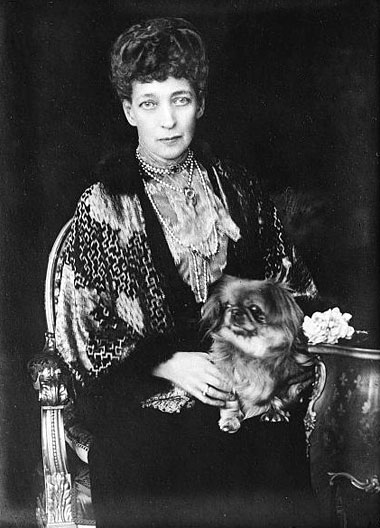
    [Queen Alexandra (1844-1925)(1923) at 79 years of age]

    The absence of a portrait of Jane Austen and the portrayal of her personages by white actresses should be viewed as the ongoing revisionism of history. Any European museum should be regarded as a Church of Revisionism because they show whitened copies, over painted authentic portraits and outright fake images of the black kings and nobles. A practice facilitated by these persons themselves by issuing whitened portraits. A look they did achieved in real life with white face paint and bleaching crèmes. It seems that the views from whites about Blacks were frozen in 1760, when nationhood was hence identified by colour. Queen Alexandra (1844-1925) (1902-1910) was famous for her beauty in advanced age, achieved by a practice called enamelling. She preferred an application of paint which made her pink all over. This technique also prescribed the careful application of blue pigments to the temple veins to heighten the illusion of a translucent, super white skin. Her rather lifeless and ethereal look suggests paralysed facial muscles by mercury derivates, as well. This miraculous vision of beauty was then further enhanced with mysterious veils that blurred the view. Yet there are photographs which show her and her mother, Queen Louise of Denmark, as brown and frizzy haired. Her husband, Edward VII was a son of Queen Victoria, who was a granddaughter of Queen Charlotte-Sophie whose ‘true mulatto’ and ‘brown’ looks were deemed ‘propagandistic’ and gave rise to many comments. Some over painted portraits of the nobility show a solid pink face, and excessive, gruesome blue veins in the face and on the hands. This undoubtedly gave rise to the nonsense about the nobility to be very white and that blue blood meant blue veins showing. It could only be understood that frightened and indoctrinated coloured Europeans took to protecting themselves from the sun with umbrellas, veils and gloves, as Blacks tan easily.

    This article should be understood in connection with my Blue Blood is Black Blood (1500-1789) thread elsewhere on this site and in Google. Any writer writes less then he knows; for sake of brevity, yet all my conclusions are based in facts and argument. Voltaire was accused by his detractors of ‘inventing his own facts.’ What are facts? I reject eurocentrism which is supposedly based in ‘fact’ and ‘empirism’ yet its a fake and evil science to hide the traumatic fact that Europe was a Black Civilisation, with Blacks despotically oppressing whites. Nobody observed Evolution, no one reproduced Evolution, and there are many ‘Missing Links,’ yet to Evolutionist, the Evolution Theory is a fact, as it better explains nature and human descent then Genesis’s Believers can. No one should believe anything; they should research everything by Google. The more sources to confirm a fact, the better. I will post more sources and welcome serious questions from readers. Whites seem to perceive Blacks as biased and therefore not capable to research these matters. But whites do not seem to suffer the same bias when researching the same matter. How come?

    Egmond Codfried
    The Hague
    June 2010

  7. #7
    dafydd dafydd manton's Avatar
    Join Date
    Jan 2009
    Location
    Sheffield, South Yorks, England. Tha knows.
    Posts
    4,831
    Blog Entries
    7
    Are not those last three sentences a bit sweeping, not to say inflammatory? Racist, even?
    Dafydd Manton, A Legend In His Own Lunchtime!! www.dafydd-manton.co.uk

    My Work Has Been Spread Over Many Fields!

  8. #8
    Banned
    Join Date
    May 2010
    Location
    The Netherlands
    Posts
    54
    JAMES LANGFORD NIBBS (1738-1795), was Jane Austen’s (1775-1817) godfather.

    This source relates to Mansfield Park.

    On the site there is a portrait of William KNIBB (1803-1845.) His skin looks very dark.


    Another portrait of William Knibb

    Source: http://en.wikipedia.org/wiki/William_Knibb


    JAMES LANGFORD NIBBS 1738-1795

    Antiguan 'Gentleman' Sugar plantation owner

    You might like to view his family tree in conjunction with reading this item.


    His full pedigree resides at the College of Arms but a copy appears in Vere Langford OLIVER's book on "THE HISTORY OF THE ISLAND OF ANTIGUA, One of the Leeward Caribbee in the West Indies, from the first Settlement in 1635 to the Present Time." Published by Mitchell and Hughes, 1896. The late Graham NIBBS located this book and kindly told me about it.


    I've put together as much as I can from the book and various sources.


    I did commission The York Herald at The College of Arms to carry out a basic search for me and that's how I established that James was granted a Coat of Arms on 13 Oct 1759. He had returned from Antigua and his then address was given as St John's College, Oxford. Later, he lived at Beauchamps House near Tiverton, Devon.

    Brian NIBBS of Jersey very kindly paid for a drawing of ‘the full achievement of Armorial Bearings'. It's a representation of this Coat of Arms (copied here) that appears in the top left hand corner of the website pages.


    The NIBBS family were sugar plantation owners in Antigua at the time. I learned originally from Lester PARRY that Jane AUSTEN's father was at Oxford with James Langford NIBBS. He became a trustee of the estate and taught a son George NIBBS, who lived for a time with the AUSTEN family at Steventon Rectory. George was in fact a godson to Jane's father as was Jane's elder brother to James Langford NIBBS. It is therefore most likely that the sugar plantation referred to in 'Mansfield Park' is none other than the NIBBS property.
    http://freepages.genealogy.rootsweb....etc/page3d.htm

  9. #9
    Registered User kiki1982's Avatar
    Join Date
    Jun 2007
    Location
    Saarburg, Germany
    Posts
    3,105
    Aside from really Jane Austen, if there were so many black people, how come that Europe is not at least mulatto? There are more white people than black people or mulatto. So if so many people were black, even kings, queens and what-not, how is it possible that we are not all mulatto, or are we all the result of recessive genes coming together? Supposedly no dominant gene met a recessive one then. And it rarely occurs that two white people get a black baby, which, given the abundance of blacks in the past, should happen more, then.

    Seriously, Jane Austen's portrait is certainly white. Most of the people you actually take as examples wore wigs, so did not have their own hair on paintings, and lived in times when curling one's hair was in fashion. It actually never went out of fashion until the 20ieth century.
    One has to laugh before being happy, because otherwise one risks to die before having laughed.

    "Je crains [...] que l'âme ne se vide à ces passe-temps vains, et que le fin du fin ne soit la fin des fins." (Edmond Rostand, Cyrano de Bergerac, Acte III, Scène VII)

  10. #10
    Banned
    Join Date
    May 2010
    Location
    The Netherlands
    Posts
    54
    Quote Originally Posted by kiki1982 View Post
    Aside from really Jane Austen, if there were so many black people, how come that Europe is not at least mulatto? There are more white people than black people or mulatto. So if so many people were black, even kings, queens and what-not, how is it possible that we are not all mulatto, or are we all the result of recessive genes coming together? Supposedly no dominant gene met a recessive one then. And it rarely occurs that two white people get a black baby, which, given the abundance of blacks in the past, should happen more, then.

    Seriously, Jane Austen's portrait is certainly white. Most of the people you actually take as examples wore wigs, so did not have their own hair on paintings, and lived in times when curling one's hair was in fashion. It actually never went out of fashion until the 20ieth century.
    Thank you for posting, but kindly let me know if you agree with my statement, (or disagree and why?), in my article that both her novel personages and her personal description point to people of colour. It's no use to go on responding to your comments if I do not know your views on these sources. There should be a measure of integrity in any discussion. My approach is wholly rational. And I welcome people challenging my findings, my findings that is not; the hysteria which seem to grip some as soon as blackness is discussed.
    Last edited by Egmond Codfried; 07-26-2010 at 10:55 AM.

  11. #11
    Registered User kiki1982's Avatar
    Join Date
    Jun 2007
    Location
    Saarburg, Germany
    Posts
    3,105
    They do not. If one is ignorant, they do.

    Is that clear?

    Learn and thou wilt be enlightened.
    One has to laugh before being happy, because otherwise one risks to die before having laughed.

    "Je crains [...] que l'âme ne se vide à ces passe-temps vains, et que le fin du fin ne soit la fin des fins." (Edmond Rostand, Cyrano de Bergerac, Acte III, Scène VII)

  12. #12
    Banned
    Join Date
    May 2010
    Location
    The Netherlands
    Posts
    54
    http://www.publicbookshelf.com/roman...y/born-heroine

    Catherine Morland, the heroine from Nothanger Abbey is described as "sallow' meaning light brown. Her strong features were Classical African features.

    A family of ten children will be always called a fine family, where there are heads and arms and legs enough for the number; but the Morlands had little other right to the word, for they were in general very plain, and Catherine, for many years of her life, as plain as any.

    She had a thin awkward figure, a sallow skin without colour, dark lank hair, and strong features--

    I found some interesting reverences to ‘rouging up’ in Eliza de Feuillide’s letters to her cousin Phylly in discussing Marie Antoinette’s beauty. De Feuillide claims that Marie Antoinette has the whitest, loveliest hands she ever saw. She rejects Phylly’s idea that it was due to ‘art.’

    http://www.jasa.net.au/books/lefaye2.htm

    In Persuasion Sir Walter Elliot uses Gowland’s, a skin-bleaching lotion, in all the months of spring. And he advises Lady Russel to ‘rouge’ because apparently she is not fit to be seen’ in the morning and hides from visitors.


    I found some interesting reverences to ‘rouging up’ in Eliza de Feuillide’s letters to her cousin Phylly in discussing Marie Antoinette’s beauty. De Feuillide claims that Marie Antoinette has the whitest, loveliest hands she ever saw. She rejects Phylly’s idea that it was due to ‘art.’

    http://www.jasa.net.au/books/lefaye2.htm

    In Persuasion Sir Walter Elliot uses Gowland’s, a skin-bleaching lotion, in all the months of spring. And he advises Lady Russel to ‘rouge’ because apparently she is not fit to be seen’ in the morning and hides from visitors.
    Last edited by Egmond Codfried; 07-26-2010 at 11:56 AM.

  13. #13
    Dance Magic Dance OrphanPip's Avatar
    Join Date
    Oct 2009
    Location
    Kuala Lumpur but from Canada
    Posts
    4,163
    Blog Entries
    25
    Sallow doesn't mean light brown, it means sickly, pale, or yellow tinged.

    Thus, the "without colour" that follows "sallow skin."

    I think we've covered your misinterpretation of 18th and 19th century English before.

  14. #14
    Registered User
    Join Date
    Apr 2010
    Posts
    6,053
    My question would be 'Who gives a sh*t anyway what colour Jane Austen was?!' - is this thread not a case of reversed-racism???

  15. #15
    Registered User Emil Miller's Avatar
    Join Date
    Jul 2008
    Location
    London, England
    Posts
    6,499
    Quote Originally Posted by hillwalker View Post
    is this thread not a case of reversed-racism???
    Most certainly.
    "L'art de la statistique est de tirer des conclusions erronèes a partir de chiffres exacts." Napoléon Bonaparte.

    "Je crois que beaucoup de gens sont dans cet état d’esprit: au fond, ils ne sentent pas concernés par l’Histoire. Mais pourtant, de temps à autre, l’Histoire pose sa main sur eux." Michel Houellebecq.

Page 1 of 9 123456 ... LastLast

Similar Threads

  1. Jane Austen - why the fuss?
    By Scheherazade in forum Austen, Jane
    Replies: 59
    Last Post: 05-25-2015, 07:51 AM
  2. Mr Rochester...
    By kiki1982 in forum Jane Eyre
    Replies: 31
    Last Post: 02-17-2011, 10:37 AM
  3. Was jane austen (1775-1817) black?
    By Egmond Codfried in forum Austen, Jane
    Replies: 52
    Last Post: 07-21-2010, 01:57 PM
  4. Saint John in Jane Eyre
    By dirac1984 in forum Jane Eyre
    Replies: 23
    Last Post: 06-23-2010, 11:35 AM
  5. Contemplations on Jane Eyre
    By kiki1982 in forum Jane Eyre
    Replies: 11
    Last Post: 05-24-2009, 07:04 AM

Posting Permissions

  • You may not post new threads
  • You may not post replies
  • You may not post attachments
  • You may not edit your posts
  •