Page 4 of 5 FirstFirst 12345 LastLast
Results 46 to 60 of 67

Thread: A Brief Introduction to Chinese Classical Poetry

  1. #46
    Wild is the Wind Silas Thorne's Avatar
    Join Date
    Dec 2008
    Location
    New Zealand (Mostly)
    Posts
    2,788
    Blog Entries
    94
    Quote Originally Posted by JBI View Post
    As it is though, I am not the most fond of the Book of songs, I prefer more Daoist and Buddhist elements than the sort of Confucian elements of the early book.
    Or rather that a lot of what Confucius thought stemmed from the traditional ideas and content of this work perhaps? Yanzi (Yanying) also lived around the same period and had many of the same ideas as Confucius because the Shijing was their moral and cultural guide in many ways.

  2. #47
    Artist and Bibliophile stlukesguild's Avatar
    Join Date
    Jul 2006
    Location
    The USA... or thereabouts
    Posts
    6,083
    Blog Entries
    78
    wlz, I won't throw Japan in with China as that small island nation... as influenced as it was by China... is really an entirely different beast. I am actually deeply enamored by (and influenced by as an artist) Japanese art. Still it is the arts of the Middle-East... spreading from Islamic India to Islamic Spain... that is most fascinating to me outside of Western culture both in terms of literature and art (and I might even throw music into the mix). I have read a slight bit of Sa'Di. I'm particular to the Arabic poetry of Islamic Andaluz that is to be found in the classic translation by Cola Franzen and which was part of a collection that inspired Garcia-Lorca and the entire 20th century Spanish Renaissance. I'm also somewhat read in the Jewish poets of Islamic Spain who with the Arabs of the same culture were profoundly influential upon the French and Provencal troubadours and as such, upon the entire tradition of European lyric poetry.
    Beware of the man with just one book. -Ovid
    The man who doesn't read good books has no advantage over the man who can't read them.- Mark Twain
    My Blog: Of Delicious Recoil
    http://stlukesguild.tumblr.com/

  3. #48
    Bibliophile JBI's Avatar
    Join Date
    Feb 2007
    Location
    Toronto
    Posts
    6,360
    Quote Originally Posted by stlukesguild View Post
    wlz, I won't throw Japan in with China as that small island nation... as influenced as it was by China... is really an entirely different beast. I am actually deeply enamored by (and influenced by as an artist) Japanese art. Still it is the arts of the Middle-East... spreading from Islamic India to Islamic Spain... that is most fascinating to me outside of Western culture both in terms of literature and art (and I might even throw music into the mix). I have read a slight bit of Sa'Di. I'm particular to the Arabic poetry of Islamic Andaluz that is to be found in the classic translation by Cola Franzen and which was part of a collection that inspired Garcia-Lorca and the entire 20th century Spanish Renaissance. I'm also somewhat read in the Jewish poets of Islamic Spain who with the Arabs of the same culture were profoundly influential upon the French and Provencal troubadours and as such, upon the entire tradition of European lyric poetry.
    It's interesting to note though the old classics of Japan were written in what was essentially Chinese, nearly pure Classical Chinese. Korea and Japan seem descended from Tang China culturally, but it is interesting to look at how they differ culturally, and how they emerge as distinct civilizations by reinterpreting and personalizing different thoughts that they incorporate.

    Tang Poetry actually had a profound effect as both starting ground and model of Japanese verse, it's just that Tang's decline led China on a different cultural path, arguably, and the reshaping of Japan as a more isolated culture emerged to cross traditional culture as a new variant.

    But all the Kimonos and clothing we originally associate with Japan are in truth Tang dynasty imports that emerge into their own forms of fashion outside of the direct, or close influence of China.

  4. #49
    Haribol Acharya blazeofglory's Avatar
    Join Date
    Jun 2007
    Location
    Kathmandu
    Posts
    4,959
    I am reading tirelessly Chinese poems, The Tao in fact. They are matchless beauties

    “Those who seek to satisfy the mind of man by hampering it with ceremonies and music and affecting charity and devotion have lost their original nature””

    “If water derives lucidity from stillness, how much more the faculties of the mind! The mind of the sage, being in repose, becomes the mirror of the universe, the speculum of all creation.

  5. #50
    Bibliophile JBI's Avatar
    Join Date
    Feb 2007
    Location
    Toronto
    Posts
    6,360
    Quote Originally Posted by blazeofglory View Post
    I am reading tirelessly Chinese poems, The Tao in fact. They are matchless beauties
    I don't know if I want to call it poetry though.

  6. #51
    Artist and Bibliophile stlukesguild's Avatar
    Join Date
    Jul 2006
    Location
    The USA... or thereabouts
    Posts
    6,083
    Blog Entries
    78
    There is an aspect of the Japanese aesthetic that is far more stripped-down... almost Minimalist or Modernist in contrast to the more "Baroque" aesthetic of the Chinese. A large part of this is owed to the comparatively hermetic experience of the Japanese... the influence of the respect for nature and natural forms rooted in the native Shinto religion... the lack of access to certain materials and influences. One might see the contrast quite obviously in the ceramic arts, which were central to both China and Japan. China produced a vast array of ceramics, some of which clearly illustrate their contact with other cultures:

    The famous ceramic army of the emperor Qin Shi Huang makes a masterful use of a naturalism (each figure is an individual and soldiers clearly show a variety of nationalities and clothing types) that almost certainly was inspired by contact with the West and the Greco-Roman world:


    The pieces show traces of paint and were quite probably painted in a naturalistic manner. Later works show clear influence of other Western sources, including Middle-Eastern... both in theme and style:


    Later Chinese ceramics make great use of porcelain which allowed for the most delicate and fine ceramic-wear. The works are commonly symmetrical, highly sophisticated and decorative in a manner that is almost Baroque (or even Rococo). It shouldn't be surprising that such works were highly valued by European collectors during the Baroque era and became the inspiration for European ceramics... especially the blue Dutch "Delftware" that drew upon the Chinese Ming pieces especially:


    The Japanese developed along a distinctly unique path. The works of the early Haniwa period show a clear respect for natural materials (no paint or other decoration) and simple... almost crude processes... as well as a unique stylization:


    This aesthetic... the respect for natural, untreated materials and the rejection of decoration remained a hallmark of Japanese ceramics... and art in general... almost by necessity. Where China has access to the fine clay suited to the most delicate porcelain, they refused to export this raw material to their competitors... recognizing the worth of having the monopoly upon the porcelain ware in demand in the West... and among their Asian neighbors. By contrast, Japanese ceramic wear appears raw... almost crude... as a result of the use of the heavier stonewear clay that did not allow for fine details... and that as a result of higher firing temperatures did not allow for brighter colors or delicate glazed decorations:


    The decoration, rather, embraced the Zen (from the Chinese Chen) calligraphic, gestural approach to painting. There were ways around the problem of the lack of access to porcelain. One of the best was the use of enamels... even gold and other metals... fused to the surfaces of the ceramic pieces. This technique was quite favored during the Momoyama period when gold leaf and the decorative was embraced:


    With time, however, the Japanese developed an aesthetic the fully embraced the limitations of "crude" stonewear... even employing what the Chinese would have seen as "mistakes" as an aesthetic in itself:

    Crude and misformed objects:


    Drips:


    Cracked and bubbled glazes:


    Ceramic not fully covered with glaze so that raw clay shows through:


    This aesthetic evolved into such a highly desired and sophisticated style that the individual ceramic artist became well-known and sought after. It's not surprising, however, that the Japanese works were not valued in the West until the advent of Modernism. The Modernist recognized the brilliantly unique elements of Japanese design... not only as seen in their ceramics... but in the hard-edged geometric architecture with its use of raw materials which inspired entire generations of architects from Frank Loyd Wright on:


    The calligraphy that made use of the gestural line as well as a contrasetween the most elegant sensitivity to materials (papers, gold leaf, colors) and the apparent random mistakes of splatters, drips, etc:


    Some works almost seem to predict Abstract Expressionism:


    Neither can we forget the brilliant design of the screen paintings:


    ... and the Ukiyo-e prints that would have the most profound impact upon Western art... from Degas and Van Gogh... to comic books and anime:

    Beware of the man with just one book. -Ovid
    The man who doesn't read good books has no advantage over the man who can't read them.- Mark Twain
    My Blog: Of Delicious Recoil
    http://stlukesguild.tumblr.com/

  7. #52
    Bibliophile JBI's Avatar
    Join Date
    Feb 2007
    Location
    Toronto
    Posts
    6,360
    You forget where it comes from though. The sculpture of the head of a rider is most certainly influenced from tribes north of Manchuria that came down and made up the first wave of Japanese immigrants - there is a cultural link between both sides of the Eastern Sea (Sea of Japan). The royal insignia of Japan, for instance, are designed in strange fashion; the mirror betrays traces of Chinese influence, and the Sword is essentially written in Chinese characters, and smithed in Sillan (Silla dynasty that ruled over much of South and North Korea) metalwork. Before the Yamato period, I think it is safe to say that the cultural exchange is rather undefined - what is Korea and what is Japan seem debatable facts.

    The very same notion was brought up at the beginning of the 20th century, when Japan justified an annexation of Korea with history in the Nihongi claiming a colony on the southern tip of the Korean Peninsula - what it implies, historically is an almost permanent presence on the peninsula, which at the time, just north of there was also engaged with a long period of Chinese garrison.

    The Shinto religion though as a construct comes into play later; Buddhism clearly usurps its position as a sort of central belief, and Confucianism dominates the structural conceptualization of the country in the early periods. Likewise, the introduction of Chinese characters (largely through Korea) brings a crosswork of forms of communication.

    Hitomaro may form the genesis of Japanese verse forms, but the actual forms themselves are adopted from Chinese sources; Tang Poetry is, in essence, Japanese foundational verse itself.

    As for Chinese art being somehow more vulgar, landscape painting which emerged during the time of disunity between the fall of the Han and the emergence of the Sui would reflect a sort of simplistic minimalism, showing a single character within a ink-drawn landscape.

    I think the affinity to Japanese artwork has to do with the fact that Japanese artwork, like impressionist and Renaissance art work seems to have been absorbed into the popular imagination. There is nothing to suggest though that the works are any less intricate, or minimalist, in the sense that John Adams can be described as more minimalist than J. S. Bach.

  8. #53
    Artist and Bibliophile stlukesguild's Avatar
    Join Date
    Jul 2006
    Location
    The USA... or thereabouts
    Posts
    6,083
    Blog Entries
    78
    You forget where it comes from though. The sculpture of the head of a rider is most certainly influenced from tribes north of Manchuria that came down and made up the first wave of Japanese immigrants -

    Almost certainly the initial settlers of Japan came from the mainland of what became China... but we are talking the Paleolithic age... some 30,000 years ago or more... well before the existence of any Chinese culture. The Jōmon period resulted in some of the oldest ceramics known (c. 14,000 BC) although it is assumed that the art was probably developed in central Asia. The ceramic Haniwa sculpture that I posted was a product of the Yayoi era (c. 900 BC) through the Kofun era (c. 250- 538 AD). The Yayoi were a people from the southern regions of Japan who may have been a mixture of Korean and Chinese with the older Jōmon. These people moved north mixing with the still existent Jōmon peoples and eventually established what would become Tokyo. There is little history of the era outside of a few Chinese records. The first Japanese records do not appear until the Jōmon era at which time the ruling classes began to adopt the Chinese written language, although they maintained a native Japanese pronunciation.

    Before the Yamato period, I think it is safe to say that the cultural exchange is rather undefined - what is Korea and what is Japan seem debatable facts.

    Certainly... while China develops as a clearly defined culture far earlier.

    The Shinto religion though as a construct comes into play later...

    Shinto is actually just a loose collection of indigenous nature-based spiritual beliefs and practices that date back to the prehistoric era.

    Buddhism clearly usurps its position as a sort of central belief

    Not really. Buddhism was embraced by many of the ruling and aristocratic classes, but in no way ousted the native Shinto beliefs. The Japanese approach to religion, indeed, seems syncretic... combining various aspects of Buddhism, Confucianism, Taoism... and later, Christianity. Currently over 120 million Japanese adhere to the Shinto religion... but in a great many instances these same persons also follow various Buddhist or even Christian practices.

    As for Chinese art being somehow more vulgar, landscape painting which emerged during the time of disunity between the fall of the Han and the emergence of the Sui would reflect a sort of simplistic minimalism, showing a single character within a ink-drawn landscape.

    I wouldn't characterize Chinese art as more "vulgar"... rather it far more likely to be more ornate... to embrace details and decoration. I agree that the Chinese painting of the Chen/Zen period provided the model for the Japanese aesthetic of Minimalism and the embrace of the gesture:


    This style (as well as the Chen/Zen Buddhist beliefs that accompanied it) seem to have suited the Japanese nature-based aesthetic and the respect for the natural... accidental... spontaneous. Where it becomes but a single short-lived aspect of Chinese art, it essentially is the core of Japanese art.

    I think the affinity to Japanese artwork has to do with the fact that Japanese artwork, like impressionist and Renaissance art work seems to have been absorbed into the popular imagination. There is nothing to suggest though that the works are any less intricate, or minimalist, in the sense that John Adams can be described as more minimalist than J. S. Bach.

    The popularity of Japanese art with the Impressionists, Abstract Expressionists, and other Modernists certainly promoted the Japanese aesthetic. Then again, the Chinese style was spread throughout Europe far earlier through Dutch and other merchants. The reality is that the minimalism, the geometry, the clean, sparse design, the flat graphic forms, and the embrace of the natural materials and "accidental" or spontaneous effects are clearly different from Chinese art and undoubtedly more in line with Modernist aesthetics. Japanese style appeared (and still appears) to many Western artists to be far more "modern" in that it is far more removed from traditional Western aesthetics. Where a painting such as Fan Kuan's Travelers amid Mountains and Streams:


    is a clear masterpiece, it is not incredibly far from the European landscape traditions:


    especially if one considers the European Romantic tradition which echoes the Chinese aesthetic in terms of presenting the overwhelming power of nature:


    the flat graphics of Japanese screen painting and Ukiyo-e prints... the near abstraction of the imagery... the verticality and the spatial distortions...


    and the intimate nature of the imagery such as scenes of everyday landscapes, scenes drawn from domestic life (as opposed to images of noble figures such as aristocrats of religious figures), or suggestions of the erotic... such as in this screen painting in which the robes of (multiple?) lovers are seen hanging like so many trophies:


    Were seen as incredibly shocking... compositionally daring... and profoundly inspirational to Western artists. There are few having the least exposure to Chinese and Japanese art who cannot discern one from the other as easily as one might discern German from Italian art. This is not to make the least value judgment or to suggest that one is inherently superior to the other... although I have my admitted preference. On the other hand, I will suggest that Japanese art has seemed to have survived contact with the West far better than Chinese. After a period of horribly derivative work, Japanese artist found a way in which to absorb Western tradition within their own native artistic language. The more abstract/nature-based works clearly echo ancient Japanese (Shinto) traditions:


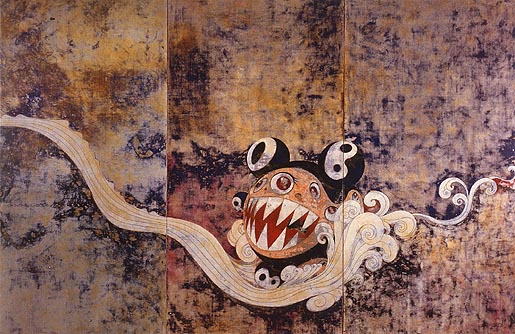
    Other artists have been able to brilliantly fuse Japanese traditions of painting and print with popular culture... especially with the cartoon/anime figures that were rooted in the Ukiyo-e:


    Chinese art, on the other hand, only seems to be beginning to come into its own once again. Many of the artists are incredibly talented in an academic sense... but prone to sad imitations of Western-style work... especially of the Pop Art tradition that lends itself to rapid production-line creations. There are, however, some fascinating exceptions such as Yun Fei Ji.
    Beware of the man with just one book. -Ovid
    The man who doesn't read good books has no advantage over the man who can't read them.- Mark Twain
    My Blog: Of Delicious Recoil
    http://stlukesguild.tumblr.com/

  9. #54
    Bibliophile JBI's Avatar
    Join Date
    Feb 2007
    Location
    Toronto
    Posts
    6,360
    I don't think you are reading history clearly; Buddhism was clearly dominant, even amongst the lower classes, as variants of Buddhism that appealed specifically to uneducated, and lower class people became dominant; what Shinto is is not really a real doctrine until it becomes one as a political force; the Nihongi and the Kojiki are essentially readable as propaganda used to legitimate rule.


    As for the Jomon period, the actual influence is vague, as Japanese art is based on riders who moved south through Korea into Japan - there is a direct line of influence in artistic style tracable to north of the former Koguryo kingdom of ancient Korea, and more north all the way into just south of Siberia, down toward Japan. The riders are most certainly the same on both sides of the border - what exists now in scholarship then is a fight between propaganda and history; the idea of a pure Japan or a Japanese Korea is merely a fallacy - there was, historically a mass migration; the earliest Japanese settlers seem to have been rooted in migrants coming north and moving South. The horse rider is essentially linkable to the continent directly, therefore displays with it a "non-Japanese" quality, in the sense that its trends are not rooted in an indigenous, self defined tradition of Japan, but rather a historical continental tribal tradition.


    As it is though it doesn't matter; Japanese poetry, and literature for that matter, seems easily to translate into English where as Chinese seems more resistant. The question is, why is that so? why is it that Haiku is more adaptable than Fu or Ci, when the narrative quality of Li Bai in Pound worked well enough.

    The answer is probably in exposure; the American government in particular poured great funding into Japanese studies around the time of the war and just after, whereas Chinese studies have always been a more esoteric endeavor, or one rooted in contemporary politics. The dominance of selected genre work, such as Confucian classics also probably slowed things down.

    But what is clear is that the language used to translate Japanese could easily be adapted toward Chinese, with modifications, as the linguistic removal isn't so drastic, with the exception of form. It's just that a new idiom will eventually be made to rise, that will utilize English as a means of conveying thoughts, as has happened with English rendition of Japanese.

    One must wait though.

  10. #55
    Bibliophile JBI's Avatar
    Join Date
    Feb 2007
    Location
    Toronto
    Posts
    6,360
    BUMP, just checking to see if anyone else is interested, so I know whether to post more on here or not.

  11. #56
    Chinese Poetry zowie86's Avatar
    Join Date
    Apr 2009
    Location
    China
    Posts
    18

    Red face

    Quote Originally Posted by JBI View Post
    BUMP, just checking to see if anyone else is interested, so I know whether to post more on here or not.
    Sure, just post here s'il vous plait.

    And I was thinking of making some noise here as well.
    .

    A teacher from China interested in the English translation of classical Chinese poetry.

  12. #57
    ésprit de l’escalier DanielBenoit's Avatar
    Join Date
    Aug 2009
    Location
    There is a Heppy Land Furfur A-waay
    Posts
    3,718
    Blog Entries
    137
    This is a wonderful thread. I think I'll bump it with a poem by Wang Wei.


    Deer Park Hermitage, tr. Chang Yin-nan & Lewis C. Walmsley

    Through the deep woods, the slanting sunlight
    Casts motley patterns on the jade-green mosses.
    No glimpse of man in this lonely mountain,
    Yet faint voices drift on the air.
    The Moments of Dominion
    That happen on the Soul
    And leave it with a Discontent
    Too exquisite — to tell —
    -Emily Dickinson
    http://www.youtube.com/watch?v=TVW8GCnr9-I
    http://www.youtube.com/watch?v=ckGIvr6WVw4

  13. #58
    Bibliophile JBI's Avatar
    Join Date
    Feb 2007
    Location
    Toronto
    Posts
    6,360
    Bump.

  14. #59
    Bibliophile JBI's Avatar
    Join Date
    Feb 2007
    Location
    Toronto
    Posts
    6,360
      作者:刘禹锡
      一
      杨柳青青江水平,闻郎江上踏歌声。
      东边日出西边雨,道是无晴却有晴.
      二
      山桃红花满上头,蜀江春水拍山流。
      花红易衰似郎意,水流无限似侬愁。

    Will write my own translation:
    Bamboo Branch Songs

    1

    Green Willows, a river flowing through,
    Hearing my man on the river singing;
    To the East, the sun,
    ------------To the West, hard rain,
    Love as true as this weather's fine.

    2

    Mountain top red with peach blossoms,
    The gush of the Yangtze bursting below
    Blossoms wither, like my man's love
    The river flows, like my endless sorrow.
    Last edited by JBI; 04-17-2011 at 06:12 PM.

  15. #60
    Maybe YesNo's Avatar
    Join Date
    Oct 2010
    Location
    For Mill, South Carolina
    Posts
    9,532
    Blog Entries
    2
    Quote Originally Posted by JBI View Post
      作者:刘禹锡
      一
      杨柳青青江水平,闻郎江上踏歌声。
      东边日出西边雨,道是无晴却有晴.
      二
      山桃红花满上头,蜀江春水拍山流。
      花红易衰似郎意,水流无限似侬愁。

    Will write my own translation:
    Bamboo Branch Songs

    1

    Green Willows, a river flowing through,
    Hearing my man on the river singing;
    To the East, the sun,
    ------------To the West, hard rain,
    Love as true as this weather's fine.

    2

    Mountain top red with peach blossoms,
    The gush of the Yangtze bursting bellow
    Blossoms wither, like my man's love
    The river flows, like my endless sorrow.
    I don't understand the poem, but here are some questions to keep the thread alive.

    Do you mean "below" rather than "bellow"?

    How do you go from 道是无晴却有晴 to "Love as true as this weather's fine"?

    I assume this is a Liu Yuxi 7-character poem. What would be an appropriate meter in English that might be used for these types of poems?

    Do you have a link to other translations of this poem for comparison?

Page 4 of 5 FirstFirst 12345 LastLast

Similar Threads

  1. A brief history of punjabi poetry.
    By durlabh in forum Poems, Poets, and Poetry
    Replies: 1
    Last Post: 02-11-2009, 04:47 AM
  2. An Introduction To Poetry
    By Tallon in forum Poems, Poets, and Poetry
    Replies: 27
    Last Post: 12-16-2008, 10:15 PM
  3. Can Poetry Matter?
    By stlukesguild in forum Poems, Poets, and Poetry
    Replies: 33
    Last Post: 08-05-2008, 12:44 PM
  4. Which One Do You Like Most Among Chinese Classical Poets
    By worldwalker in forum Poems, Poets, and Poetry
    Replies: 15
    Last Post: 09-21-2007, 01:39 PM
  5. The "State" of American Poetry Today
    By jon1jt in forum Poems, Poets, and Poetry
    Replies: 0
    Last Post: 09-16-2006, 04:41 PM

Tags for this Thread

Posting Permissions

  • You may not post new threads
  • You may not post replies
  • You may not post attachments
  • You may not edit your posts
  •