Page 13 of 16 FirstFirst ... 38910111213141516 LastLast
Results 181 to 195 of 232

Thread: Poe Short Story Discussion Group

  1. #181
    The Poetic Warrior Dark Muse's Avatar
    Join Date
    Nov 2007
    Location
    Within the winds
    Posts
    8,905
    Blog Entries
    964
    To an extent I agree with you. I do not think the story is just intended to be about alcohol or that he acted purely because of his drunkenness, but at the same time I think Poe was more concerned with the psychology of man and the decent into madness than he was with symbolism.

    I do not think the cat is actually meant to be a metaphor for something specific, but rather I think the focus of the story is intended to explore the possibility that indeed a seemingly ordinary man is capable of these horrendous acts.

    If you consider the Imp of the Perverse which is referenced within this story, it is Poe's view point that man does not in fact need a reason to commit evil acts outside the act itself. That people do bad things for the very reason that they can. People will do something pricelessly because they know that they should do it.

    So I do not think there is really a specific tangible reason behind the actions of the narrator, but perhaps in a way that is Poe's point and purpose, that we feel the need to seek out some true motive, some solid grounds for why he would act in such a way, and do not want to accept the truth, that there is no reason beyond the attraction of the vileness in itself.

    That is what makes it so horrifying

    Deep into that darkness peering, long I stood there, wondering, fearing, doubting, dreaming dreams no mortal ever dared to dream before. ~ Edgar Allan Poe

  2. #182
    The Poetic Warrior Dark Muse's Avatar
    Join Date
    Nov 2007
    Location
    Within the winds
    Posts
    8,905
    Blog Entries
    964
    Now that I have more time on my hands, I would like to try and get a new story going. The story I have in mind to do next is The Man of the Crowd.

    Hopefully sometime of the weakend I will have an official introduction posted for the story. In the meantime for anyone who is interested and wants to get an early start, here is the link for the online text of the story:

    http://classiclit.about.com/library/...-eapoe-man.htm

    Deep into that darkness peering, long I stood there, wondering, fearing, doubting, dreaming dreams no mortal ever dared to dream before. ~ Edgar Allan Poe

  3. #183
    The Poetic Warrior Dark Muse's Avatar
    Join Date
    Nov 2007
    Location
    Within the winds
    Posts
    8,905
    Blog Entries
    964
    The Man of the Crowd


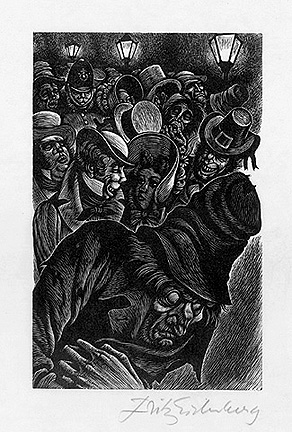
    "The Man of the Crowd" stands apart from Poe's much more infamous tales of phantasmal horror because it has a much stronger psychological aspect to it then many of Poe's other stories typically tend to have, and while still drawing from dramatic concepts and trying to pull at some deep rooted fear within the reader, it has a stronger root in reality then a majority of his other works. I think this is a story that could be appreciated both by Poe fanatics such as myself and even those who are not typically fans of Poe.

    In spite of the grizzly nature of many of Poe's stories, I think it is evident within some of his works that Poe does have his own brand of bazaar humor and I do believe in a lot of way's Poe makes mockery of himself and his own fears within his work, while "The Man of the Crowd" is viewed as being one of Poe's tales of Horror and Mystery there is some humorous aspects that play out within. Poe has a great love for mystery and in many way's this story is a sort of parody of the conventional mystery story. It puts the reader in suspense, gives them clues, and suggestions, misleads them, and then at the end, surprises, but instead of wrapping everything up in a package as typical in the mystery genre it only leaves behind more questions and speculation, forcing the reader to find the answer within themselves.

    One of the many reoccurring themes that Poe often draws from within his stories is the idea of the double. "William Wilson" is perhaps one of Poe's most well known and blatant stories of the double, "The Cask of Amontillado" is another story which plays with the concept of the double. "The Man of the Crowd" can also be seen as a sort of double story. I found this interesting excerpt of an essay talking about this story and ideas of the double which I found to be quite insightful. Because of copyright reasons I cannot repost it but you may view it here:

    http://www.litencyc.com/php/sworks.p...true&UID=19679

    Much like "The Black Cat" previously discussed, "The Man of the Crowd" is another story that starts out in a seemingly rather normal domestic ordinary scene which then starts to take a very unusual turn as events unfold. The story sets up with the narrator engaging in the act of people watching, something which many of us today can still relate to. And as he watches the figures of the crowd go by he begins to draw various conclusions about them based on their dress, gestures, etc... when one figure in particularly suddenly captivates his attention to the point of becoming obsessed.

    "The Man of the Crowd" online text:

    http://classiclit.about.com/library/...-eapoe-man.htm

    Deep into that darkness peering, long I stood there, wondering, fearing, doubting, dreaming dreams no mortal ever dared to dream before. ~ Edgar Allan Poe

  4. #184
    Of Subatomic Importance Quark's Avatar
    Join Date
    May 2006
    Posts
    1,368
    That was a good read, DM. It gave me something to do this morning. An odd story, though, don't you think. I find myself more interested in the narrator than I do the old criminal. It seems like the narrator is trying to keep a scientific detachment throughout this episode but finds himself slipping into a subjective attachment to the guy he's trailing. I wonder if that's why he breaks off his pursuit.
    "Par instants je suis le Pauvre Navire
    [...] Par instants je meurs la mort du Pecheur
    [...] O mais! par instants"

    --"Birds in the Night" by Paul Verlaine (1844-1896). Join the discussion here: http://www.online-literature.com/for...5&goto=newpost

  5. #185
    The Poetic Warrior Dark Muse's Avatar
    Join Date
    Nov 2007
    Location
    Within the winds
    Posts
    8,905
    Blog Entries
    964
    I am glad that you enjoyed it. It is an interesting story and does offer much speculation. Interesting that you call a man a criminal sense while the narrator makes certain allusions to this, we do not acutally see physcial evidence of a crime. Only how the narrator passes jugement on him from his own assumptions. There is much that can be discussed about the end, but in my first reading of the story I had through the "old man" and the narrator were one in the same and upon my second reading I think I still may belive that is true. that in truth the narrator is the one who can never be alone, he is the true man of the crowd, and is not acutally following anyone, but conjures up an image of someone he dilludes himself into thinking he is following, when it is him all along.

    Deep into that darkness peering, long I stood there, wondering, fearing, doubting, dreaming dreams no mortal ever dared to dream before. ~ Edgar Allan Poe

  6. #186
    Of Subatomic Importance Quark's Avatar
    Join Date
    May 2006
    Posts
    1,368
    Quote Originally Posted by Dark Muse View Post
    Interesting that you call a man a criminal sense while the narrator makes certain allusions to this, we do not acutally see physcial evidence of a crime.
    The narrator does catch "a diamond and of a dagger" under the old man's cloak. This could all be delusion--which the narrator is quite prone to. At least in his mind, though, this is enough to criminalize the character, and I follow his lead. I'm not convinced either, though, that the old man is a criminal. I tend to doubt it actually. The narrator seems to suggest that so he can be done with the affair.

    Quote Originally Posted by Dark Muse View Post
    There is much that can be discussed about the end, but in my first reading of the story I had through the "old man" and the narrator were one in the same and upon my second reading I think I still may belive that is true.
    That's interesting. Yes, I could see the old man as a part of the narrator--that underside of the narrator that he doesn't want to acknowledge.

    Quote Originally Posted by Dark Muse View Post
    that in truth the narrator is the one who can never be alone, he is the true man of the crowd, and is not acutally following anyone, but conjures up an image of someone he dilludes himself into thinking he is following, when it is him all along.
    Yet it seems like these characters are quite by themselves. Neither of them interact with anyone in the story, and they pass their time pretty much unnoticed. They are surrounded by people, but that seems to make them feel even more alone. It's as Poe says of the pedestrians he sees "Others, still a numerous class, were restless in their movements, had flushed faces, and talked and gesticulated to themselves, as if feeling in solitude on account of the very denseness of the company around." The very denseness of the crowd makes it feel like solitude. People stop being people to them, and they just become things in the way. It's as if they aren't actually there. I think both these characters probably feel quite alone.
    "Par instants je suis le Pauvre Navire
    [...] Par instants je meurs la mort du Pecheur
    [...] O mais! par instants"

    --"Birds in the Night" by Paul Verlaine (1844-1896). Join the discussion here: http://www.online-literature.com/for...5&goto=newpost

  7. #187
    The Poetic Warrior Dark Muse's Avatar
    Join Date
    Nov 2007
    Location
    Within the winds
    Posts
    8,905
    Blog Entries
    964
    Quote Originally Posted by Quark View Post
    The narrator does catch "a diamond and of a dagger" under the old man's cloak. This could all be delusion--which the narrator is quite prone to. At least in his mind, though, this is enough to criminalize the character, and I follow his lead. I'm not convinced either, though, that the old man is a criminal. I tend to doubt it actually. The narrator seems to suggest that so he can be done with the affair.
    I think the mention of the dagger and the diamond is a clever device Poe uses to help mislead the reader, and I think perhaps it is a bit of his humor in this story, he teases the reader with this hint, but it also reflects when people do catch only part of something without seeing the whole picture and so they begin to jump to conclusions.

    On its own, a diamond and a dagger do sound quite ominous and Poe does drop this quite intentionally to put the reader in a certain frame of mind, it makes the reader suspect something is going to happen, prepares them for some heinous crime to occur, and that is what one would expect from Poe yet the story takes a rather different direction.

    Notice the way in which the dagger and diamond are only mentioned this once and never come up again, nor is there any indication of any crime happening. Other then the narrator no one else seems to be after the old man.

    The reader is subject to the speculations of the narrator who himself does not truly have the whole picture. Look at the way in which he makes assumptions about the other characters, judging them to be gamblers, and such based on how they are dressed or the way in which they carry themselves. There are some possible legitimate explanations for the diamond and the dagger.


    Quote Originally Posted by Quark View Post
    That's interesting. Yes, I could see the old man as a part of the narrator--that underside of the narrator that he doesn't want to acknowledge.
    Yes that is part of the idea of the double that Poe often uses within his stories. When the narrator first encounters the old man he is instantly drawn to him by a certain something in which he caught upon the mans face

    With my brow to the glass, I was thus occupied in scrutinizing the mob, when suddenly there came into view a countenance (that of a decrepid old man, some sixty-five or seventy years of age)-a countenance which at once arrested and absorbed my whole attention, on account of the absolute idiosyncrasy of its expression. Any thing even remotely resembling that expression I had never seen before.
    Perhaps it is really something of himself that he sees within the figure that catches his attention, perhaps he is seeing himself in the future, what he will be reduced to or become, and he projects this image, and imagines he is seeing a strange, he cannot truly recogonize himself as this being.

    Yet it seems like these characters are quite by themselves. Neither of them interact with anyone in the story, and they pass their time pretty much unnoticed. They are surrounded by people, but that seems to make them feel even more alone. It's as Poe says of the pedestrians he sees "Others, still a numerous class, were restless in their movements, had flushed faces, and talked and gesticulated to themselves, as if feeling in solitude on account of the very denseness of the company around." The very denseness of the crowd makes it feel like solitude. People stop being people to them, and they just become things in the way. It's as if they aren't actually there. I think both these characters probably feel quite alone.[/QUOTE]

    That is a very good and interesting observation. I never quite saw it that way before, but ti does bring up a very good point. While they submerge themselves within this crowd and are nver truly "alone" at the same time they are completely isolated, they do not seem to be noticed by anyone else and they have not connection or interaction with anyone else there. The crowd in a way does in fact seem to furhter inhance thier isolation, they turly become lost within the crowd and yet reamain secluded within themselves becoming unattantive to the rest of the world around them and so absorbed in thier wanderings.

    Deep into that darkness peering, long I stood there, wondering, fearing, doubting, dreaming dreams no mortal ever dared to dream before. ~ Edgar Allan Poe

  8. #188
    Of Subatomic Importance Quark's Avatar
    Join Date
    May 2006
    Posts
    1,368
    Quote Originally Posted by Dark Muse View Post
    I think the mention of the dagger and the diamond is a clever device Poe uses to help mislead the reader, and I think perhaps it is a bit of his humor in this story, he teases the reader with this hint, but it also reflects when people do catch only part of something without seeing the whole picture and so they begin to jump to conclusions
    That's true, but something about this story makes me think that dagger and diamond are significant in some sense. I doubt that Poe is just teasing readers. This is one of the few details that are mentioned about the old man, and if you start taking away parts of his character then he just becomes a blank. The old man has to have some significance (imagined or actual), or else the story really isn't worth the effort. This makes me a little hesitant to chalk up parts of his character to just Poe toying with us. That could be part of it, but shouldn't there be more? If the old man doesn't have a knife and diamond, why would the narrator bring it up? That is, why does the narrator choose this man to call a criminal? If this detail doesn't tell us anything about the old man, maybe it tells us something about the narrator.
    "Par instants je suis le Pauvre Navire
    [...] Par instants je meurs la mort du Pecheur
    [...] O mais! par instants"

    --"Birds in the Night" by Paul Verlaine (1844-1896). Join the discussion here: http://www.online-literature.com/for...5&goto=newpost

  9. #189
    The Poetic Warrior Dark Muse's Avatar
    Join Date
    Nov 2007
    Location
    Within the winds
    Posts
    8,905
    Blog Entries
    964
    I think I will begin to post portions of the text for this story now in order to try and gain a deeper understanding of the narrator, and just what Poe attempting to convey with this story and what the role of the old man my really be.

    Ce grand malheur, de ne pouvoir etre seul.
    LA BRUYERE.

    IT WAS well said of a certain German book that "er lasst sich nicht lesen"-it does not permit itself to be read. There are some secrets which do not permit themselves to be told. Men die nightly in their beds, wringing the hands of ghostly confessors, and looking them piteously in the eyes-die with despair of heart and convulsion of throat, on account of the hideousness of mysteries which will not suffer themselves to be revealed. Now and then, alas, the conscience of man takes up a burden so heavy in horror that it can be thrown down only into the grave. And thus the essence of all crime is undivulged.

    Not long ago, about the closing in of an evening in autumn, I sat at the large bow-window of the D--Coffee-House in London. For some months I had been ill in health, but was now convalescent, and, with returning strength, found myself in one of those happy moods which are so precisely the converse of ennui-moods of the keenest appetency, when the film from the mental vision departs-achlus os prin epeen- and the intellect, electrified, surpasses as greatly its everyday condition, as does the vivid yet candid reason of Leibnitz, the mad and flimsy rhetoric of Gorgias. Merely to breathe was enjoyment; and I derived positive pleasure even from many of the legitimate sources of pain. I felt a calm but inquisitive interest in every thing. With a cigar in my mouth and a newspaper in my lap, I had been amusing myself for the greater part of the afternoon, now in poring over advertisements, now in observing the promiscuous company in the room, and now in peering through the smoky panes into the street.

    This latter is one of the principal thoroughfares of the city, and had been very much crowded during the whole day. But, as the darkness came on, the throng momently increased; and, by the time the lamps were well lighted, two dense and continuous tides of population were rushing past the door. At this particular period of the evening I had never before been in a similar situation, and the tumultuous sea of human heads filled me, therefore, with a delicious novelty of emotion. I gave up, at length, all care of things within the hotel, and became absorbed in contemplation of the scene without.
    This sets up the scene.

    I will give my own comments to portions of the text a little later.

    Deep into that darkness peering, long I stood there, wondering, fearing, doubting, dreaming dreams no mortal ever dared to dream before. ~ Edgar Allan Poe

  10. #190
    The Poetic Warrior Dark Muse's Avatar
    Join Date
    Nov 2007
    Location
    Within the winds
    Posts
    8,905
    Blog Entries
    964
    Here is some information I looked up regaurding the quote that starts off this story.

    The story is introduced with the epigraph, "Ce grand malheur, de ne pouvoir être seul"—a quote taken from The Characters of Man by Jean de la Bruyère. It translates to Such a great misfortune, not to be able to be alone.

    Deep into that darkness peering, long I stood there, wondering, fearing, doubting, dreaming dreams no mortal ever dared to dream before. ~ Edgar Allan Poe

  11. #191
    Of Subatomic Importance Quark's Avatar
    Join Date
    May 2006
    Posts
    1,368
    IT WAS well said of a certain German book that "er lasst sich nicht lesen"-it does not permit itself to be read.
    Right away, this first quotation establishes a central trait of the narrator: he's quite learned and intellectual. Other habits--such as his mania for classification and his erudite allusions--bear this out, too, but Poe's first line introduced this impression to me immediately. I don't entirely know why Poe characterized the narrator this way. Why does the narrator need such intellectualism? It probably connects to some theme--or is a theme in itself--but right now I don't know what to do with it.

    Men die nightly in their beds, wringing the hands of ghostly confessors, and looking them piteously in the eyes-die with despair of heart and convulsion of throat, on account of the hideousness of mysteries which will not suffer themselves to be revealed. Now and then, alas, the conscience of man takes up a burden so heavy in horror that it can be thrown down only into the grave. And thus the essence of all crime is undivulged.

    Not long ago
    This prologue makes it sound like the narrator is calling up this story as example of this point, but since this is a Poe story it will probably do the exact opposite.

    For some months I had been ill in health, but was now convalescent, and, with returning strength, found myself in one of those happy moods which are so precisely the converse of ennui-moods of the keenest appetency, when the film from the mental vision departs-achlus os prin epeen- and the intellect, electrified, surpasses as greatly its everyday condition, as does the vivid yet candid reason of Leibnitz, the mad and flimsy rhetoric of Gorgias. Merely to breathe was enjoyment; and I derived positive pleasure even from many of the legitimate sources of pain. I felt a calm but inquisitive interest in every thing.
    How many Poe stories have a narrator with heightened sensations and fevered thoughts? It's a trope he comes back to a lot.
    I had been amusing myself for the greater part of the afternoon, now in poring over advertisements, now in observing the promiscuous company in the room, and now in peering through the smoky panes into the street.
    I hadn't noticed this one the first reading, but it seems like the narrator draws a parallel between these activities. Reading the paper is like peering at those around, which is in turn like looking out the window at people. Eventually it will end up with his stalking someone/himself in the streets, but it all start with him reading the paper in a bow-window of a coffee shop. Again, there is probably some significance here which I'm too lazy to draw out. Once the Chekhov thread finishes with "The Trousseau" I should have more time to look at this story. At the moment, my attention is a little split, so I'll have to limp along with this story only half-interpreted.

    the lamps were well lighted, two dense and continuous tides of population were rushing past the door.
    The crowd starts as a crowd. I mean, they're not the gamblers, business men, and other categories that he sorts them into later.
    At this particular period of the evening I had never before been in a similar situation, and the tumultuous sea of human heads filled me, therefore, with a delicious novelty of emotion. I gave up, at length, all care of things within the hotel, and became absorbed in contemplation of the scene without.
    So there's a change before he starts dividing them into groups. Can we say that he usually just sees them as a crowd?
    "Par instants je suis le Pauvre Navire
    [...] Par instants je meurs la mort du Pecheur
    [...] O mais! par instants"

    --"Birds in the Night" by Paul Verlaine (1844-1896). Join the discussion here: http://www.online-literature.com/for...5&goto=newpost

  12. #192
    The Poetic Warrior Dark Muse's Avatar
    Join Date
    Nov 2007
    Location
    Within the winds
    Posts
    8,905
    Blog Entries
    964
    First I woud like to share some thoughts on the quote that Poe starts us off on, as he is found of using quotes at the start of his stories, I think it is something important to consider here. First I think there is some significance in the fact that he is alluding to a book called "The Characters of Man" while I am not familair with this work, the title alone bares imporance on this story and what will in fold, and then the translation of the quote itself "Such a great misfortune, not to be able to be alone." We can see how these words are reflected within the story. As you already mentioned about the isolation of both the narrator and the old man while at the same time they are lost within a crowd of people, and this quote at the begining does sort of offset the final quote at the end of the story.

    Quote Originally Posted by Quark View Post
    Right away, this first quotation establishes a central trait of the narrator: he's quite learned and intellectual. Other habits--such as his mania for classification and his erudite allusions--bear this out, too, but Poe's first line introduced this impression to me immediately. I don't entirely know why Poe characterized the narrator this way. Why does the narrator need such intellectualism? It probably connects to some theme--or is a theme in itself--but right now I don't know what to do with it.
    This is another common habit of Poe's to portray narrators that seem to be rather well educated or of an intellectual mind. Perhaps in someway this reflects upon himself, the way in which his own great imagination tormented him, and with all the illusions he does make in his stories I can gather Poe himself was well educated.

    I think it is also significant to look at just what is being alluded to within this work that he brings forth in the start of the story:

    "-it does not permit itself to be read. There are some secrets which do not permit themselves to be told.
    The mention of secrets here is interesting and alludes to the mystery that will carry throughout the story, it also brings to mind just what secrets are being called into question here. The secret of the old man? The secret of the narrator? Perhaps both.

    Quote Originally Posted by Quark View Post
    This prologue makes it sound like the narrator is calling up this story as example of this point, but since this is a Poe story it will probably do the exact opposite.
    First of all I just have to say, that is a wonderful Poesque passaion. I just love his use of lanague and the images which he can conjure up. And that is a good observation, it is an interesting scene which he starts off with.


    Quote Originally Posted by Quark View Post
    How many Poe stories have a narrator with heightened sensations and fevered thoughts? It's a trope he comes back to a lot.
    Yes this is another common occurance of his, and in many ways it adds to the sensationlisim of the story, and it also brings up that imporant question that is often so much a part of Poe's stories, and that is the question of the reliable narrator, this also sets up the reader to question if from this point on they can take what is told at face vaule.

    Quote Originally Posted by Quark View Post
    I hadn't noticed this one the first reading, but it seems like the narrator draws a parallel between these activities. Reading the paper is like peering at those around, which is in turn like looking out the window at people. Eventually it will end up with his stalking someone/himself in the streets, but it all start with him reading the paper in a bow-window of a coffee shop. Again, there is probably some significance here which I'm too lazy to draw out. Once the Chekhov thread finishes with "The Trousseau" I should have more time to look at this story. At the moment, my attention is a little split, so I'll have to limp along with this story only half-interpreted..
    Hehe well I am happy to have anything you can offer, since so far no one else wants to jump in. That is an interesting observation you make here, I myself had not really noticed it before. We do have this whole them of reading, and when it refelcts his looking at the paper before scanning around the room, perhaps there is a connection between what will become his obcession, and his earlier reading habbits, perhaps in this current state of his something he had seen in the paper helped trigger his imgination.


    Quote Originally Posted by Quark View Post
    The crowd starts as a crowd. I mean, they're not the gamblers, business men, and other categories that he sorts them into later.


    So there's a change before he starts dividing them into groups. Can we say that he usually just sees them as a crowd?
    Another good point. He starts out with the general and slowly starts to zoom in on the specific, until he narrows it down even more to a single individual.

    At this particular period of the evening I had never before been in a similar situation, and the tumultuous sea of human heads filled me, therefore, with a delicious novelty of emotion. I gave up, at length, all care of things within the hotel, and became absorbed in contemplation of the scene without.
    This I think speaks of some foreboding of what is to happen later. As here he mentions he has never been in this situation before, and later when he starts to follow the old man he is at first drawn to something unfamilar in the mans face. Also we see the start of his obcession, or obsesive tendices. He abandons all else to focus only on the crowd outside the window and then from there he begins to try and put them in various groups. He is being slowly drawn outside and "into the crowd" as it were from this point, though he is now still just a specator. He is already beigning to loose attention to his whereabouts in no longer noticing what is taking place inside the hotel.

    Deep into that darkness peering, long I stood there, wondering, fearing, doubting, dreaming dreams no mortal ever dared to dream before. ~ Edgar Allan Poe

  13. #193
    Of Subatomic Importance Quark's Avatar
    Join Date
    May 2006
    Posts
    1,368
    Sorry to be away for so long. I've been trying to buoy up some threads that I think would be good if they ever got going. So many of these reading groups flounder in their first days before they really get a chance, and I didn't want to see that happen again to "The Man with the Blue Guitar" and the Confessions discussions.

    Anyway

    Quote Originally Posted by Dark Muse View Post
    "Such a great misfortune, not to be able to be alone."
    I do think that's key. Listen to me! I sound like Virgil. Every story to him has a key scene or a key line. Usually, I don't like the idea of a key, but here it seems applicable. I wonder, though, in what way it's applicable. Are we really meant to take it as face value? Or, is it like the German quotation that the narrator pulls out? Do we take it seriously as a window into the story's meaning, or is it a hasty (and wrong) interpretation thrown out to make a problem go away?

    Quote Originally Posted by Dark Muse View Post
    This is another common habit of Poe's to portray narrators that seem to be rather well educated or of an intellectual mind.
    I think it works, too. It exposes the narrator, but at the same time it conceals him. Education often helps people express themselves, but it also makes them force their thoughts into prearranged boxes. In that sense, it both helps and hinders expression. When there's a narrator who's educated to the degree this one is, I always wonder when education is helping and when it's hurting our understanding of the action.

    Quote Originally Posted by Dark Muse View Post
    That is an interesting observation you make here, I myself had not really noticed it before. We do have this whole them of reading, and when it refelcts his looking at the paper before scanning around the room, perhaps there is a connection between what will become his obcession, and his earlier reading habbits, perhaps in this current state of his something he had seen in the paper helped trigger his imgination.
    I thought there might be parallel being drawn between newspaper reading itself and leering at people in the streets. Perhaps the parallel is that both are voyeuristic and judgmental?

    Quote Originally Posted by Dark Muse View Post
    He starts out with the general and slowly starts to zoom in on the specific, until he narrows it down even more to a single individual.
    Maybe it isn't even as gradual as that. Maybe the narrator switches from seeing them as a crowd one minute, and as individuals the next. There's a transformation that happens at the beginning of this story, and it seems to happen at once. He goes from sluggish one second to seeing everything brilliantly the next. The change from crowd to individuals could have happened instantly along with that change.

    Quote Originally Posted by Dark Muse View Post
    He is being slowly drawn outside and "into the crowd" as it were from this point, though he is now still just a specator. He is already beigning to loose attention to his whereabouts in no longer noticing what is taking place inside the hotel.
    Yeah, he gets more and more disoriented as the pursuit goes on. I wonder why, though. Is it just to show he's being obsessive?
    "Par instants je suis le Pauvre Navire
    [...] Par instants je meurs la mort du Pecheur
    [...] O mais! par instants"

    --"Birds in the Night" by Paul Verlaine (1844-1896). Join the discussion here: http://www.online-literature.com/for...5&goto=newpost

  14. #194
    The Poetic Warrior Dark Muse's Avatar
    Join Date
    Nov 2007
    Location
    Within the winds
    Posts
    8,905
    Blog Entries
    964
    Quote Originally Posted by Quark View Post
    Sorry to be away for so long. I've been trying to buoy up some threads that I think would be good if they ever got going. So many of these reading groups flounder in their first days before they really get a chance, and I didn't want to see that happen again to "The Man with the Blue Guitar" and the Confessions discussions.
    It is quite alright. It took me a little while to get to posting to the last bit of the Trousseau


    Quote Originally Posted by Quark View Post
    I do think that's key. Listen to me! I sound like Virgil. Every story to him has a key scene or a key line. Usually, I don't like the idea of a key, but here it seems applicable. I wonder, though, in what way it's applicable. Are we really meant to take it as face value? Or, is it like the German quotation that the narrator pulls out? Do we take it seriously as a window into the story's meaning, or is it a hasty (and wrong) interpretation thrown out to make a problem go away?
    Interesting idea, and I definitely think that it is a "key" or some kind or of some particular significance to the story. Something to keep in mind while the story progressess. It may very well be meant in irony but perhaps it is intended to offer a code into the sercerts of the minds of man.


    Quote Originally Posted by Quark View Post
    I think it works, too. It exposes the narrator, but at the same time it conceals him. Education often helps people express themselves, but it also makes them force their thoughts into prearranged boxes. In that sense, it both helps and hinders expression. When there's a narrator who's educated to the degree this one is, I always wonder when education is helping and when it's hurting our understanding of the action.
    Yes, I agree and I think Poe is quite aware of how education can be used as both an aid and hinderance.


    Quote Originally Posted by Quark View Post
    I thought there might be parallel being drawn between newspaper reading itself and leering at people in the streets. Perhaps the parallel is that both are voyeuristic and judgmental?
    Interesting idea, in the narrator I can see where he is both a voyer as well as jugemental in his watching of the crowd, there is certaintly some connection to that, and his activity of reading.

    Quote Originally Posted by Quark View Post
    Maybe it isn't even as gradual as that. Maybe the narrator switches from seeing them as a crowd one minute, and as individuals the next. There's a transformation that happens at the beginning of this story, and it seems to happen at once. He goes from sluggish one second to seeing everything brilliantly the next. The change from crowd to individuals could have happened instantly along with that change.
    Good point! That very well may be the case

    Quote Originally Posted by Quark View Post
    Yeah, he gets more and more disoriented as the pursuit goes on. I wonder why, though. Is it just to show he's being obsessive?
    I think as it progresses it becomes about something more then just obcessiveness. Perhaps in the way in which he spends so much time watching this crowd and placing them into varrious catagories, and then the way he becomes fixed upon this old man, maybe he gets so wrapped up into it, that he acutally in someway needs to uncover this old man's secerets in order to reveal his own idenity. He sort of looses who he is within the crowd, and seeks to rediscover himself through this old man in someway.

    Or maybe it is a shift in roles for the narrator, while we still see him as following the old man, he moves from being an observer of the crowd to being just another figure within the crowd, and there may now be others observing him and making judgements about him, as he becomes one of the nameless figures just passing by on the street.

    I could see this being almost Twilight Zoney

    Ok, I will shortly post the next section of the text.

    Deep into that darkness peering, long I stood there, wondering, fearing, doubting, dreaming dreams no mortal ever dared to dream before. ~ Edgar Allan Poe

  15. #195
    The Poetic Warrior Dark Muse's Avatar
    Join Date
    Nov 2007
    Location
    Within the winds
    Posts
    8,905
    Blog Entries
    964
    At first my observations took an abstract and generalizing turn. I looked at the passengers in masses, and thought of them in their aggregate relations. Soon, however, I descended to details, and regarded with minute interest the innumerable varieties of figure, dress, air, gait, visage, and expression of countenance.

    By far the greater number of those who went by had a satisfied, business-like demeanor, and seemed to be thinking only of making their way through the press. Their brows were knit, and their eyes rolled quickly; when pushed against by fellow-wayfarers they evinced no symptom of impatience, but adjusted their clothes and hurried on. Others, still a numerous class, were restless in their movements, had flushed faces, and talked and gesticulated to themselves, as if feeling in solitude on account of the very denseness of the company around. When impeded in their progress, these people suddenly ceased muttering; but redoubled their gesticulations, and awaited, with an absent and overdone smile upon their lips, the course of the persons impeding them. If jostled, they bowed profusely to the jostlers, and appeared overwhelmed with confusion. There was nothing very distinctive about these two large classes beyond what I have noted. Their habiliments belonged to that order which is pointedly termed the decent. They were undoubtedly noblemen, merchants, attorneys, tradesmen, stock-jobbers-the Eupatrids and the common-places of society-men of leisure and men actively engaged in affairs of their own-conducting business upon their own responsibility. They did not greatly excite my attention.

    The tribe of clerks was an obvious one; and here I discerned two remarkable divisions. There were the junior clerks of flash houses- young gentlemen with tight coats, bright boots, well-oiled hair, and supercilious lips. Setting aside a certain dapperness of carriage, which may be termed deskism for want of a better word, the manner of these persons seemed to be an exact facsimile of what had been the perfection of bon ton about twelve or eighteen months before. They wore the castoff graces of the gentry;-and this, I believe, involves the best definition of the class.

    The division of the upper clerks of staunch firms, or of the "steady old fellows," it was not possible to mistake. These were known by their coats and pantaloons of black or brown, made to sit comfortably, with white cravats and waistcoats, broad solid-looking shoes, and thick hose or gaiters. They had all slightly bald heads, from which the right ears, long used to pen-holding, had an odd habit of standing off on end. I observed that they always removed or settled their hats with both bands, and wore watches, with short gold chains of a substantial and ancient pattern. Theirs was the affectation of respectability-if indeed there be an affectation so honorable.

    The narrator now begins his classfication of the crowd and starts to go into more deatil, moving away from the more general or vauge scene that he starts with.

    At first my observations took an abstract and generalizing turn. I looked at the passengers in masses, and thought of them in their aggregate relations. Soon, however, I descended to details, and regarded with minute interest the innumerable varieties of figure, dress, air, gait, visage, and expression of countenance.
    This I just wanted to point out becasue it refelcts back upon what we have previously discussed. The narrator recgonizes the way in which he is starting to become more focused upon the crowd, and he admits himself how he started as viewing them as just a general mass and then began to zoom in on more specific details. It is then these varrious details that he will collect to start to make his jugements and catagorization.

    Deep into that darkness peering, long I stood there, wondering, fearing, doubting, dreaming dreams no mortal ever dared to dream before. ~ Edgar Allan Poe

Similar Threads

  1. Short stories are an outdated form
    By Watershed in forum General Literature
    Replies: 49
    Last Post: 12-17-2010, 01:52 AM
  2. Replies: 0
    Last Post: 09-21-2007, 09:48 AM
  3. Shop Talk, My Short Story
    By Virgil in forum Short Story Sharing
    Replies: 36
    Last Post: 04-06-2007, 07:31 PM
  4. SHORT STORY
    By wayaatli in forum The Literature Network
    Replies: 2
    Last Post: 09-01-2004, 05:19 PM

Posting Permissions

  • You may not post new threads
  • You may not post replies
  • You may not post attachments
  • You may not edit your posts
  •