


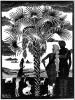
from Stevens, Collected Poetry & Prose
from OWL'S CLOVER
{from Section IV, part six}
VI. If these were theoretical people, like
Small bees of spring, sniffing the coldest buds
Of a time to come-- A shade of horror turns
The bees to scorpions blackly-barbed, a shade
Of fear changes the scorpions to skins.
The civil fiction, the calico idea,
The Johnsonian composition, abstract man,
All are evasions like a repeated phrase,
Which, by its repetition, comes to bear
A meaning without a meaning. These people have
A meaning within the meaning they convey,
Walking the paths, watching the gilding sun,
To be swept across them when they are revealed,
For a moment, once each century or two.
The future for them is always the deepest dome,
The darkest blue of the dome and the wings around
The giant Phosphor of their earliest prayers.
Once each century or two. But then so great,
So epical a twist, catastrophe
For Isaac Watts: the diverting of the dream
Of heaven from heaven to the future, as a god,
Takes time and tinkering, melodious
And practical. The envoi to the past
Is largely another winding of the clock.
The tempo, in short, of this complicated shift,
With interruptions by vast hymns, blood odes,
Parades of whole races with attendant bands,
And the bees, the scorpions, the men that think,
The summer Sundays in the park, must be
A leaden ticking circular in width.
How shall we face the edge of time? We walk
In the park. We regret we have no nightingale.
We must have the throstle on the gramophone.
Where shall we find more than derisive words?
When shall lush chorals spiral through our fire
And daunt that old assassin, heart's desire?

 Reply With Quote
 ure poetry," which is to say, a poetry which should depend for its effectiveness on its rhythms and the tonal values of the words employed with as complete a dissociation from ideational content as may be humanly possible. Those who have argued for such "pure poetry" have frequently, if not always, been obsessed with some hazy notion of an analogy between music and poetry. As a shining example of this school take Sidney Lanier, who was a skilled musician as well as a notable poet. Lanier advanced the theory that every vowel has its color value. This was not an association of ideas; the letter "e" was not red because it is in the word red, or green because it is in the word green, but the hearer, experiencing the word should, on Lanier's theory, experience, simultaneously with the sound, a distinct sensation of color. In the second decade of this century--the movement began in the first decade--numerous poetic schools drove theory hard. Perhaps none strove especially to carry out Lanier's color hypothesis, but there were the Imagists, and there was Vorticism and Cubism, and many more "isms" besides. For the most part, these schools have died the death which could have been prophesied for them. Poetry is founded in ideas; to be effective and lasting, poetry must be based on life, it must touch and vitalize emotion. For proof, one has but to turn to the poetry that has endured. In poetry, doctrinaire composition has no permanent place.
 Originally Posted by quasimodo1

 Qusai, I was going to say what a terrible poem. And it is. But then I realized the significance of the title, "The Man Whose Pharanx Was Bad," and that is the point of the poem. The pharanx is bad.
  Cute and clever, but I never really like when poets consciously write bad stuff. Sure it's consciously done, but it's still bad stuff.

