He knew that if he started with the pack on Sunday at dawn he would not be back until late at night. But he consented that they should start on Monday morning at seven. The obedient Miss Cummins was told to prepare for the Frijoles trip. On Sunday Romero had his day off. He had not put in an appearance when the Princess retired on Sunday night, but on Monday morning, as she was dressing, she saw him bringing in the three horses from the corral. She was in high spirits.
The night had been cold. There was ice at the edges of the irrigation ditch, and the chipmunks crawled into the sun and lay with wide, dumb, anxious eyes, almost too numb to run.
"We may be away two or three days," said the Princess.
"Very well. We won't begin to be anxious about you before Thursday, then," said Mrs. Wilkieson, who was young and capable: from Chicago. "Anyway," she added, "Romero will see you through. He's so trustworthy."
The sun was already on the desert as they set off towards the mountains, making the greasewood and the sage pale as pale-grey sands, luminous the great level around them. To the right glinted the shadows of the adobe pueblo, flat and almost invisible on the plain, earth of its earth. Behind lay the ranch and the tufts of tall, plumy cottonwoods, whose summits were yellowing under the perfect blue sky.
Autumn breaking into colour in the great spaces of the South-West.
But the three trotted gently along the trail, towards the sun that sparkled yellow just above the dark bulk of the ponderous mountains. Side-slopes were already gleaming yellow, flaming with a second light, under coldish blue of the pale sky. The front slopes were in shadow, with submerged lustre of red oak scrub and dull-gold aspens, blue-black pines and grey-blue rock. While the canyon was full of a deep blueness.
They rode single file, Romero first, on a black horse. Himself in black, made a flickering black spot in the delicate pallor of the great landscape, where even pine trees at a distance take a film of blue paler than their green. Romero rode on in silence past the tufts of furry greasewood. The Princess came next, on her sorrel mare. And Miss Cummins, who was not quite happy on horseback, came last, in the pale dust that the others kicked up. Sometimes her horse sneezed, and she started.
But on they went at a gentle trot. Romero never looked round. He could hear the sound of the hoofs following, and that was all he wanted.
For the rest, he held ahead. And the Princess, with that black, unheeding figure always travelling away from her, felt strangely helpless, withal elated.
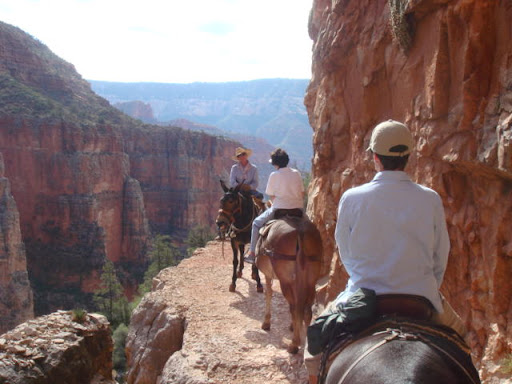
They neared the pale, round foot-hills, dotted with the round dark piñon and cedar shrubs. The horses clinked and trotted among the stones. Occasionally a big round greasewood held out fleecy tufts of flowers, pure gold. They wound into blue shadow, then up a steep stony slope, with the world lying pallid away behind and below. Then they dropped into the shadow of the San Cristobal canyon.
The stream was running full and swift. Occasionally the horses snatched at a tuft of grass. The trail narrowed and became rocky; the rocks closed in; it was dark and cool as the horses climbed and climbed upwards, and the tree trunks crowded in the shadowy, silent tightness of the canyon. They were among cottonwood trees that ran straight up and smooth and round to an extraordinary height. Above, the tips were gold, and it was sun. But away below, where the horses struggled up the rocks and wound among the trunks, there was still blue shadow by the sound of waters and an occasional grey festoon of old man's beard, and here and there a pale, dripping crane's-bill flower among the tangle and the débris of the virgin place. And again the chill entered the Princess's heart as she realised what a tangle of decay and despair lay in the virgin forests.
They scrambled downwards, splashed across stream, up rocks and along the trail of the other side. Romero's black horse stopped, looked down quizzically at the fallen trees, then stepped over lightly. The Princess's sorrel followed, carefully. But Miss Cummins's buckskin made a fuss, and had to be got round.
In the same silence, save for the clinking of the horses and the splashing as the trail crossed stream, they worked their way upwards in the tight, tangled shadow of the canyon. Sometimes, crossing stream, the Princess would glance upwards, and then always her heart caught in her breast. For high up, away in heaven, the mountain heights shone yellow, dappled with dark spruce firs, clear almost as speckled daffodils against the pale turquoise blue lying high and serene above the dark-blue shadow where the Princess was. And she would snatch at the blood-red leaves of the oak as her horse crossed a more open slope, not knowing what she felt.
They were getting fairly high, occasionally lifted above the canyon itself, in the low groove below the speckled, gold-sparkling heights which towered beyond. Then again they dipped and crossed stream, the horses stepping gingerly across a tangle of fallen, frail aspen stems, then suddenly floundering in a mass of rocks. The black emerged ahead, his black tail waving. The Princess let her mare find her own footing; then she too emerged from the clatter. She rode on after the black. Then came a great frantic rattle of the buckskin behind. The Princess was aware of Romero's dark face looking round, with a strange, demon-like watchfulness, before she herself looked round, to see the buckskin scrambling rather lamely beyond the rocks, with one of his pale buff knees already red with blood.
"He almost went down!" called Miss Cummins.
But Romero was already out of the saddle and hastening down the path. He made quiet little noises to the buckskin, and began examining the cut knee.
"Is he hurt?" cried Miss Cummins anxiously, and she climbed hastily down.
"Oh, my goodness!" she cried, as she saw the blood running down the slender buff leg of the horse in a thin trickle. "Isn't that awful?" She spoke in a stricken voice, and her face was white.
Romero was still carefully feeling the knee of the buckskin. Then he made him walk a few paces. And at last he stood up straight and shook his head.
"Not very bad!" he said. "Nothing broken."
Again he bent and worked at the knees. Then he looked up at the Princess.
"He can go on," he said. "It's not bad."
The Princess looked down at the dark face in silence.
"What, go on right up here?" cried Miss Cummins. "How many hours?"
"About five!" said Romero simply.
"Five hours!" cried Miss Cummins. "A horse with a lame knee! And a steep mountain! Why-y!"
"Yes, it's pretty steep up there," said Romero, pushing back his hat and staring fixedly at the bleeding knee. The buckskin stood in a stricken sort of dejection. "But I think he'll make it all right," the man added.
"Oh!" cried Miss Cummins, her eyes bright with sudden passion of unshed tears. "I wouldn't think of it. I wouldn't ride him up there, not for any money."
"Why wouldn't you?" asked Romero.
"It hurts him."
Romero bent down again to the horse's knee.
"Maybe it hurts him a little," he said. "But he can make it all right, and his leg won't get stiff."
"What! Ride him five hours up the steep mountains?" cried Miss Cummins. "I couldn't. I just couldn't do it. I'll lead him a little way and see if he can go. But I couldn't ride him again. I couldn't. Let me walk."
"But Miss Cummins, dear, if Romero says he'll be all right?" said the Princess.
"I know it hurts him. Oh, I just couldn't bear it."
There was no doing anything with Miss Cummins. The thought of a hurt animal always put her into a sort of hysterics.
They walked forward a little, leading the buckskin. He limped rather badly. Miss Cummins sat on a rock.
"Why, it's agony to see him!" she cried. "It's cruel!"
"He won't limp after a bit, if you take no notice of him," said Romero. "Now he plays up, and limps very much, because he wants to make you see."
"I don't think there can be much playing up," said Miss Cummins bitterly. "We can see how it must hurt him."
"It don't hurt much," said Romero.
But now Miss Cummins was silent with antipathy.
It was a deadlock. The party remained motionless on the trail, the Princess in the saddle, Miss Cummins seated on a rock, Romero standing black and remote near the drooping buckskin.
"Well!" said the man suddenly at last. "I guess we go back, then."
And he looked up swiftly at his horse, which was cropping at the mountain herbage and treading on the trailing reins.
"No!" cried the Princess. "Oh no!" Her voice rang with a great wail of disappointment and anger. Then she checked herself.
Miss Cummins rose with energy.
"Let me lead the buckskin home," she said, with cold dignity, "and you two go on."
This was received in silence. The Princess was looking down at her with a sardonic, almost cruel gaze.
"We've only come about two hours," said Miss Cummins. "I don't mind a bit leading him home. But I couldn't ride him. I couldn't have him ridden with that knee."
This again was received in dead silence. Romero remained impassive, almost inert.
"Very well, then," said the Princess. "You lead him home. You'll be quite all right. Nothing can happen to you, possibly. And say to them that we have gone on and shall be home tomorrow--or the day after."
She spoke coldly and distinctly. For she could not bear to be thwarted.




Originally Posted by Virgil


 "It's so mysterious, the land of tears."
 Reply With Quote

 .
.