Buying through this banner helps support the forum!
Page 10 of 19 FirstFirst ... 56789101112131415 ... LastLast
Results 136 to 150 of 278

Thread: Your favourite artist and Painting

  1. #136
    Artist and Bibliophile stlukesguild's Avatar
    Join Date
    Jul 2006
    Location
    The USA... or thereabouts
    Posts
    6,083
    Blog Entries
    78
    Cornell also built upon the image of the Victorian writing box from which the sophisticated young man would probably compose his love letters while traveling the world. This results in L'Egypte de Mlle Cleo de Merode cours elementaire d'histoire naturelle:


    ... in which the artist collects various images and items (sand, images of the nile, locusts, etc...) related to the tale of of the ballerina (Cleo/Cleopatra) for whom an Egyptian prince purportedly falls madly in love.

    The jewelry box offers other possibilities as in Taglioni's Jewell Box:


    From the brief narrative enclosed in the box lid we can immediately understand Cornell's poetic interpretation:

    On a moonlight night in the winter of 1835 the carriage of Marie TAGLIONI was halted by a Russian highwayman, and that enchanting creature commanded to dance for this audience of one upon a panther's skin spread over the snow beneath the stars. From this actuality arose the legend that to keep alive the memory . . . TAGLIONI formed the habit of placing a piece of artificial ice in her jewel casket . . . where, melting among the sparkling stones, there was evoked a hint . . . of the starlit heavens, over the ice-covered landscape.

    Even something as mundane as the medicine cabinet in the old pharmacy becomes something altogether wonderful in Cornell's imagination as we wonder what sort of magic is being doled out of this "Pharmacy" with jars of colored marbles, cork balls, butterfly wings, red sand, letters and notes, etc...:


    Pharmacy

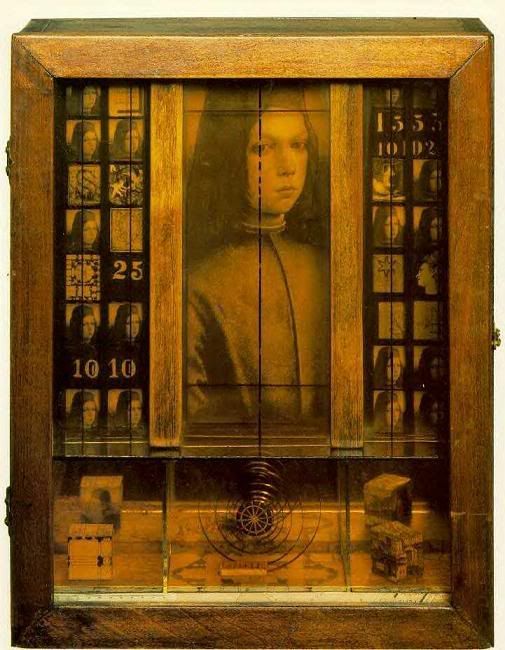
    Perhaps Cornell's greatest works are the so-called DeMedici Slot Machines. In these works Cornell blends the image of the old slot machine where the gypsy might tell one's fortune with portraits of DeMedici children painted by Renaissance masters staged in boxes that are clearly structured upon the floor-plans of DeMedici churches (the floor-plans themselves included in the boxes) and surrounded by toy balls, blocks, etc... The child princess and princesses... children of the DeMedici who most probably were forced into growing up fast are now presented as eternal children surrounded by toys in what is essentially a poetic game for adults:


    DeMedici Slot Machine (DeMedici Princess)


    DeMedici Slot Machine (Pinturicchio Boy)


    DeMedici Slot Machine (DeMedici Prince)

    Among Cornell's later works are endless "hotels"... boxes which evoke the subtle colors and peeling paint and imagery suggestive of a now-lost... perhaps never-existent world of French hotels as imagined by an American in love with the French culture of poetry and fairy tale and beloved literature and art... an American who had never traveled to France and probably never would have wanted to do so, and chance destroying his dreams and illusions:


    Hotel du Nord


    Hotel Etoile

    I have always imagined Cornell as a visual artist who was most akin with a writer such as Emily Dickinson. Like Dickinson, Cornell was a very private individual... almost reclusive... who never really traveled, except such as he did in imagination. Like Dickinson, he exhibited a characteristic New England sensibility: somewhat stark... minimal... even severe at times. Both the poet and the artist are often imagined in romanticized or sentimental terms by those who have not spent time with their work... but in both the poet and the artist have the ability to have shaped an entire world within tiny "boxes" that are formally rigorous... austere... and hard as diamonds, resulting in a truly original American art that seems unprecedented... and has never been emulated.

    Further looks at Cornell:

    http://pem.org/cornell/
    http://www.artseditor.com/html/featu..._cornell.shtml
    http://www.ibiblio.org/wm/paint/auth/cornell/
    http://www.josephcornellsdreams.com/
    http://www.npr.org/templates/story/s...toryId=1523240
    Last edited by stlukesguild; 06-30-2008 at 10:51 AM.
    Beware of the man with just one book. -Ovid
    The man who doesn't read good books has no advantage over the man who can't read them.- Mark Twain
    My Blog: Of Delicious Recoil
    http://stlukesguild.tumblr.com/

  2. #137
    Ditsy Pixie Niamh's Avatar
    Join Date
    Nov 2006
    Location
    Marino, Dublin, Ireland
    Posts
    14,243
    Blog Entries
    118
    Wow! Thank you so much for all the info and art you have contrabuted to this thread St Lukes! There are some real gems! I cnat stop staring at some of klee's paintings! keep the info coming and links to sites about the Artists too would be great!

    Any thank you to everyone else who has posted some of their chocolate favourites for all of us to look at!
    "Come away O human child!To the waters of the wild, With a faery hand in hand, For the worlds more full of weeping than you can understand."
    W.B.Yeats

    "If it looks like a Dwarf and smells like a Dwarf, then it's probably a Dwarf (or a latrine wearing dungarees)"
    Artemins Fowl and the Lost Colony by Eoin Colfer


    my poems-please comment Forum Rules

  3. #138
    Registered User ex ponto's Avatar
    Join Date
    Dec 2007
    Posts
    93
    Quote Originally Posted by stlukesguild View Post
    "Hamlet is Hamlet whether it was written by the shadowy figure known as Shakespeare or by Sir Francis Bacon or even by one of those lesser claimants like the Earl of Oxford."(
    You're right, thank you!

  4. #139
    Artist and Bibliophile stlukesguild's Avatar
    Join Date
    Jul 2006
    Location
    The USA... or thereabouts
    Posts
    6,083
    Blog Entries
    78
    8. Max Beckmann-

    Beckmann ranks among the giants of early Modernism just behind Picasso and Matisse... yet he is certainly far less well-known than many artists of less influence or genius. This was certainly due in large part to the fact that he was German at a period of time in which being German was not something popular with a good majority of the world. Unlike many of the artists of Europe, Beckmann was unable to negotiate a passport to Britain or the United States during the Nazi era, and as such he sat out more than a decade in Holland, before and during the war, isolated from most of the art world. Beckmann was damned by the Nazis for not being German enough, his manner of painting was not French/formalist enough (too German) to gain him the support of figures such as Alfred Barr (director of the Museum of Modern Art) or Peggy Guggenheim in assisting him with an escape from Europe, and after the war his manner of painting... Expressionism... was damned by his native country for being "too German" at a time when Germany wished to present itself as a good international partner... following whatever was the dominant international style.

    But in all of this I'm getting ahead of myself. Max Beckmann was born in Germany in 1884. He attended art school and was academically trained as a painter. By the time he had entered his mid-twenties he was earning recognition by both collectors and the state. His ambition was to be a great history painter in the manner of Rubens or Delacroix, and he was openly dismissive of a great majority of Modern art, including German Expressionism... of which he would become the greatest practitioner. When he was 30, the First World War broke out and Beckmann was sent to the trenches as a medical orderly. Initially he was excited... looking forward to witnessing the sort of acts of grandeur and heroism that he had long read about, and that he imagined would inspire his work. Quickly, however, his excitement turned to horror as he witnessed the absolute grotesque destructiveness, waste, death, suffering, and stupidity that was the first major war of the modern, mechanized world. Like many, Beckmann left the war an absolutely changed man. He had a nervous breakdown, and upon returning home was unable to function living with his wife, a talented and successful opera singer. For almost 7 years he lived with a close friend and family and struggled to create an art that could speak of this new world as he now saw it.

    Where Beckmann had once dismissed the distortions of Modernism and Expressionism as so much "fancy", he now saw it as a means of conveying the fragmented, broken world. His paintings from the late 19-teens are among his first mature works. In these he combined the distortions of German Expressionism and Cubism with those of Munch, Van Gogh, and the German Gothic painters and sculptors such as Mathias Grunwald, Tilman Riemenschneider, and Lucas Cranach.

    His breakthrough painting... and one of the most harrowing masterpieces of Modern art... was the large canvas entitled Night:


    This painting portrays the sort of random acts of violence committed in Germany during the unsettled days following WWI. (A good film that offers a similar view of the time is Fritz Lang's M). In Beckmann's painting a group of thugs have broken into a family's apartment and they begin to reap havoc. The father is strangled and hung, the mother half-stripped in preparation for rape, no doubt, and tied to a support beam. A young daughter is thrown out of the window while another daughter/relative witnesses it all in horror. The shallow space, the stark coloring, and the gaunt and wooden forms of the figures recall medieval paintings...


    and sculpture...


    ... especially scenes of martyrdoms and brutal crucifixions. The father in Beckmann's Night distinctly recalls a Christ-like figure... with his rigid limbs (ala the Grunwald's Rigor mortis-laden Crucifixion), and palm open to us... shadowed in such a way as to suggest the very wounds of Christ.

    A good many of Beckmann's paintings of this era utilized Christian iconography as a sort of analogy to the sort of suffering of the war and post-war era. At the same time... he made great use of the theater/stage/night club. Beckmann began to take on an absurdest philosophy... believing that all the world was most certainly nothing more than a stage... a meaningless, but somehow brutally beautiful show... a noisesome sound and fury... "signifying nothing". Nightclubs, clowns, masked carnival revelers, trapeze artists, and magicians all began to populate his paintings... which grew as crowded and shallow as puppet theaters:


    By the mid 1920s, Beckmann's paintings began to take on a calmer, more "classical" look. There was a greater simplicity of form and an opening up of the space... and the figures themselves began to grow more robust... healthy. In part this was in response to the general shift toward classicism or Neo-classicism during this time, and it echoes the similar directions taken by Picasso, Matisse, and many others. It was also due to the revival of Beckmann's love life through his marriage to a second far younger wife, "Quappi":


    The greatest "tension" in his paintings at this time are sexual in nature... usually taking the form of powerful, muscular, Amazon women. Beckmann was a prolific reader a was deeply fascinated with philosophy, theology, mysticism, gnosticism, psychology, and mythology. His images of these powerful "femme fatales" were certainly rooted, in part, in his readings. They also mirrored his own feelings of being somewhat at the mercy of his own passions when it came to his young wife... to sex... to his animal urges... and he may have recognized that there was perhaps something universal in such feelings:


    continued...
    Last edited by stlukesguild; 07-02-2008 at 12:55 AM.
    Beware of the man with just one book. -Ovid
    The man who doesn't read good books has no advantage over the man who can't read them.- Mark Twain
    My Blog: Of Delicious Recoil
    http://stlukesguild.tumblr.com/

  5. #140
    Artist and Bibliophile stlukesguild's Avatar
    Join Date
    Jul 2006
    Location
    The USA... or thereabouts
    Posts
    6,083
    Blog Entries
    78
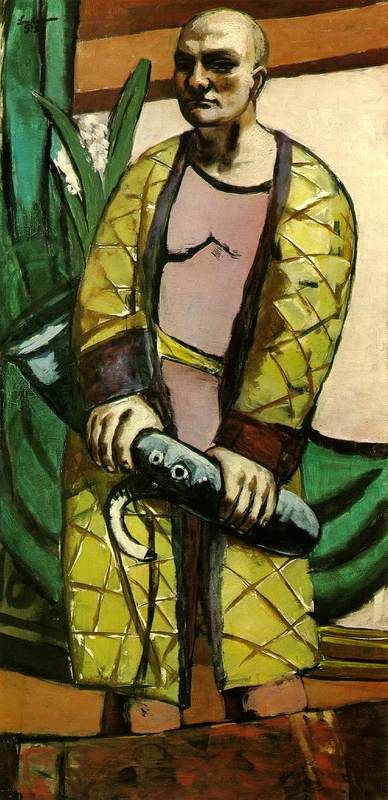
    While the male figures in many of these paintings were certainly surrogates for Beckmann himself, the artist was also more direct in exploring himself through self-portraits. Only Rembrandt and Picasso may equal Beckmann in the intensity and number of self-portraits. Beckmann explored all the various guises of himself. The artist as entertainer/performer (dressed in a gymnastic/trapeze costume beneath his dressing gown and clutching his saxophone):


    The artist as the intense young man with empty eyes... a powerful woodblock print that gives some notion of the artist's abilities in the graphic media:


    most important was the artist as a success:


    This painting of the artist dressed in his tuxedo, nonchalantly smoking (an image that would be echoed in the famous photograph of Marlena Dietrich) perfectly conveyed the image of Beckmann as the most famous German artist of his time... a Modern success story. And shortly before his fall. Beckmann had only a few more years of attending soirées with well-to-do art collectors and beautiful young women:


    With the rise of the Nazi party and Adolf Hitler, who adamantly despised Modern Art, Beckmann was declared a "cultural Bolshevik", and dismissed from his teaching posts. His paintings were soon confiscated from museums across Germany, and he became the best represented artist in the so-called "Degenerate Art Show", an exhibition staged by the Nazis to mock Modernism in art. Beckmann fled Germany for Amsterdam, never to return to his homeland.

    The works of this period are very telling of the political upheavals of the time. The self-portraits show the artist in shackles:


    ... as a clown or circus performer in a hellishly lit circus:


    ... or trapped in his apartment... the landscape outside his window reduced to an empty black... a void... his ear held to his horn listening for the tramp of marching boots:

    ...

    The key painting of this period was his first triptych (a three-panel painting format usually reserved for altarpieces), Departure. This painting portrays a central group with a woman and child that echoes a Madonna and Christ-child and a Christ-like fisherman/king and protective masked Greek hero. This group stands in a a small boat before an open sea... before an unknown but open and free future, as the artist flees his homeland. The two flanking panels portray an enclosed, crowded space filled once more with noise and acts of violence.

    Similar ominous images show up during this period. Figures caged or imprisoned:


    Still life paintings on the traditional Memento mori ("remember death") theme with skulls and other images such as burning candles suggestive of the continual march of time:


    continued...
    Last edited by stlukesguild; 07-02-2008 at 01:00 AM.
    Beware of the man with just one book. -Ovid
    The man who doesn't read good books has no advantage over the man who can't read them.- Mark Twain
    My Blog: Of Delicious Recoil
    http://stlukesguild.tumblr.com/

  6. #141
    Artist and Bibliophile stlukesguild's Avatar
    Join Date
    Jul 2006
    Location
    The USA... or thereabouts
    Posts
    6,083
    Blog Entries
    78
    Two of the most powerful paintings of the war-years are the huge Bird's Hell and Death. In the former, Beckmann portrays a crowded hell (his compositions growing ever more crammed and echoing the horror vacuii or "fear of emptiness" ..."of the void" that is a common element of medieval art) in which giant Heironymus Bosch-like birds torture and kill their human prey before a great German Eagle, a noisy marching band, and arms/wings raised in a sieg heil!salute:


    Deathis a surreal scene in which the deceased is surrounded in a darkened room by an upside-down choir and various monstrous sea-creatures and figures carrying out obscene acts... all overseen by a black, multi-footed priest:


    During the war, Amsterdam was occupied by the Germans and Beckmann was under orders not to create any art under penalty of death. In spite of this... and in spite of the difficulties he faced in earning an income, obtaining supplies, or selling his art... he continued to paint... and paint prolifically. He produced at least 6 of his triptychs during this period and dozens, if not hundreds, of other paintings... many of them quite large. His paintings grew increasingly crowded as figures butted up against each other, interlocked like so many puzzle pieces. His imagery grew increasingly dense and symbolically-laden, as he built upon his knowledge of history, mythology, gnosticism, etc... These paintings immediately strike one as powerful and darkly brooding... the lush and sensuous colors (purples, oranges, neon-greens) glow brilliantly like stained glass surrounded by the bituminous black leading... yet a specific or easily defined "meaning" of the symbolism often alludes the viewer. Such paintings certainly include the triptych, The Actors, in which a King-like actor unexpectedly commits suicide on the stage before his horrified co-star, while the director checks his notes looking for a scene that obviously wasn't in the script... while to the right a scene almost certainly suggesting Christ's arrest is underway:


    It might be noted that these paintings are all quite sizable...


    ...heroic-scaled mythologies prooving that Beckmann had surely achieved his goal of becoming a great history painter... unfortunately a history painter in an age in which history had become horror.

    The last 5 years of Beckmann's life were spent in the United States. There the artist captured images of the immediately recognizable landscape of the American South-West:


    ... or images of the modern urban landscape/cityscape of highways, high-rises, and high-tension bridges surrounding great cities such as San Francisco:


    Beckmann taught painting at the graduate level (in spite of his severely limited abilities in English) in San Francisco and in St. Louis, where the painter, Philip Guston, one of the rising stars of Abstract Expressionism, recommended the artist... as a personal hero. The great muscular Amazon women again make their appearance in his painting... inspired by what he imagined as a uniquely American type of woman as witnessed in the cinema and on the beaches:


    The artist continued to paint himself... now as something of the cool and collected American sophisticate, dressed in his casual dress jacket... still sucking on the very cigarettes that would speed his early death. Beckmann spent his final year in New York City... a city that awakened in him his former love of extreme spectacle. He spoke of the city as a Babylon beyond anything imagined by the "provincial" Europeans, where he could hear the wild beasts roar. He died in New York of a massive heart-attack... on the way to take another final look this last self-portrait as it hung in a gallery space. In his apartment on an easel was his final completed painting, The Falling Man:


    The painting portrays a partially-nude male figure falling through the skies... flanked by towering buildings that billow with smoke and flame... high-rise buildings that could only have been found in New York. The painting again leaves one partially puzzled... but moved. The image echoes that of the "Hanged Man" and "The Tower" from the tarot deck (imagery that Beckmann was certainly familiar with). Perhaps even more disturbing for the contemporary viewer is what almost amounts to a premonition of the fall of the World Trade Center buildings and the people falling after leaping from the flames. And yet what does one make of the winged angel-like figures in the distance? As Babylon's towers eventually crumble and fall and and mankind with them... something in the distance... on the horizon... waits?

    Beckmann's reputation after his death rapidly faded. His style of painting placed him firmly at the head of the German Expressionist movement at a time when German artists/art collectors/art critics were seeking to avoid anything that looked "too German"... or too intense or powerful. German art of the era preferred to present a weak shadow of American abstraction... the new "International Style". In the United States, on the other hand, Beckmann was simply too much representative of the "old world" at a time when American painting was asserting itself as the dominant and most advanced art of its time. The Museum of Modern Art and the Met (among other Museums) would both turn down the chance for a Beckmann retrospective as recently as the early 1980s. By the mid-1980s, however, Beckmann's reputation began to grow. Philip Guston's late figurative work, Francis Bacon's Expressionistic triptychs and Picassos late paintings began to have a major impact upon young artists of the so-called Neo-Expressionist movement. Major new figures suddenly burst upon the scene out of Germany... painters such as Anselm Kiefer, George Bazelitz, Jorge Immendorf, Gerhard Richter, etc... who all rejected the cool, detached formalism and minimalism of the current "international style", and began to discover their own artistic roots in earlier German art. It soon became obvious that Beckmann was a forgotten precursor and giant to all of these. Once "rediscovered" his reputation continued to grow (there have been at least 3 retrospectives of his works at major American museums in the past decade or so) until he now stands deservedly among the greatest painters of the 20th century.


    I'll be leaving for a brief trip to New York and Washington D.C. so no new postings 'til next week.
    Last edited by stlukesguild; 07-02-2008 at 01:31 AM.
    Beware of the man with just one book. -Ovid
    The man who doesn't read good books has no advantage over the man who can't read them.- Mark Twain
    My Blog: Of Delicious Recoil
    http://stlukesguild.tumblr.com/

  7. #142
    Of Subatomic Importance Quark's Avatar
    Join Date
    May 2006
    Posts
    1,368
    I like the Goya that Trystan posted earlier:

    Quote Originally Posted by Trystan View Post
    The way he dehumanizes the soldiers on the right by grouping them together is very clever. They become a faceless battery rather than individual people. Meanwhile, between the agonizing peasants about to be executed and the pile of bodies is the single man with his arms in the air. He's in this oddly heroic and simultaneously despairing pose, too. Also, we know he's about to be murdered. The body directly to his right is in almost the same pose--prefiguring the white-shirted man's death. This adds something dramatic. It's not just a moment of confrontation between the man and the soldiers. It's also a process that can't be stopped. Above the drama, though, is the cityscape which is solemn looking. Its dignity contrasts with the gruesome action in the foreground.

    Altogether, I really enjoyed the painting. Thanks for posting it Trystan.
    Last edited by Quark; 07-03-2008 at 02:03 PM.
    "Par instants je suis le Pauvre Navire
    [...] Par instants je meurs la mort du Pecheur
    [...] O mais! par instants"

    --"Birds in the Night" by Paul Verlaine (1844-1896). Join the discussion here: http://www.online-literature.com/for...5&goto=newpost

  8. #143
    Artist and Bibliophile stlukesguild's Avatar
    Join Date
    Jul 2006
    Location
    The USA... or thereabouts
    Posts
    6,083
    Blog Entries
    78
    Oops... double post.
    Last edited by stlukesguild; 07-07-2008 at 12:21 AM.
    Beware of the man with just one book. -Ovid
    The man who doesn't read good books has no advantage over the man who can't read them.- Mark Twain
    My Blog: Of Delicious Recoil
    http://stlukesguild.tumblr.com/

  9. #144
    Artist and Bibliophile stlukesguild's Avatar
    Join Date
    Jul 2006
    Location
    The USA... or thereabouts
    Posts
    6,083
    Blog Entries
    78
    Yes... the Goya is certainly a powerful painting. The artist masterfully leads our eye... down the sloping hill to the faceless phalanx of soldiers who stand more as a "thing"... a machine... than as individual beings. From them we are lead along their rifles and bayonets to the poor souls awaiting imminent execution. These persons are seen as distinct individuals. The central figure, dressed in white, gestures in a manner that shows no fear... no cowering to these mindless purveyors of death and destruction. He is also clearly portrayed as an almost Christ-like figure... his pose echoing that of the crucifixion... the monk with his clutched crucifix before him reinforcing this symbolism and his left arm leading the eye to the church tower in the background which acts as a symbolic and visual axis upon which the painting is divided. Like the painting of the Execution of Lady Jane Gray, which we discussed earlier, the stark white of Goya's "martyr" creates a great deal of tension as we cannot help but recognize that this virginal color will soon be stained in the blood of the wearer. The painting is a marvelous Romantic-era masterwork: loosely or boldly painted... dramatic... theatrical... emotionally charged.
    Beware of the man with just one book. -Ovid
    The man who doesn't read good books has no advantage over the man who can't read them.- Mark Twain
    My Blog: Of Delicious Recoil
    http://stlukesguild.tumblr.com/

  10. #145
    Tu le connais, lecteur... Kafka's Crow's Avatar
    Join Date
    Jan 2008
    Location
    ...the timekept City
    Posts
    847
    Blog Entries
    2
    I like the various portraits of Ezra Pound by Wyndham Lewis:


    "The farther he goes the more good it does me. I don’t want philosophies, tracts, dogmas, creeds, ways out, truths, answers, nothing from the bargain basement. He is the most courageous, remorseless writer going and the more he grinds my nose in the sh1t the more I am grateful to him..."
    -- Harold Pinter on Samuel Beckett

  11. #146
    Tu le connais, lecteur... Kafka's Crow's Avatar
    Join Date
    Jan 2008
    Location
    ...the timekept City
    Posts
    847
    Blog Entries
    2
    Quote Originally Posted by stlukesguild View Post
    Yes... the Goya is certainly a powerful painting. The artist masterfully leads our eye... down the sloping hill to the faceless phalanx of soldiers who stand more as a "thing"... a machine... than as individual beings. From them we are lead along their rifles and bayonets to the poor souls awaiting imminent execution. These persons are seen as distinct individuals. The central figure, dressed in white, gestures in a manner that shows no fear... no cowering to these mindless purveyors of death and destruction. He is also clearly portrayed as an almost Christ-like figure... his pose echoing that of the crucifixion... the monk with his clutched crucifix before him reinforcing this symbolism and his left arm leading the eye to the church tower in the background which acts as a symbolic and visual axis upon which the painting is divided. Like the painting of the Execution of Lady Jane Gray, which we discussed earlier, the stark white of Goya's "martyr" creates a great deal of tension as we cannot help but recognize that this virginal color will soon be stained in the blood of the wearer. The painting is a marvelous Romantic-era masterwork: loosely or boldly painted... dramatic... theatrical... emotionally charged.

    I think it is from the series called 'The Horrors of War' or something. Goya only gets better with Saturn Devouring One of His Sons:


    And who can forget the two Maja paintings? I incorporated the above painting of Saturn in an essay on Lautreamont once, I think he makes use of it in Maldoror.
    "The farther he goes the more good it does me. I don’t want philosophies, tracts, dogmas, creeds, ways out, truths, answers, nothing from the bargain basement. He is the most courageous, remorseless writer going and the more he grinds my nose in the sh1t the more I am grateful to him..."
    -- Harold Pinter on Samuel Beckett

  12. #147
    Champion Pierogi Eater Mr. Vandemar's Avatar
    Join Date
    Jul 2008
    Location
    Where the Wild Things Are
    Posts
    91
    The Goya painting with the man in white is startling. Notice that his shirt is so brilliantly white, while the others are so dark. He is in the moment of truth. His comrades are dead, they are lifeless (and so is their colour). He is about to become a martyr, and this is his time to shine. While the others, aside from the monk, are trying to escape and avoid death, he is not. He is (like Christ) putting his hands up in acknowledgement and acceptance of his death. That is why his shirt is so white.

    Also, notice the monk praying beside him. This also leads me to the Christ-like comparison that Goya gives. I think he is there so that we can make that connection. Is he just praying, or is he praying for protection and exemption? His anxious expression lead me to the latter. I think that he is there so that we make the religious connection and to amplify and accent the faith of the man in white.
    Last edited by Mr. Vandemar; 07-07-2008 at 12:52 AM. Reason: Added new paragraph, original post was only one

  13. #148
    Artist and Bibliophile stlukesguild's Avatar
    Join Date
    Jul 2006
    Location
    The USA... or thereabouts
    Posts
    6,083
    Blog Entries
    78
    I think it is from the series called 'The Horrors of War' or something.

    It was one of two paintings. The first portraying the Spanish uprising against the Napoleonic forces on May 2nd. The second displaying the Napoleonic response. The painting was certainly one of many works "inspired" by the horrors of the French invasion of Spain, but the series you are referring to, The Disasters of War, is actually a series of prints:


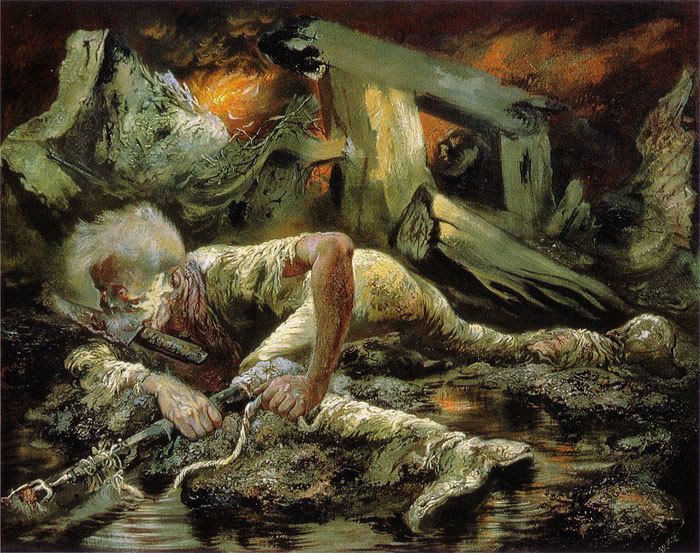
    There are many more prints from this series... a good many far more explicit in their violence: scenes of rape, executions, mutilations... on both sides of the conflict. Goya's graphic portrayal of the horrors of war combined with his expressive handling of his media... and the expressive distortions of his later "Black Paintings" such as Saturn Devouring his Children, made him a major influence upon Modern art and especially upon Expressionists such as Otto Dix:


    ... George Grosz:


    ... and Max Beckmann (who we looked at above).

    ... continued...
    Beware of the man with just one book. -Ovid
    The man who doesn't read good books has no advantage over the man who can't read them.- Mark Twain
    My Blog: Of Delicious Recoil
    http://stlukesguild.tumblr.com/

  14. #149
    Artist and Bibliophile stlukesguild's Avatar
    Join Date
    Jul 2006
    Location
    The USA... or thereabouts
    Posts
    6,083
    Blog Entries
    78
    Goya's late painting... including the Saturn Devouring his Children... are often referred to as his "black paintings"... both because of the predominance of the color black, but also because of the darkness of the themes of most of these paintings, including witchcraft...


    ...exorcism...


    ...religious fanaticism and the inquisition...


    ...the asylums for the mentally disturbed...


    One of my favorites is The Dog:


    In this stark and almost empty painting a lone dog... seemingly lost at sea and facing the swelling waves that threaten to drown him... looks up... with very little hope... for a non-existent master... God?

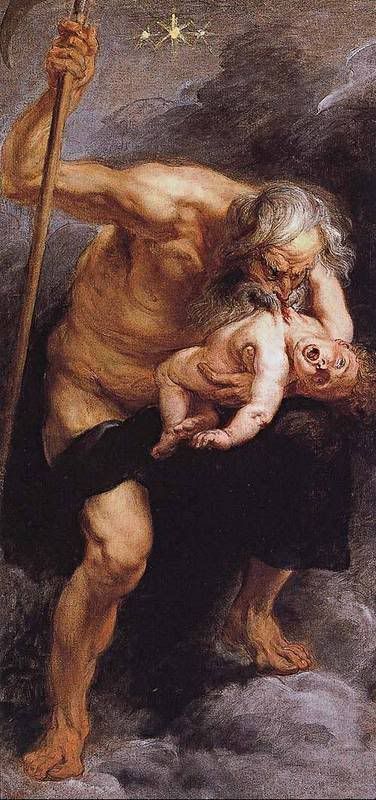
    Returning to the painting of Saturn Devouring his Children I must say I have always been struck by the fact that in spite of the horrific image, Goya's painting strikes me as less shocking than Ruben's version of the same theme:


    ... because of the realism that the elder master brings to the subject that strips away a distance between us and what is portrayed.
    Beware of the man with just one book. -Ovid
    The man who doesn't read good books has no advantage over the man who can't read them.- Mark Twain
    My Blog: Of Delicious Recoil
    http://stlukesguild.tumblr.com/

  15. #150
    Artist and Bibliophile stlukesguild's Avatar
    Join Date
    Jul 2006
    Location
    The USA... or thereabouts
    Posts
    6,083
    Blog Entries
    78
    9. Sultan Muhammad, Bihzad, the Shanameh and Classical Persian Book Illumination.

    So let's leave the modern era... and let's leave the art of the West and turn to the Middle-East. As an admitted and unrepentant bibliophile I have long been enamored of the book as an art object: everything from William Morris’ Kelmscott Chaucer, Aldus Manutius’ Hynerotomachia Poliphili, Albrecht Dürer’s Apocalypse, Henri Matisse’s Jazz, Dore’s illustrated classics, Chagall’s Four Tales from the Arabian Nights, and of course William Blake’s visionary illuminations of his own poetry... on through contemporary works of "book arts" have in their way, been as familiar and as important to me as an artist as almost any work in the more traditional genre of painting. Being something of a medievalist as well (medieval art offered me the first real understanding of the world of art beyond “realism”) I must admit that it has been the medieval book more than anything that has kept me obsessed with the book as a visual art form.

    I have had a long love affair with the medieval book in all its splendid variety: the Anglo-Saxon and Celtic manuscripts (the Book of Durrow, the Book of Kells, the Lindesfarne Gospels) with their ornate calligraphy woven into the most magical of knotted and intertwined abstractions… the boldly graphic, expressively colored and often horrific Hiberno-Islamic illuminations of the Commentaries of Beatus of Liebana on the Book of Revelations (works which most certainly were a major source of inspiration for Picasso), the marvelous French Gothic manuscripts such as the beautiful Paris Psalter and the expressionistic Hours of the Rohan Master. Of course I was forever enchanted with the exquisitely delicate works of the Limbourg Brothers, especially the Très Riches Heures du Duc de Berry, perhaps THE masterwork of late medieval book arts in Europe.

    Naturally, I was equally drawn to the wonders of the book as an art form as it existed beyond the West… especially the Moorish, Turkish, Arabic, and Persian books. The marvelous gilded labyrinths of Islamic calligraphy to be found in the finest volumes of the Qu’ran dazzled me like nothing else...


    ...save perhaps the most ornate examples of Anglo-Saxon/Celtic interlace. Even more fascinating were the magical manuscripts illuminating the most illustrious work of Persian poetry: Nezami (Nezami-ye Ganjavi),Omar Khayyám, Attar (Abū Hamīd bin Abū Bakr Ibrāhīm), Shams (Shams-e-Tabrīzī Ab'ul Hasan Yamīn al-Dīn Khusrow), Saadi (Saadi-Muslih-ud-Din Mushrif ibn Abdullah), Rumi (Jalal ad-Din Muhammad Balkhi-Rumi), Hafez (Khwāja Šams ud-Dīn Muhammad Hāfez-e Šīrāzī). These enchanting illuminated miniatures, gilded and spectacularly patterned, teeming with tiny, elegant figures and staged in the most sumptuous bedecked interiors or the most sensuous and idyllic garden settings immediately brought to life the whole resplendent, exotic, and sensual atmosphere of the Arabian Nights... the exotic Middle-east as a Westerner might dream it. These were the most fabulous of visual fairy tales and dreamscapes in which one might lose oneself for hours.

    Persian culture is ancient and Persia had existed as a stable empire for some 1300 years, far outlasting its great rivals, Greece and Rome. From 643-650 the Persian Empire under the Sasanian rulers suffered a devastating defeat at the hands of the Byzantine Empire which so weakened them as to result in their subsequent subjugation by the small and numerically inferior Islamic Arab forces, and later by invading Mongols. It isn't until the 11th century and the rise of the great classical Persian poets, especially Abolqasem Ferdowsi, whose Shahnameh is the epic poem of Persia/Iran, that Persian culture once again began to assert itself. Persia had accepted the Arab religion of Islam, but contrary to Muhammad ibn Ismail al-Bukhari's iconoclastic strictures as put forth in his "Life of the Prophet", the al-Jaami al-Sahih, and the influence of the rise of iconoclasm in the Byzantine Empire beginning in the 8th century under the emperor, Leo II, the tradition of imagery and visual narrative was deeply ingrained in Persian culture.

    With the rise to power of the Safavid rulers in 1501, and a growing awareness of their own Persian history and culture, Persian poetry and art entered a "golden age". Manuscript illumination became thought of as the highest form of art, combining calligraphy:


    ... magnificent endsheets:


    ... marvelous landscapes:


    ... ornate interwoven abstractions:


    ... even collage! as in this page in which each shape in the design and the very lettering itself is produced from cut paper!
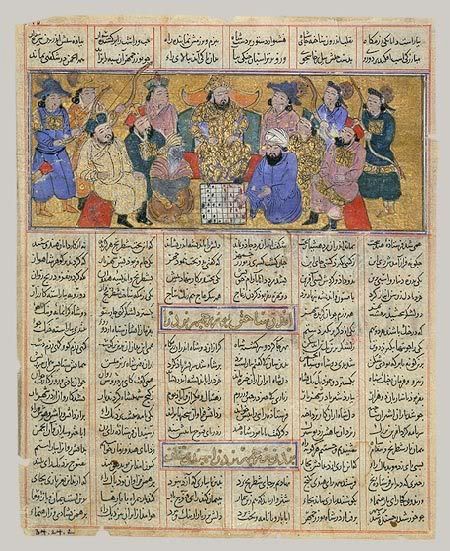

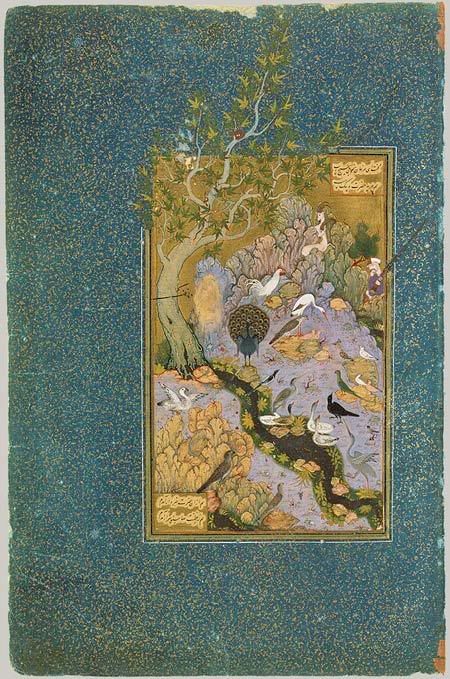
    Three great schools of painting and book production arose in the cities of Shiraz, Herat, and Tabriz. The school of Shiraz was especially known for a more symmetrical/geometric approach to painting and page layout, and a frieze-like approach... even early on, as can be seen in the “Demotte Shanameh.”


    The Shiraz school would reach its artistic peak with the production of an illuminated copy of Nezami’s Kahmseh, produced in 1491.


    The details, clarity, and confidence of this work surpass anything before seen in Persian miniatures. Painting of Shiraz would have a major influence throughout Persia.

    The school of Tabriz under the Turkoman workshops was especially known for expressionistic or even “Dionysian” paintings in which figures are staged in the most sensuous, and florid landscapes. Faces and creatures (“grotesques”) are often found hidden in the rocks and vegetation. The luxuriant and lush foliage and rolling clouds were clearly influenced by Chinese art. To this the Turkoman artists at Tabriz added the most brilliant coloring.


    continued...
    Last edited by stlukesguild; 07-08-2008 at 03:54 PM.
    Beware of the man with just one book. -Ovid
    The man who doesn't read good books has no advantage over the man who can't read them.- Mark Twain
    My Blog: Of Delicious Recoil
    http://stlukesguild.tumblr.com/

Page 10 of 19 FirstFirst ... 56789101112131415 ... LastLast

Similar Threads

  1. Do you know the artist? please help!
    By imthefoolonthehill in forum Who Said That?
    Replies: 2
    Last Post: 08-03-2005, 12:34 PM

Posting Permissions

  • You may not post new threads
  • You may not post replies
  • You may not post attachments
  • You may not edit your posts
  •