Page 47 of 74 FirstFirst ... 37424344454647484950515257 ... LastLast
Results 691 to 705 of 1106

Thread: Chekhov Short Story Thread

  1. #691
    The Poetic Warrior Dark Muse's Avatar
    Join Date
    Nov 2007
    Location
    Within the winds
    Posts
    8,905
    Blog Entries
    964
    Her mother, Pelageya, has run to the master's house to say that Yefim is dying. She has been gone a long time, and ought to be back. Varka lies awake on the stove, and hears her father's "boo--boo--boo." And then she hears someone has driven up to the hut. It is a young doctor from the town, who has been sent from the big house where he is staying on a visit. The doctor comes into the hut; he cannot be seen in the darkness, but he can be heard coughing and rattling the door.
    Do you think the stove was mentioned here, as a symbol of the bluring between reality and dream. The fact that in her waking life the stove played so much of a part of Varka, and now in her dreams she is lying upon a stove.

    "I can do nothing. You must go into the hospital, there they will operate on you. Go at once . . . You must go! It's rather late, they will all be asleep in the hospital, but that doesn't matter, I will give you a note. Do you hear?"
    Once more we have the idea of others being able to sleep while Varka must remain awake. I could not help but to find it somewhat humurs the idea of the hospital being asleep, though now it seems to be another reflection of Varka's denied desire and the constant taunting of her with it.

    Deep into that darkness peering, long I stood there, wondering, fearing, doubting, dreaming dreams no mortal ever dared to dream before. ~ Edgar Allan Poe

  2. #692
    Of Subatomic Importance Quark's Avatar
    Join Date
    May 2006
    Posts
    1,368
    Quote Originally Posted by Dark Muse View Post
    Do you think the stove was mentioned here, as a symbol of the bluring between reality and dream. The fact that in her waking life the stove played so much of a part of Varka, and now in her dreams she is lying upon a stove.
    I don't think this part is actually blurred. She really is laying on the stove, and she doesn't start to dream until later when she imagines her mother on the road. At the part I quoted, she's still aware of reality. Later, though, she will start blending perception and dream more frequently. Chekhov is showing a progression from the beginning when she is still somewhat aware to the end when she completely loses touch. The stove, here, at this point, is still a symbol of her awake life. I'm glad that you pointed out the stove's importance, though, because it does play a large role in Varka's life. It's part of her job, and she uses that job to repress her urge to sleep. Chekhov says "Varka leaves the cradle, and runs to the shed for firewood. She is glad. When one moves and runs about, one is not so sleepy as when one is sitting down. She brings the wood, heats the stove, and feels that her wooden face is getting supple again, and that her thoughts are growing clearer." The stove is one of the few things keeping her awake.

    Quote Originally Posted by Dark Muse View Post
    Once more we have the idea of others being able to sleep while Varka must remain awake. I could not help but to find it somewhat humurs the idea of the hospital being asleep, though now it seems to be another reflection of Varka's denied desire and the constant taunting of her with it.
    I hadn't noticed that--good point. The hospital workers are much like the visions in Varka's dream. They both get to sleep while the protagonists suffer. This makes Varka's and her father's plight seem even more similar, and I think that's why the father is included in the story. He's just another illustration of Varka's problems. Other than that, I don't see any reason for why he should be written into the story.

    I looked into the "liquid mud" mystery some more. I'm still confused by it, though. Everything in Varka's vision has a relation to her awake life; the shadows are cast by the clothes, the green forest is the light from the lamp, the movement is caused by the swaying shadows. The "liquid mud," however, doesn't relate to anything--at least directly. I think it may be there because the floors and walls are unclean, and therefore the light and shadows would have a consistency which would appear in her dreams. Varka could then interpret the consistency as mud or mist. The "liquid mud" might then be Chekhov's way of reminding the reader of the dirty, squalid conditions Varka lives in.

    That's a theory, at least.
    "Par instants je suis le Pauvre Navire
    [...] Par instants je meurs la mort du Pecheur
    [...] O mais! par instants"

    --"Birds in the Night" by Paul Verlaine (1844-1896). Join the discussion here: http://www.online-literature.com/for...5&goto=newpost

  3. #693
    The Poetic Warrior Dark Muse's Avatar
    Join Date
    Nov 2007
    Location
    Within the winds
    Posts
    8,905
    Blog Entries
    964
    Quote Originally Posted by Quark View Post
    I don't think this part is actually blurred. She really is laying on the stove, and she doesn't start to dream until later when she imagines her mother on the road. At the part I quoted, she's still aware of reality. Later, though, she will start blending perception and dream more frequently. Chekhov is showing a progression from the beginning when she is still somewhat aware to the end when she completely loses touch. The stove, here, at this point, is still a symbol of her awake life. I'm glad that you pointed out the stove's importance, though, because it does play a large role in Varka's life. It's part of her job, and she uses that job to repress her urge to sleep. Chekhov says "Varka leaves the cradle, and runs to the shed for firewood. She is glad. When one moves and runs about, one is not so sleepy as when one is sitting down. She brings the wood, heats the stove, and feels that her wooden face is getting supple again, and that her thoughts are growing clearer." The stove is one of the few things keeping her awake.
    But the way it is quoted in the text it makes it sound as if the stove is also part of her dream

    Varka lies awake on the stove, and hears her father's "boo--boo--boo." And then she hears someone has driven up to the hut.
    She is lying awake upon the stove while she is listening to her father dying. The stove has entered into her dream world as well as being apart of her "real" world.


    Quote Originally Posted by Quark View Post
    I hadn't noticed that--good point. The hospital workers are much like the visions in Varka's dream. They both get to sleep while the protagonists suffer. This makes Varka's and her father's plight seem even more similar, and I think that's why the father is included in the story. He's just another illustration of Varka's problems. Other than that, I don't see any reason for why he should be written into the story.
    I felt that in someway the story of her father must have some imporance, though I cannot see how it directly relates to her current situation other than to link thier suffering.

    Though I know in my book it says she is 13 during the time she is working for the Shoemaker. I wonder if her father's death could be the reason why she must be put to work.

    Quote Originally Posted by Quark View Post
    I looked into the "liquid mud" mystery some more. I'm still confused by it, though. Everything in Varka's vision has a relation to her awake life; the shadows are cast by the clothes, the green forest is the light from the lamp, the movement is caused by the swaying shadows. The "liquid mud," however, doesn't relate to anything--at least directly. I think it may be there because the floors and walls are unclean, and therefore the light and shadows would have a consistency which would appear in her dreams. Varka could then interpret the consistency as mud or mist. The "liquid mud" might then be Chekhov's way of reminding the reader of the dirty, squalid conditions Varka lives in.

    That's a theory, at least.

    That does make sense, partiucarly sense it says that the men "lie down in the mud" it could be just another way she blurs her surroundings with the dream image, and her own wish to sink down upon the floor and sleep. It could be reflective of the squallor she now lives in.

    Deep into that darkness peering, long I stood there, wondering, fearing, doubting, dreaming dreams no mortal ever dared to dream before. ~ Edgar Allan Poe

  4. #694
    Of Subatomic Importance Quark's Avatar
    Join Date
    May 2006
    Posts
    1,368
    Quote Originally Posted by Dark Muse View Post
    But the way it is quoted in the text it makes it sound as if the stove is also part of her dream
    What part makes you think it's in her dream. It appears that her dream starts immediately after the section I quoted. Chekhov describes the beginning of her dream:

    But now it is a clear bright morning. Pelageya is not at home; she has gone to the hospital to find what is being done to Yefim. Somewhere there is a baby crying, and Varka hears someone singing with her own voice:
    This quick change from night to day could not have happened so quickly--and indeed it didn't. When she wakes from her dream she notices that the sun is just rising, so that what she just experienced must have been a dream. Everything before the quote above doesn't seem like a dream. It's logically connected with everything else that happened in her awake life.

    Quote Originally Posted by Dark Muse View Post
    I felt that in someway the story of her father must have some imporance, though I cannot see how it directly relates to her current situation other than to link thier suffering.
    No, the father doesn't directly relate to the plot in any way, but he does bring out some themes which might go unnoticed in a first read. I talked a little about the element of class in this story already, but there are other ideas the father helps create. He certainly reminds us of Varka's passivity. Both father and daughter quietly accept their fate. The father's death also heightens our pity for Varka. Now that's she's orphaned, she will have an even worse life than before. Her second dream is an anticipation of that worse life. So, while the father doesn't have anything directly to do with the plot, he does help reinforce some ideas that might pass unnoticed.

    Quote Originally Posted by Dark Muse View Post
    I wonder if her father's death could be the reason why she must be put to work.
    I had supposed that the whole family worked for the shoemaker since that sort of thing was not uncommon, but I'm not sure whether that was the case or not here.
    "Par instants je suis le Pauvre Navire
    [...] Par instants je meurs la mort du Pecheur
    [...] O mais! par instants"

    --"Birds in the Night" by Paul Verlaine (1844-1896). Join the discussion here: http://www.online-literature.com/for...5&goto=newpost

  5. #695
    The Poetic Warrior Dark Muse's Avatar
    Join Date
    Nov 2007
    Location
    Within the winds
    Posts
    8,905
    Blog Entries
    964
    That part that I quoted where it says:

    Varka lies awake on the stove, and hears her father's "boo--boo--boo." And then she hears someone has driven up to the hut.
    Here it states that she is lying on the stove listening to her father. Her father is part of the dream, but she hears him while she is on the stove.

    The stove plays a role both while she dreams and while she is awake. Later during the dream it also states:

    Pelageya rushes to the stove and begins looking for the broken pot with the matches. A minute passes in silence. The doctor, feeling in his pocket, lights a match.
    The stove seems almost a link between both worlds. It appears to her in her dreams, but it is also a focus of her waking life.
    Last edited by Dark Muse; 07-03-2008 at 12:17 AM.

    Deep into that darkness peering, long I stood there, wondering, fearing, doubting, dreaming dreams no mortal ever dared to dream before. ~ Edgar Allan Poe

  6. #696
    Of Subatomic Importance Quark's Avatar
    Join Date
    May 2006
    Posts
    1,368
    Quote Originally Posted by Dark Muse View Post
    Here it states that she is lying on the stove listening to her father. Her father is part of the dream, but she hears him while she is on the stove.
    Oh, I was out of it for a moment there. Yes, I see what you mean now. There is a stove in both the dream and reality. Of course, Varka's dream duplicates everything in the actual room. The clothes, the lamp, the noises, shadows, everything gets reproduced in the dream. Her mother forcing her to go to town even mirrors Varka's mistress.

    Looking back at the dream, I think it probably likely that Varka got her job after being orphaned and not before. The dream ends with them looking for jobs. It's probable that Varka got her job at that point. Originally, I had just focused on the fact that it appeared that they were lower-class servants to begin with anyway. But, it looks like they change masters at some point.
    "Par instants je suis le Pauvre Navire
    [...] Par instants je meurs la mort du Pecheur
    [...] O mais! par instants"

    --"Birds in the Night" by Paul Verlaine (1844-1896). Join the discussion here: http://www.online-literature.com/for...5&goto=newpost

  7. #697
    The Poetic Warrior Dark Muse's Avatar
    Join Date
    Nov 2007
    Location
    Within the winds
    Posts
    8,905
    Blog Entries
    964
    I am surprsied by how drasticly different are two translations are. The wording in mine is very different than the online text.

    In the other story The Black Monk, I think the two versions were pretty similar, but in this one it has changed quite a bit. Though I think I might like my translation better

    Deep into that darkness peering, long I stood there, wondering, fearing, doubting, dreaming dreams no mortal ever dared to dream before. ~ Edgar Allan Poe

  8. #698
    The Poetic Warrior Dark Muse's Avatar
    Join Date
    Nov 2007
    Location
    Within the winds
    Posts
    8,905
    Blog Entries
    964
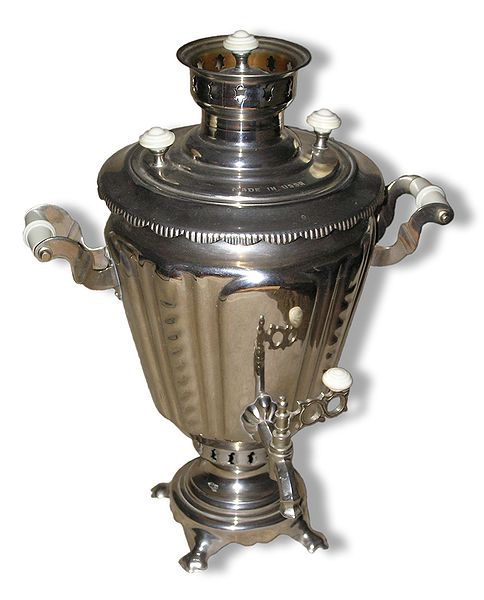
    This is a samovar, it is mentioned a little later on in the story, and I had no idea what it was so I decided to look it up. They were used to heat and boil water.


    Deep into that darkness peering, long I stood there, wondering, fearing, doubting, dreaming dreams no mortal ever dared to dream before. ~ Edgar Allan Poe

  9. #699
    Of Subatomic Importance Quark's Avatar
    Join Date
    May 2006
    Posts
    1,368
    Quote Originally Posted by Dark Muse View Post
    I am surprsied by how drasticly different are two translations are. The wording in mine is very different than the online text.
    I've read a couple of other translations, and what I notice about this one is that it's rather terse. Usually the story is stretched out a little more, but in this one it's told with the absolute minimum of words. It's been a while, though, so I don't remember if the words were altered like in your translation. If I remember, I think they were quite similar. In fact, I remember the "liquid mud" phrase being in all of them. If you see any large differences between the your translation and the online one, it would be interesting to know. The untranslated line from Varka's song was certainly interesting. It linked her song to her dead father's noises. In the fully-translated versions you don't get that.

    Quote Originally Posted by Dark Muse View Post
    I think I might like my translation better
    I haven't read your version, so I can't say. There is one part I really like about the online translation, though. It's the sentence "That foe is the baby." The online version sets it off in its own paragraph which gives it a really dramatic effect. Other translations blend that sentence in with the rest of the text, but the online version uses it much better.

    Quote Originally Posted by Dark Muse View Post
    This is a samovar, it is mentioned a little later on in the story, and I had no idea what it was so I decided to look it up. They were used to heat and boil water.
    I had no idea that samovars were so ornate. I read a lot of Russian Lit, so I've had plenty exposure to the concept of a samovar. I just pictured something a little more functional. Maybe that was an upper-end samovar. It's hard to imagine that every family owned a shining silver object like that when many of them couldn't even buy their own four walls. Nineteenth-century Russia had some pretty warped priorities, though.
    "Par instants je suis le Pauvre Navire
    [...] Par instants je meurs la mort du Pecheur
    [...] O mais! par instants"

    --"Birds in the Night" by Paul Verlaine (1844-1896). Join the discussion here: http://www.online-literature.com/for...5&goto=newpost

  10. #700
    The Poetic Warrior Dark Muse's Avatar
    Join Date
    Nov 2007
    Location
    Within the winds
    Posts
    8,905
    Blog Entries
    964
    Quote Originally Posted by Quark View Post
    I've read a couple of other translations, and what I notice about this one is that it's rather terse. Usually the story is stretched out a little more, but in this one it's told with the absolute minimum of words. It's been a while, though, so I don't remember if the words were altered like in your translation. If I remember, I think they were quite similar. In fact, I remember the "liquid mud" phrase being in all of them. If you see any large differences between the your translation and the online one, it would be interesting to know. The untranslated line from Varka's song was certainly interesting. It linked her song to her dead father's noises. In the fully-translated versions you don't get that..
    I noticed in the next section right after the part you posted there seemed to be some signifiance differences in the wording.

    I will post some of the differences that really stuck out in my mind in the part you posted. I will not repost the entire text, just the parts that were really different.

    Her mother, Pelageya, has run to the master's house to say that Yefim is dying. She has been gone a long time, and ought to be back.
    In my version it says:

    Mother Pelageya has run to the mannor-hour to tell the squire that Yefim is dying. She has been gone a long time...will she ever return?
    Online text:

    The doctor comes into the hut; he cannot be seen in the darkness
    Mine:

    The doctor comes into the hut; in the darkness he is invisible
    Online text:

    "In a minute, sir, in a minute," says Pelageya. She rushes out of the hut, and soon afterwards comes back with a bit of candle.
    Mine:

    "Immediately batiushka, immediately!" cries Pelagheya, running out of the cabint. In a minute she returns with a candle end.
    Online text:

    Come, what is it? What are you thinking about?" says the doctor, bending down to him. "Aha! have you had this long?"

    "What? Dying, your honour, my hour has come. . . . I am not to stay among the living."

    "Don't talk nonsense! We will cure you!"

    "That's as you please, your honour, we humbly thank you, only we understand. . . . Since death has come, there it is."
    Mine:

    "Well, what's the matter with you" asks the doctor, bending over him. "Ah! You have been like this long?"

    "What is the matter?" The time has come, your honour, to die....I shall not live any longer..."

    "Nonsense...We'll soon cure you!"

    "As you will your honour. Thank you humbly...only we understand. If we must die, we must die...."

    Quote Originally Posted by Quark View Post
    I had no idea that samovars were so ornate. I read a lot of Russian Lit, so I've had plenty exposure to the concept of a samovar. I just pictured something a little more functional. Maybe that was an upper-end samovar. It's hard to imagine that every family owned a shining silver object like that when many of them couldn't even buy their own four walls. Nineteenth-century Russia had some pretty warped priorities, though.

    When I was looking up pictures that is one of the plainest ones there were. Many of them were even more ornate than that.

    Though there were some that looked to be maybe brass instead of silver.

    Here are some others:


    Deep into that darkness peering, long I stood there, wondering, fearing, doubting, dreaming dreams no mortal ever dared to dream before. ~ Edgar Allan Poe

  11. #701
    Of Subatomic Importance Quark's Avatar
    Join Date
    May 2006
    Posts
    1,368
    Quote Originally Posted by Dark Muse View Post
    I noticed in the next section right after the part you posted there seemed to be some signifiance differences in the wording.

    I will post some of the differences that really stuck out in my mind in the part you posted. I will not repost the entire text, just the parts that were really different.
    In most of quotes I like your translation better, too. The wordings are rather similar, but the punctuation is much more graceful in your version. The online translation is somewhat clumsy in the way it lumps words together. Take this quote:

    "In a minute, sir, in a minute," says Pelageya. She rushes out of the hut, and soon afterwards comes back with a bit of candle.
    It isn't much different from your version:
    "Immediately batiushka, immediately!" cries Pelagheya, running out of the cabint. In a minute she returns with a candle end.
    Yet, your translation splits the two sentences much better. Since Pelageya is exiting while she is speaking it makes sense that those two actions should be part of the same sentence. The part about her returning is then correctly set off as its own sentence because it's a separate action which happens later. By turning the part about Pelageya leaving the room into a phrase, the translation is improved.

    The only quote that I thought read better in the online text is the one with the father. The online translation uses language which fits Yefim's attitude, whereas the other text makes Yefim to plainspoken. He's supposed to be somewhat otherworldly here. It says that Yefim looked through the walls as though they weren't there, and he has an oddly accepting, peaceful demeanor when talking about his own death. The grander, more generalized language that the online version uses fits this more than the other.

    Quote Originally Posted by Dark Muse View Post
    When I was looking up pictures that is one of the plainest ones there were. Many of them were even more ornate than that.

    Though there were some that looked to be maybe brass instead of silver.
    The Russians must have been crazy for boiled water. I have to admit, though, they are handsome looking things. I wonder whether everyone owned one of these or just a few. From what I've read they seem to be a necessity to a Russian household; but, then again, the cost of the thing must have been ridiculous.

    Anyway, here's the next section of "Sleepy." I don't mean to push ahead too far if you haven't gotten through with the last section, but I want to make sure we have something to comment on. This is the end of Varka's dream:

    But now it is a clear bright morning. Pelageya is not at home; she has gone to the hospital to find what is being done to Yefim. Somewhere there is a baby crying, and Varka hears someone singing with her own voice:

    "Hush-a-bye, my baby wee, I will sing a song to thee."

    Pelageya comes back; she crosses herself and whispers:

    "They put him to rights in the night, but towards morning he gave up his soul to God. . . . The Kingdom of Heaven be his and peace everlasting. . . . They say he was taken too late. . . . He ought to have gone sooner. . . ."

    Varka goes out into the road and cries there, but all at once someone hits her on the back of her head so hard that her forehead knocks against a birch tree. She raises her eyes, and sees facing her, her master, the shoemaker.

    "What are you about, you scabby slut?" he says. "The child is crying, and you are asleep!"

    He gives her a sharp slap behind the ear, and she shakes her head, rocks the cradle, and murmurs her song. The green patch and the shadows from the trousers and the baby-clothes move up and down, nod to her, and soon take possession of her brain again. Again she sees the high road covered with liquid mud. The people with wallets on their backs and the shadows have lain down and are fast asleep. Looking at them, Varka has a passionate longing for sleep; she would lie down with enjoyment, but her mother Pelageya is walking beside her, hurrying her on. They are hastening together to the town to find situations.

    "Give alms, for Christ's sake!" her mother begs of the people they meet. "Show us the Divine Mercy, kind-hearted gentlefolk!"

    "Give the baby here!" a familiar voice answers. "Give the baby here!" the same voice repeats, this time harshly and angrily. "Are you asleep, you wretched girl?"

    "Par instants je suis le Pauvre Navire
    [...] Par instants je meurs la mort du Pecheur
    [...] O mais! par instants"

    --"Birds in the Night" by Paul Verlaine (1844-1896). Join the discussion here: http://www.online-literature.com/for...5&goto=newpost

  12. #702
    Our wee Olympic swimmer Janine's Avatar
    Join Date
    Oct 2006
    Location
    Southern New Jersey, near Philadelphia
    Posts
    9,300
    Blog Entries
    3
    Hi, Quark and DM, I see you are finally doing "Sleepy" haha - good oportunity while I am shopping for a new computer/and taking my month's break. This is funny, DM, I copied some photos awhile back, of some of those objects you posted, mostly samovars. The photos look great in your post - very interesting.
    "It's so mysterious, the land of tears."

    Chapter 7, The Little Prince ~ Antoine de Saint-Exupéry

  13. #703
    The Poetic Warrior Dark Muse's Avatar
    Join Date
    Nov 2007
    Location
    Within the winds
    Posts
    8,905
    Blog Entries
    964
    But now it is a clear bright morning. Pelageya is not at home; she has gone to the hospital to find what is being done to Yefim. Somewhere there is a baby crying, and Varka hears someone singing with her own voice:

    "Hush-a-bye, my baby wee, I will sing a song to thee."
    I really liked this part, I think it is where the blurry between the lines of reality and dream really begin to take hold. As she is no longer really aware that it is her signing, but she hears "another voice" in her dream signing instead.

    "They put him to rights in the night, but towards morning he gave up his soul to God. . . . The Kingdom of Heaven be his and peace everlasting. . . . They say he was taken too late. . . . He ought to have gone sooner. . . ."
    I wondered if there is intended to be some meaning behind the father arriving to the hospital too late. For some reason that fact just stuck out within my mind.

    I did like the way this was worded better in my text:

    "Last night he was better, toward morning he gave his soul to God... Heveanly kingdom, eternal rest!..... They say we brought him too late....We should have done it sooner..."
    I like the way it was more personalized here with the using the "We" instead of just stating it as a plain fact. It feels more emtional here I think.

    Also, I found interesting the way in which it says that he was better right before he died. Is that becasue of the peace he felt knowing the end had come at last? That he finnaly did just resgin himself to his fate in the end.

    "What are you about, you scabby slut?" he says. "The child is crying, and you are asleep!"
    I found it intersting that in my version they took out the word slut.

    He gives her a sharp slap behind the ear, and she shakes her head, rocks the cradle, and murmurs her song. The green patch and the shadows from the trousers and the baby-clothes move up and down, nod to her, and soon take possession of her brain again. Again she sees the high road covered with liquid mud. The people with wallets on their backs and the shadows have lain down and are fast asleep. Looking at them, Varka has a passionate longing for sleep; she would lie down with enjoyment, but her mother Pelageya is walking beside her, hurrying her on. They are hastening together to the town to find situations.
    I love the way in which the green light and the other items return again here. As she begins to drift off again. I wonder, is there any signifigance to why the men have wallets? Sense it makes a point of mentioning it. Is that meant to be a class symbol as well? They are alloud to sleep becasue they have money?

    When I first read this, I wondered what it meant by "situations" at first, it never dawned on me, that it was jobs they were now looking for untill you mentioned it.

    The green patch and the shadows from the trousers and the baby-clothes move up and down, nod to her
    In my version it says that they "wink" at her. I think the imagery of winking is much more powerful, I loved the idea of the objects and the lights winking at her. To me that just added more to the mocking factor and trying to tempt her with what she could not have.

    "Give the baby here!" a familiar voice answers. "Give the baby here!" the same voice repeats, this time harshly and angrily. "Are you asleep, you wretched girl?"
    I really liked this scene when the mistress came in and intrupted her dreams. In the events that happen after it, I think everything, even what is real begins to take on an almost dream like feeling to it.

    Also I liked the way this is woven into her dream.

    As in my book, her mother repeats the same words as the mistress by saying:

    "Give me a kopeck for the love of Christ"
    and after that the mistress addresses Varka by saying:

    "Give me here the child"

    Deep into that darkness peering, long I stood there, wondering, fearing, doubting, dreaming dreams no mortal ever dared to dream before. ~ Edgar Allan Poe

  14. #704
    The Poetic Warrior Dark Muse's Avatar
    Join Date
    Nov 2007
    Location
    Within the winds
    Posts
    8,905
    Blog Entries
    964
    Quote Originally Posted by Janine View Post
    Hi, Quark and DM, I see you are finally doing "Sleepy" haha - good oportunity while I am shopping for a new computer/and taking my month's break. This is funny, DM, I copied some photos awhile back of some of those objects you posted. They look great in your thread - very interesting.
    Hehe thank you. They are interesting

    Deep into that darkness peering, long I stood there, wondering, fearing, doubting, dreaming dreams no mortal ever dared to dream before. ~ Edgar Allan Poe

  15. #705
    Our wee Olympic swimmer Janine's Avatar
    Join Date
    Oct 2006
    Location
    Southern New Jersey, near Philadelphia
    Posts
    9,300
    Blog Entries
    3
    You are welcome - photos are fun. See you all next week. Library is closed till then.
    "It's so mysterious, the land of tears."

    Chapter 7, The Little Prince ~ Antoine de Saint-Exupéry

Similar Threads

  1. Searching for Holocaust short story
    By richards1052 in forum General Literature
    Replies: 2
    Last Post: 09-27-2014, 06:52 PM
  2. Annual Short Story Competition 2008!
    By Scheherazade in forum 2008 Contest Archive
    Replies: 46
    Last Post: 12-28-2008, 08:08 AM
  3. Writing a Short Story
    By Hunnii in forum Short Story Sharing
    Replies: 6
    Last Post: 12-22-2007, 02:59 AM
  4. Shop Talk, My Short Story
    By Virgil in forum Short Story Sharing
    Replies: 36
    Last Post: 04-06-2007, 07:31 PM

Posting Permissions

  • You may not post new threads
  • You may not post replies
  • You may not post attachments
  • You may not edit your posts
  •