


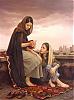
Ahan, here is a justification of changing of the places, as the Proserpina legend was in Sicily and Shakespeare tries to relate Perdita to this mythical character (a relationship between the plot of the lost flower girl and the classical story of Proserpina), he changes Sicilia with Bohemia.Originally Posted by Janine

The relationship between Hermione and Queen Anne Boleyn is interesting. I didn't read this play before, so I don't have any idea where they are similar exactly and if Shakespeare refers to this or not, Let's find any direct resemblance between these two during reading. It is apparent that both are accused of infidelity while there were innocence about Perdita and Elizabeth I, I don’t have any idea unless I read about Perdita in the play.I don't know if he is stretching his theory here but it certainly is a fascinating one. I never thought of the connecting when I first experienced the play (listened to it on audiofile). The wife is indeed falsely accused. There are definite parallels and all this would have occurred during or after Shakespeare's life. Elizabeth I sat on the throne of england during the time of Shakespeare. She often attended his performances. Perdita may represent Elizabeth in a sense, so maybe Shakespeare is trying to make a statement in this play. I happened to just see the HBO miniseries film last night "Elizabeth I" and I have to tell you, there were many supposed lovers who got the axe in those days. If you shone in the light of the Queen's favors all was rosy, but cross her and that could easily be your downfall. One tread a very thin line with serving all monarchs of that time.
I've got a problem, is it Robert or Richard Greene?!There is no one source for The Winter's Tale, although Shakespeare relies heavily on the works of Richard Greene, a London writer in the 1580s and '90s.
Thank you, Janine. I try to start this thread today!I would think making up a new thread would be your best bet. I think it would be great to make one up of all of Shakespeares performances on stage or screen in one separate thread, like a general 'Shakespeare Performance' thread perhaps. That would be truly entertaining and enlightening. Do you want to start that thread, sophia? I love stage and screen performances of Shakespeare particularly, so count me in. I know I can come up with some great photos; I copy them all the time for my own files. We could collaborate on getting it launched, if you want or if you need any help I would be glad to help out; just email me on here, if interested.
I'll be glad if I can participate in your visual threads and ideas!I have several ideas for visual threads, myself; I may be acting on those by the weekend.
It seems to me as a kind of madness, without any investigation and questioning deciding on poisoning a King is not rational at all. About Camillo's accepting Leonetes plot and then revealing the plot to Polixenes, here is the justification of his act:I thought Leonetes' jealousy was very rash and unproven and cruel. He did not try the man in question, his supposed friend but went ahead with plans to poison him immediately. I don't know how much more rash one could be. In his rashness he wounds many lives. I think Camillo's behavior was commendable, even though he did oppose his monarch, and the monarch's were suppose to be appointed, or anointed by God. I still think he had a fairness of heart and took the risk to warn Polixenes. I think when Camillo seems to be convinced of the guilt of the two as lovers, in his reply to Leonetes, he is actually playing along with him and all the time knows he will intercept, whatever Leonetes wishes him to do towards the other king. I don't think for one, the killing of a king, from another realm was such a wise political move, in those days - it would only bring on war, and no doubt Camillo knew this and acted on the love of his country. He may also have seen the 'rashness' in Leonetes behavior and felt it would be temporary. To kill a king is a pretty huge offense.
I must believe you, sir.
I do, and will fetch off Bohemia for't; (ActI-ii 333-4)
In the footnote, it is said
Fetch off : perhaps deliberately ambiguous: 1)kill; 2)bear off, resuce.
From The Oxford Companion to Shakespeare:
The Winter's Tale is primarily a dramatization of Robert *Greene's prose romance Pandosto (subtitled The Triumph of Time, and also known as 'The History of Dorastus and Fawnia'), which had first appeared in 1588 and had gone through five editions before Shakespeare composed The Winter's Tale. Shakespeare had probably known this work for some time: in any case he was not working from its most recent edition, printed in 1607, since this text alters the wording of the oracle's declaration, and the play here follows the earlier editions verbatim. Shakespeare changes the principals' names (Pandosto becomes Leontes, Bellaria becomes Hermione; Egistus becomes Polixenes; Dorastus and Fawnia become Florizel and Perdita), exchanges the places of *Bohemia and Sicilia (though even in Greene Bohemia is miraculously
provided with a coast), and drastically alters the story's tragic ending. The statue scene is entirely Shakespeare's invention (though it draws in part on the story of Pygmalion and Galatea, told in *Ovid's Metamorphoses): in Pandosto, Bellaria is genuinely and finally dead after the trial scene, and when years later Fawnia is brought to Pandosto's court he falls in love with her. After learning of her identity, he commits suicide. The play has no other major sources, though it derives incidental details from a number of texts (besides Plutarch and Boccaccio). Polixenes' defence of art (4.4.89-97) borrows from a similar passage in *Puttenham's Art of English Poesy (1589), while Shakespeare's knowledge of *Giulio Romano (5.2.96) probably derives, whether at first or second hand, from Giorgio Vasari's Vite de' piu eccellenti pittori, scultori, e architettori (1550). The scene of the mother's statue in Paulina's gallery may have been influenced, too, by *James I'S commissioning of painted memorial sculptures of his predecessor *Elizabeth 1 (completed in 1607) and of his mother Mary Stuart (completed before 1612), both in *Westminster Abbey.
I think so, before her convining of Polixenes to remain, he was there for nine months (Nine changes of the wat'ry star hath been (II-ii 1). And Leonete's obsessive questions about Mamillius being his son or not, resembling him or not! He even doubts the real identity of Mamillius as his own son. This remindes me of Othello!
And perceiving the amount of the speeches, Leonete's dialogue is not so long in comparison to Polixenes, it is Polixenes who is speaking and Leontes just answers in short dialogues which can represent some implicit anger and jealousy in Leonete. This is even before Herione's dialogues. Abd as they exit, Leonete starts his long dialogues full of rash, jealousy ....
I agree to, but it cannot be the time Hermione convinces Polinexes, too.Personally, I don't think we can pin down the exact moment or cause of Leontes jealousy. I agree with Janine, though. I think Leontes jealousy was very rash and very cruel, and I applaud Camillo's actions.
I have to read harold Bloom's criticism.It seems obvious to me that Leontes is suffering from some sort of paranoia, maybe sexual paranoia, and as Harold Bloom suggests, perhaps this is amplified by his close identification with Polixines.
Their closeness, going back to boyhood, is shown in the lines:
We were as twinn'd lambs that did frisk i' the sun
And bleat the one at the other: what chang'd
Was innocence for innocence: we knew not
The doctrine of ill-doing, nor dream'd
That any did. Had we pursu'd that life,
And our weak spirits ne'er been higher rear'd
With stronger blood, we should have answer'd heaven
Boldly 'not guilty', the imposition clear'd
Hereditary ours.
Bloom thinks the lines above suggest the Polixenes was not affected negatively in adulthood by the two men's closeness as boy, however, this closeness could be the root of Leontes jealousy, a jealousy that eventually drives him mad. I would agree with that.
Shakespeare, before revealing Leonete's evil plot and jealousy, refers to both of the kings as innocent, not guilty, through Camillo, Polinexes, and other characters, which we got surprised by Leonete's insane jealousy.

 Reply With Quote





 "It's so mysterious, the land of tears."
 I'll have to hurry up.
