I'm on book VII now. I'm very cruious to see how things proceed after what happened in the underworld.



I'm on book VII now. I'm very cruious to see how things proceed after what happened in the underworld.
"Do you mind if I reel in this fish?" - Dale Harris
"For sale: baby shoes, never worn." - Ernest Hemingway
Blog
Before we move on to Book VI, I thought I should bring up the death of Palinurus. Here's the Dryden translation (probably not the best, but it's the easiest to find online):
Besides just being a very poetic passage, I think it shows the Gods taking over the leadership from human control. In the middle of Book V Aeneas makes all the important decisions, but toward the end there's a shift back toward divine leadership. In the archery contest, for example, the Gods decide to ignite Acestes arrow and make him the victor even though the contest had already been won. It seems like they're wresting the judging of the games out Aeneas control. Likewise, by killing Palinurus Neptune is taking control of the ships from the Trojans.Dire dreams to thee, and iron sleep, he bears;
And, lighting on thy prow, the form of Phorbas wears.
Then thus the traitor god began his tale:
"The winds, my friend, inspire a pleasing gale;
The ships, without thy care, securely sail.
Now steal an hour of sweet repose; and I
Will take the rudder and thy room supply."
To whom the yawning pilot, half asleep:
"Me dost thou bid to trust the treach'rous deep,
The harlot smiles of her dissembling face,
And to her faith commit the Trojan race?
Shall I believe the Siren South again,
And, oft betray'd, not know the monster main?"
He said: his fasten'd hands the rudder keep,
And, fix'd on heav'n, his eyes repel invading sleep.
The god was wroth, and at his temples threw
A branch in Lethe dipp'd, and drunk with Stygian dew:
The pilot, vanquish'd by the pow'r divine,
Soon clos'd his swimming eyes, and lay supine.
Scarce were his limbs extended at their length,
The god, insulting with superior strength,
Fell heavy on him, plung'd him in the sea,
And, with the stern, the rudder tore away.
Headlong he fell, and, struggling in the main,
Cried out for helping hands, but cried in vain.
The victor daemon mounts obscure in air,
While the ship sails without the pilot's care.
On Neptune's faith the floating fleet relies;
But what the man forsook, the god supplies,
And o'er the dang'rous deep secure the navy flies;
Glides by the Sirens' cliffs, a shelfy coast,
Long infamous for ships and sailors lost,
And white with bones. Th' impetuous ocean roars,
And rocks rebellow from the sounding shores.
The watchful hero felt the knocks, and found
The tossing vessel sail'd on shoaly ground.
Sure of his pilot's loss, he takes himself
The helm, and steers aloof, and shuns the shelf.
Inly he griev'd, and, groaning from the breast,
Deplor'd his death; and thus his pain express'd:
"For faith repos'd on seas, and on the flatt'ring sky,
Thy naked corpse is doom'd on shores unknown to lie.
You still have papers to grade in June? Tough break. I'm sure the proposal will go well, though.Originally Posted by Petrarch's Love

Well, Anchises and the Sybil kind of give it away.
"Par instants je suis le Pauvre Navire
[...] Par instants je meurs la mort du Pecheur
[...] O mais! par instants"
--"Birds in the Night" by Paul Verlaine (1844-1896). Join the discussion here: http://www.online-literature.com/for...5&goto=newpost
I mean in regards to his departure through the false.
"Do you mind if I reel in this fish?" - Dale Harris
"For sale: baby shoes, never worn." - Ernest Hemingway
Blog
Their exit through the portal of false dreams has baffled many readers. No one is entirely sure what Vergil meant by it. Some believe this means that everything Aeneas experienced in the underworld or after it is a false dream. To me, this seems a little far-fetched. I think they exit through the false because they are not actually dead.
"Par instants je suis le Pauvre Navire
[...] Par instants je meurs la mort du Pecheur
[...] O mais! par instants"
--"Birds in the Night" by Paul Verlaine (1844-1896). Join the discussion here: http://www.online-literature.com/for...5&goto=newpost
It seems like we're ready to move on. I guess that means I should introduce the next Book.
Book VI
Detail from Turner's Aeneas and the Sybil (1798)
I was surprised to find that there's actually a dearth of good paintings of Hades. One would think that it would be a much painted locale, but it turns out that there are few good depictions of Book VI. Brueghel's is perhaps the best for its wide view and dark colors, but it portrays the suffering in the underworld much differently than in the Aeneid. I decided to go with some more accurate paintings of Book VI, but I think they misrepresent the tone of this part of the Aeneid. If you speculated from the two images I posted, you would probably think this section must be scenic and cheery. Really, though, it's quite gloomy. The Book starts with Aeneas arriving at Cumae and inquiring of the Sybil direction to the underworld. The seer explains a few tasks that Aeneas has to accomplish to gain entrance, and Aeneas (with divine help) finishes them all. Then, he descends into the home of the dead where he meets with former friends and acquaintances. After much sorrow, he finds his father. Anchises explains the grand plan that Aeneas must realize, and the son leaves through the ivory portal to go found Rome.
Now that the introduction is out of the way, let's start the discussion of Book VI.
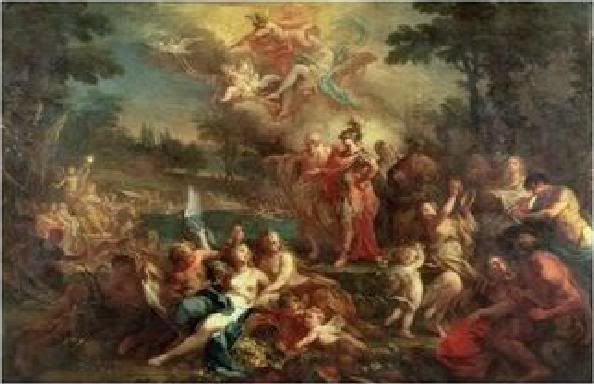
Low resolution image of The Vision of Aeneas in the Elysian Fields by Sebastiano Conca (1740)
"Par instants je suis le Pauvre Navire
[...] Par instants je meurs la mort du Pecheur
[...] O mais! par instants"
--"Birds in the Night" by Paul Verlaine (1844-1896). Join the discussion here: http://www.online-literature.com/for...5&goto=newpost
Ugh, I was hoping I wouldn't have to start the discussion. It not that I don't like Book VI. No, it may be my favorite Book. I've just read it so many times that even I'm beginning to grow tired with what I have to say about it. I am curious to know what other people gather from it, though. To get things going, I'll post what I tell everyone about Book VI.
The sixth Book breaks into three dramatic parts: Aeneas relinquishing control to the Gods, Aeneas witnessing the suffering of Hades, and then finally Aeneas gaining resolve in Elysium. The first part begins when Aeneas begins the tasks allotted to him by the Sibyl. He isn't able to accomplish any of these by himself and only faith will allow him pass into the underworld. Initially, the Sibyl demands that he pray. Then, the Sibyl tells him he must find the Golden Bough, but he's told that only a divinely chosen person will be able to take it. Aeneas can't even find the tree without the guides sent by Venus. After he gets the metallic branch, he must perform funeral rites for the Gods. Each of these three tasks force Aeneas to trust in the heavenly will and not his own.
Below, he's confronted with the shades of characters who represent the suffering in Aeneas's life. He meets Palinurus, Dido, and Deiphobus. Each character portrays part of Aeneas's pain since the downfall of Troy. Palinurus, the most recently deceased, represents the difficult voyage the Trojans have had to make. Dido is love that Aeneas has had to forgo. Deiphobus reminds Aeneas of the fall of Troy, and the fact that he couldn't fight to save it. Together these characters push Aeneas to the brink of despair.
Later the dispirited Aeneas finds his father in Elysium. Anchises rallies Aeneas by explaining to him the glory of Rome. This completes the movement from devotion through despair to firm resolve. Aeneas emerges from the underworld a strong stoic leader. Also, this process quiets any reservations the reader may have about Aeneas's character. By having him go through this process Vergil justifies--and even glorifies--his hero.
The personal progression of Aeneas, however, is not the only going on in Book VI. In fact, it's probably not even the most interesting. More entertaining--at least for me--has always been poetry behind the mood and emotion of this section. The mystery and wonder of the underworld, the pathos in his conversations with friends, and the hope at the end probably captivate the reader as much as what's happening to Aeneas. I'll talk about this more and post some chunks of Book VI in my next post.
Last edited by Quark; 06-11-2008 at 12:51 AM.
"Par instants je suis le Pauvre Navire
[...] Par instants je meurs la mort du Pecheur
[...] O mais! par instants"
--"Birds in the Night" by Paul Verlaine (1844-1896). Join the discussion here: http://www.online-literature.com/for...5&goto=newpost
Thanks Quark. Let's spend some time reviewing Book VI, since it is so central to the epic. Let's look at various elements of it. First, I wanted to understand the remarkable character of the Sybil of Cumae. Here's something from Wkipedia:
So The word sibyl comes (via Latin) from the ancient Greek word sibylla, meaning prophetess. There were eventually many Sibyls in the ancient world,[1] but because of the importance of the Cumaean Sibyl in the legends of early Rome codified in Virgil's Aeneid VI, she became the most famous among Romans, supplanting the Erythraean Sibyl famed among Greeks: in Latin she was often simply referred to as The Sibyl.The word sibyl comes (via Latin) from the ancient Greek word sibylla, meaning prophetess. There were eventually many Sibyls in the ancient world,[1] but because of the importance of the Cumaean Sibyl in the legends of early Rome codified in Virgil's Aeneid VI, she became the most famous among Romans, supplanting the Erythraean Sibyl famed among Greeks: in Latin she was often simply referred to as The Sibyl.
irgil did not invent the term and she is not the only sybil. Apparently the legends of Rome already had sybils. I had not known that.
Apparently certain prophesies by Sybils were codified in Roman history:
http://en.wikipedia.org/wiki/Cumaean_SibylThe story of the acquisition of the Sibylline Books by Lucius Tarquinius Superbus, the semi-legendary last king of the Roman Kingdom, or Tarquinius Priscus, is one of the famous mythic elements of Roman history.[3]
Centuries ago, concurrent with the 50th Olympiad and the Founding of the City of Rome, an old woman "who was not a native of the country" (Dionysius) arrived incognita in Rome. She offered nine books of prophecies to King Tarquin; and as the king declined to purchase them, owing to the exorbitant price she demanded, she burned three and offered the remaining six to Tarquin at the same stiff price, which he again refused, whereupon she burned three more and repeated her offer. Tarquin then relented and purchased the last three at the full original price, whereupon she "disappeared from among men" (Dionysius).
The books were thereafter kept in the Temple of Jupiter on the Capitoline Hill, Rome, to be consulted only in emergencies. The temple burned down in the 80s BC, and the books with it, necessitating a re-collection of Sibylline prophecies from all parts of the empire (Tacitus 6.12). These were carefully sorted and those determined to be legitimate were saved in the rebuilt temple. The Emperor Augustus had them moved to the Temple of Apollo on the Palatine Hill, where they remained for most of the remaining Imperial Period.
The Books were burned in AD 405 by the General Flavius Stilicho, who was a Christian and regarded the books as Pagan and therefore "evil". At the time of the Visigothic invasion five years later in AD 410, certain Pagan apologists bemoaned the loss of the books, claiming that the invasion of the city was evidence of the wrath of the Pagan gods over the destruction of the books.
WHat's interesting is that the cave where the Sybil of Cumae lives is in the sacred grove of the goddess Diana. Diana is a goddess of female power, the goddess of the moon, the sister of Apollo. There is a world of female power associated here.
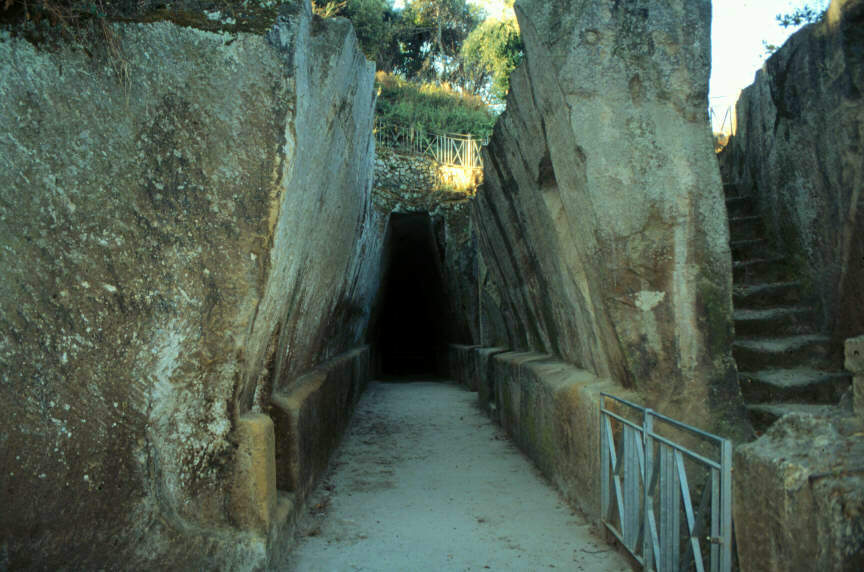
Two observations here: 1) No matter how devut pius Aeneas actually is, he is still criticized for being too slow to pray to the gods. 2) The image being emphasized in association with the Sybil are openings, caverns, tunnels, cave, mouths, things that open, "gape wide". Please forgive me for this, it's a little embarressing but I think it's implied in the text, it reminds me of female genitalia. Here's a picture of the actual cave entrance the sybil is supposed to have lived:Now carved out of the rockly flanks of Cumae
lies an enormous cavern pierced by a hundred tunnels,
a hundred mouths with as many voices rushng out,
the Sybl's rant replies. They have just gained
the sacred sill when the virgin cries aloud:
"Now is the time to ask your fate to speak!
The god, look, the god!"
So she cries before
the entrance--suddenly all her features, all
her color changes, her braided hair flies loose
and her breast heaves, her heart bursts with frenzy,
she seems to rise in height, the ring of her voice no longer
human--the breath, the pwer of god comes closer, closer.
"Why so slow Trojan Aeneas? she shouts, "so slow
to pray, to swear your vows? Not until you do
will the great jaws of our spellbound house gape wide."
And with that command the prophetess fell silent.
(ll 52-67)
The other association to the sybil is her voice. It is her voice through which she formulates the prophesies.
Her voice is a direct contact with the gods. I find this an incredible creation on Virgil's part, undoubtly taken from Roman folklore from which we don't probaly have the full context.But the Sybil, still not broken in by Apollo, storms
with a wild fury through her cave. And the more she tries
to pitch the great god off her breast, the more his bridle
exhuasts her raving lips, overwhelming her untamed heart,
bending her to his will. Now the hundred immense
mouths of the house swing open, all on their own,
and bear the Sybil's answers through the air:
You who have braved the terrors of the sea,
... a city built by Greeks!"
(ll93-116)
LET THERE BE LIGHT
"Love follows knowledge." – St. Catherine of Siena
My literature blog: http://ashesfromburntroses.blogspot.com/
Interesting. I didn't know the Romans had systematized prophesy so thoroughly. Book VI certainly must not have seemed like a stretch for any, then, contemporary readers. Or, maybe there were a few sticklers saying things like "The Sibyl is supposed to have nine books! Not four! Outrage!"
I hadn't thought about the cave showing feminine power. Diana is the goddess of sorcery, so that's why I thought it would be a natural choice for Vergil. He seems to be trying to make the underworld appear mysterious and magical. Who better for a architect of the underworld than Diana, then?
That is a sexy cave. I'm surprised you didn't have blur the entrance. It may be a stretch, though, to interpret this sexually. I understand that we have a woman with her hair coming undone and her clothes flying off--my favorite part. And, I also know that she standing by some orifice-like holes. Yet, for all this, it seems like there's no other way Vergil could do it. The clothes flying off seems more aimed to show the tempestuous force of the Sibyl, and the passageways have to be holes. I'll go back and look some more at the beginning of Book VI to see if I can find anything suggestive, but I'm not sure I will. We'll have to wait and see what other readers come away with.
Yeah, I don't know how much of the Sibyl Vergil imagines and how much was already assumed. She is a commanding character.
"Par instants je suis le Pauvre Navire
[...] Par instants je meurs la mort du Pecheur
[...] O mais! par instants"
--"Birds in the Night" by Paul Verlaine (1844-1896). Join the discussion here: http://www.online-literature.com/for...5&goto=newpost
I'll be reading The Aenead in January 2009. Anyone still reading it? LOL
I never did finish the second half. I will join you in a discussion if you wish. Just go ahead and post comments as you read.
LET THERE BE LIGHT
"Love follows knowledge." – St. Catherine of Siena
My literature blog: http://ashesfromburntroses.blogspot.com/
Thanks Virgil.
I'm into book 2 of Dryden's translation. I'm finding very beautiful and moving.
I'm struck by the sense of predestination, fate, etc. Different from the Iliad and the Odyssey. The Iliad had more than the Odyssey but much of it seemed to be the gods playing with mortals. The Odyssey seemed to give a lot of responibility to the mortals. From the opening when the gods laugh and say that the mortals just blame them for their troubles when in fact they make their own hardships. But the Aeneid is very fatalistic. Interesting change.
Book II is pretty exciting. Drama, fighting, gods--there's a lot going on. I like the part when Aeneas sees the Gods wrecking Troy and realizes that everything's lost. It often reminds me of other situations when it seems like things are out of your control.
The Gods do appear to be more commanding here. It could be because Vergil had a better idea of the narrative's shape to begin with than did Homer. Since the Iliad and Odysses were oral tales subject to retelling and all the alterations that come it, Homer probably didn't know exactly what would follow as much as Vergil who could devise the entire work ahead of time. Vergil, then, could put the Gods in charge of the narrative in a way that perhaps Homer couldn't. That is what the Gods do in the Aeneid, after all. They tell Aeneas exactly what's going to happen in the story--what direction that narrative will take. Aeneas has to bend his will to the events forecasted.
"Par instants je suis le Pauvre Navire
[...] Par instants je meurs la mort du Pecheur
[...] O mais! par instants"
--"Birds in the Night" by Paul Verlaine (1844-1896). Join the discussion here: http://www.online-literature.com/for...5&goto=newpost
I too am reading the Aeneid this year. Happy to participate in the forum.
I'll be glad to discuss anything you wish on the Aenied Bart. Just feel free to stop back to this thread. If I miss your posts, just drop me a note in my profile page. And welcome to lit net. Hope you enjoy it.
LET THERE BE LIGHT
"Love follows knowledge." – St. Catherine of Siena
My literature blog: http://ashesfromburntroses.blogspot.com/
are you guys still reading "the Aeneid"? i have enjoyed reading the comments about the previous five books and would like to hear what everyone has to say on the rest. is it a new thread somewhere?
 Posting Permissions

 Reply With Quote