Page 9 of 14 FirstFirst ... 4567891011121314 LastLast
Results 121 to 135 of 207

Thread: The Aeneid Discussion Group

  1. #121
    Of Subatomic Importance Quark's Avatar
    Join Date
    May 2006
    Posts
    1,368
    If Virgil (LitNet Virgil) doesn't mind, I though I'd get started on Book IV. Aeneas finishes his story at the end of Book III, and the next book describes the relationship between Aeneas and Dido. It's one of the more popular sections of The Aeneid, so I hope people will come back to discuss it. Anyway, here's:

    Book IV


    Aeneas at Dido's Court by Guerin 1815


    I'll start with a summary, and move on from there. Book IV is the conclusion of the mini-tragedy begun in Book I. This part of the story is not directly connected with the founding of Rome, so it can be best understood as a separate unit. Book II and III which do describe Aeneas' progress from Troy to Italy fit much more into the epic's plot, but this section stands alone as a diversion away from the main story. Book I introduces the characters and acts as the exposition in the mini-tragedy, while Book IV contains most of the action and the resolution. If we're using Freytag's analysis, that means the rising action, climax, falling action, and denouement all fall under Book IV.

    The rising action, everything up to the spread of rumors (1-179), describes the growth of Dido's and Aeneas' affection for each other. Mutual identity is the basis for their love. Both lovers are widowed exiles looking to establish new kingdoms. While Venus assists in enticing Dido, I wonder whether this trick was even necessary. Aeneas and Dido are so similar that they couldn't fail to be attractive to each other. Vergil (I'll use the alternate English spelling to refer to the poet) even heightens the similarities with a series of images and allusions. He compares Aeneas to Apollo and Dido to Apollo's twin Diana. Aeneas is the sun to the poet, and Dido the moon. Complementary or identical features become the dominant characteristics in each character in Book IV. Eventually the infatuation culminates in their romance in the cave

    The crisis--everything up to the confrontation between A and D (173-296)--is set in motion by the spread of Rumor. The reports of Aeneas's and Dido's love affair reach the jealous King Iarbas who had designs on Dido himself. Outraged, he demands that Jove should get rid of Aeneas. The God is angered that Aeneas has stopped his journey for Italy, and he dispatches Mercury to push the Trojan hero to his goal. Aeneas reluctantly acquiesces. Dido, meanwhile, hears of Aeneas' plan to leave, and calls him to her court.

    The falling action includes the confrontation between Aeneas and Dido (296-500). Dido accuses Aeneas of betrayal and entreats him to stay, if only until the weather improves. One certainly sympathizes Dido in this scene, and many of us may even agree with her attacks on Aeneas.

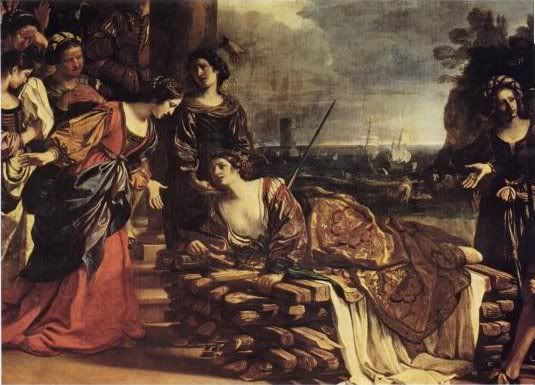
    Eventually the story reaches it's resolution (500-705). An utterly devastated Dido stabs herself to put an end to her suffering. The Tyrians lament their now uncertain fate, and Aeneas sails away remarkably calm.


    The Death of Dido by Guercino 1625
    "Par instants je suis le Pauvre Navire
    [...] Par instants je meurs la mort du Pecheur
    [...] O mais! par instants"

    --"Birds in the Night" by Paul Verlaine (1844-1896). Join the discussion here: http://www.online-literature.com/for...5&goto=newpost

  2. #122
    Registered User
    Join Date
    Apr 2008
    Posts
    5
    Love and Empire: The Virgilian Superimposition of the Collective and Posterity

    Love, the mechanism of cohesion within the Aenead, it is the driving force of Aeneas, and a fervency that is projected and radiated by Virgil. Not only does love have a motivating position within this tragic, yet glorious narration, but there is a gradation that pervades the story, love has frequency; the lower stratum of this stratified gradation is inhabited by the common sort of love, or romantically unifying fervency, and the higher elevation of this stratified stage is populated with a love of a superior caliber. This love, transcendental patriotism, the love of country, the unifying fervency of the collective—the key element of concentration that is a heavenly ordained mission, duty, and objective, directly relating to Empire (not only the abstraction, but also to the actual Roman Empire)—is the crescendo of the story. The Virgilian conception of soul depends on this love; it demands this dedication, this allegiance to society, to civilization, which is the immortalizing mechanism of the culture, the progenitor (Aeneas), and the constituent.

  3. #123
    Of Subatomic Importance Quark's Avatar
    Join Date
    May 2006
    Posts
    1,368
    Quote Originally Posted by ryi5005 View Post
    Love and Empire: The Virgilian Superimposition of the Collective and Posterity

    Love, the mechanism of cohesion within the Aenead, it is the driving force of Aeneas, and a fervency that is projected and radiated by Virgil. Not only does love have a motivating position within this tragic, yet glorious narration, but there is a gradation that pervades the story, love has frequency; the lower stratum of this stratified gradation is inhabited by the common sort of love, or romantically unifying fervency, and the higher elevation of this stratified stage is populated with a love of a superior caliber. This love, transcendental patriotism, the love of country, the unifying fervency of the collective—the key element of concentration that is a heavenly ordained mission, duty, and objective, directly relating to Empire (not only the abstraction, but also to the actual Roman Empire)—is the crescendo of the story. The Virgilian conception of soul depends on this love; it demands this dedication, this allegiance to society, to civilization, which is the immortalizing mechanism of the culture, the progenitor (Aeneas), and the constituent.
    The premise of your paper is strong. There's plenty in the Aeneid to support those claims. Even outside of the Aeneid evidence is easy to find. Much of what separates the Eclogues from the Georgics is that idealized love you're bringing up. I encourage you to stick with your topic, but without knowing what kind of paper you're writing I can't be very specific with my advice. Is it a High School or college essay? Are you expected to do research? Were you told the paper had to be a particular length?

    Staying very general, I can make a few suggestions. First, you should narrow your argument. Is the paper about the subordination of certain forms of love under others, or is it about Vergil's conception of the soul? While those two topics are somewhat complementary, your paper might lose focus if you try to talk about both simultaneously. Pick one argument for your paper, and write thoroughly on that. The other might work as a conclusion, but it shouldn't get in the way of your main argument.

    Also, you might help yourself if you expand your definition of love beyond patriotism and romance. Think about Aeneas' impulse to fight in the battle at Troy or Aeneas' attachment to his father. You might include these feelings in your discussion of love.

    The last idea: check the structure of the Aeneid in relationship to your argument about love. Does Aeneas progress from one form of love to another? Are the forms of love presented in any particular order? These may be good questions to investigate.

    Hope the paper goes well.
    "Par instants je suis le Pauvre Navire
    [...] Par instants je meurs la mort du Pecheur
    [...] O mais! par instants"

    --"Birds in the Night" by Paul Verlaine (1844-1896). Join the discussion here: http://www.online-literature.com/for...5&goto=newpost

  4. #124
    Vincit Qui Se Vincit Virgil's Avatar
    Join Date
    Nov 2005
    Location
    New York
    Posts
    20,354
    Blog Entries
    248
    Quote Originally Posted by ryi5005 View Post
    Love and Empire: The Virgilian Superimposition of the Collective and Posterity

    Love, the mechanism of cohesion within the Aenead, it is the driving force of Aeneas, and a fervency that is projected and radiated by Virgil. Not only does love have a motivating position within this tragic, yet glorious narration, but there is a gradation that pervades the story, love has frequency; the lower stratum of this stratified gradation is inhabited by the common sort of love, or romantically unifying fervency, and the higher elevation of this stratified stage is populated with a love of a superior caliber. This love, transcendental patriotism, the love of country, the unifying fervency of the collective—the key element of concentration that is a heavenly ordained mission, duty, and objective, directly relating to Empire (not only the abstraction, but also to the actual Roman Empire)—is the crescendo of the story. The Virgilian conception of soul depends on this love; it demands this dedication, this allegiance to society, to civilization, which is the immortalizing mechanism of the culture, the progenitor (Aeneas), and the constituent.
    I agree with Quark's suggestions. I think that is a good idea for a paper. I would make clear up front what you mean by love. Yes, this could be a solid paper. How long of a paper were you projecting?
    LET THERE BE LIGHT

    "Love follows knowledge." – St. Catherine of Siena

    My literature blog: http://ashesfromburntroses.blogspot.com/

  5. #125
    Vincit Qui Se Vincit Virgil's Avatar
    Join Date
    Nov 2005
    Location
    New York
    Posts
    20,354
    Blog Entries
    248
    I'm glad you started Book IV Quark. I needed a kick in the bhind.

    Within this thread we've already discussed the three dimensionality of the two major characters and how Virgil presents Dido's femine view on par with a male view. So I wanted to concentrate my points about Book IV to two other themes. First is again the religious theme.

    The Book opens with Dido telling us of the vow she made to her dead husband to remain faithful. Notice how she places this vow in the context of moral laws:
    "I pray that the earth gape deep enough to take me down
    or the almighty Father blast me with one bolt to the shades
    the pale, glimmering shades in hell, the pit of night,
    before I dishonor you, my conscience, break your laws."
    l. 32-35)
    But her sister Anna persuades her otherwise in a way I think that would have been shocking to Roman readers.

    ...But Anna answered:
    "dear one, dearer than light to me, your sister,
    would you waste away, grieving your youth away, alone,
    never to know the joy of children, all the gifts of love?
    Do you really believe that's what the dust desires,
    the ghosts in their ashen tombs?"
    (l. 39-44)
    First we see the contrast to Aeneas. Aeneas throughout the epic sacrifices for the greater good, but here Anna outlines the temptation that Dido is under, almost serves it on a plate, and Dido we see later submits to the temptation. She doesn't sacrifice in the manner that Aeneas does. But what i think would be particularly shocking to Romans would be this breaking of her vow to the dead. "Do you really believe that's what the dust desires/the ghosts in their ashen tombs?" Roman religion was not quite the same as Greek religion. Some have portrayed the Roman religion the same as the ancient Greek's only with the names changed. No, that's not right. The Romans had an element of worship for one's ancestor's, where the spirit's of one's dead ancestor's rose to the level of diety. For Anna to undermine a vow to a dead ancestor (and notice how her phrasing is couched in reference to the dead, with dust and ghosts and ashen tombs) is sacriligious. No good can come of breaking this vow. I continue to be amazed at how religious a work this is.

    I'll save my other point on Book IV for either tonight or tomorrow.
    LET THERE BE LIGHT

    "Love follows knowledge." – St. Catherine of Siena

    My literature blog: http://ashesfromburntroses.blogspot.com/

  6. #126
    A ist der Affe NickAdams's Avatar
    Join Date
    May 2007
    Location
    Some mesto, or another. Bog knows you wouldn't be able to viddy me from your okno.
    Posts
    1,481
    Virgil: I think I'm the idiot savant. I haven't been participated in this thread, because I couldn't find the book; I forgot it was on Litnet.

    "Do you mind if I reel in this fish?" - Dale Harris

    "For sale: baby shoes, never worn." - Ernest Hemingway


    Blog

  7. #127
    Of Subatomic Importance Quark's Avatar
    Join Date
    May 2006
    Posts
    1,368
    Quote Originally Posted by Virgil View Post
    The Book opens with Dido telling us of the vow she made to her dead husband to remain faithful. Notice how she places this vow in the context of moral laws:
    She does make that rather solemn vow in moral terms, and it's bolstered with all sorts of religious implication. A Roman audience probably would have considered her fidelity toward Sychaeus noble and divinely important. Today, though, readers may view her determination as cold-hearted and extreme. A hurt lover vowing never to love again is common occurrence in more contemporary fiction, and usually the reader is drawn into wishing the character would forget their past. With these examples in mind, we might consider Dido's speech a little Miss Haversham-like.

    Quote Originally Posted by Virgil View Post
    But her sister Anna persuades her otherwise in a way I think that would have been shocking to Roman readers.
    I think Roman readers would have considered Anna's argument specious, but I don't know if they would be outraged. Anna isn't telling her sister to disregard her obligations to Sychaeus; she's merely reinterpreting them so as to sanction her loving Aeneas. There is some disrespect in her tone which may have offended some, but I don't think it would have shocked anyone.

    Quote Originally Posted by Virgil View Post
    The Romans had an element of worship for one's ancestor's, where the spirit's of one's dead ancestor's rose to the level of diety. For Anna to undermine a vow to a dead ancestor (and notice how her phrasing is couched in reference to the dead, with dust and ghosts and ashen tombs) is sacriligious.
    Remember that Sychaeus is Dido's husband and not her ancestor.

    Quote Originally Posted by Virgil View Post
    First we see the contrast to Aeneas. Aeneas throughout the epic sacrifices for the greater good, but here Anna outlines the temptation that Dido is under, almost serves it on a plate, and Dido we see later submits to the temptation. She doesn't sacrifice in the manner that Aeneas does.
    That's right, but "submits to the temptation" makes it seem like she's making a decision--like there's two choices and she picks the wrong one. Decisions are not what separate Aeneas from Dido. It's the calm, collected manner which makes Aeneas able to leave Carthage. In an extended simile Vergil compares Aeneas to a strong-rooted oak tree:

    Sed nullis ille movetur
    fletibus, aut voces ullas tractabilis audit;
    fata obstant placidasque viri deus obstruit auris.
    Ac velut annoso validam cum robore quercum
    Alpini Boreae nunc hinc nunc flatibus illinc
    eruere inter se certant; it stridor, et altae
    consternunt terram concusso stipite frondes;
    ipsa haeret scopulis et quantum vertice ad auras
    aetherias, tantum radice in Tartara tendit;
    haud secus adsiduis hinc atque hinc vocibus heros
    tunditur, et magno persentit pectore curas
    (iv, 438-48)

    No tears, no pleading, move him ; no man can yield
    When a god stops his ears. As northern winds
    Sweep over Alpine mountains, in their fury
    Fighting each other to uproot an oak-tree
    Whose ancient strength endures against their roaring
    And he trunk shudders and the leaves come down
    Strewing the ground, but the old tree clings to the mountain,
    Its roots as deep toward hell as its crest toward heaven,
    And still holds on--even so, Aeneas, shaken
    By storm-blasts of appeal, by voices calling
    From every side, is tossed and torn, and steady.

    Dido, on the other hand, is "frenzied as Orestes" and "mad as Pentheus." Her unstable mind is what separates her from her Trojan counterpart. And, it's not as though Dido weighs two options and goes with the wrong one. She doesn't make a choice at all.

    Quote Originally Posted by NickAdams View Post
    Virgil: I think I'm the idiot savant. I haven't been participated in this thread, because I couldn't find the book; I forgot it was on Litnet.
    D'oh.
    "Par instants je suis le Pauvre Navire
    [...] Par instants je meurs la mort du Pecheur
    [...] O mais! par instants"

    --"Birds in the Night" by Paul Verlaine (1844-1896). Join the discussion here: http://www.online-literature.com/for...5&goto=newpost

  8. #128
    Vincit Qui Se Vincit Virgil's Avatar
    Join Date
    Nov 2005
    Location
    New York
    Posts
    20,354
    Blog Entries
    248
    Hey great response Quark.

    Quote Originally Posted by Quark View Post
    She does make that rather solemn vow in moral terms, and it's bolstered with all sorts of religious implication. A Roman audience probably would have considered her fidelity toward Sychaeus noble and divinely important. Today, though, readers may view her determination as cold-hearted and extreme. A hurt lover vowing never to love again is common occurrence in more contemporary fiction, and usually the reader is drawn into wishing the character would forget their past. With these examples in mind, we might consider Dido's speech a little Miss Haversham-like.
    I wouldn't say Miss Haversham-like. There's a whole social context that affects this, and I'll get to that as my other point of Book IV. I don't look at fiction or any art for that matter outside of its historical time and place. I don't think Virgil had in mind today's concept of love.

    I think Roman readers would have considered Anna's argument specious, but I don't know if they would be outraged. Anna isn't telling her sister to disregard her obligations to Sychaeus; she's merely reinterpreting them so as to sanction her loving Aeneas. There is some disrespect in her tone which may have offended some, but I don't think it would have shocked anyone.
    Perhaps. I'm not a cultural expert on the period. I used the word "outrage" to express they would have reacted to it. I can't claim to what extent.

    Remember that Sychaeus is Dido's husband and not her ancestor.
    That is a very good point. I don't know how much difference that makes.

    That's right, but "submits to the temptation" makes it seem like she's making a decision--like there's two choices and she picks the wrong one. Decisions are not what separate Aeneas from Dido. It's the calm, collected manner which makes Aeneas able to leave Carthage. In an extended simile Vergil compares Aeneas to a strong-rooted oak tree:

    Sed nullis ille movetur
    fletibus, aut voces ullas tractabilis audit;
    fata obstant placidasque viri deus obstruit auris.
    Ac velut annoso validam cum robore quercum
    Alpini Boreae nunc hinc nunc flatibus illinc
    eruere inter se certant; it stridor, et altae
    consternunt terram concusso stipite frondes;
    ipsa haeret scopulis et quantum vertice ad auras
    aetherias, tantum radice in Tartara tendit;
    haud secus adsiduis hinc atque hinc vocibus heros
    tunditur, et magno persentit pectore curas
    (iv, 438-48)

    No tears, no pleading, move him ; no man can yield
    When a god stops his ears. As northern winds
    Sweep over Alpine mountains, in their fury
    Fighting each other to uproot an oak-tree
    Whose ancient strength endures against their roaring
    And he trunk shudders and the leaves come down
    Strewing the ground, but the old tree clings to the mountain,
    Its roots as deep toward hell as its crest toward heaven,
    And still holds on--even so, Aeneas, shaken
    By storm-blasts of appeal, by voices calling
    From every side, is tossed and torn, and steady.

    Dido, on the other hand, is "frenzied as Orestes" and "mad as Pentheus." Her unstable mind is what separates her from her Trojan counterpart. And, it's not as though Dido weighs two options and goes with the wrong one. She doesn't make a choice at all.
    Oh the contrast is definitely intended. I completely agree.
    LET THERE BE LIGHT

    "Love follows knowledge." – St. Catherine of Siena

    My literature blog: http://ashesfromburntroses.blogspot.com/

  9. #129
    A ist der Affe NickAdams's Avatar
    Join Date
    May 2007
    Location
    Some mesto, or another. Bog knows you wouldn't be able to viddy me from your okno.
    Posts
    1,481
    I got it, I got it! I'll try and catch up, since you guys are only in the fourth book of twelve.

    "Do you mind if I reel in this fish?" - Dale Harris

    "For sale: baby shoes, never worn." - Ernest Hemingway


    Blog

  10. #130
    Of Subatomic Importance Quark's Avatar
    Join Date
    May 2006
    Posts
    1,368
    Quote Originally Posted by Virgil View Post
    There's a whole social context that affects this, and I'll get to that as my other point of Book IV.
    I'll wait for your second point, then. Is it also about religion?

    Quote Originally Posted by Virgil View Post
    Perhaps. I'm not a cultural expert on the period. I used the word "outrage" to express they would have reacted to it. I can't claim to what extent.
    It's certain they would have reacted to it, but in what way and to what extent is the question. If Anna had crossed some religious line, then the audience would be shocked. I don't think she does that, though. You're right that respect for the dead was a central idea in Roman culture, but Anna doesn't ask Dido to ignore Sychaeus' wishes. All she does is reinterpret them to make Dido's relationship with Aeneas permissible. Anna's questions imply that Dido's husband would want her to be happy, instead of faithful. A Roman audience may have found the reasoning implausible, but I don't think they would have been shocked by it. Like I mentioned before, the tone is irreverent, but the argument itself stays with the bounds of decorum.

    Quote Originally Posted by NickAdams View Post
    I got it, I got it! I'll try and catch up, since you guys are only in the fourth book of twelve.
    You shouldn't have any problems catching up. Feel free to post any comments you might have on the first three books, too. I'd respond to them at least.
    Last edited by Quark; 04-16-2008 at 07:58 PM.
    "Par instants je suis le Pauvre Navire
    [...] Par instants je meurs la mort du Pecheur
    [...] O mais! par instants"

    --"Birds in the Night" by Paul Verlaine (1844-1896). Join the discussion here: http://www.online-literature.com/for...5&goto=newpost

  11. #131
    Vincit Qui Se Vincit Virgil's Avatar
    Join Date
    Nov 2005
    Location
    New York
    Posts
    20,354
    Blog Entries
    248
    Quote Originally Posted by NickAdams View Post
    I got it, I got it! I'll try and catch up, since you guys are only in the fourth book of twelve.
    Glad to have you aboard Nick. We're going so slow you should have no trouble.
    LET THERE BE LIGHT

    "Love follows knowledge." – St. Catherine of Siena

    My literature blog: http://ashesfromburntroses.blogspot.com/

  12. #132
    A ist der Affe NickAdams's Avatar
    Join Date
    May 2007
    Location
    Some mesto, or another. Bog knows you wouldn't be able to viddy me from your okno.
    Posts
    1,481
    I have the Allen Mandelbaum translation, which has an introduction that I plan on sharing with you in the future (a few paragraphs at most).

    Quote Originally Posted by Quark View Post
    You shouldn't have any problems catching up. Feel free to post any comments you might have on the first three books, too. I'd respond to them at least.
    I'm not too familiar with Greek mythology, but I figure that it will all make sense in the end. There are so many names mentioned, I get confused and sometimes don't know who was speaking until I've completed the section.

    Quote Originally Posted by Virgil View Post
    Glad to have you aboard Nick. We're going so slow you should have no trouble.
    I'm on the second book now; I wish I was reading it as I write this. I'm captivated. I can't say I have been analyzing each line. I've been reading it like a thriller; I find it to be a page turner. When it comes to the gods, the drama never ends. Maybe the themes will come to me on reflection, but I'm just enjoying the story right now. I feel like a child again, watching those Saturday epics on television. I love a good hero.

    "Do you mind if I reel in this fish?" - Dale Harris

    "For sale: baby shoes, never worn." - Ernest Hemingway


    Blog

  13. #133
    Of Subatomic Importance Quark's Avatar
    Join Date
    May 2006
    Posts
    1,368
    Quote Originally Posted by NickAdams View Post
    I'm not too familiar with Greek mythology, but I figure that it will all make sense in the end. There are so many names mentioned, I get confused and sometimes don't know who was speaking until I've completed the section.
    Thankfully, the Aeneid has a smaller cast than the Iliad. There's only a handful of Gods in Vergil's epic, as opposed to the full complement included in the Greek epics. The only divine players you really have to know are Jove, Venus, Juno, and Mercury. And, while there is a lengthy history for each of these characters all you need to know in the Aeneid is their relationship to the hero. A quick rundown should help.

    Venus--Aeneas' mother. She helps Aeneas to Italy.

    Jove--head God who promises Venus that Aeneas will reach Italy and found a new, powerful kingdom

    Juno--bent on stopping Aeneas from founding the new empire

    Mercury--Jove's personal errand boy

    These Gods have wider roles in the mythology and in the epic beyond this, but that's all you have to know to understand what's going on. There are a few others that I didn't mention who also figure in--like Cupid or Vulcan. They don't figure prominently much, though. When they do, it's easy to tell what they're doing.

    Quote Originally Posted by NickAdams View Post
    I'm on the second book now; I wish I was reading it as I write this. I'm captivated. I can't say I have been analyzing each line. I've been reading it like a thriller; I find it to be a page turner. When it comes to the gods, the drama never ends. Maybe the themes will come to me on reflection, but I'm just enjoying the story right now. I feel like a child again, watching those Saturday epics on television. I love a good hero.
    The second book is exciting--quite violent, too. Some people have suggested that Vergil must have seen battle in order to write about its chaos so well. Did you think he may have gone over the top, though? The scene with Priam is pretty grisly. Were you alright with how gruesome it got?
    Last edited by Quark; 04-17-2008 at 08:29 PM.
    "Par instants je suis le Pauvre Navire
    [...] Par instants je meurs la mort du Pecheur
    [...] O mais! par instants"

    --"Birds in the Night" by Paul Verlaine (1844-1896). Join the discussion here: http://www.online-literature.com/for...5&goto=newpost

  14. #134
    A ist der Affe NickAdams's Avatar
    Join Date
    May 2007
    Location
    Some mesto, or another. Bog knows you wouldn't be able to viddy me from your okno.
    Posts
    1,481
    Quote Originally Posted by Quark View Post
    Thankfully, the Aeneid has a smaller cast than the Iliad. There's only a handful of Gods in Vergil's epic, as opposed to the full complement included in the Greek epics. The only divine players you really have to know are Jove, Venus, Juno, and Mercury. And, while there is a lengthy history for each of these characters all you need to know in the Aeneid is their relationship to the hero. A quick rundown should help.

    Venus--Aeneas' mother. She helps Aeneas to Italy.

    Jove--head God who promises Venus that Aeneas will reach Italy and found a new, powerful kingdom

    Juno--bent on stopping Aeneas from founding the new empire

    Mercury--Jove's personal errand boy

    These Gods have wider roles in the mythology and in the epic beyond this, but that's all you have to know to understand what's going on. There are a few others that I didn't mention who also figure in--like Cupid or Vulcan. They don't figure prominently much, though. When they do, it's easy to tell what they're doing.


    The second book is exciting--quite violent, too. Some people have suggested that Vergil must have seen battle in order to write about its chaos so well. Did you think he may have gone over the top, though? The scene with Priam is pretty grisly. Were you alright with how gruesome it got?
    I spent the weekend performing the traditional writer ritual of consuming alcohol, but I finished the second book today.

    Thanks for the rundown.

    I don't think it was over the top. Aeneis was telling the tale and gave details you would expect from a soldier. I enjoyed Priam's fall, or the telling of it. When Aeneis says that Priam's trunk lays on the shore, does he mean his body was taken to the beach?

    "Do you mind if I reel in this fish?" - Dale Harris

    "For sale: baby shoes, never worn." - Ernest Hemingway


    Blog

  15. #135
    in angulo cum libro Petrarch's Love's Avatar
    Join Date
    Dec 2005
    Location
    California
    Posts
    2,333
    Blog Entries
    24
    Just checking back in to see how this discussion is going. The many demands on my time of late have been keeping me away, but I'll see if I can carve out a little time in the coming days to make some remarks on book IV. Glad to see Nick's joining in. Don't know that I buy Dido as Mrs. Havisham, but I doubt I'll forget it soon. Now I have this image in my mind of Mrs. Havisham standing on a funerary pyre crazily crying out STELLA.

    When Aeneis says that Priam's trunk lays on the shore, does he mean his body was taken to the beach?
    Yes, his decapitated corpse evidently ends up on the beach. I think the idea is that they're piling up the dead on the shore outside the walls of the city, and he ends up a nameless corpse among the slaughtered. I've always imagined they threw the body off a wall to the beach below, but I don't think there's anything in the text about that, just my imagination.

    Anyway, good discussion so far on book IV. Even after having read it several times, it's almost impossible not to get completely swept up in the intensity of the ending to that book. Interesting that Virgil focused right away on the idea of the breaking of the vow. I don't really know exactly how shocking that would have been to a Roman audience either, though it's never struck me as something that would be way out of the bounds of acceptability. What was the second point you wanted to make, Virg? I may have a few things to add, but maybe we'll let Nick catch up a bit?

    "In rime sparse il suono/ di quei sospiri ond' io nudriva 'l core/ in sul mio primo giovenile errore"~ Francesco Petrarca
    "Follies and nonsense, whims and inconsistencies do divert me, I own, and I laugh at them whenever I can."~ Jane Austen

Similar Threads

  1. The Aeneid
    By Anthony in forum The Aeneid
    Replies: 2
    Last Post: 11-28-2007, 12:23 AM
  2. Welcome to Shakespeare Discussion Group!
    By Scheherazade in forum Forum Book Club
    Replies: 1
    Last Post: 11-28-2006, 07:49 PM
  3. Book discussion suggestion =).
    By JediFonger in forum The Literature Network
    Replies: 0
    Last Post: 10-27-2004, 02:33 PM

Posting Permissions

  • You may not post new threads
  • You may not post replies
  • You may not post attachments
  • You may not edit your posts
  •