Can an omniscient god exist if the universe is inherently non-deterministic?


Can an omniscient god exist if the universe is inherently non-deterministic?
Faith is believing what you know ain't so - Mark Twain
The preachers deal with men of straw, as they are men of straw themselves - Henry David Thoreau
The way to see faith is to shut the eye of reason - Benjamin Franklin
The teaching of the church, theoretically astute, is a lie in practice and a compound of vulgar superstitions and sorcery - Leo Tolstoy
May I rephrase your question to ask: Can an omniscient god be moral or compassionate if He/She/It foresaw all that would be visited on humanity in the form of natural disasters, pandemics and human ignorance and cruelty?Originally Posted by atiguhya padma


What more exactly do you mean by non-deterministic?
Labyrinth

It seems to me that this is essentially another look at the "Free Will v.s. Omniscience" debate. Here are some definitions of "Determinism":
“Determinism is the theory that all human action is caused entirely by preceding events, and not by the exercise of the Will.”
“Causal determinism is, roughly speaking, the idea that every event is necessitated by antecedent events and conditions together with the laws of nature. The idea is ancient, but first became subject to clarification and mathematical analysis in the eighteenth century. Determinism is deeply connected with our understanding of the physical sciences and their explanatory ambitions, on the one hand, and with our views about human free action on the other. In both of these general areas there is no agreement over whether determinism is true (or even whether it can be known true or false), and what the import for human agency would be in either case.”
I think that the answer here is clear. Why would omniscience play any deciding role in morallity or compassion? Is it at all possible that this poor divinity necessarily created the Universe as a result of it's character and essence, but sadly did a poor job of it and isn't powerful enough to solve all of the problems here?
My point is that it is possible for nearly anything to be the case, if the only characterization we place on the theoretical god is omniscience. If the god is omnipotent as well, however, then I think that the question has greater meaning.
Last edited by ShoutGrace; 07-13-2007 at 03:10 PM.
“As Kingfishers catch fire, dragonflies draw flame . . .”
Why disqualify the rush? I'm tabled. I'm tabled.
Careless of me. In positing omniscient I took omnipotent to be implied.

A well-phrased question. I will take non-determinism as simply that future events are not wholly determined by those events which precede them. If the omniscient God is capable of knowing the factors that affect future events, the ones that the term "non-deterministic" implies are not the preceding events, then I think God can exist in a non-deterministic universe.
To show that one does exist with ontology is a different story. To say that an omniscient God must know these factors because he is omniscient is circular. Good thread.
Omniscient means everywhere and omnipotent means can do anything?
I think if we took God to be the basic force behind everything, energy, or if we took it to be something that powered energy, I mean something more basic than energy, then we could say yes, it's possible. (I don't know if what I'm saying is garbage or not, if it is, feel more than free to say so!)
Anyway, I think that the universe is non-deterministic. I mean, that wasn't the question, but I think that it is. It seems to be anyway. It seems that I can decide to do something, perhaps after much flip-flopping, and that decision will affect events; and that I am something which can decide such things.
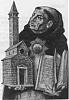
The following is an attempt to convey the thoughts of Thomas Aquinas on these very interesting and important questions.
God's omniscience does not necessarily conflict with either non-determinism or with Free Will. God's omniscience does not cause events to occur in the way he knows they will turn out, any more than my knowing the end of Hamlet kills the prince. The compatibility of omniscience with free will is a little subtler. Since all beings other than God are created beings, they do not possess existence of themselves but only through God. God's knowledge does not force these beings to act in a way contrary to themselves, but rather is the motive force that comes from within them.
The question of God's morality does not come up, since within the very meaning of the term 'God' is that he is possessed of all Goodness.
aude sapere
If 'God' is omniscient and the first cause then God at very least assented to and more literally caused everything that follows from his prescient decision to create the world.
To give someone free will knowing in advance how he or she will use it surely means to become a collaborator or at least an ennabler of anything they might do. If 'God' is possessed of all goodness he is ipse facto possessed of all evil as well. And the question of 'His' morality does indeed come up with every falsehood proclaimed in his name (however sincerely put forward), every abuse inflicted on every child, every person who dies of starvation, every soldier on every side and every civilian who is killed in war.
Not being a religious person, I don't claim to be an expert by any stretch of the imagination, but in reading this thread I had a question which takes the original question a step back. The original question is:
To which I ask the question, can God exist? By this I'm not making a statement that there is no God, but rather that God does not 'exist' in the way that we exist. If, as the theory goes, God created existence, then by definition God does not 'exist' but is beyond existence. Or even is existence.
So the answer to your question would be no. An omnicient God does not exist. The universe exists, God is beyond existence. God does not reside in the universe therefore cannot be judged or interpreted within the boundaries or observable rules and nature of the universe.

The answer I'm most familar with to this conundrum is that "we can't know all ends". God is a collaborator in evil by virtue of the fact that he knew it would happen before he created the world, but that's his perogative, and his reasons must have been good ones. The religious person has to have faith that the world has turned out in the best possible way that it could. In other words, when he concieved of the universe, God had many different options about how much or little free will he would provide his creation with. He chose to provide the exact amount necessary for the least amount of evil to occur. We can't easily comprehend this, because God's reasons are inscrutable ones.
Of course, a Deist could just argue that God created the universe, then sat back to watch, admire, and "see what would happen". Or maybe God's motivations are simply impossible for human beings to comprehend.
[QUOTE=Noisms;419192]The answer I'm most familar with to this conundrum is that "we can't know all ends". God is a collaborator in evil by virtue of the fact that he knew it would happen before he created the world, but that's his perogative, and his reasons must have been good ones.[QUOTE]
Which takes you back to the beginning of this circular argument, i.e., the Bible or other central book for other religions. God must be good because in the Bible God is demonstrated to be good. But on the other hand, is 'God' is inscrutable, can we ever know what he means by "good"?[QUOTE]
Therefore 'He' might indeed - for those inscrutable reasons - have chosen the worst possible option (in our eyes and experience).The religious person has to have faith that the world has turned out in the best possible way that it could. In other words, when he concieved of the universe, God had many different options about how much or little free will he would provide his creation with. He chose to provide the exact amount necessary for the least amount of evil to occur. We can't easily comprehend this, because God's reasons are inscrutable ones.
A really hard-wired Deist, a dyed-in the-wool deist, a this must be true otherwise what is the point of life - of my life, especially deist would argue anything other than contemplate even for a moment that there may be an explanation for existence other than a deity, and no compulsion to be moral other than a) one is happier that way or b) morality is the only guarantee of the species' survival.Of course, a Deist could just argue that God created the universe, then sat back to watch, admire, and "see what would happen". Or maybe God's motivations are simply impossible for human beings to comprehend.
I still think you're thinking about this all the wrong way. You are trying to understand God within the confines of the universe, explaining God in terms of the universe is like comparing apples with the Empire State Building, there's no relationship.
Think of it in different terms. God is a composer, the universe a grand opera God is creating. God decides to compose the opera, chooses the tune, the harmony. He wants it to turn out a particular way, and in so doing he reflects in the opera (universe) the characteristics he wants it to display, which may or may not be characteristics which exist in God. So he reflects in the opera, a part of himself, but he does not become part of the opera. In terms of the opera, people are insignificant individual notes. Thinking about it this way, how could the notes ever understand or even comprehend the whole opera? All they could see and understand would be their part in it. From God's perspective, people form the tune, but having been given free will it is for the person to decide what note they play. If they choose the wrong note they'll be out of harmony with the opera and will be discarded. Would God consider a plea from the note that perhaps God should have composed a different tune, so they could fit? Of course not, because God is concerned with the opera, and if the note doesn't fit it must be struck out. Perhaps you should consider the opera still in progress, as yet unfinished and still unfolding. When the opera is finished, God could replay it, and those who have remained in harmony would be replayed, those who did not cease to be. Hence those who 'fit' God's grand tune live forever, those who do not don't figure in the replay.
If there is a God then humans most certainly could not understand it. God does not exist in the universe. Back to the opera analogy it's like expecting the single note to comprehend the composer which, considered in those terms, is pretty ridiculous, the note can't even comprehend the opera.
This is one of probably 3,537,822,012 conjectures as to what 'God' is. I've been working on something about that:
God is the most fertile metaphor ever,
that non-existent being which,
once contrived, was the inspiration
of ‘countless proofs’ of his existence
and conjured up hierarchies
of priests and temples and gold,
armies that marched in his defense.
Belief in God is the first
and only miracle some need.
My main response to yours is a) what it reveals of your own benevolent nature, and b) how beautifully written it is. Thank you.
P.S. I suppose we could conjecture whether the composer was more like Mozart, Verdi or Wagner!

[QUOTE=PrinceMyshkin;419691]
I would imagine that many peolpe who want to get to the bottom (or top) of this mytery may have started with Aquinas (although that is certainly not necessary). Personnaly I pleasantly had the wind knocked out me by Aquinas and Augustine, being the rosary toting, novena celebrating, mass going Catholic kid that I was. But the quotes here all pose incredibly intelligent questions and statements.
And so I don't have to keep stating that this is just my opinion, I say it here at the top. As I have stated elsewhere, I generally step on tender areas unintentionally when I attempt this, so forgive me if I do.
First, Bii hit the year-nail on the head. All of the debate from time immemorial speaks from the position of God hanging around for a google of millenia and then deciding to create the universe. I don't see it that way. The purported supreme intelligence of God is predicated on intelligence as we experience it. The same goes for the characteristic of omniscient, omnipotent and infinite. We see intelligence mostly as something focused. We have to see it that way to analyze it quanitatively. God is outside these types of analyses because the intelligence of God is somewhat an unfocused intelligence. The closest example we can identify with in abstract art, Jackson Pollock, if you will.
The focus of God's intelligence comes from us!! We invented the awareness of God and thus are responsible for God's existence. This is not meant to be a figurative statement. Before us we had a spontaneous transformation of highly concentrated matter and energy intrinsically endowed with intelligence as ubiquitous and embedded as cosmic background radiation has come to be known. As we evolved, so did the focus of God. This is not to detract from the eternal nature of God, not as depicted in the Holy books of the world's cultures, but nevertheless always was and always will be. As Prince points out, inspired humans wrote the bible, humans like we who are discussing this very matter here. They tried to express the same thoughts as we. Our advantage is the insight into ourselves and the universe and the very nature of matter and energy, which in fact is God's insight. God is alive through us. God knows God through us. We are the image and likeness because we are a mirror.
So how does God know what will happen for all time? God doesn't know that. We have all heard that time itself does not exist, it is a construct. We have all heard that one of the current hypotheses for reality is that it is multi-layered, there are many universes within the fabric space/time. So, everything happens at once. Past, present and future are fabrications we use to make sense of something "beyond our existence." The idea of an omnicient God is an attempt to reconcile a multi-layered universe with what was available in 3000 B.C. for the Bible, much earlier for Hebrew, Muslim and Hindu holy books, I think.
This way of God existing is quite backwards from traditional thinking as far as I know. It is present in the poetry of Rilke and possibly others. God knows what we are thinking because we know what we are thinking. We know what we are going to do (if even unconsciously) before we do it.
However, there are unpredictable events in the universe(s). Although, given a high-level view of all parallel realities, that would be much diminished from what we mean by that in this reality, given this hypothetical scientific POV.
In the end, this should not diminish one's faith or belief, just as knowing the way a play is written does not diminish our enjoyment of it. God is much like these boards, given they would not shut them down if no one posted. They would still exist, the intelligent idea behind them would be there, but they would have no focus or life. The End. I am sorry for being Thread-piggy Jr. (you are older than me Prince).
 Posting Permissions

 Reply With Quote