Page 34 of 71 FirstFirst ... 24293031323334353637383944 ... LastLast
Results 496 to 510 of 1056

Thread: PoemoftheWeek

  1. #496
    unidentified hit record blp's Avatar
    Join Date
    Apr 2005
    Posts
    2,436
    Blog Entries
    40
    Here it is again, since we're on a new page.

    THAT is no country for old men. The young
    In one another's arms, birds in the trees
    - Those dying generations - at their song,
    The salmon-falls, the mackerel-crowded seas,
    Fish, flesh, or fowl, commend all summer long
    Whatever is begotten, born, and dies.
    Caught in that sensual music all neglect
    Monuments of unageing intellect.

    An aged man is but a paltry thing,
    A tattered coat upon a stick, unless
    Soul clap its hands and sing, and louder sing
    For every tatter in its mortal dress,
    Nor is there singing school but studying
    Monuments of its own magnificence;
    And therefore I have sailed the seas and come
    To the holy city of Byzantium.

    O sages standing in God's holy fire
    As in the gold mosaic of a wall,
    Come from the holy fire, perne in a gyre,
    And be the singing-masters of my soul.
    Consume my heart away; sick with desire
    And fastened to a dying animal
    It knows not what it is; and gather me
    Into the artifice of eternity.

    Once out of nature I shall never take
    My bodily form from any natural thing,
    But such a form as Grecian goldsmiths make
    Of hammered gold and gold enamelling
    To keep a drowsy Emperor awake;
    Or set upon a golden bough to sing
    To lords and ladies of Byzantium
    Of what is past, or passing, or to come.


    I like little snatches of Yeats - A terrible beauty is born, some rough beast, slouching towards Bethlehem to be born, and the foul rag and bone shop of the heart, but (sorry) I've never enjoyed a whole poem enough to look at him much and he appears to have had some rather odd philosophical views, as well as in interest in the occult. Still, look around at other early modernists, in art and architecture as well as literature, and you find some awfully funny views about. I don't want to be too quick to judge.

    'Gyre' from S3, L3 here, is a key term in said philosophical schema and also turns up in Yeats' The Second Coming. It means a whirl, vortex or, as Yeats would have it, a historical cycle. Jerome Rothenberg and Pierre Joris in Poems for the Millennium describe his vision of this as 'a mapping of all history and consciousness as a recurrent interplay of cycles' and quote R. Ellman , in explanation, 'a conflict of opposites...represented by two interpenetrating cones or gyres, the apex of one in the base of the other' and Yeats: 'What if Christ and Oedipus or, to shift the names, Saint Catherine of Genoa and Michael Angelo, are the two scales of balance, the two butt-ends of a see-saw? What if there is an arithmetic or geometry that can exactly measure the slope of a balance, the dip of a scale, and so date the coming of that something?'

    Hmmm.

    Well, a few other scattered observations: the title of this one is oddly similar to the famous phrase from The Second Coming, Slouching towards Bethlehem. No idea whether this is significant. The phrase golden bough, S4, L6, is the name of a book by J.G Frazer of comparative religion and myth, showing the parallels between Christianity and other traditions predating it, published 1922 and a key reference point for Pound and Eliot. Not sure of the specific significance of the title.

    This is getting long, so I'll hang back for now.

  2. #497
    dreamer genoveva's Avatar
    Join Date
    Feb 2006
    Location
    Oregon
    Posts
    592
    Where is Byzantium?
    "I have so often dreamed of you that you become unreal." ~ Robert Desnos

  3. #498
    Quote Originally Posted by genoveva
    Where is Byzantium?
    It's an old name for Istanbul / Constantinople.

  4. #499
    Vincit Qui Se Vincit Virgil's Avatar
    Join Date
    Nov 2005
    Location
    New York
    Posts
    20,354
    Blog Entries
    248
    Quote Originally Posted by The Unnamable
    Sorry, Virgil but I’ve grown to like Yeats less and less over the years. The problem I have with this poem is that it offers artifice as a preference to the natural. Certain lines stand out (as they often do in Yeats) but he comes across as a bit of a fart to me. The poem has been called ‘Romantic’ but I would have to agree with a less modern Romantic:

    “Not in Utopia, subterranean fields, --
    Or some secreted island, Heaven knows where!
    But in the very world, which is the world
    Of all of us, -- the place where in the end
    We find our happiness, or not at all!”
    The Prelude (1850) bk. 12, 1. 204

    Yes, I can see the fear of growing old and I can ‘enjoy’ the unembellished image of “A tattered coat upon a stick” but can he really be serious about that golden bird?
    Yes, he splits from moderns. That's his way of looking at the world. All sorts of writers have all sorts of kooky ideas. To you ideas are paramount; to me the aesthetics. Ultimately it's his artistry, not his ideas, that makes him a poet. If ideas were paramount, he could have written an essay and be precisely clear. To me there are only a handful of poets writing in engish with his poetic skills: Shakespeare, Keats, Pope, come to mind.
    Last edited by Virgil; 04-03-2006 at 11:25 PM.
    LET THERE BE LIGHT

    "Love follows knowledge." – St. Catherine of Siena

    My literature blog: http://ashesfromburntroses.blogspot.com/

  5. #500
    in angulo cum libro Petrarch's Love's Avatar
    Join Date
    Dec 2005
    Location
    California
    Posts
    2,333
    Blog Entries
    24
    The phrase golden bough, S4, L6, is the name of a book by J.G Frazer of comparative religion and myth, showing the parallels between Christianity and other traditions predating it, published 1922 and a key reference point for Pound and Eliot. Not sure of the specific significance of the title.
    The golden bough is a reference from the Aeneid, book six, in which Aeneas must search for the golden bough in order to pass safely through the underworld (has this come up elsewhere in this thread or is it just deja vu?). I don't know if this was in Yeats' mind or not when he was writing this (I'd be interested if anyone were to suggest a significant way in which they are linked). My Norton anthology quotes Yeats as having written the following about the golden bough and bird:
    I have read somewhere, that in the Emperor's palace at byzantium was a tree made of gold and silver and artificial birds that sang.
    The Norton also cites, Hans Christian Anderson's Emperor's Nightengale, which I don't remember having read. It's not here on Lit. Net.
    Ultimately it's his artistry, not his ideas, that make him a poet.
    I agree, that I enjoy Yeats most on the aesthetic level. Maybe we could talk about form a little to begin with? I think he does a beautiful job in the ottava rima here. The concluding couplet really puts the emphasis on the end of the stanza, and he uses that fairly effectively. If you read just from the final lines of each stanza you could still get the gist of the poem:

    Caught in that sensual music all neglect
    Monuments of unageing intellect.
    And therefore I have sailed the seas and come
    To the holy city of Byzantium.
    Into the artifice of eternity.
    Of what is past, or passing, or to come.
    I love the sound of that repeated rhyme between "come" and "Byzantium" for some reason. It also highlights the transition from the sense of coming to Byzantium in the third stanza to the sense of Byzantium and what is to come at the end. Through the use of the repeated rhyme in chiasmus he smoothly suggests the way the speaker is travelling from across the seas, to Byzantium and from thence to "the artifice of eternity."

    "In rime sparse il suono/ di quei sospiri ond' io nudriva 'l core/ in sul mio primo giovenile errore"~ Francesco Petrarca
    "Follies and nonsense, whims and inconsistencies do divert me, I own, and I laugh at them whenever I can."~ Jane Austen

  6. #501
    unidentified hit record blp's Avatar
    Join Date
    Apr 2005
    Posts
    2,436
    Blog Entries
    40
    Quote Originally Posted by Xamonas Chegwe
    It's an old name for Istanbul / Constantinople.
    ...and its significance would be, I think, though I can't offer a very complete or reliable history, that it was the capital of empire in Europe and the Mediterranean, prior to power shifting to Rome, and, as such, also a capital of culture. Byzantine art is exemplified by icon painting - lots of gilding, flatness and stylisation - a style that continued for a long time in the Roman Empire before early Renaissance artists looked back to Greek classicism for a greater naturalism. Yeats is alluding to and yearning for the arch artifice of Byzantine art - paralleling other modernist breaks with the lineal progression from Renaissance classicism that had characterised western art for some five centuries.

  7. #502
    Vincit Qui Se Vincit Virgil's Avatar
    Join Date
    Nov 2005
    Location
    New York
    Posts
    20,354
    Blog Entries
    248
    Quote Originally Posted by blp
    ...and its significance would be, I think, though I can't offer a very complete or reliable history, that it was the capital of empire in Europe and the Mediterranean, prior to power shifting to Rome, and, as such, also a capital of culture. Byzantine art is exemplified by icon painting - lots of gilding, flatness and stylisation - a style that continued for a long time in the Roman Empire before early Renaissance artists looked back to Greek classicism for a greater naturalism. Yeats is alluding to and yearning for the arch artifice of Byzantine art - paralleling other modernist breaks with the lineal progression from Renaissance classicism that had characterised western art for some five centuries.
    Your history is a little off. Byzantium became Rome's second capital in the 4th century AD. When Rome and the western half of the empire collasped (arguably attributed to 476 AD) the eastern half continued with Constantinople [Byzantium is the original Greek name of town that was there prior to Emperor Constantine making it a major city 331(? I think)] as the capital, and we have come to reffer to that culture as the Byzantines, but they still considered themselves "Romanoi," the continuation of the Roman culture, even to the end in the 15th century. I think you're right to assume that Yeats is identifying with the art of the Byzantines. It's not clear to me what period of Byzantine art he's referring to, the art of the 6th century under emperor Justinian or the art during the middle ages.
    LET THERE BE LIGHT

    "Love follows knowledge." – St. Catherine of Siena

    My literature blog: http://ashesfromburntroses.blogspot.com/

  8. #503
    Love of Controversy rabid reader's Avatar
    Join Date
    Mar 2006
    Location
    Ontario
    Posts
    715
    Blog Entries
    3
    From a religious aspect, which may proove valuble. After the split of Roman birthed the first division in Christaianity. Byzantium founded the Eastern Orthadox Church... this division was made final when the crusaders invaded Constanitopal, during the First Crusade, and had a hooker dance on the alter of the EO's holiest church.
    A tragic situation exists precisely when virtue does not triumph but when it is still felt that man is nobler than the forces which destroy him.
    - Orwell

    Read of my Shepherd

  9. #504
    Vincit Qui Se Vincit Virgil's Avatar
    Join Date
    Nov 2005
    Location
    New York
    Posts
    20,354
    Blog Entries
    248
    Quote Originally Posted by rabid reader
    From a religious aspect, which may proove valuble. After the split of Roman birthed the first division in Christaianity. Byzantium founded the Eastern Orthadox Church... this division was made final when the crusaders invaded Constanitopal, during the First Crusade, and had a hooker dance on the alter of the EO's holiest church.
    Well, this perspective is pretty wrong.

    Political divsion occured technically in 1054, referred to as the Schism. That's the political official division. Cultural divsion was occuring even before the western half of the empire collasped in the 5th century. First crusade occured in 1095.

    Crusaders sacked Constantiople in 1204, the fourth crusade.

    a hooker dance on the alter of the EO's holiest church
    What? Where is that from?


    Anybody for discussing the poem? I don't think the East-West Church split is relevant.
    LET THERE BE LIGHT

    "Love follows knowledge." – St. Catherine of Siena

    My literature blog: http://ashesfromburntroses.blogspot.com/

  10. #505
    in angulo cum libro Petrarch's Love's Avatar
    Join Date
    Dec 2005
    Location
    California
    Posts
    2,333
    Blog Entries
    24
    It's not clear to me what period of Byzantine art he's referring to, the art of the 6th century under emperor Justinian or the art during the middle ages.
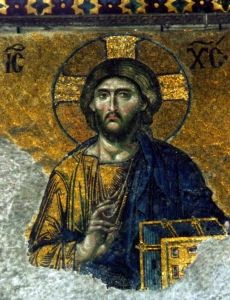
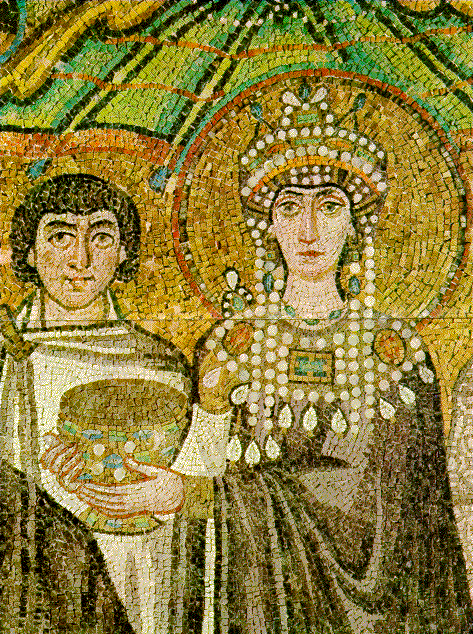
    Virgil--My Norton glosses the line "As in the gold mosaic of a wall" as a reference to the mosaics in Hagia Sophia. It's unclear whether that's coming from something they know about Yeats or the editor's imagination though. In any case, I thought I'd offer a couple of pics. as a visual aid for those who aren't familiar with the Byzantine style (and for the enjoyment of those who are).


    The second and third shots of the interior really show how mosaic could look like "sages standing in god's holy fire."

    Here's a quote from Yeats I found in the Norton notes:

    "I think that in early Byzantium, maybe never before or since in recorded history, religious, aestehtic, and practical life were one, that architects and artificers...spoke to the multitude in gold and silver. The painter, the mosaic worker, the worker in gold and silver, the illuminator of sacred books were almost impersonal, almost perhaps without conciousness of individual design, absorbed in their subject matter and that vision of a whole people."

    "In rime sparse il suono/ di quei sospiri ond' io nudriva 'l core/ in sul mio primo giovenile errore"~ Francesco Petrarca
    "Follies and nonsense, whims and inconsistencies do divert me, I own, and I laugh at them whenever I can."~ Jane Austen

  11. #506
    Registered User jackyyyy's Avatar
    Join Date
    Mar 2006
    Posts
    459
    I like it, Virgil, and more each time I read it. Though my view of it is still forming, I can write something.

    Whatever is begotten, born, and dies.
    Caught in that sensual music all neglect
    Monuments of unageing intellect.


    The 'Sensual music' is reproduction, life's rythme, and the intellect of life does not 'really' change, just continues/repeats. He shows this, mortality and the process of life's things. The first stanza, 'One another's arms', he is pointing out life again, and how 'he' does not fit or want 'that'.

    O sages standing in God's holy fire
    As in the gold mosaic of a wall,
    Come from the holy fire, perne in a gyre,
    And be the singing-masters of my soul.


    He writes God's holy fire, so I assume he means the Christian God since it's singular, and he then writes, 'as in', so he is comparing. The 'singing-masters' term makes him sound a little irreverend. He calls them '"O" sages', which came across both ways to me - sarcastic or normal. I don't think its ambiguous if its true that he is comparing the one Christian God with the choice here. He references Byzantine, its art and culture, which points us at that information, and then by the final stanza he seems to go up a gear.. he is clear he wants that 'type' of immortality. In fact, he now welcomes it. Greek soldiers, icondom was bestowed on them by supernatural somethings. Life as a song that can only repeat is limited, happy/unhappy, and immortality, as this 'icon', is his choice.

    Consume my heart away; sick with desire
    And fastened to a dying animal
    It knows not what it is; and gather me
    Into the artifice of eternity.


    He is acknowledging his mind is everything, welcoming the supernaturals to take him away, to solve his heart. He wants no more heart.

    Once out of nature I shall never take
    My bodily form from any natural thing,


    'I shall NEVER' is strong here, like he is spitting it out.

    I fell wrong of, ', perne in a gyre' .. first thought of a leg in a swirl of something (beer). 'perne/a' shows up in other languages. Can anyone offer up the official meaning of this expression, as it sits in this poem?
    Art is art.

  12. #507
    Vincit Qui Se Vincit Virgil's Avatar
    Join Date
    Nov 2005
    Location
    New York
    Posts
    20,354
    Blog Entries
    248
    Let me give this a kick start. Here's how I would summarize the stanzas:

    Stanza 1: The mortatlity of the natural world
    Stanza 2: The mortality of man
    Stanza 3: The purging of mortal flesh into immortality
    Stanza 4: The permanence of immortal form


    Petrarch - Those are beautiful images. It was Yeat's poem which made me go an explore the artistry of the Byzantines. The early Renaissance painters owe a bit to them. I would not be surprised if the works you pasted here were prior to the Italian Renaissance and a comparison would show just how far ahead the Byzantines were artistically.

    Quote Originally Posted by jackyyyy
    I fell wrong of, ', perne in a gyre' .. first thought of a leg in a swirl of something (beer). 'perne/a' shows up in other languages. Can anyone offer up the official meaning of this expression, as it sits in this poem?
    Jacky - I think we discussed "gyre" when we discussed Yeat's "The Second Coming", a few pages back in this thread. I think he means it to be a spiraling corkscrew motion. The note (from The Selected Poems and Two Plays of WBY)I have for "perne in a gyre" for this poem is the folllowing: "swoop down in a whirling movement".
    LET THERE BE LIGHT

    "Love follows knowledge." – St. Catherine of Siena

    My literature blog: http://ashesfromburntroses.blogspot.com/

  13. #508
    Registered User jackyyyy's Avatar
    Join Date
    Mar 2006
    Posts
    459
    I wondered if that was commonly accepted. Okay, so we all onboard with that, and I checked on perne after I posted, Greek. Possibly, and since its a thread for Yeats, it explains his drive in these message - I am seeing more than a poem here, a statement.
    Art is art.

  14. #509
    Quoted from my Norton Anthology:

    "I think that if I could be given a month of Antiquity and leave to spend it where I chose, I would spend it in Byzantium a little before Justinian opened St. Sophia and closed the Acadamy of Plato [6th cent. CE]... I think that in early Byzantium, maybe never before or since in recorded history, religious, aesthetic and practical life were one, that architect and artificers...spoke to the multitude and the few alike. The painter, the mosaic worker, the worker in gold and silver, the illuminator of sacred books, were almost impersonal, almost perhaps without the consciousness of individual design, absorbed in their subject matter and that the vision of a whole people." - WB Yeats in A Vision

    I thought this might help. I'm glad you chose the Yeats, I just began studying a couple of his poems for a class but this wasn't one of them chosen by the professor. We did get to listen to Yeats read his poem "Lake Isle of Innisfree" though.

    In the last stanza one of the things that sort of jumps out at me is the repeated use of the word "gold". He really seems to hammer (no pun intended) that into the mind of the reader. Doesn't Plato have some sort of parable about gold and wisdom? I thought there might be some connection here but I don't remember what it is that I remember that from.
    Last edited by chmpman; 04-05-2006 at 03:43 PM.

  15. #510
    Registered User jackyyyy's Avatar
    Join Date
    Mar 2006
    Posts
    459
    But such a form as Grecian goldsmiths make
    Of hammered gold and gold enamelling
    To keep a drowsy Emperor awake;
    Or set upon a golden bough to sing
    To lords and ladies of Byzantium
    Of what is past, or passing, or to come.

    Its derision, to be wise on a bough to drowsy Emperors, or be humble and useful/decorative to Lords and Ladies. Greek Goddish pranking??, and it reminds me of Plato. I wonder if Yeats is laughing at himself here, he was a 'sage' afterall.
    Art is art.

Posting Permissions

  • You may not post new threads
  • You may not post replies
  • You may not post attachments
  • You may not edit your posts
  •